“Considerations for a Future Patrol Boat” –USNI

Photo: a Navy MkVI

The April edition of U.S. Naval Institute Proceeding has a short article written by Coast Guard Lieutenants James Martin and Jasper Campbell discussing the recapitalization of the 87 foot WPB fleet and suggesting adaptation of the Navy’s MkVI patrol boat as a replacement.

Any choice of a new class of ships for the Coast Guard must depend on how it will integrate into the legacy fleet. Choices are strongly influenced by the strengths and weaknesses of the other assets available.

Marine Protector class cutter, USCGC Barracuda (WPB-87301), USCG photo

In FY2021 the Coast Guard expects to decommission eight of the 87 foot Marine Protector class without replacement. This change is justified as follows,

 This initiative decommissions eight 87-foot Marine Protector Class CPBs. This initiative is based on the acquisition of the Fast Response Cutter (FRC) and Response Boat – Medium (RB-M), both of which are more capable than the legacy assets that they replace. Decommissioning these assets focuses patrol boat funding on operating and supporting new assets, such as the FRCs, as well as other strategic priorities. Forecasted material condition as assessed by the Coast Guard’s Patrol Boat Product Line will be a factor in identifying the specific cutter hulls to be decommissioned, ensuring that the cutters with the best material condition remain operational.

Overall fleet performance degradation will be minimized since FRCs outperform previous patrol boats and RB-Ms are more capable than previous boats. Finally, the decommissionings will focus on areas where the combination of FRCs and RB-Ms provides sufficient capability to remove the operational need for an 87-foot CPB

What they really seem to be saying is that RB-M, unlike the boats they replaced, are able to do some of the missions the WPBs were intended to do. On the other hand the 110 foot Island class WPBs were already more capable than the 87 footers so its not like the 87 footers were doing missions the 110s could not. The real difference here may be that, because we now have more larger patrol craft, both Webber and Island class than we did previously, we don’t need as many Marine Protector Class.

Nevertheless it does appear that the Coast Guard sees a need for some WPBs. The USNI article refers to a 2018 statement by the Commandant that, “Recurring Depot Availability Program (RDAP) is anticipated to extend the service life of the 87s well into 2030.”

The capability gaps between the Marine Protector class and the smaller boats below them in size, now RB-ms, has shrunk, while the gap between them and the larger Patrol craft, soon to be all FRCs, has grown. This suggests that any replacement should be, if anything, more capable than the Marine Protector class, not less. While faster and more heavily armed, than the 87 foot WPBs, it appears that the MkVI is less capable in terms of characteristics the Coast Guard values. They have less endurance, appear less seaworthy, and as currently configured, the only boats they can launch are flat bottomed rubber raiding craft.

It appears, any WPB replacement’s capabilities should move closer to those of the FRC rather than the RB-M. Still I see their role as much different from that of the Webber class. The Webbers would be used primarily on regularly scheduled patrols while the WPB replace would be the true “Fast Response Cutters,” on standby for developing emergencies. 

I offered a description of my concept of a WPB replacement earlier, including concepts of operation and manning, explaining why it should be larger, faster, and better armed. There was additional discussion about the concept here. My suggestion was that it should be one and a half to twice as large as the 87 foot WPBs and about half the size of the 353 ton Webber class…136 to 182 tons full load, or roughly 100′ (30.5 meter) to 130′ (39.6 meter) in length, not too much different from the Island class cutter, 110 feet (33.5 meter) loa and 168 tons. 

I also saw it being uniquely equipped to fill a current gap in our Port, Waterways, and Coastal Security mission, that of being able to defend our critical ports, by being able to forcibly stop any vessel, regardless of its size, speed, or maneuverability.

Such a ship would also be both of interest for Foreign Military Sales and as a reserve element for potential combat roles.

“Coast Guard Cutter Procurement: Background and Issues for Congress, Updated April 15, 2020” –CRS

The Congressional Research Service (CRS) has again updated their “Coast Guard Cutter Procurement: Background and Issues for Congress.” The last updated edition of this analysis, that I reported on here, was dated 28 Jan. 2020. The FY2021 PC&I request includes funding for OPC#3 and long lead time material for #4, plus small amounts for the NSC and FRC program. Not addressed here is the second Polar Security Cutter for which funding is also requested, addressed in a separate CRS report. There is a good breakdown of the entire request for vessels here.

As noted earlier, eight Marine Protector class, 87 foot WPBs are to be decommissioned without replacement. 

Congress has routinely added Webber class Fast Response Cutters to previous budgets. I have to believe the Congress will fund four additional FRCs, if not in FY2021 then in 2022, so that we can ccomplete the program of record and replace all six Island class WPBs of PATFORSWA. A 12th NSC seems much less likely, but not impossible. The summary for the 15 April edition is quoted below. 

Summary

The Coast Guard’s program of record (POR) calls for procuring 8 National Security Cutters (NSCs), 25 Offshore Patrol Cutters (OPCs), and 58 Fast Response Cutters (FRCs) as replacements for 90 aging Coast Guard high-endurance cutters, medium-endurance cutters, and patrol craft. The Coast Guard’s proposed FY2021 budget requests a total of $597 million in procurement funding for the NSC, OPC, and FRC programs. It also proposes a rescission of $70 million in FY2020 procurement funding that Congress provided for the NSC program.

NSCs are the Coast Guard’s largest and most capable general-purpose cutters; they are replacing the Coast Guard’s 12 Hamilton-class high-endurance cutters. NSCs have an estimated average procurement cost of about $670 million per ship. Although the Coast Guard’s POR calls for procuring 8 NSCs to replace the 12 Hamilton-class cutters, Congress through FY2020 has fully funded 11 NSCs, including the 10th and 11th in FY2018. In FY2020, Congress provided $100.5 million for procurement of long lead time materials (LLTM) for a 12th NSC, so as to preserve the option of procuring a 12th NSC while the Coast Guard evaluates its future needs. The funding can be used for procuring LLTM for a 12th NSC if the Coast Guard determines it is needed. The Coast Guard’s proposed FY2021 budget requests $31 million in procurement funding for activities within the NSC program; this request does not include further funding for a 12th NSC. The Coast Guard’s proposed FY2021 budget also proposes a rescission of $70 million of the $100.5 million that Congress provided for a 12th NSC, with the intent of reprogramming that funding to the Coast Guard’s Polar Security Cutter (PSC) program. Eight NSCs have entered service; the seventh and eighth were commissioned into service on August 24, 2019. The 9th through 11th are under construction; the 9th is scheduled for delivery in 2020.

OPCs are to be less expensive and in some respects less capable than NSCs; they are intended to replace the Coast Guard’s 29 aged medium-endurance cutters. Coast Guard officials describe the OPC and PSC programs as the service’s highest acquisition priorities. OPCs have an estimated average procurement cost of about $411 million per ship. The first OPC was funded in FY2018. The Coast Guard’s proposed FY2021 budget requests $546 million in procurement funding for the third OPC, LLTM for the fourth, and other program costs. On October 11, 2019, the Department of Homeland Security (DHS), of which the Coast Guard is a part, announced that DHS had granted extraordinary contractual relief to Eastern Shipbuilding Group (ESG) of Panama City, FL, the builder of the first four OPCs, under P.L. 85-804 as amended (50 U.S.C. 1431-1435), a law that authorizes certain federal agencies to provide certain types of extraordinary relief to contractors who are encountering difficulties in the performance of federal contracts or subcontracts relating to national defense. ESG reportedly submitted a request for extraordinary relief on June 30, 2019, after ESG’s shipbuilding facilities were damaged by Hurricane Michael, which passed through the Florida panhandle on October 10, 2018. The Coast Guard intends to hold a competition for a contract to build OPCs 5 through 15.

FRCs are considerably smaller and less expensive than OPCs; they are intended to replace the Coast Guard’s 49 aging Island-class patrol boats. FRCs have an estimated average procurement cost of about $65 million per boat. A total of 60 have been funded through FY2020, including four in FY2020. Four of the 60 are to be used by the Coast Guard in the Persian Gulf and are not counted against the Coast Guard’s 58-ship POR for the program, which relates to domestic operations. Excluding these four FRCs, 56 FRCs for domestic operations have been funded through FY2020. The 36th FRC was commissioned into service on January 10, 2020. The Coast Guard’s proposed FY2021 budget requests $20 million in procurement funding for the FRC program; this request does not include funding for any additional FRCs.

Are PATFORSWA WPBs Being Equipped With a Target Designation System?

Crewmembers aboard the U.S. Coast Guard cutter USCGC Adak (WPB-1333) raise the American flag. Adak is assigned to CTF 55, supporting maritime security operations and theater security cooperation in the U.S. 5th Fleet area of responsibility. U.S. Coast Guard photo by Seaman Frank Iannazzo-Simmons

NavyRecognition has some more details about the multi-unit exercise that prompted recent Iranian harassment of Navy and Coast Guard vessels, “U.S. Navy Surface Forces and Army Helicopters Conduct Live Fire Exercise in North Arabian Gulf.”

The ships involved in the event included Navy Expeditionary Landing Base ship USS Lewis B. Puller (ESB-3), coastal patrol ships USS Sirocco (PC 6), USS Whirlwind (PC 11), USS Firebolt (PC 10 ), USS Tempest (PC 2), Coast Guard patrol boats USCGC Adak (WPB 1333), USCGC Maui (WPB 1304), USCGC Wrangell (WPB 1332), and guided-missile destroyer USS Paul Hamilton (DDG 60).

In addition, there were Army AH-64 Apache attack helicopters operating from USS Lewis B. Puller. What I found particularly interesting was:

On the ships involved without organic aircraft control capabilities, a Joint Terminal Attack Controller (JTAC) was embarked to communicate directly with the aircraft and provide targeting information.

Does this mean that the Island class WPBs are getting a form of data link to allow them to pass targeting information to the Army attack helicopters? Other DOD aircraft?

Will the Webber class WPCs expected to go to PATFORSWA going to get these?

Six Navy Ships in 4th Fleet

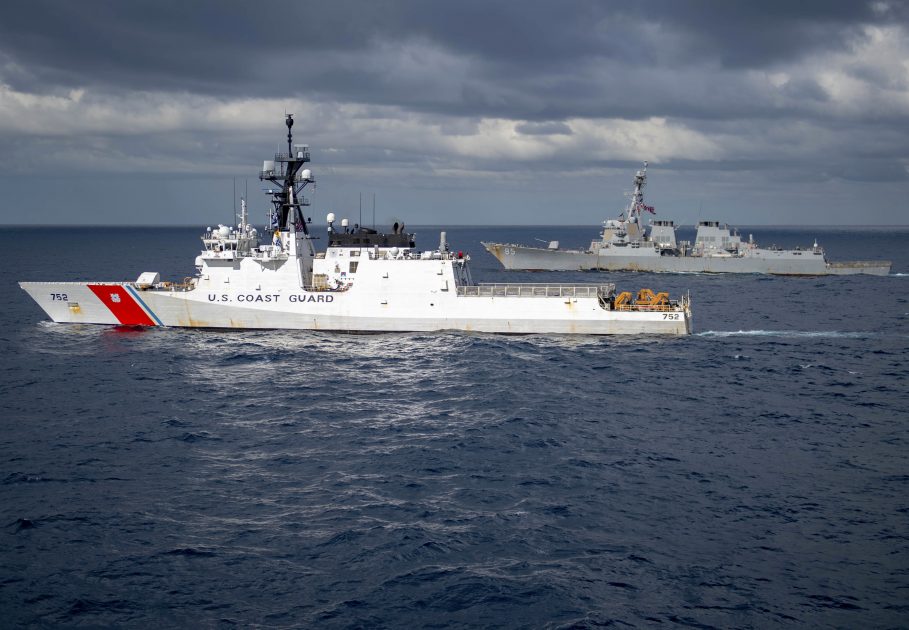
USCGC Stratton (WMSL-752), left, and the U.S. Navy Arleigh Burke-class guided-missile destroyer USS McCampbell (DDG-85) maneuver in formation during Talisman Sabre 2019 on July 11, 2019. US Navy Photo

Having watched the US Naval Institute News’ Fleet and Marine Tracker for some time, I am a bit surprised to see six ship assigned to Fourth Fleet, inspite of the on going COVID-19 problem. Six ships is only 2% of the Navy’s 296 “battleforce” ships (Note, the 3 Mayport based Cyclone class patrol craft that sometimes assist in drug enforcement are not counted among the 296), but it is far more than we typically see in the area. Unfortunately the USNI site gives us no information about what type ships are deployed or where they are. (Pacific or Caribbean?) 

This is the first solid evidence I have seen that the Navy is actually going to carry through on their stated intention to surge assets for drug enforcement. There were four ships reported in the area on April 13, also an unusually high number. There were six reported on April 6. March 30, there were two. March 23 there was only one. Prior to that it was ususally one ship, on rare occasions two, sometimes none. 

Supposedly additional aircraft and other assets are also being assigned to support the ships.

Battle of Amami-Ōshima

This December 2001 “battle,” described as a six hour firefight, between a small North Korea (NK) vessel and four Japanese Coast Guard cutters was unusual, but it is interesting for what it can tell us about the difficulties of dealing with a vessel that refuses to stop, as would probably be the case with a terrorist attack.

The incident happened outside Japanese territorial waters but inside their EEZ.

The NK vessel appeared to be a trawler, but this was no trawler. It was reportedly capable of 33 knots.

The Japanese went through the usual procedures trying to get the vessel to stop, flags, loud hailer, warning shots. When these were ignored, at least initially the Japanese apparently chose an aim point forward in the vessel where it was unlikely to hit crew members. Over 1000 shots were fired.

As appears to be standard procedure with the Japanese Coast Guard, it was not a single cutter, but a team of cutters that responded. In this case four. Japan Coast Guard aircraft were on scene, but apparently they had no airborne use of force capability.

Generally in the video, it appears that the cutters remained abaft the beam of the target vessel, minimizing the pursued vessels opportunity to ram a cutter and also insuring that friendly vessels were not in the line of fire.

Tsurugi class cutter PS202 Hotaka. From Wikipedia commons.

The Japanese cutters seen in the video appear to be Tsurugi class “high speed special patrol ships” specifically designed to intercept high speed North Korean vessels engaged in espionage or smuggling. They are longer but lighter than the Webber class, 50 meters (164 feet) in length with a 220 ton full load displacement and three diesels totaling

15,000 HP through three water jets. They are reportedly capable of 50 knots (other sources indicate 40 knots) and are armed with a JM61 20 mm Gatling gun, the Japanese version of the same gun that arms the Phalanx close in weapon system (CIWS). These might be thought of as similar to my proposal for a WPB replacement, Response boat, large–interceptor.

After the North Korean vessel was disabled the cutters came close aboard (about time 6:30). The wisdom of this was questionable since the vessel had been firing at the cutters. In fact the nearby cutter was fired upon. Subsequently apparently the crew of the NK vessel detonated scuttling charges, which had they been larger, might have damaged a nearby cutter.

15 survivors were seen after the sinking, but the cutters were told to ignore them as there was fear they would respond to rescue attempts with suicidal violence. The Japan CG cutter crews were relatively small. All members of the N. Korean crew were lost. Only three bodies were recovered.

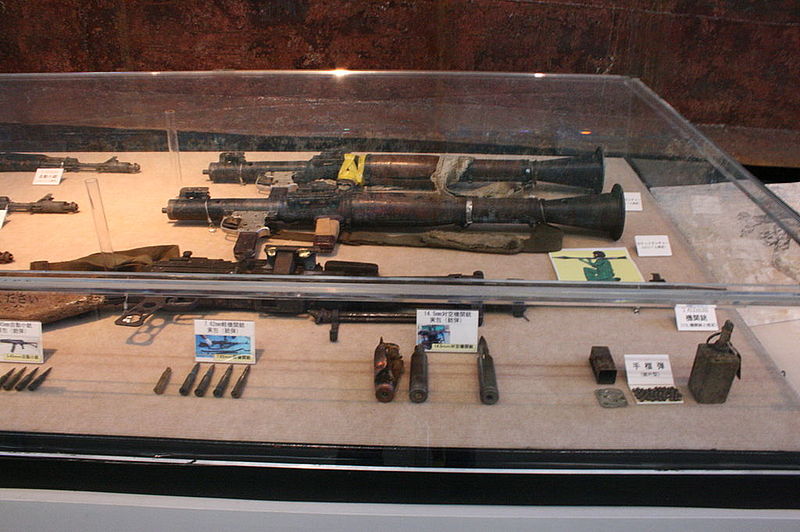
The North Korean vessel was small, 29.7 meters (97.4 feet) in length, but still the weapons used against it were found wanting. Due to the presence of heavy weapons like RPGs, recoilless rifles, and MANPADs on N. Korea spy vessels, the Japanese concluded that the 20mm Gatling gun was not adequate for their purposes and now expect to include vessels with 40mm guns in any similar future operation.

As I have noted before, I believe all Coast Guard vessels, WPB and larger, should be armed to forcibly stop any vessel regardless of size and have an effective range of at least 4,000 yards, so as to be outside the effective range of most potential improvised vessel weapon systems.

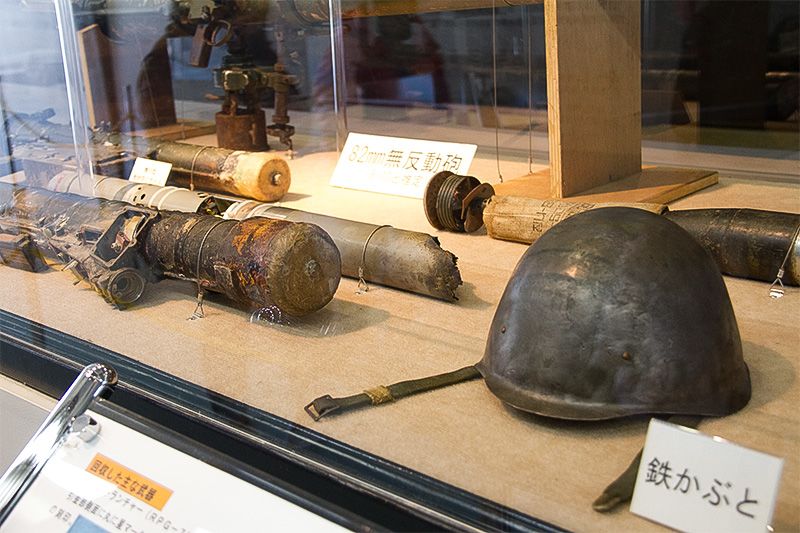
The North Korean vessel was subsequently raised to allow investigation of the incident. The vessel and some of its contents are on display at the Japan Coast Guard museum in Yokohama (see below).

A steel helmet and parts of a Soviet B-10 recoilless rifle.

ZPU-2 14.5mm anti-aircraft gun found on the North Korean spy trawler sunk by the Japanese Coast Guard in 2001. Transferred from ja.Wikipedia; ja:Image:North-Korea spy-vessel 2.jpg, Author: Bakkai at Japanese Wikipedia

Weapons including RPGs and automatic weapons found when the North Korean vessel was raised. Author: Nomansland511 (a.k.a. nattou)

North-Korean Spy Vessel Rear View, showing boat hangar in stern. Author: nattou

North-Korean Spy Vessel in Japan Coast Guard Yokohama Base, Kanagawa, Japan. Author: nattou

“IRGCN Vessels Conduct Unsafe, Unprofessional Interaction with U.S. Naval Forces in Arabian Gulf” –US CENTCOM

NORTH ARABIAN GULF (April 15, 2020) Iranian Islamic Revolutionary Guard Corps Navy (IRGCN) vessels conducted unsafe and unprofessional actions against U.S. Military ships by crossing the ships’ bows and sterns at close range while operating in international waters of the North Arabian Gulf. U.S. forces are conducting joint interoperability operations in support of maritime security in the U.S. 5th Fleet area of operations. (U.S. Navy photo)

The following is a news release from US Fifth Fleet Public Affairs: (I bet one of those long range acoustic projectors could be really unpleasant if someone shouted over one of them at you at close range. Maybe every cutter should have them.)

On April 15, eleven Iranian Islamic Revolutionary Guard Corps Navy (IRGCN) vessels repeatedly conducted dangerous and harassing approaches of the USS Lewis B. Puller (ESB 3), USS Paul Hamilton (DDG 60), USS Firebolt (PC 10), USS Sirocco (PC 6), USCGC Wrangell (WPB 1332) and USCGC Maui (WPB 1304) while the U.S. vessels were conducting joint integration operations with U.S. Army AH-64E Apache attack helicopters in the international waters of the North Arabian Gulf.

The IRGCN vessels repeatedly crossed the bows and sterns of the U.S. vessels at extremely close range and high speeds, including multiple crossings of the Puller with a 50 yard closest point of approach (CPA) and within 10 yards of Maui’s bow.

The U.S. crews issued multiple warnings via bridge-to-bridge radio, five short blasts from the ships’ horns and long range acoustic noise maker devices, but received no response from the IRGCN.

After approximately one hour, the IRGCN vessels responded to the bridge-to-bridge radio queries, then maneuvered away from the U.S. ships and opened distance between them.

The IRGCN’s dangerous and provocative actions increased the risk of miscalculation and collision, were not in accordance with the internationally recognized Convention on the International Regulations for Preventing Collisions at Sea (COLREGS) “rules of the road” or internationally recognized maritime customs, and were not in accordance with the obligation under international law to act with due regard for the safety of other vessels in the area.

The U.S. Navy, Coast Guard, Marines and Army have been conducting joint interoperability operations in the North Arabian Gulf since late March.

U.S. naval forces continue to remain vigilant and are trained to act in a professional manner, while our commanding officers retain the inherent right to act in self-defense.

NORTH ARABIAN GULF (April 15, 2020) Iranian Islamic Revolutionary Guard Corps Navy (IRGCN) vessels conducted unsafe and unprofessional actions against U.S. Military ships by crossing the ships’ bows and sterns at close range while operating in international waters of the North Arabian Gulf. The expeditionary mobile sea base USS Lewis B. Puller (ESB 3) is conducting joint interoperability operations in support of maritime security in the U.S. 5th Fleet area of operations. (U.S. Navy photo)

“USCG Polar Security Cutter” –Maritime Reporter and Engineering News

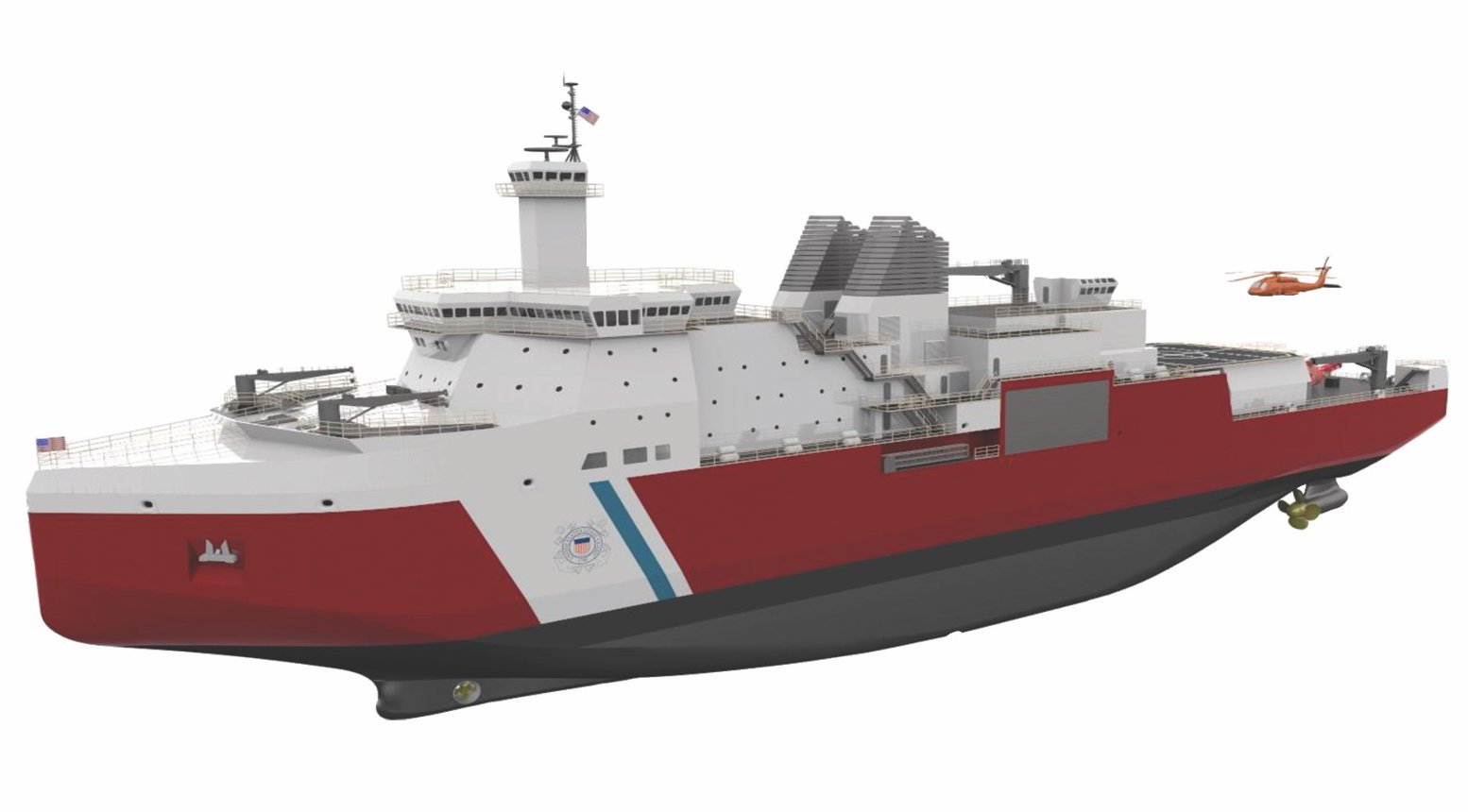
Maritime Reporter and Engineering News has a brief, four page, report on the Coast Guard’s Polar Security Cutter (PSC) (heavy icebreaker) program written by marine consultant, lawyer, and retired USCG Captain Dennis L. Bryant, Academy class of 1968.

There is not a lot new here if you have been following this website, but it is a good summary.

While it is true that, The design of the PSC is based on that of the German polar research and supply icebreaker Polarstern II,” we now know that while Polarstern II was supposed to have been the parent design for the PSC, that project was cancelled and no contract for its construction was ever awarded.

Looking at the current plan for three heavy and three medium icebreakers, he suggests that the Coast Guard,

 “…consider the alternative of three heavy polar icebreakers utilizing the current design and then have three other heavy polar icebreakers constructed on the same hull and propulsion design, but with greater emphasis on oceanographic and atmospheric research in polar waters.  Utilizing the same hull and propulsion design will save time and money in the construction phase.”

Since the price has come down and should continue to do so with each successive ship, building more ships of basically the same configuration makes sense. There are already plans to provide space for science and research.

Presumably, at least the first two PSCs, and perhaps all three, will be assigned primarily to work in the Antarctic. The second class will probably work primarily in the Arctic. Operating frequently in the US EEZ, enforcing US laws and regulations, it makes sense to arm them more like other large cutters, like the NSC or OPC. In view of the apparent improvements being made to projectiles for the 57mm Mk110, a good fit might be two of these, one forward and one aft, to provide 360 defensive coverage. Using two of these weapons rather than one of 57mm and a second different weapon like the Phalanx, would minimize requirements for training and spares.

If things become confrontational in Antarctica, asI expect they will, these more heavily armed icebreakers could be used there as well.

The Forgotten American Explorer Who Discovered Antarctica — and Why It Is Important

USS Vincennes in Disappointment Bay, Antarctica, during the Wilkes expedition. (Public Domain)

Smithsonian Magazine brings us the story of American explorer Charles Wilkes, who while commanding USS Vincennes, was the first to map the coast of Antarctica. They talk about why it is important and why the apparent decline in US interest in Antarctica is dangerous.

As the northern ice melts, the Arctic Ocean is already the scene of international jockeying for mining rights. But as China scholar Anne-Marie Brady has documented extensively, Beijing views Antarctica as the last great terrestrial frontier on Earth, hosting great deposits of coal, natural gas, precious minerals, added to plentiful fish stocks in the surrounding ocean and even vast freshwater reserves locked up in Antarctic ice. China intends to exploit the continent fully once the current Antarctic Treaty expires in 2048, if not sooner. With nations hungry for new sources of oil and mineral wealth, and China laying the groundwork for industrialization of the pole, the stakes for Antarctica couldn’t be higher.

This is why we need icebreakers, and why they have to have provision installing effective self defense weapons. We cannot expect the Antarctic treaty to extend beyond 2048. As soon as one nation withdraws there is going to be a land rush there and it could lead to armed conflict.

As the nation with the greatest historical investment in Antarctica, the U.S. has the resources and authority to lead an international re-commitment to south polar conservation. By reaffirming its leadership role at the pole, America can ensure that the great game of the 21ar century does not repeat the mistakes of those of centuries prior, when the world’s pristine frontiers were fought over and ransacked with little thought for environmental damage, or for what future human generations might do once the last wilderness on Earth melts away.


Emerging Unmanned Air System Technologies

The unmanned air system (UAS) market is rapidly expanding and innovation has been rapid. The Coast Guard is just entering the field. Current plans are to provide ScanEagle UAS on all Bertholf class National Security Cutters (NSC) and all Argus class Offshore Patrol Cutters OPC). There is also an intention to procure long range, long endurance land based UAS for maritime domain awareness.

So far there is no indication of a decision to procure UAS for smaller vessels (like WPBs or WPCs) or for sectors or air stations for use in support of local Search and Rescue (SAR) or Marine Environmental Protection (MEP) missions. Issues of operating UAS in domestic airspace are still unresolved, but the potential is too great not to find solutions. Ultimately they are likely to become ubiquitous in Coast Guard operations.

Meanwhile the Army is looking at procuring a new generation of UAS. They are testing four airframes, all are vertical take-off.

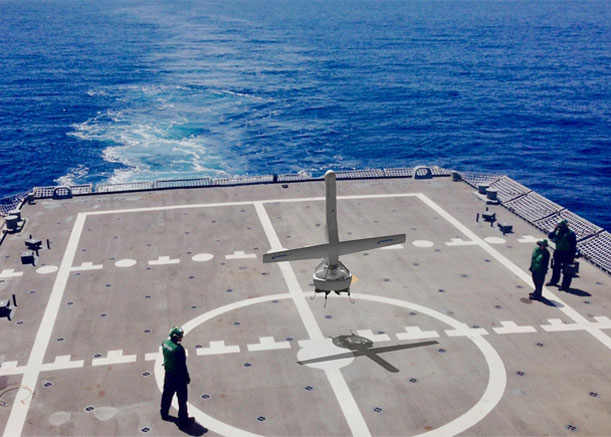
Three of the contenders – Arcturus UAV’s Jump 20, L3 Harris Technologies’ FVR-90, and Textron’s Aerosonde HQ – share a similar configuration, something we’ve never seen on a full-size manned aircraft. Each of them has wings and a pusher propeller in back for forward flight, but also quadcopter-style mini-rotors for vertical takeoff and landing. The fourth, equally unconventional design is Martin UAV’s V-Bat, a “tail-sitter” that has a single large fan for both vertical and forward flight, changing from one mode to the other by simply turning 90 degrees.

The potential to operate these from small spaces is obvious and with autonomous take-off and landing it is likely training for operators may not be too demanding, as the Coast Guard will one day, hopefully, move to providing their own operators for Coast Guard owned systems.

There is even emerging technology that may allow autonomous landing on moving ships.

“One of the technologies we’ve been looking at is very simple, but will help in the landing of our UAVs,” Venable said. “It’s an optical landing system by Planck Aerosystems that uses something like a QR code that is about 3 feet square, and the aircraft scan it, locks on and lands on it.”


“Cooperative Maritime Law Enforcement and Overfishing in the South China Sea” –CIMSEC

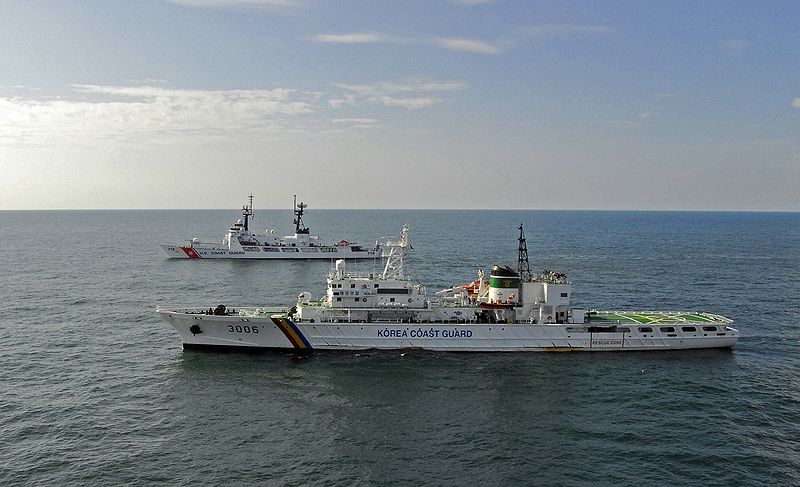
Republic of Korea Coast Guard vessel #3006 in company with U.S. Coast Guard cutter USCGC Boutwell (WHEC-719) during the North Pacific Coast Guard Forum in August 2007. This forum was created to increase international maritime safety and security in the Northern Pacific Ocean and its borders. The Boutwell worked with the Korean coast guard while on their way to Yokosuka, Japan. The Japanese coast guard is one of the six nations involved in the forum.

CIMSEC brings us a discussion of the possibility of cooperative fisheries enforcement in the South China Sea to stop both overfishing and Illegal, Unregulated, Unreported (IUU) fishing and perhaps bring China into a more mutually beneficial relationship with her neighbors.

Earlier, I had a suggestion about how we might form an instrument of cooperative enforcement by forming a “Combined Maritime Security Task Force Pacific,” a law enforcement alliance rather than a military one.

Probably before that could be fully realized, the various nations with competing claims to the waters of the South China Sea, need to take their claims to the UN’s International Tribunal. The more nations use it, the more pressure on China to participate. If, they do not present a cases before the international their claims will be weakened.