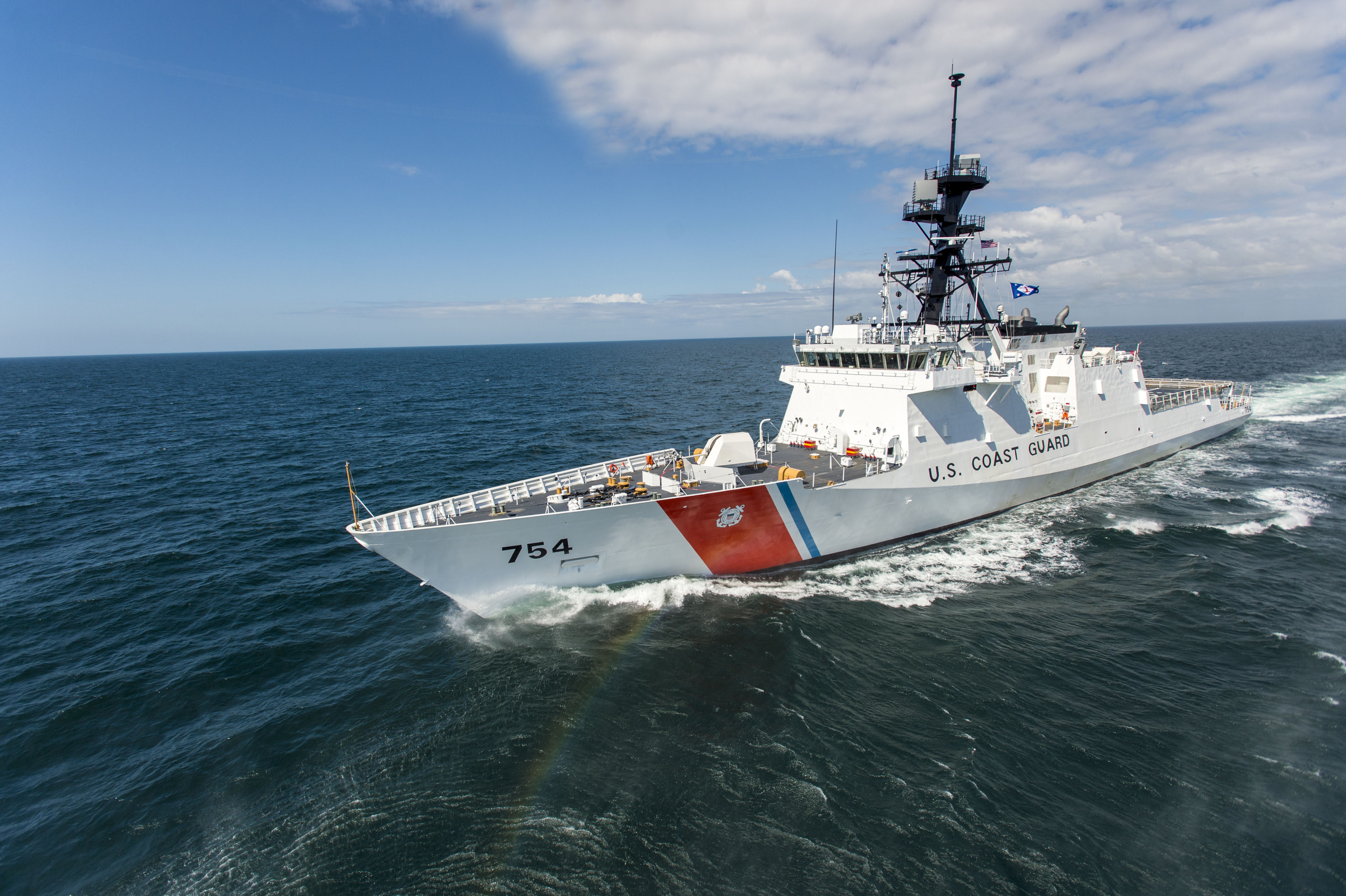
“RIGHTING THE SHIP, The Coast Guard Must Improve its Process for Addressing Bullying, Harrassment, and Retaliation” –House Committee Majority Report

I am just passing this along. I confess I have not read beyond the executive summary and I will not be commenting on it. Comments are still welcome, but I have been too long out of the service to comment meaningfully.

Thanks to Brymar Consulting for bringing this to my attention.

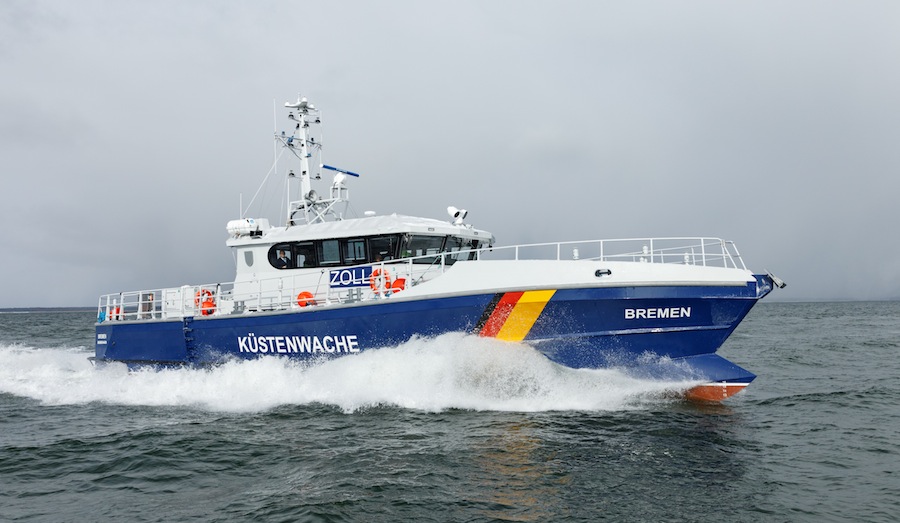
New German Patrol Boat with Innovative Bow Form

German Customs 24 meter patrol boat. Photo by Jarek Jõepera

Bairdmaritime reports delivery of three new 24 meter patrol boats designed and built for Germany’s Customs Agency.

A unique aspect of the design is the bow. We have seen other novel bow designs, including the Ulstein X-bow and the Damen Axe-bow. These bows reduce pitch compared to conventional bow designs, but unless the foc’sle is raised, these designs tend to be wet forward. There is also a very unique bow on the new Italian Patrol Frigate.

Additional advantages of the longer waterline, that comes with extending the bow forward, can be increased speed or improved fuel efficiency.

My gut feeling is, I like the look of this particular bow. The idea seems to be that when a swell rises up over the wedge shape we see just above the waterline, it generates a down force, counteracting to some extent the normal tendency of the bow to lift, reducing pitch much of the time. But unlike a axe bow, there is still a flare to the bow that would tend to keep the bow above the green water when conditions get really bad. Looks like it might be worth a look, and maybe some testing.

“Operation Kurukuru: USCGC Washington supports “noble cause” through teamwork” –D14 PAO

Below is a news release, quoted in full. A few points to note.

  • the huge area involved
  • Pacific Islanders need help to make this work
  • involvement of Australia
  • enforcement seems to be having an effect
  • Coast Guard is making a long term commitment

There is also information about the FRCs scheduled to go to Guam.

united states coast guard

News Release

U.S. Coast Guard 14th District Hawaii and the Pacific
Contact: 14th District Public Affairs
Office: (808) 535-3230
After Hours: (808) 265-7748
14th District online newsroom

Operation Kurukuru: USCGC Washington supports “noble cause” through teamwork

Operation Kurukuru Operation Kurukuru USCGC Washington

Editors’ Note: Click on images to download high resolution version.

Scattered clouds stretched across the sky, meeting the vivid blue Palauan waters on the horizon. The maritime law enforcement boarding team completes their final preparations on the fantail of the USCGC Washington (WPB 1331) as the small boat detail lowers the cutter’s ridged inflatable boat (RIB) into the water. Petty Officer 1st Class Ralph Pastore, Washington’s boarding officer, finalizes the details with the RIB’s coxswain, Petty Officer 3rd Class Michael Reo and Seaman Duke Joseph of the Palauan Division of Maritime Law Enforcement. Their target is a long-line fishing vessel making way about a half-mile off the cutter’s port bow.

Washington’s crew was patrolling Palau’s exclusive economic zone (EEZ) as part of the Pacific Islands Forum Fisheries Agency (FFA) Operation Kurukuru, a coordinated maritime surveillance operation. The operation’s goal is to combat illegal, unreported, and unregulated (IUU) fishing. Success depends on the ability of partners, like Palau and the United States, to work together.

“This is my second time coming down here and working with a Palauan shiprider,” said Pastore. “Last time I was able to get a good idea of how they work both on land and out here on the ocean so it makes the job easier”

The operation, targeting the multi-million-dollar IUU fishing, was conducted from Oct. 7 to 18, across 8.2 million square miles. To put in perspective, that covers an area the size of Russia, India, and Egypt combined. Assets and crews from multiple counties were involved including the Washington, an HC-130 Hercules airplane and crew from Hawaii temporarily based out of Tonga, and an intelligence specialist working out of the Regional Fisheries Surveillance Center at the FFA headquarters in Honiara, Solomon Islands, where the joint operation was coordinated.

The 12-day operation saw around 132 sea days of active patrolling and 540 flight hours of maritime air surveillance. There were 131 total boardings both at sea and dockside, with only four violations found and no unknown vessels detected.

“The fact there were no unknown fishing vessels found with such thorough air surveillance converge and only four infringements imposed with such a high level of boardings is evidence that current regulations and law enforcement practices are working well with the four FFA operations leading the effort,” said the FFA Surveillance Operations Officer, Cmdr, Robert Lewis, seconded from the Royal Australian navy.

But what do those boardings look like? At sea, the team launches from the Washington and makes its way through the water to the fishing vessel. Upon boarding, the team’s interpreter speaks with the crew to ensure no human rights violations exist while Joesph talks to the master of the ship.

“I was looking for licenses, the fish log and also on deck we are looking for signs of catching sharks, shark fins, any parts of sharks, turtles and steel wires for fishing,” said Joseph after the boarding. “You’re not supposed to use steel wire for fishing.”

Kurukuru is a Japanese term meaning round and round. Fish are migratory animals and they annually travel throughout the Pacific providing an important renewable resource for Pacific Island Countries and Territories (PICTs). As with anything of value, there will always be actors who wish to cut corners and skirt laws. IUU undermines efforts to conserve and manage fish stocks, presenting a dire threat to many PICT’s efforts to protect these vital resources for generations to come.

“I think for us Palauans, our nation is small, and we don’t have enough people and manpower to protect our waters,” said Joseph. “The waters are very big, so with the help of the United States and working together we can protect the waters for the Palauan people for the future.”

Bilateral shiprider agreements are a key tool for the Coast Guard 14th District. The United States maintains 11 of these agreements with Pacific Forum countries. By embarking ship riders, Coast Guard crews are able to support allies in the region and work toward expanded security addressing regional challenges to peace, prosperity, and social inclusion. These agreements also provide a framework to build valuable relationships between Coast Guard and PICT counterparts.

‘We were able to establish a nice camaraderie, especially with the Palauan national living with our crew,” said Pastore. “A shiprider is always a plus to have for us because we are able to sit down and ask questions Coast Guard law enforcement normally won’t be able to.”

Operation Kurukuru is one of Washington’s last operational patrols before being decommissioned in December. A number of the cutter’s crew will transfer to the three new Fast Response Cutters (FRC) scheduled to replace the cutter and its sister ships, Kiska (WPB 1336) and the already decommissioned Assateague (WPB 1337). FRCs are some of the Coast Guard’s newest platforms and are equipped with the latest technologies. The first FRC arriving in Guam will be the Coast Guard Cutter Myrtle Hazard (WPC 1339).

“Having experience in the area of responsibility will be beneficial,” said Lt. j.g. Victor Broskey, the Washington’s executive officer. “There’s quite a few crewmembers slated to be on the commissioning crew who served in Guam before, so I think the Coast Guard has set us up pretty well for the first crew.”

This retention of crewmembers in the area means the lessons learned from joint evolutions such as the one conducted between the Washington’s boarding team and Joseph will carry over to the new FRCs, ensuring the goodwill developed by the crew of the Washington will remain relevant.

With the information Joseph gathered from the boarding, Palauan authorities will be able to inspect the long-line fishing vessel when it pulls back into port. Thus ensuring the master is following the Palauan law by matching his records and his fish hold, contributing to the overall success of the efforts between the United States and its partners in the region to combat IUU.

As is usually the case in the Pacific, a successful operation depends on the teamwork between partners. The crew of the Washington strives to cultivate these critical relationships and lay additional groundwork for future joint activities. The cutter’s motto is “our cause is noble,” and throughout the ongoing efforts, the crew lives up to this saying, ensuring success in the region long after this cutter is replaced by new ships bearing the famous racing stripe and serving Pacific communities.

-USCG-

A Successful Test of TALONS and an Air Droppable Rescue Boat

The Towed Airborne Lift of Naval Systems (TALONS) is a parafoil-based system shown kiting from the Greenough Advanced Rescue Craft. TALONS relays data between the MCM USV and the LCS via the government-developed multi-vehicle communication relays system. (Credit: US Navy/Released)

There are two items of interest here.

Naval News brings us more news about TALONS and incidentally, info on an air droppable rescue boat. We have been following DARPA’s development of TALONS (Towed Airborne Lift of Naval Systems) for about four years.

Putting sensors at 1000 feet gives a horizon distance of 38.7 miles compared with 8.7 miles for a more typical height of 50 feet. This latest test show how truly small the footprint of this system can be. The boat is only 15’8” (4.8M) in length.

I had never heard of the Greenough Advanced Rescue Craft (GARC). Apparently it is a standard Air Force system. The Coast Guard used to have a capability to drop a lifeboat from a fixed wing aircraft. The Air Force apparently still does and it looks like it could be remote controlled to go to the rescue of those in distress. Check out the description in at the link below.

“The Unmanned GARC is 15’8” (4.8M) in length and a full load displacement of 3,600lbs. It has a top speed in excess of 35 knots, a range of 400+ nautical miles at 30 knots (700+ nm range at 6 knots). It can operate up to sea state 4.”

A U.S. Coast Guard Boeing PB-1G Fortress carrying a lifeboat in 1948. The USCG used the PB-1G from 1945 to 1959. US Coast Guard photo 5261

When we used to do this (even before my time), I am pretty sure the survivors had to make their way to the boat, which could be problematic. Looks like this one could be driven to the survivors and probably has a radio link.

Offshore Patrol Cutter Program Alternatives

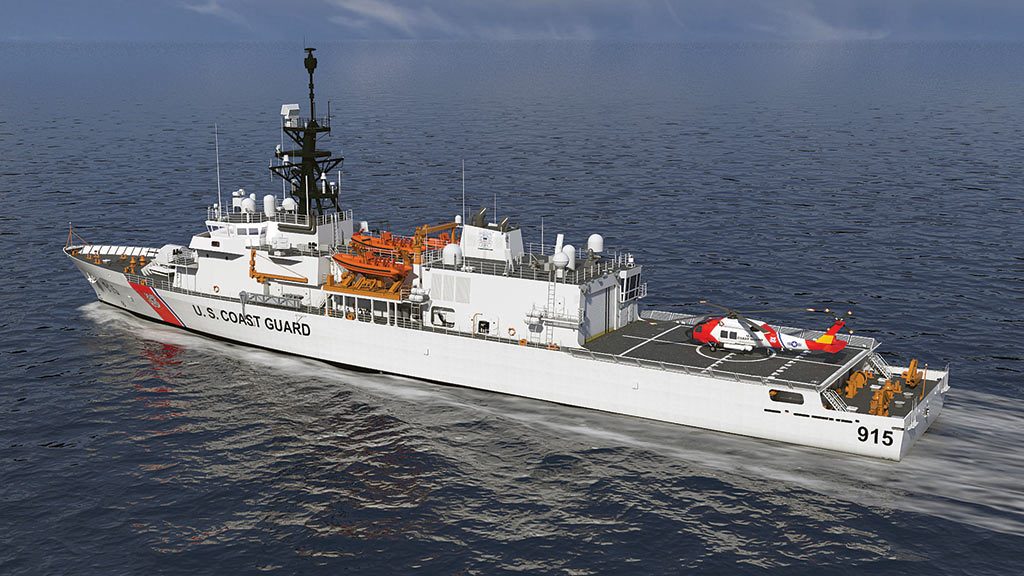
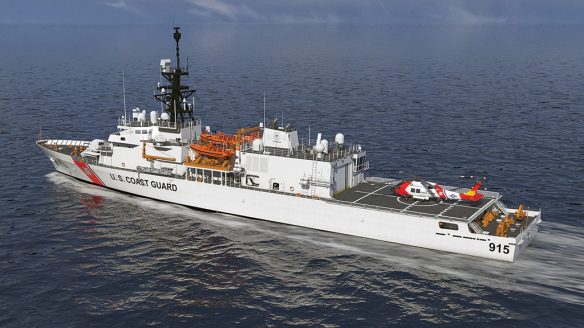
Offshore Patrol Cutter port quarter

Note: I have had to revise some of my conclusions about when benchmarks would be achieved. The text below has been changed to reflect the correction. 

I have been talking about the OPC for over nine years, and it is frustrating to see what appeared to be real progress toward impressive new ships come apart, but with the Offshore Patrol Cutter program in flux, perhaps it would be worthwhile to look at where we are, where do we want to go, and what the current restraints and limitations are. Maybe there is a better way.

As currently envisioned the last OPCs are not expected to be funded until FY2034 nor delivered until 2037. A lot can happen between now and then.

Where are we?

The current thinking is to provide contract relief for Eastern and allow them to build the first four ships. Meanwhile the Coast Guard will recompete a contract for OPC #5 with options for #6-15.

But even this is uncertain. Congress has 60 days from the announcement (11 Oct. 2019 to 10 Dec.?) to consider the proposed contract relief. If I interpret correctly, unless they take action to deny relief, construction will go ahead. That suggest that denial of contract relief is unlikely, but by no means, are we sure it will happen.

It seems likely we will get four OPCs from Eastern, but even that is uncertain. Really we have no assurance we will get any OPCs at all.

What do we need? What are the constraints?:

We should have begun replacing the WMECs we have now, 25 years ago, so the need is urgent. We can also be pretty sure we need more large cutters (those of over 1000 tons full load) than are currently planned.

Realistically we cannot expect great increases in either PC&I (Procurement, Construction, and Improvement) or operating budget. That means, hopefully, the Coast Guard will get around the $2B/year PC&I successive Commandants have been saying we will need, but probably little or no more, and further, that we should not expect significant personnel increases.

The current plan will provide fewer large cutters than we have now. Eleven NSCs are replacing twelve WHECs and 25 OPCs are expected to replace 29 WMECs. That is 36 to replace 41. In fact if you look back a little further the Coast Guard had even more large ships. Editions of Combat Fleets of the World for the years indicated show that in 1990/91 we had 50 and in 2000/2001 there were 44. The Fleet Mix Study conducted more than a decade ago indicated we actually need an even larger fleet. 

The need to rapidly replace the existing WMECs and ultimately expand the fleet, within the constraints of budget and manpower are in direct conflict, particularly when the cutters have become bigger and more expensive and their crews size has, with few exceptions increased.

Replace the WMECs we have ASAP:

The WMECs we have need to be replaced as soon as possible. If the recompete goes as expected, the fourteenth OPC will not replace the last 210 until fourth quarter FY2032. That 210 will be over 63 years old. The last 270 decommissioned will be at least 48 years old. We can only expect that these vessels will have increasingly frequent major machinery casualties. The high number of major casualties that were experienced when the Coast Guard responded to the earthquake in Haiti is only a taste of what we can expect in the future.

More Cutters: 

The Fleet Mix Study of 2009 showed we needed 66 large cutters to fully accomplish all the Coast Guard’s statutory missions. A 2011 revision reduced the total to 58.

That number was perhaps artificially low because it assumed the “Crew Rotation Concept” would be applied to all National Security Cutters and Offshore Patrol Cutters, allowing an unrealistically high 225 days away from home. We have, to some extent, seen Webber class step up to perform some of these missions, but the need for more large ships is still apparent.

Unfortunately we have not updated the Fleet mix study based on more recent experience with the NSC and FRC. We really need to do that so that we can make more informed decisions and present a better case to Congress.

PC&I Budget

The FY2019 Procurement, Construction, and Improvements (PC&I) budget was $2,248.26M, of that less than $1.6M went to ship construction and improvement. It is unlikely we will see significantly larger budgets devoted to ship construction, and this includes funding for Polar Security Cutter, in service sustainment, and in the out years WPB replacement, and possibly new buoy tenders. We don’t unfortunately have any comprehensive long term shipbuilding plan that looks beyond five years.

Operating Budget/Crew Costs

Personnel costs are particularly important in overall lifecycle cost calculations. These come out of the operating budget which has actually shrunk in real terms.

The fleet that is being replaced (12 WHECs, 29 WMECs, and 44 WPBs) and the projected fleet, as currently planned (11 NSCs, 25 OPCs, and 64 FRCs) have almost the same total crew count, but it is doing so with the five fewer large cutters. The more numerous Webber class cutters have a larger crew than the 110 foot WPBs, 24 vice 16. Ultimately I expect 64 FRC to replace the 44 WPB110s for an increase of 832 billets. The OPCs will apparently have a crew of about 100, about  the same as that of the 270s, but about 25 more than are currently assigned to 210 foot WMECs. Replacing 14 of 210s with OPCs will add about 350 billets. Only the National Security Cutters have smaller crews than the ships they have replaced. My Combat Fleets of the World shows the crew of the NSCs to be 122 and that of the 378s to be 177, eleven NSCs compared to twelve WHEC378s would be decrease of 782 billets.

By my count the Legacy fleet of 85 vessels (12 WMECs when the NSCs started building, 28 WMECs when the OPCs started building, and 44 WPBs when the FRCs started building) required 5,349 billets. (The nominal fleet the program of record supposedly replaced included 29 WMECs and 49 WPBs, would have included another 179 billets or 5,528.) The currently planned fleet of 100 vessels (11 NSCs, 25 OPCs, and 64 FRCs) requires 5,378 billets. 

If we are to increase the number of larger cutters while leaving the total number of billets little changed, we would need to trade off some of the OPCs for more numerous vessels with smaller crews.

The Alternatives: 

The first question is, is the OPC, as currently designed, the vessel we still want?

While I don’t think it will happen, in view of the increasing likelihood of a great power conflict, the wisest thing that could happen, is that we replace the OPCs with what ever design the Navy chooses for the new FFG. That would take a massive infusion of cash and manpower, not going to happen.

If we reopen the competition to include other designs built to the same requirements we not only complicate logistics and training in the future, we also probably delay the decision process another year. Looks like the Coast Guard is trying to avoid that. They have a design they like, and once production is underway, it will certainly be cheaper than the NSCs.

Do we want a ship built to different requirements, maybe something like my proposed Cutter X? The Coast Guard came up with the requirements for the OPC, so I have to assume that for at least some missions, we need ships that meet those requirements. (I understand that the first two OPCs will go to Kodiak.) On the other hand, several years ago, Congress asked the Coast Guard if there weren’t missions or geographic areas that did not require ability to conduct helicopter and boat operations in such severe conditions?  That question was apparently never answered, as far as I know, but we know for a fact that less capable ships have been performing these missions for decades. We see it in the way the fleet was distributed. Most 378s went to the Pacific where long distances and ALPAT demanded great range and seakeeping. 210s generally went to the West Coast and SE and Gulf coasts where the weather tended to be more benign. 270s tended to based further North in the Atlantic since they were more seaworthy than the 210, if not as capable as the 378s.

We have a mixed fleet of WMECs, perhaps their replacements should be a mixed fleet as well, allowing the more robust OPCs to be used where those characteristics are most likely to be needed, while we also build more smaller, cheaper ship to provide the numbers we need. As before, I will refer to this class, slotted between the OPCs and the Webber class WPCs as Cutter X.

Considering Cutter X, to be significantly cheaper than the OPCs and have a significantly smaller crew, we probably should look to designs that are half the size of the OPC or smaller. That does not mean these ships will be small. In fact they could be larger than any of the existing WMECs, and more than twice the size of the 210s. The 327 foot Treasury class WHECs would qualify in terms of size. Average procurement cost for the OPCs, before the need for contract relief surfaced was $421M per ship. Cutter X should cost less than $250M. Actually it should be possible to build them for less than $200M.

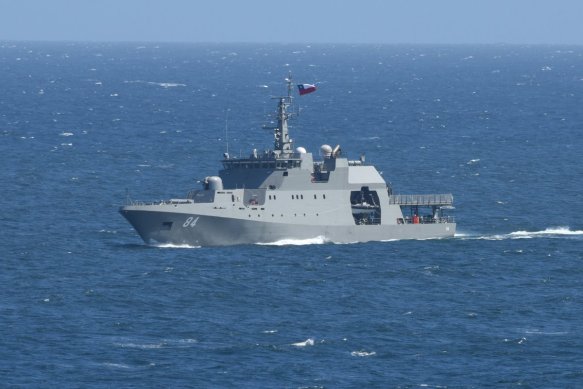
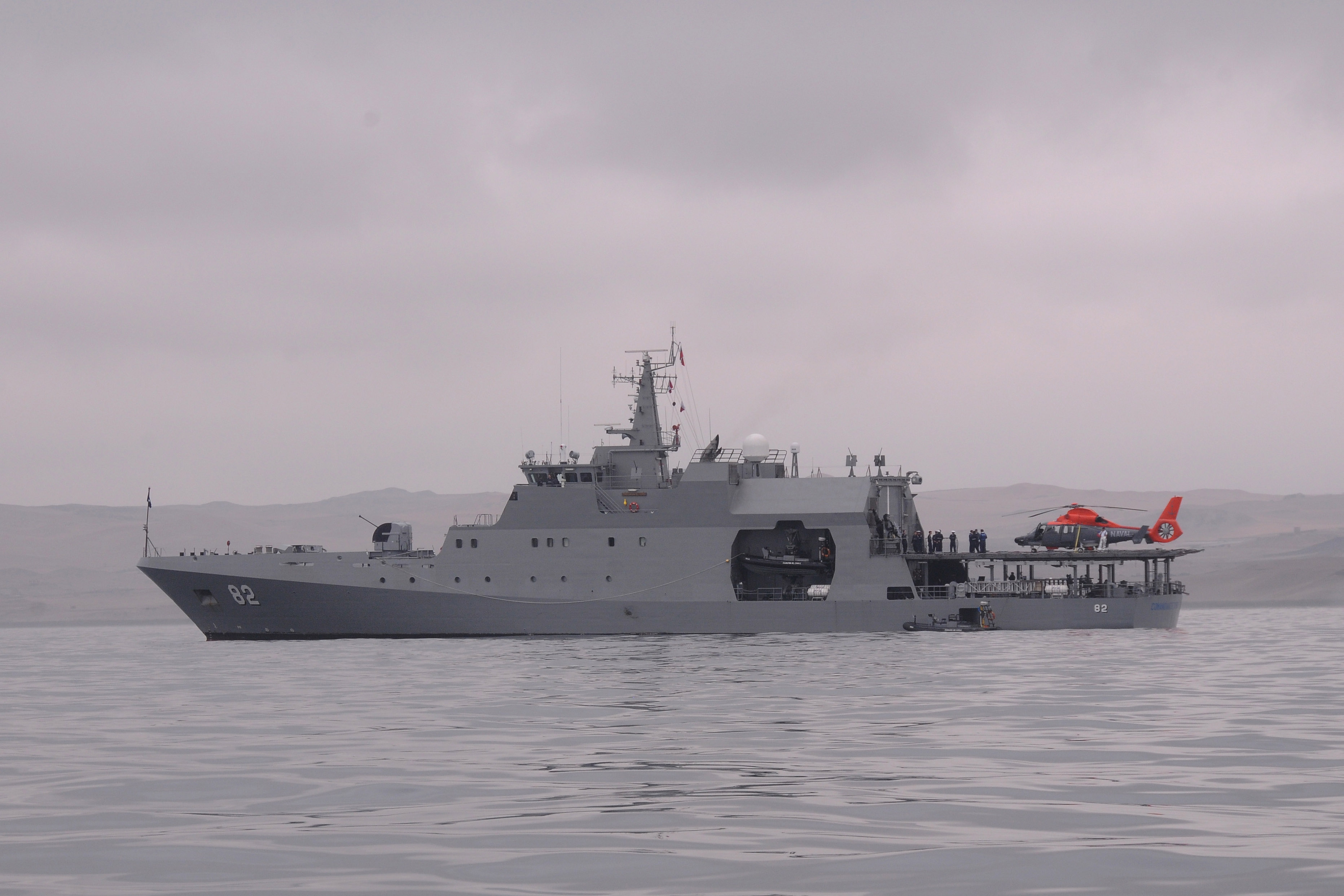
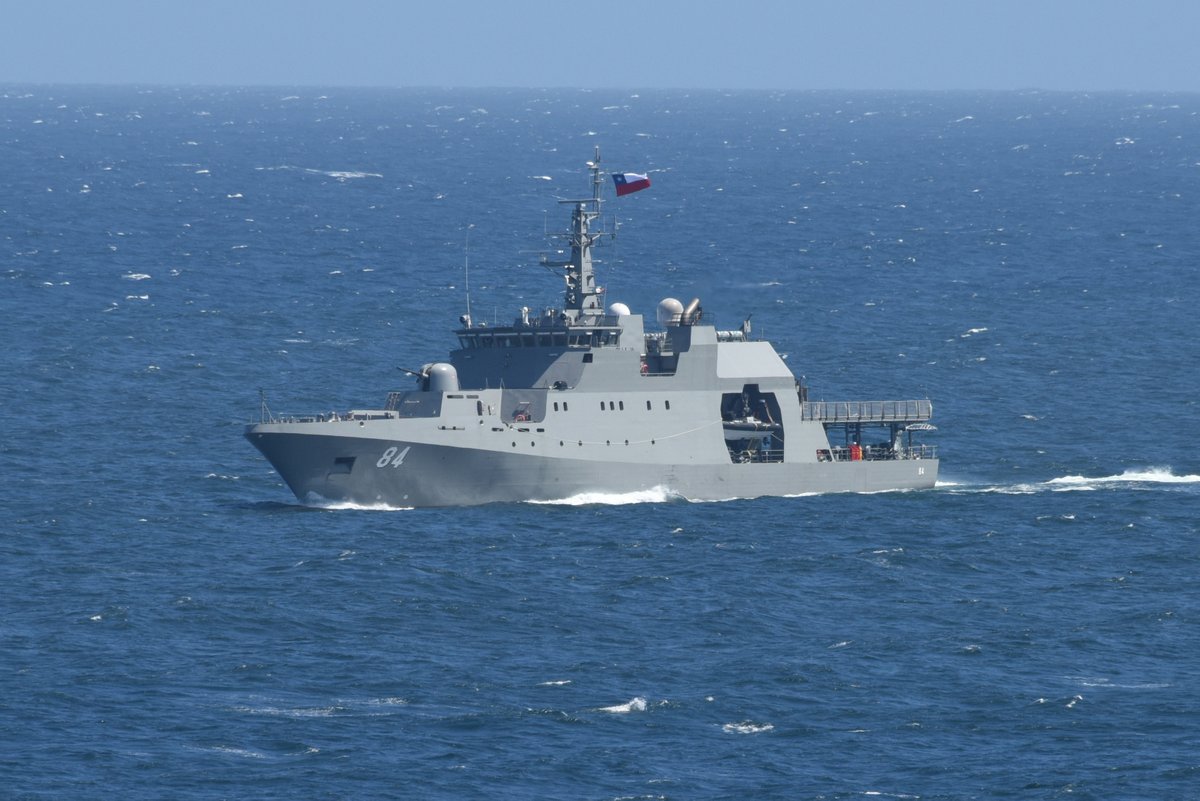
I have pointed to a number of designs that might be considered, but to offer a concrete example, consider the Fassmer OPV-80 design used by the German Police Coast Guard, and the Navies of Chile, Colombia, and Honduras.  It can operate and hangar a medium sized helicopter, has two boats on davits and a third larger boat on a stern ramp, and can be armed with a medium caliber gun up to 76mm. The German versions are getting Bofors 57mm guns like those used by the Coast Guard. There is space for two containers under the flight deck. Its crew is 40 or less.

Some of this class have been ice strengthened.
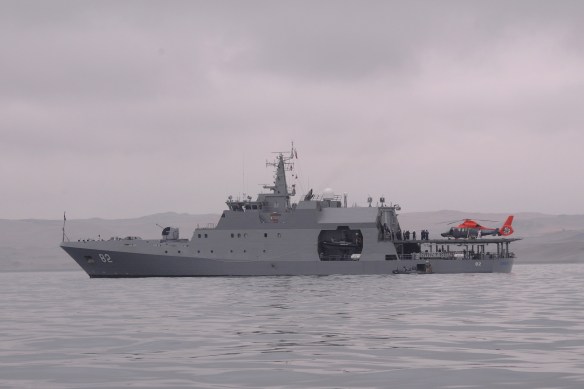
Chilean OPV84, Cabo Odger

A possible program: 

I will offer what I believe to be a possible alternative to the current plan with the objective of replacing the aging fleet as rapidly as possible, ultimately increasing the number of larger patrol ships in the fleet and keeping the budget and manpower similar to what we have been experiencing.

In looking at an alternative program there a number of milestones that might be considered.

  • When would we replace all the 210s? At this point we should have at least 26 new generation large cutters (replacing 12 WHECs and 14 WMEC210s). This is currently planned to occur in 2032.
  • When would we get to 36 new generation large cutters currently planned? Now FY2037.
  • What kind of fleet will we have at the end of FY2037? Current plan 11 NSCs and 25 OPCs.

The proposal is in three parts:

  • Proceed with the OPC program as currently envisioned funding one OPC per year through FY2025. In FY2026 and 2027, fund one, rather than two, and halt the program at ten ship with the last delivered in 2030.
  • Continue to fund one NSC a year through FY2023, this will give us 15 NSCs, with the last delivered in 2026.
  • Start a program for Cutter X in FY2021. Fund construction for the first ship in FY2024, then two ships in FY2025 to 2027, then three ships a year in FY 2028 to 2034 (the last year for the current plan). This will provide a total of 28 ships with the last delivered FY2037.

This breaks down to:

  • FY2020 to FY2023 we would fund one NSC and one OPC,
  • FY2024 we fund one OPC and the first Cutter X.
  • FY2025 to FY2027 we build one OPC and two Cutter X (which should cost the same as two OPCs).
  • From FY2028 through 2034 we fund three Cutter X per year (which should cost less than two OPCs).

This is how the benchmarks break down:

  • When would we replace all the 210s? At this point we should have at least 26 new generation large cutters (replacing 12 WHECs and 14 WMEC210s). This is currently planned to occur in 2032. In 2028, 15 NSCs, 8 OPCs, three Cutter X (plus 13 WMEC270)
  • When would we get to 36 new generation large cutters currently planned? Now FY2037. In 2032, by the end of the year, 38 ships, 15 NSCs, 10 OPCs, 13 cutter X. 
  • What kind of fleet will we have at the end of FY2037? Current plan 11 NSCs and 25 OPCs. At the end of FY 2037, 53 ships, 15 NSCs, 10 OPCs, 28 cutter X. 

At the end of FY2037 we will have effectively replaced the 12 WHEC and the 13 WMEC270s with 25 more capable NSCs and OPCs. The 14 WMEC210 and Alex Haley will have been replace by Cutter X and 13 additional large cutters added to the fleet, 17 more than the current plan.

Even if we did not fund NSCs 13-15, it would only take one additional year to replace the 210s and to reach 36 new generation ships. and we would still have 50 ships at the end of FY2037.

We really need to do a new Fleet Mix Study and we need to follow it up with a long term shipbuilding plan, something Congress has been asking for for years.


“USCG’s Schultz on Halifax Forum, Budget, Pacific, Arctic” –Defense and Aerospace Report

Above is a Defense and Aerospace report interview with the Commandant, Adm. Karl Schultz. It is worth a look.

There is a lot here about what is going on in the Western Pacific and our response to China’s changing behavior. There is a lot of discussion about the Philippine Coast Guard which is apparently growing at a tremendous rate. There is also some discussion about other coast guards in South East Asia and the USCG’s place with “The Quad” (US, Australia, New Zealand, and France).

Thanks to Lee for bringing this to my attention. 

Navy and Coast Guard Boats Collide on Womens Bay, Kodiak

This is a 2011 photo showing the Coast Guard Aids to Navigation Team Kodiak 38-foot Special Purpose Craft – Training Boat that collided with a Navy boat in Womens Bay on Wednesday. (Coast Guard)

Navy Times is reporting a collision between a Coast Guard ANT team in a 38 foot boat and a Navy 41 foot boat that left nine injured, including six Coast Guard and three Navy. One Navy crew member was reported in serious, but stable condition.

It would have been well after sunset when the collision occurred (7:30 PM).

Combatant Craft Medium. U.S. Navy photo by Mass Communication Specialist 2nd Class Timothy M. Black/Released

“Surface Navy Association names two new Vice Presidents to focus on Navy and Coast Guard Enlisted members”

USS Zephyr (PC 8) and U.S. Coast Guard Law Enforcement Detachment Pacific personnel, conducting operations in support of JIATF-S Operation Martillo. U.S. Navy photo by MC3 Casey J. Hopkins

Passing this along:

December 4, 2019
For immediate release
Surface Navy Association names two new Vice Presidents to focus on Navy and Coast Guard Enlisted members The Surface Navy Association has established two new Vice President positions created to specifically focus on providing tailored programs, professional development and other outreach initiatives dedicated to better serve our Navy and Coast Guard Enlisted members.
The Association’s board of directors has approved Retired Master Chief PeIy Officer of the Coast Guard Charles “Skip” Bowen and Retired Fleet Master Chief (AW/SW) JoAnn Marie Ortloff to the new positions.
Bowen joined the Coast Guard in 1978 and served for 32 years. A lifelong cutterman, Bowen commanded 5 separate Coast Guard units ashore and afloat. His career culminated as the service’s senior Enlisted member from 2006 to 2010. His post Coast Guard volunteerism includes service as the co-chair of the CG National Retiree Council (CGNRC) from 2013 to 2016. He is also the immediate past President of the Association for Rescue at Sea and remains an active board member. He joined Bollinger Shipyards in 2011 and is currently Bollinger’s Vice President of Government Relations. Bowen will serve as the SNA East Coast Vice President for Enlisted members.
Ortloff joined the Navy in 1982 and served as an Air Traffic Controller (AC) afloat and ashore. She eventually served as Commander, U.S. THIRD Fleet Command Master Chief 2009-2012 and U.S. Naval Forces Europe and Africa Fleet Master Chief from May 2012 April 2015. Following retirement, she continues to serve as a volunteer for organizations that benefit those still serving, including an appointment to the Defense Advisory Council on Women in The Services (DACOWITS). Ortloff will serve as the SNA West Coast Vice President for Enlisted members.
“These positions will help us better serve our Enlisted members, a long-standing priority” said SNA Chairman of the Board Adm. James Hogg (ret.). “We are excited to have such highly qualified individuals take on these important responsibilities.” “SNA has much to offer our Enlisted shipmates,” said Ortloff. “My job will be to reinforce the professional development of Enlisted Surface Warriors and Cuttermen.” “I’m enthusiastic about helping our Enlisted shipmates take advantage of the benefits of SNA participation, membership and professional development,” said Bowen. “For both the Navy and the Coast Guard, Enlisted members are the heartbeat of the service. This Association has a lot to offer and our job will be to help communicate that fact to members of both services around the world.” The SNA promotes greater coordination and communication among those in the military, business, and academic communities who share a common interest in naval surface warfare and to support the activities of surface naval forces, to include Coast Guard cuttermen. SNA provides for its members support, programs, and ac0vi0es that enable professional growth, personal satisfaction, and camaraderie.
SNA has more than 7,000 members in 29 chapters and 2 interest groups around the world.
Surface Navy Association – http://www.navysna.org/

WINNER ANNOUNCEMENT – 2019 HOPLEY YEATON CUTTER EXCELLENCE AND SUPERIOR CUTTERMAN AWARDS

NSC 5 James on builders trials in the Gulf of Mexico March 30, 2015.

Passing this along:

united states coast guard

R 060959 DEC 19
FM COMDT COGARD WASHINGTON DC//CG-7//
TO ALCOAST
UNCLAS //N01650//
ALCOAST 377/19
COMDTNOTE 1650
SUBJ:  WINNER ANNOUNCEMENT – 2019 HOPLEY YEATON CUTTER EXCELLENCE AND SUPERIOR
CUTTERMAN AWARDS
1. The Douglas Munro Chapter of the Surface Navy Association is honored to announce
and congratulate the recipients of the 2019 Hopley Yeaton Cutter Excellence and
Superior Cutterman Awards. The winners were selected from amongst a highly
competitive pool of nominees. This year’s winners are:
    a. Cutter Excellence Award (Large Cutter): TIE CGC JAMES (WMSL 754)/CGC STRATTON (WMSL 752)
    b. Cutter Excellence Award (Small Cutter): CGC ORCAS (WPB-1327)
    c. Superior Cutterman Award (Officer): CWO Brad Jopling – CGC POLAR STAR (WAGB 10)
    d. Superior Cutterman Award (Enlisted): YN2 Samantha Tober – USCGC HOLLYHOCK (WLB 214)
2. Hopley Yeaton Cutter Excellence Award (Large) – TIE CGC JAMES (WMSL 754)/
CGC STRATTON (WMSL 752):
    a. JAMES was the first U.S. asset on scene in the Bahamas following Hurricane
DORIAN, where the cutter acted as Commander, Task Group (CTG) Bahamas. JAMES
exercised Tactical Control (TACON) over two surface action groups, each comprised
of a medium endurance cutter and four fast response cutters, while providing air
traffic control for 32 aircraft conducting 198 sorties, answering 1388 search and
rescue calls, and saving 457 people. JAMES’ ship’s force completed three JIATF-S
patrols, seized 12,055 kgs of cocaine and delivered 64 suspected traffickers for
U.S. prosecution. JAMES also expended significant effort to achieve outstanding
engineering readiness, including $4M in maintenance contracts and an innovative
35-day post-patrol MDE repair. JAMES was the first Legend-class cutter to receive
the permanent Scan Eagle drone technology install, and achieved a 1,060 kg drug
bust during its first use.
    b. STRATTON completed a 165-day Western Pacific (WESTPAC) deployment immediately
following achievement of the Overall Operational Readiness Excellence (“E”) award.
STRATTON’s WESTPAC deployment included exercising the US-Fiji bi-lateral agreement
and acting under the TACON of Amphibious Group Seven for Exercise Talisman Sabre (TS19),
a three week Indo-Pacific Command Exercise against a fictional opposing force in the
Pacific theater. Thereafter, STRATTON shifted TACON to Combined Task Force (CTF) 73 for
exercises in the first island chain surrounding China, including Cooperation Afloat
Readiness and Training (CARAT). For numerous exercises, STRATTON was the lead planner
for divisional tactics, SAR, MDA, VBSS/MLE gunnery, cross-deck flight operations, and
fueling at sea. STRATTON conducted Freedom of Navigation Operations (FONOPS), often
in close proximity to politically sensitive areas such as the Paracel Islands,
Senkaku Islands, Scarborough Reef, and the Korean Peninsula supporting U.N. Security
Council Resolutions (UNSCR).
    c. Honorable Mentions for the Large Cutter Award are:
       CGC BERTHOLF (WMSL 750)
       CGC POLAR STAR (WAGB 10)
       CGC RESOLUTE (WMEC 620)
3. Hopley Yeaton Cutter Excellence Award (Small) – CGC ORCAS (WPB-1327):
    a. Despite its remote location, turbulent Pacific Northwest weather conditions
and challenges with the Government Shutdown, ORCAS completed the most Living
Marine Resource (LMR) boardings of any USCG unit for FY19. These boardings
resulted in 61 safety violations, four major fisheries violations, and three
vessel terminations. ORCAS played a pivotal role during the largest meth drug
seizure in D13 history; ORCAS towed the interdicted vessel with 1,595 kgs of
methamphetamine 120NM in 10 ft seas, and stood an eight-day custody watch over
the vessel until turnover to the DEA. Managing five safe-to-sail casualties
including underway engine room flooding due to a leaking shaft and loss of both
SSDGs underway due to bad fuel, ORCAS performed flawlessly in meeting all
operational tasking. Committed to its crew and community, ORCAS hosted an
“Eight Bells” sunset cruise for 75+ family members & various local state &
federal partners, in addition to 300 hours of volunteer work for the Marshfield
Cemetery, City of North Bend, Habitat for Humanity, and Operation Rebuild Hope.
    b. Honorable Mentions for the Small Cutter Award are:
       CGC ISAAC MAYO (WPC 1112)
       CGC BAILEY BARCO (WPC 1122)
       CGC KATHERINE WALKER (WLM 552)
4. Hopley Yeaton Superior Cutterman Award (Officer) – CWO Brad Jopling:
    a. A permanent cutterman with ten years of sea time, CWO Jopling serves as Main
Propulsion Assistant (MPA) in CGC POLAR STAR (WAGB 10). In this capacity, CWO
Jopling was absolutely pivotal in ensuring POLAR STAR sailed for Operation DEEP
FREEZE 2019 in support of resupplying McMurdo station, Antarctica, and Presidential
mandates. Through his efforts, POLAR STAR completed a new $4.4M electrical
propulsion control & monitoring system upgrade to correct major system flaws and
greatly improved electrical plant reliability. CWO Jopling led the cutter through
a $10M dry dock availability, working to secure $1.3M of crucial parts and the
early discovery of correctable gaps. CWO Jopling’s inspirationally developed his
subordinates by leading drills, training, and managing crew personnel tempo
(PERSTEMPO). As a direct result of his dedication, the crew was ready to respond
to numerous fire and flooding casualties, including an out of control incinerator
fire and an electrical fire on the ship’s Westinghouse propulsion control system.
Lastly, while on deployment, hove to in Antarctic ice, CWO Jopling demonstrated
exceptional valor by entering a compartment flooded to chest level with 28 degree
water and executed an innovative repair to replace the centerline shaft seal and
enable icebreaking operations to resume.
    b. Honorable Mentions for the Superior Cutterman Award (Officer) are:
       CDR Charles Novak – CGC HARRIET LANE (WMEC 903)
       CAPT Roy Brubaker – CGC RESOLUTE (WMEC 620)
       LCDR Nicholas Zieser – CGC HAMILTON (WMSL 753)
5. Hopley Yeaton Superior Cutterman Award (Enlisted) – YN2 Samantha Tober:
    a. YN2 Samantha Tober is a temporary cutterman serving as independent duty
Yeoman in CGC HOLLYHOCK (WLB 214). Embracing the “can-do” cutterman mentality,
YN2 Tober exceled in all aspects and went the extra mile to get the job done. As
a qualified Master Helmsman, YN2 Tober completed 68 moorings, 85 Aids to Navigation
evolutions, 30 restricted waters transits, and helmed through 188 hours of
icebreaking operations. YN2 Tober revamped the cutter’s Master Helmsman JQR,
including developing ice navigation and close quarters maneuvering sections.
Through YN2’s efforts, the cutter excelled in executing CG policy and taking care
of its 50 person crew, including 100% compliance during the Finance & Administration
inspection, work-day schedule revisions, inport watch duty rotation management, crew
pay and transfers, sailor of the quarter program, and public affairs program
(personally leading over 70 tour groups). Lastly, when HOLLYHOCK was selected to
prototype a commercial Short Range UAS, YN2 volunteered to become a remote pilot,
completed 40 hours of training and instruction, passed the FAA licensing exam, and
logged 16 flight hours.
    b. Honorable Mentions for the Superior Cutterman Award (Enlisted) are:
       BM1 Luke Berghuis – CGC KIMBALL (WMSL 756)
       BM2 Donald Abey – CGC WAESCHE (WMSL 751)
       SN Matthew Sevy – CGC MOHAWK (WMEC 913)
6. The SNA will coordinate with OPCONs to recognize this year’s winners.
7. Bravo Zulu and great work to this year’s Hopley Yeaton Award recipients
and nominees. This year’s nominees were selected by panels consisted of 48
Active Duty and Retired Permanent cuttermen from the ranks of O9 to E5 who
collectively amassed 496 years of sea time. The sheer volume of praiseworthy
nominees, as well as the high quality award write-ups continues to impress.
Thank you to all commands for submitting and reviewing nominations.
8. RDML Matthew W. Sibley, Assistant Commandant for Capability, sends.
9. Internet release is authorized.