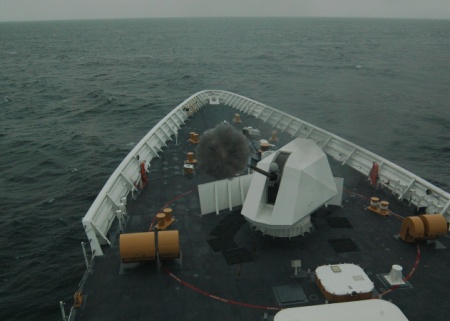
CG Sink-EX?

Coast Guard coordinates removal of sunken tug near Juneau, Alaska

https://www.dvidshub.net/image/2420118/coast-guard-coordinates-removal-sunken-tug-near-juneau-alaska#.Vs0c6YRWu20

This looks like it might be an opportunitiy to test the lethality of our 57mm guns. We have a tug that needs to be disposed of. Let’s see how well a Bertholf’s 57mm Mk110 does against this small target.

NSCfires57mm

In April 2012 we had an opportunity to exercise our weapons against a derilect Japanese fishing vessel that had been adrift since the Tsunami of 11 March 2011. USCGC Anacapa let loose with her 25mm and probably scored over a hundred hits, but ultimately had to use fire hoses to sink the little ship. I used this as an example of how hard it is to sink a ship with gunfire. 

To be fair lets make sure that all the tugs few bulkheads are watertight; you would want to make sure they were before towing it anyway. To make it interesting, start shooting from between 10,000 and 12,000 yards, and fire say 20 rounds at that range. Then close to about 7,000 and shoot another 20. If the tug hasn’t sunk, close to no less than 4,000 and try to finish it off.

Would be very interested to see the results, including how long it takes to sink the ship? How many hits at what ranges? It would be good for an aircraft to get some video of the damage, as it progresses too. The Navy might also be interested in the results.

Document Alert: The Trans-Pacific Partnerships: Strategic Implications–CRS

There is a new and interesting product from the Congressional Research Service, “The Trans-Pacific Partnership: Strategic Implications.” 

Growth in trade naturally grows the Coast Guard’s responsibilities. This, unlike NAFTA would impact primarily the marine transportation system.

Congress still has to approve implementing legislation. Would be interesting to know how the presidential candidates feel about this agreement.

Good News–and Bad, from the Western Pacific

A great New York Times article , “Palau vs the Poachers,” looking at Palau’s attempts to police their waters as a microcosm of the problems created by poaching and overfishing.

I’ll repeat my oft stated contention that we do not spend nearly enough time in the Western Pacific where the US has a huge chunk of Exclusive Economic Zone (EEZ). There is a new Marine Reserve to protect. Plus we have an obligation to help former US territories that are now independent island nations struggling to effectively protect their own fisheries.

The work of “SkyTruth” and Google in crowd sourcing fisheries intelligence recounted here is encouraging, but there is simply to little enforcement. There were a couple of paragraphs that particularly stood out to me.

The oceans belong to everyone and no one, and the general perception is that they are too big to need protection. We also tend to think of fish as an ever-regenerating crop, there forever for our taking. But roughly 90 percent of the world’s ocean stocks are depleted or overexploited; one study predicts that by 2050, the sea could contain more plastic waste than fish. Though most governments have neither the inclination nor the resources to patrol the oceans, Palau is trying a different approach, and whether it succeeds or fails may have consequences for the entire planet.

In the span of one human lifetime, humankind has become brutally adept at plundering the seas. In the late 1940s, the annual global catch was roughly 16.5 million tons; now, after decades of innovation, this number is about 94 million tons. ‘‘That’s equivalent in weight of the entire human population at the turn of the 20th century, removed from the sea each and every year,’’ Paul Greenberg, an author of books about fish and seafood, told me.

Project 22160 patrol ships, Russia’s Cutter X

The Zelenodolsk Shipyard in the Volga area will lay down the third Project 22160 patrol ship Pavel Derzhavin on February 18, shipyard spokesman Andrei Spiridonov told TASS on Monday. "The shipyard will hold a solemn ceremony of laying down the Project 22160 patrol ship Pavel Derzhavin developed by the Severnoye Design Bureau in St. Petersburg [in northwest Russia]," the spokesman said.

Recently, NavyRecognition reported Russia was laying down a third Project 22160 patrol ship. The first of this class should enter service next year. In size they fall between the Offshore Patrol Cutter and the Webber class WPCs, in the range I have called “Cutter X.” The size (1200-1800 tons full load) seems to be favored by many navies and coast guards.These ships are a bit unusual among small Russian ships in having a substantial range.

Reportedly the Russians are building six of these. Specs are as follows:

  • Length: 94 meters (308 ft)
  • Beam: 14 meters (46 ft)
  • Draught: 3.4 meters (11.2 ft)
  • Speed: 30 knots
  • Range: 6,000 nmi
  • Endurance:  60 days
  • Crew: 80

At one point there was a public statement that these had been designed to counter piracy off the Horne of Africa. But it has been more recently reported that they will be quipped with Kalibr (Tomahawkski) land attack missiles, the type recently used by ships in the Caspian Sea to attack targets in Syria. The ship is “modular” and has a reconfigurable space under the rear of the flight deck. The missile will be mounted in containers under the flight deck. Adding anti-submarine or additional anti-ship capabilities would require trading off the Kalibr missiles.

Russian Project 22160

The ship has a new naval gun mount incorporating a 57mm gun. The gun is reportedly capable of 300 rounds per minute and a range of 12 km. Effective range is about 4 km. This is a development of gun with a long history in Soviet and Russian Service in both anti-air and anti-armor roles, and as is frequently the case with Russian weapons, the ammunition is shared in common with the Russian Army.

In addition they will carry short range Anti-Air missiles. It appears they will be vertical launched from canisters between the gun and superstructure.

While these ships do not have a strong self defense capability, the mounting of cruise missiles similar to the Tomahawk on small vessels, particularly on one like this, that has a relatively long range, gives them a sort of miniature maritime strike capability, far less capable, but also far cheaper than a Carrier Strike Group. While the ships are small and the weapons unobtrusive, the potential to accurately strike up to eight separate targets would have required an attack by dozens of aircraft not too many years ago.

Apparently all six ships are to be assigned to the Black Sea Fleet and will be home ported in Novorossiysk.

Interestingly, it appears the Russians may also be building a similar size anti-submarine warfare ship. Again NavyRecognition has the report.

European Concern for Maritime Cargo Security

The Irish Times is reporting that Europe has not attempted to track cargoes like the US Coast Guard does. In the article it was not apparent that the author was even aware that the US Coast Guard has such a system.

There is currently no comprehensive system to track shipments and cargos through EU ports and along its approximately 70,000km of coastline – a deficiency that has long been exploited by organised criminals and which could increasingly prove irresistible to terrorists too, say European security officials.

Sounds like an opportunity for some international cooperation.

Chilean Icebreaker/Supply Vessel, plus Other News From Chile

ChileanIcebreaker

Photo: New Chilean Icebreaker/Antarctic Supply Vessel.  

I recently had an exchange of emails with Andrés Tavolari, a lawyer and Chilean Marine Reserve Officer, who wrote one of our most popular posts, Three Nations Share German OPV Design.

He tells me Chile is building an icebreaker/supply ship. In terms of horsepower, it will be more powerful than the old Wind class icebreakers and only slightly less powerful than the Glacier. Our resident icebreaker expert, Tups, talked about this ship in a comment on an earlier post.

VARD is designing an icebreaker for the Chilean Navy:

http://www.marinelink.com/news/icebreaker-antarctic404371.aspx

One thing that puzzles me is the performance. 14.5 MW for 2 knots in 1 m ice? I mean, the bigger South African research vessel S. A. Agulhas II can do 5 knots with just 9 MW propulsion power (12 MW installed power).

My initial comment was that “Some times they just call out the minimum contract specs. Does not mean they might not be capable of more.” While that might be the case, there is an alternate possibility, perhaps the hull will not be strong enough to break heavier ice or to break one meter of ice at a faster rate. If you look at where Chile has their Antarctic stations, they are all about as far from the Pole as you can get and still be in Antarctica. Perhaps they do not need great icebreaking performance to accomplish their mission. Shaping very thick steel plate is undoubtably difficult and one of the more demanding aspects of building an icebreaker. Perhaps lighter plate is seen as a reasonable compromise.

512px-Antarctica_CIA_svg

Antarctic claims. This chart from Wikipedia Commons. 

Chile’s current icebreaker is the former Canadian Icebreaker CCGS Norman McLeod Rogers, which entered service originally in 1969.

Also of interest, the Chilean Navy magazine has published a special edition with some nice pictures regarding several naval and maritime activities. The text is written in Spanish, but it is mostly pictures and graphics. So the language doesn’t preclude understanding much of it.

Andres pointed out, on pages 36 and 37, there is a graphic with the ships and aircraft of the Navy. Among others there are 3 OPVs, 18 Protector class boats, 4 Grumete / Dabur class boats, 26 Archangel boats and 15 Defender boats, and 3 C-295 Persuader MPA and 8 HH-65 Dolphin helicopters. All in all, there are 22.000 men and women in the navy, including some 2.800 marines. The icebreaker is illustrated on page 44.

On page 45 there is some information regarding the OPVs project called “Danubio”. This is a continuation of the OPV project Andres posted about earlier.

Andres also sent along some information about their Navy’s Shipyard, in the form of a power point presentation including some pictures of the damage suffered by the 2010 tsunami, and its reconstruction (slides 19 – 26). Slide 39 covers the icebreaker.

We also talked a little about the organization of Chile’s Coast Guard counterpart, DIRECTEMAR. It is a part of the Navy organization. While heads of DIRECTEMAR have gone on to head the Navy, these officers have not come up through the ranks in DIRECTEMAR, they have been regular Navy officers.

DIRECTEMAR’s counterpart to our WPBs are the 16 Danubio Class, delivered 1999-2004.

  • 125 tons fl
  • 25 knots
  • 33.1×6.6×1.9 meters or 109x22x6.2 feet
  • one 12.7mm
  • 2 MTU 16V2000 M90 diesels 3,200HP
  • 2 off, 8 enlisted
Many of DIRECTEMAR’s small boats will look familiar. They have a number of USCG type boats procured through Foreign Military Sales, which have proven effective in countering illegal fishing activities.

Document Alert: World Wide Threat Assessment of the US Intelligence Community, 2/9/16

We have a statement for the record (pdf) from James R. Clapper, Director of National Intelligence, dated February 9, 2016. Perhaps it is the nature of the beast, but there is no good news, and much that is bad.

Smuggling of every type appears to be on the rise including drugs and people. We can expect an increase in illegal immigration as a result of violence, poverty, and disorder in Latin America and particularly Cuba and Central America.

It is a relatively compact document. There are sections on Terrorism (pp 4-6), transnational organized crime (pp 11-12), Arctic (p 13), Environmental Risks and Climate Change (pp 13-14), health (including potential pandemics) (pp 14-15), and Global Displacement, “These 60 million consist of approximately 20 million refugees, 38 million internally displaced persons (IDPs), and approximately 2 million stateless persons, also according to UNHCR statistics.” (p.15)

There are also regional assessments including one on Latin America and the Caribbean (pp 28-29).

There is no regional assessment for the US. In terms of direct terrorist threats to the US, while there is a recognition of an aspiration on the part of various groups to attack the US, but the emphasis seems to be on “homegrown violent extremists” (HVEs) and there is nothing about the possibility of a maritime attack on the US. Is that because none exist?