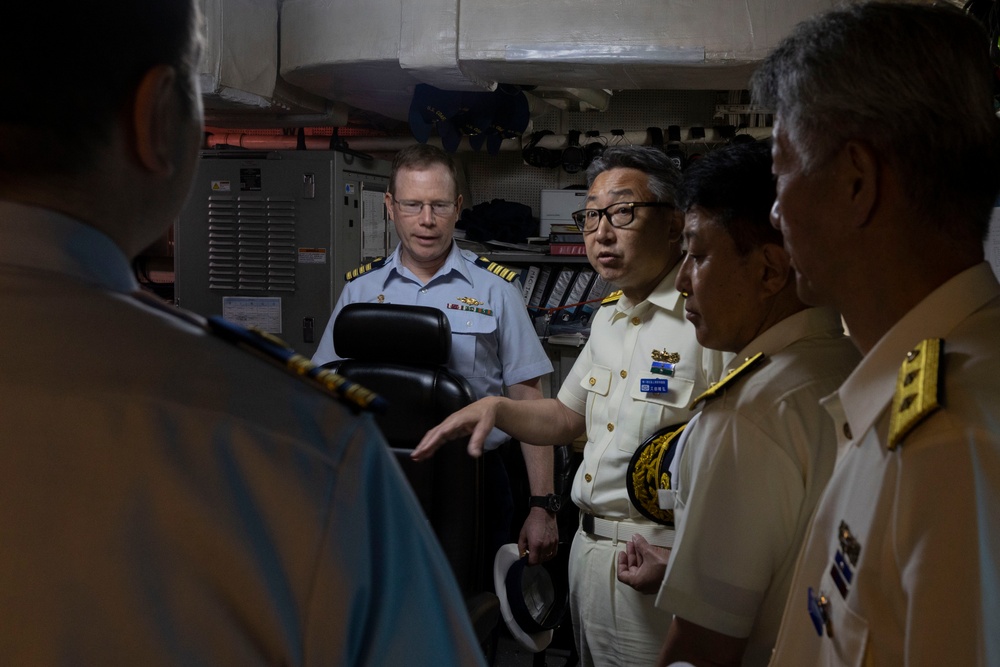
“U.S., Japan, and Korea Coast Guards Conduct Trilateral Operations” –News Release

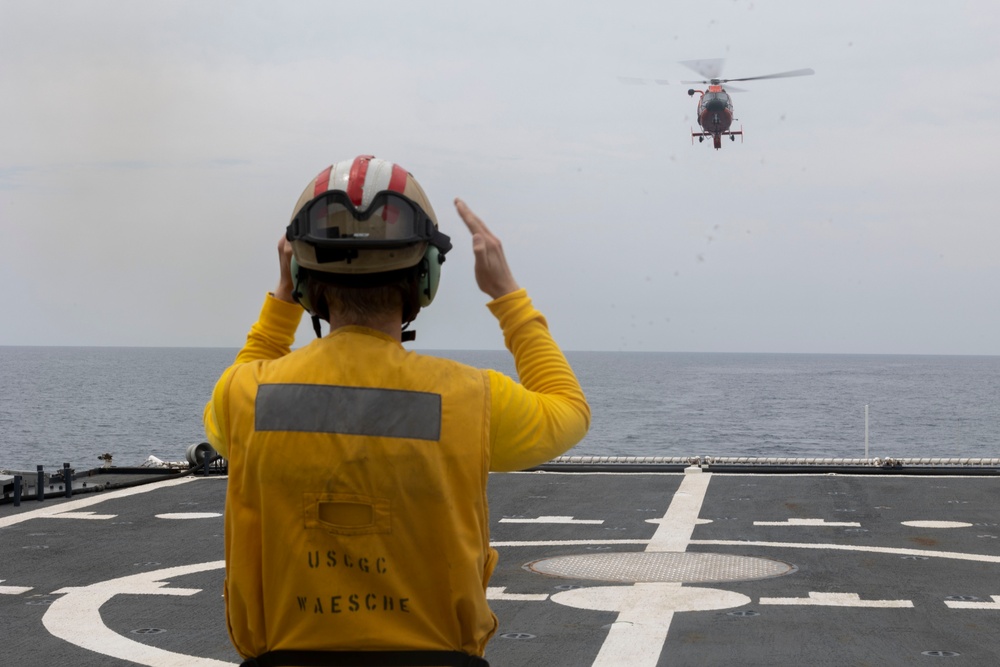
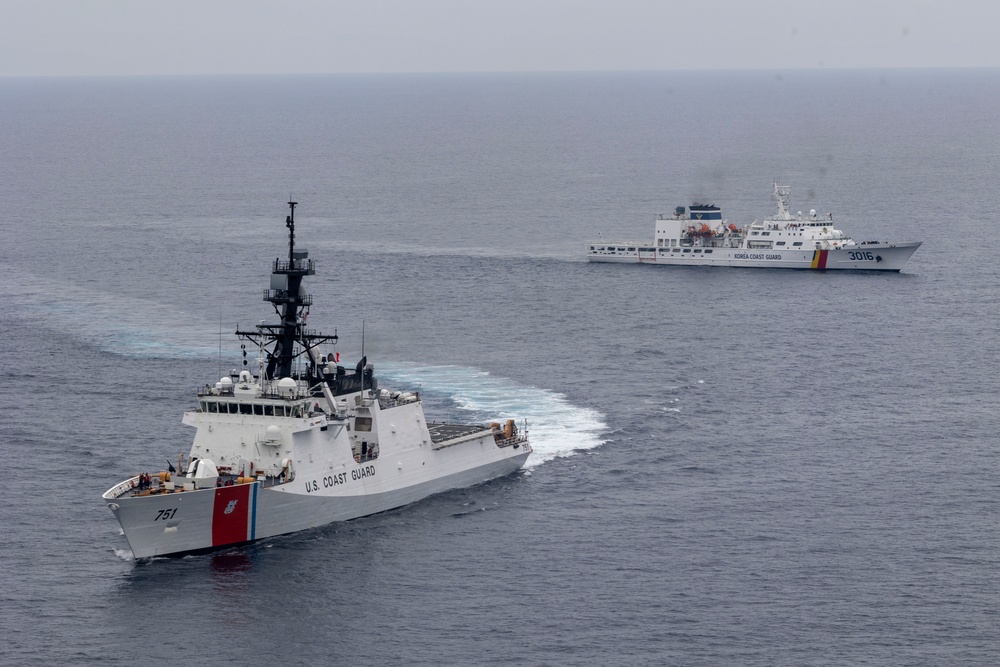
Republic of Korea Coast Guard vessel KCG Taepyongyang (KCG-3016), U.S. Coast Guard Cutter Waesche (WMSL-751) and Japan Coast Guard vessel JCGC Wakasa (PL-93) patrol in formation during a trilateral exercise in the East Sea, June 6, 2024. U.S. Coast Guard missions in the Indo-Pacific focus on issues directly supporting and advancing our regional partners’ efforts to protect fish stocks, ensure safety of life at sea, support environmental response, and provide disaster relief. (U.S. Marine Corps photo by Cpl. Elijah Murphy)

Below is a release from Coast Guard News. Once again, we have a National Security Cutter in the far Western Pacific (here, here, here, and here). A couple of things worth noting.

The Cutter is operating under a 7th Fleet Destroyer Squadron (DESRON 15) rather than US Coast Guard Operational Control.

While S. Korea has an EEZ 2.65% that of the US, the South Korean Coast Guard with about a quarter the number of personnel as the US Coast Guard, operates about the same number of large patrol cutters (>1,000 tons, 36 vs 34) as its US counterpart.

Japan has an EEZ about 39.5% that of the US. The Japan Coast Guard with about a third the personnel of the USCG, operates about twice as many large patrol cutters (70+).

Both the S. Korean and Japan Coast Guards have far fewer aircraft than the USCG.
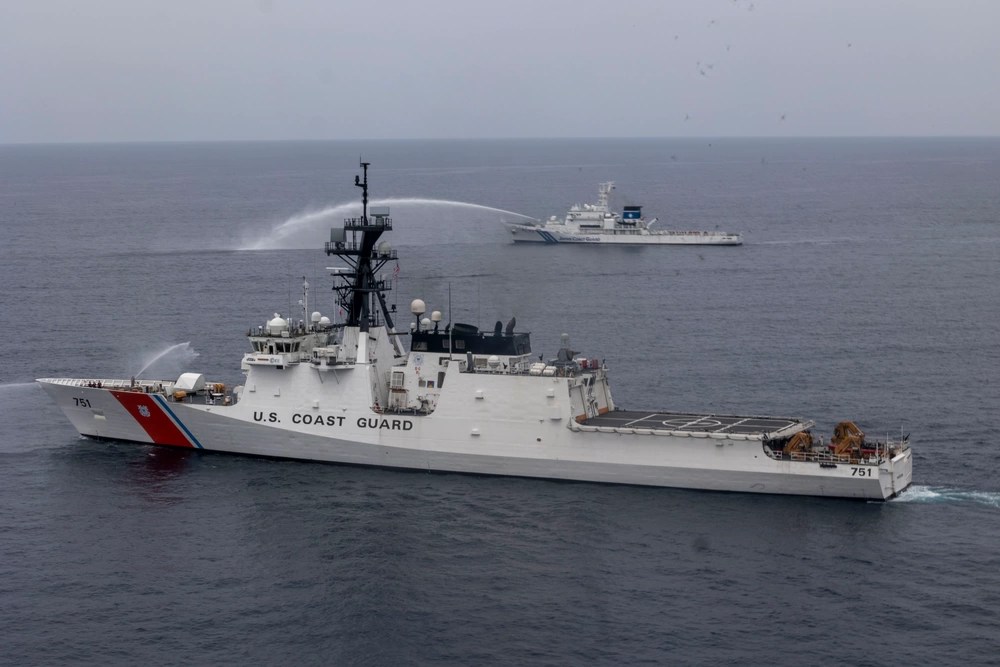
U.S. Coast Guard Cutter Waesche and Japan Coast Guard vessel JCGC Wakasa (PL-93) test their water cannons during a trilateral search and rescue exercise in the East Sea, June 6, 2024. (U.S. Marine Corps photo by Cpl. Elijah Murphy)


June 9, 2024

U.S., Japan, and Korea Coast Guards Conduct Trilateral Operations
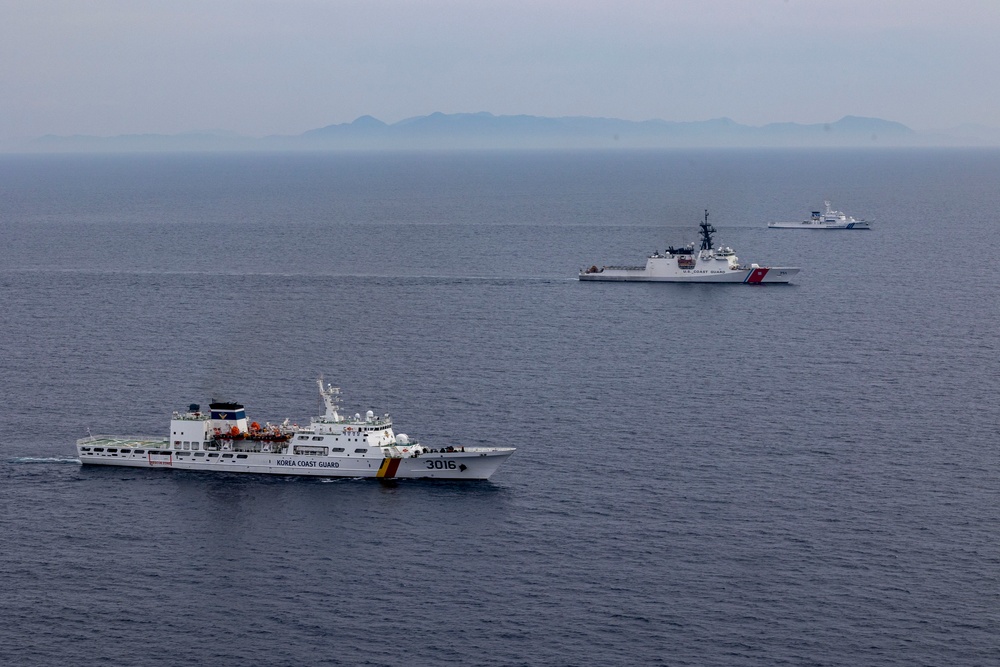
MAIZURU, Japan – U.S. Coast Guard Cutter Waesche (WMSL 751) departed Maizuru, Japan, June 6, following several engagements with the Japan Coast Guard, Republic of Korea Coast Guard and multiple Japanese dignitaries. Once underway, the Waesche, the Japan Coast Guard vessel Wakasa (PL 93), and the Republic of Korea Coast Guard patrol vessel Taepyongyang (KCG 3016) conducted a joint search and rescue exercise at sea.

Waesche arrived on June 3 and is the first U.S. Coast Guard cutter to pull into Maizuru.

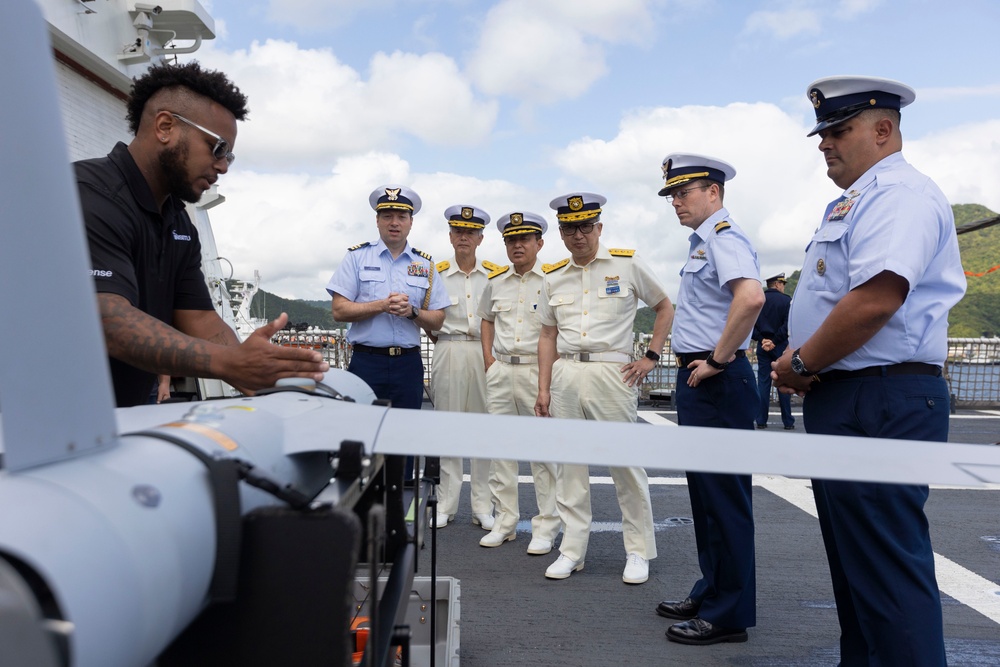
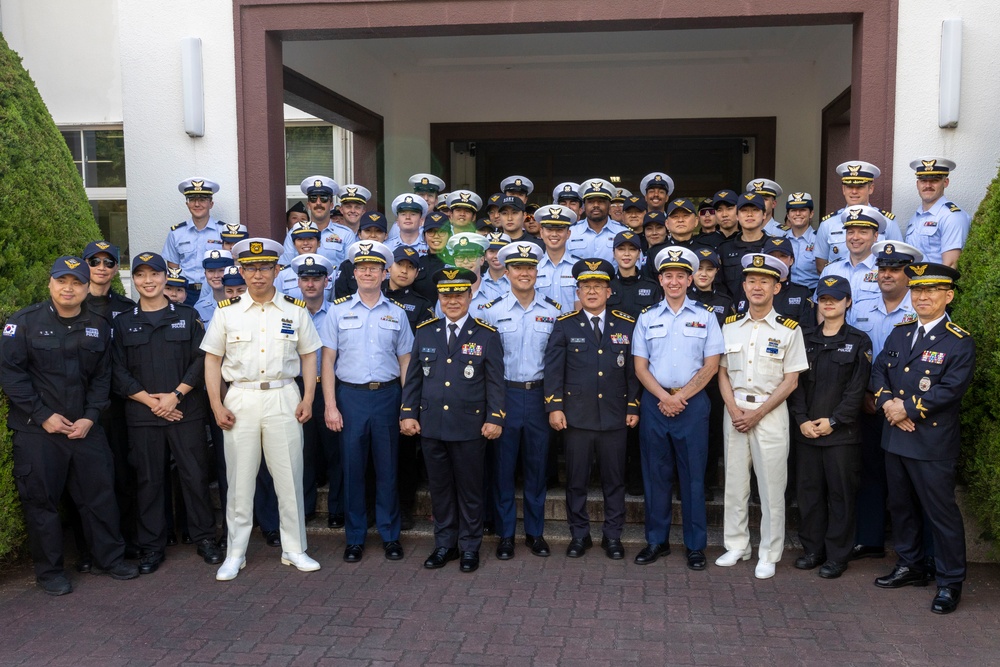
While moored in Maizuru, the Waesche crew attended a reception to commemorate the first joint search and rescue exercise between the three coast guards. Capt. Tyson Scofield, U.S. Coast Guard Cutter Waesche commanding officer, met with Rear Adm. Hisada Takahiro, Japan Coast Guard 8th Regional commander and Maizuru Mayor Akitsu Kamota to discuss the continued cooperation between the three nations, specifically recognizing the importance search and rescue response efforts.

“This joint search and rescue exercise with the Japan Coast Guard, Republic of Korea Coast Guard and U.S. Coast Guard highlights the strong bond between our maritime nations,” said Tyson. “Increasing interoperability to assist mariners at sea, highlights the strength of our maritime cooperation. Together, we continue to build strong relationships with like-minded nations throughout the Indo-Pacific.”

During the search and rescue exercise, officers from the three coast guards joined as observers on each nation’s ship to share best practices and learn from each other. This provided each coast guard an opportunity to work together with each other’s crews during the exercise.

Waesche is proud to support the United States’ continued efforts to facilitate force-multiplying partnerships in the region to bolster interoperability across the Indo-Pacific.

Waesche is assigned to Destroyer Squadron (DESRON) 15, the Navy’s largest DESRON and the U.S. 7th Fleet’s principal surface force. DESRON 15 regularly assumes tactical control of surface units operating in the area.

Commissioned in 2010, Waesche is the second legend-class national security cutter and is homeported in Alameda, California. National security cutters are 418-feet long, 54-feet wide, and have a 4,600 long-ton displacement. They have a top speed in excess of 28 knots, a range of 12,000 nautical miles, and can hold a crew of up to 170. The advanced technologies of the national security cutter class ships are designed to support global operations and missions.

Russian Navy Coming to the Straits of Florida Next Week

Map of the Caribbean Sea and its islands. Photo credit: Wikipedia Commons, author–Kmusser, all data from Vector Map.

MSN reports three Russian Navy surface ships and a nuclear-powered submarine are expected call on Havana next week.

“Russian ships are expected to make port calls in Cuba and perhaps Venezuela. The regional exercises are expected to last through the summer and culminate in a global naval exercise in the fall.”

Of course, the US is not objecting to the presence of a few Russian Ships operating in waters close to the US. Nevertheless, the Coast Guard may encounter these ships.

It would be interesting to know what kind of ships they are sending.

Meanwhile close to Russia, “NATO to Kick Off Largest Baltic Operations Exercise to Date.”

Three Apparent Fatalities in Drug Interdiction Incident

HNLMS Groningen’s crew interdicts a suspected drug boat in the Caribbean Sea, Sept. 27, 2020. HNLMS Groningen is a Holland-class offshore patrol vessel operated by the Royal Netherlands Navy. (Royal Netherlands Navy photo)

Below is a news release from District 7. It is unusual in that smugglers apparently turned toward the boarding party and prompted a response using deadly force. It appears likely this resulted in three fatalities among the smugglers. “There were no reported injuries to the combined law enforcement team members.”


June 6, 2024

Coast Guard, Dutch suspend search for missing persons following counter drug mission in Caribbean Sea

MIAMI – The U.S. Coast Guard, Royal Netherlands Navy and Dutch Caribbean Coast Guard suspended a search for three suspected smugglers who went overboard during pursuit of a non-compliant vessel suspected of smuggling illicit narcotics in the Caribbean Sea, June 4, 2024.

Active search efforts were suspended, Tuesday evening, pending new information.

In the early morning hours on Tuesday, a Royal Netherlands Navy ship with an embarked U.S. Coast Guard law enforcement detachment deployed for a counter drug patrol identified a vessel suspected of smuggling narcotics in international waters. The vessel failed to stop when signaled and the smuggling vessel operator instead increased speed and changed direction toward the Dutch pursuit boat, called a fast-raiding interception and special forces craft (FRISC).

The FRISC boat crew, consisting of Dutch and U.S. Coast Guard boarding team members, discharged their weapons at the go-fast vessel in self-defense and defense of others in response to the life-threatening situation. The go-fast vessel caught fire and sank, and three suspected smugglers went overboard into the water and were not recovered.

There were no reported injuries to the combined law enforcement team members.

“The Coast Guard is America’s primary maritime law enforcement agency, and our crews work hard to safely bring suspected smugglers to face federal prosecution in the United States for alleged crimes,” said Lt. Cmdr. John W. Beal, Coast Guard District Seven public affairs officer. “The missions our Coast Guard servicemembers and allied partners do every day to deny transnational criminal organizations access to maritime smuggling routes are inherently dangerous. The decision to suspend active search efforts is not one we take lightly, and the Coast Guard is working to investigate the incident in accordance with Coast Guard policy.”

Assets and crews involved in the search efforts included:

  • Royal Netherlands Navy ship HNLMS Groningen
  • Royal Netherlands Navy ship HNLMS Pelikaan
  • U.S. Coast Guard helicopter
  • Kustwacht Caribisch Gebied helicopter
  • Kustwacht Caribisch Gebied cutter Jaguar

Detecting and interdicting illegal drug traffickers on the high seas involves significant interagency and international coordination. Once interdiction becomes imminent, the law enforcement phase of the operation begins, and control of the operation shifts to the U.S. Coast Guard throughout the interdiction and apprehension phases. Interdictions in the Caribbean Sea are performed by members of the U.S. Coast Guard under the authority and control of the Coast Guard’s Seventh District, headquartered in Miami.

“Coasties, Marines and Sailors Awarded for Seizing Millions of Pounds of Explosive Materials in Middle East” –Military.com

220822-A-KS490-1182 STRAIT OF HORMUZ (Aug. 22, 2022) From the left, U.S. Coast Guard fast response cutters USCGC Glen Harris (WPC 1144), USCGC John Scheuerman (WPC 1146), USCGC Emlen Tunnell (WPC 1145) and USCGC Clarence Sutphin Jr. (WPC 1147) transit the Strait of Hormuz, Aug. 22. The cutters are forward-deployed to U.S. 5th Fleet to help ensure maritime security and stability across the Middle East. (U.S. Army photo by Spc. Noah Martin)

Military.com reports,

“Hundreds of service members earned an award for seizing two million pounds of “explosive precursor material” in the Gulf of Oman last year, according to a citation obtained by Military.com. It is one of the U.S. military’s largest publicly revealed hauls as it works to stifle arms smuggling in the region.”

The award was made to “192 Marines and sailors with the 26th MEU, 342 sailors assigned to the USS Carter Hall” and unreported numbers of additional personnel “aboard the USS Stethem and Coast Guard Cutters Emlen Tunnell, Glen Harris and John Scheuerman…”

This is not the first time PATFORSWA cutters have stopped shipments of explosives.

I had never heard of the Meritorious Team Commendation (MTC). It is a Coast Guard unit award created in 1993 for groups or teams that are not identifiable by OPFAC as a United States Coast Guard unit.

“USCGC Myrtle Hazard (WPC 1139) enters first drydock maintenance in Honolulu” –Forces Micronesia/Sector Guam

The USCGC Myrtle Hazard (WPC 1139) crew departs Guam for Honolulu on May 13, 2024, marking a significant milestone as the crew prepare for the first drydock maintenance period of approximately four and a half months. Commissioned in 2021, the Myrtle Hazard is the first of three Guam-based Fast Response Cutters to make the transit to Hawaii from Guam, traveling 3,743 miles to undergo this crucial maintenance phase. (U.S. Coast Guard photo by Chief Warrant Officer Sara Muir)

Below is a U.S. Coast Guard Forces Micronesia/Sector Guam news release (more photos there) that clarifies how Guam based Fast Response Cutters will be maintained. Just to provide a hint of how arduous this was, the distance from their base to Hawaii, 3743 nautical miles, would take 12 days at a 14 knot cruise speed, while the nominal range and endurance of ships of this class is 5 days and 2500 miles. Actually, she departed Guam on May 13 and arrived in Hawaii, May 28, 15 days later, presumably having stopped at least once to refuel and resupply. 

USCGC Myrtle Hazard arrived in Guam in September of 2020. This is her very first drydocking. Just getting to Hawaii required a transit equal to 16.3% of the miles she transited during the previous 42 months.

June 4, 2024

USCGC Myrtle Hazard (WPC 1139) enters first drydock maintenance in Honolulu

SANTA RITA, Guam — The USCGC Myrtle Hazard (WPC 1139) crew arrived in Honolulu on May 28, 2024, marking a significant milestone as it enters its first drydock maintenance period of approximately four and a half months. 

Commissioned in 2021, the Myrtle Hazard is the first of three Guam-based Fast Response Cutters (FRCs) to transit to Hawaii from Guam, traveling 3,743 miles to undergo this crucial maintenance phase.

In just the past two years, the Myrtle Hazard crew patrolled a vast 1.9 million square nautical mile area traveling as far south as Australia, accruing over 23,000 nautical miles steamed. The cutter crew enhanced regional maritime security and strengthened international cooperation by participating as the deputy commodore’s platform during a search and rescue exercise phase of Pacific Partnership 2022, the largest multinational humanitarian exercise in the Indo-Pacific. They also operationalized newly signed agreements by conducting historic bilateral boardings with Papua New Guinea, rescued mariners in dangerous sea conditions in the Northern Mariana Islands, and participated in critical operations escorting Department of Defense assets. The drydock maintenance is crucial for maintaining these high standards and ensuring the cutter’s continued ability to perform such missions.

“Throughout the transit east, as we leapfrogged through the Federated States of Micronesia and the Republic of the Marshall Islands to reach Hawaii, this crew demonstrated extraordinary resilience and skill. Despite several engineering challenges that tested our capabilities, their steadfast commitment and proficient handling of all casualties ensured our safe and timely arrival for drydock maintenance. I am immensely proud of their dedication and professionalism, which continue to ensure our readiness and effectiveness in fulfilling our missions,” said Lt. Emma Saunders, commanding officer of the USCGC Myrtle Hazard, on her first transit since assuming command.

Why Drydock is Essential

Drydock maintenance is vital for operational readiness, extending the cutter’s service life, and ensuring the safety of its crew. It involves a series of comprehensive inspections and repairs the crew cannot perform while the vessel is waterborne. These include hull preservation, mechanical overhauls, and technological upgrades, all of which are crucial for maintaining the cutter’s peak performance and safety standards.

Logistical Excellence and Risk Management

The logistical operation to transfer the cutter from Guam to Honolulu highlights the strategic planning and risk management necessary for this evolution. By proactively addressing maintenance needs, the team can meet operational commitments without compromising the safety or effectiveness of the fleet.

“Regular maintenance isn’t just about keeping our ships in shape; it’s about ensuring we’re always ready to meet the challenges we face at sea. Working closely with Coast Guard District 14 and our logistics teams, we schedule these critical maintenance periods to keep our missions running smoothly without missing a beat. This careful planning ensures we’re always there where we’re needed most, from safeguarding our shores to ensuring maritime safety and security across the Pacific. It’s a team effort, and every member of Team Guam plays a part in keeping our commitment strong and our presence steady in the waters we protect and the communities we serve.” said Capt. Robert Kistner, emphasizing the critical role of regular maintenance.

Next Steps for Guam-Based FRCs

Following the Myrtle Hazard, the other two Guam-based FRCs, USCGC Oliver Henry (WPC 1140) and USCGC Frederick Hatch (WPC 1143), will undergo their respective drydock periods. This systematic approach ensures that all vessels maintain their operational capabilities and readiness.

“We are committed to continuous improvement in maintenance practices, which is crucial for fulfilling our mission to protect and secure maritime interests in the Pacific,” said Kistner. “We look forward to Myrtle Hazard’s return this Fall.”

Future Outlook

As Base Guam continues to come online under the command of Cmdr. Dana Hiatt and operators employ the recently established Operational Logistics Command Expeditionary Team (LOG-X) more frequently; the U.S. Coast Guard is exploring enhancements in local maintenance capabilities and infrastructure in the Pacific. This includes potential investments in existing and new purpose-built facilities for Team Guam, which are crucial for minimizing downtime and ensuring a ready fleet capable of meeting future challenges.

Myrtle Hazard, the 39th 154-foot Sentinel-class FRC, is named in honor of the first enlisted woman in the U.S. Coast Guard who served as an electrician and radio operator. As part of the Guam-based cutters, it is a cornerstone for the U.S. Coast Guard’s ongoing commitment to the people of Oceania, focusing on maritime safety, security, and stewardship.

-USCG-

About U.S. Coast Guard Team Guam
Comprising over 350 members, this team is focused on maritime safety, security, and stewardship in Oceania. U.S. Coast Guard Forces Micronesia/Sector Guam, U.S. Coast Guard Base Guam, and their sub-units are staffed by dedicated active-duty, reserve, and civilian personnel. With a significant presence in Guam, Saipan, and the Micronesia sub-region, this integrated team focuses on operations and logistics to support maritime safety, security, and stewardship in Oceania and maintains close ties with local communities.

PATFORSWA FRCs Recieve Maintenance in Theater

USCGC John Scheuerman (WPC-1146) and USCGC Clarence Sutphin Jr. (WPC-1147) enroute PATFORSWA

A US Naval Forces Central Command news release reporting change of Command of Destroyer Squadron 50 included this little tidbit,

“Coles also built maintenance capacity in a highly dynamic environment when he enabled the U.S. Coast Guard’s Patrol Forces Southwest Asia to execute maintenance on all five of their fast-response cutters in a forward logistics location. This kept the FRC fleet 100 percent ready for tasking.”

PATFORSWA has six FRCs, but maybe only five needed maintenance. Anyway, nice to know they can be maintained in theater rather than having to be rotated out. Not too surprising considering the older Island class cutters were also maintained in theater.

“Argentina’s Navy gets even closer to US Navy” –ArmyRecognition

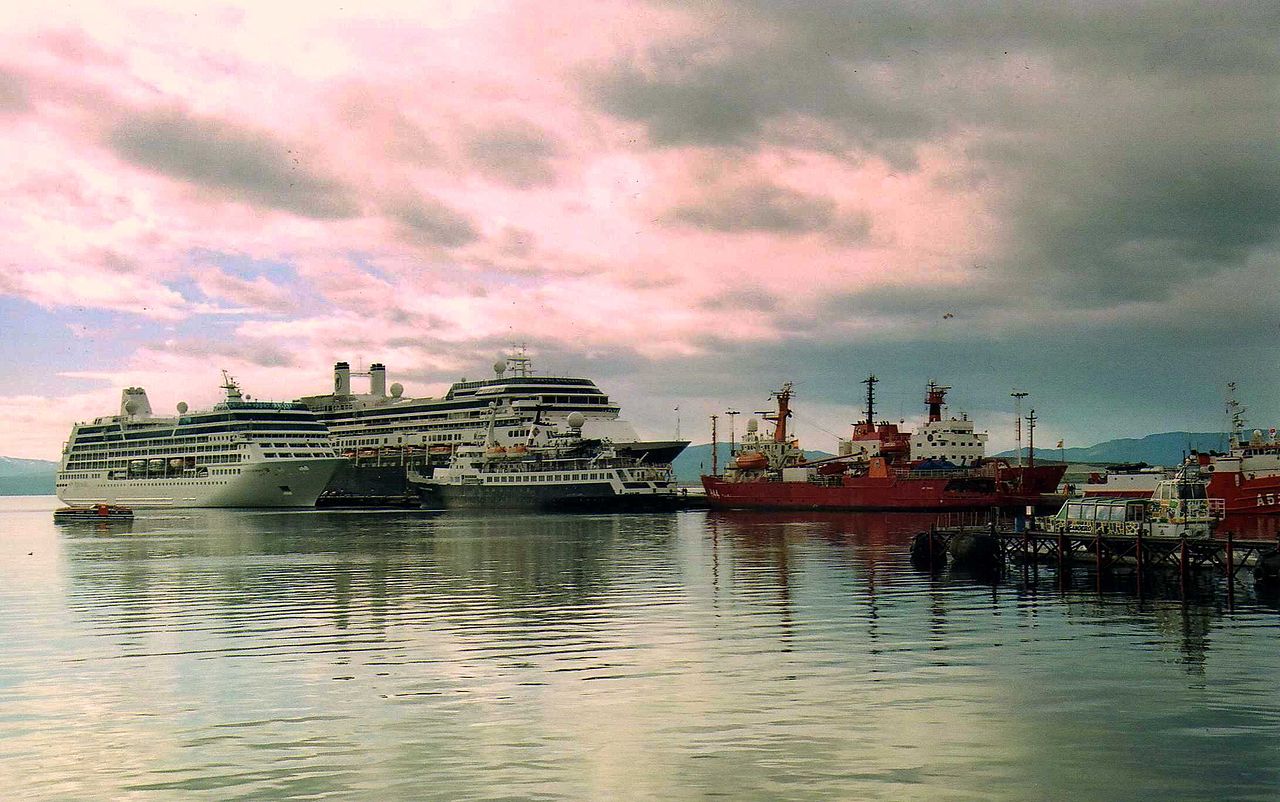
Cruise ships at dock, Ushuaia, Tierra del Fuego, Argentina. Photo Credit: Rodolfo Pace

Army Recognition reports interaction between the US and Argentine Navies as part of Exercise Southern Seas 2024, being conducted as USS George Washington (CVN-73) transits from the East Coast to her new Homeport in Japan.

There is a particularly interesting note here,

“A central aspect of this evolving partnership is the establishment of an integrated naval base in Ushuaia, the southernmost city in Argentina. This base is strategically important as it faces the Strait of Magellan and is close to Antarctica. The collaboration on this base is intended to enhance logistical capabilities for both countries and serve as a critical point for repair and resupply operations for commercial and military vessels. This move is part of a broader strategy to assert Argentina’s sovereign rights in Antarctica.”

This may suggest that the US is recognizing that the Southern Ocean and Antarctic may be an area of future conflict.

Aside from the obvious relevance of a new logistics base that US Coast Guard icebreakers may use for support of the US contingent in Antarctica, another Coast Guard asset, USCGC James, has been working with Argentina as well,

“Argentina has also agreed to joint naval training exercises with the U.S. Coast Guard to protect its fishing resources. This proposal includes allowing the U.S. Coast Guard Cutter James to patrol Argentine waters, a move that has sparked debate within the Argentine Congress regarding national sovereignty and the presence of foreign military forces​​.”

“U.S. Coast Guard Cutter Munro holds a change of command ceremony” –News Release

Royal Navy vessel HMS Spey (P234) (foreground) conducts coordinated ship maneuvers with U.S. Coast Guard Cutter Munro (WMSL 755) Sept. 17, 2023, in the South China Sea. Munro is deployed to the Indo-Pacific to advance relationships with ally and partner nations to build a more stable, free, open and resilient region with unrestricted, lawful access to the maritime commons. (U.S. Navy photo by Chief Petty Officer Brett Cote)

Below is a news release. Routine change of command, but the Munro’s recent activities are interesting for their variety, three very different activities in widely dispersed areas, Eastern Pacific, Western Pacific, and far Northern Pacific. More info in these earlier news releases:


 May 31, 2024

U.S. Coast Guard Cutter Munro holds a change of command ceremony

SAN DIEGO — The U.S. Coast Guard Cutter Munro (WMSL 755) held a change of command ceremony Thursday in San Diego.

Vice Adm. Andrew J. Tiongson, Commander, U.S. Coast Guard Pacific Area, presided over the ceremony in which Capt. James O’Mara IV relieved Capt. Rula Deisher as Munro’s commanding officer.

Deisher served as Munro’s commanding officer from May 2022 to May 2024, sailing over 73,000 nautical miles to 17 ports, including eight foreign countries during patrols in the Bering Sea, Western Pacific, and Eastern Pacific.

Most recently, Munro and the crew were responsible for the interdiction and seizure of illegal narcotics worth an estimated $460 million in wholesale value and over $2 billion in street value while patrolling the Eastern Pacific Ocean in support of the Joint Interagency Task Force-South. Munro’s crew also supported Operation Southern Shield during their recent patrol by conducting 16 fisheries boardings in the Southern Pacific Regional Fisheries Management Organization convention area, upholding the maritime rules-based order.

During Munro’s Western Pacific patrol, the cutter and crew hosted multiple engagements with foreign partners, including a discussion about the SAPPHIRE agreement with Japanese Coast Guard officers, a subject matter expert exchange, an at-sea engagement with the Korea Coast Guard, and participated in CARAT Brunei, where Munro worked alongside the Royal Brunei Navy in professional subject matter expert exchanges, leadership conferences, and an at-sea engagement.

While patrolling the Bering Sea, Munro conducted 24 fisheries boardings and two search-and-rescue cases, including the medical evacuation of a critical patient from Dutch Harbor, Alaska, to Anchorage, Alaska.

“To the crew of Munro, thank you,” said Deisher. “I am so proud of your endless dedication and care toward each other and our mission. This crew is phenomenal, and it has been an honor and privilege to sail with them and learn from them.”

Deisher’s next assignment is to serve as the Seventeenth District’s Response Division chief.

O’Mara, the incoming commanding officer, brings a wealth of experience to Munro.

Reporting from the Coast Guard’s Eleventh District as the Enforcement Branch chief, O’Mara oversaw assets across 1,000 miles of shoreline from the California-Oregon state line to the Mexico border and 73 federal waterways. He also worked closely with the Department of Defense Joint Interagency Task Forces and the Department of Homeland Security Joint Task Force West to conduct effective drug and law enforcement interdiction efforts across the Eastern Pacific.

Munro will be O’Mara’s seventh ship and fourth command, following previous commands aboard the Coast Guard Cutters Active (WMEC 618), Farallon (WPB 1301), Monomoy (WPB 1326), and Narwhal (WPB 87335).

The change of command ceremony, a time-honored tradition, is a significant event conducted before the assembled company of a command. It confirms to the unit’s men and women that the authority of command is maintained. The ceremony symbolizes a transfer of total responsibility, authority, and accountability from one individual to another, marking a new chapter in the command’s history.

Commissioned in 2017, Munro is one of four Coast Guard Legend-class national security cutters homeported in Alameda. National security cutters, measuring 418 feet long and 54 feet wide, boast a top speed of over 28 knots, a range of 12,000 nautical miles, endurance of up to 90 days, and can hold a crew of up to 170. The advanced technologies of the national security cutter class ships support the national objective of maintaining the security of America’s maritime boundaries and providing long-range search and rescue capabilities.

“US Coast Guard Cutter Seneca returns home after a two-month patrol in the Windward Passage and Florida Straits” –News Release

U.S. Coast Guard Cutter Seneca (WMEC 906) patrols off the coast of Haiti, April 13, 2024, during a deployment to the Windward Passage. The crew of Seneca completed a 58-day patrol in the Windward Passage and Florida Straits to deter illegal migration while supporting Homeland Security Task Force – Southeast (HSTF-SE) and Operation Vigilant Sentry (OVS). (U.S. Coast Guard photo)

Below is a District 7 news release. The unstated news here is that in spite of being almost two months in the area where migrants are expected to attempt to sail to the US, Seneca apparently made no intercepts. That is good news. The patrols, along with changes in immigration policy, are in fact discouraging attempts to migrate illegally by sea, at least in this area.

The ship also got to participate in Miami’s Fleet Week and was visited by the Secretary of the Navy. All good.


May 31, 2024

US Coast Guard Cutter Seneca returns home after a two-month patrol in the Windward Passage and Florida Straits

PORTSMOUTH, Va. — The crew of U.S. Coast Guard Cutter Seneca (WMEC 906) returned to their home port in Portsmouth, May 21, 2024, following a 58-day migrant interdiction patrol in the Windward Passage and Florida Straits.

Seneca’s crew deployed in support of Homeland Security Task Force – Southeast (HSTF-SE) and Operation Vigilant Sentry (OVS) while at sea in the Coast Guard Seventh District’s area of operations.

Patrolling off the coast of Haiti and southern Florida Straits, Seneca’s presence helped deter migrants from taking to the sea in unsafe vessels to ensure the safety of life at sea and protect the maritime borders of the United States.

While at sea, Seneca worked with a Coast Guard Air Station Miami HC-144 Ocean Sentry airplane crew and responded to an international search and rescue case involving an overboard passenger who fell from a cruise ship.

During the deployment, Seneca’s crew had the opportunity to attend the inaugural Fleet Week 2024 in Miami, Florida in early May. Crew members conducted nearly 1,000 public tours over a six-day period, showcasing the U.S. Coast Guard, cutter Seneca, and the service’s missions. Seneca hosted numerous VIPs aboard to include Secretary of the Navy Carlos Del Toro, local and state politicians.

“It’s been an honor leading Seneca and her crew, serving alongside the best and brightest women and men in the service,” said Capt. James F. McCormack, commanding officer of Seneca. “Seneca and her crew provided stability in the maritime environment of the South Florida Straits and represented the Coast Guard with distinction amongst the other U.S. maritime services at Fleet Week Miami. Seneca lived up to our motto, “Tradition of Honor, A Legacy of Action.””

While deployed, Seneca’s crew transited over 9,000 nautical miles.

Established in 2003, HSTF-SE is the Department of Homeland Security-led interagency task force charged with directing operational and tactical planning, command and control, and functions as a standing organization to deter, mitigate, and respond to maritime mass migration in the Caribbean Sea and Florida Straits.

OVS is the 2004 DHS plan that provides the structure for deploying joint air and surface assets and personnel to respond to irregular maritime migration in the Caribbean corridor of the United States. Its primary objectives are to protect life at sea while deterring and dissuading mass maritime migration alongside our federal, state, and local partners.

Seneca is a 270-foot, Famous-class medium endurance cutter. The cutter’s primary missions are counter drug operations, migrant interdiction, enforcement of laws and treaties, and search and rescue in support of U.S. Coast Guard operations throughout the Western Hemisphere.

For information on how to join the U.S. Coast Guard, visit www.GoCoastGuard.com to learn more about active duty and reserve, officer and enlisted opportunities. Information on how to apply to the U.S. Coast Guard Academy can be found here.