Chuck Hill's CG Blog

Chuck Hill's CG Blog

“‘Blue Africa’ Partnership Seeks to Curb Annual $10B Loss from Illegal Fishing” –USNI

Comparison of Africa size with other continents. From Wikipedia, by Jacopo Bertolotti.

The US Naval Institute News Service reports

“Faced with an annual $10 billion loss from Illegal, unreported and unregulated fishing, West African nations are moving to work together to better understand and police their exclusive economic zones as a group, the head of U.S. Naval Forces in Europe and Africa told USNI News last month.”

Not surprisingly the Coast Guard was involved.

The idea for a combined push emerged at the first African Maritime Forces Summit held in March at Cabo Verde organized by NAVEUR. Navy Secretary Carlos Del Toro and Coast Guard Commandant Adm. Linda Fagan represented the U.S. along with 80 other countries.

Fisheries management in African waters requires regional cooperation. As I noted in a 2014 post, among other problems, there are so many countries in Africa (54 countries, at least 32 with coastlines) that their individual EEZs are too small to manage fishing stocks. If one country attempts to rebuild stocks by reducing fishing, a neighboring country may take advantage of their sacrifice and undo their efforts.

The USNI post talks about replicating something like Joint Interagency Task Force South in U.S. Southern Command. The NAVCENT sponsored Combined Maritime Forces might also serve as a model. There is also the South Pacific Regional Fisheries Management Organisation that might also serve as a model. Bilateral shiprider agreements could also be useful.

The Coast Guard has been working with African Nations for some time now.

“U.S. Iraq and Kuwait Wrap Up Successful Trilateral Exercise” –NAVCENT

231002-N-NO146-1002 ARABIAN GULF (Oct. 2, 2023) An Iraqi vessel approaches the Sentinel-class U.S. Coast Guard fast response cutter USCGC Robert Goldman (WPC 1142) during a trilateral exercise in the Arabian Gulf, Oct. 2. The Sentinel-class U.S. Coast Guard fast response cutters USCGC Robert Goldman (WPC 1142) and USCGC Clarence Sutphin Jr. (WPC 1146) teamed with Kuwait Coast Guard fast patrol boat Wadhah (P 316), Kuwait Coast Guard speed boat (400), Kuwait Navy supply ship KNS Al-dorrar, Kuwait Navy patrol boat KNS Failaka, Kuwait Navy coastal patrol boat KNS Bateel 3 and KNS Bateel 4, a Kuwait helicopter, Iraq Navy patrol boat PB-307 and Iraq Navy patrol boat PB-310 to conduct joint patrols focused on visit, board, search, and seizure (VBSS) procedures, small boat operations, fishermen safety, and communication equipment checks, among many maritime security concerns during the two-day exercise. (Photo by Courtesy photo)

Below is a NAVCENT news release involving PATFORSWA.

U.S. Iraq and Kuwait Wrap Up Successful Trilateral Exercise

By U.S. Naval Forces Central Command Public Affairs | October 03, 2023

MANAMA, Bahrain —

Maritime forces from Iraq, Kuwait and the United States completed a two-day trilateral exercise focusing on counter-piracy and maritime security in the Northern Arabian Gulf, Oct. 3.

The Sentinel-class U.S. Coast Guard fast response cutters USCGC Robert Goldman (WPC 1142) and USCGC Clarence Sutphin Jr. (WPC 1146) teamed with Kuwait Coast Guard fast patrol boat Wadhah (P 316), Kuwait Coast Guard speed boat (400), Kuwait Navy supply ship KNS Al-dorrar, Kuwait Navy patrol boat KNS Failaka, Kuwait Navy coastal patrol boat KNS Bateel 3 and KNS Bateel 4, a Kuwait helicopter, Iraq Navy patrol boat PB-307 and Iraq Navy patrol boat PB-310 to conduct joint patrols focused on visit, board, search, and seizure (VBSS) procedures, small boat operations, fishermen safety, and communication equipment checks, among many maritime security concerns.

This exercise builds upon previous VBSS engagement training by introducing simulated target vessels, increased VBSS drill repetitions and, as a first, conducting VBSS exercises aboard Kuwaiti ships.

Six years ago, the trilateral exercise concept was driven by the three partner nations’ desire to cooperatively address maritime security concerns in the Arabian Gulf. Since that time, the exercises have grown in complexity and are more focused on regional needs.

“Part of what makes this exercise valuable is the ability to take advantage of the wide breadth of knowledge, experience and VBSS tactics together,” said Lt. Hunter Stowes, Goldman’s commanding officer. “Exercises like this continues to strengthen our regional partnerships, maintain and improve upon our ability to integrate seamlessly with our allies and improve our skill sets in the maritime domain.”

“Kuwaiti naval forces cooperate and coordinate with regional navies to ensure maritime security in the Northern Arabian Gulf,” said Major Gen. Haza AlAlati, Commander Kuwait Naval Force.

“Our exercises, working alongside U.S. 5th Fleet, Kuwait and Iraq Navies, ensure the security and safety of the fisherman in the international waters in the Northern Arabian Gulf,” said Major Gen. Talal Almuwanes, Commander Kuwait Coast Guard.

“The aim of this exercise is to enhance skills, develop training capabilities, maintain preparedness and readiness, exchange experiences between the participating forces, and strengthen international relations within the framework of cooperation and coordination for joint action,” said Major Gen. Laith Abdul Sattar Abdul Jabbar, Iraq Um Qaser Naval Base commander.

Vice Adm. Brad Cooper, Commander U.S. Naval Forces Central Command/U.S. 5th Fleet, said the exercises demonstrate the flexibility of regional forces to adapt to changing environments.

“With this latest iteration, we are continuing to advance interoperability at sea,” he said. “It’s an honor to continue this series of exercises with our Kuwaiti and Iraqi friends. This trilateral exercise proves once again that when we work together, we achieve so much more. Maritime security in the Northern Arabian Gulf is critical to regional maritime security, reinforcing the value and importance of these exercises with Kuwait and Iraq.”

U.S. Naval Forces Central Command/U.S. 5th Fleet’s area of operations (AOO) encompasses about 2.5 million square miles of water area and includes the Arabian Gulf, Red Sea, Gulf of Oman, Gulf of Aden, Arabian Sea and parts of the Indian Ocean. This expanse, comprised of 21 nations, includes three critical choke points at the Strait of Hormuz, the Suez Canal and the Strait of Bab al Mandeb.

A-10 Attack Aircraft Drilled with PATFOSWA Cutters

A-10 Thunderbolt II Canon, McChord AFB, Washington. Photo credit. mrkoww@gmail.com

The US Naval Institute news service published a report on Sept. 25, 2023, “2 A-10 Warthogs Drill with U.S. Destroyer in Middle East Maritime Exercise.” Interestingly the story also recounted previous instances where A-10s were used in the Maritime environment, including the following,

“On April 28, a U.S. Navy P-8A Poseidon patrol aircraft, two Air Force A-10 Warthogs and three U.S. Coast Guard cutters with embarked U.S. Marine Corps joint terminal attack controllers, trained together in the Persian Gulf.”

The three cutters would have been three of the six 154 foot Webber class cutters assigned to Patrol Forces Southwest Asia (PATFORSWA).

USCGC John Scheuerman (WPC-1146) and USCGC Clarence Sutphin Jr. (WPC-1147) enroute PATFORSWA

You can draw your own conclusions about what this means for how the cutters will be used if there are hostilities with Iran, but I will offer my thoughts.

Iranian swarm tactics provide a “target rich environment,” but those targets are not of equal importance. What the A-10s would see on their own would be very confusing. Priority targets could include command ships, drone carriers, and boats armed with cruise missiles and torpedoes, before taking on the much more numerous vessels armed with only machine guns and unguided rockets that provide a screen for the more important vessels.

The cutters could provide reference points, forward observation posts, from which the P-8 and Marine terminal attack controllers could point the A-10s to the highest priority targets.

Hopefully the Marines would also bring along some extra firepower to defend the cutters as well.

Camera drone’s-eye view of IRGC boats on display, March 2023. A) The air defense boat. B) Light missile boat with Bladerunner hull. C) light missile boats on Interceptor hull. D) light missile boats on Interceptor hull (alternative design). E) Missile boat, with type of missile unclear. F) RIB, possibly explosive boat or uncrewed. G) RIB with lightweight anti-ship torpedoes, can be carried aboard a Shahid Soleimani-class missile corvette. H) Interceptor boat. I) Interceptor boat with new type of missile.

“French-Led Combined Task Force 150 seized more illegal narcotics in the Arabian Sea” –NAVCENT

ARABIAN SEA (Sept. 7, 2023) United Kingdom Royal Navy Sailors assigned to frigate HMS Lancaster (F 229) inventory illicit drugs seized in the Arabian Sea, Sept. 7. (Photo by Courtesy photo)

Below is a news release from US Naval Forces Central Command.

5th Fleet (NAVCENT) has been doing some interesting stuff. They have assembled a coalition called “Combined Maritime Forces” that might serve as a model for operations in the South China Sea, Western Pacific, and the Eastern Pacific/Caribbean drug transit zones. Of course, the US Coast Guard is playing a part here and here.


MANAMA, Bahrain —On September 7, UK warship HMS Lancaster (F229), operating in support of the French-led Combined Task Force (CTF) 150 seized more than 450kg of illegal drugs including heroin and hashish in the Arabian Sea.

With a street value of approximately $9.5 million this is the first narcotics seizure since the French Navy took over command of CTF 150 from the UK in July. The Combined Maritime Forces (CMF) remain committed to disrupting criminal and terrorist activities by restricting their freedom of maneuver in the maritime environment.

Capt Yannick Bossu, CTF 150 Commanding officer said, “This seizure demonstrates once again the operational effectiveness of CTF 150 and illustrates the UK and France’s commitment to maritime security alongside their regional and international partners.”

Cmdr Chris Sharp, HMS Lancaster Commanding Officer remarked, “This success again demonstrates how international partners can work together in stopping illegal maritime activity which funds terrorist activity. This was a great success shared by all those involved.”

CTF 150 is one of the five operational forces of CMF, a 38-nation maritime partnership headquartered in Bahrain. CMF strengthens the maritime security in this strategic area, by countering activities that finance terrorism and international crime. This is the twelfth time that France commanded CTF 150.

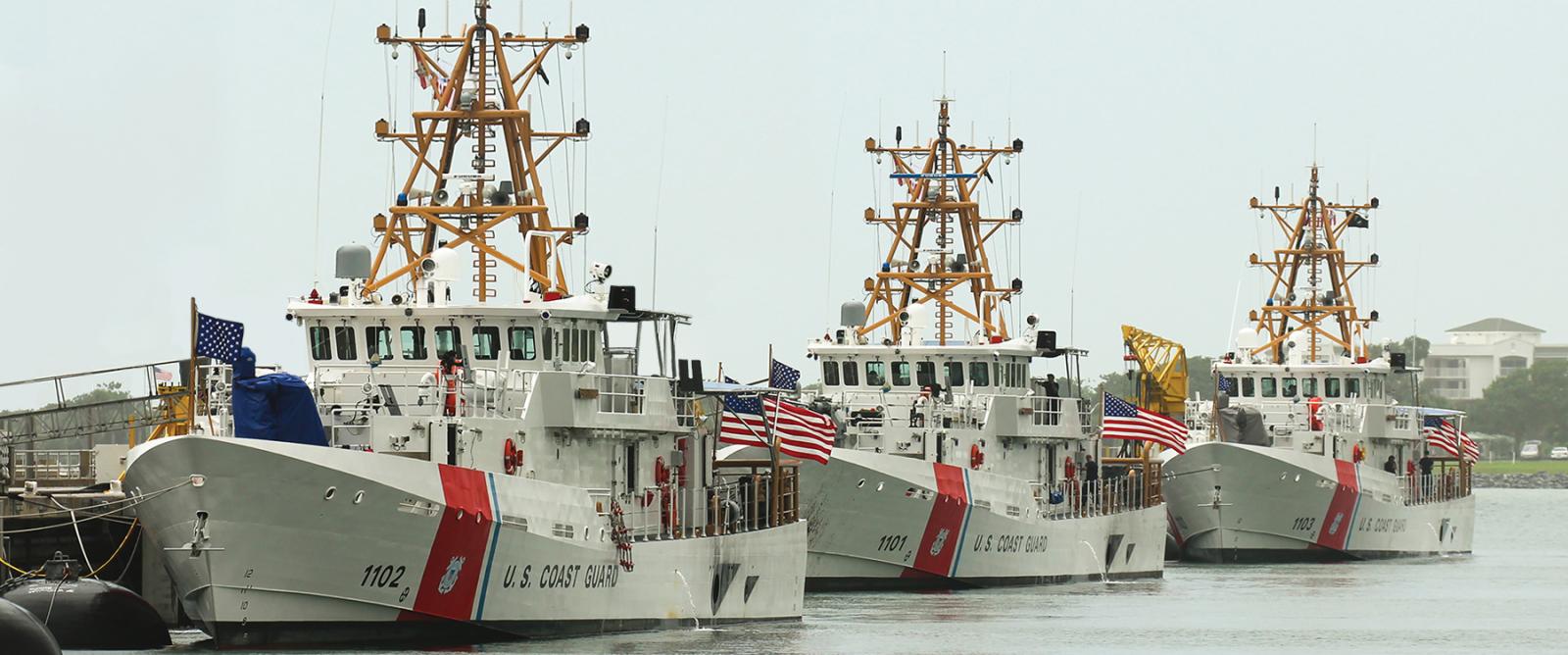
Three Articles About the Webber Class FRC

The first three fast response cutters—the USCGC Richard Etheridge (WPC-1102), Bernard C. Webber (WPC-1101), and William Flores (WPC-1103).
U.S. COAST GUARD

The September issue of US Naval Institute Proceedings has two articles about the Webber class WPCs that are currently featured articles online.

MSN shared a 1945 article by James Holmes, J. C. Wylie Chair of Maritime Strategy at the Naval War College, that seconds Cdr. Hulse proposal, “The U.S. Navy Needs Sentinel-Class Cutters to Serve as Missile Patrol Craft,

These are the right ships to help carry out U.S. maritime strategy in congested coastal terrain such as the Western Pacific, in wartime and times of tense peace alike. Denying an antagonist like China’s navy access to waters around and between Pacific islands is the strategy’s beating heart. Swarms of small, cheap, lethal surface and subsurface warships working with aircraft overhead and troops on the islands can close the straits along the first island chain, laying fields of overlapping fire that imprison Chinese sea and air forces within the island chain and bar the return home to units plying the Western Pacific. For self-defense, small surface combatants can mingle with merchant traffic amid East Asia’s cluttered maritime geography. In so doing they obscure their whereabouts and turn ambient conditions to tactical advantage. Let Chinese rocketeers try to distinguish friend from foe.

The first article by Lt. Chan suggests, 

Continuing production of fast response and national security cutters and transferring early hulls to regional allies would improve deterrence and interoperability.

This may not seem to make sense from the Coast Guard’s point of view in that USCGC Bernard C. Webber was commissioned in 2012 and the last of the 65 funded vessels of the class will be commissioned in about three years at which point the Webber will be only about 14 years old, still pretty new for a Coast Guard vessel. But looking at this from a whole of government perspective it looks a bit different. State Department hopes to gain or maintain influence with friendly nations that may not be able to afford adequate resources to patrol their waters. We also have an interest in the health of our ship building industry. There is presidency for this. Australia has twice built new patrol boats for their Western Pacific neighboring island nations. The Coast Guard would, of course, be much more receptive to the idea if funding for the replacement craft came out of someone else’s budget.

If the Navy did choose to build vessels of this class, and keep the production line going, then transfers of early model FRCs might be more readily accepted as they reach 20 or more years old.

The Second Article by Cdr. Hulse suggests,

“…the FRC’s Mk IV over-the-horizon cutter boat weighs 8,700 pounds and is stored in a notch near the stern. While this boat is highly capable for a variety of Coast Guard missions, it would not play a role for the Navy in conflict. Instead, a Navy FRC could mount a Naval Strike Missile box launcher with four tubes (8,600 pounds) at the stern, making it a formidable surface combatant. In addition, the deck forward of the pilothouse has considerable space for launching and recovering unmanned aerial vehicles (UAVs), enabling aerial surveillance and targeting. In fact, a Coast Guard FRC launched and recovered an Aerovel Flexrotor UAV while operating with the U.S. Navy’s Task Force 59 in Bahrain…with the current production line delivering four new FRCs per year to the Coast Guard at $65 million each. At that rate, the Navy could field 20 FRCs in just five years for the price of one Constellation-class frigate, which is projected to cost $1.3 billion per hull.”

The article goes into considerable detail about how the class has exceeded expectations along with cautions about what was required to make them succeed. It also suggests that the FRC could be the basis for an unmanned surface vessel.

Boots on the Ground, Navy Style:

City police forces have found they need patrolmen walking the beat who know the neighborhood and the people who live there to effectively fight crime. Armies need infantry to control and hold territory.

High end combatants can defeat their hostile counterparts to make sea control possible, but effective sea control is not possible without craft that can get into shallow water and enter every port. As Julian Corbett would said, Naval Control is not exercised by battleships.

The US Navy, forever focused on winning the big battle, has never had much enthusiasm for the craft that are the “boots on the ground” of a naval war. They tend to assume that allies and/or the Coast Guard will fill that role, or if not, they can build them when they need them and to some extent it has worked. Even so, it might have worked better if we had built and operated more of the vessels of the type before the shooting started.

In World War I, the US built hundreds of subchasers and 1000 ton destroyers. In WWII it was hundreds of PT boats that proved largely ineffective as torpedo boats but essential for the destruction of coastal traffic in both the Pacific and the Mediterranean. They were supplemented by the original LCS, Landing Craft Support, heavily armed shallow draft landing craft, nearly the same size as the FRCs. For Vietnam the Navy called on the Coast Guard and also built 170 Swift Boats and 718 Patrol Boat, River.

The U.S. Navy destroyer USS William D. Porter (DD-579) sinking after she was near-missed by a “Kamikaze” suicide aircraft off Okinawa, 10 June 1945. USS LCS(L)(3)-86 and McCool‘s LCS(L)(3)-122 are alongside, taking off her crew. Though not actually hit by the enemy plane, William D. Porter received fatal underwater damage from the near-by explosion.

Why would the Navy want these Patrol Craft?:

  • To enforce blockades
  • To counter kamikaze UAS and USV.
  • To support UAS, USV, and UUVs
  • To counter covert mine laying, arms smuggling, and intelligence agent or special forces transportation by boat.
  • To escort landing craft into an amphibious objective area. To rescue personnel from craft that are sunk. To tow disabled craft to safety. If properly equipped, to provide short range direct Naval fire support.

    Strait of Hormuz, august 6, USS Thomas Hudner, the Navy’s Lewis and Clark class cargo ship USNS Amelia Earhart and the U.S. Coast Guard’s Sentinel class cutter USCGC Charles Moulthrope, L3Harris Arabian Fox uncrewed surface vessel (USV)

If assigned to 5th Fleet, it would be logical to equip them with Hellfire/JASM or APKWS to counter Iranian drones and swarm tactics. In the Western Pacific arming with Naval Strike Missile is logical as would using the same air-search radars being used on the FRCs based in Bahrain. It might be possible to fit a Sea RAM forward, but if not, one or two remote weapon stations with an AAW capability might be enough.

A Final Note:

There is another reason we might want to have other nations to have FRCs. Since my cell phone has facial recognition, I think US Navy ships will have a hard time hiding among the traffic, particularly at the start of a conflict when their satellites are operational, and their fishing boats and merchant ships seem to be everywhere. But telling a USN FRC from a Vietnamese, Philippine, or Malaysian FRC would be quite difficult. It would complicate targeting.

“New office reduces the logistics burden for remote expeditions” –MyCG

ARABIAN GULF (Oct. 20, 2011) Logistics Specialist Seaman Krystal K. Weed inventories supplies in a storeroom aboard the aircraft carrier USS George H.W. Bush (CVN 77). George H.W. Bush was deployed to the U.S. 5th Fleet area of responsibility on its first operational deployment conducting maritime security operations and support missions as part of Operations Enduring Freedom and New Dawn. (U.S. Navy photo by Mass Communication Specialist Seaman Jessica Echerri/Released) 111020-N-JD217-003

Below is a story from MyCG.

This marks a significant change in Coast Guard operations. Not only are there now more distant operations. Operations “halfway around the world” are expected to continue and perhaps increase. Such operations are no longer one off or special. They are becoming routine.

Presumably this is based in Alameda because most of these new distant operations are expected to be in the Pacific, but it will also support Atlantic Area operations.


Aug. 30, 2023

New office reduces the logistics burden for remote expeditions

By Cmdr. Jeff Henderson, Deputy Office Chief, Office of Expeditionary Logistics (DOL-X)

Talk about logistics to any Coast Guard operator deployed to a remote region and they may share a common frustration – getting what they need, when they need it, and in the right location, can be difficult and all-consuming.

The Office of Expeditionary Logistics (DOL-X), the Coast Guard’s solution to relieve the remote logistics burden, celebrated reaching its full operational capability with a ribbon cutting ceremony Aug. 14 in Alameda, Calif.

“DOL-X represents our unwavering commitment to the development and execution of Coast Guard expeditionary logistics,” said Rear Adm. Carola List, Director of Operational Logistics (DOL), during the milestone ceremony.

Without question, expeditionary operations demand more from our existing mission support enterprise. The deputy commandant for Mission Support’s, Mission Support Action Plan, designed DOL-X to reduce logistical burdens for crews operating in remote environments and initial prototype tests have demonstrated real-time, measurable impacts. Expeditionary operations demand innovative solutions that extend operational reach while leveraging support from interagency and joint partners, coalition forces, and host nations. As DOL-X continues to mature, efforts will continue to ensure end-to-end synchronization and reliability and most importantly, lighten the load from the backs of our deployed shipmates.

Before becoming fully operational, DOL-X tested its capabilities with assigned DOL-X personnel providing dedicated logistical support for Coast Guard Cutter Mohawk’s deployment to U.S. Africa Command, two fast response cutters deployed to Patrol Forces Southwest Asia, and Coast Guard Cutter Midgett’s deployment to the Western Pacific. The downrange logisticians successfully integrated into the U.S. Navy’s Fifth, Sixth and Seventh fleets to act as in-theatre logistical integrators. In doing so, DOL-X created first-class partnerships at the fleet and task force level for logistics support.

These initial tests were so successful that DOL-X will now be supporting Coast Guard Cutter Stratton and Munro’s Western Pacific patrols. The former patrol included the completion of a historic Taiwan Strait transit and the first trilateral exercise between the Philippines, Japan, and the U.S. Both deployments were unique and dynamic opportunities to refine DOL-X’s in-theatre deployment support and further enhance interoperability with DoD and partner nations.

Resources:

“NPS Research on Coast Guard Icebreaker to Enhance Arctic Readiness” –Marine Link

During a seven-week Arctic transit aboard the U.S. Coast Guard icebreaker USCGC Healy (WAGB 20), Dr. Nita Shattuck from the Naval Postgraduate School (NPS) will study the impact of the extreme environment on crew performance and potential mitigations. Additional research includes assessment of an Amos01 3D printer installed by David Dausen from NPS’ Consortium for Advanced Manufacturing Research and Education (CAMRE), and specially instrumented to measure the impact of adverse Arctic sea conditions.

Marine Link reports the Naval Post Graduate School is doing some interesting studies on the working environment experienced by USCGC Healy’s crew.

To study the effects of these conditions on a ship’s crew at sea, Shattuck and her team will collect physiological data from the Healy’s crew members. Using innovative wearable technology, they will continuously monitor physiological processes such as sleep, heart rate, heart rate variability, respiration, oxygen saturation, and skin temperature. Study participants indicate that the rings are an improvement over wrist-worn wearables. The team will also use other sensors to monitor ambient light, noise levels, motion, and vibration aboard the ship.

The report also mentions that Healy will be going to Tromsø, Norway. How they get there will be interesting. Will they go the Northwest Passage through the Canadian EEZ or the Northern Sea Route through Russia’s EEZ?

“Southern Command: Russia disperses ships in fear of Ukrainian strikes” –Kyiv Independent

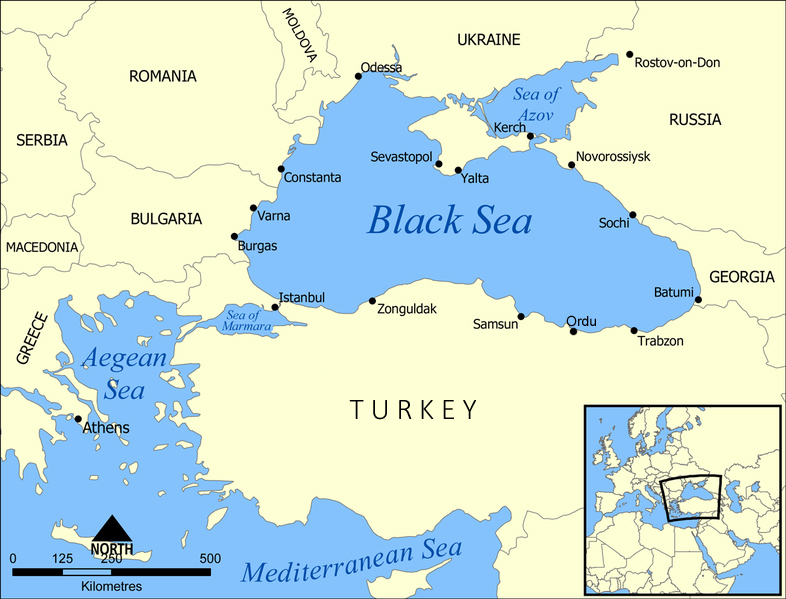
A map showing the location of the Black Sea and some of the large or prominent ports around it. The Sea of Azov and Sea of Marmara are also labelled. Created by User:NormanEinstein, Wikipedia

Kyiv Independent reports,

Russia has dispersed its naval forces in the Black Sea between the southeastern coast of Crimea and Novorossiysk in fear of Ukrainian surface drone strikes, Southern Command spokesperson Natalia Humeniuk said on Aug. 18.

Well, the US Navy is all a twitter about “Distributed Maritime Operations” (DMO) so is this a good idea for the Russian Black Sea Fleet? Like most such questions, it depends.

It depends on how good Ukrainian intelligence is. The supposed advantage for the Russian Fleet would be that their ships are harder to find, but is this case? Not only does Ukraine have access to some Western intelligence sources, but they seem to have good independent intelligence. All their successful USV attacks seem to have been against valid targets though there are many more potential targets that were not directly supporting the Russian military. When Russian ships are in port, the Ukrainians are going to know it.

Convoying has been a feature of Naval Warfare for over a thousand years because it is a defensive tactic that takes the choice of where and when to concentrate out of the hands of the offense. Spreading out the potential targets requires diluting the defense. That leaves the choice of where and when to concentrate effort in the hands of the Ukrainians.

To be successful, the defense has to detect all of the incoming USVs at a distance from their target and have sufficient numbers of countermeasures systems, in the right place, to engage all incoming USVs as they are detected.

The Ukrainian USVs don’t seem to be too hard to defeat once they are detected. Most of the successful countermeasures seem to have used machineguns, but you need one or more within effective range to engage every attacking USV.

The Ukrainians have told the world that no Russian Black Sea port is safe.

On August 4, Ukraine’s maritime authorities issued a “war risk area warning” to all international mariners headed for six Russian Black Sea ports, including Novorossiysk and the smaller oil-exporting terminals of Tuapse and Taman. The warning is scheduled to go into effect on August 23 and continue “until further notice” (Interfax-Ukraine, August 5). And on August 8, Zelenskyy’s economic adviser Oleh Ustenko told US media that “everything the Russians are moving back and forth on the Black Sea are our valid military targets,” including oil tankers or terminals.

When you multiply the number of points you have to defend, you divide your defensive force. USVs are cheap and readily produced. Ukraine will not have trouble finding targets. Ukraine will attempt to overwhelm the defenses by creating situations where even if the defense is taking out say four out of five or six out of seven attacking drones, the Russians still loose, even if it is only one ship at a time.

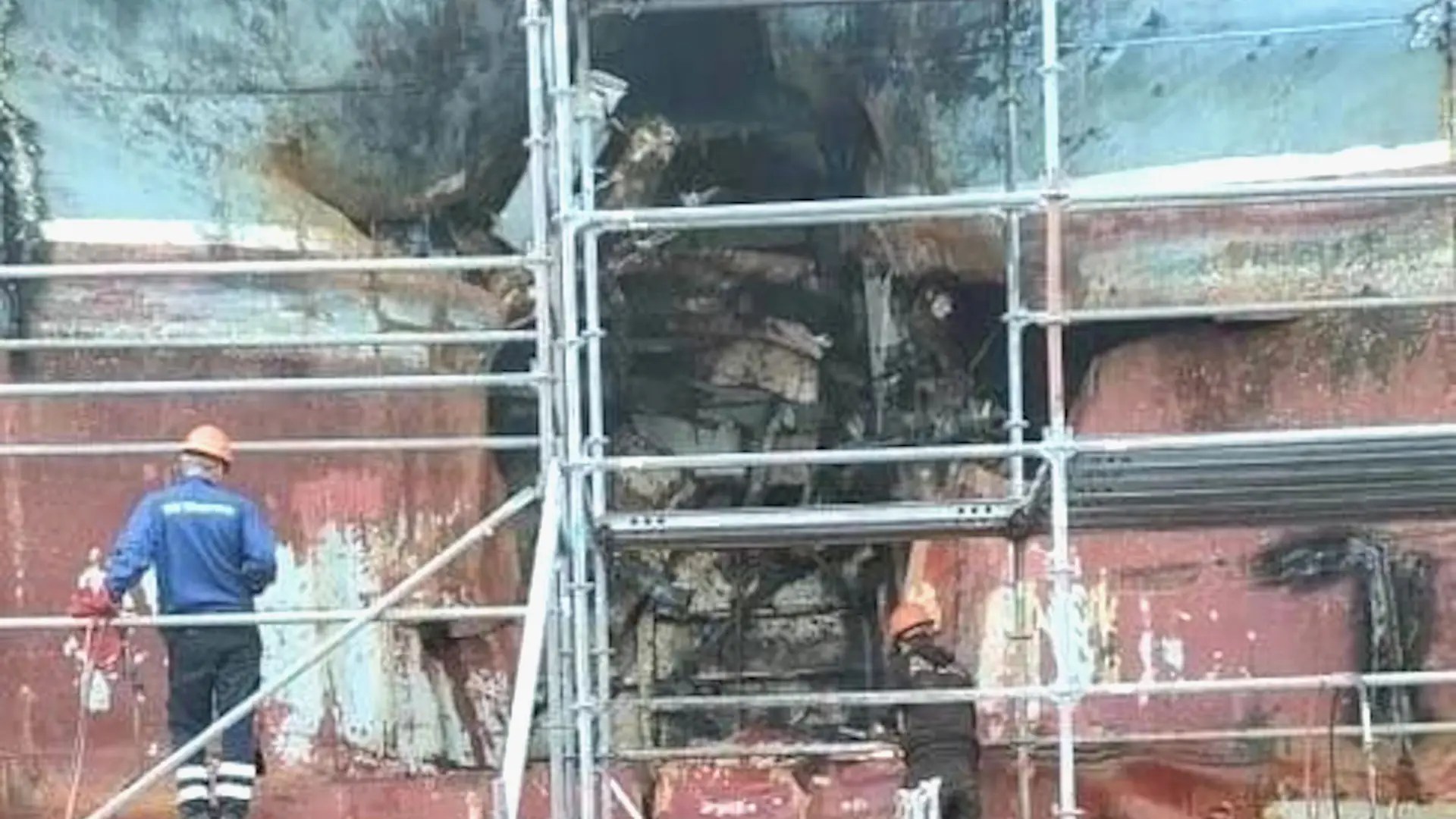
Damage Resulting from Ukrainian USV Attacks –The Drive

The Drive provides information showing the results of Ukrainian Unmanned Surface Vessel (USV) attacks on a small Russian tanker and a Russian Navy LST. Reportedly the USVs were equipped with 450 kg of explosives (about 1000 pounds). The explosions occurred essentially at the waterline. Had the explosions occurred well below the waterline, or particularly below the keel, the effect would have been greater. Even in the photo above, it appears the explosion cause more damage below the waterline than above. Had it been well above the waterline, the effect on the ship would probably have been less, but similar sized bomb or missile hits on the superstructure would likely have caused more personnel casualties.

Our First Look At Hole Blasted Into Russian Tanker By Ukrainian Drone Boat

“Drone Boat Leading Navy Ships In The Strait Of Hormuz A Sign Of Things To Come” –The Drive

Strait of Hormuz, August 6, USS Thomas Hudner (DDG-116), Lewis and Clark class cargo ship USNS Amelia Earhart (T-AKE-6) and USCGC Charles Moulthrope (WPC-1141) with L3Harris Arabian Fox uncrewed surface vessel (USV) in the foreground.

The Drive has a post discussing 5th Fleet/NAVCENT’s pioneering work with Unmanned surface systems (UAS) and the creation of Task Force 59.

Coast Guard Webber class patrol craft are prominent in the operation as they have been in previous UAS operations. I suspect this is because the WPCs are readily available to the 5th Fleet commander. Their size and maneuverability make them easier to operate in close proximity to the small UAS (and in the vicinity of Iranian Revolutionary Guard Corp (IRGC) small craft). They are heavily armed enough to prevent the IRGC from stealing the UAS. They have tried to do it in the past

Specs on the 13 foot L3 Harris Arabian Fox (40 knot maximum speed and 36 hour endurance) lend credibility to the long-range reported for Ukrainian Kamikaze UAS, up to 450 nautical miles (approximately 833 km).