More on the Navy’s New Design for Maintaining Maritime Superiority

Waesche Carat 2012

This is a post I wrote for CIMSEC. under the title “A Design for Maintaining Maritime Superiority”–A Coastie’s View.” It is an expanded version of an earlier post that appeared here. The rewrite really begins about half way down under the header, “What I Want to See.”

Recently the new Chief of Naval Operations issued a document “Design for Maintaining Maritime Superiority” that outlines how, hopefully, the US Navy can maintain a maritime superiority our foes will recognize and avoid confronting.

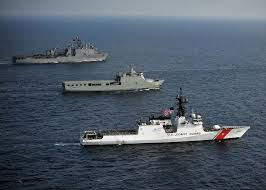
If you look for anything specifically regarding the Coast Guard here, you will not find it (other than the cutter in the formation on the cover). The Coast Guard is not mentioned even once, but it does talk about some things that are Coast Guard related. Perhaps the Coast Guard should not feel bad about this. It only mentions the Marine Corps once.

Three Forces that are Changing the Environment

  • The first global force is the traffic on the oceans, seas, and waterways, including the sea floor – the classic maritime system.
  • A second increasingly influential force is the rise of the global information system – the information that rides on the servers, undersea cables, satellites, and wireless networks that increasingly envelop and connect the globe.
  • The third interrelated force is the increasing rate of technological creation and adoption.

Obviously the Coast Guard facilitates and regulates marine traffic, and is tapped into the global information system. In wartime, these contacts will become essential since they will form the basis for naval control of shipping. He also talks about new trade routes opening in the Arctic. These will only be reliable if we have new icebreakers. He also talks about illegal trafficking.

“This maritime traffic also includes mass and uncontrolled migration and illicit shipment of material and people.”

A Document That Explicitly Recognizes the Competition

“For the first time in 25 years, the United States is facing a return to great power competition. Russia and China both have advanced their military capabilities to act as global powers. Their goals are backed by a growing arsenal of high-end warfighting capabilities, many of which are focused specifically on our vulnerabilities and are increasingly designed from the ground up to leverage the maritime, technological and information systems. They continue to develop and field information-enabled weapons, both kinetic and non-kinetic, with increasing range, precision and destructive capacity. Both China and Russia are also engaging in coercion and competition below the traditional thresholds of high-end conflict, but nonetheless exploit the weakness of accepted norms in space, cyber and the electromagnetic spectrum. The Russian Navy is operating with a frequency and in areas not seen for almost two decades, and the Chinese PLA(N) is extending its reach around the world.

“…Coupled with a continued dedication to furthering its nuclear weapons and missile programs, North Korea’s provocative actions continue to threaten security in North Asia and beyond.

“…while the recent international agreement with Iran is intended to curb its nuclear ambitions, Tehran’s advanced missiles, proxy forces and other conventional capabilities continue to pose threats to which the Navy must remain prepared to respond.

“…international terrorist groups have proven their resilience and adaptability and now pose a long-term threat to stability and security around the world.”

Recognizing Budgetary Limitations

“There is also a fourth ‘force’ that shapes our security environment. Barring an unforeseen change, even as we face new challenges and an increasing pace, the Defense and Navy budgets likely will continue to be under pressure. We will not be able to “buy” our way out of the challenges that we face. The budget environment will force tough choices but must also inspire new thinking.”

Throughout there is an emphasis on understanding history and the strategic concepts of the past. There is also a recognition of the need to work with partners.

“EXPAND AND STRENGTHEN OUR NETWORK OF PARTNERS: Deepen operational relationships with other services, agencies, industry, allies and partners – who operate with the Navy to support our shared interests.”

Other than the Marine Corps, the US Navy has no closer partner than the US Coast Guard. And while only about one eighth the size of the US Navy, in terms of personnel, the US Coast Guard is larger than Britain’s Royal Navy or the French Navy. The partnership has been a long and successful one, but I would like to see the Navy be a better partner to the Coast Guard. This is how the Navy can help the Coast Guard help the Navy.

What I Want to See

If we have a “run out of money, now we have to think” situation, one thing we can do is to try to get the maximum return from the relatively small investment needed to make the Coast Guard an effective naval reserve force.

WPC Kathleen_Moore

We need explicit support from the Navy at every level, particularly within Congress and the Administration, for Coast Guard recapitalization. While the Navy’s fleet averages approximately 14 years old. The Coast Guard’s major cutters average over 40. The proposed new ships, are more capable than those they replace. They are better able to work cooperatively with the Navy. The nine unit 4,500 ton “National Security Cutter”program is nearing completion with funds for the ninth ship in the FY2016 budget. The 58 unit, 154 foot, 353 ton Webber Class  program is well underway with 32 completed, building, or funded. But the Coast Guard is about to start its largest acquisition in history, 25 LCS sized Offshore Patrol Cutters. Unfortunately, it appears that while the first ship will be funded in FY2018 the last will not be completed until at least 2035. This program really needs to be accelerated.

We need an explicit statement from the Navy that they expect the Coast Guard to defend ports against unconventional threats, so that they can keep more forces forward deployed. This is in fact the current reality. The Sea Frontiers are long gone. Navy vessels no longer patrol the US coast. The surface Navy is concentrated in only a handful of ports. No Navy surface combatants are homeported on the East Coast north of the Chesapeake Bay. If a vessel suspected of being under the control of terrorists approaches the US coast the nearest Navy surface vessel may be hundreds of miles away.

We need the Navy to supply the weapons the Coast Guard need to defend ports against unconventional attack using vessels of any size, with a probability approaching 100%. These should include small missile systems like Hellfire or Griffin to stop small, fast, highly maneuverable threats and we need a ship stopper, probably a light weight anti-ship torpedoes that target propellers to stop larger threats. We need these systems on not just the largest cutters, in fact they are needed more by the the smaller cutters that are far more likely to be in a position to make a difference. These include the Webber class and perhaps even the smaller WPBs.

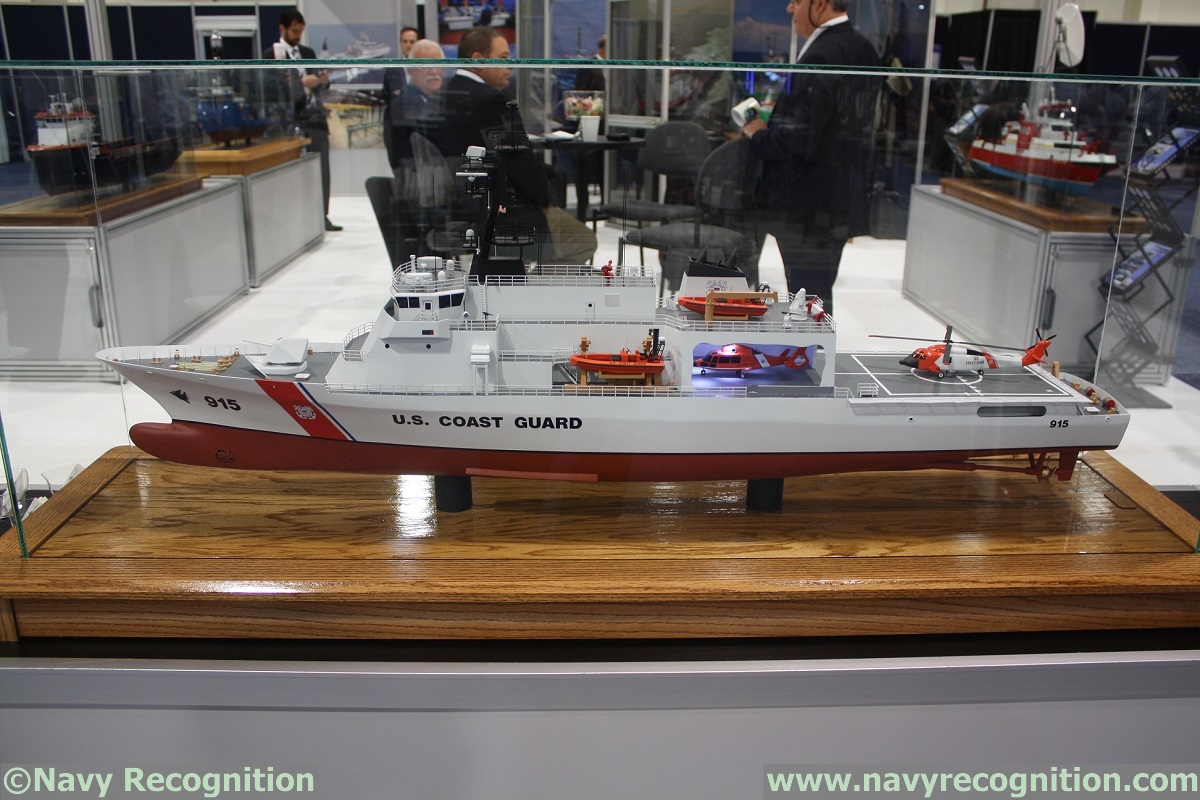
We need to reactivate the Coast Guard’s ASW program and ensure that all the new large cutters (National Security Cutters and Offshore Patrol Cutters) have an ASW capability, if not installed on all of the cutters, at least planned, prototyped, tested, and practiced on a few ships (particularly in the Pacific). The National Security Cutters and the Offshore Patrol Cutters are (or will be) capable of supporting MH-60R ASW helicopters. Adding a towed array likeCAPTAS-4 (the basis for the LCS ASW module) or CAPTAS-2 would give them a useful ASW capability that could be used to escort ARGs, fleet train, or high value cargo shipments. Towed arrays might even help catch semi-submersible drug runners in peacetime.
IMG_4128

The Coast Guard is the low end of America’s Naval high-low mix. It is a source of numbers when numbers are needed. The Coast Guard has more assets for low end functions like blockade than the Navy. The Navy has about 105 cruisers, destroyers, LCS, PCs, and is not expected to have more than 125 similar assets for the forseeable future. The Coast Guard has about 165 patrol cutters  including 75 patrol boats 87 feet long, about 50 patrol craft 110 to 154 feet in length (58 Webber class WPCs are planned), and about 40 ships 210 foot or larger that can be called on, just as they were during the Vietnam War, when the Coast Guard operated as many as 33 vessels off the coast in support of Operation MarketTime, in spite of the fact that the Navy had almost three times as many surface warships as they do now. The current program of record will provide 34 new generation cutters including nine 4500 ton National Security Cutters and 25 Offshore Patrol Cutters that should be at least 2500 tons.

The Coast Guard provides peacetime maritime security, but is currently under-armed even for this mission. A small investment could make it far more useful in wartime.

(Note there is another post on this looking at the “design” from a Navy point of view.)
Sensor Hosting Autonomous Remote Craft (SHARC)

These little Unmanned Surface Vehicles (USVs) may be one way to enhance our Maritime Domain Awareness. They have already traveled a million nautical miles.

NavyRecognition has the story.

I could see a line of these in the Eastern Pacific, used to detect drug smuggling semi-submersibles.

Perhaps we will also see them used to cue Anti-Submarine Warfare Continuous Trail Unmanned Vessels.(ACTUV) or maritime patrol aircraft to the presence of submarines. It might not be too expensive to provide a line of them covering an entire trans oceanic route.

There will almost certainly be a war time role for launching these or something similar. Maybe a role for our buoy tenders.

European Concern for Maritime Cargo Security

The Irish Times is reporting that Europe has not attempted to track cargoes like the US Coast Guard does. In the article it was not apparent that the author was even aware that the US Coast Guard has such a system.

There is currently no comprehensive system to track shipments and cargos through EU ports and along its approximately 70,000km of coastline – a deficiency that has long been exploited by organised criminals and which could increasingly prove irresistible to terrorists too, say European security officials.

Sounds like an opportunity for some international cooperation.

Document Alert: World Wide Threat Assessment of the US Intelligence Community, 2/9/16

We have a statement for the record (pdf) from James R. Clapper, Director of National Intelligence, dated February 9, 2016. Perhaps it is the nature of the beast, but there is no good news, and much that is bad.

Smuggling of every type appears to be on the rise including drugs and people. We can expect an increase in illegal immigration as a result of violence, poverty, and disorder in Latin America and particularly Cuba and Central America.

It is a relatively compact document. There are sections on Terrorism (pp 4-6), transnational organized crime (pp 11-12), Arctic (p 13), Environmental Risks and Climate Change (pp 13-14), health (including potential pandemics) (pp 14-15), and Global Displacement, “These 60 million consist of approximately 20 million refugees, 38 million internally displaced persons (IDPs), and approximately 2 million stateless persons, also according to UNHCR statistics.” (p.15)

There are also regional assessments including one on Latin America and the Caribbean (pp 28-29).

There is no regional assessment for the US. In terms of direct terrorist threats to the US, while there is a recognition of an aspiration on the part of various groups to attack the US, but the emphasis seems to be on “homegrown violent extremists” (HVEs) and there is nothing about the possibility of a maritime attack on the US. Is that because none exist?

Turkey’s OPC

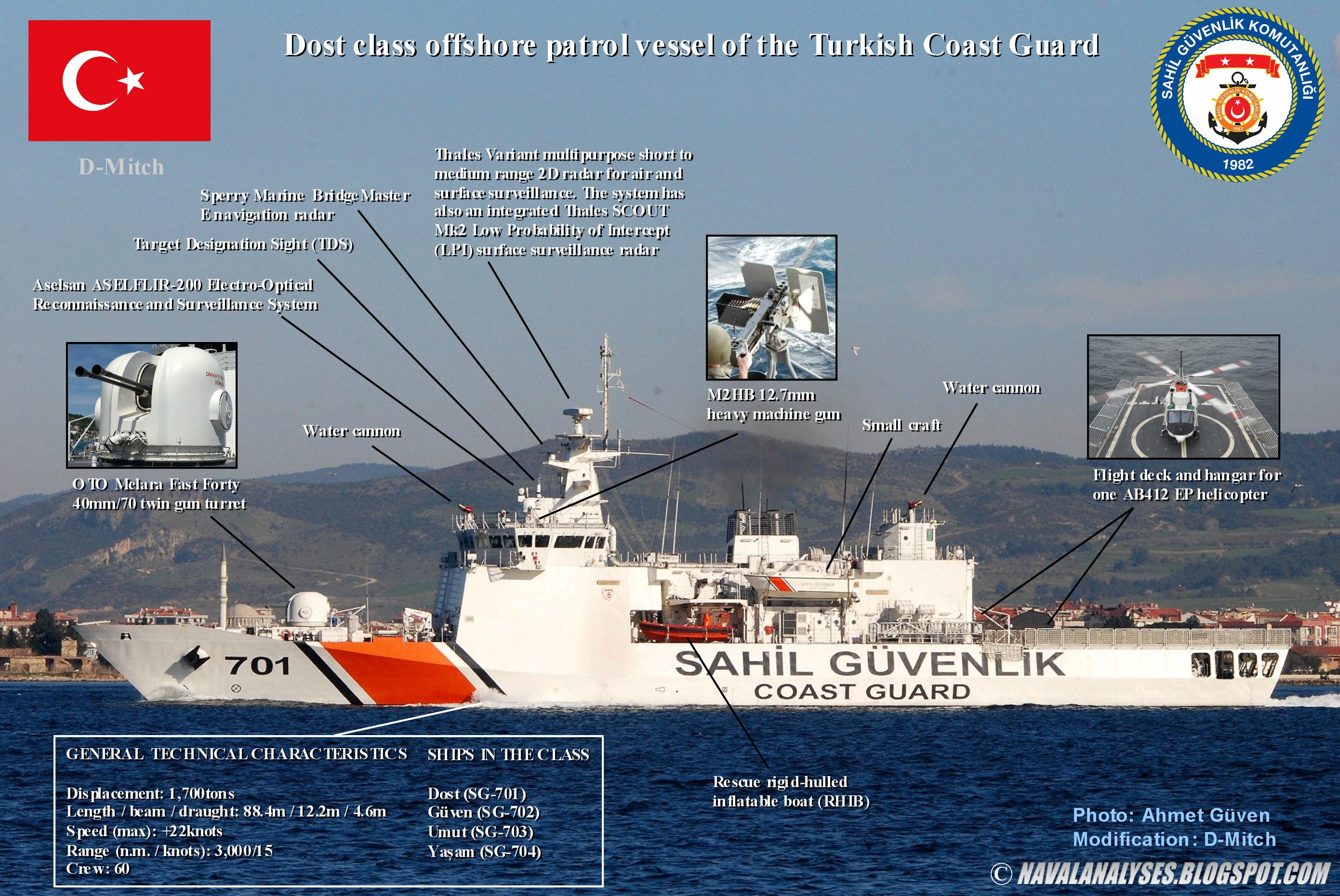
DOST class, Turkish CG

Photo: NavalAnalyses.Blogspot.Com. Click on the photo to enlarge

The German Navy Blog “Marine Forum,”

“5 January, Turkey, Acting on a tip-off / intelligence input, Turkish Coast Guard ships „Yasam“ and „Umut“ intercept Bolivian-flagged freighter „Joudi“ in international waters off Tobruk (Libya) … after receiving Bolivian government permission to board and search ship, boarding team finds 13 tonnes of cannabis.
“(rmks: first such action distant from Turkish waters; made feasible with induction of large DOST class patrol ships–emphasis applied–Chuck)”

So I looked up the class. The four ships of this class are the largest vessels in the Turkish Coast Guard. The next largest are only 210 tons. They are based on the Italian Sirio Class patrol vessels which operate under the Italian Navy but were paid for by the Transport and Navigation Ministry. I suspect the Sirio Class (appropriately modified) may have been the basis of the Marinette Marine’s OPC proposal.

Specs for the Turkish ships from my Combat Fleets of the World, 16th ed. with my translation to English units are:

  • Displacement: 1,700 tons (full load)
  • Overall Length: 88.4m (292 ft)
  • Length at Waterline: 80.3m (265 ft)
  • Beam: 12.2m (40.26 ft)
  • Draught: 4.6m (15.2 ft)
  • Speed: 22 knots
  • Power 4 MTU 16V, diesels, 2CP props, 14,120 BHP

The Gun: The Beda Bofors twin 40mm/70 gun is not a bad choice. It has been around for a while and it has improved over time. Current models are rated at 450 rounds per minute per barrel for 900 rounds per minute for the twin mount. That is faster than a .50 cal. M2 machine gun. The Italian Navy used this as a CIWS before switching to the improved 120 round per minute 76mm. It also has adequate range, 13,675 yards (12,500 m). This is less range than either a 57mm or 76mm, but adequate for most Coast Guard missions. There are at least four different projectiles available. The standard projectiles are about two pounds. There is also a high velocity solid tungsten alloy rod armour-piercing fin-stabilized discarding sabot (APFSDS) projectile that would probably be good for destroying fairly large diesel engines. .

If I read this correctly, the video is 380 rounds in 43 seconds.

Also from “Combat Fleets” this on the Turkish Coast Guard.

“Personnel: Approx. 2,200 total including 800 regulars and 1,400 conscripts, plus 1,050 on loan from the navy.

“Aviation: Coast Guard air assets include one Maule MX-7 light fixed-wing  and three CASA CN-235 maritime patrol aircraft (the basic airframe for the HC-144, Chuck). Three Austa-Bell AB-206B Helicopters and thirteen search and rescue configured Agusta-Bell 412 helicopters. The aircraft are pained white with an orange diagonal stripe.”

Navy PCs Support Operation Martillo, WPCs Next?

USS_Hurricane_(PC-3),_USS_Typhoon_(PC-5)_and_USS_Chinook_(PC-9)_underway_in_March_2015

Navy photo: The U.S. Navy Cyclone-class coastal patrol ships assigned to Patrol Coastal Squadron 1 (PCRON 1), USS Hurricane (PC-3), USS Chinook (PC-9) and USS Typhoon (PC-5), transit in formation during a divisional tactics exercise in the Persian Gulf.

The Navy has announced they have three 387 ton (fl) Cyclone class patrol craft based in Mayport, rotating through the 4th Fleet’s area in support of Operation Martillo, the counter drug operation off Central America.

We know there are not enough ships to respond to all the intelligence we have on drug trafficing in SouthCom’s area of responsibility.

These little ships are considerably smaller than those we normally send South, but they are very similar in size to the new 353 ton Webber class WPCs. We have six Webber class in Miami, six in Key West, and will soon have six in Puerto Rico. If we could rotate some of these through the Transit zones, they might make a difference.

Thanks to Lee for bringing this to my attention.


Venezuela Claims USCG Violates Their Air Space

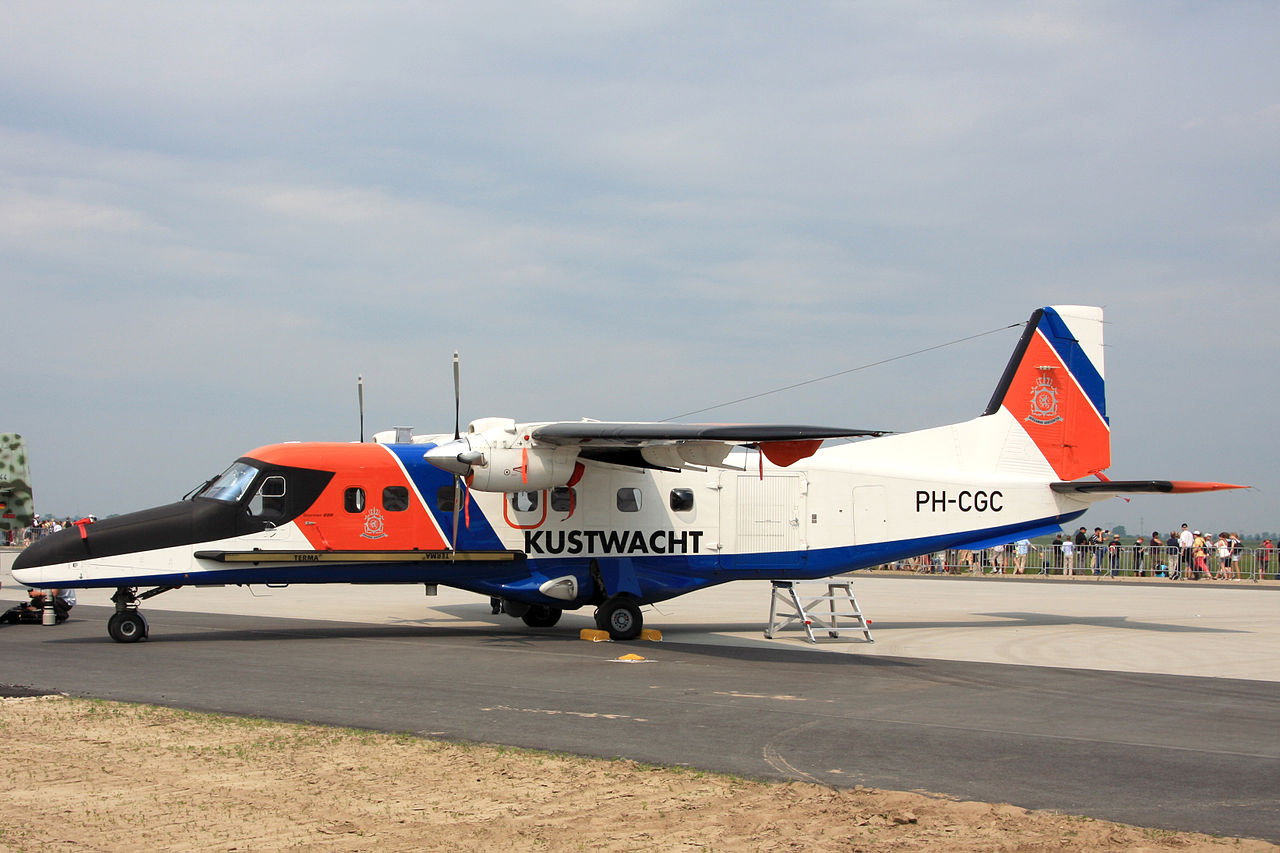
1280px-2010-06-11_Do228_Kustwacht_PH-CGC_EDDB_01

Photo: Do 228 of the Dutch Coast Guard at Berlin Schönefeld Airport. Photographer: “Wo st 01/Wikipedia”

We have a report that Venezuela is claiming a USCG aircraft violated their air space and further they suspect this may have had something to do with an upcoming election.

“Defense Minister Vladimir Padrino said Sunday the Dash-8 aircraft flew out of Curacao, a Dutch island not far off Venezuela’s Caribbean coast. He said that during a 30-minute period the plane twice entered Venezuelan airspace over the tiny archipelago of Los Monjes on Friday while performing what appeared to be a reconnaissance mission in the Gulf of Venezuela, which is also bounded by Colombia…he said the timing of the apparent maneuvers, as the country prepares for key legislative elections next month, was suspicious, recalling other U.S. military exercises that allegedly preceded a brief coup in 2002 against then President Hugo Chavez.”

Of course the USCG does not operate the Dash-8, but I suppose in the right circumstances an HC-144 might be mistaken for a Dash-8. The Dutch Caribbean Coast Guard which operates out of Curacao does operate Dash-8 aircraft, and they, like the USCG, make their aircraft with diagonal stripes as seen in the photo above.

This sort of misunderstanding is very unfortunate, because it impugns the motives of the Coast Guard. The USCG has worked effectively with Cuba, Russia, and China, and I am sure there are reasons to work with Venezuela as well, but this sort of thing gets in the way.

“Opinion: Coast Guard Budget Reductions Puts U.S. at Risk”–USNI

The US Naval Institute has a nice opinion piece by a retired Navy Rear Admiral, advocating restoration of funding cut from the Coast Guard budget over the last few years, and not incidentally greater number of National Security Cutters (NSC) to replace the High Endurance Cutters.

This is not the Admiral’s first editorial advocating for the Coast Guard. Whatever his affiliation, his opinions are on point, and I would really like to see the Congress add a ninth NSC to the budget

Long Range Interceptor In Action

I would not normally talk about a routine law enforcement action, but this video has some interesting aspects.

Stratton recently intercepted a second semi-submersible, that had been spotted by a Navy patrol aircraft, arresting its four crewmembers and recovering 12,000 pounds of its 16,000 pound cargo of Cocaine, before the semi-submersible sank under tow.

What I wanted to point out in the video was:

First, the instrumentation on the 35 foot Long Range Interceptor ship’s boat (time 1:12). (Correction–I made and error here, this is actually the instrumentation on a 26 foot “Over-the-Horizon (OTH) IV” of which the Coast Guard has procured 101.) It looks a lot like the “glass cockpit” of a modern light plane. Long Range Interceptors are only deployed by the Bertholf class National Security Cutters. (The OTH-IV is operated from the NSCs, WHECs, WMECs, and WPCs. Anyone know if they are also operated from WAGBs and WLBs?)

Second, was the way the boat was recovered in the stern ramp of Stratton (2:25 to 3:00). Note there is no one in the bow to attach the line that will pull the boat up onto the ramp. In 2013 we had a fatality on the Waesche because the automatic capture mechanism was not working properly and Petty Officer Travis Obendorf was on the bow of the boat. You can access the accident report here.