Some how I missed this when it came out. Lots of topics covered.
Thanks to Luke for bringing this to my attention.

Some how I missed this when it came out. Lots of topics covered.
Thanks to Luke for bringing this to my attention.
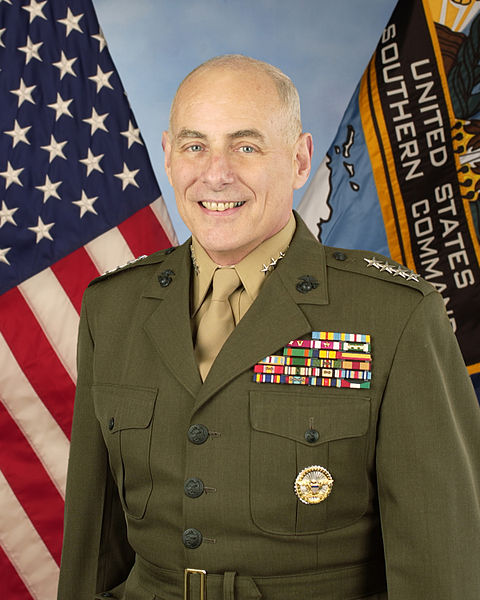
John Francis Kelly (born May 11, 1950, pictured here in 2012) is a retired United States Marine Corps general and the former commander of United States Southern Command.
The New York Times has reported that President-Elect Trump has chosen retired Marine General and former SOUTHCOM commander John Kelly to head the Department of Homeland Security.
General Kelly served as SOUTHCOM November 19, 2012 – January 16, 2016. That experience should make him extremely familiar with the Coast Guard. He has supported the Coast Guard in the past, and here.
As I understand it, he will need to have a waiver from the Senate to serve because he retired less than seven years ago, but it appears he will have broad bi-partisan support having received the endorsement of President Obama’s former Defense Secretary Leon Panetta.
l
Many of us have wondered about the apparent duplication of effort by the Coast Guard and Customs and Border Protection’s (CBP) Air and Marine Operations (AMO). Apparently the The U.S. House of Representatives, Committee on Homeland Security, Subcommittee on Border and Maritime Security had the same concern and asked for an audit by the Department of Homeland Security (DHS) Office of the Inspector General (OIG). This resulted in a report, “AMO and Coast Guard Maritime Missions Are Not Duplicative, But Could Improve with Better Coordination (pdf).”
Guess there is no suspense in what their findings were, but I find the methodology and conclusions less than complete and satisfying.
The recommendations of the audit were:
Recommendation #1: We recommend that the DHS Under Secretary for Management reestablish an oversight mechanism at the DHS level to ensure that AMO and the Coast Guard coordinate operations.
Recommendation #2: We recommend that the Coast Guard Commandant, CBP Commissioner, and U.S. Immigration and Customs Enforcement Director revise the Maritime Operations Coordination Plan to include requirements for coordination and information sharing at all levels, especially the local level.
So the response was equally predictable–form a committee.
I’m sorry, but my BS meter is off the scale. The alarm went off first, when they consistently called the territorial sea, “customs waters” lending a presumption that this is a Customs job.
While their conclusion may ultimately prove correct, they essentially failed to look at the most significant area of overlap–Maritime Patrol Aircraft. The audit concentrated exclusively on drug enforcement and failed to consider Alien Migrant Interdiction Operations (AMIO). And they failed to answer the most basic questions.
While coordination is always assumed to be a “good thing,” the only real reason you should want two agencies performing the same function would indicate less coordination, not more.
There is no doubt AMO does useful work, that is not the point. The question is, what is the most effective and economical way to distribute resources. Should DHS be working toward a different distribution of tasking and resources?
Unanswered questions:
Why does Customs need boats? The Revenue Cutter Service was Customs’ boat service. Why doesn’t the Coast Guard still fulfill that function? The Coast Guard operates boats. Boats are on standby with crews at the ready. When Customs needs a boat, why don’t they ride Coast Guard boats? What is the cost of an operating hour for comparable Coast Guard and Customs boats?
AMO does need aircraft to do several tasks, including interdiction of smuggling by air, but why does Customs need to have a fleet of maritime patrol aircraft for interdiction of surface vessels, when the Coast Guard also has to provide a similar fleet for a whole range of missions? The AMO operates a fleet of 14 P-3s including both Airborne Early Warning models and P-3 Long Range Trackers. They are over 40 years old and undergoing an extensive and expensive life extension program. AMO also operates Bombardier DHC-8, and Beach King Air 350ER equipped with marine search radars. What is the cost of an operating hour for comparable Coast Guard and Customs aircraft?
AMO regularly performs air interdiction. Perhaps they should be the ones doing the low speed air interdiction over DC.
Other missions:
In addition to drug enforcement, the two agencies seem to have overlapping missions in Alien Migrant Interdiction Operations (AMIO) and counter terrorism. Why weren’t these missions looked at as well?
AMO boats are suitable only for very short ranged AMIO missions while Coast Guard vessels a suitable for interception long before the approach the US coast.
It appears that AMO assets are limited to small arms. If the terrorist threat is anything much larger than a small boat, they are unlikely to be effective in countering it without assistance.
What about Jurisdiction?
AMO operates primarily within the customs waters, but it maintains the authority to pursue vessels fleeing the customs waters or hovering outside those waters as a means of avoiding AMO jurisdiction.
The Coast Guard is not similarly limited in the Marine environment. The effects of this on agency effectiveness was not considered.
Maybe AMO’s jurisdiction should be extended to cover the entire EEZ, but that is not the case now and AMO’s boats don’t seem suited for operations much beyond 12 miles. They are generally very fast, but probably short legged with minimal protection for the crew from the elements.
The characteristics of their boats don’t seem to square with the very long range character of their aircraft like the P-3s.
Why overlapping responsibility might be a good idea–coordination be damned:
There is one reason you might want two agencies responsible for the same law enforcement mission. That would be if you worry about the possibility that one of the agencies might be compromised. For instance if one agency is somehow compromised by a criminal organization. The law enforcement agency might still appear successful. The criminal organization might use the agency to eliminate its competitors, providing intelligence. A second independent agency might uncover this corruption.
Use of Force:
There is an interesting section comparing the two agencies’ use of force policies.
Approval for Employing Use of Force
Coast Guard crews must receive approval from the appropriate official in the chain of command, typically an Admiral, before using force to stop noncompliant vessels. According to the Coast Guard, the approval time can take from 10 minutes to several hours depending on the case. In contrast, AMO policy reflects a more traditional law enforcement approach and allows its agents to make use of force decisions.
According to the Coast Guard, it needs a use of force policy to cover a vast range of mission sets across a legally and jurisdictionally complex operating environment. Although the approval process has some level of risk mitigation, the Coast Guard designed the process to relieve on-scene officers of the need to access U.S. jurisdiction and legal authority to employ force against a noncompliant vessel, and allows those officers to focus on executing the tactics and procedures to safely and effectively employ that force.
We participated in use of force demonstrations for noncompliant vessels with both components and experienced the delay in the Coast Guard’s approval process. Although there are potential safety concerns for Coast Guard boat crews during a pursuit, the Coast Guard stated that it updated its law enforcement manual to “refine and streamline the process in every way possible” to reduce the time lapse from when the Coast Guard vessel is “overt” (known by the suspected vessel to be following) to when the necessary actions (use of force) are completed.
Hopefully if a Coast Guard CO sees a terrorist attack underway, he will have the flexibility to act on the knowledge, even if there is no time to get approval.
Using Statistics that do not correlate:
As noted, the report only looked at drug enforcement and only at a small part of the mission. Quoting from the report,
“There are 206 combined locations where AMO and the Coast Guard conduct operations in customs waters. Of the 206, there are 17 locations (8 percent) where AMO and the Coast Guard have similar capabilities and an overlapping area of responsibility.”
” In FY 2015, at the 17 overlapping locations, all of AMO’s drug seizures occurred on land or in customs waters, where marine units primarily conduct operations.”
“The Coast Guard is a multi-mission agency, including law enforcement that operates in both customs and international waters. In contrast to AMO, Coast Guard personnel assigned to drug and migrant interdiction do not conduct investigative or land operations. In FY 2015, 93 percent of Coast Guard drug seizures occurred in international waters (Transit Zone) (emphasis applied–Chuck). AMO only deploys aircraft in this area; it does not have the vessels to operate in these waters.”
“In the overlapping locations, 84 percent of reported drug seizures were from AMO operations. These seizures occurred, in part, because of the different activities of each agency. For example, while some of AMO operations were intelligence based, the Coast Guard conducts routine patrols looking for illegal activity. Although Coast Guard patrols are not as effective as intelligence-based operations, they show a presence and can deter illegal activity.” (Emphasis applied–Chuck)
First note that this compares Customs’ seizures both on land and on the water with the seizures of the Coast Guard, a multimission agency, on the water alone. This also seems to imply that Customs was not sharing their intelligence with the Coast Guard.
FY 2015 Drug Seizures from the 17 Overlapping Locations Agency Customs Waters (Drugs in Pounds) AMO 28,707 (land and water) (84%) Coast Guard 5,602 (16%) Total 34,309.
I doubt the Coast Guard units they looked at drug interdiction as their primary mission. Certainly the AMO units did.
Why the difference in statistics?:
According to Coast Guard statistics, Coast Guard drug seizures in FY2015 were 319,229.4 lbs of Cocaine and 78,262 lbs of Marijuana. Appendix C indicates that the Coast Guard had seized 199,749 lbs of Cocaine and 57,855 lbs of Marijuana. (Why the large difference in these figures?)
Figures reported for AMO in Appendix C were 243,387 lb of cocaine and 719,180 lb of Marijuana.
Pounds of drugs is not a very informative metric, if various types of drugs are aggravated. It also says nothing about its purity. After being cut there is less drugs in a pound of drugs.
Over the past five years, according to Coast Guard statistics, Coast Guard cutters, Allied ships and U.S. Navy ships with Coast Guard boarding teams, in the transit zone, removed more than 500 metric tons of cocaine—a wholesale value of nearly $17 billion. According to the Coast Guard, “this is approximately three times the amount of cocaine, at twice the purity, seized by all other U.S. federal, state and local and tribal law enforcement agencies combined over the same time span.”
The figures above don’t seem to square.
Costs:
Looking at this, I found a cost comparison of what the two agencies spend for their personnel interesting. The total AMO budget for FY2015 was $750M supporting 1,665 members, while the CG budget of $8,380M supported 41,700. Budget/Personnel equals $450,450 per AMO member and $200,959 per CG member. There are probably lots of reasons AMO cost more than twice as much per member, but it might have been worth some examination.
Conclusion:
Bottom line, this report failed to answer the question, “Why do both the Coast Guard and Customs have both boats and maritime patrol aircraft?”
What we got was a distorted comparison of the relative success of the Coast Guard and Customs drug interdiction efforts.
These distortions can have consequences and should not be allowed to pass unchallenged. I can understand the Coast Guard not wanting to offend people in the IG office, but I have no such problem, and neither should the subcommittee that requested the audit.
Thanks to Brymar consulting’s web site for alerting me to this.

Photo: U.S. Air Force E-3 Sentry AWACS, an RC-135, and KC-135s sit at the CURACAO/ARUBA Cooperative Security Location. Photo via SOUTHCOM.
While the Navy may be providing less support for the Drug War, since all the Frigates have been decommissioned, DODBUZZ reports increased participation by the Air Force. Seems they see detecting and chasing Drug Smugglers as a training opportunity, with a side benefit.
“The large-scale air operation in the Caribbean included a number of U.S. aircraft, including HC-130s, DH-8s, B-1Bs, B-52s, AWACS, JSTARS, Global Hawks, KC-135s and KC-10s, James said. Space and cyber assets “were also brought into the mix,” she said, but didn’t elaborate.”
Somthing I would have loved to have seen:
“In March, a B-1B Lancer flew a low pass over a drug smuggling boat in the Caribbean Sea, prompting those onboard to dump 500 kilos of cocaine into the deep blue.”
The Eleventh District has provided a news release which I will quote in full.
A crewmember of a vessel suspected of illicit trafficking activity in the Eastern Pacific Ocean died Tuesday night during the U.S. Coast Guard’s pursuit and interdiction of the boat some 200 miles off the west coast of Isla de Coco, Costa Rica. The exact cause of death is not known and is under investigation.
A U.S. Coast Guard helicopter, operating from a Coast Guard cutter patrolling the area, pursued the suspicious vessel. The helicopter signaled the vessel to stop but it failed to do so. Pursuant to Coast Guard procedures, a precision marksman aboard the helicopter then fired warning shots in front of the vessel, which were ignored by the vessel’s crew. The marksman then fired rounds into the vessel’s outboard engines, disabling the vessel and bringing the pursuit to a halt.
Once the suspect vessel stopped, a Coast Guard law enforcement team from the cutter boarded the vessel and discovered an injured suspect, who later died.
“Our efforts to stem the flow of illegal drugs are inherently dangerous. We go to extraordinary lengths to minimize the chance of injury during these operations,” said Rear Adm. Todd Sokalzuk, Commander of the 11th Coast Guard District. “It is regrettable that in this case the crewmembers did not heed multiple orders and warnings to stop their vessel, causing us to employ tactics necessary to disable their engines. Unfortunately, one of the crewmembers was fatally injured during this interdiction,” he said.
An investigation is underway to review the details of Tuesday’s interdiction and determine what caused the suspected smuggler’s fatal injuries.
In 2015, a record 109 metric tons of cocaine and 316 suspects were interdicted in the Eastern Pacific by the U.S. Coast Guard and partner agencies. In fiscal year 2016, the record pace of interdictions continues, with over 132 tons seized, and 410 suspects taken into custody.

HMNZS Wellington intercepts suspected toothfish poachers
CIMSEC “Midrats” blog radio show has an online interview with a State Department employee I was lucky enough to meet earlier, Scott Cheney-Peters, LCDR, USNR about international fisheries issues. You can find it here. Nominally it is an hour, but it took me a little longer than that because download was not seamless.
The discussion also touches on international networking/cooperation/enforcement, maritime domain awareness, human traffic, drug enforcement, and the ship rider program.
The US Naval Institute News Service has produced a short video on the drug war featuring the Stratton and her CO.
The video shows huge quantities of Cocaine on the flight deck of presumably Stratton. A viewer might assume the entire quantity was taken when Stratton successfully interdicted a self propelled semi-submersible with 7,000 kilos. Actually the deck cargo seen in the film is 30,000 kilos with includes not only Stratton’s haul but that of several other seizures.. These included other Coast Guard seizures and operations by other US agencies and international allies.

Procurement of 14 C-27J aircraft was one of the achievements sited. C-27Js replace C-130s at CGAS Sacramento.
The Commandant has issued a mid-term update on his earlier published “Strategic Intent, 2015-2019” (pdf). The new document is available in pdf format. You can find it here: “United States Coast Guard Commandant’s Strategic Intent, 2015-2019, Mid-Term Report.”
It is relatively short and readable at 21 pages. The recurring themes of the Commandant’s administration are all there, starting with TOC (transnational organized crime) and its deleterious effect on Western Hemisphere governance and prosperity. It does read a little like an Officer Evaluation Report input.
There is nothing particularly surprising here, but even for me, the enumeration of the scope the Coast Guard’s authorities, responsibilities, and international contacts is still mind boggling.
I am not going to try to summarize the report, but there were a few things that struck me.
The Commandant mentions service life extension programs for the seagoing buoy tenders (already begun), the 47 foot MLBs, and the 87 foot WPBs (in the future), but there is no mention of what we will do about the inland tender fleet. There will also be a life extension program for helicopters before they are finally replaced.
“Extend the service life of our rotary wing assets and align with DOD’s Future Vertical Lift initiative.”
There is mention of a program I was not aware of, the “Defense Threat Reduction Agency National Coast Watch System project.” The Defense Threat Reduction Agency attempts to track and reduce the WMD threat. It is not really clear what our role is here. We know about the container inspection programs in foreign ports. Is that it, or is there more to this? (that can be discussed at an unclassified level.)
Once again, the Congressional Research Service’s Ronald O’Rourke has revised his “Coast Guard Cutter Procurement: Background and Issues for Congress” with the new edition issued April 15. This has got to be a hot topic because previous revisions were issued March 22, January 27, and December 14, 2015. That is four revisions in four months, on average every six weeks, but the latest is only 24 days after the previous edition. I have begun to sense, we may have turned a corner. The tone of the reports has changed over these four months, from, how long will it take us to reach the “Program of Record” (POR), to consideration of, if we should perhaps go beyond the POR.
The NSC, OPC, and FRC programs pose several issues for Congress, including the following:
“whether to fund the acquisition of a 10th NSC in FY2017;
“whether to fund the acquisition of four FRCs in FY2017, as requested, or some other number, such as six, which was the number projected for FY2017 under the Coast Guard’s FY2016 budget submission;
“whether to use annual or multiyear contracting for procuring FRCs;
“whether to use annual or multiyear contracting for procuring OPCs;
“planned procurement quantities for NSCs, OPCS, and FRCs;
“the cost, design, and acquisition strategy for the OPC;
“initial testing of the NSC; and
“rotational crewing of the NSC.”
The latest revision includes three substantial Appendices:
Appendix C is entirely new and appears to have been the reason for the revision.
Appendix A (p. 17-22) is a fairly detailed discussion of the results of the Fleet Mix Study and asks why we so seldom hear that the program of record is not enough to assure the Coast Guard to successfully accomplish its assigned missions.
The Fleet Mix Study was made public in 2012 long after its completion in 2009. It is due for a reexamination and the Commandant has said another will be done. When that happens, we seriously need to look at more than just more of the same assets. We need to look at additional technology, equipment, and weapons that might allow us to accomplish these missions without a major increase in personnel.
Looking at “Table A-3. Force Mixes and Mission Performance Gaps” (document page 18) I would note that if we get to Fleet Mix Analysis Phase 1 (FMA-1, an increase over the POR including 9 Bertholf class NSCs, 32 OPCs and 63 Webber Class FRCs, for a total of 104 vessels), we will have addressed all the “Very High Risk Gaps” found in the Fleet Mix Study that included SAR capability, “Defense Readiness Capacity,” and “Counter Drug capacity.” What will remain are “High” or lower risks in Ports, Waterways, and Coastal Security (PWCS) and Living Marine Resources (LMR), and a low to very low risk to the Alien Migrant Interdiction Operations (AMIO) mission. This total of more than 40 NSCs and OPCs certainly should not be out of the question, after all the Coast Guard has included over 40 ships larger than a thousand tons for the last several decades.
Still, I would note that, no matter how many ships we have, the Ports, Waterways, and Coastal Security (PWCS) mission will always be at risk, unless weapons are available to quickly and reliably stop terrorists’ exploitation of a larger merchant vessel to make an attack. Guns alone are simply not up to the task. I have identified two weapons that might address this threat, (1) equipping our WPCs and possibly WPBs with light weight torpedoes that target a ships propellers or (2) equipping our larger ships with the Long Range Anti-Ship Missile (LRASM) which might allow our larger cutter to effectively support our smaller cutters and respond to an attack, even if the large cutter 200 miles from the targeted port. Either would also make our ships much more capable of making a meaningful contribution to Defense Readiness.
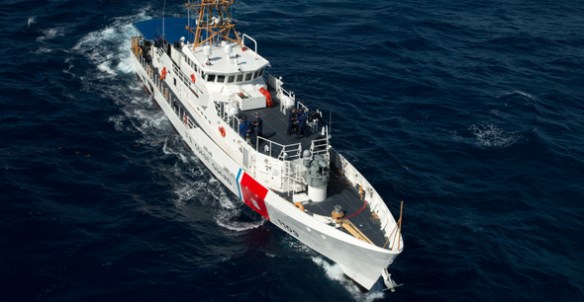
SouthCom, actually two SouthComs in a row, and the Commandant have noted that while they have excellent intelligence on drug smugglers in the transit zone, they simply do not have adequate numbers of vessels to respond. (Here, here, and here) There were never enough, but after decommissioning the Perry class frigates, the Navy’s contribution appears to have declined significantly. The Coast Guard seems to have upped their game, possibly more than making up for the Navy’s absence, but still–not enough ships.
There may be a way at least partially address this problem.
We now have 16 Webber class WPCs in three homeports in the Seventh District, six in Miami, six in Key West, and four, soon to be six, in Puerto Rico. These may be “Fast Response Cutters,” but clearly they are not all sitting in homeport waiting for SAR cases. These are law enforcement assets and they are meant to patrol. Could we perhaps, maintain as many as four in the Eastern Pacific by rotating cutters from the 7th District to fill this role in the transit zone? Obviously, it is not impossible, since the Navy is sending their similar sized Cyclone class PCs to the Eastern Pacific, but what would it take to make it work well?
Obviously they would need additional fuel and supplies while deployed. There is a good chance between Colombia, Panama, and Costa Rica, we could find a port willing to host these little white ships.
Aside from “beans and black oil” they might also need some administrative, maintenance, or medical support.
The Navy might make itself useful here by providing a simple MSC manned support vessel that could be as basic as an Offshore Support Vessel loaded with containerized offices and logistical support to provide support that the port cannot. The Navy has already chartered a number of ships of this type and could charter another.
We could start this small. First study the results of the Navy’s Cyclone class deployment. Then send a single ship from say Miami, a month later we get a second ship from Key West. Let them figure out what they need and how the problems they will inevitably encounter can be solved.
Because they cannot embark a helicopter, they will need a complementary fixed wing support, but this is already being done at least to some extent.
Once we get to a total of 18 Webber class in these three home ports, we could keep four ships assigned to SouthCom by sending two ships each month and rotating them back after two months. Seventh district would still four ships assigned to each home port, which would mean that even if two are down for maintenance they would still have two for SAR and local law enforcement.

