Hearing: Coast Guard Requirements, Priorities, and Future Acquisition Plans (FY-2018)


May 18, the Commandant, Admiral Paul F. Zukunft, addressed the House Appropriations Homeland Security Subcommittee. The recorded testimony is above. It is fairly long (1h40m). The Commandant’s initial statement, following the introductions, begins at 8m40s and ends approximately minute 14.

The administration’s FY 2018 budget request was not available, but the Commandant was there to discuss future priorities, requirements, and programs. The Department Secretary, General Kelly, is expected to address the Subcommittee on May 24 at 3PM Eastern.

I will just mention a few of the items I thought significant.

Admiral Zukunft noted that Huntington Ingalls has begun cutting steel for NSC #9. Questioned about NSC#10, he said, if it were funded, the Coast Guard would of course use it, but that the Offshore Patrol Cutter (OPC) is the Coast Guard’s #1 priority. His response, that another NSC would have an effect on long-range operating cost, seemed to suggest anticipated significantly lower operating costs for the OPC. Significantly, there has been no mention of reducing the OPC program by one ship to offset the addition of NSC #9. (There is already a strong push to build more NSCs, a bill to authorized a multi-year buy of three more.)

He contended that the Coast Guard has taken a harder hit, due to budget restrictions, than other armed services and would need 5% annual growth and at least $2B annually for Acquisitions, Construction, and Improvements (AC&I). Later he stated that this annual AC&I appropriation would included about $300M annually for shore facilities. He pointed to a need to restore 1100 Reserve Billets and add 5,000 active duty military billets while retaining current levels of Civilian staff.

Apparently the FY2918 budget will begin a program to replace 35 Inland tenders at an estimated cost of approximately $25M each ($875M total). (Even if, in the unlikely event, this program were funded in only five years, that would only average $175M/year, so it is not a big program, but one that should have begun at least a decade ago.)

Cyber security for ports was discussed. The Commandant sees the Coast Guard role as decimating best practices, rather than imposing regulation. We now have a cyber program of record–still very small, two CG Academy graduates going directly into the program. The fact that two billets is worth mentioning, is probably the best indication of how really small the program is. A much smaller pre-World War II Coast Guard probably had more people working on breaking German and Japanese codes. 

Marine Inspection was addressed. The Commandant noted the increased demand for Inspections because 6,000 tugs have been added to inspection program. He noted a need for more stringent oversight of 3rd party inspectors, who in some cases have not been as meticulous as they should have been. He also noted that the US flag merchant fleet, notably the MSC’s Afloat Prepositioning Fleet, will need replacement, which will also raise demand for marine inspectors.

The Commandant also voiced his support for the Jones Act. He noted, we only have three shipyards building Jones Act ships in the US, and their loss would be short-sighted.

There was much discussion about the Arctic and the Icebreaker Fleet. Looks like follow-on funding for icebreaker program (at least after the first) will have to come from CG AC&I rather than the Navy budget. This may be difficult, but it is the way it should be. The chair of committee expressed his reservations about attempting to fund such big-ticket items through the DHS budget. The Commandant stated that the Coast Guard is still considering the acquisition of the commercial Icebreaker Aiviq (but apparently they are doing it very slowly–the chairman of the committee seemed a bit irritated about this).

The committee members seemed to latch onto the idea that the USCG, rather than the Navy, would be responsible for enforcing US sovereignty in the Arctic (which by US definition includes the Aleutians), and seemed to be asking if the Coast Guard was prepared to fight the Russians and/or Chinese in the Arctic. The Commandant suggested instead, that our role was to provide presence in the pre-conflict phase in order assert US sovereignty. He acknowledged that the National Security Cutters are only armed defensively and are not suitable for conventional naval warfare against an enemy combatant.

The Commandant acknowledged that, at some point it may be desirable to arm Polar Icebreakers, meaning they should be built with space, weight, and power reservations for additional weapons.

(I am all for keeping open the option of arming our icebreakers, so that they can defend themselves and do their part, if there is a conflict in a polar region, but there did not seem to be recognition among the Congression Representatives, that an Arctic conflict is most likely to be determined by submarines and aircraft. The icebreakers’ role is likely to be primarily logistical.)

The Commandant apparently does expect that there may be disagreements with regard to the extent of the US authority over certain areas of the Arctic.

In discussing the need for land based Unmanned Air Systems, there was a curious note at minute 40 about go-fast boats going south. Where are they going?

Alien Migrant Interdiction (AMIO). We have gone for seven weeks without a single Cuban Migrant being interdicted. This is because of the end of Wet Foot/Dry Foot Policy. This has allowed reallocation of resources to drug interdiction South of Cuba and human trafficking from the Bahamas

A Congressional Representative, from Texas pointed out there is no CG presence on the Rio Grande River, in spite of it being an international waterway. There was no mention of it, but perhaps he was thinking of the Falcon Lake incident in 2010 when an American was allegedly shot in the head by Mexican drug runners. Maybe something we should reconsider.

The Commandant promised the CG would have an unfunded priority list for FY2018.

Littoral Challenges Addressed at OPTECH South 2017–DefenseMediaNetwork

littoral optech south

DefenseMediaNetwork reports on a conference organized by the Naval War College conducted in Colombia,

“With the theme of “transnational threats and cooperation in the littorals,” the objective of OPTECH South has been to develop cooperative and technologically advanced ways impede kidnappings, drug running, and prevent other transnational threats and crimes in the Western Hemisphere that are affordable and sustainable.”

Sounds like something the Coast Guard would be interested in.

There were representatives from SOUTHCOM, OPNAV, ONR, NPS, CJCS, Canada, Brazil, Australia, UK, and Mexico. Noted that I saw no mention of the USCG and inquired if there was USCG representation. Had an e-mail discussion with one of the organizers of the conference, Stephan Benson, and he confirmed that there was no US Coast Guard representation at the conference.

I know we are short of money but found this curious.

They are now looking for USCG representation at OPTECH North.

Thanks to Lee for bringing this to my attention. 

Breaking Defense Interviews the Commandant

Coast Guard Commandant Adm. Paul Zukunft (right) meets with then-Southern Command chief Gen. John Kelly, now Trump’s nominee for Secretary of Homeland Security.

Coast Guard Commandant Adm. Paul Zukunft (right) meets with then-Southern Command chief Gen. John Kelly, now Trump’s nominee for Secretary of Homeland Security.

Breaking Defense’s Robbin Laird has an Interview with the Commandant and speculates on the prospects for the Coast Guard under the new administration and DHS selectee General John Kelly.

Trump, Kelly, & The Coast Guard: Exclusive Interview With Adm. Zukunft

Its a good one, and even the comments are worth reading. There is much of the same we have heard before. The Commandant has a clear and consistant message and agenda, but there is more detail about a possible role in the far Western Pacific.

“I have discussed with the CNO (Chief of Naval Operations Adm. John Richardson, the senior officer in the Navy) the concept that we would create a permanent USCG presence in the South China Sea and related areas,” Zukunft said. “This would allow us to expand our working relationship with Vietnam, the Philippines, and Japan. We can spearhead work with allies on freedom of navigation exercises as well.”

This is the first time I have seen the phrase “permanent USCG presence in the South China Sea and related areas.” Does that mean we will have a CG patrol squadron working out of Sinagpore or Okinawa (or Cam Ranh Bay), like the one in Bahrain? Or are we just looking at the Webber class WPCs we already know are going to Guam? (Must be more to it than that.) I do think we should put some OPCs in Guam, if only to patrol the EEZ in the Western Pacific.

Until recently we might have considered the possibility of basing in the Philippines, but that no longer looks like a possibility.

What ever you may think of the incoming administration, for the Coast Guard at least, it looks promising.

Thanks to Luke for bringing this to my attention. 

More on the DHS-Select

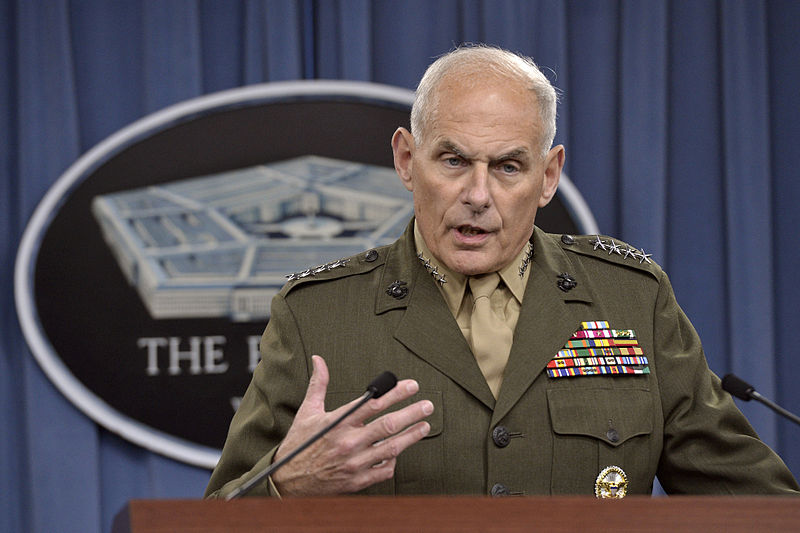
Marine Corps Gen. John F. Kelly, commander of U.S. Southern Command, discusses the latest developments in his command's efforts to stem the flow of drugs from South and Central America while briefing reporters at the Pentagon, March 13, 2014.

Marine Corps Gen. John F. Kelly, commander of U.S. Southern Command, discusses the latest developments in his command’s efforts to stem the flow of drugs from South and Central America while briefing reporters at the Pentagon, March 13, 2014. 

DOD photo by Glenn Fawcett

BreakingDefense has a post on Trump’s pick to head the Department of Homeland Security. If you don’t already know about retired Marine General John Kelly and his tour as SOUTHCOM, its worth the read.

It leads me to believe, the Coast Guard will not be cutting its drug interdiction mission in the Eastern Pacific any time soon.

An earlier post pointed to his history of support for the Coast Guard.

Commandant Talks Prospects for Next Administration

Defense & Aerospace Report Editor Vago Muradian interviews the Commandant, Adm. Paul Zukunft, at the 2016 Reagan National Defense Forum.

The Commandant hit many of themes we have heard him discuss before, but there was also mention of beginning to replace the inland Aids to Navigation fleet. We were supposed to have had a joint program with the Corp of Engineers to develop a common design, but I haven’t heard anything about that for several years now. They are certainly due for replacement. It almost sounds like they just realized they needed to do something about this.

Where is that 30 year shipbuilding plan?

Brookings Institute–A conversation with Commandant of the U.S. Coast Guard Admiral Paul F. Zukunft

Another video, this one almost an hour.

President-Elect Picks Retired Marine General John Kelly to Head DHS

John Francis Kelly (born May 11, 1950) is a retired United States Marine Corps general and the former commander of United States Southern Command.

John Francis Kelly (born May 11, 1950, pictured here in 2012) is a retired United States Marine Corps general and the former commander of United States Southern Command.

The New York Times has reported that President-Elect Trump has chosen retired Marine General and former SOUTHCOM commander John Kelly to head the Department of Homeland Security.

General Kelly served as SOUTHCOM November 19, 2012 – January 16, 2016. That experience should make him extremely familiar with the Coast Guard. He has supported the Coast Guard in the past, and here.

As I understand it, he will need to have a waiver from the Senate to serve because he retired less than seven years ago, but it appears he will have broad bi-partisan support having received the endorsement of President Obama’s former Defense Secretary Leon Panetta.