“Coast Guard Exercises Contract Option for 10 Additional Fast Response Cutters” –News Release

220822-A-KS490-1178 STRAIT OF HORMUZ (Aug. 22, 2022) From the left, U.S. Coast Guard fast response cutters USCGC Glen Harris (WPC 1144), USCGC John Scheuerman (WPC 1146), USCGC Emlen Tunnell (WPC 1145) and USCGC Clarence Sutphin Jr. (WPC 1147) transit the Strait of Hormuz, Aug. 22. The cutters are deployed to the U.S. 5th Fleet area of operations to help ensure maritime security and stability in the Middle East region. (U.S. Army photo by Spc. Noah Martin)

Below is a Coast Guard News Release.


Sept. 10, 2025

Coast Guard Exercises Contract Option for 10 Additional Fast Response Cutters

WASHINGTON — The U.S. Coast Guard has exercised a contract option with Bollinger Shipyards of Lockport, Louisiana, to fund initial construction on 10 additional Fast Response Cutters (FRCs), Tuesday. The $507 million option supports ongoing efforts to modernize the fleet and expand the Coast Guard’s global maritime mission.

The action made possible by the passage of Public Law 119-21, known as the One Big Beautiful Bill Act, increases the total number of FRCs ordered under the current agreement from 67 to 77. Supported by historic investments, this legislation provides nearly $25 billion – the largest single funding commitment in Coast Guard history – including $1 billion dollars for additional FRCs. The first FRC funded through this option is expected to be delivered in fiscal year 2028.

“As the first Coast Guard contracting action to execute over $100 million in reconciliation funds and the first reconciliation-funded action executed by a cutter program, this is a historic accomplishment for the Service,” said Rear Adm. Mike Campbell, the Coast Guard’s Director of Systems Integration and Chief Acquisition Officer. “Since its introduction to the fleet in 2012 as the successor to the 110-foot Island class patrol boat, the Fast Response Cutter has consistently proven its capabilities, adaptability and effectiveness in a wide range of maritime environments and Coast Guard missions.”

Sentinel-class FRCs are critical assets in the Coast Guard’s mission to control, secure and defend the U.S. border and maritime approaches. To date, 59 of these cutters are in service, replacing the aging fleet of 1980s-era Island-class 110-foot patrol boats. The Sentinel-class FRCs feature advanced command, control, communications, computers, intelligence, surveillance and reconnaissance equipment; over-the-horizon cutter boat deployment to reach vessels of interest; and improved habitability and seakeeping. Expanding the FRC fleet continues the Coast Guard’s modernization through Force Design 2028, an initiative introduced by Secretary of Homeland Security Kristi Noem to transform the Coast Guard into a more agile, capable and responsive fighting force.

The FRC fleet will complement the capabilities of the service’s national security cutters (NSCs), offshore patrol cutters (OPCs) and polar security cutters (PSCs) as an essential element of the Nation’s layered maritime security strategy.

Spike NLOS Missile System Photos and Video

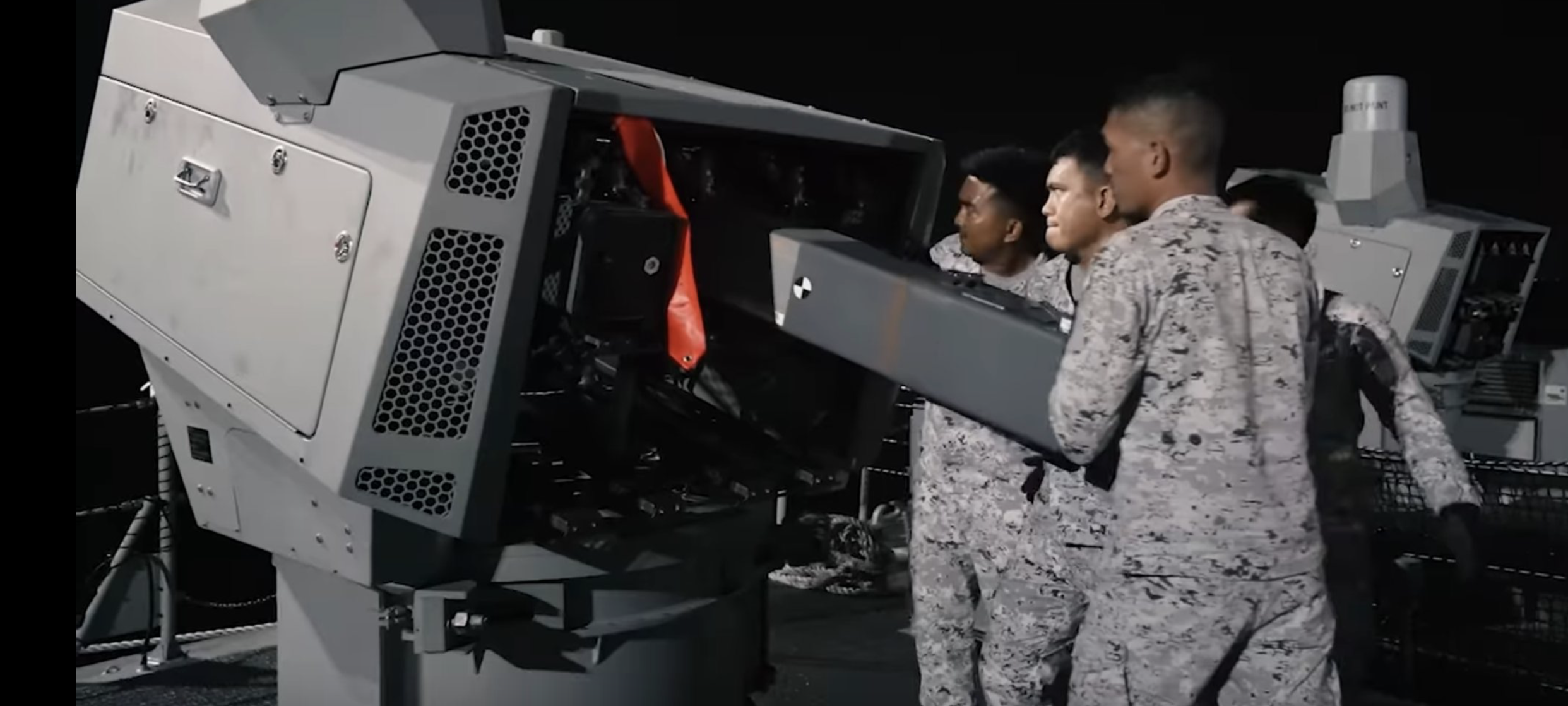
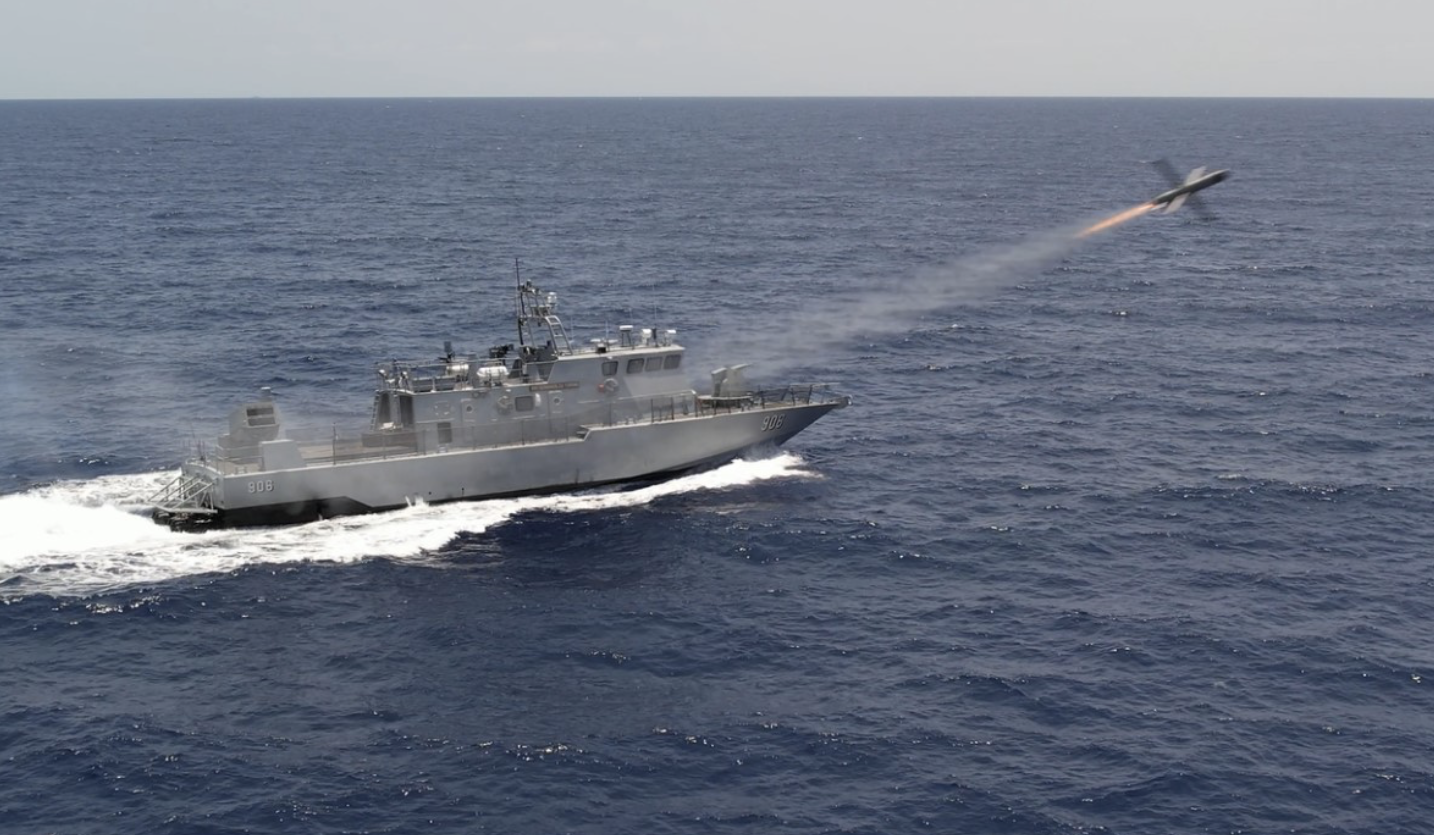
A FaceBook friend alerted me to photos and the video above of an exercise launch of Spike NLOS missiles from a Philippine Acero class Fast Attack Craft (FAC), a version of the Israeli Shaldag V.

I see a need for something similar in the Coast Guard.

There was a discussion of Spike NLOS in earlier post. That post showed two smaller four round launchers fitted to an 11.9 meter craft.

The missile never leaves its shipping container until it is launched.

“Spike NLOS is delivered as a ‘wooden roound’ enabling long shelf life, low maintenance, and low life-cycle cost.”

TYPHOON MLS NLOS has an eight cell Spike NLOS missile launcher and integrated Toplite stabilized observation and target acquisition system (same as on the Mk38 mod2 and mod3). Photo: RAFAEL via defense-update.com

Below is one of the Philippine Acero class launching a Spike NLOS. In the US, Spike NLOS is currently used by the US Army and it is marketed through Lockheed Martin.

Philippine Navy Acero class patrol boat launches Rafael Spike NLOS. The vessel features a Rafael Typhoon MLS-NLOS missile launcher capable of carrying 8 Spike-NLOS surface-to-surface missiles (limited to 4 ships only). Additionally, it is armed with one Mk.44 Bushmaster II autocannon mounted on a Rafael Typhoon Mk 30-C remote-controlled weapon station, two M2HB Browning 12.7 mm/50-cal. heavy machine guns mounted on Rafael Mini Typhoon remote-controlled weapon stations, and two M60 7.62 mm/30-cal. GP machine guns.

“Strengthening Pacific Security: U.S. Shiprider Agreements” –Real Clear Defense

Following efforts with Kiribati partners, the USCGC Oliver Henry (WPC 1140) crew transit in the Republic of Marshall Islands Exclusive Economic Zone during the next leg of their expeditionary patrol on Feb. 24, 2024. Underway in support of Operation Blue Pacific, the cutter crew showcased the effectiveness of the U.S. and RMI maritime bilateral agreement, conducting a shared patrol with shipriders emphasizing collaborative efforts in maritime safety, security, and stewardship in terms of resource protection. (U.S. Coast Guard photo)

Real Clear Defense provides an overview of the nature and importance of Coast Guard ship rider agreements with Pacific Island nations.

U.S. Coast Guard Forces Micronesia Sector Guam Commander Capt. Nicholas R. Simmons and the Honorable Joses R. Gallen, Secretary of Justice, Federated States of Micronesia, signed an expanded shiprider agreement allowing remote coordination of authorities, the first of its kind aboard the USCGC Myrtle Hazard (WPC 1139) in Guam, on Oct. 13, 2022. The agreement will enable to U.S to act on behalf of the FSM to combat illicit maritime activity and to strengthen international security operations. (U.S. Coast Guard photo by Chief Warrant Officer Sara Muir)

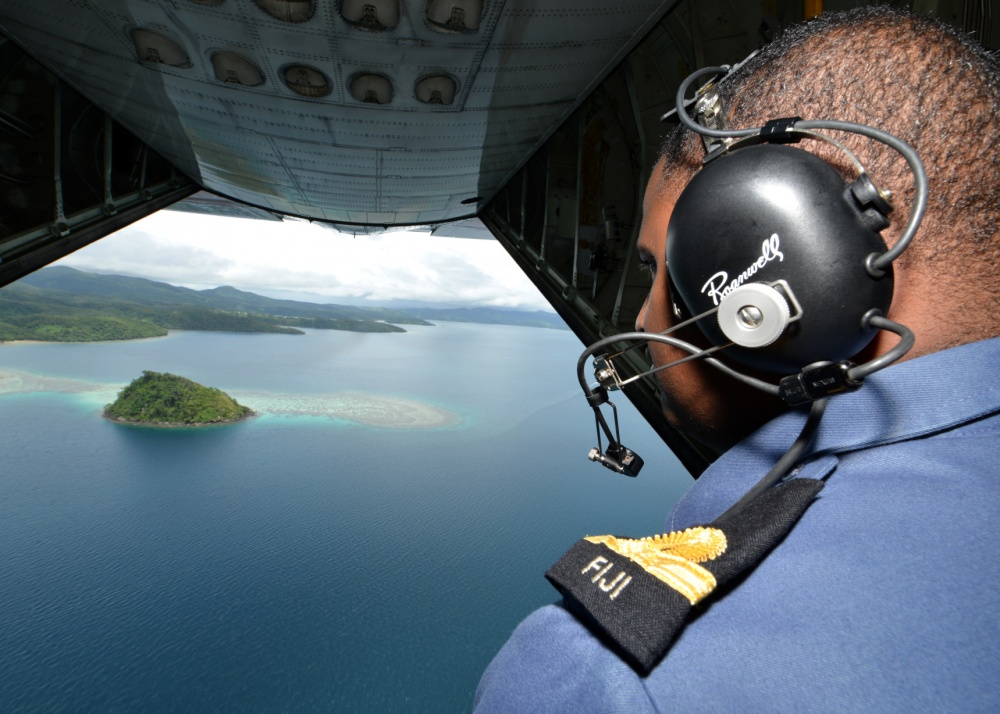
Fijian navy Sub-Lt. Opeti Enesi looks out from an Air Station Barbers Point HC-130 Hercules over the Fijian Islands, Dec. 8, 2018. The Hercules aircrew was providing support for a Fijian navy patrol boat during law enforcement operations. (U.S. Coast Guard photo by Petty Officer 3rd Class Matthew West/Released)

“Coast Guard to send 3 more cutters to Guam, has no plans to escort Philippine ships” –Stars and Stripes

A U.S. Coast Guard boat crew and boarding team from U.S. Coast Guard Cutter Oliver Berry (WPC 1124) approaches a foreign fishing vessel to conduct a joint boarding inspection with members of the Western and Central Pacific Fisheries Commission on the high seas in Oceania, Sept. 22, 2024. U.S. Coast Guard Cutter Oliver Berry’s crew recently completed a 45-day patrol in Oceania in support of Operation Blue Pacific, promoting security, safety, sovereignty, and economic prosperity in the region.

Stars and Stripes reports,

The Coast Guard will double its Guam fleet to six cutters but doesn’t plan to accompany the Philippine coast guard as it struggles to maintain territorial claims in the South China Sea, the service’s Pacific-area commander said Friday.

This is based on a video news conference by Pacific Area Commander Vice Adm. Andrew Tiongson speaking from Japan.

“The Coast Guard will not escort Philippine resupply missions to the BRP Sierra Madre, a grounded warship garrisoned by Filipino troops at the Second Thomas Shoal in the South China Sea, according to Tiongson.”

The Philippines has not asked for escorts, Tiongson said. “We do advise, and we do assist,” he said. “We provide what we would do in this situation.”

He also said, “It’s possible we may get another Indo-Pacific support cutter,” using the description applied to USCGC Harriet Lane, recently arrived in the Pacific Area to support operations in the Western Pacific.

There is more in the article.

“Coast Guard Cutter Kimball returns home following Bering Sea deployment” –CG News

U.S. Coast Guard Cutter Kimball (WMSL 756) conducts a passing exercise with the Royal Canadian Navy ship HMCS Regina while Kimball patrols the Bering Sea, July 18, 2024. During Kimball’s 122-day patrol, the crew also interacted with strategic partners in Victoria, Canada, strengthening relationships by focusing on shared interests in the Bering Sea and the expanding Artic region. U.S. Coast Guard photo by Ensign James Bongard.

Below is a Coast Guard News release. It wasn’t like the ALPATs I remember. For one thing it was four months long. There was the interaction with the Canadian Navy, shadowing Chinese warships, engagement and community outreach during a port visit in Nome, but this caught my attention.

Kimball’s crew was instrumental in conducting a proof of concept fueling at sea with the Coast Guard Cutter Bailey Barco (WPC-1122), a fast response cutter (FRC) homeported in Ketchikan, Alaska. This successful evolution extended the endurance of the Bailey Barco and resulted in Bailey Barco’s crew conducting over 10 vessel boardings in Bristol Bay, Alaska, an area not routinely accessed by FRCs due to logistical constraints.

Pacific Area has been pushing the envelope on employing the Fast Response Cutters, doing things never expected. A second set of eyes on patrol.


Aug. 7, 2024

Coast Guard Cutter Kimball returns home following Bering Sea deployment

HONOLULU — The crew of the Coast Guard Cutter Kimball (WMSL 756) returned to their home port at Base Honolulu, Thursday, after completing a 122-day patrol in the Northern Pacific, Bering Sea, and American Arctic.

Kimball’s crew patrolled in support of Operation Alaskan Groundfish Enforcer, Alaskan Sentinel and Bering Shield, promoting maritime governance by enforcing domestic fishery regulations while countering illicit maritime activity from foreign fleets along the maritime boundary line.

Kimball’s crew detected four Chinese surface combatants operating in vicinity of the Amchitka and Amukta Passage within the U.S. exclusive economic zone in early July. Under Operation Frontier Sentinel, Kimball monitored the Chinese vessels, meeting presence with presence to ensure there were no disruptions to U.S. interests in the maritime environment around Alaska.

Kimball’s crew interacted with strategic partners in Victoria, Canada, strengthening relationships by focusing on shared interests in the Bering Sea and the expanding Artic region. Kimball’s command cadre met with senior leadership from the Royal Canadian Navy at the Canadian Maritime Forces Pacific and Joint Task Force Pacific headquarters, participating in geopolitical analysis briefs and roundtable discussions on enhancing joint maritime domain awareness in the Arctic. The visit included tours of the HMCS Ottawa, HMCS Corner Brook and culminated later in the patrol with a passing exercise with HMCS Regina, promoting interoperability with the Royal Canadian Navy and simultaneously advancing the Tri-Service Maritime Strategy through U.S. sea-service engagements.

Showcasing law enforcement expertise, Kimball’s crew ensured fishing vessels in the Bering Sea were within compliance of all federal fishery conservation laws and safety requirements through the completion of twenty living marine resources boardings. Kimball’s boarding team identified one vessel operating in violation of U.S. fisheries regulations, resulting in a $4,500 violation from National Oceanic and Atmospheric Administration’s (NOAA) office of law enforcement.

Kimball’s crew protected U.S. economic interests monitoring foreign fishing vessels along the maritime boundary line, preventing U.S. economic exclusion zone incursions. Kimball’s law enforcement teams conducted a joint boarding with Customs and Border Protection and NOAA of a foreign flagged reefer vessel to inspect fish bait being imported into the United States strengthening federal partnerships in the region.

While operating in the Bering Sea, the crew demonstrated the multi-mission agility of the national security cutter’s advanced command-and-control capabilities by coordinating Alaskan based Coast Guard air and surface assets, forming dynamic force packages that dramatically enhanced the nation’s offshore search and rescue (SAR) abilities. Kimball operated with a forward deployed MH-60 Jayhawk helicopter and aircrew in Cold Bay, Alaska, and the District Seventeen command center to execute complex SAR exercises for improving, coordination, response times, and range of rotary Coast Guard assets to assist mariners in distress.

Additionally, Kimball’s crew was instrumental in conducting a proof of concept fueling at sea with the Coast Guard Cutter Bailey Barco (WPC-1122), a fast response cutter (FRC) homeported in Ketchikan, Alaska. This successful evolution extended the endurance of the Bailey Barco and resulted in Bailey Barco’s crew conducting over 10 vessel boardings in Bristol Bay, Alaska, an area not routinely accessed by FRCs due to logistical constraints.

During port visits in Alaska, Kimball’s crew engaged with local communities. In Nome, crewmembers engaged with the tribal leadership and conducted two community outreach events, including public training and engagements for “Kids Don’t Float,” a statewide initiative to prevent youth drowning incidents. Kimball crewmembers demonstrated the importance of proper life jacket use and cold immersion survival. While in Dutch Harbor, crewmembers volunteered for community events including staging tents and site facilities for summer cultural camps.

“This crew excelled at operating in one of the harshest maritime environments, rising to the challenge of meeting presence with presence when encountering strategic competitors, ensuring the safety and security of U.S. fishermen, engaging with local communities, and providing overarching SAR coverage throughout the Bering Sea” said Capt. Robert Kinsey, Kimball’s commanding officer. “The Coast Guard is a key domestic and international Arctic security leader, shaping the region to promote rule of law and prevent foreign malign influence. I couldn’t be more proud of the crew’s professionalism, dedication, and ability to work together with our partners, foreign and federal, to deliver mission excellence for the American people.”

Commissioned in 2019, Kimball is one of ten commissioned Coast Guard legend-class national security cutters and one of two homeported in Honolulu. National security cutters are 418-feet long, 54-feet wide, and have a 4,600 long-ton displacement. They have a top speed more than 28 knots, a range of 12,000 nautical miles, and can hold a crew of up to 170. National security cutters routinely conduct operations throughout the Pacific and Atlantic, where their combination of range, speed, and ability to operate in extreme weather provides the mission flexibility necessary to conduct vital strategic missions.

The namesake of U.S. Coast Guard Cutter Kimball is Sumner Increase Kimball, who was organizer of the United States Life-Saving Service and the General Superintendent of the Life-Saving Service from 1878–1915. The ship’s motto is “Wield the Paddles Together: Work Together.”

“Q&A: Vice Admiral Andrew J. Tiongson, Commander, Pacific Area and Commander, Defense Force West, U.S. Coast Guard” –Seapower

Tiongson speaks at a press conference before the crew of the Coast Guard Cutter Waesche offloads 18,219 pounds of cocaine, worth more than $239 million, on Dec. 6, 2023. U.S. Coast Guard

The Navy League’s on-line magazine, Seapower, has an interview with the Pacific Area Commander. There is a lot of good information here.

HC-130Js (and C-27Js):

CGAS Sacramento will “transition” to HC-130Js. Pacific Area certainly needs the long range aircraft because, while 84% of the US EEZ is in Pacific Area they have only three fixed wing air stations (Kodiak, Barbers Point, and Sacramento) while Atlantic Area has five fixed wing air stations to cover only 16% of the US EEZ.

What will happen to the C-27Js? No mention was made of these. They might go to Guam. That would be helpful in providing fixed wing search aircraft in the Western Pacific. Recently there was a SAR case in the Western Pacific. A C-130 was dispatched from Barbers Point, but the flight was so long the crew needed a day’s rest before the aircraft could be used in the search. On the other hand, Guam might not be an optimal location since it is so far West. There are other options.

Fast Response Cutters:

As I read the statement, the intention is to have a total of six FRCs in Guam and add a fourth in Hawaii.

His discussion about these little ships clearly indicates that their nominal five-day endurance (same as the preceding 110 foot WPBs) is being exceeded regularly.

“The FRCs, first off, are game changers for the Coast Guard in general. Back in the day, we had patrol boats that were limited in terms of the sea states they could handle, the food that they could carry, the number of crew members and certainly their duration at sea. The FRCs have changed that.”

Six WPCs in the same port is not unusual. District 7 has three different ports, each homeport to six or seven Webber class, but this may be a move toward replicating a PATFORSWA type organization to support 7th Fleet in the Western Pacific.

Large Patrol Cutters:

There was a brief discussion of the Offshore Patrol Cutters, but no indication of when they are expected to arrive in PACAREA.

A second “Harriet Lane or Indo-Pacific support cutter” is on PACAREA’s unfunded priority list. For some reason, I think this may happen.

Commercial Icebreaker Procurement:

Plans for the commercial icebreaker (Aiviq) were discussed. It will be homeported in Juneau, as reported here in March, but still has not been purchased and it will take two years to complete changes to make it fully operational.

The admiral was asked, “Is the commercial icebreaker going to be crewed by Coast Guardsmen or by a contract crew?” and there was no definitive answer. Should the Coast Guard adopt a hybrid crew, as has been done by some Navy vessels it would be a major change in Coast Guard policy.

The Eastern Pacific Drug Transit Zone: 

Atlantic Area cutters are not assisting in Eastern Pacific drug transit zone interdiction efforts, as they normally would, because they are heavily engaged in migrant interdiction operations.

Trusted Partner:

The Area Commander talked a lot about what being a trusted partner meant, about partnerships with Asian coast guards, and the outsized effect of having a few good people in liaison positions.

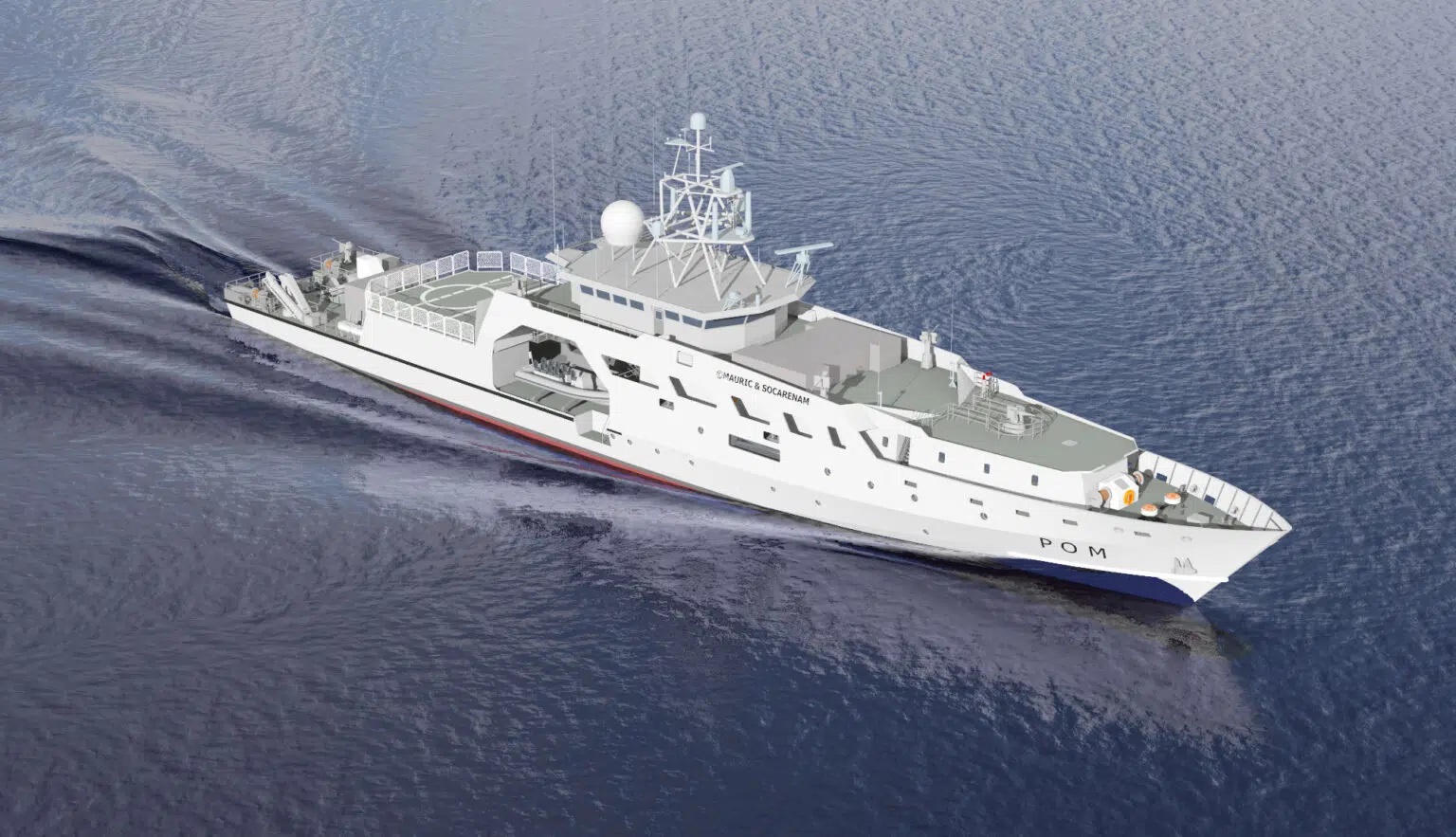
The Félix Éboué class, a Modern, Minimalist, Medium Endurance Cutter

An artist’s rendering, Félix Éboué class or Patrouilleurs Outre-mer (POM)

The Offshore Patrol Cutter (OPC) is described as, “…a capability bridge between the national security cutter, which patrols the open ocean in the most demanding maritime environments, and the fast response cutter, which serves closer to shore.”

That may have been the intention, but that is not what we got.

While the National Security Cutter is better than the WHECs they replaced in almost every way, the OPCs are not only better than the WMECs they will replace, but they are also, in every way except maximum speed, better than the WHECs as well. Instead of a high/low mix of cutters, they all turned out high end. We should not be surprised the OPCs construction and operating costs approach those of the NSCs.

Construction costs are typically proportional to displacement. The OPCs’ displacement is 98% that of the NSC and 1232.8% (more than 12 times) that of the Fast Response Cutters.

This would not be a bad thing, if we had enough NSCs and OPCs to meet our large patrol cutter needs, but I don’t think we will ever get there.

We are expected to ultimately end up with only 36 large patrol cutters, fewer than we have had in decades and fewer than other Coast Guards with far smaller EEZs.

A new fleet mix study has been completed, but the results have not been made public (Why not? This is not transparency). I suspect it shows a need for substantially more than 36 large patrol cutters.

If we look at the previous “Fleet Mix Study,” now over a dozen years old, which minimized requirements because it did not consider “High Latitude regions of the ice shelf and Deployable Operations Group (DOG),” and assumed that NSCs would use the “Crew Rotation Concept” that was expected to allow them to operate 230 days per year, to meet all statutory requirements, the study indicated the Coast Guard needed 66 large cutters, 30 more than currently planned, and 91 FRCs.

If we want significantly more large patrol cutters than currently planned, perhaps we need a smaller, cheaper alternative to the OPCs that requires a smaller crew and are more economical to operate. In previous posts, I have referred to this alternative as (Cutter X).

Thinking Ahead: 

Getting funding for more than two OPCs per year is probably unrealistic. The last OPC is not expected to be commissioned until 2038, 14 years from now. If we continue to build only two large patrol cutter a year, will not be able to grow the fleet until after 2038 and then it will grow slowly because the National Security Cutters will start aging out.

We might not be able to continue to build OPC sized patrol cutter after 2038. The Coast Guard will want to build Arctic Security Cutters (or perhaps Arctic Patrol Cutters). Both the Juniper class WLBs and Keeper class WLMs will need to be replaced.

(Where is our long-range shipbuilding plan?)

If we started in the next year of two, we could be producing true medium endurance cutters in significant numbers before the planned completion of the OPC program. On a 3 for 1 or even 2 for 1 exchange for the last few OPCs, if we tried, we could start to grow the fleet perhaps as early as 2032.

That is why the Félix Éboué class is worth a look. It is, what I believe may be, the absolute minimum fully capable Offshore Patrol Vessel. It covers all the bases. It is good enough for most operating areas. That is not to say, there are no good reasons for some add–ons, but I think it is a kind of benchmark. It is also a good representation of Cutter X. There are reasons we might want to go bigger, but before you increase the quality of the individual cutters, first we need to have enough.


The French Experience

France, like the US has a huge Exclusive Economic Zone (EEZ), the largest in the world, 11,691,000 km2 (4,514,000 sq mi). The US EEZ is 11,351,000 km2.

Unlike the US, the French don’t have a coast guard that operates ocean going ships to enforce laws and protect sovereignty. The French Navy does this, and uses a fleet of Offshore Patrol Vessels, some of which are referred to as frigates.

The Félix Éboué class is their newest class of OPVs. They are intended specifically to patrol the waters of French overseas territories in the Pacific and Indian Oceans. They will be based, two each, at NouméaTahiti and La Réunion. They replace the P400 class, which are slightly larger than the Webber class WPC, which were found to be inadequate.

I have found some very good photos of the second ship of the class being fitted out, that show details I had not seen before, and would like to share them. I will also bring forward some of my earlier commentary with updates, so as to consolidate information on this interesting class.

Comparison with Webber class WPC (FRC):

Below is a comparison between the FRC and the Félix Éboué class (POM) that was included in an earlier post, updated with information about the propulsion system on the French ships.

French overseas patrol vessel (POMs) Auguste Bénébig. Photo: http://www.meretmarine.com

Like an FRC:

I always thought these looked like oversized Webber class, the proportions are similar, and the much larger POM is not much more complicated than the Webber class. The crew of the POM is 30, only six more than that of the FRC. Both have a bridge with a 360-degree view positioned well aft, minimizing vertical acceleration. Both have an 8 meter boat in a stern ramp. The armament is similar with four .50 cal. machine guns and a single medium caliber gun in the bow, a 20mm on the POM and a 25mm on the FRC. The POM uses slightly less powerful diesel engines, 2x ABC 16V DZC medium speed diesels 3.7MW each @ 1,000rpm, for a total of about 9924 HP compared to 11,600 for the FRC. (I am told the POM’s engines are also more economical and simpler to maintain.) But the French ships still manage to make 24 knots, a couple of knots more than claimed for the OPC. With similar crew and systems, they should not cost much more than the FRCs to operate.

Unlike an FRC:
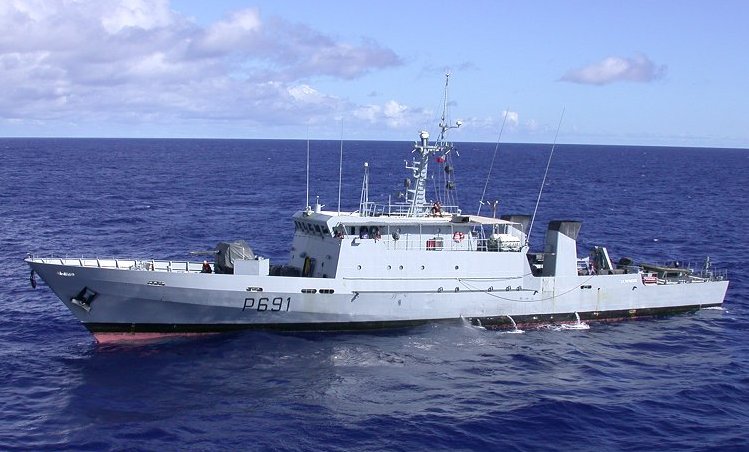
P400 patrol ship Tapageuse at sea near Tahiti (18 June 2003). Photographer: Jean-Michel Roche

While they would have been thinking of their existing 373 ton P400 class pictured above, it might appear to us that they wanted a ship to do the same sorts of missions the Webber class Fast Response cutters (FRC) are doing out of Guam, but they recognized that these ships would be far from any major naval base and that they would need to travel great distances and would be exposed to extreme weather conditions, so they needed to be larger (1300 tons vs 353 tons for the FRC) and have greater range (5500 miles vs 2500) and endurance (30 days vs 5 days).

Having chosen a larger hull, they took advantage of the greater volume and deck space to add a second RHIB, a multimode radar, space for 29 passengers (roughly a platoon of Marines), a sickbay, a dive locker, space for a 20 foot containerized mission module, a flight deck and hangar for a 700-kilogram-class rotor-blade drone (not yet deployed), and a holding area for up to six prisoners.

Some sources also indicate the French ships also have electric motors that would allow them to cruise on the ship’s service generators and secure the main propulsion engines, but I have seen no specifics.

The Photographs: 

The second of the French Navy’s six new overseas patrol vessels (POM), the Teriieroo a Teriierooiterai, which will be based in French Polynesia and has been named in tribute to a Companion of the Liberation native of this Pacific territory, Photo: http://www.meretmarine.com

The Teriieroo at Teriierooiterai fitting out at the end of July, 2023 in Boulogne. Photo: http://www.meretmarine.com

Stern ramp for 8 meter RHIB. French Navy overseas patrol vessel (POM), Teriieroo a Teriierooiterai, fitting out 2023. Photo: http://www.meretmarine.com

Second 8 meter RHIB and davit (only) on starboard side. French Navy overseas patrol vessel (POM), Teriieroo a Teriierooiterai, fitting out 2023. Photo: http://www.meretmarine.com

Aliaca aerial drone on its launch catapult. French Navy overseas patrol vessel (POM), Teriieroo a Teriierooiterai, fitting out 2023. Photo: http://www.meretmarine.com

Recovery System for Unmanned Air System, French Navy overseas patrol vessel (POM), Teriieroo a Teriierooiterai, fitting out 2023. Photo: http://www.meretmarine.com

“U.S. Coast Guard Cutters return home after successful Central American deployment” –D11 News Release

USCGC Forrest Rednour (WPC 1129) and Blackfin (WPB 87317) in Costa Rica

Below is a District 11 news release. Did an earlier post on this unusual deployment.

The 800 operational hours claimed for each vessel works out to 33.3 operational days out of 49 deployed, so I presume that means about 16 days in transit, there and back.

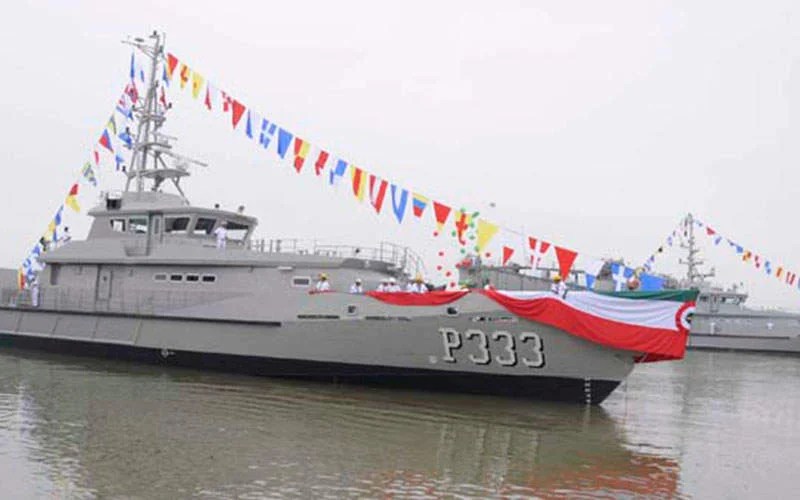
The Mexican Navy vessel mentioned, ARM PALENQUE, the third of ten Tenochtitlan-class patrol vessels, looks a lot like a Webber class Fast Response Cutter. It is also a Damen design, but a bit smaller (a Stan Patrol 4207 vs 4708 for the FRC). Damen has been very successful with this design. More than 50 have been built for more than a dozen agencies. (USCGC Blackfin and the other Marine Protector class patrol boats are also based on a Damen design.)

Mexican Navy ARM Palenque (PC-333) at launching March 2014. Credit Secrtaria de Marina.


June 10, 2024

U.S. Coast Guard Cutters return home after successful Central American deployment

SAN PEDRO, Calif. — U.S. Coast Guard cutters Forrest Rednour and Blackfin have returned to their homeports after a 49-day deployment in Central America, where they played a crucial role in multiple operations.

During this period, both cutters demonstrated outstanding readiness and operational capability, significantly contributing to international cooperation, search and rescue missions, and efforts to combat criminal activities. This deployment was part of a broader strategy to enhance regional security and strengthen partnerships. Throughout the mission, Forrest Rednour covered over 8,200 miles and logged 800 operational hours, while Blackfin covered over 8,300 miles and also logged 800 operational hours.

“The amount of effort and commitment from both crews during this 49-day deployment was remarkable,” said Rear Adm. Andrew Sugimoto, commander, Coast Guard District 11. “Their readiness and professional exchanges provided an invaluable experience to our partner nations and crews. The enthusiasm to lead multiple engagements with several international maritime organizations helped strengthen ties and fortify continued collaboration between all.”

Key Achievements:

Search and Rescue Exercises (SAREX):

  • Manzanillo, Mexico: Blackfin led a successful SAR operation, including helicopter rescue exercises with the Mexican Navy.
  • Puerto Quetzal, Guatemala: Hosted tours and conducted SAR exercises with the Guatemalan Navy, building stronger maritime partnerships.
  • La Union, El Salvador: Rednour led a SAR exercise and joint operations with the Salvadoran Navy, marking the first U.S. vessel visit to this port in two years.

Partnership and Training:

  • Amapala, Honduras: Engaged in discussions and training on maritime law enforcement and security with the Honduran Navy and Merchant Marine.
  • Golfito, Costa Rica: Shared knowledge on maritime governance with the Costa Rican Coast Guard, enhancing mutual understanding.
  • Rodman, Panama: Provided damage control and medical evacuation training to Panamanian forces, marking the first U.S.-Panama Coast Guard engagement in over two years.
  • PASSEX with ARM PALENQUE: Forrest Rednour and Blackfin conducted a passage exercise (PASSEX) with the Mexican Navy’s ARM PALENQUE. This included formation steaming, code exercises, and a crew exchange to enhance mutual operational understanding and cooperation.

“This patrol was truly an amazing experience and a testament to the incredible devotion to duty that the crews of the Forrest Rednour and Blackfin have,” said Lt. Kevin Ng, commanding officer of Coast Guard Cutter Forrest Rednour. “Both crews adapted and overcame several challenges leading up to and during the patrol, but never took their eyes off the main objective. As a result, the Coast Guard was able to strengthen the valuable relationships that the United States has with our international partners throughout Central America and unify our efforts to address critical maritime security initiatives in the Eastern Pacific. Thank you to crews on a job well done, District 11 and Sector Los Angeles/Long Beach for the coordination, and the families and friends of the crew for all of the support; the success of this historic patrol could not have been accomplished without them all.”

“I could not be prouder of both crews for the incredible amount of hard work they have dedicated to making this historic patrol possible. The success of this Surface Action Group is a testament to the Coast Guard’s ability to overcome dynamic challenges in the completion of unprecedented mission sets. It also signifies the Coast Guard’s steadfast commitment to advancing our vital maritime partnerships in the Eastern Pacific. The international relationships formed and strengthened during this deployment have set the groundwork for future engagements which I look forward to watching,” said Lt. j.g. James Morrison, commanding officer of Coast Guard Cutter Blackfin.

Commissioned in 2018, the Coast Guard Cutter Forrest Rednour is one of the Coast Guard’s Sentinel-class fast response cutters homeported in San Pedro, California. Sentinel-class cutters are 154 feet long and 25 feet wide and have a 353 long-ton displacement. They have a top speed in excess of 28 knots and a range of 2,500 nautical miles. They can hold a crew of up to 24. The namesake of the Forrest Rednour is Petty Officer 2nd Class Forrest O. Rednour, who heroically rescued survivors from the torpedoed USAT (US Army Transport–Chuck) Dorchester during World War II and was posthumously awarded the Navy and Marine Corps Medal.

Commissioned in 2000, the USCGC Blackfin is one of the Coast Guard’s Marine Protector-class patrol boats homeported in Santa Barbara, California. Marine Protector-class patrol boats are 87 feet long and 19.5 feet wide and have a 100 long-ton displacement. They have a top speed of 25 knots and a range of 900 nautical miles. They can hold a crew of up to 10. The Blackfin is equipped with advanced electronics and navigation systems for multi-mission operations, including search and rescue, law enforcement, and homeland security. The Blackfin shares the name of the USS Blackfin (SS-322), a submarine that participated in World War II and the Korean War.

“Coasties, Marines and Sailors Awarded for Seizing Millions of Pounds of Explosive Materials in Middle East” –Military.com

220822-A-KS490-1182 STRAIT OF HORMUZ (Aug. 22, 2022) From the left, U.S. Coast Guard fast response cutters USCGC Glen Harris (WPC 1144), USCGC John Scheuerman (WPC 1146), USCGC Emlen Tunnell (WPC 1145) and USCGC Clarence Sutphin Jr. (WPC 1147) transit the Strait of Hormuz, Aug. 22. The cutters are forward-deployed to U.S. 5th Fleet to help ensure maritime security and stability across the Middle East. (U.S. Army photo by Spc. Noah Martin)

Military.com reports,

“Hundreds of service members earned an award for seizing two million pounds of “explosive precursor material” in the Gulf of Oman last year, according to a citation obtained by Military.com. It is one of the U.S. military’s largest publicly revealed hauls as it works to stifle arms smuggling in the region.”

The award was made to “192 Marines and sailors with the 26th MEU, 342 sailors assigned to the USS Carter Hall” and unreported numbers of additional personnel “aboard the USS Stethem and Coast Guard Cutters Emlen Tunnell, Glen Harris and John Scheuerman…”

This is not the first time PATFORSWA cutters have stopped shipments of explosives.

I had never heard of the Meritorious Team Commendation (MTC). It is a Coast Guard unit award created in 1993 for groups or teams that are not identifiable by OPFAC as a United States Coast Guard unit.

“USCGC Myrtle Hazard (WPC 1139) enters first drydock maintenance in Honolulu” –Forces Micronesia/Sector Guam

The USCGC Myrtle Hazard (WPC 1139) crew departs Guam for Honolulu on May 13, 2024, marking a significant milestone as the crew prepare for the first drydock maintenance period of approximately four and a half months. Commissioned in 2021, the Myrtle Hazard is the first of three Guam-based Fast Response Cutters to make the transit to Hawaii from Guam, traveling 3,743 miles to undergo this crucial maintenance phase. (U.S. Coast Guard photo by Chief Warrant Officer Sara Muir)

Below is a U.S. Coast Guard Forces Micronesia/Sector Guam news release (more photos there) that clarifies how Guam based Fast Response Cutters will be maintained. Just to provide a hint of how arduous this was, the distance from their base to Hawaii, 3743 nautical miles, would take 12 days at a 14 knot cruise speed, while the nominal range and endurance of ships of this class is 5 days and 2500 miles. Actually, she departed Guam on May 13 and arrived in Hawaii, May 28, 15 days later, presumably having stopped at least once to refuel and resupply. 

USCGC Myrtle Hazard arrived in Guam in September of 2020. This is her very first drydocking. Just getting to Hawaii required a transit equal to 16.3% of the miles she transited during the previous 42 months.

June 4, 2024

USCGC Myrtle Hazard (WPC 1139) enters first drydock maintenance in Honolulu

SANTA RITA, Guam — The USCGC Myrtle Hazard (WPC 1139) crew arrived in Honolulu on May 28, 2024, marking a significant milestone as it enters its first drydock maintenance period of approximately four and a half months. 

Commissioned in 2021, the Myrtle Hazard is the first of three Guam-based Fast Response Cutters (FRCs) to transit to Hawaii from Guam, traveling 3,743 miles to undergo this crucial maintenance phase.

In just the past two years, the Myrtle Hazard crew patrolled a vast 1.9 million square nautical mile area traveling as far south as Australia, accruing over 23,000 nautical miles steamed. The cutter crew enhanced regional maritime security and strengthened international cooperation by participating as the deputy commodore’s platform during a search and rescue exercise phase of Pacific Partnership 2022, the largest multinational humanitarian exercise in the Indo-Pacific. They also operationalized newly signed agreements by conducting historic bilateral boardings with Papua New Guinea, rescued mariners in dangerous sea conditions in the Northern Mariana Islands, and participated in critical operations escorting Department of Defense assets. The drydock maintenance is crucial for maintaining these high standards and ensuring the cutter’s continued ability to perform such missions.

“Throughout the transit east, as we leapfrogged through the Federated States of Micronesia and the Republic of the Marshall Islands to reach Hawaii, this crew demonstrated extraordinary resilience and skill. Despite several engineering challenges that tested our capabilities, their steadfast commitment and proficient handling of all casualties ensured our safe and timely arrival for drydock maintenance. I am immensely proud of their dedication and professionalism, which continue to ensure our readiness and effectiveness in fulfilling our missions,” said Lt. Emma Saunders, commanding officer of the USCGC Myrtle Hazard, on her first transit since assuming command.

Why Drydock is Essential

Drydock maintenance is vital for operational readiness, extending the cutter’s service life, and ensuring the safety of its crew. It involves a series of comprehensive inspections and repairs the crew cannot perform while the vessel is waterborne. These include hull preservation, mechanical overhauls, and technological upgrades, all of which are crucial for maintaining the cutter’s peak performance and safety standards.

Logistical Excellence and Risk Management

The logistical operation to transfer the cutter from Guam to Honolulu highlights the strategic planning and risk management necessary for this evolution. By proactively addressing maintenance needs, the team can meet operational commitments without compromising the safety or effectiveness of the fleet.

“Regular maintenance isn’t just about keeping our ships in shape; it’s about ensuring we’re always ready to meet the challenges we face at sea. Working closely with Coast Guard District 14 and our logistics teams, we schedule these critical maintenance periods to keep our missions running smoothly without missing a beat. This careful planning ensures we’re always there where we’re needed most, from safeguarding our shores to ensuring maritime safety and security across the Pacific. It’s a team effort, and every member of Team Guam plays a part in keeping our commitment strong and our presence steady in the waters we protect and the communities we serve.” said Capt. Robert Kistner, emphasizing the critical role of regular maintenance.

Next Steps for Guam-Based FRCs

Following the Myrtle Hazard, the other two Guam-based FRCs, USCGC Oliver Henry (WPC 1140) and USCGC Frederick Hatch (WPC 1143), will undergo their respective drydock periods. This systematic approach ensures that all vessels maintain their operational capabilities and readiness.

“We are committed to continuous improvement in maintenance practices, which is crucial for fulfilling our mission to protect and secure maritime interests in the Pacific,” said Kistner. “We look forward to Myrtle Hazard’s return this Fall.”

Future Outlook

As Base Guam continues to come online under the command of Cmdr. Dana Hiatt and operators employ the recently established Operational Logistics Command Expeditionary Team (LOG-X) more frequently; the U.S. Coast Guard is exploring enhancements in local maintenance capabilities and infrastructure in the Pacific. This includes potential investments in existing and new purpose-built facilities for Team Guam, which are crucial for minimizing downtime and ensuring a ready fleet capable of meeting future challenges.

Myrtle Hazard, the 39th 154-foot Sentinel-class FRC, is named in honor of the first enlisted woman in the U.S. Coast Guard who served as an electrician and radio operator. As part of the Guam-based cutters, it is a cornerstone for the U.S. Coast Guard’s ongoing commitment to the people of Oceania, focusing on maritime safety, security, and stewardship.

-USCG-

About U.S. Coast Guard Team Guam
Comprising over 350 members, this team is focused on maritime safety, security, and stewardship in Oceania. U.S. Coast Guard Forces Micronesia/Sector Guam, U.S. Coast Guard Base Guam, and their sub-units are staffed by dedicated active-duty, reserve, and civilian personnel. With a significant presence in Guam, Saipan, and the Micronesia sub-region, this integrated team focuses on operations and logistics to support maritime safety, security, and stewardship in Oceania and maintains close ties with local communities.