Group 2 VTOL UAS

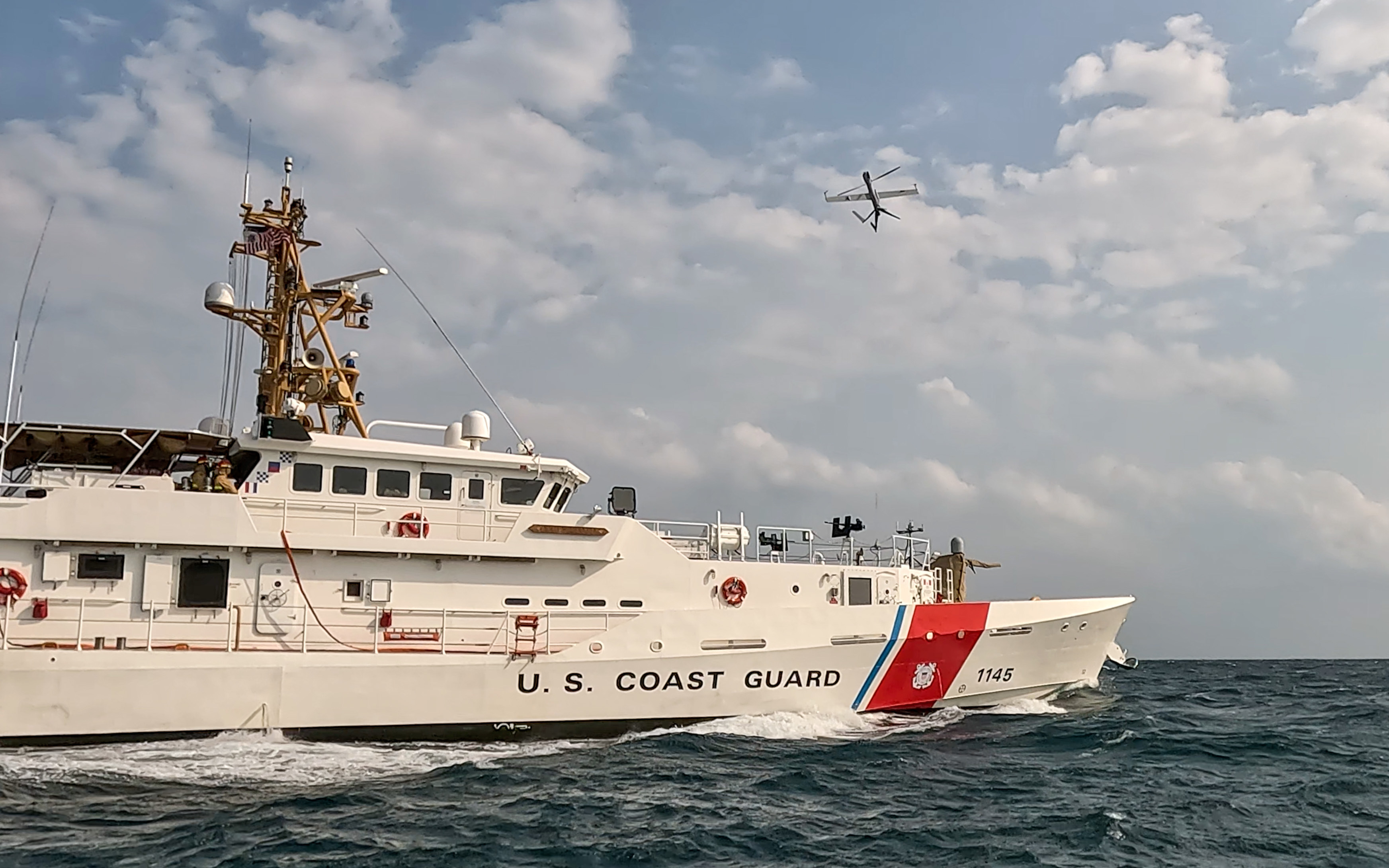
221207-N-NO146-1001 ARABIAN GULF (Dec. 7, 2022) An Aerovel Flexrotor unmanned aerial vehicle (UAV) takes off from U.S. Coast Guard fast response cutter USCGC Emlen Tunnell (WPC 1145) transiting the Arabian Gulf, Dec. 7. U.S. 5th Fleet’s Task Force 59 launched the UAV during Digital Horizon, a three-week event focused on integrating new unmanned and artificial intelligence platforms, including 10 that are in the region for the first time. (U.S. Navy photo)

We have begun to see very capable, vertical takeoff and landing (VTOL) unmanned air systems that fall into the DOD Group Two standard.

  • Weight: 21 to 55 pounds (10 to 25 kg)
  • Nominal operating altitude: <3500 feet or 1 km above ground level.
  • Speed: <250 knots

Recently Elbit Systems reported they would be providing a Group 2 VTOL to the Israeli Army, and we have the photo above of an Aerovel Flexrotor taking off from a Webber class patrol craft,

These small, unmanned air systems (UAS), which can combine sophisticated sensors and endurance of four to over 24 hours, may be better search platforms than our H-65 helicopters.

Group 2 UAS are even smaller than the Martin V-Bat. It appears, they might be able to operate from Webber class cutters. Operating UAS from the Webber class on a regular basis would provide them much of the air search advantage of larger flight deck equipped cutters.

Below is a news release on another aircraft in this class, the Edge Autonomy VXE30. The VIDAR sensor referred to in the news release, is also used on the Scan Eagle (a catapult launched Group 2 UAS) used on National Security Cutters. There is more on the unmanned VXE30 here.


Edge Autonomy’s VXE30 UAS. The VXE30 vertical take-off and landing (VTOL) solution is the latest and most advanced version of the “Stalker” series of small uncrewed aerial systems (sUAS) from Edge Autonomy.


Sentient’s AI-enabled ViDAR optical sensors soar on Edge Autonomy’s VXE30 “Stalker” UAS in successful live demonstrations

ViDAR – Sentient’s AI-enabled wide area motion imagery deployed for real-time maritime surveillance at the edge

VIRGINIA BEACH, Va. (Aug 29, 2023) – Sentient Vision Systems (Sentient) has successfully completed live demonstrations of its AI-enabled ViDAR (Visual Detection and Ranging) payload deployed on Edge Autonomy’s VXE30 UAS. The VXE30 vertical take-off and landing (VTOL) solution is the latest and most advanced version of the “Stalker” series of small uncrewed aerial systems (sUAS) from Edge Autonomy. When coupled with Sentient’s ViDAR, the VXE30 provides a passive, wide area search capability, enabling it to serve a myriad of maritime operations. The joint capability will be on display at DSEI 2023, 12-15 September in London.

ViDAR, developed by Sentient, utilizes AI; Computer Vision, and Machine Learning integrated with Electro-Optic and Infrared (EO/IR) sensors to passively detect objects that are difficult to spot by the human eye or recognize on a conventional radar. With these enhanced capabilities, Stalker will be more capable of accurately detecting and locating people, objects, and vessels (day and night) far from the operator.

ViDAR has been deployed on intelligence, surveillance, and reconnaissance missions (ISR), maritime patrol and border protection, as well as search and rescue missions since 2015. ViDAR is proven to be effective in challenging maritime conditions up to Sea State 6 (very rough with waves 13 to 20 feet high/ 4 to 6 meters).

Sentient has successfully evolved ViDAR into a compact, lightweight, low power form factor—low SWaP (size, weight, and power) — suitable for deployment on small Group 2 / NATO Class 1 UAS such as the VXE30. Its successful integration onto the VXE30 demonstrates its broad operating envelope and ability to provide unprecedented long-endurance imaging capability in contested environments all around the world.

Joshua Stinson, Edge Autonomy’s Chief Growth Officer said, “The integration of ViDAR onto the VXE30 is an essential part of our UAS deployment program. ViDAR’s passive detection system will further the VXE30’s capabilities to remain undetected in a contested environment while carrying a powerful maritime detection sensor that provides a real-time picture of the maritime domain. This capability could make all the difference in a mission’s success.”

Paul Harris, Sentient’s VP of Business Development agreed and said, “We are delighted to be working with Edge Autonomy to demonstrate how effective ViDAR is at increasing the utility of the small and agile VXE30 for the challenges of the modern battlespace. We look forward to displaying our joint capabilities at DSEI.”

With close to 4,500 systems deployed, Sentient’s AI-enabled sensor edge solutions for wide area motion imagery are proven for detection in missions worldwide.

——–ends——–

About Sentient Vision Systems www.sentientvision.com

Sentient Vision Systems specializes in passive, modular optical sensors for persistent, wide area motion imagery. Sentient’s artificial Intelligence (AI)-enabled edge solutions better detect and identify small objects in real time, on land and at sea. With more than 20 years of development in moving target indication, AI computer vision and machine learning, Sentient has deployed thousands of systems worldwide in the field of Intelligence, Surveillance, Search and Rescue, enhancing situational awareness, accelerating informed decisions, and saved numerous lives. Follow Sentient on LinkedIn , VimeoYouTube and Twitter

About Edge Autonomy www.edgeautonomy.io

Edge Autonomy is a leader in providing innovative autonomous systems, advanced optics, and resilient energy solutions to the U.S. Department of Defense, the U.S. Federal Civilian Agencies, allied governments, academic institutions, and commercial entities. Edge Autonomy draws on a 34+ year history of aerospace engineering, advanced manufacturing expertise, and technologically advanced manufacturing. With headquarters in San Luis Obispo, CA, and key production capabilities abroad, Edge Autonomy’s 400+ team members deliver results in multiple markets. Follow Edge Autonomy on LinkedInFacebook and Twitter.

Tour of Bollinger’s Lockport Yard, Where FRCs Are Built

“Creating Cutters for the Next Generation of Heroes,” This banner hangs over a passageway in one of the shops at Bollinger’s Lockport shipyard.

The Navy and Coast Guard have had a lot of bad news from the ship building industry lately. Delays and cost overruns seem to the norm. Both the Polar Security Cutter and the Offshore Patrol Cutter programs are running well behind schedule. The Fast Response Cutter program has been a notable success story, delivering on time and on budget in spite of Covid, category 4 Hurricane Ida in 2021, and the recent supply chain problems. It looks like the program will soon start to wind down.

I recently had the opportunity to tour Bollinger’s Lockport, Louisiana shipyard where the Coast Guard Webber class cutters are being built. A retired Coast Guard mustang, Mark Matta, Director Program Management at the yard, explained the operation of the yard and showed me around.

Before we start looking at the yard itself, I will mention a few things I learned in the course of our conversations.

  • The Lockport yard was optimized exclusively for production of FRCs. They employed about 600 people but that is declining as the program has slowed. They are understandably concerned about the loss of talent that will occur as the program ends.
  • The ships were built in four major sections or blocks, stern, mid-body, bow, and superstructure.
  • They have a second dedicated facility at Tampa to facilitate the handover of the ships to the Coast Guard.
  • They will have a continued relationship with the FRCs because of long term sustainment and warrantee work.
  • The yard demonstrated an ability to produce a new ship every 70 days and they believe they could have improved on that rate.
  • The yard was able to deliver on time following Hurricane because, when it struck, their work was already three months ahead of schedule.
  • They are still feeling the effects of Hurricane Ida.
  • The program went into a phase II with upgrades beginning with FRC #33.
  • The ships are built to American Bureau of Shipping (ABS) warship standards and inspected by ABS.
  • Sound powered phones are still an important part of the internal communications system. The FRCs have a very extensive network of sound powered phones.
  • The Coast Guard crews are given six weeks of training prior to commissioning by a Bollinger subsidiary.
  • Extra racks and storage are being added to every berthing area.
  • The Mk38 systems on the PATFORSWA cutters have been upgraded to use the 30mm gun. Given that it, unlike the 25mm has an airburst round, it probably has a good capability against UAS. Presumably this change was made at the same time other Counter UAS systems were installed. The 30mm will also be more effective against small craft.

(Construction Zone–Photos of the yard will return shortly.)

Three Articles About the Webber Class FRC

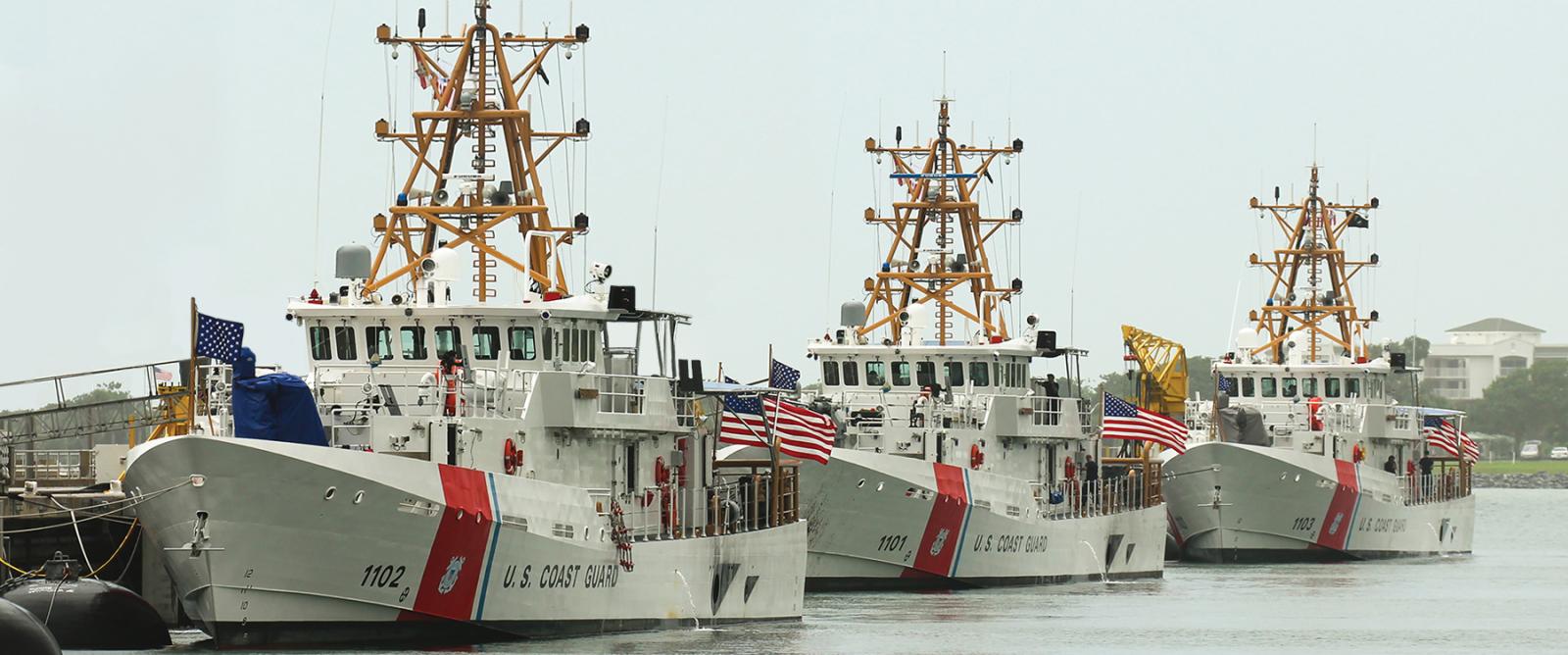
The first three fast response cutters—the USCGC Richard Etheridge (WPC-1102), Bernard C. Webber (WPC-1101), and William Flores (WPC-1103).
U.S. COAST GUARD

The September issue of US Naval Institute Proceedings has two articles about the Webber class WPCs that are currently featured articles online.

MSN shared a 1945 article by James Holmes, J. C. Wylie Chair of Maritime Strategy at the Naval War College, that seconds Cdr. Hulse proposal, “The U.S. Navy Needs Sentinel-Class Cutters to Serve as Missile Patrol Craft,

These are the right ships to help carry out U.S. maritime strategy in congested coastal terrain such as the Western Pacific, in wartime and times of tense peace alike. Denying an antagonist like China’s navy access to waters around and between Pacific islands is the strategy’s beating heart. Swarms of small, cheap, lethal surface and subsurface warships working with aircraft overhead and troops on the islands can close the straits along the first island chain, laying fields of overlapping fire that imprison Chinese sea and air forces within the island chain and bar the return home to units plying the Western Pacific. For self-defense, small surface combatants can mingle with merchant traffic amid East Asia’s cluttered maritime geography. In so doing they obscure their whereabouts and turn ambient conditions to tactical advantage. Let Chinese rocketeers try to distinguish friend from foe.

The first article by Lt. Chan suggests, 

Continuing production of fast response and national security cutters and transferring early hulls to regional allies would improve deterrence and interoperability.

This may not seem to make sense from the Coast Guard’s point of view in that USCGC Bernard C. Webber was commissioned in 2012 and the last of the 65 funded vessels of the class will be commissioned in about three years at which point the Webber will be only about 14 years old, still pretty new for a Coast Guard vessel. But looking at this from a whole of government perspective it looks a bit different. State Department hopes to gain or maintain influence with friendly nations that may not be able to afford adequate resources to patrol their waters. We also have an interest in the health of our ship building industry. There is presidency for this. Australia has twice built new patrol boats for their Western Pacific neighboring island nations. The Coast Guard would, of course, be much more receptive to the idea if funding for the replacement craft came out of someone else’s budget.

If the Navy did choose to build vessels of this class, and keep the production line going, then transfers of early model FRCs might be more readily accepted as they reach 20 or more years old.

The Second Article by Cdr. Hulse suggests,

“…the FRC’s Mk IV over-the-horizon cutter boat weighs 8,700 pounds and is stored in a notch near the stern. While this boat is highly capable for a variety of Coast Guard missions, it would not play a role for the Navy in conflict. Instead, a Navy FRC could mount a Naval Strike Missile box launcher with four tubes (8,600 pounds) at the stern, making it a formidable surface combatant. In addition, the deck forward of the pilothouse has considerable space for launching and recovering unmanned aerial vehicles (UAVs), enabling aerial surveillance and targeting. In fact, a Coast Guard FRC launched and recovered an Aerovel Flexrotor UAV while operating with the U.S. Navy’s Task Force 59 in Bahrain…with the current production line delivering four new FRCs per year to the Coast Guard at $65 million each. At that rate, the Navy could field 20 FRCs in just five years for the price of one Constellation-class frigate, which is projected to cost $1.3 billion per hull.”

The article goes into considerable detail about how the class has exceeded expectations along with cautions about what was required to make them succeed. It also suggests that the FRC could be the basis for an unmanned surface vessel.

Boots on the Ground, Navy Style:

City police forces have found they need patrolmen walking the beat who know the neighborhood and the people who live there to effectively fight crime. Armies need infantry to control and hold territory.

High end combatants can defeat their hostile counterparts to make sea control possible, but effective sea control is not possible without craft that can get into shallow water and enter every port. As Julian Corbett would said, Naval Control is not exercised by battleships.

The US Navy, forever focused on winning the big battle, has never had much enthusiasm for the craft that are the “boots on the ground” of a naval war. They tend to assume that allies and/or the Coast Guard will fill that role, or if not, they can build them when they need them and to some extent it has worked. Even so, it might have worked better if we had built and operated more of the vessels of the type before the shooting started.

In World War I, the US built hundreds of subchasers and 1000 ton destroyers. In WWII it was hundreds of PT boats that proved largely ineffective as torpedo boats but essential for the destruction of coastal traffic in both the Pacific and the Mediterranean. They were supplemented by the original LCS, Landing Craft Support, heavily armed shallow draft landing craft, nearly the same size as the FRCs. For Vietnam the Navy called on the Coast Guard and also built 170 Swift Boats and 718 Patrol Boat, River.

The U.S. Navy destroyer USS William D. Porter (DD-579) sinking after she was near-missed by a “Kamikaze” suicide aircraft off Okinawa, 10 June 1945. USS LCS(L)(3)-86 and McCool‘s LCS(L)(3)-122 are alongside, taking off her crew. Though not actually hit by the enemy plane, William D. Porter received fatal underwater damage from the near-by explosion.

Why would the Navy want these Patrol Craft?:

  • To enforce blockades
  • To counter kamikaze UAS and USV.
  • To support UAS, USV, and UUVs
  • To counter covert mine laying, arms smuggling, and intelligence agent or special forces transportation by boat.
  • To escort landing craft into an amphibious objective area. To rescue personnel from craft that are sunk. To tow disabled craft to safety. If properly equipped, to provide short range direct Naval fire support.

    Strait of Hormuz, august 6, USS Thomas Hudner, the Navy’s Lewis and Clark class cargo ship USNS Amelia Earhart and the U.S. Coast Guard’s Sentinel class cutter USCGC Charles Moulthrope, L3Harris Arabian Fox uncrewed surface vessel (USV)

If assigned to 5th Fleet, it would be logical to equip them with Hellfire/JASM or APKWS to counter Iranian drones and swarm tactics. In the Western Pacific arming with Naval Strike Missile is logical as would using the same air-search radars being used on the FRCs based in Bahrain. It might be possible to fit a Sea RAM forward, but if not, one or two remote weapon stations with an AAW capability might be enough.

A Final Note:

There is another reason we might want to have other nations to have FRCs. Since my cell phone has facial recognition, I think US Navy ships will have a hard time hiding among the traffic, particularly at the start of a conflict when their satellites are operational, and their fishing boats and merchant ships seem to be everywhere. But telling a USN FRC from a Vietnamese, Philippine, or Malaysian FRC would be quite difficult. It would complicate targeting.

“Papua New Guinea leads joint maritime operations with U.S. Coast Guard” –Coast Guard News

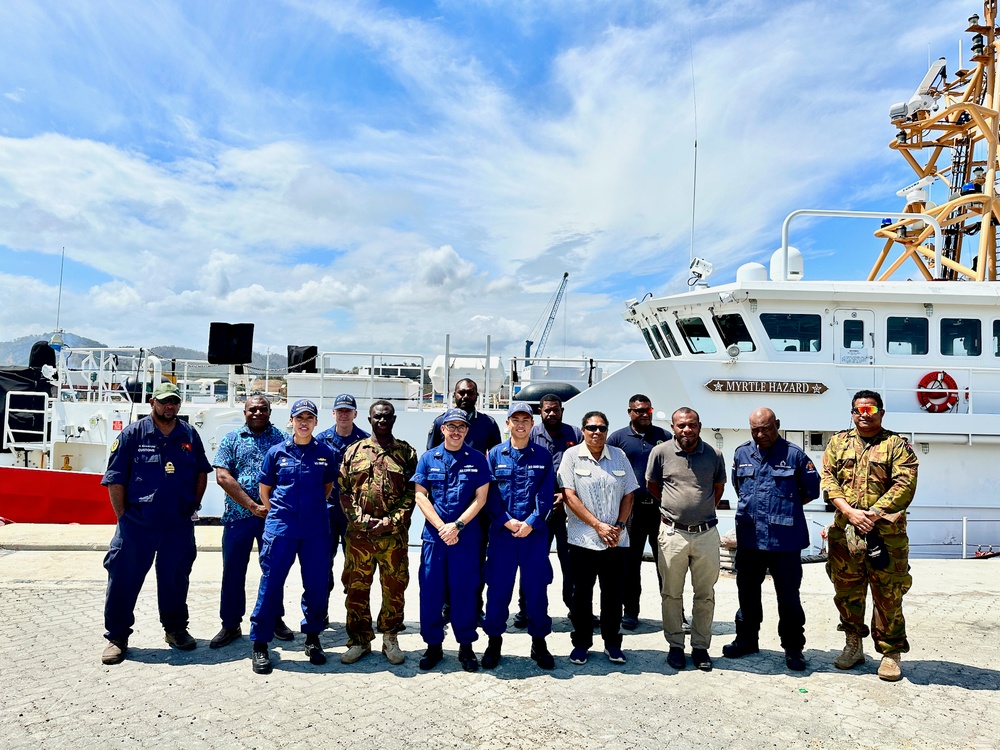
USCGC Myrtle Hazard (WPC 1139) hosts operational planning and subject matter exchange with partners in Port Moresby, Papua New Guinea

The USCGC Myrtle Hazard (WPC 1139) command stand for a photo with partners from the Papua New Guinea Defense Forces, Customs Services, National Fisheries Authority, and Department of Transport’s maritime security division following an operational planning and subject matter exchange with partners in Port Moresby, Papua New Guinea on Aug. 22, 2023. The U.S. Coast Guard is in Papua New Guinea at the invitation of the PNG government to join their lead in maritime operations to combat illegal fishing and safeguard maritime resources following the recent signing and ratification of the bilateral agreement between the United States and Papua New Guinea. (U.S. Coast Guard photo by Chief Warrant Officer Sara Muir) 

Passing along this from Coast Guard News. Like the fact that the Papua New Guinea government is taking the lead on this. We are helping them build capacity not doing the job for them.


Aug. 23, 2023

Papua New Guinea leads joint maritime operations with U.S. Coast Guard

Editor’s Note: For more images, please click here

PORT MORESBY, Papua New Guinea — Papua New Guinea (PNG) has invited the USCGC Myrtle Hazard (WPC 1139) to join their lead in maritime operations to combat illegal fishing and safeguard maritime resources during August 2023.

This collaborative effort marks the first time a joint patrol effort will be executed at sea since the signing and ratification of the recent bilateral defense agreement between PNG and the United States, which allows the U.S. to embark shipriders from PNG agencies aboard the ship to conduct at sea boardings on other vessels operating in the exclusive economic zone (EEZ) under their national agency authority. This is the U.S. Coast Guard vessel deployment first announced during Secretary of Defense Austin’s engagement with Prime Minister James Marape in July.

PNG’s lead in this mission aligns with their sovereign rights to protect the EEZ and emphasizes the country’s commitment to maritime domain awareness, fisheries regulation enforcement, and sovereignty protection. The PNG government requested the U.S. Coast Guard’s participation to utilize the platform and crew of the Guam-based 154-foot Fast Repones Cutter, currently on an expeditionary patrol, to expand coverage of the heavily trafficked maritime EEZ.

“Through our recent operational planning and subject matter exchange, the partnership between the Papua New Guinea Defence Force and the U.S. Coast Guard reached new heights. The spirit of collaboration and shared mission to ensure regional maritime security reflects our nations’ aligned values and commitment. This initiative fosters growth in our bilateral relationship and paves the way for innovative approaches to safeguard our waters and the sustainable use of our ocean resources. Working alongside the U.S. Coast Guard is an honor, and PNGDF eagerly anticipates our cooperative efforts’ continued growth and success,” said Commodore Philip Polewara, the Acting Chief of the PNG Defence Force.

The PNG-led patrol aims to observe activity and conduct boardings to reduce illegal fishing and illicit maritime activities in PNG’s EEZ. It’s part of a long-term effort to counter illegal maritime activity and safeguard the sustainable use of maritime resources.

This collaboration is vital to Operation Blue Pacific and augments ongoing efforts by the Pacific Islands Forum Fisheries Agency and Western and Central Pacific Fisheries Commission. It underscores the recent bilateral agreement, signed in May and ratified in the last few weeks, enabling the Myrtle Hazard crew to work collaboratively within PNG’s legal framework and strengthen relations with agencies with shared objectives.

The USCGC Oliver Henry (WPC 1140) crew was the first U.S. Coast Guard Fast Response Cutter to call on port in Papua New Guinea during their southern expeditionary patrol in the fall of 2022 to build relations, conduct engagements, and resupply.

The USCGC Myrtle Hazard’s crew is building on the work of their colleagues – already engaging with the PNG Defense Force through exchanges in the northern part of the country on this patrol, bolstering cooperation and understanding. This activity included subject matter exchanges with the PNG Defense Force Patrol Vessel Ted Diro crew and a port call in Rabaul, where the team engaged with the local community at the Rabaul Yacht Club. Additionally, the advance team and cutter crew conducted operations planning and subject matter exchanges across agencies in Port Moresby and ship tours for the embassy team and partners.

“We are deeply honored to collaborate with the Papua New Guinea Defense Force, Papua New Guinea Customs Services, Papua New Guinea National Fisheries Authority, and the Department of Transport’s Maritime Security Division at the invitation of the Papua New Guinea Government,” said Lt. Jalle Merritt, commanding officer of the USCGC Myrtle Hazard. “Our shared mission reflects PNG’s leading role in regional security, and we are committed to supporting their goals in this significant undertaking.”

For more information about this patrol and other related activities, please contact Chief Warrant Officer Sara Muir at sara.g.muir@uscg.mil or the respective agencies in Papua New Guinea.

Coast Guard in Oceania in the News

The USCGC Oliver Henry (WPC 1140) crew arrives in Manus, Papua New Guinea, on Aug. 14, 2022, from Guam as part of a patrol headed south to assist partner nations in upholding and asserting their sovereignty while protecting U.S. national interests. The U.S. Coast Guard is participating with partners to support the Pacific Islands Forum Fisheries Agency-led Operation Island Chief and the larger Operation Blue Pacific through patrols in the Western Pacific in August and September 2022. (U.S. Coast Guard photo by SW3 Victor Villanueva, NMCB-FOUR)

A couple of recent articles about the US relations with Palau and Papua New Guinea.

Map of the exclusive economic zones in the Pacific.

There has long been interest in a US base on Manus, Papua New Guinea, but this is politically sensitive. Basing cutters there that protect an important economic resource and occasionally rescue the locals when they get in trouble, would probably be most welcome.

On the map above, Manus and Guam do not look that far apart, but Manus is 1,737.88 km (938 nautical miles) SSE of Guam. That is about the distance from Miami to New York City. 

Cutters based in Manus would be closer to parts Freely Associated States (FAS) of Palau and Federated States of Micronesia than cutters based in Guam and much closer to most non-FAS Micronesian nations. It might also be a good place to site a fixed wing forward operating base (CGAS Honolulu DET).

I am beginning to think we will see two new bases in the Western Pacific, one in American Samoa and one in Manus.

If we do end up with additional Webber class based outside Hawaii and Guam, we might need a squadron support organization similar to, and perhaps even larger than, PATFORSWA, to support all FRCs based in the Pacific South and West of Hawaii, e.g. a PATFORSWPAC.

“Icebreakers, Pay Raise, New Cutters: House Adds $430M to Coast Guard Budget” –Military.com

FOUR WEBBER CLASS PATROL CRAFT. 220822-A-KS490-1182 STRAIT OF HORMUZ (Aug. 22, 2022) From the left, U.S. Coast Guard fast response cutters USCGC Glen Harris (WPC 1144), USCGC John Scheuerman (WPC 1146), USCGC Emlen Tunnell (WPC 1145) and USCGC Clarence Sutphin Jr. (WPC 1147) transit the Strait of Hormuz, Aug. 22. The cutters are forward-deployed to U.S. 5th Fleet to help ensure maritime security and stability across the Middle East. (U.S. Army photo by Spc. Noah Martin)

Military.com reports,

The House Appropriations Committee on Wednesday approved an increase to the Coast Guard’s fiscal 2024 budget, forwarding a bill to the full chamber that funds a 5.2% pay raise for members, a commercial icebreaker, four additional fast response cutters, and an extra HC-130J Super Hercules aircraft.

In addition to the projects in the original budget request, the committe has obviously, they have been looking at the Coast Guard’s FY2024 Unfunded Priority List.

The Unfunded Priority List included requests for an additional $1.6B.

The House Appropriations Committee recommendation would fund about $430M, including two big ticket items, four additional Webber class patrol craft and an additional C-130J. The unfunded priority list had listed the total price for the cutters and aircraft as $538.5M, so the markup may not include all the support costs for the cutters and missionization costs for the aircraft included in the Unfunded Priority list.

This still has a way to go before becoming law, but the Coast Guard has been receiving substantial bipartisan support and for the last few years Procurement, Construction, and Improvements budgets have been increased substantially over the requested amounts. There seems to be wide support for additional Webber class cutters to serve in the Western Pacific. As I noted in March,

We shouldn’t expect everything on the list to be approved, but I think we will definitely see the additional C-130 and at least three additional FRCs. Some of the other items will probably be approved as well. Those items not funded in FY2024 will likely be included in the FY2025 budget.

PATFORSWA’s USCGC Glen Harris, 2 Busts, May 8 and May 10, Heroin and Meth

Below are a pair of news releases from NAVCENT.


NEWS | May 10, 2023

U.S. Seizes $80 Million Heroin Shipment in Gulf of Oman

By U.S. Naval Central Forces Command Public Affairs

A U.S. Coast Guard fast response cutter seized $80 million worth of heroin from a fishing vessel transiting the Gulf of Oman, May 10, during the ship’s second drug bust this week.

USCGC Glen Harris (WPC 1144) was operating in support of Combined Task Force (CTF) 150 when a boarding team discovered 1,964 kilograms of heroin on a vessel transiting international waters after departing Chah Bahar, Iran. Glen Harris also seized $30 million worth of methamphetamine and heroin two days ago from another fishing vessel that departed the same port.

“I’m very proud of my crew and all we’ve been able to accomplish as a team this week,” said Lt. Nick Jabs, Glen Harris’s commanding officer. “We’re out here to work with regional partners and disrupt any destabilizing maritime activity at sea. We will continue getting after it.”

Glen Harris’s previous seizure on May 8 included 580 kilograms of methamphetamine and 35 kilograms of heroin.

The ship arrived in the Middle East last year as part of a contingent of U.S. Coast Guard cutters that are forward-deployed to the region under Patrol Forces Southwest Asia.

CTF 150 is one of four task forces that form the world’s largest multinational naval partnership, Combined Maritime Forces. Naval forces supporting CTF 150 have now seized illegal drugs worth a combined estimated U.S. street value of more than $250 million in 2023. These efforts help ensure legitimate commercial shipping transits the region free from non-state threats.


NEWS | May 8, 2023

U.S. Coast Guard Seizes $30 Million in Drugs with International Task Force

By U.S. Naval Central Forces Command Public Affairs

A U.S. Coast Guard fast response cutter seized more than $30 million of heroin and methamphetamine from a fishing vessel transiting the Gulf of Oman, May 8.

Operating in support of Combined Task Force (CTF) 150, USCGC Glen Harris (WPC 1144) seized 580 kilograms of methamphetamine and 35 kilograms of heroin from a vessel transiting international waters after departing Chah Bahar, Iran.

CTF 150 is one of four task forces that form the world’s largest multinational naval partnership, Combined Maritime Forces. Naval forces supporting CTF 150 have seized illegal drugs worth a combined estimated U.S. street value of nearly $200 million in 2023.

Glen Harris arrived in the Middle East last year and operates from the U.S. Navy base in Bahrain where CMF is headquartered with U.S. Naval Forces Central Command and U.S. 5th Fleet.

The fast response cutter is part of a contingent of U.S. Coast Guard ships forward-deployed to the region under Patrol Forces Southwest Asia (PATFORSWA). PATFORSWA deploys Coast Guard personnel and ships alongside U.S. and regional naval forces throughout the Middle East.

“The dedication and expertise of Glen Harris’s leadership and crew embody our commitment to interdict and remove illicit narcotics from the sea, denying malign actors the ability to destabilize the region,” said Capt. Eric A. Helgen, PATFORSWA’s commander. “I could not be more proud of our fast response cutter crews.”

Currently led by the United Kingdom, CTF 150 conducts maritime security and counter-terrorism operations in the Gulf of Oman and Indian Ocean to disrupt criminal and terrorist organizations and their related illicit activities, including the movement of personnel, weapons, narcotics and charcoal. These efforts help ensure legitimate commercial shipping transits the region free from non-state threats.

U.S. and international naval units in the Middle East seized illegal drugs totaling $1 billion in value from 2021 to 2022.

“GAPPED BILLET SQUALL ON THE HORIZON: THE USCG OFFICER CORPS COULD BE IN TROUBLE” –CIMSEC

CIMSEC has an interesting article by a serving officer, Lt. Joseph O’Connell.

He starts off talking about gapped billets in the Coast Guard in general, 200 in 2021, but then concentrates on gapped afloat billets, 11 in 2021.

” This shortage grows more acute when considering the critical billets O3 and O4 officers fill aboard Coast Guard cutters: Operations Officers, Engineer Officers, Executive Officers, and Commanding Officers, depending on the cutter class.”

I am sure his observations are accurate, as far as they go, but I think he may have missed an important aspect of the Coast Guard’s assignment policies that has resulted in many officers, with sea going ambitions, making the choice to leave the service at the O-3/4 level. If we don’t do something differently, the problem is going to get worse.

As the Coast Guard continues to bring new hulls online while operating legacy assets the demand for afloat officers will far outstrip the limited and dwindling supply, with projections anticipating a 25% increase in cutter billets from current levels.

A change in personnel assignment policy could make a big difference.

I am long out of the service, so it is best if you check to see if my assumptions are correct.

Assumptions:

  • The ambition of most seagoing officers is ultimately to have a command afloat.
  • Being a department head or XO is not an end in itself. It should be seen as a step toward command.
  • Assignment officers are more likely to select an officer to command if they have had a previous successful command tour.
  • If an O-3 sees that it is extremely unlikely he will ever get a command, he is unlikely to seek a department head or XO job and may very well leave the service.

Effects:

Coast Guard personnel policies have created a situation where if you have not gotten a command as an E-3, it is unlikely you ever will.

The service is procuring 65 Webber class WPCs. At least 51 have already been commissioned. While a few are commanded by warrants or O-4s, generally they are commanded by O-3s. These and the few other O-3 afloat command billets create a large pool of potential future COs to choose from.

Those that have been or expect to be O-3 COs are unlikely to seek billets as department heads or XOs.

Those who miss the opportunity to command at the O-3 level, will see little chance they will be an afloat CO in the future.

Proposal:

Make command of a Webber class an O-4 billet.

Require that those selected to command Webber class WPCs will have completed a successful department head or XO afloat tour.

Rationale:

While some may feel command of a patrol craft requires only a junior officer, consider that these little ships, unlike WPBs, are doing all the same missions as an MEC (except the aviation component) with a smaller crew and fewer senior personnel to advise and support the CO. These ships generally operate independently, unlike Navy patrol craft which generally operate in groups under a squadron commander. We are seeing some of them embark on voyages of thousands of miles, operating outside US waters.

This policy would provide an incentive for officers to seek department head or XO tours as O-3s.

The Officers chosen to be COs at the O-4 level will be more experienced and more mature.

The service will have had more time to evaluate the officers prior to assignment including direct observation by a CO afloat, who should make a recommendation for or against a future command afloat.

Ultimately some officers will determine that they really have no chance of getting a CO afloat tour, but it will happen later in their career, when they may have found other rewarding work and they are less likely to leave the service.

New Units for Alaska, the Haley, and Nome

Northeast Russia and Alaska. Photo: Shutterstock

One of our readers sent me an article from the Alaska Beacon about the need for additional housing for the military that includes some insight into the Coast Guard’s future in Alaska.

The information about the Coast Guard is toward the end of the article. This seems to be confirmation that the two FRCs in Ketchikan will be joined by four more, two in Kodiak and one each in Sitka and Seward, and that their additional supporting infrastructure is being provided.

We already knew the third and fourth OPCs, Ingham (917) and Rush (918), will be going to Kodiak.

What About USCGC Alex Haley?:

The crew of the USCGC Alex Haley (WMEC 39) transfers custody of the detained fishing vessel Run Da to a People’s Republic of China Coast Guard patrol vessel in the Sea of Japan, June 21, 2018. The Alex Haley and PRC Coast Guard crews detained the Run Da suspected of illegal high seas drift net fishing. U.S. Coast Guard photo. Petty Officer 1st Class William Colclough

The Alex Haley is currently homeported in Kodiak. When I saw that two OPCs were to be homeported in Kodiak, my first assumption was that they would replace the Haley as well as USCGC Douglas Munro also based there, but perhaps that assumption was unwarranted.

Alex Haley is nominally a medium endurance cutter, but with a 10,000 nautical mile range and a 3,484 tons full load displacement, she is more of a high endurance cutter with the crew of a 270 foot WMEC.

She is an old ship, having been originally commissioned in 1971, but still younger than any of the 210 and considerably more capable. She is well suited to the Alaskan environment, so I don’t see her being moved outside the 17th District (Alaska). She is simple, meaning she is relatively easy to maintain, but with twin shafts and four engines, she also has redundancy.

She was extensively renovated, and her engines replaced before she was recommissioned into the Coast Guard in 1999, more than eight years after the last 270 was commissioned.

The second OPC to be based in Kodiak probably will not arrive before 2028. The last 210 will probably not be decommissioned until about 2033.

If the intention is to ultimately have three OPCs in Kodiak, as I believe may be the case, there is a good possibility that the Haley could hang on until that ship arrives.

What about Nome?:

USCGC Alex Haley moored in Nome, AK.

There is also mention of the planned port expansion in Nome with a suggestion that the Coast Guard may have units there.

One tight spot may be Nome, where there are plans to expand the city port into a deepwater, Arctic-service port which Moore called a “fantastic opportunity” for Coast Guard operations.

I don’t think we will see either large patrol cutters (unless it is the Alex Haley) or FRCs based there, but moving one of the Juniper class seagoing buoy tenders there, with its light icebreaking capability might make sense. I suppose a medium icebreaker might be a possibility, but that is a very long shot.

There will probably be a seasonal air detachment stationed in Nome.

Thanks to Paul for bringing this to my attention.

Coast Guard’s FY2024 Unfunded Priority List

The crew USCGC Oliver Henry (WPC 1140) visit Ulithi Atoll on Oct. 31, 2022, the first time a fast response cutter visited the atoll and delivered 20 boxes of supplies, 50 personal floatation devices, and sporting equipment donated by the cutter crew, the extended U.S. Coast Guard Guam family, Ulithi Falalop Community Action Program, Guam Island Girl Power Foundation, and Ayuda Foundation. Ulithi was a central U.S. staging area during World War II, and home to a U.S. Coast Guard Loran-C communications station from 1944 to 1965 before operations relocated to Yap and ultimately shuttered in 1987. (U.S. Coast Guard photo by Petty Officer 3rd Class Zena Suzuki)

The Coast Guard has published its FY2024 Unfunded Priority List. The ten page document includes 26 line items totaling $1.6B. Much of it is infrastructure improvement, but there are also items to expand capabilities.

Four Additional Fast Response Cutters:

The single largest item is four additional Webber class WPCs. I think this will be approved and that this includes funding of facilities for a new base in American Samoa.

$400M “Funds the acquisition of four FRCs to further the Indo-Pacific Strategy of the United States through expanded presence and engagement to promote a free an open Indo-Pacific. Additional FRCs will begin to transform the Coast Guard from an organization which currently provides episodic presence, to be persistent and visible, strengthening coordination with Allied and partner nations to bolster regional security.”

Historically FRCs have been funded at about $65M each, and even that included support costs in addition to construction costs. There has been inflation, but the list gives us some information about that effect in a separate line item.

$34M “Fast Response Cutter (FRC) Economic Price Adjustment (EPA). Funding aids in reducing unfunded EPA growth resultant from the unprecedented rise in material and labor indices associated with contractual costs for production of hulls 1145 -1164 and procurement of spares. This amount provides the $34 million necessary for the projected EPA liability in FY 2024.

That is $34M spread over 20 ships or an increase of less than $2M per ship, so there is probably at least $120M for support costs over and above construction costs.

Aviation Improvements (note the third item indicates C-27Js will be assigned to CGAS Clearwater, FL, presumably replacing the C-130Hs there now)

  • $138.5M One Missionized HC-130J Aircraft. rovides funding to purchase one missionized HC-130J aircraft in the Block Upgrade 8.1 configuration, manufactured by Lockheed Martin, and currently missionized by L3 Technologies. This funding supports acquisition costs for one of the unfunded three missionized C-130Js required to achieve the Coast Guard’s current program of record of 22 airframes and initial sparing.
  • $113M Four MH-60T Aircraft. Provides funding to outfit and assemble 4 MH-60T aircraft that would facilitate a future Air Station transition from MH-65s to MH-60s in FY 2026. These aircraft would be assembled at the Coast Guard’s Aviation Logistics Center in Elizabeth City, NC.
  • $25M Sparing for Fixed-Wing Aircraft Transitions. Provides initial sparing to establish on-site inventory for HC-130J and HC-27J aircraft planned for delivery to Barbers Point, HI, ($10 million) and Clearwater, FL ($15 million). This funding includes spare parts for aircraft, sensor suites, depot maintenance material, and ground support equipment necessary for aircraft operations as well as LLTM required to accelerate the missionization of HC-27J aircraft. (Scalable)

Infrastructure improvements are requested for:

  • Polar Security Cutter (PSC) Homeport Seattle (Phase 1-2), $130M
  • FRC Homeport Astoria (Phase 2), $30M
  • Waterways Commerce Cutter (WCC) Homeports – Sault Ste Marie, MI and Memphis, TN, $48M
  • NSC and Ocean-Going Buoy Tender (WLB) Homeport – Honolulu, HI (Phase 2), $15M
  • Offshore Patrol Cutter (OPC) Homeport – NAVSTA Newport, RI (Phase 2), $100M
  • Training Center Cape May -Multipurpose Recruit Training Facility, $130M
  • Alaska Housing (Kodiak), $26M
  • Sector Facilities – Sector Sault Ste Marie, MI, $35M
  • Consolidated Base Facilities – Base Charleston, SC, $22.6
  • Coast Guard Yard Upgrade: Ship Handling Facility – Baltimore, MD (Phase 1), $60M
  • Sector Facilities – Sector Lower Mississippi River – Memphis, TN, $37M
  • Station Waterfront – Station Rockland, ME, $40.7M
  • Mission Support Facility (MSF) – Joint Base Andrews, MD (Phase 3), $20M

Miscellaneous:

  • Great Lakes Icebreaker – Long Lead Time Material (LLTM), $20M
  • Special Purpose Craft (MLB)– Heavy Weather Recapitalization, $24M
  • Mariner Credentialing Program, (Navita) Acquisition, $11M
  • National Security Cutter (NSC) –Follow-On Acquisition Funding, $50M
  • National Security Cutters Operational Support Initiatives, $9.7M
  • Operations and Defense Industrial Base, $42M
  • Recruiting & Retention, $9m
  • Modernized Learning Management System, $3M

What does it all mean:

None of these items are in the current budget request, but Congress has historically added to the Coast Guard request. The Coast Guard has been shy about providing an unfunded priority request in the past. Several years there was no unfunded priority list. This is the first time I have seen mention of the Coast Guard’s list in industry news publications (here and here). The new CG administration is making public a good case for increased funding.

We shouldn’t expect everything on the list to be approved, but I think we will definitely see the additional C-130 and at least three additional FRCs. Some of the other items will probably be approved as well. Those items not funded in FY2024 will likely be included in the FY2025 budget.