The 2017 Budget

It seems a bit late to talk about the FY2017 budget, but here we are, eight months into the FY, and it is finally signed into law. This is a bit rambling, forgive me, but that is the budget process.

The Coast Guard’s description of the Obama administration’s original budget request is here. It is fairly detailed, but now obsolete.

A short summary of the Coast Guard budget, as part of a summary of the Department budget, contained in the Omnibus bill is here. It is quoted in full below.

Coast Guard – The bill contains $10.5 billion for the U.S. Coast Guard – an increase of $344 million above the previous Administration’s request and a decrease of $467.3 million below the fiscal year 2016 enacted level. Specifically, the bill:

  • Provides 1.6 percent military pay increase;

  • Provides $7.1 billion for operations and training, military personnel costs, aviation and cutter hours, and to reduce a maintenance backlog that can hinder readiness and response; and

  • Provides $1.37 billion – $233 million above the request – for modernization and recapitalization of vessels, aircraft, and facilities. This includes funding for the Polar Ice Breaking Vessel program, the acquisition of an Offshore Patrol Cutter, an HC130-J aircraft, six Fast Response Cutters, and facility improvements at multiple locations throughout the United States.

The good news here is that the Coast Guard will not see a dramatic cut to pay for “the Wall.” The bad news is that the total budget is down over $600M from the FY2016 enacted budget (I know this is different from the summary above, but that is what I got), most of which is an approximately $580M cut in AC&I which included NSC#9.

There is actually a small increase in operating budget from last year and from the initial budget request, a bit over $100M.

There is a pleasant surprise in the notes explaining budget reductions in the Coast Guard’s explanation of the initial budget request:

“National Security Cutter Energy Efficiency -$13.5M

(O FTE) Reflects savings from a re-calculation of National Security Cutter (NSC) energy costs based on observed energy expenditures during NSC operations, without impacting the ability to carry out those operations”

Apparently the big cutters are not costing a much to fuel as we expected. I suppose this could just reflect current oil prices.

There is also a note that there will be a permanent increase in the crew size for all NSCs.

You can see the actual bill here (pdf), the Coast Guard budget is on pages 28-32.

Unexpected items in the Operating Budget

  • Additional $4.49M for Cyber
  • $5M for the CG museum

Reserves: A total of$112,302,000 is provided for Reserve Training.

The AC&I Budget includes:

  • $2M for design work on Great Lakes icebreaking capacity
  • $1M for design work on Inland AtoN fleet
  • $99M for Shore and AtoN (Almost doubles original request of $51.1M) 
  • National Security Cutter. A total of $255,400,000 is provided for the National Security Cutter (NSC) program. The total includes $95,000,000 for procurement of long lead time materials associated with a tenth National Security Cutter, and $3,400,000 for post-delivery activities for the ninth NSC. In addition, $30,000,000 is included to support a necessary Structural Enhancement Dry-dock Availability (SEDA) for the second NSC.
  • $325M for six FRC (rather than four for $240M in the original request)
  • $55M total for the Polar Icebreaker program.
  • $90M for a missionized C-130J
  • $44.52M for shore facilities
  • Major Acquisition Systems Infrastructure. A total of $50,000,000 is provided, including $22,000,000 to support the Coast Guard’s plan to homeport OPCs in the arctic region to replace aging assets.
  • A total of $36,319,000 is provided for Research, Development, Test, and Evaluation (RDT&E). Includes $18M to evaluate long range shore based Unmanned Air Systems.

There is a change in ship procurement policy:

“The policy requiring the Coast Guard to obtain appropriations for the total acquisition cost of a vessel, including long lead time materials, production costs, and post-production costs, before a production contract can be awarded has the potential to create shipbuilding inefficiencies, force delays in the obligation of production funds, and require post production funds far in advance of when they will be used. The Office of Management and Budget is expected to give the Coast Guard the flexibility to acquire vessels, including the Offshore Patrol Cutter (OPC), in the most efficient manner within the guidelines of strict governance measures.”

Funding for Coast Guard OCO/GWOT activities ($162.7M) is provided directly through the Operating Expenses appropriation instead of through the Navy’s Operation and Maintenance account.

There are some requirements incorporated in the law.

“Not later than 90 days after the date of enactment of this Act, the Coast Guard shall brief the Committees on plans, including a funding strategy,  for improving the cybersecurity posture of the Coast Guard and balancing requirements of operating within the “.mil” domain while adhering to DHS cyber directives.”

“The Coast Guard is directed to submit to the Committees a Capital Investment Plan (CIP) for fiscal years 2018 through 2022 by June 30,2017.”

“The Coast Guard is directed to move quickly in approving additional Ballast Water Management Systems (BWMS)and shall work with the Environmental Protection Agency to reexamine whether the most probable number method can be used as an alternative for testing the effectiveness of treatment systems. The Coast Guard is further directed to brief the Committees on the status of its BWMS testing efforts as set forth in the House report.”

“Not later than 180 days after the date of enactment of this Act, the Secretary shall submit to the Committees a report on the Coast Guard’s plans to ensure long-term search and rescue coverage for the Arctic. This report shall also address the Coast Guard’s capability for conducting response missions throughout the Western Alaska Captain of the Port Zone, including the Bering Sea and Arctic Ocean. The report shall provide details on pollution response equipment; spill response organizations; spill prevention and mitigation methods; and response partnerships with federal, state, and local entities.”

“The Coast Guard is directed to brief the Committees not later than 30 days after the date of enactment of this Act on any changes expected in the funding requirement for OCO/GWOT activities during fiscal year 2017. Further, the Coast Guard is directed to include details of its current and future support to Central Command in the classified annex of the fiscal year 2018 budget request.”

“Under the new strategy, the IPO (Icebreaker Project Office–Chuck) will obtain detailed industry feedback through trade-off analyses to further refine and validate operational requirements. A report on polar icebreaker requirements, preferred design, overall acquisition strategy, and a breakout of funds necessary to support the acquisition shall be submitted to the Committees not later than 90 days after the date of enactment of this Act.” (I personally don’t think this is a realistic deadline–Chuck)

“The Senate report encouraged the Coast Guard to explore the use of water purification systems free of bromine. Within 90 days of the date of enactment of this Act, the Coast Guard shall brief the Committees on the costs, benefits, and feasibility of adopting this new type of system.”

“The Coast Guard is directed to examine the feasibility, costs, and benefits of conducting intelligence, surveillance, and reconnaissance missions in transit zones using long range/ultralong endurance, land based, unmanned aerial systems. Within the total provided for RDT &E, $18,000,000 is included for the Coast Guard, in collaboration with CBP and S&T to perform an analysts of alternatives (AoA) on available systems and mission equipment packages before conducting a proof of .. ~ concept demonstration of selected systems. The Coast Guard shall brief the Committees on its plans for conducting the AoA and proof of concept within 180 days after the date of enactment of this Act. Further, the Coast Guard, along with CBP and S&T, shall brief the Committees on the results of the demonstration within 90 days following its completion. “
Fincantieri’s Icebreaker Design Team Emerges

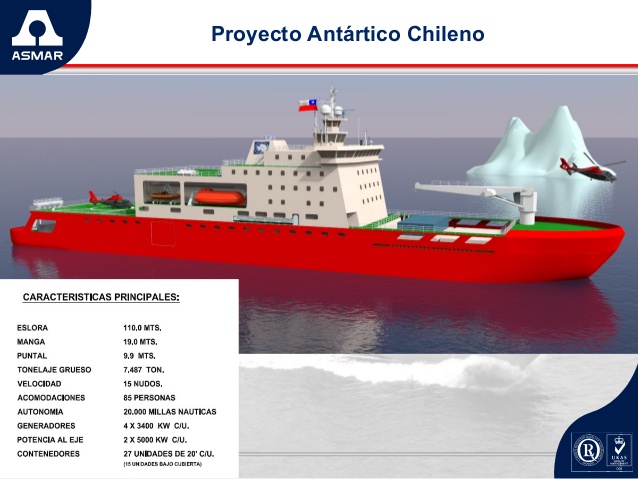
Photo: VARD designed icebreaking supply vessel for Chile. 

MarineLog is reporting, “APRIL 6, 2017—Philly Shipyard, Philadelphia, PA, is teaming with Fincantieri Marine Group (FMG) to compete for the detail design and construction of the next generation heavy polar icebreaker for the United States Coast Guard (USCG).”

“Over the next year, FMG and Philly Shipyard, along with the naval architecture and marine engineering firm, Vard, will develop a baseline icebreaker design, cost estimate and project schedule and then refine them based on the results of the technical studies and corresponding feedback from the USCG.”

This is in response to a contracted awarded to five shipbuilders on Feb. 22, 2017, for preliminary design studies and analysis. Contracts were awarded to Bollinger Shipyards, LLC, Lockport, LA; Fincantieri Marine Group, LLC, Washington, DC; General Dynamics/National Steel and Shipbuilding Company, San Diego, CA; Huntington Ingalls, Inc., Pascagoula, MS; and VT Halter Marine, Inc., Pascagoula, MS, totalling approximately $20M.

Fincantieri is building a 9000 ton research icebreaker for Norway and Vard has designed an icebreaking supply vessel for Chile.

Draft Polar Icebreaker Specs Issued

The Acquisitions Directorate (CG-9) is reporting that they have issued draft specifications for the Polar Icebreaker. The following is a verbatim copy of the press release.

The Coast Guard released its draft heavy polar icebreaker system specifications in a request for information (RFI) today. The request seeks questions, comments and feedback related to heavy polar icebreaker technology risks, sustainability, producibility and affordability. The RFI can be found here.

This RFI is part of ongoing market research conducted with the Navy and includes the draft specifications for icebreaker hull structure, propulsion and electrical plants, command and surveillance systems, weaponry, outfitting and auxiliary systems. Industry sources are invited to submit responses by June 16, 2017, at 11 a.m. Eastern time.

Following market research, the Coast Guard plans to release a request for proposal for detail design and construction of a heavy polar icebreaker in fiscal year 2018. The service plans to begin production activities in 2020.

For more information: Polar Icebreaker program page

We don’t have access to the specifications.

“Due to size limitations, the draft HPIB System Specification will be posted to FedBizOpps (FBO) via multiple document packages which will be deemed “limited access” and “export controlled.” All vendors must be granted “explicit access” by USCG in the FBO system in order to gain access to these limited access or export controlled packages.”

My Unfunded Priority List

An earlier post reported a plea by Representative Duncan Hunter, Chair of the Transportation Subcommittee on Coast Guard and Maritime Transportation, for the Coast Guard to provide an unfunded priority list to include six icebreakers and unmanned Air System.

Thought perhaps I would list my own “unfunded priorities.” These are not in any particular order.

PLATFORM SHORTFALLS

Icebreakers: We have a documented requirement for three heavy and three medium icebreakers, certainly they should be on the list. Additionally they should be designed with the ability to be upgraded to wartime role. Specifically they should have provision for adding defensive systems similar to those on the LPD–a pair of SeaRAM and a pair of gun systems, either Mk46 mounts or Mk38 mod 2/3s. We might want the guns permanently installed on at least on the medium icebreakers for the law enforcement mission. Additionally they should have provision for supporting containerized mission modules like those developed for the LCS and lab/storage space identified that might be converted to magazine space to support armed helicopters.

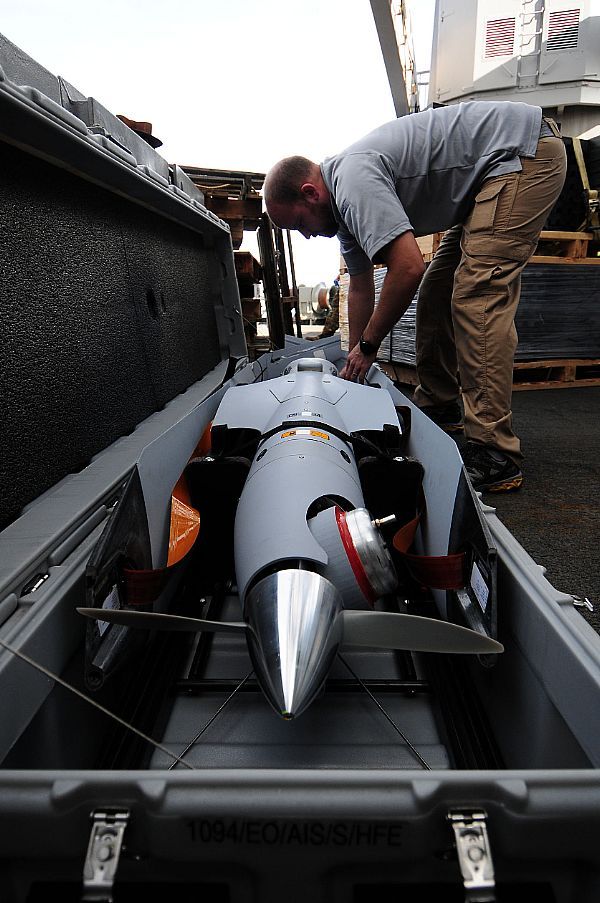
110225-N-RC734-011 PACIFIC OCEAN (Feb. 25, 2011) Guy Mcallister, from Insitu Group, performs maintenance on the Scan Eagle unmanned aerial vehicle (UAV) aboard the amphibious dock landing ship USS Comstock (LSD 45). Scan Eagle is a runway independent, long-endurance, UAV system designed to provide multiple surveillance, reconnaissance data, and battlefield damage assessment missions. Comstock is part of the Boxer Amphibious Ready Group, which is underway in the U.S. 7th Fleet area of responsibility during a western Pacific deployment. (U.S. Navy photo by Mass Communication Specialist 2nd Class Joseph M. Buliavac/Released)

110225-N-RC734-011
PACIFIC OCEAN (Feb. 25, 2011) Guy Mcallister, from Insitu Group, performs maintenance on the Scan Eagle unmanned aerial vehicle (UAV) aboard the amphibious dock landing ship USS Comstock (LSD 45). Scan Eagle is a runway independent, long-endurance, UAV system designed to provide multiple surveillance, reconnaissance data, and battlefield damage assessment missions. Comstock is part of the Boxer Amphibious Ready Group, which is underway in the U.S. 7th Fleet area of responsibility during a western Pacific deployment. (U.S. Navy photo by Mass Communication Specialist 2nd Class Joseph M. Buliavac/Released)

Unmanned Air Systems (UAS): We seem to be making progress on deploying UAS for the Bertholf class NSCs which will logically be extended to the Offshore Patrol Cutters. So far we see very little progress on land based UAS. This may be because use of the Navy’s BAMS system is anticipated. At any rate, we will need a land based UAS or access to the information from one to provide Maritime Domain Awareness. We also need to start looking at putting UAS on the Webber class. They should be capable of handling ScanEagle sized UAS.

File:USCGC Bluebell - 2015 Rose Festival Portland, OR.jpg

Photo: The Coast Guard Cutter Bluebell sits moored along the Willamette River waterfront in Portland, Ore., June 4, 2015. The Bluebell, which celebrated its 70th anniversary this year, is one of many ships participating in the 100th year of the Portland Rose Festival. (U.S. Coast Guard photo by Chief Petty Officer David Mosley.)

Recapitalize the Inland Tender Fleet: This is long overdue. The program was supposed to begin in 2009, but so far, no tangible results. It seems to have been hanging fire for way too long.

Expand the Program of Record to the FMA-1 level: The Fleet Mix Study identified additional assets required to meet the Coast Guard’s statutory obligations identifying four asset levels above those planned in the program of record. Lets move at least to first increment.

Alternative Fleet Mix Asset Quantities

————–POR       FMA-1      FMA-2      FMA-3       FMA-4
NSC                8             9                 9                 9                  9
OPC              25           32               43                50               57
FRC              58           63               75                80               91
HC-130         22            32               35                44               44
HC-144A       36            37               38                40               65
H-60              42            80               86                99             106
H-65             102         140             159              188            223
UAS-LB           4            19                21                21              22
UAS-CB        42            15                19               19               19

At the very least, looks like we need to add some medium range search aircraft (C-27J or HC-144).

Increase Endurance of Webber Class Cutters: The Webber class could be more useful if the endurance were extended beyond five days (currently the same as the 87 cutters, which have only one-third the range). We needed to look into changes that would allow an endurance of ten days to two weeks. They already have the fuel for it.

MISSION EQUIPMENT SHORTFALLS

Seagull_torpedo_trial_1

Ship Stopper (Light Weight Homing Torpedo): Develop a system to forcibly stop even the largest merchant ships by disabling their propulsion, that can be mounted on our patrol boats. A torpedo seems the most likely solution. Without such a system, there is a huge hole in our Ports, Waterways, and Coastal Security mission.

121211-N-HW977-692

Photo: SeaGriffin Launcher

Counter to Small High Speed Craft (Small Guided Weapon): Identify and fit weapons to WPB and larger vessels that are capable of reliably stopping or destroying small fast boats that may be used as fast inshore attack craft and suicide or remote-controlled unmanned explosive motor boats. These weapons must also limit the possibility of collateral damage. Small missiles like SeaGriffin or Hellfire appear likely solutions.

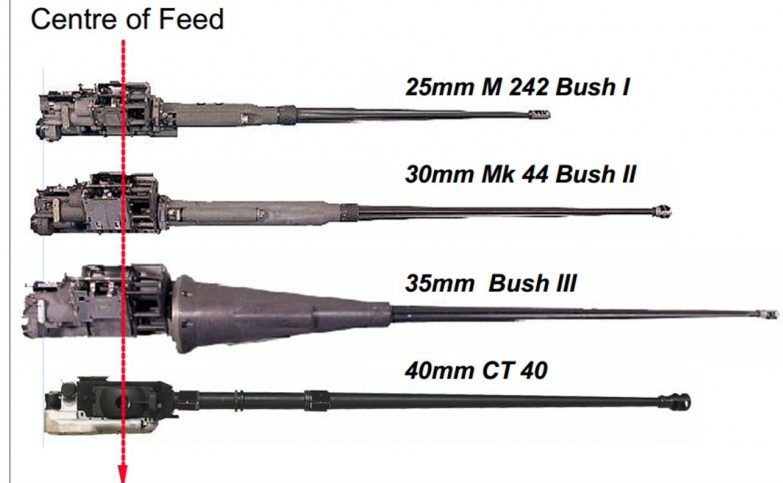
40 mm case telescoped gun (bottom) compared to conventional guns.

40 mm case telescoped gun (bottom) compared to conventional guns.

Improved Gun–Penetration, Range, and Accuracy: The .50 cal. and 25mm guns we have on our WPBs and WPCs have serious limitations in their ability to reach their targets from outside the range of weapons terrorist adversaries might improvise for use against the cutters. They have limited ability to reach the vitals of medium to large merchant vessels, and their accuracy increases the possibility of collateral damage and decreases their probability of success. 30, 35, and 40 mm replacements for the 25 mm in our Mk38 mod2 mounts are readily available.

Laser Designator: Provide each station, WPB, and WPC with a hand-held laser designator to allow them to designate targets for our DOD partners.

CONTINGENCY PLANNING SHORTFALLS

Vessel Wartime Upgrades: Develop plans for a range of options to upgrade Coast Guard assets for an extended conflict against a near peer.


Changes Ahead, Acquisition, Organization? and Again, Where is the Damn Unfunded Priority List?

Two new posts regarding the Coast Guard’s future, both from Defense News.

The first, “Commentary: US Coast Guard deserves military level funding,” by Representative Duncan D. Hunter (R-CA) is a plea for better funding of the Coast Guard. Its significance is less what it says, than who is saying it.

The second, “US Coast Guard urged to step up requirements,” by Christopher P. Cavas, quotes Representative Hunter and his chief of staff, Joe Kasper. It primarily encourages the Coast Guard to provide a comprehensive unfunded priority list, primarily with regard to icebreakers, Unmanned Air Systems, and, some what obliquely, the inland tender fleet, but it goes further, indicating Hunter will attempt to have the Coast Guard moved into the DOD and have our larger cutters better armed.

So who is Representative Hunter?  He is the son of long serving representative Duncan L. Hunter. He serves on the Armed Services, Education and the Workforce and Transportation and Infrastructure committees, and most importantly for us, he chairs the Transportation Subcommittee on Coast Guard and Maritime Transportation. He is a Marine Reserve Major. The day after the September 11 attacks, Hunter quit his job and joined the Corps. He served two tours in Iraq as an artillary officer and was recalled to duty for a tour in Afghanistan.

Perhaps significantly he and Rep. Chris Collins (R-NY) were the first members of Congress to endorse Trump.

I first became aware of him watching the video you can see here, “Coast Guard and Maritime Transportation Subcommittee Hearing on Coast Guard Arctic Implementation Capabilities 7/12/16.” I should have been paying more attention earlier when I included another video of a subcommittee hearing here, “Subcommittee on Coast Guard and Maritime Transportation: Examining Cutter, Aircraft, and Communications Needs.”

If you look, particularly at the first video from 2016, you will see his frustration with the Coast Guard leadership. This call for an “expansive” unfunded priority list seems to be an effort to teach the Coast Guard leadership how to “play the game.”

“We’re trying to instill some courage in the Coast Guard,” he added. “They’re taking on a bigger role, doing more things. We’re talking about the Arctic, about inland waterways. Until you ask for it, it is going to be increasingly difficult for us on the Hill to sound the need. There is no confusion around the Navy’s fleet size, there’s good awareness on where the Navy needs to be. The Navy knows how to play this game, to advocate for its needs.  Until you start getting out in front and making the case for where you need to be and not worrying about the effect on your budget, you’re never going to get what you need.”

I have expressed my own inability to understand why the Coast Guard will not provide an unfunded priorities list even when it is requested by Congress. Here in 2013, and again in 2014.

Hopefully we will see one this year.

Thanks to Luke for bringing these to my attention.


Icebreakers and Motherships at SNA 2017

Defense & Aerospace Report Editor Vago Muradian interviews General Dynamics NASSCO’s Tom Wetherald regarding its US Coast Guard icebreaker and US Navy ship programs with during the 29th Surface Navy Association Symposium in Arlington, Virginia.

Interestingly NASSCO, like Eastern, teamed with VARD to develop their icebreaker concept.

Notably I see not weapons or positions for weapons on the icebreaker concept.

It may be good news for us that more Expeditionary Sea Bases (formerly “Afloat Forward Staging Bases”). It is likely one will go to to SOUTHCOM and may be available to support counter drug operations.

A Little More on the Offshore Patrol Cutter

OPC "Placemat"

OPC “Placemat”

MarineLink has a story on the OPC, and it includes a bit more detail, and it raises some questions. I’ve also seen a couple of stories about how they will be equipped that will be referred to below.

There is this:

“Zukunft’s budget suggests at least one cutter, or an immediate separate order, will be arctic capable, and Vard and Canadian engineering consultancy BMT Fleet are already understood to be working on project documents for a Canadian “arctic offshore patrol ship” of Vard 7 100 type.”

VARD 7-100 ICE, the Canadian AOPS

VARD 7-100 ICE, the Canadian AOPS

Vard actually has two designs designated “7-100,” an offshore patrol vessel (pdf) very similar to the OPC and the 7-100 ICE. Apparently, it is the 7-100 ICE they are referring to here. The VARD 7-100 ICE (pdf) is also known as the Canadian Navy’s Arctic Offshore Patrol Ship (AOPS). Does that mean the Coast Guard is looking at the Canadian AOPS as a possible Arctic Patrol Vessel, perhaps filling the role of one or two of the three medium icebreaker? They do have power similar to the old Wind class icebreakers.

We also have this indication the standard OPCs are still expected to patrol the Arctic. (Var refers to the OPC as the Vard 7 110.)

“…the Vard 7 110’s will also patrol the “increasingly accessible Arctic”, a theatre which might require a more closed superstructure, more akin to the Vard 7 100.”

The Vard 7 100 ICE has its ground tackle below the foc’sle deck to protect it from freezing. Perhaps that is what this means. This has also been done on some European Frigates.

Then there is this little bit of speculation about who will build follow on ships”

“Owned by the Italian state via Fintecna, Fincantieri doubled after its acquisition of Vard to become the fourth largest shipbuilder in the world and the largest in the Med. As we wrote these words, Financtieri’s Trieste-based minds were making a friendly offer for the 44 percent of Vard they don’t own. It’s worth noting that in January 2009, Fincantieri bought Manitowoc Marine Group and its two yards in Wisconsin, including the Marinette Marine that built the first Freedom Class littoral combat ship. So, Eastern, it seems, has a rival and a friend in Fincantieri, another maker of mid-sized vessels for the U.S. Navy. So, who knows what may be next from U.S. military-industrial strategists keen to share financial resources with capable NATO allies while also creating jobs at home. For now, all eyes will be on those remaining OPVs.

They are pointing out that there may be competition for the follow on contract. That is good for the Coast Guard.

I would also point out that it also means Marinette might make modified OPCs for the Navy, if the Navy ever realizes that the LCS is not going to make a very good “small surface combatant.”

Northrop Grumman Corporation reports they have been awarded a contract for the design of the C4ISR and machinery control systems (MCS).

“The systems being supplied include integrated bridge systems, command and control consoles, navigation and combat data distribution systems, ship-wide computer network systems, machinery control systems and propulsion control systems

“Included in the design phase of the OPC program is a MCS land-based test facility, as well as a C4ISR test and integration facility, both of which will be located in Charlottesville. Additional work will be conducted at company facilities in San Diego, and Ocean Springs, Mississippi. Northrop Grumman will also provide key C4ISR and MCS integration roles during production testing and shipboard trials to be held in Panama City, Florida.”

MarineLog identified the engines to be used.

Each 360 foot-long vessel will be powered by two FM-MAN 16V 28/33D diesel engines, each rated at 9,763 bhp at 1,000 rpm.

We have consistently seen the speed quoted as 22.5 knots sustained or 22 or more. I suspect they are being conservative. With almost 20,000 HP, the ship ought to make 24 or even 25 knots, in all but the most adverse conditions of load and bottom fouling.

I would have preferred the 20,000 KW (26820 HP) engines advertised for the VARD 7 1000 which would have assured 25 knots, but it’s not bad. If the 7 110 follows the pattern of the 7 100 OPV, than there will be hybrid propulsion, with electric motors on the shaft in addition to geared diesel drive from the main engines. For a cruising speed of 14 knots, that would require two electric motors of about 1,500 HP each.

 “In order to provide fuel efficiency and greater range, this vessel is powered by CODELAD (combined diesel and electric) which allows for instantaneous changeover.”

This would make a lot of sense, in that in addition to the fuel economy benefits it would improve the ships survivability. It could lose both main diesel engines and still have propulsion.

“Congress Must Re-Set Department of Homeland Security Priorities: American Lives Depend on It”–Heritage Foundation

US Capital West Side, by Martin Falbisoner

US Capital West Side, by Martin Falbisoner

The influencial Conservative think tank, Heritage Foundation, has issued a report on the Department of Homeland Security that will likely strongly influence the incoming administration and Congress.

It does not call for any radical increase in the Coast Guard budget for FY2017 ($10.85B). In fact it calls of less funding than was enacted in 2016 ($11.112B), but more than the current administration has requested ($10.322B).

It does support the Offshore Patrol Cutter (OPC) and Polar Icebreaker (PIB) programs and continued procurement of six Webber class (FRC) rather than the four currently requested.

For the future, it appears they support a more stable AC&I budget of at least $1.5B. To me it appears likely the AC&I budget will go higher as both the OPC and PIB enter the construction phase, and they spoke against imposition of a defacto ceiling.

The most significant new direction, seemed to be strong support for Unmanned Air Systems.

Unmanned Aerial Systems. The Coast Guard would also benefit greatly from procuring UASs to support NSC operations. According to the GAO, “Coast Guard officials acknowledged that the lack of [cutter-based] unmanned aircraft would create a gap between the NSC’s actual and planned capabilities.” Dr. William Posage, program manager for the Coast Guard Research and Development Center, explained that the lack of cutter-based UAS technologies “left the NSC with an enormous surveillance gap in her ability to perform her mission.” Notably, the operational effectiveness of the NSC without a UAS component would “be comparable to that of the 378-foot Hamilton class high-endurance cutter,” the very program it was designed to replace with capability enhancements.

The Coast Guard has successfully tested the FireScout and ScanEagle UAS platforms, both of which would significantly amplify the NSC’s surveillance, detection, classification, and prosecution capabilities. Widely used for similar naval operations, they have successfully contributed to a handful of at-sea Coast Guard demonstrations. According to an assessment by the Coast Guard Office of Aviation Forces, the presence of two vertical take-off FireScout UASs aboard an NSC would enable the cutter to cover three times the presence radius of an NSC without them. Similarly, according to a Senate Appropriations Committee report, “[t]he Coast Guard has reported…that its long standing plan to add vertical take-off unmanned aircraft systems to the National Security Cutters would result in an estimated 95- to 225-percent increase in surveillance coverage within an 800 nautical mile radius of the cutter and an estimated 95-percent increase in the number of prosecutions achieved by the cutter.”

The Coast Guard’s FY 2017 budget justification states that funding for the NSC program will in part “establish sUAS [small UAS] capability aboard one NSC, to include engineering analysis, non-recurring engineering, procurement and installation of sUAS components, and system testing and certification.” Admiral Zukunft testified before the House Transportation Committee in March 2016 that this activity would involve a “down select” for a sUAS capability “that will go on board” the NSC. The NSC will amplify its aerial ISR capabilities dramatically with the longer-term integration of sUAS, while the sea service should continue to evaluate the vertical unmanned aerial vehicle (VUAV) platform.

This seems to indicate a two pronged approach, first a small UAS (Scan Eagle or something similar) in the near future and a continued interest in evaluating a vertical takeoff unmanned system like Firescout or potentially DARPA’s TERN.

All the UAS discussion centers on the National Security Cutters. There is no discussion of the possibility of using UAS on any other classes.

Breaking Defense Interviews the Commandant

Coast Guard Commandant Adm. Paul Zukunft (right) meets with then-Southern Command chief Gen. John Kelly, now Trump’s nominee for Secretary of Homeland Security.

Coast Guard Commandant Adm. Paul Zukunft (right) meets with then-Southern Command chief Gen. John Kelly, now Trump’s nominee for Secretary of Homeland Security.

Breaking Defense’s Robbin Laird has an Interview with the Commandant and speculates on the prospects for the Coast Guard under the new administration and DHS selectee General John Kelly.

Trump, Kelly, & The Coast Guard: Exclusive Interview With Adm. Zukunft

Its a good one, and even the comments are worth reading. There is much of the same we have heard before. The Commandant has a clear and consistant message and agenda, but there is more detail about a possible role in the far Western Pacific.

“I have discussed with the CNO (Chief of Naval Operations Adm. John Richardson, the senior officer in the Navy) the concept that we would create a permanent USCG presence in the South China Sea and related areas,” Zukunft said. “This would allow us to expand our working relationship with Vietnam, the Philippines, and Japan. We can spearhead work with allies on freedom of navigation exercises as well.”

This is the first time I have seen the phrase “permanent USCG presence in the South China Sea and related areas.” Does that mean we will have a CG patrol squadron working out of Sinagpore or Okinawa (or Cam Ranh Bay), like the one in Bahrain? Or are we just looking at the Webber class WPCs we already know are going to Guam? (Must be more to it than that.) I do think we should put some OPCs in Guam, if only to patrol the EEZ in the Western Pacific.

Until recently we might have considered the possibility of basing in the Philippines, but that no longer looks like a possibility.

What ever you may think of the incoming administration, for the Coast Guard at least, it looks promising.

Thanks to Luke for bringing this to my attention.