USINDOPACOM Exercises & Engagements

INDOPACOM Defense Forum Special Features has a post that includes the map above that shows where “Exercise, Joint Combined Exchange or Training Teams” are located.

On the linked post, you can hover over the dots, and it will list activities in that location. Coast Guard is associated with dots identified as Solomon Islands, Federated States of Micronesia (FSM), Guam, Palau, Papua New Guinea, and Australia. It should have included the Marshall Islands as well. All these are also associated with Operation Blue Pacific.

Federated States of Micronesia, the Marshall Islands, and Palau are Compact of Free Association states. Guam and the Northern Mariana Islands are US territory.

The same post also has a different map that shows the location of DOD units normally located in the AOR (area of operations) that may be of interest.

“U.S. Coast Guard Cutter Munro holds a change of command ceremony” –News Release

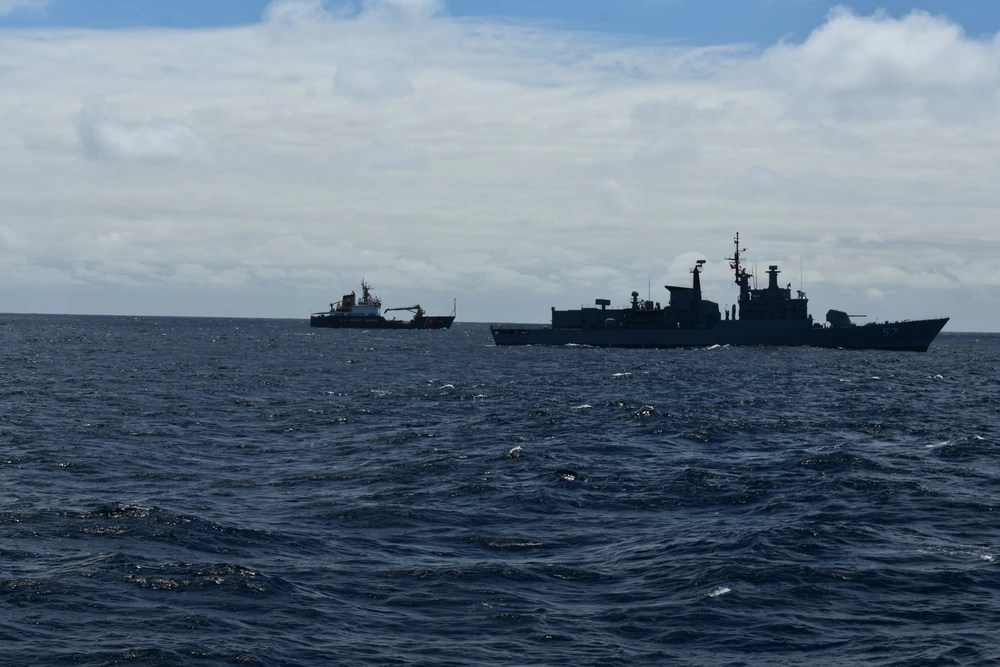
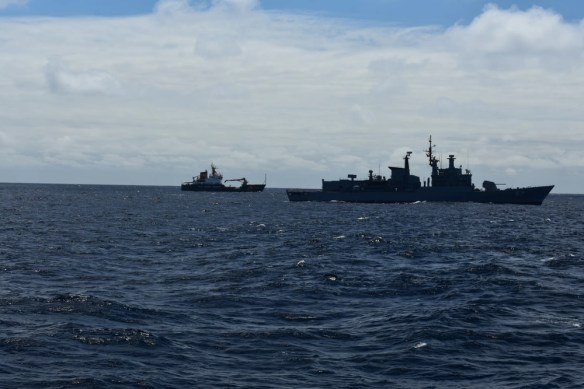
Royal Navy vessel HMS Spey (P234) (foreground) conducts coordinated ship maneuvers with U.S. Coast Guard Cutter Munro (WMSL 755) Sept. 17, 2023, in the South China Sea. Munro is deployed to the Indo-Pacific to advance relationships with ally and partner nations to build a more stable, free, open and resilient region with unrestricted, lawful access to the maritime commons. (U.S. Navy photo by Chief Petty Officer Brett Cote)

Below is a news release. Routine change of command, but the Munro’s recent activities are interesting for their variety, three very different activities in widely dispersed areas, Eastern Pacific, Western Pacific, and far Northern Pacific. More info in these earlier news releases:


 May 31, 2024

U.S. Coast Guard Cutter Munro holds a change of command ceremony

SAN DIEGO — The U.S. Coast Guard Cutter Munro (WMSL 755) held a change of command ceremony Thursday in San Diego.

Vice Adm. Andrew J. Tiongson, Commander, U.S. Coast Guard Pacific Area, presided over the ceremony in which Capt. James O’Mara IV relieved Capt. Rula Deisher as Munro’s commanding officer.

Deisher served as Munro’s commanding officer from May 2022 to May 2024, sailing over 73,000 nautical miles to 17 ports, including eight foreign countries during patrols in the Bering Sea, Western Pacific, and Eastern Pacific.

Most recently, Munro and the crew were responsible for the interdiction and seizure of illegal narcotics worth an estimated $460 million in wholesale value and over $2 billion in street value while patrolling the Eastern Pacific Ocean in support of the Joint Interagency Task Force-South. Munro’s crew also supported Operation Southern Shield during their recent patrol by conducting 16 fisheries boardings in the Southern Pacific Regional Fisheries Management Organization convention area, upholding the maritime rules-based order.

During Munro’s Western Pacific patrol, the cutter and crew hosted multiple engagements with foreign partners, including a discussion about the SAPPHIRE agreement with Japanese Coast Guard officers, a subject matter expert exchange, an at-sea engagement with the Korea Coast Guard, and participated in CARAT Brunei, where Munro worked alongside the Royal Brunei Navy in professional subject matter expert exchanges, leadership conferences, and an at-sea engagement.

While patrolling the Bering Sea, Munro conducted 24 fisheries boardings and two search-and-rescue cases, including the medical evacuation of a critical patient from Dutch Harbor, Alaska, to Anchorage, Alaska.

“To the crew of Munro, thank you,” said Deisher. “I am so proud of your endless dedication and care toward each other and our mission. This crew is phenomenal, and it has been an honor and privilege to sail with them and learn from them.”

Deisher’s next assignment is to serve as the Seventeenth District’s Response Division chief.

O’Mara, the incoming commanding officer, brings a wealth of experience to Munro.

Reporting from the Coast Guard’s Eleventh District as the Enforcement Branch chief, O’Mara oversaw assets across 1,000 miles of shoreline from the California-Oregon state line to the Mexico border and 73 federal waterways. He also worked closely with the Department of Defense Joint Interagency Task Forces and the Department of Homeland Security Joint Task Force West to conduct effective drug and law enforcement interdiction efforts across the Eastern Pacific.

Munro will be O’Mara’s seventh ship and fourth command, following previous commands aboard the Coast Guard Cutters Active (WMEC 618), Farallon (WPB 1301), Monomoy (WPB 1326), and Narwhal (WPB 87335).

The change of command ceremony, a time-honored tradition, is a significant event conducted before the assembled company of a command. It confirms to the unit’s men and women that the authority of command is maintained. The ceremony symbolizes a transfer of total responsibility, authority, and accountability from one individual to another, marking a new chapter in the command’s history.

Commissioned in 2017, Munro is one of four Coast Guard Legend-class national security cutters homeported in Alameda. National security cutters, measuring 418 feet long and 54 feet wide, boast a top speed of over 28 knots, a range of 12,000 nautical miles, endurance of up to 90 days, and can hold a crew of up to 170. The advanced technologies of the national security cutter class ships support the national objective of maintaining the security of America’s maritime boundaries and providing long-range search and rescue capabilities.

“Sri Lanka Holds Fleet Review in Trincomalee,” Two Former Coast Guard Cutters Participate

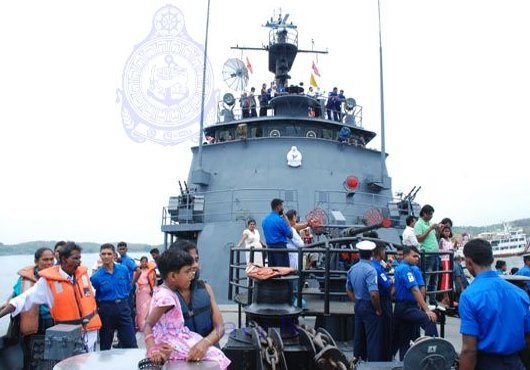
SLNS Gajabahu (P626) (the former USCGC Sherman), SLNS Sayurala (P623) and SLNS Sindurala (P624) during 2022 Colombo Naval Exercise. SLNS Samudura (P261) (the former USCGC Courageous) also visible in the distance. Photo defence.lk

SeaWaves Magazine reports,

Hon. Ranil Wickremesinghe, the President and Commander – in – Chief of the Armed Forces of Democratic Socialist Republic of Sri Lanka visited Trincomalee 1st March to review the naval fleet stationed there. Accompanied by Commander of the Navy, Vice Admiral Priyantha Perera, the President inspected the naval fleet, which included a variety of ships. Governor Eastern Province Hon. Senthil Thondaman, State Minister of Defence Premitha Bandara Tennakoon, Chief of Staff to the President and Senior Adviser to the President on National Security Sagala Ratnayaka, Defence Secretary General Kamal Gunaratne (Ret’d) and Chief of Defence Staff General Shavendra Silva and a group of distinguished invitees were also present on this occasion.

Two of the ships were former US Coast Guard cutters, SLNS Gajabahu (P626) (the former USCGC Sherman, transferred to the Sri Lankan Navy in 2019) and SLNS Samudura (P261) (the former USCGC Courageous, transferred to the Sri Lankan Navy in 2005).

The Sri Lankan Navy includes a third former US Coast Guard cutter, SLNS_Vijayabahu_(P627) (the former USCGC Munro, transferred to the Sri Lankan Navy in 2022).

SLNS-Samudura, the former USCGC Courageous

“Allies, partners tap into technology to monitor maritime domain” –Indo-Pacific Defense Forum

Winkel Tripel projection, WGS84 datum, central meridian : 150°E. Source Wikipedia Commons, Author: Eric Gaba

The Indo-Pacific Defense Forum reports,

“Maritime domain awareness (MDA) in the Indo-Pacific is moving from an abstract aspiration to a functional collective security approach for managing the region’s dynamic offshore spaces,” noted an April 2023 article in PacNet, a publication of Pacific Forum, a Hawaii-based foreign policy research institute. “Much of the cost-savings in maritime enforcement activities is due to emerging technologies including access to satellites that provide clearer and more accurate images, as well as artificial intelligence and big data platforms dedicated to vessel tracking, prediction, and anomaly detection.”

There are fusion centers in India, Singapore and Vanuatu. These fusion centers would be useful in wartime, but they are essentially a cooperative exchange of information among maritime law enforcement agencies. In addition to its importance in countering IUU and drug smuggling, better maritime domain awareness may give warning of a terrorist attack. Shouldn’t the US Coast Guard have a fusion center in Alameda under Pacific Area? Probably should be one on the West coast of South America too.

“Coast Guard hosts Pacific Quadrilateral Coordinating Group on Oahu” –CG News

Below is a news release from Coast Guard News. Looks like Western Pacific fisheries is finally getting the attention it has deserved. The “Pacific Quad” mentioned here (Australia, France, New Zealand, and the US) should not be confused with “The Quad” (Australia, India, Japan, and the US) which is an informal military association.

I am still hoping to see my “Combined Maritime Security Task Force, Pacific” formed.

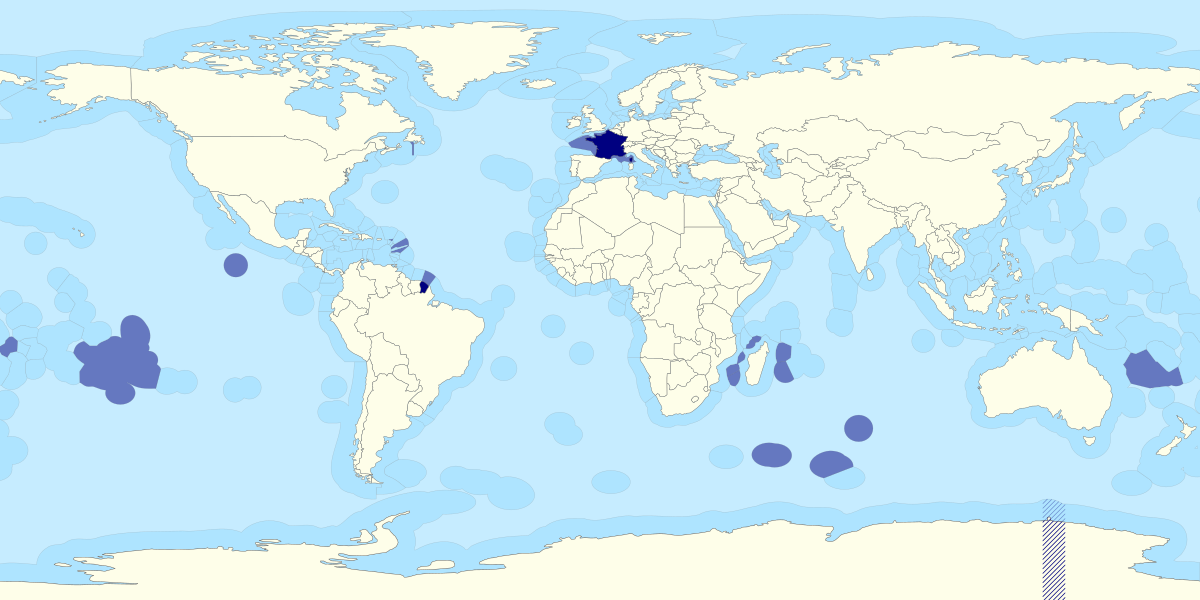
Territory of France and its Exclusive Economic Zone. (Antarctic territorial claims in lighter tone). Credit B1mbo via Wikipedia.

If you are wondering why France is in this group, take a look at their Exclusive Economic Zone, above.


Nov. 3, 2023

Coast Guard hosts Pacific Quadrilateral Coordinating Group on Oahu

HONOLULU — The U.S. Coast Guard recently hosted the Pacific Quadrilateral Defense Coordinating Group from Oct. 9 to 11, 2023, focusing on enhancing maritime security in the Pacific.

The meeting gathered leaders from Australia, France, New Zealand, the United States, and the Forum Fisheries Agency. Rear Adm. Michael Day, U.S. Coast Guard District 14 commander, emphasized the importance of this collaboration, particularly in the context of regional challenges such as climate change and security.

“These face-to-face meetings and continued cooperation among our nations are not just strategic imperatives; they are lifelines to the people of the Blue Pacific,” said Day.

He further highlighted the impact of this collaboration, emphasizing the human element and recognizing the responsibilities of the larger nations in the Pacific, “We acknowledge the historical context, and while we do not seek to rewrite the past, we are committed to a future where the sovereignty and livelihoods of Pacific Island Countries are safeguarded. Climate change, followed by regional tensions, looms large as challenges we all face, and our shared responsibility is to address these threats. Our commitment to combating illegal fishing and ensuring maritime safety is not just about security; it’s about ensuring a sustainable and secure future for the communities who call the Pacific home.”

The Pacific QUAD was established in 1998, and brings together defense and security agencies from Australia, France, New Zealand and the United States in a mutual commitment to partnering with the Pacific Island countries to collectively enhance regional security.

During the meeting, discussions covered various topics, including their annual report, training programs, tactical calendar, information sharing and support for the Forum Fisheries Agency operations. Additionally, three new principals joined the group. Brig. Gen. Yann Latil (France), Air Comm. John Haly (Australia), and Brig. Gen. Andy Shaw (Aotearoa New Zealand).

The Pacific QUAD’s mission is to combat illegal fishing in the Southwest Pacific and collaborate closely with Pacific Island nations. The group operates at both a strategic and operational level, with annual and biannual meetings, respectively.

This year, examples of their collaboration included: an agreement with New Zealand, joint gatherings and strengthening cooperation with Australian Maritime Security Advisors, a successful search and rescue operation, and an international mass rescue exercise, highlighting the positive impact of their efforts on regional stability and maritime safety.

The Pacific QUAD, consisting of New Zealand, the United States, France, and Australia, annually rotates its principal chairmanship position as part of its collaborative approach. Last year, Air Commodore Darryn Robert Webb of New Zealand handed over the role to Rear Adm. Michael Day, who has now passed it to Brig. Gen. Yann Latil, the commander of French Forces New Caledonia. Latil is expected to transfer the responsibility to Air Commodore John Haly, the Australian Joint Operations Command, Director General Operations and Plans (J3), next year. This rotation underscores the ongoing commitment of the Pacific QUAD nations to regional stability and cooperation.

“After a very successful meeting in Honolulu this year, I am happy to take over the American coordination of the Pacific Quad’s work and I look forward to hosting my fellow principals and their teams in Noumea next year,” said Brig. Gen. Yann Latil, the commander of French Forces New Caledonia.

U.S. Coast Guard District 14, covering a vast area in the Central and Western Pacific, plays a crucial role in maritime safety, resource protection, security and national defense through partnerships and international engagement.

Buoy Tender, FRC, C-130 Used for International Fisheries Enforcement–Operation Southern Shield

PERU, 10.06.2023, Courtesy Photo, USCG District 11
San Francisco based USCGC Alder (WLB-216) raises the South Pacific Regional Fisheries Management Organization (SPRFMO) flag while patrolling the Eastern Pacific Ocean during Operation Southern Shield in October 2023. The Coast Guard recently completed the first high-seas boardings and inspections off the coast of Peru under a newly adopted multi-lateral agreement to monitor fishing and transshipment operations within the SPRFMO Convention Area, a region which encompasses nearly a quarter of the Earth’s high seas. (U.S. Coast Guard photo by Petty Officer 2nd Class Kenneth Honore)

Below is a District 11 news release. It came with 24 photos. I have included a few here. The captions are informative. I have edited some of the captions to include homeports and minimize duplication. I have also added a few links and the schematic below.

SPRFMO CONVENTION AREA
This schematic is available only to illustrate the Area of application of the SPRFMO Convention, which is described in legal terms in Article 5. The schematic is not part of the Convention text and has no legal status; it is not intended to reflect exactly the maritime spaces of adjoining coastal states.
PERU, 10.07.2023, Courtesy Photo, USCG District 11
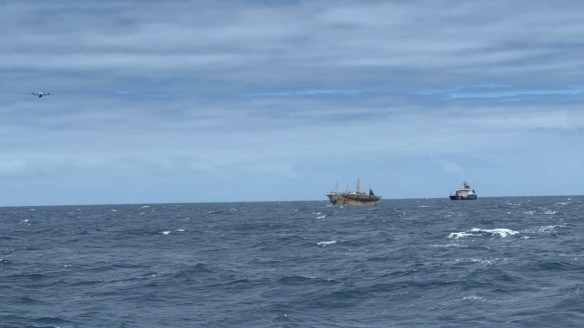
The Coast Guard Cutter Alder approaches a squid fishing vessel while CG-2007, a C-130 from Air Station Barbers Point in Hawaii, flies over (upper left) during Operation Southern Shield 2023, October 2023. The Coast Guard recently completed the first high-seas boardings and inspections off the coast of Peru under a newly adopted multi-lateral agreement to monitor fishing
and transshipment operations within the South Pacific Regional Fisheries Management Organization (SPRFMO)Convention Area. (U.S. Coast Guard photo)

LIMA, PERU, 10.06.2023, Courtesy Photo, USCG District 11
The aircrew of the Coast Guard 2007, an HC-130 based out of U.S. Coast Guard
Air Station Barbers Point, Hawaii, poses for a picture with observers from the Peruvian Navy and Air Force, in Lima Peru, October 2023. During the course of two weeks, Peruvian observers accompanied the USCG aircrew as they conducted overflights of the fishing fleet on the high seas during Operation Southern Shield 2023. (U.S. Coast Guard photo by pilot-in-charge, Lt. Zachary Hunter)

There was a Webber Class WPC involved as well. This follows the pattern of pairing a WLB with an FRC for distant operations that we have also seen in the Western Pacific.
PERU, 10.06.2023, Courtesy Photo, USCG District 11
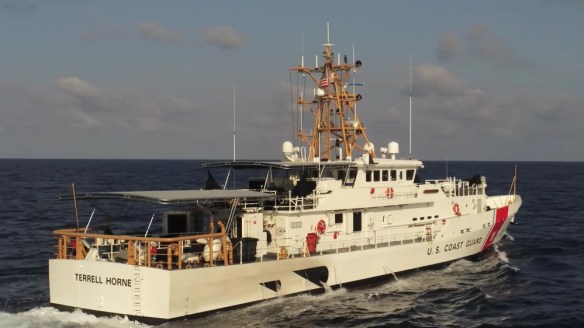
The crew of San Pedro based USCGC Terrell Horne (WPC-1131) conducts a patrol in the Eastern Pacific Ocean in support of Operation Southern Shield 2023, October 2023. (U.S. Coast Guard photo)

These operations followed an international exercise, GALAPEX 2023.

09.23.2023, Courtesy Photo, USCG District 11
Participants in GALAPEX 2023 pose for a group picture following a law enforcement boarding exercise during GALAPEX 2023, Sept. 23, 2023. Coast Guard Cutters Alder and Terrell Horne conducted a boarding of Ecuador Bae Isla Floreana as the first major exercise and introduction to GALAPEX, a recurring multi-national maritime exercise led by Ecuador and included participation with delegates from Argentina, Brazil, Chile, Colombia, Costa Rica, the European Union, France, Italy, Mexico, Panama, Peru, the United Kingdom, and the United States. (U.S. Coast Guard photo by Lt. j.g. Kimberly Byron)
09.25.2023, Courtesy Photo, USCG District 11
U.S. Coast Guard Cutter Alder (background) transits in formation alongside Peru BAP (Buque Armada Peruana) Bolognesi (FM-57) as it prepares for the next exercise during GALAPEX 2023, Sept.25, 2023. (U.S. Coast Guard photo)


 Oct. 16, 2023

Coast Guard Cutter crews conduct first high-seas boardings off the coast of Peru, under new SPRFMO measure

ALAMEDA, Calif. — The crews of the Coast Guard Cutters Alder, Terrell Horne and an HC-130 Hercules aircraft recently completed the first high-seas boardings and inspections, in the Eastern Pacific Ocean, under a newly adopted conservation and management measure to monitor and inspect fishing and transshipment operations at-sea in the South Pacific Regional Fisheries Management Organization (SPRFMO) Convention Area.

As part of Operation Southern Shield, the Coast Guard conducted boardings and overflights within the SPRFMO Convention Area on the high seas off the coast of Peru. For years, the Coast Guard has executed counter-illegal, unreported, or unregulated (IUU) fishing operations and participated in high seas boarding inspections (HSBI) around the globe. This operation was significant as it was timed to implement newly adopted rules in the SPRFMO Convention Area, which comprises nearly a quarter of the Earth’s high seas. The SPRFMO Commission consists of 17 members from Asia, Europe, the Americas, and Oceania, as well as two cooperating non-contracting parties. The primary species targeted in the Convention area are jack mackerel and jumbo flying squid.

Just prior to Operation Southern Shield, the Coast Guard participated in GALAPEX 2023, a recurring joint and multinational exercise hosted by Ecuador and executed in the vicinity of the Galapagos Islands. The Coast Guard conducted communications exercises, practiced counter-narcotics boarding scenarios, and hosted observers from Peru, Ecuador, and Brazil. GALAPEX culminated with full-scale exercises focused on a coordinated multinational response to counter IUU fishing. At the conclusion of the exercise, the Coast Guard patrolled south to focus on high seas boarding inspections off the coast of Peru.

“The U.S. Coast Guard remains committed to conducting combined maritime operations and exercises throughout the Eastern Pacific and will continue to capitalize on every opportunity to work with, learn from, and coordinate through our partners,” said Capt. James O’Mara, Chief of Enforcement for Coast Guard 11th District.  “The relationships our services build while planning and executing these operations are essential. The logistics required to enable these operations are significant, and it only happens with the tremendous support of partners like Ecuador and Peru.”

IUU fishing has replaced piracy as the leading global maritime security threat. Areas out on the high seas, beyond any country’s exclusive economic zone, can be exploited by fishermen engaged in IUU fishing, as they fish beyond the reach of most law enforcement entities. The Coast Guard’s actions provide inspection presence on the high seas among a distant water fishing fleet made up of more than 400 fishing and transshipment vessels. Much of the fishing in the Eastern Pacific is accomplished by these distant water fishing vessels, some which remain at sea for years at a time, and many of which are supported by transshipment vessels. The Coast Guard’s recent operation directly supported Central and South American partners and their desire to monitor and expand maritime domain awareness of fishing activity near their exclusive economic zones.

Each day during the operation a Coast Guard C-130 aircraft flew sorties over the fishing fleet on the high seas with observers from the Peruvian Navy and Air Force. The crew of the Coast Guard Cutter Terrell Horne also diverted to assist the Peruvian Navy in a search and rescue operation. The Terrell Horne located the vessel, then transported an injured fisherman back to shore to receive further medical care from local Peruvian officials.

“The U.S. Coast Guard is committed to working with our allies and partners to strengthen the international fisheries enforcement regime and stop the pervasive IUU fishing threat,” said Rear Adm. Andrew Sugimoto, commander, Coast Guard 11th District. “Operation Southern Shield is just the latest example of that commitment, and we will continue to model and support rules-based order. We applaud the SPRFMO Commission for adopting these latest inspection guidelines and hope to see additional management measures adopted in the future to ensure the sustainability of our ocean resources. Last year we operated off the Galapagos, this year off the coast of Peru, and we will continue to deploy aircraft, cutters, and personnel to support our partners and monitor these distant water fleets wherever they roam. These operations help bring like-minded countries closer together to protect vulnerable fish stocks, support the economic stability of coastal nations, the livelihoods of small-scale and artisanal fishermen, and safeguard ocean resources that fuel global populations and economies.”

“US to Deploy Coastguard Ship to Papua New Guinea” –The Defense Post

The USCGC Oliver Henry (WPC 1140) crew arrives in Manus, Papua New Guinea, on Aug. 14, 2022, from Guam as part of a patrol headed south to assist partner nations in upholding and asserting their sovereignty while protecting U.S. national interests. The U.S. Coast Guard is participating with partners to support the Pacific Islands Forum Fisheries Agency-led Operation Island Chief and the larger Operation Blue Pacific through patrols in the Western Pacific in August and September 2022. (U.S. Coast Guard photo by SW3 Victor Villanueva, NMCB-FOUR)

(Sorry, this is a couple of weeks old.)

The Defense Post reports,

US Defense Secretary Lloyd Austin on Thursday announced the deployment of a US Coastguard ship to Papua New Guinea, as Washington seeks to boost its military footprint in the region amid fierce competition for influence with China…“A US Coastguard cutter will be here in August,” Austin said as he became the first Pentagon boss to visit Papua New Guinea.

Again, the Coast Guard is being used as an instrument of foreign policy. That is not a bad thing, but it is a fact.

It is not like the Coast Guard has not been there before. The photo is from 2022, but the US and Papua New Guinea are seeking closer, mutually beneficial ties.

For Papua New Guinea this means improvements to dual use (military and civilian) infrastructure (ports and airfields), increased economic activity, and help with preventing IUU fishing.

For the US, the diplomatic activity is prompted by Chinese attempts to obtain influence in Oceania that seemed to have been demonstrated when the Soloman Islands failed to respond to a request for a routine replenishment stop for USCGC Oliver Henry (pictured above).

Thanks to Paul for bringing this to my attention. 

“Upgun Cutters to Meet Today’s Naval Threats” –USNI

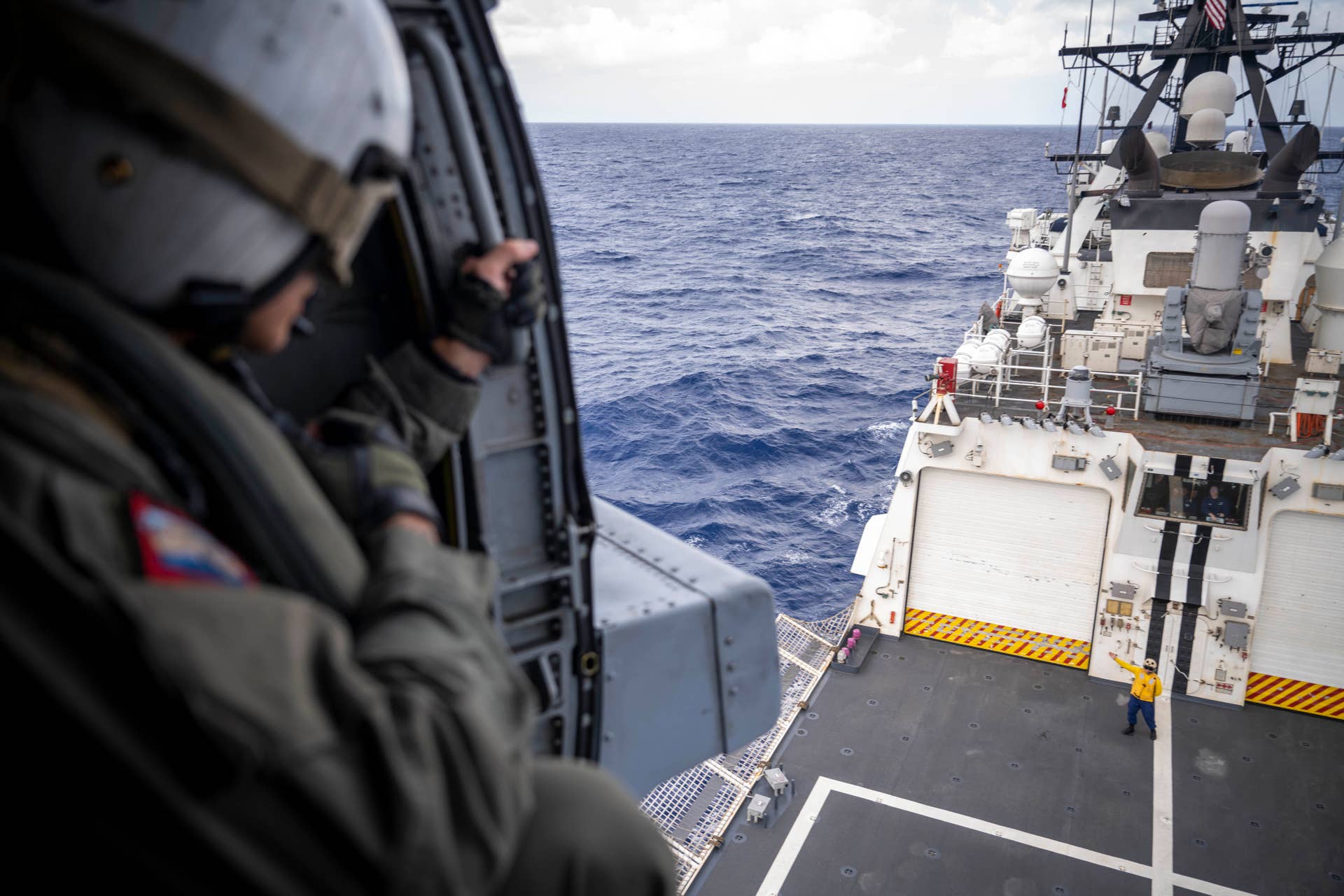
PACIFIC OCEAN (July 30, 2022) U.S. Navy Petty Officer 1st Class Humberto Alba, a naval aircrewman tactical-helicopter, attached to Helicopter Maritime Strike Squadron (HSM) 37, deployed on U.S. Coast Guard Legend-class cutter USCGC Midgett (WMSL 757), looks down at a USCGC crewmember after taking off during flight operations during Rim of the Pacific (RIMPAC) 2022. (U.S. Coast Guard photo by Petty Officer 3rd Class Taylor Bacon)

This essay from the July 2023 issue of Proceedings, is featured on the US Naval Institute Proceedings web site. It won Second Prize in the Midshipmen & Cadets Essay Contest—Sponsored by the U.S. Naval Institute.

This is just one of many such articles that have been published repeatedly over the years. The logic is clear,

If more heavily armed, Coast Guard cutters could better support the Navy and enhance defense readiness.

At small marginal cost, cutters could make a significant contribution to our nation’s naval strength, but it has not happened in the last 30+ years. Why not?

It seems the Leadership of both the Navy and Coast Guard have other priorities, and there is no sponsor in a position of power to push the program.

The Navy is in trouble. The Navy has been shrinking over most of the last 34 years, from down from 592 Sept. 30, 1989, to 299 as of this week. It began with the collapse of the Soviet Union. I’m sure it seemed like good idea at the time, but the “peace dividend” meant there was not much reason to build new ships. Teams that had developed a long string of successful ship designs ceased to exist. Shipyards closed. As a result, they have had difficulty fielding new classes of ships. Their new generation shipbuilding programs have been plagued with problems, while the Chinese navy has been building ships at a furious pace.

The Coast Guard has had its own troubled recapitalization program, beginning with “Deepwater” and while the NSC and FRC programs seem to have been successful, if long delayed, the Offshore Patrol Cutter and Icebreaker programs are still having significant difficulties. But perhaps more importantly, Coast Guard leadership sees the conventional model of a combat ready Coast Guard as counterproductive to other Coast Guard priorities.

Personally, I feel fears that a more heavily armed Coast Guard would not be welcome in many parts of the world is overblown, but the fear does exist and the conventional model of permanently installed weapon systems operated and maintained by Coastguardsmen would require a diversion of assets unless the budget is increased and more assets are provided. There is a cost to the Coast Guard in terms of training and maintenance time for both units and individuals, even if the Navy pays for the systems.

I think there is an alternative that would address the fears of the Coast Guard leadership and create a powerful sponsor in the Navy. 

The Navy Reserve could be that sponsor. It is a reservoir of trained talent, but where do they go upon mobilization? There are only so many ships. Their crews, while they may have some shortages, are essentially at war time manning levels. There are only so many helicopter landing spots on Navy ships. Many Navy Reservists have no really appropriate place to serve upon full mobilization.

Coast Guard units can provide a place where they can be used effectively. Navy helicopters and their crews can fly from Coast Guard cutters. Modularized versions of towed array sonar systems could be operated and maintained by Navy reservists on large cutters.

Initially at least, these reinforced cutters would be best used in the board reaches of the Pacific, beyond the effective range of enemy land based and air-launched anti-ship missiles, where the primary threat would be submarines, protecting the logistics ships that are essential for prosecuting a war in the Western Pacific.

In 2012, Admiral Jonathan W. Greenert, U.S. Navy, advocated,

“We need to move from ‘luxury-car’ platforms—with their built-in capabilities—toward dependable ‘trucks’ that can handle a changing payload selection.”

If the Navy can provide payloads, the Coast Guard can provide some trucks.

“US Coast Guard Seeks Bigger Role to Search, Board Vessels in Pacific” –gCaptain

The USCGC Oliver Henry (WPC 1140) crew arrives in Manus, Papua New Guinea, on Aug. 14, 2022, from Guam as part of a patrol headed south to assist partner nations in upholding and asserting their sovereignty while protecting U.S. national interests. The U.S. Coast Guard is participating with partners to support the Pacific Islands Forum Fisheries Agency-led Operation Island Chief and the larger Operation Blue Pacific through patrols in the Western Pacific in August and September 2022. (U.S. Coast Guard photo by SW3 Victor Villanueva, NMCB-FOUR)

gCaptain reports,

“The United States Coast Guard is in talks with Pacific Island countries to expand its maritime law enforcement role by allowing U.S. officers to board and search vessels suspected of illegal activity within their economic zones, officials said.”

This is about expanding and streamlining the shiprider program. In one case the Coast Guard already have permission to work with a national command center and act on behalf of another nation, Federated States of Micronesia, even if there is no shiprider physically aboard the cutter.

“More specifically, the agreement provides a coordinating mechanism and process for U.S. law enforcement personnel to work with the FSM National Police through command centers to receive approval from the FSM to act.”

Thanks to Lee for bringing this to my attention. 

Coast Guard in Oceania in the News

The USCGC Oliver Henry (WPC 1140) crew arrives in Manus, Papua New Guinea, on Aug. 14, 2022, from Guam as part of a patrol headed south to assist partner nations in upholding and asserting their sovereignty while protecting U.S. national interests. The U.S. Coast Guard is participating with partners to support the Pacific Islands Forum Fisheries Agency-led Operation Island Chief and the larger Operation Blue Pacific through patrols in the Western Pacific in August and September 2022. (U.S. Coast Guard photo by SW3 Victor Villanueva, NMCB-FOUR)

A couple of recent articles about the US relations with Palau and Papua New Guinea.

Map of the exclusive economic zones in the Pacific.

There has long been interest in a US base on Manus, Papua New Guinea, but this is politically sensitive. Basing cutters there that protect an important economic resource and occasionally rescue the locals when they get in trouble, would probably be most welcome.

On the map above, Manus and Guam do not look that far apart, but Manus is 1,737.88 km (938 nautical miles) SSE of Guam. That is about the distance from Miami to New York City. 

Cutters based in Manus would be closer to parts Freely Associated States (FAS) of Palau and Federated States of Micronesia than cutters based in Guam and much closer to most non-FAS Micronesian nations. It might also be a good place to site a fixed wing forward operating base (CGAS Honolulu DET).

I am beginning to think we will see two new bases in the Western Pacific, one in American Samoa and one in Manus.

If we do end up with additional Webber class based outside Hawaii and Guam, we might need a squadron support organization similar to, and perhaps even larger than, PATFORSWA, to support all FRCs based in the Pacific South and West of Hawaii, e.g. a PATFORSWPAC.