The U.N. human rights chief said Friday that U.S. military strikes against boats in the Caribbean Sea and eastern Pacific Ocean allegedly carrying illegal drugs from South America are “unacceptable” and must stop.
The U.N. High Commissioner for Human Rights Volker Türk called for an investigation into the strikes, in what appeared to mark the first such condemnation of its kind from a United Nations organization.
MANAMA, Bahrain – Graphic illustration of the flag of Colombia and the Combined Maritime Forces logo. CMF welcomed Colombia, Jan. 21th, as the 41th member of the world’s largest maritime security partnership. 240127-N-NO146-1001.JPG, Photo By: NAVCENT Public Affairs
Below is a news release from Combined Maritime Forces / US 5th Fleet.
I would not normally make a separate post about this, but recently I saw someone remark that International Law has no enforcement mechanism.
Combined Maritime Forces (CMF) is an international law enforcement mechanism.
It is, after all, not a military alliance, it is a law enforcement alliance, and while its police powers are limited, they are nevertheless real. Its power extends beyond national territorial seas and is derived from the concurrence of its members that certain behaviors are unacceptable.
It is not yet effective against nation states, but it does operate against the gray zone agents of nation states.
This is a remarkable development and overtime, hopefully, it will be extended to other geographic areas and broadened in scope.
Colombia Joins Combined Maritime Forces in Middle East as 41st Member
By Combined Maritime Forces Public Affairs | January 27, 2024
MANAMA, Bahrain —Combined Maritime Forces welcomed Colombia as the 41st member of the world’s largest maritime security partnership, Jan 21.
“It is a privilege to have Colombia as an official part of CMF,” said Vice Adm. Brad Cooper, CMF commander. “We welcome the Colombians in the largest international naval coalition, dedicated to maritime security and stability in the Middle East, and protecting some of the world’s most important waterways. I look forward to sharing our experiences and being ‘Ready Together’ with our new partners.”
CMF is comprised of a headquarters staff and five combined task forces focusing on defeating terrorism, preventing piracy, encouraging regional cooperation, and promoting a safe maritime environment. The naval partnership upholds the international rules-based order by supporting security and stability across 3.2 million square miles of water encompassing some of the world’s most important shipping lanes.
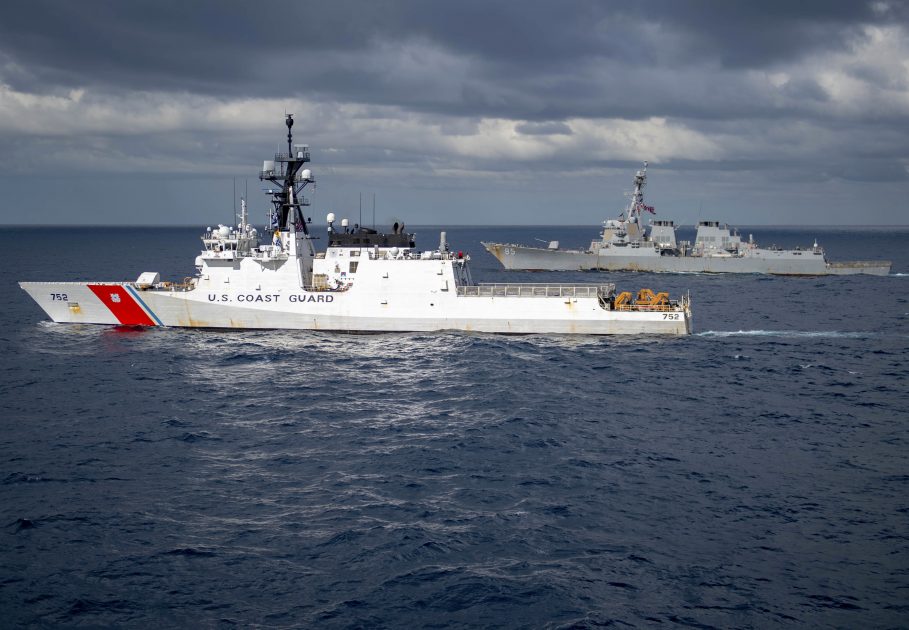
USCGC Stratton (WMSL-752), left, and the U.S. Navy Arleigh Burke-class guided-missile destroyer USS McCampbell (DDG-85) maneuver in formation during Talisman Sabre 2019 on July 11, 2019. US Navy Photo
Why do the authors, two Navy LCdr. and a Marine Capt., think this? They contend:
Their destroyers are overworked.
The Navy is having a hard time keeping their ships maintained.
Cutters are less intimidating
and less expensive
If the Chinese start playing bumper boats with Destroyers, they might damage expensive equipment. “…if a ship from the Chinese Navy, Coast Guard, or maritime militia were to ram a U.S. vessel conducting a FONOP, the ensuing visuals, narratives, and potential loss of combat capability would be starkly different between a Navy gray hull and a Coast Guard white hull.”
They talk about using LCS as an alternative, but then denigrate the possibility,
The Navy has rightfully used littoral combat ships (LCSs) to conduct limited FONOPs in the South China Sea, somewhat relieving overworked destroyers like the USS John S. McCain. However, the smaller LCS’s myriad of problems, curtailed acquisition numbers, and early retirement of the first four hulls mean the Navy will soon have to lean even more heavily on larger and generally older ships. With only 10 to 14 cruisers and destroyers available to Seventh Fleet at any given time, the Navy can ill-afford to use these high-demand, low-density, Aegis ships for FONOPs.
This, in spite of the fact, that LCS have only recently begun making regular deployments to the Western Pacific and LCSs are being added to the fleet at a rate of four per year.
First, I have no problem with Cutters doing FONOPs when they are in the Western Pacific, but that should not be the only reason, they are there.
US Navy ships are not overworked. That is a fiction. Having looked at the “USNI News Fleet and Marine Tracker” over many years, I can say, Navy ships are typically deployed about one third of the time, and they are underway only about 25% of the time, far less than Coast Guard cutters. That is not to say the people are not overworked, by burdensome administrative and overly broad qualification requirements for their junior officers. The ships are behind in maintenance because of lack of support, not time underway. Ships don’t need to spend 75% of their time, tied up in maintenance, to remain effective.
In war time, well over half the navy should be underway and forward deployed. The fact that they cannot support a much smaller forward presence, of which much of the time is not underway, in peacetime, points to a serious deficit in the Navy’s support structure. Where are the repairs ships, the tenders, the floating dry docks that allow a navy to be truly expeditionary?
If the Navy does not want to use carriers, cruisers, or destroyers for FONOPs because they are afraid of having them damaged, there are other alternatives. They could use amphibs: LHAs, LHDs, LPDs, and LSDs. They could use Military Sealift Command ships. MSC ships are clearly not as intimidating as carriers, cruisers, and destroyers. Were they to be damaged “the ensuing visuals, narratives, and potential loss of combat capability would be starkly different…”
I would suggest using the new Navaho class tug and salvage ships. They are an excellent choice for playing bumper boats. They have strong steel hulls and are powerful enough to tow a nuclear-powered carrier. Their hulls are reinforced to allow hull to hull contact with other ships. Plus, they are a lot less expensive. Even less expensive than a Coast Guard cutter.
But really, using tugs or cutters to do FONOP kind of misses the point. The Chinese and the Russians are not upset because foreign ships are transiting waters they claim. They are upset because foreign warships are transiting the waters the claim. If we stop sending warships into the waters they claim, we are creating a defacto case that they have a right to such exclusion. That Coast Guard cutters may not be considered warships would weaken our case that, foreign warships in these waters is the norm.
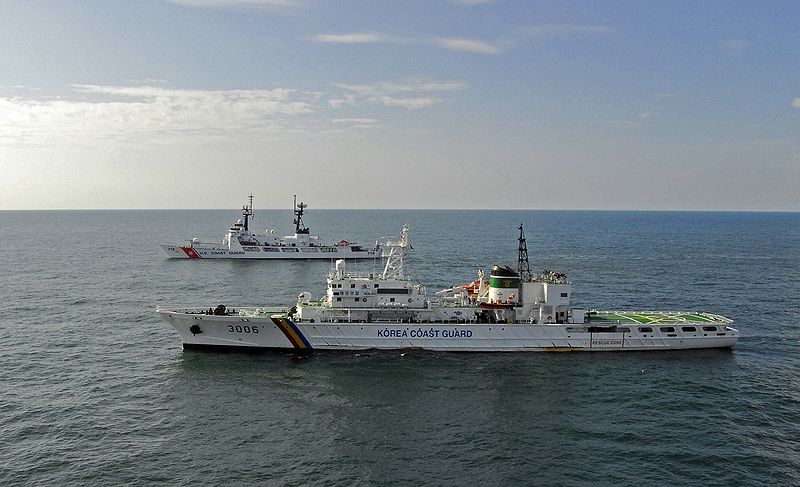
Republic of Korea Coast Guard vessel #3006 in company with U.S. Coast Guard cutter USCGC Boutwell (WHEC-719) during the North Pacific Coast Guard Forum in August 2007. This forum was created to increase international maritime safety and security in the Northern Pacific Ocean and its borders. The Boutwell worked with the Korean coast guard while on their way to Yokosuka, Japan. The Japanese coast guard is one of the six nations involved in the forum.
CIMSEC brings us a discussion of the possibility of cooperative fisheries enforcement in the South China Sea to stop both overfishing and Illegal, Unregulated, Unreported (IUU) fishing and perhaps bring China into a more mutually beneficial relationship with her neighbors.
Earlier, I had a suggestion about how we might form an instrument of cooperative enforcement by forming a “Combined Maritime Security Task Force Pacific,” a law enforcement alliance rather than a military one.
Probably before that could be fully realized, the various nations with competing claims to the waters of the South China Sea, need to take their claims to the UN’s International Tribunal. The more nations use it, the more pressure on China to participate. If, they do not present a cases before the international their claims will be weakened.
A Japan Coast Guard helicopter approaches an Indian Coast Guard patrol vessel during a joint exercise off Chennai, India, January 2018 (Photo: The Asahi Shimbun via Getty)
“The so-called Quad group of Indo-Pacific maritime democracies – Australia, India, Japan, and the United States – is a valuable grouping, although it is still under utilized in many ways. One of the most effective ways that these countries could work together to enhance maritime security in the Indo-Pacific would be through coordinating the work of their coast guard agencies.”
While India in particular, is adverse to committing to a military alliance, these nations share a commitment to a rules based international system.
Quadrilateral cooperation through the countries’ coast guards could provide an answer to this political problem. As principally law-enforcement agencies, coast guards can provide many practical benefits in building a stable and secure maritime domain, without the overtones of a military alliance.
Using ship-riders, this sort of cooperation could go beyond capacity building and uphold the norms of international behavior. It might lead to the kind of standing maritime security task force I advocated earlier. When coast guards are in conflict, having multiple coast guards on scene could insure that instead of a “he said, she said” situation, we could have a “he said, we say” situation that would show a united front against bullying.
Given Bertholf and Stratton‘s stay in the Western Pacific and Walnut and Joseph Gerczak‘s support of Samoa, which was coordinated with Australia and New Zealand, it appears we may already be moving in this direction.
CSIS and the United States Naval Institute (USNI) conduct an interview with Admiral Karl L. Schultz, the 26th Commandant of the United States Coast Guard, conducted 1 August, 2018.
Below I will attempt to outline the conversation, noting the topics and in some cases providing a comment.
The first question is about immigration. Coast Guard is the “away game.” minimizing the factors that push immigration to the US.
The Commandant does not expect a substantial increase in help from the Navy, because they are already heavily tasked, but would welcome any additional help.
06:30 Talk about Inland fleet. Congressional support is evident. $25M provided so far.
9:20 House Appropriations Committee decision to divert $750M from the icebreaker program to fund “the Wall” in their markup of the FY2019 budget bill. The Commandant is “guardedly optimistic”
11:30 Human capital readiness? Operating account has been flat and effectively we have lost 10% in purchasing power. Want to increase leadership training.
16:30 Support for combatant commanders.
18:00 Capacity building and partnering. Detachments working on host nation platforms.
21:00 Defense Force planning–Not going back to the MARDEZ model.
22:30 Situation in Venezuela/Preparation for dealing with mass migration.
24:30 Arctic forums–Need to project our sovereignty
29:00 UNCLOS
30:00 Maritime Domain Awareness (MDA)
32:30 Tracking cargo as an element of MDA
34:00 Cyber
36:15 High Latitude engagement/partnerships.
39:30 Perhaps the icebreaker should be the “Polar Security Cutter?”
40:00 International ice patrol, still an important mission.
41:00 CG role in response to Chinese aggressiveness in the South China Sea. In discussion with Indo-Pacific Command. Will see more CG presence there.
44:00 Offshore Patrol Cutter (OPC)–on track
46:30 Border issue — passed on that
48:00 Small satellites–we are looking at them
49:00 African Capacity building/cooperation. May send an MEC.
51:30 Tech modernization. Looking at it more holistically.
Other Coverage:
This interview prompted a couple of notable posts.
Military.com reported on the possibility of a greater Coast Guard role in South East Asia and capacity building in Africa. It probably should be noted that the title, “Coast Guard Could Send Ship to Pacific to ‘Temper Chinese Influence’,”is a bit deceptive in that the Commandant’s remark about tempering Chinese Influence was in regard to Oceania, the islands of the Central and Western Pacific. The Commandant was quoted in the Seapower post, “In the Oceania region, there are places where helping them protect their interests, tempering that Chinese influence, is absolutely essential.”
Note on the author from the referenced post: “Michael Sinclair is an active duty Coast Guard officer with 20 years of service. In addition to eight years working as a judge advocate he has served as a patrol boat captain in the Arabian Gulf. He Is finishing a Masters of Law in National Security from Georgetown University and will soon be the Coast Guard’s legislative counsel. The views here are his own and do not reflect those of the Coast Guard or the Department of Homeland Security. For a more in-depth analysis on the prospects of a “Coast Guard” for space, read this draft of his forthcoming academic paper.”
He suggest:
“… America would be better served by consolidating all commercial launch-to-orbit-to-landing oversight and regulatory functions within the “prevention” arm of a new “Space Guard.”A Space Guard, initially conceived of by Cynthia McKinley in 2000 and later expounded on by James Bennett in 2011, should optimally mirror the organizational structure of the Coast Guard, which generally separates its mission functions into broad categories of “prevention” and “response.” Prevention authorities are essentially regulatory authorities and response authorities are best categorized as operational authorities.”
He sees a number of parallel missions
Regulation and facilitation of navigation
Derelict destruction –Space Debris Mitigation
Search and Rescue
Construction standards
Vessel Traffic Control
“In order to truly establish effective space governance, the U.S. government should more fully consider capabilities, capacity, and partnerships for search and rescue, and really, the full spectrum of space activity.The authority to act does not mean a whole lot if there is no capability to execute the action, or the capacity is not sufficient to prove meaningful. Specifically, in the space search and rescue context, this would likely mean some sort of (optimally international) rescue coordination center working with in-space assets that were themselves permanently stationed and in sufficient numbers so that they would be available to render assistance, as needed.”
He sees a “Space Guard” as less escalatory than a “Space Force”
“…such an agency operating under the idea that it is at its core, a humanitarian organization focused on rescue and protection of all space actors, may be sufficiently de-escalatory so as to help mitigate against a potential arms race in space—a source of concern dating back to the Soviet Union’s launch of Sputnik itself, and seemingly resurgent with the increasingly aggressive postures of both Russia and China within the domain.”
For all the parallels with the oceans, space is yet to evolve many of the mechanisms we have regulating activities a sea.
Much of the Coast Guard’s authority is dependent on international acceptance of the idea of territorial sea and EEZ. There is nothing comparable in space.
As traffic increases, who will allocate orbits to prevent collisions?
What will stop the equivalent of flags of convenience in space?
The concept of a “Space Guard” tied to the concept of a Coast Guard in space may seem innocuous to Americans, but to the Russians, a “Guards” unit is an elite military unit. Such an organization will need to be international if it is to be seen as impartial and benevolent.
Despite the title, don’t expect a recitation of Coast Guard priorities. Most of the material is familiar, but there were a few interesting comments, including some that might be surprising. A number of things the Commandant said here made news.
That the NSCs could be made into frigates.
That the Polar Icebreaker would cost less than $1B
His support of transgender CG personnel.
I’ll give a quick outline of what was talked about. At the end I will rant a bit about some of my pet peeves.
The Commandant’s prepared statement is relatively short beginning at time 2m45s and ending about 11m.
6m00 In our listing of missions, the Commandant said Defense Operations should be listed first. He noted that there are 20 ships chopped to Combatant Commanders including eleven ships operating under SOUTHCOM.
Q&A begins at 11:00.
16m20s The Commandant noted there is a Chinese ship rider on a USCG cutter off Japan and that Coast Guard aircraft are flying out of Japan.
17m30s Boarder protection/drug interdiction
20m Called the OPCs “light frigates”
22m As for priorities the Commandant noted a need to invest in ISR and Cyber
23m Cyber threat.
24m Expect return to sea duty because of length of training.
26m30s “Demise of the cutterman”/Human Capital Plan–fewer moves–removed the stigma of geographic stability
29m25s Highest percentage of retention of all services–40% of enlisted and 50% of officers will still be in the service after 20 years
30m Law of the Sea. Extended continental shelf in the Arctic.
32m30s Need for presence in the Arctic.
36m ISR, 38m15s Firescout. An interesting side note was that the Commandant seemed to quash any possibility of using the MQ-8 Firescout. He noted when they deployed on a cutter 20 people came with the system. He called it unoccupied but not unmanned.
40m Icebreakers
43m30s Comments on transgender members
45m15s Icebreakers–will drive the price down below $1B.
47m NSC as frigate–no conversations with the Navy about this. Performance of Hamilton.
49m50s Count the NSCs toward the 355 ship Navy.
50m30s Illegal migration and virulent infectious disease
53m35s CG training teams in the Philippines and Vietnam to provide competency to operate platforms to be provided by Japan. Two patrol boats going to Costa Rica. Other efforts to build capacity.
56m DHS is the right place for the CG.
The Commandant touched on a couple of my pet peeves, specifically
He called the OPCs “Light Frigates,” so why aren’t they designated that way? WMSM and WMSL are just wrong in too many ways. Give our ships a designation our partners and politicians can understand. A WLB is a cutter and also a buoy tender. The OPC can be both a cutter and a light frigate. I have suggested WPF. Maybe WFF for the Bertholfs and WFL for the Offshore Patrol Cutters. If we want to be thought of as a military service, we need to start using designations that will be seen and understood as military.
He mentioned the possibility of including the Bertholfs in the 355 ship fleet total. Coast Guard combatants should be included when the country counts its fleet. No, the cutters are not aircraft carriers or destroyers, but the current fleet of about 275 ships includes about 70 ships that have no weapons larger than a .50 cal. These include eleven MCM ships and about 60 ships manned by civilian crews such as tugs, high speed transports, salvage ships, underway replenishment ships, and surveillance ships. Counting the Cutters as part of the National Fleet would raise our profile as a military service. The Navy might not like it, but it does give a better idea of our actually available assets for wartime, which is the point of such a listing.





 Chuck Hill's CG Blog