“US Coast Guard Seeks Bigger Role to Search, Board Vessels in Pacific” –gCaptain

The USCGC Oliver Henry (WPC 1140) crew arrives in Manus, Papua New Guinea, on Aug. 14, 2022, from Guam as part of a patrol headed south to assist partner nations in upholding and asserting their sovereignty while protecting U.S. national interests. The U.S. Coast Guard is participating with partners to support the Pacific Islands Forum Fisheries Agency-led Operation Island Chief and the larger Operation Blue Pacific through patrols in the Western Pacific in August and September 2022. (U.S. Coast Guard photo by SW3 Victor Villanueva, NMCB-FOUR)

gCaptain reports,

“The United States Coast Guard is in talks with Pacific Island countries to expand its maritime law enforcement role by allowing U.S. officers to board and search vessels suspected of illegal activity within their economic zones, officials said.”

This is about expanding and streamlining the shiprider program. In one case the Coast Guard already have permission to work with a national command center and act on behalf of another nation, Federated States of Micronesia, even if there is no shiprider physically aboard the cutter.

“More specifically, the agreement provides a coordinating mechanism and process for U.S. law enforcement personnel to work with the FSM National Police through command centers to receive approval from the FSM to act.”

Thanks to Lee for bringing this to my attention. 

“US Navy ‘operationalizes’ drones in 4th Fleet’s UNITAS event” –Defense News

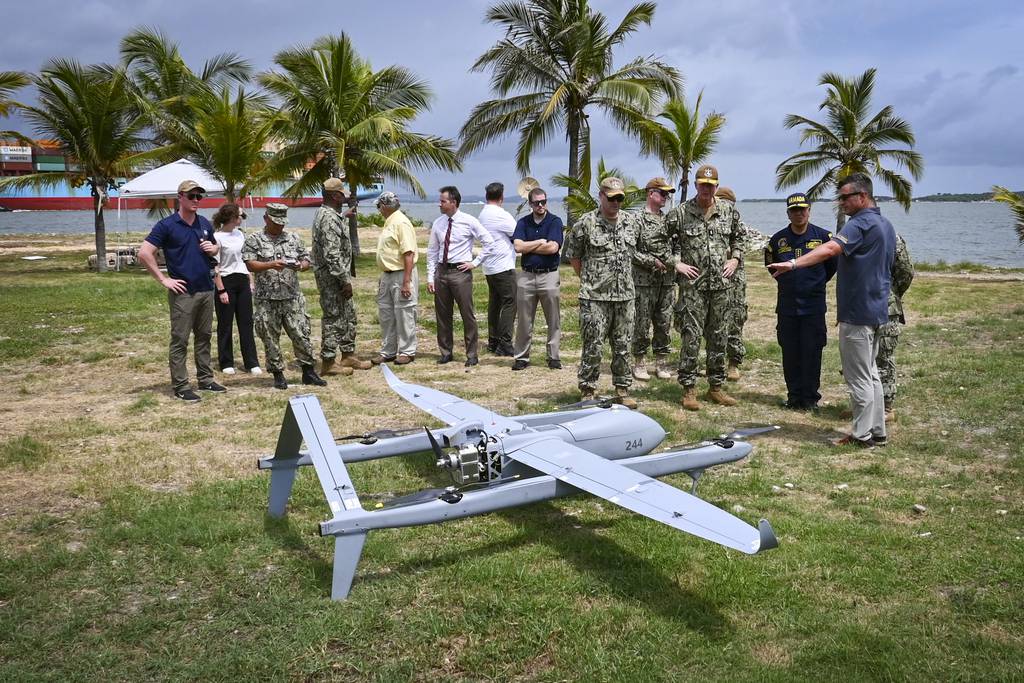
Personnel from the U.S. and Colombian navies attend a demonstration of Aerosonde MK4.7 Hybrid Quad drone during UNITAS on July 16, 2023. (MC1 Hunter Harwell/U.S. Navy)

Defense News reports,

“The U.S. Navy leveraged air and surface drones throughout its two-week UNITAS 2023 naval exercise near Latin America, the first major event since service leadership announced the region would host the sea service’s second unmanned operations hub.”

The Coast Guard certainly has an interest in 4th Fleet’s use of unmanned systems since their area of responsibility (AOR) includes the Eastern Pacific drug transit zones and the Caribbean.

Apparently, not all the systems are in place yet.

“Some of the same systems will return this fall for operations and exercises in the Caribbean and Eastern Pacific Ocean, he added.”

Importantly 4 Fleet is developing a “mesh network that compiles a detailed common operating picture of the region — then AI tools could help flag areas where potentially problematic activities are happening.”

Hopefully we will see video of the SINKEX as recorded by the UAS.

“Indian Navy’s INS Sunayna Pays Visit to Beira, Mozambique” –BNN

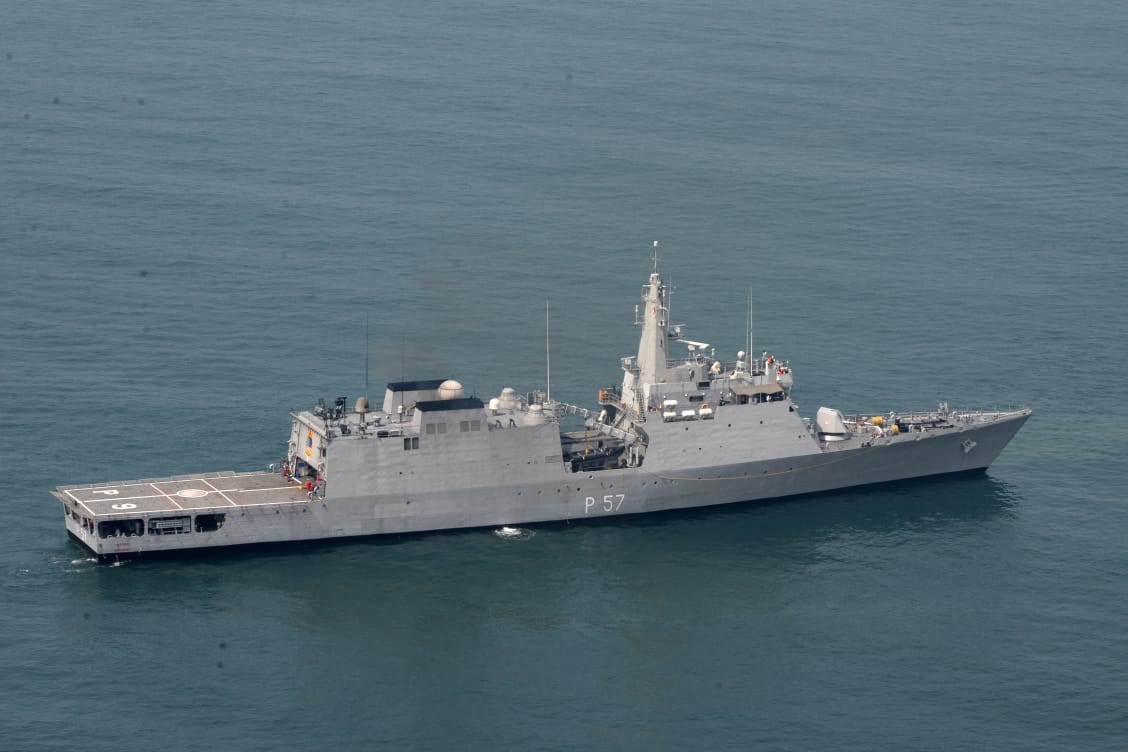
INS Sunanya (P57) at sea, 21 May 2020. Photo Credit: Indian Ministry of Defence.

BNN reports on the visit of the Indian Navy Offshore Patrol Vessel Sunayna to the Nation of Mozambique.

During the port call, personnel from the Indian Navy and the Mozambique Navy engaged in a variety of professional and training engagements, deck visits, and sporting events. Joint training sessions in navigation, fire fighting, damage control, VBSS, and asymmetric warfare were held as part of the maritime partnership exercise.

Sounds like they were engaged in the same sort of “capacity building” the US Coast Guard engages in. Fishing is an important part of the Mozambique economy so Illegal, Unregulated, and Unreported fishing is a problem for them.

There has been increasing cooperation between the US and India in response to Chinese aggressiveness. We might want to spend a little time with the Indian Navy/Coast Guard to gain their insights and benefit the efforts of both nations. Perhaps the Coast Guard should participate in the annual Malabar exercise.

INS Sunayna (P57) is a 105 meter (344 foot) Saryu class Offshore Patrol Vessel. May be worth noting that this visit was done by the Indian Navy rather than the Indian Coast Guard, though they have similar ships.

“As it helps combat unlawful fishing internationally, NGA is ‘posturing’ for an AI-driven future” –DefenseScoop

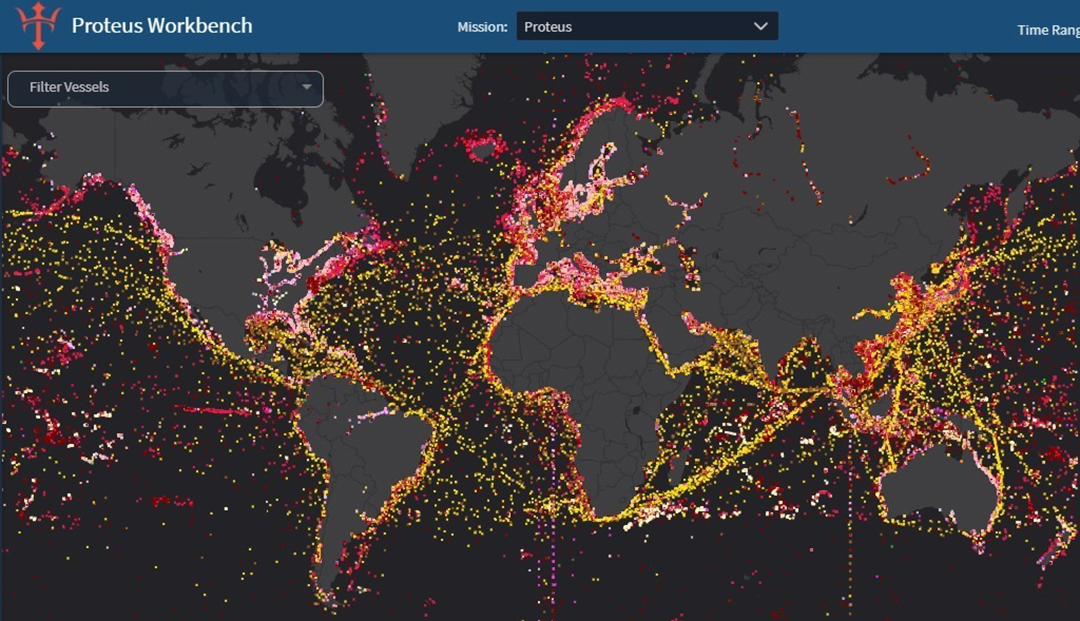
DefenseScoop reports that the National Geospatial-Intelligence Agency (NGA) is using AI to sort data for an application called Enhanced Domain Awareness (EDA) to provide maritime domain awareness information to US and partner countries to help them deal with Illegal, Unregulated, Unreported (IUU) fishing.

“Just to give you a sense of the scale and how much we’re talking about — there’s around 470 U.S. own space-based remote sensing systems that are available today. And that’s going to expand to around 1,400 by 2030, we expect. So globally, there’s about a seven-fold increase in those systems. So the limiting factor isn’t how much of the Earth we can observe or how often — it’s how quickly we can derive insights from that data. And so that’s where, of course, AI and automation comes in. It helps us increase the speed and our capability to react to military and human humanitarian response efforts,” he explained.

This grew out of a SOUTHCOM effort and isn’t limited to IUU.

“When you log into EDA, whether it is on the U.S. side or the partner-nation side, many of the projects that you’ll see in there revolve around different priority lines of effort,” Kurey explained. For Southcom, besides IUU “you’ll find other things like counter-narcotics missions, and things like that. But it’s all encompassing, and you’ll find information and data and projects that I mentioned before will support a tactical environment, operational environment, or strategic messaging,” he said.

The system is being extended to other users.

As the platform continues to mature and blossom, now other combatant commands — including U.S. Northern Command, European Command and Indo-Pacific Command — are beginning to explore how they can integrate it into their own initiatives for data organization and support.

Coast Guard in Oceania in the News

The USCGC Oliver Henry (WPC 1140) crew arrives in Manus, Papua New Guinea, on Aug. 14, 2022, from Guam as part of a patrol headed south to assist partner nations in upholding and asserting their sovereignty while protecting U.S. national interests. The U.S. Coast Guard is participating with partners to support the Pacific Islands Forum Fisheries Agency-led Operation Island Chief and the larger Operation Blue Pacific through patrols in the Western Pacific in August and September 2022. (U.S. Coast Guard photo by SW3 Victor Villanueva, NMCB-FOUR)

A couple of recent articles about the US relations with Palau and Papua New Guinea.

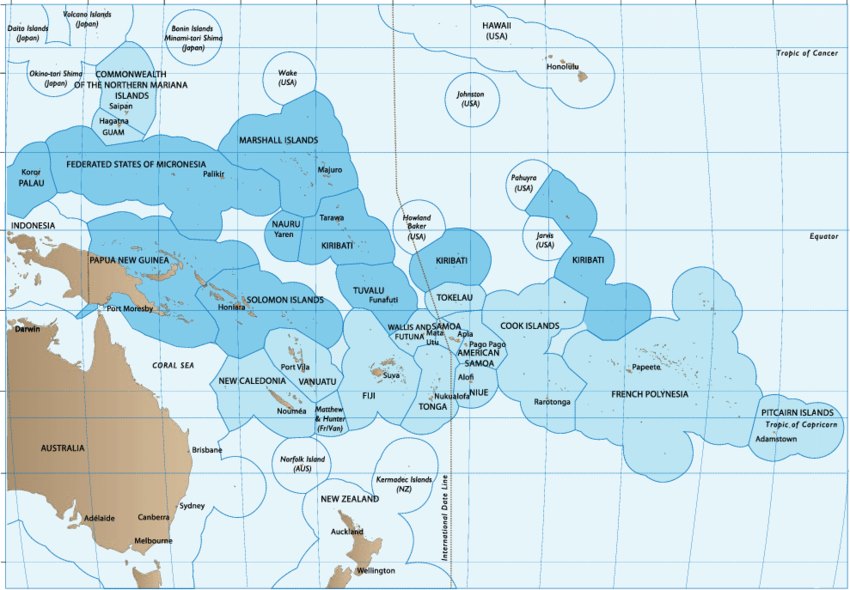
Map of the exclusive economic zones in the Pacific.

There has long been interest in a US base on Manus, Papua New Guinea, but this is politically sensitive. Basing cutters there that protect an important economic resource and occasionally rescue the locals when they get in trouble, would probably be most welcome.

On the map above, Manus and Guam do not look that far apart, but Manus is 1,737.88 km (938 nautical miles) SSE of Guam. That is about the distance from Miami to New York City. 

Cutters based in Manus would be closer to parts Freely Associated States (FAS) of Palau and Federated States of Micronesia than cutters based in Guam and much closer to most non-FAS Micronesian nations. It might also be a good place to site a fixed wing forward operating base (CGAS Honolulu DET).

I am beginning to think we will see two new bases in the Western Pacific, one in American Samoa and one in Manus.

If we do end up with additional Webber class based outside Hawaii and Guam, we might need a squadron support organization similar to, and perhaps even larger than, PATFORSWA, to support all FRCs based in the Pacific South and West of Hawaii, e.g. a PATFORSWPAC.

“The Compacts of Free Association and the Role of the U.S. Coast Guard” –CSIS

Estimated exclusive economic zones (EEZs) of Pacific Island countries and territories (PICTs). The EEZs of countries that are the Parties to the Nauru Agreement are shown in darker blue. Note that not all EEZs of PICTs have been officially delineated under the United Nations Convention on the Law of the Sea. Source: Patrick Lehodey

(Before we start, CSIS also has a great overview of what has been going on in the Western Pacific/Oceania, “STRATEGIC UPGRADES IN THE PACIFIC,” that includes an interactive map. You might want to take a look at it if you want an update on what has been happening in the Western Pacific.)

The Center for Strategic and International Studies has a study proposing,

“One way for the U.S. to show value to the relationship is by aiding the FAS (Freely Associated States–Chuck) in combating illegal maritime activities, building maritime law enforcement capacity, and working with local government and civilian partners to conduct a range of maritime domain training using the USCG as the interlocutor.”

This seems to be encouragement to do more of what the Coast Guard is already doing as part of the aid package negotiations. But to do more, the Coast Guard needs more. US EEZ South and West of Hawaii is equal to 181% the size of the entire Atlantic Area (AA) EEZ, where more than half of all Coast Guard assets are assigned.

If we add the Freely Associated States:

Without considering the other eleven additional island states with EEZs totaling 7.3 times that of the entire Atlantic Area EEZ, the US and Freely Associated States alone have a combined EEZ 4.85 times that of the entire Atlantic Area, e.g., East Coast, Gulf Coast, Puerto Rico, and the Virgin Islands. Permanently based in this huge area we have exactly three patrol craft and a buoy tender, and not a single Coast Guard aircraft.

Will the Coast Guard get the four additional Webber Class Fast Response Cutters on their Unfunded Priorities List? Will there be at least a fixed wing aviation support detachment?

A US Coast Guard base in one of the Freely Associated States could be a win-win.

Thanks to Paul for bringing this to my attention.

“Indo-Pacific partners lead global fight against IUU fishing” –Indo-Pacific Defense Forum

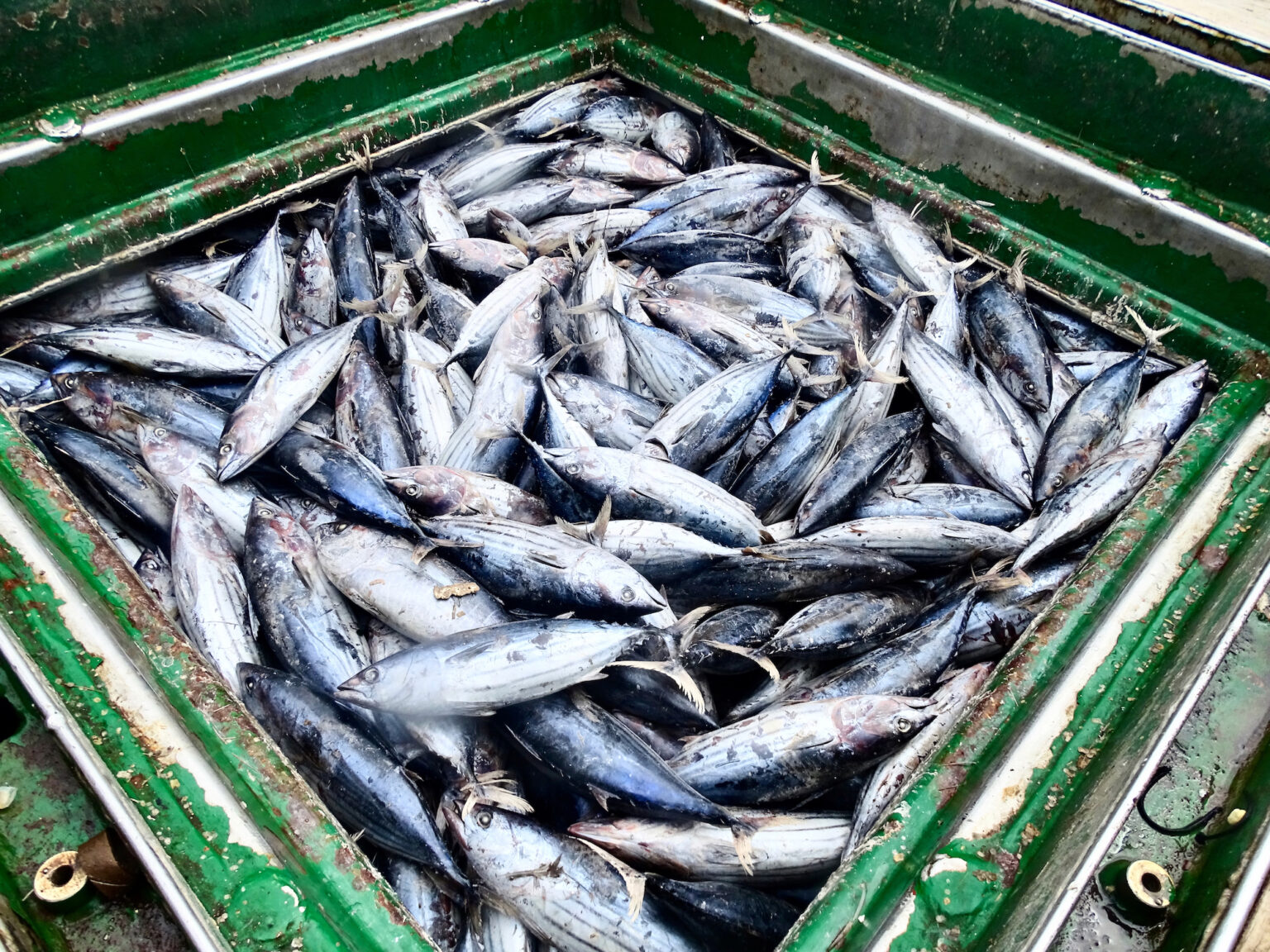
Catch is readied for inspection during a boarding by USCGC Frederick Hatch crew members and a local maritime officer in Micronesia’s EEZ. IMAGE CREDIT: PETTY OFFICER 2ND CLASS BRANDON CHAPLEA/U.S. COAST GUARD

The Indo-Pacific Defense Forum has a nice piece about cooperative efforts to curb Illegal, Unreported, Unregulated (IUU) fishing. USCG gets a lot of credit.

USCGC Stratton Headed for the Western Pacific

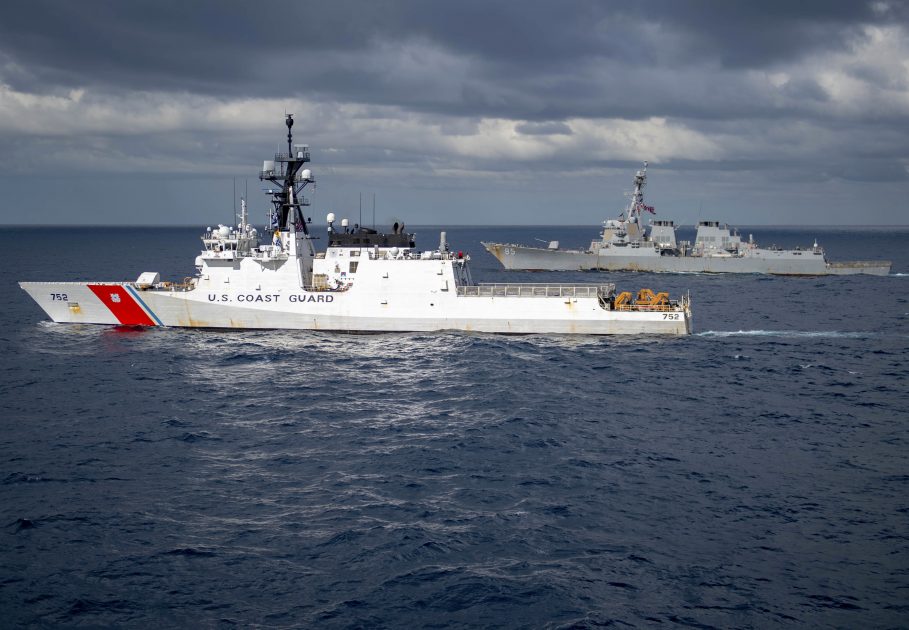
USCGC Stratton (WMSL-752), left, and the U.S. Navy Arleigh Burke-class guided-missile destroyer USS McCampbell (DDG-85) maneuver in formation during Talisman Sabre 2019 on July 11, 2019. US Navy Photo

American Military News reports, “Coast Guard cutter changes command in Honolulu en route to South China Sea.”

I don’t think there is anything unexpected or surprising here, but it does provide a good overview and perspective on what the five Pacific Area cutters of this class have been doing.

It also notes another ship of this class, USCGC “Kimball is currently dry-docked at Pacific Shipyards International in Honolulu Harbor for its first maintenance period since it first arrived in Hawaii in 2018.”

“Coast Guard to Send Additional Cutter to Hawaii” –Military.com

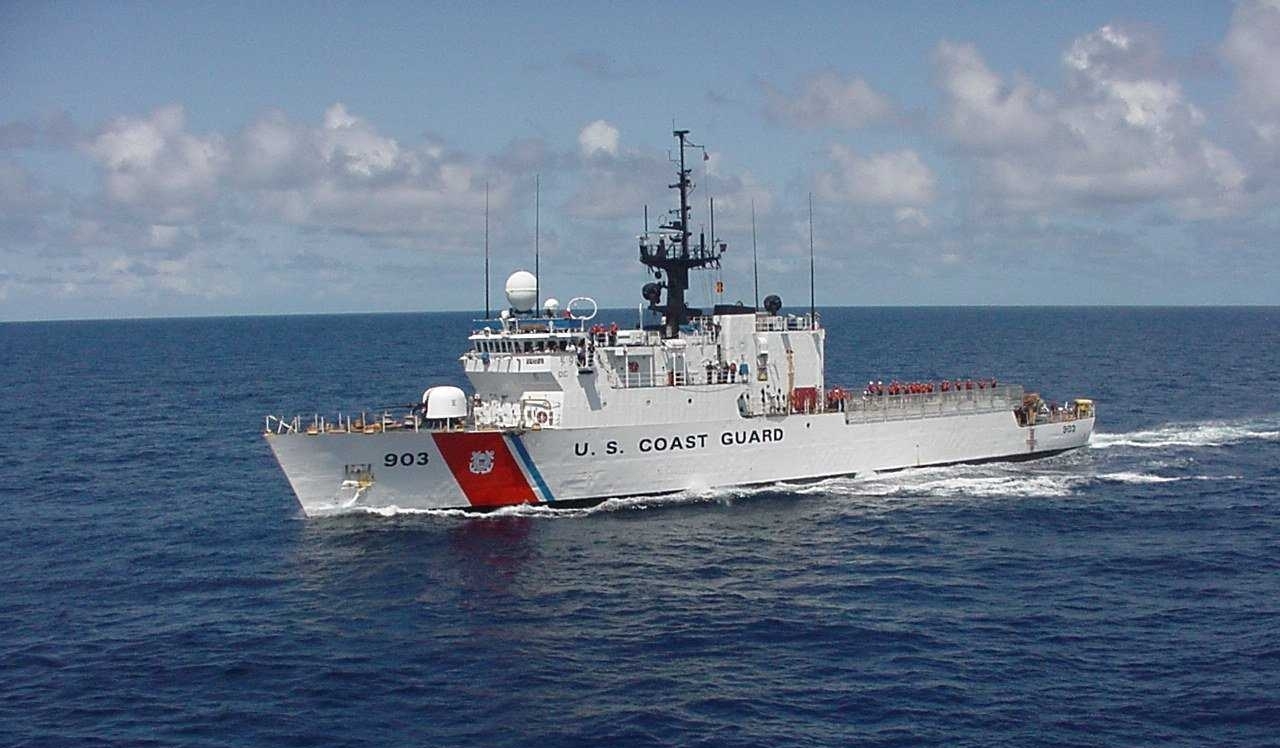
USCGC Harriet Lane (WMEC-903), March 17, 2009. US Coast Guard photo. She may look a little different now having gone through the Service Life Extension Program.

Military.com reports USCGC Harriet Lane is to be the new “Indo-Pacific Support Cutter,” and that she will be based in Honolulu beginning early FY2024. This is a change of homeport from Portsmouth, VA.

We knew this was coming, and Harriet Lane was the likely candidate. She will be the only WMEC 270 in the Pacific and will be used to counter Illegal, Unregulated, Unreported (IUU) fishing in the US EEZ and that of our friends and allies. They will also probably do a lot of training with friendly maritime law enforcement agencies. Her capabilities are a good match for the role. WMEC270s have been doing similar tasks off West Africa for years.

Thanks to Walter, a former dirt dart, for bringing this to my attention.

“Navy, Coast Guard Begin Oceania Maritime Security Initiative Patrol” –DVIDS

USS Mobile (LCS 26), an Independence-class littoral combat ship, was commissioned in 2021 and is homeported in San Diego. (U.S. Navy photo by Eric Parsons/Released)

Below is a press release from the Defense Visual Information Distribution Service (DVIDS). This may not be much different from the previous times Coast Guard Law Enforcement Detachments (LEDETs) were assigned to Navy units transiting to the Western Pacific. It is not at all clear how long they will be doing IUU fisheries enforcement.

SAN DIEGO— The U.S. Navy and U.S. Coast Guard began their joint patrol in the Western Pacific under the Oceania Maritime Security Initiative (OMSI) to reduce and eliminate illegal, unregulated, unreported fishing, combat transnational crimes, and enhance regional security, March 20.

“OMSI is imperative to ensure that the Western and Central Pacific Fisheries Commission Convention (WCPFC) agreement is upheld within the Indo-Pacific region,” said Cmdr. Richard Skinnell, commanding officer of the Navy’s primary participating unit, the Independence-variant littoral combat ship USS Mobile (LCD 26). “This initiative allows us the opportunity to work jointly with other branches of the military as well as our allies and partners.”

OMSI, a Secretary of Defense program, improves maritime security and domain awareness by enabling Coast Guard law enforcement personnel to conduct maritime law enforcement operations from Navy ships. These joint and combined operations ensure the U.S. military honors its security commitments to allies, partners, and friends.
“Collaborating with our partners throughout Oceania is essential in ensuring a free and open Blue Pacific,” said Cmdr. Jeff Bryant, chief of enforcement, U.S. Coast Guard District Fourteen. It is a privilege and we are proud to support the Federated States of Micronesia through dedicated partnership in the effort to maintain maritime governance and preserve maritime sovereignty.”

The WCPFC international fisheries agreement prioritizes the long-term conservation and sustainable use of highly migratory fish stocks in the Western and Central Pacific Ocean.

“The U.S. Coast Guard is always ready and looking forward to executing the OMSI mission alongside our U.S. Navy partners,” said Bryant.

Independence-variant littoral combat ship USS Mobile (LCS 26), with an embarked Coast Guard law enforcement detachment from the Pacific Tactical Law Enforcement Team, supports maritime law with partner nations by enforcing the WCPFC agreement and by suppressing illicit activities. Independence-variant LCS is the platform of choice for this mission due to its fast and agile maneuvering capabilities, large flight deck with manned and unmanned aviation assets and surface warfare mission set.

An integral part of U.S. Pacific Fleet, U.S. 3rd Fleet operates naval forces in the Indo-Pacific and provides the realistic, relevant training necessary to flawlessly execute our Navy’s role across the full spectrum of military operations–from combat operations to humanitarian assistance and disaster relief. U.S. 3rd Fleet works together with our allies and partners to advance freedom of navigation, the rule of law, and other principles that underpin security for the Indo-Pacific region.

I only saw this press release because this was buried in this US Naval Institute News Service article, “Makin Island ARG Docks in Busan, 3 LCS Now Underway in Indo- PACOM,”

“Meanwhile, a third U.S. Littoral Combat Ship, USS Mobile (LCS-26), is now deployed to the Indo-Pacific, joining USS Charleston (LCS-18) and USS Oakland (LCS-24), according to a 3rd Fleet release on Thursday.

The LCSs are taking part in U.S. Navy and U.S. Coast Guard joint patrol in the Western Pacific under the Oceania Maritime Security Initiative (OMSI) to reduce and eliminate illegal, unregulated, unreported fishing, combat transnational crimes and enhance regional security with the patrol being conducted by Mobile with an embarked Coast Guard law enforcement detachment from the Pacific Tactical Law Enforcement Team. Charleston is currently operating around the Indian Ocean while Oakland is around the South China Sea.”

The USNI article may give the impression that all three LCS have Coast Guard LEDETs aboard and that all three are countering IUU, but the referenced news release only mentions USS Mobile. 

It may be significant that USS Mobile is conducting these operations under 3rd Fleet rather than 7th Fleet. Recently 3rd Fleet, which previously was primarily a training and readiness organization, has been taking on more operational responsibility. We may start seeing more of this kind of activity.