How Does the Program of Record Compare to Historic Fleets

 The U.S. Coast Guard cutter USCGC Morgenthau (WHEC-722) heads out to sea from its home port in Alameda, California (USA), passing under the Golden Gate Bridge.


The U.S. Coast Guard cutter USCGC Morgenthau (WHEC-722) heads out to sea from its home port in Alameda, California (USA), passing under the Golden Gate Bridge.

A question from a reader prompted me to look at how the “Program of Record” (POR) compares with Coast Guard patrol fleets of the past.

The program of record is
8 NSCs
25 OPCs
58 FRCs
—————

91 vessels total

1990: Looking back at the “Combat Fleets of the World 1990/1991” the Fleet was:
12 WHEC 378′
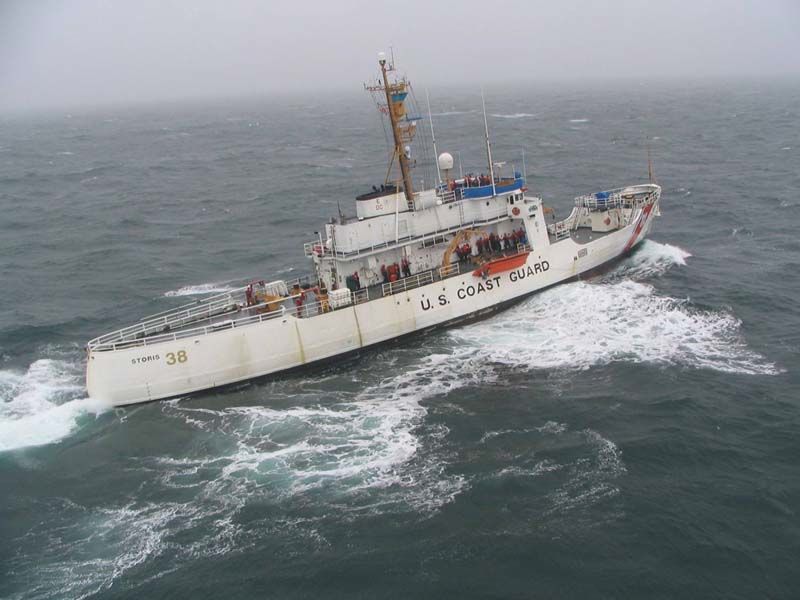
32 WMECs (16×210′, 10×270′ (three building), Storis, 3×213′, 3×205′)
34 WPB 110′ (plus 15 building)
3 WSES 110′ surface effects ships
4 WPB 95′
——————-
85 vessels total
(There were also five Aerostat Radar Balloon tenders.)
 –
2000: “The Combat Fleets of the World 2000-2001” showed
 –
12 WHEC 378′
32 WMEC (13×270′, 16×210′, Alex Haley, Storis, Acushnet)
49 WPB 110′
——————-
93 vessels total.
 –
2013: “The Combat Fleets of the World, 16th Edition,” copyright 2013 listed:
 –
3 NSCs
8 WHEC 378′
28 WMEC (13×270′, 14×210′, Alex Haley)
4 FRCs
41 WPB 110′
——————–
84 vessels total
 –
Comparing the Program of Record (plus NSC #9) to the fleet of 2000: You can look at it this way,
  • 9 NSCs and 3 OPCs is more than adequate replacement for the 12 WHEC 378s
  • 49 of the FRCs is more than adequate replacement for 49 WPB 110s (and we have only had 41 anyway since the WPB 123 screw up)
  • That leaves 22 OPCs and 9 FRCs to cover for the 32 WMECs.
Conclusion: 
I think we would all be pretty happy, if we had the Program of Record fleet in place right now. It really would be a substantial improvement, but while the NSCs and the FRCs are well on the way, the first of the long-delayed OPCs will not be delivered until 2021, and, if everything goes according to plan, the last probably not before 2034, at which time even the newest 270 will be 44 years old. A lot can happen between now and then.
The 2000 fleet was, I believe, the benchmark against which the program of record was measured in the Fleet Mix Study. By 2013 we were already down nine vessels. By my estimate, by the time the last 210 is replaced it will probably be 60 years old. That is expecting a lot. Can we possibly expect that none of these ships will become unserviceable before they are replaced? Building no more than two OPCs a year is really too slow. Once the first ship is built, tested, and approved for full rate production, we should accelerate construction to the maximum. That can’t happen until at least FY2022, probably FY 2023.
By the end of FY2022 we should have already funded 7 ships. The remaining 18 would take nine years, if we buy them at the currently projected schedule. Instead we could fund the entire remaining program from FY2023-2027 by doing a single Multi-Year Procurement of 18 ships. If Eastern alone could not do it, Marinette, which like the designer VARD, is also a Fincantieri company, would probably be more than willing to build an additional couple a year, particularly if the Navy stops building Freedom class LCS/frigates.
 –
We could have the program complete by FY2030, four years early.
 –
Thanks to Peter for initiating this line of thought. 
uscgc_citrus_1984

USCGC Citrus (WMEC-300), USCG photo

storisfoam

USCGC Storis WMEC-38)

USCGC Acushnet

USCGC Acushnet (WMEC-167), USCG photo


TRS-3D Baseline D Multi-Mode Radar for 9th NSC.

NavyRecognition reports, “Airbus Defense and Space, Inc., under contract with its affiliate Airbus DS Electronics and Border Security GmbH, will provide the TRS-3D Baseline D multi-mode radar (MMR) for the U.S. Coast Guard’s ninth National Security Cutter (NSC).”

The Bertholf Class have been equipped with the rotating Active Electronically Scanned Array (AESA) TRS-3D multi-mode (air search, surface search, helicopter control, and firecontrol) radars from the first. My understanding is that this is an improved version of the same radar that equips earlier National Security Cutters and the Freedom class LCS.

Airbus (formerly EADS) has an excellent multi-paged description of the system here.

It is not clear to me how this compares with the TRS-4D system, also from Airbus. The TRS-4D will equip Freedom Class LCS beginning with LCS-17, and I expected it to be used on the Offshore Patrol Cutter (OPC). (Late note: in fact the OPCs will have the SAAB Sea Giraffe multi-mode radar– Chuck) The TRS-4D appears to be very similar in many respects, but it looks at higher elevations and is lighter. Is it a replacement for the TRS-3D or is it a “junior” version of the same technology?

“Congress Must Re-Set Department of Homeland Security Priorities: American Lives Depend on It”–Heritage Foundation

US Capital West Side, by Martin Falbisoner

US Capital West Side, by Martin Falbisoner

The influencial Conservative think tank, Heritage Foundation, has issued a report on the Department of Homeland Security that will likely strongly influence the incoming administration and Congress.

It does not call for any radical increase in the Coast Guard budget for FY2017 ($10.85B). In fact it calls of less funding than was enacted in 2016 ($11.112B), but more than the current administration has requested ($10.322B).

It does support the Offshore Patrol Cutter (OPC) and Polar Icebreaker (PIB) programs and continued procurement of six Webber class (FRC) rather than the four currently requested.

For the future, it appears they support a more stable AC&I budget of at least $1.5B. To me it appears likely the AC&I budget will go higher as both the OPC and PIB enter the construction phase, and they spoke against imposition of a defacto ceiling.

The most significant new direction, seemed to be strong support for Unmanned Air Systems.

Unmanned Aerial Systems. The Coast Guard would also benefit greatly from procuring UASs to support NSC operations. According to the GAO, “Coast Guard officials acknowledged that the lack of [cutter-based] unmanned aircraft would create a gap between the NSC’s actual and planned capabilities.” Dr. William Posage, program manager for the Coast Guard Research and Development Center, explained that the lack of cutter-based UAS technologies “left the NSC with an enormous surveillance gap in her ability to perform her mission.” Notably, the operational effectiveness of the NSC without a UAS component would “be comparable to that of the 378-foot Hamilton class high-endurance cutter,” the very program it was designed to replace with capability enhancements.

The Coast Guard has successfully tested the FireScout and ScanEagle UAS platforms, both of which would significantly amplify the NSC’s surveillance, detection, classification, and prosecution capabilities. Widely used for similar naval operations, they have successfully contributed to a handful of at-sea Coast Guard demonstrations. According to an assessment by the Coast Guard Office of Aviation Forces, the presence of two vertical take-off FireScout UASs aboard an NSC would enable the cutter to cover three times the presence radius of an NSC without them. Similarly, according to a Senate Appropriations Committee report, “[t]he Coast Guard has reported…that its long standing plan to add vertical take-off unmanned aircraft systems to the National Security Cutters would result in an estimated 95- to 225-percent increase in surveillance coverage within an 800 nautical mile radius of the cutter and an estimated 95-percent increase in the number of prosecutions achieved by the cutter.”

The Coast Guard’s FY 2017 budget justification states that funding for the NSC program will in part “establish sUAS [small UAS] capability aboard one NSC, to include engineering analysis, non-recurring engineering, procurement and installation of sUAS components, and system testing and certification.” Admiral Zukunft testified before the House Transportation Committee in March 2016 that this activity would involve a “down select” for a sUAS capability “that will go on board” the NSC. The NSC will amplify its aerial ISR capabilities dramatically with the longer-term integration of sUAS, while the sea service should continue to evaluate the vertical unmanned aerial vehicle (VUAV) platform.

This seems to indicate a two pronged approach, first a small UAS (Scan Eagle or something similar) in the near future and a continued interest in evaluating a vertical takeoff unmanned system like Firescout or potentially DARPA’s TERN.

All the UAS discussion centers on the National Security Cutters. There is no discussion of the possibility of using UAS on any other classes.

Commandant Talks Prospects for Next Administration

Defense & Aerospace Report Editor Vago Muradian interviews the Commandant, Adm. Paul Zukunft, at the 2016 Reagan National Defense Forum.

The Commandant hit many of themes we have heard him discuss before, but there was also mention of beginning to replace the inland Aids to Navigation fleet. We were supposed to have had a joint program with the Corp of Engineers to develop a common design, but I haven’t heard anything about that for several years now. They are certainly due for replacement. It almost sounds like they just realized they needed to do something about this.

Where is that 30 year shipbuilding plan?

“AGAINST THE GROWING ANTI-SHIP MISSILE THREAT, ARE WE TRULY SEMPER PARATUS?”–CIMSEC

CIMSEC has a new post that is worth the read, “Against the Growing Anti-ship Missile Threat, Are We Truly Semper Paratus?” It is the first of two parts.

Pointing toward the increasing ubiquity of anti-ship missiles, it suggests that we install the SeaRAM system in place of the Phalanx on the Bertholf class National Security Cutters (NSC), and that we also install the system on the Offshore Patrol Cutters (OPC) and the new icebreakers.

With the Commandant’s proposal,  that the new administration send cutters to the Western Pacific to counter Chinese aggressiveness, better self-defense systems make more sense than ever.

Fitting the system to at least a couple of West Coast NSCs that might be available for WestPAC deployment should be relatively straight forward since the systems have much in common with the Phalanx system it would replace. SeaRAM would have the additional benefit of increasing the ships anti-surface capability as well.

Navy Rethinks the LCS–Manning, Crew Rotation, Homeporting

800px-USS-Freedom-rear-130222-N-DR144-367

Photo: USS Freedom (LCS-1)

The US Naval Institute news service reports “Results of New LCS Review is Departure from Original Vision.”

Why should we care?:

For one thing the LCS were planned to be multi-crewed. Their plan was a bit different from our Crew Rotation Concept, but the idea was the same, multiple crews rotating among multiple ships to provide more deployed time. The Coast Guard had planned to apply the Crew Rotation Concept to the National Security Cutters, but I have also seen it referred to with regard to the Offshore Patrol Cutters.

Earlier I called the Offshore Patrol Cutter, the other LCS, and it does look like they will continue to share some systems and training. If the OPCs emerge with space for modular systems, we may see even more cross talk between the programs. The two types (LCS and OPCs) are similar in size, so comparisons are inevitable.

Hopefully we can learn from their experience.

The results: 

The Navy is abandoning their planned rotation of three crews among two ships in favor of a plan that would assign two crews to a single ship, much like the way SSBNs are manned by blue and gold crews. The significant difference is that the crews “own” the ships, they don’t expect to walk away to a different hull and never see it again.

The size of the crews is to be increased. Originally there was to have been a core crew of 40. That was increased to 50, and it is now planned to increase the core crew to 70 plus a 23 person air detachment. Maximum berthing is reportedly 98. Adding a CG LE team should max out the berthing. This pushes the crew much closer to what the Coast Guard was planning for the OPC, (pdf) a crew of 104. That means a full crew for each LCS is really 163, two core crews of 70 and 23 in the air detachment.

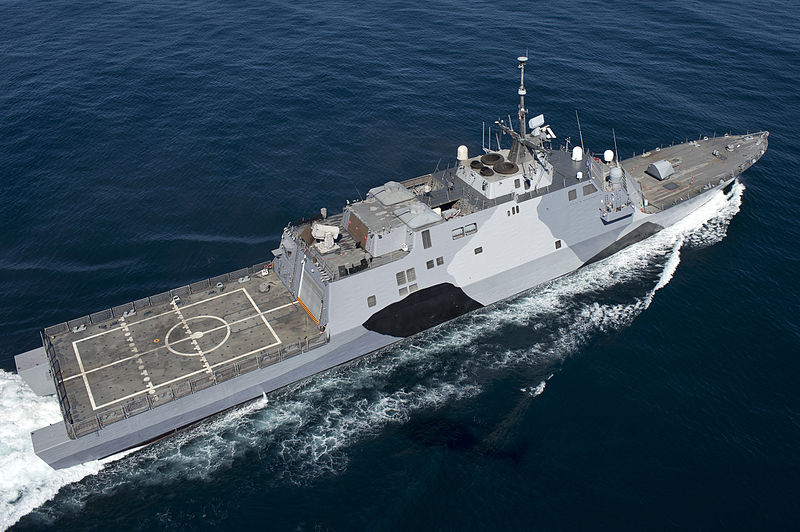
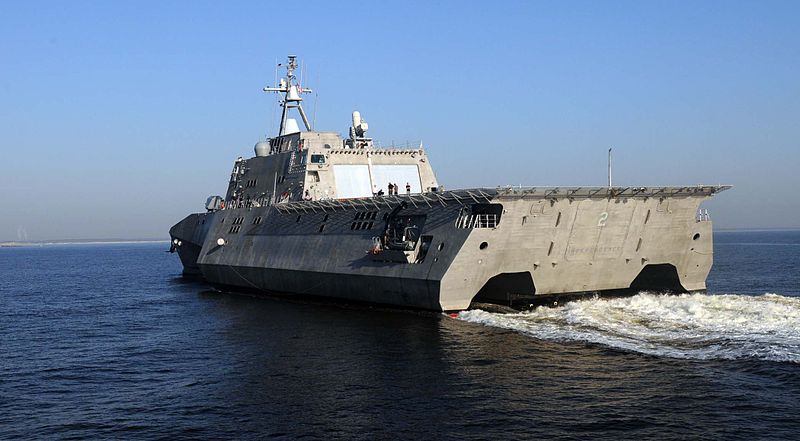
Instead of basing a mix of both types of LCS on each coast, the new plan would put the trimaran Independence class, with its longer range, on the West Coast (San Diego) while the shorter legged, monohull Freedom class will be based on the East Coast (Mayport, FL). That makes a lot of sense.

The ships will be organized into six four ship divisions with each division assigned a single mission (mine countermeasures, anti-surface, or antisubmarine). The four oldest ships will be single crewed, will not be assigned to a division and will instead be used for training and testing. Again this makes sense since subsequent ships are somewhat different, having incorporated lessons learned on the first ships.

That doesn’t necessarily mean there will be one division of each class assigned each of the three missions although that may the result. To me the Independence class appears better suited for ASW and the Freedom class by default better used as minecountermeasures ship.

uss_independence_lcs_2

Photo: USS Independence (LCS-2), U.S. Navy photo by Mass Communication Specialist 2nd Class Justan Williams 

Lessons: 

When the Coast Guard finally decides to abandon the Crew Rotation Concept, as currently envisioned–four crews for three ships. They can point to the LCS experience as justification.

As a means to allow increased time underway, permanently augmenting the NSCs’ crews to allow generous leave and TAD assignments is probably a better solution. After all, if we have a crew of 160 or so assigned to each NSC or OPC, we could probably keep them underway at least as much as the LCS are.

Applying a division staff organization to the NSCs and perhaps the OPCs is probably a good idea. In addition to a post command captain, that could, among other things, provide initial advice to newly arrived COs and possibly a relief CO function; it could provide personnel augmentation for those specialists positions that have little or no redundancy in the typical ship’s organization, allowing them some leave and/or TAD while the ship is underway, with the objective of keeping the crew members underway time at 185 days or less, while the ship is away from homeport for a considerably longer time.

USNI News Video: U.S. Coast Guard and the Drug War

The US Naval Institute News Service has produced a short video on the drug war featuring the Stratton and her CO.

The video shows huge quantities of Cocaine on the flight deck of presumably Stratton. A viewer might assume the entire quantity was taken when Stratton successfully interdicted a self propelled semi-submersible with 7,000 kilos. Actually the deck cargo seen in the film is 30,000 kilos with includes not only Stratton’s haul but that of several other seizures.. These included other Coast Guard seizures and operations by other US agencies and international allies.

How About a Coast Guard Sink-Ex?

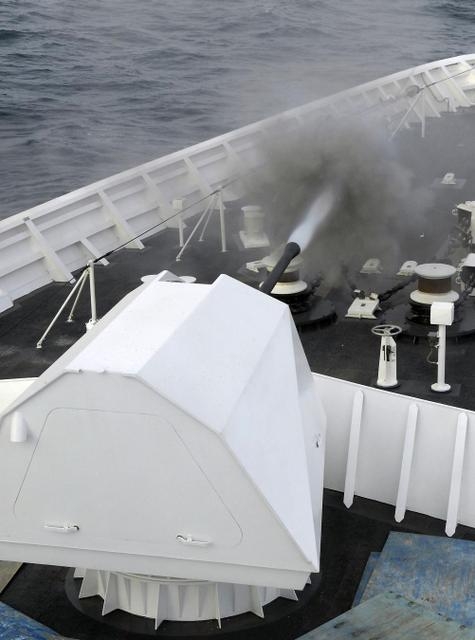
Test firing of the 57mm Bofors aboard USCGC Bertholf, photo by MMagaro

Test firing of the 57mm Bofors aboard USCGC Bertholf, photo by MMagaro

Are our weapons adequate for the Ports, Waterways, and Coastal Security Mission? Let’s find out.

The Navy Times is reporting that the Navy will have an unusually large number of ships available for “Sink-Ex” exercises in 2017.

The SINKEX fleet grew from five ships last year to seven ships available in 2017, including four frigates, the landing ship tank Racine and two attack cargo ships.

According to the source document, the Navy’s 30 year shipbuilding plan (pp 13/14), one of the stated purposes of a Sink-EX is weapons effectiveness evaluation. I think this might be a good opportunity for us to test out our weapons for the Ports, Waterways, and Coastal Security (PWCS) mission. This mission implies we must have the ability to forcibly stop a ship, regardless of its size. A Sink-Ex could be an opportunity to answer once and for all the question “Is the Coast Guard adequately armed for the mission?”  Personally I don’t think so, and what little evidence we have seems to indicate that is the case.

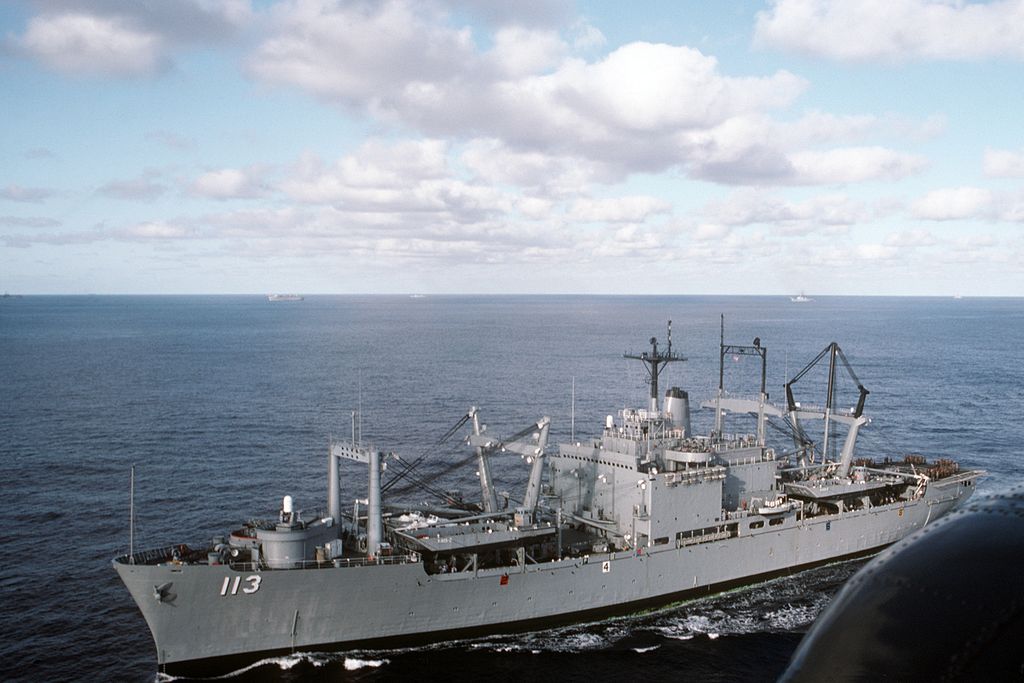
The two attack cargo ships are Charleston class LKAs, the ex-Durham (LKA-114) and ex-St. Louis (LKA-116), built in the late ’60s. These are medium sized auxiliary ships, 9,000 tons light and 18,500 tons fully loaded, 576 feet (176 meters) in length. Structurally they are not much different from merchant ships of the period. Unfortunately they don’t have the big diesel engines found on modern merchant ships, and the are far smaller than many current merchant ships but they are still, in most respects, representative of the target set the Coast Guard should be interested in.

USS_Charleston_(LKA-113)

Photo: USS Charleston (LKA-113)

We have four gun systems that might be tested. .50 cal., 25 mm, 57 mm, and 76 mm. The 25 mm and 57 mm are particularly important as the .50 cal is probably too small and short ranged and the 76 mm is going out of service. Still, we should still attempt to include the 76 mm because if the 57 mm proves inadequate, our next question should be, “Would the 76 mm have been successful?” Testing the 25, 57, and 76 mm guns would require use of at least two ships, a 378 for both the 76 and 25 mm, and a Bertholf class for the 57 mm. (Alternately an LCS might provide the 57 mm, a Bear class the 76 mm, and a 110 or Webber class the 25 mm.)

1280px-USCG_Gallatin_Mk_75_firing

This could be a CG R&D project, but of course it would require Navy assistance, perhaps a joint project. Because our objective is to at least stop the target, rather than sink it, loss of power or steering would constitute a success. To determine if this is the case, we need information about what is happening inside the hull when the we get a hit. Will the round penetrate not only the hull but also critical systems, the loss of which would result in loss of power or control of the ship? Because it would probably be dangerous to go back on board the target after it has been shelled, the target would need to be instrumented with sensors and the results broadcast back. Aside from putting cameras inside the spaces, a technique might be to seal up and pressurize equipment like boilers, turbines, and steering gear and have them instrumented to detect any loss of pressure that would indicate a breach.

We would also want to conduct the exercise at a reasonable ranges. Since the real targets might be equipped with weapons that might be typically available to terrorist organizations, including anti-tank missiles and Soviet era antitank and anti-aircraft guns,that might target critical systems on the cutter, I believe the cutter should stand off at least 4000 yards, but for the 25 mm, we would probably need to close to 3,000 yards. A logical sequence might be,

  1. 378 closes to 3000 yards engages with 25 mm then withdraws
  2. NSC closes to 4,000 yards and engages, then withdraws
  3. 378 closes to 4,000 yards and engages.

We would also want to fire a reasonable number of rounds, probably about 150 rounds of 25 mm, about 100 rounds of 57 mm, and about 80 rounds of 76 mm, basically shoot enough to exhaust the ammunition normally carried on the mount.

Realistically this would have to be part of a larger Sink-Ex with more than one target, but it might be reasonable to allow the Coast Guard a day to try their systems against one of the targets before the other firing units come on scene.

Should our current systems prove not up to the task, we would also want to know the results for possible candidate systems, so we might ask that these candidate systems be used against the target as well. These might include, APKWS, Griffin, Hellfire, the 5″ gun, and the light weight torpedo. I don’t think it has ever been tried, but with the right depth settings, is it possible to hit a deep draft surface target with our current light weight torpedoes?

Let’s at least find out if we have a chance of succeeding in this mission. 

Commandant’s Strategic Intent, Mid-Term Report

Coast Guard Capt. Douglas Nash, commanding officer of Coast Guard Air Sation Sacramento, salutes a Coast Guard C-27J pilot during a change of watch ceremony at Air Station Sacramento's hanger in McClellan Park, Thursday, July 1, 2016. The ceremony marked the final day that an HC-130 Hercules crew stood the watch at Air Station Sacramento and introduced the newest aircraft. Coast Guard photo by Petty Officer 3rd Class Loumania Stewart

Procurement of 14 C-27J aircraft was one of the achievements sited. C-27Js replace C-130s at CGAS Sacramento. 

The Commandant has issued a mid-term update on his earlier published “Strategic Intent, 2015-2019” (pdf). The new document is available in pdf format. You can find it here: “United States Coast Guard Commandant’s Strategic Intent, 2015-2019, Mid-Term Report.”

It is relatively short and readable at 21 pages. The recurring themes of the Commandant’s administration are all there, starting with TOC (transnational organized crime) and its deleterious effect on Western Hemisphere governance and prosperity. It does read a little like an Officer Evaluation Report input.

There is nothing particularly surprising here, but even for me, the enumeration of the scope the Coast Guard’s authorities, responsibilities, and international contacts is still mind boggling.

I am not going to try to summarize the report, but there were a few things that struck me.

The Commandant mentions service life extension programs for the seagoing buoy tenders (already begun), the 47 foot MLBs, and the 87 foot WPBs (in the future), but there is no mention of what we will do about the inland tender fleet. There will also be a life extension program for helicopters before they are finally replaced.

“Extend the service life of our rotary wing assets and align with DOD’s Future Vertical Lift initiative.”

There is mention of a program I was not aware of, the “Defense Threat Reduction Agency National Coast Watch System project.” The Defense Threat Reduction Agency attempts to track and reduce the WMD threat. It is not really clear what our role is here. We know about the container inspection programs in foreign ports. Is that it, or is there more to this? (that can be discussed at an unclassified level.)

USCG Contracts for Scan Eagle UAS

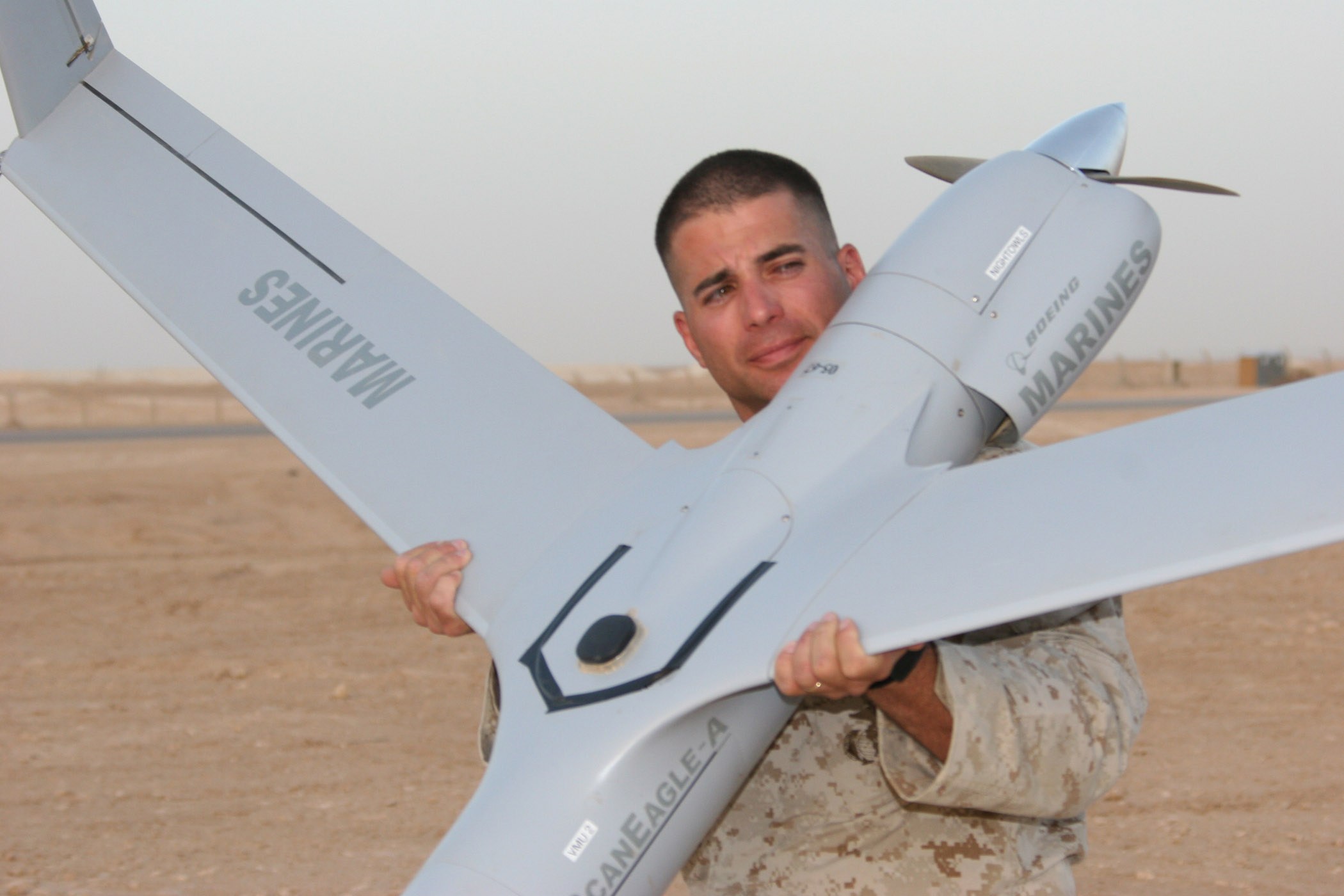
ScanEagleIraq

It is a small step, but NavyRecognition is reporting that the Coast Guard has contracted with Insitu to provide one Bertholf class National Security Cutter with Scan Eagle UAS.

The Coast Guard procured the necessary services through a pre-existing multiple award contract executed by Naval Air Systems Command. The initial $4.5-million task order includes operation, integration, maintenance and sparing of a contractor-owned sUAS on one NSC for one year. The task order has a total potential value of $12.3 million that includes options for deployment of and data from prototype sUAS capability for up to three additional years beyond the base year. The Coast Guard will have full ownership of the surveillance data obtained.

This is a system suggested here five years ago. Additional details on the system were included in my earlier post. There are also comments regarding our experience with the system in the intervening years.

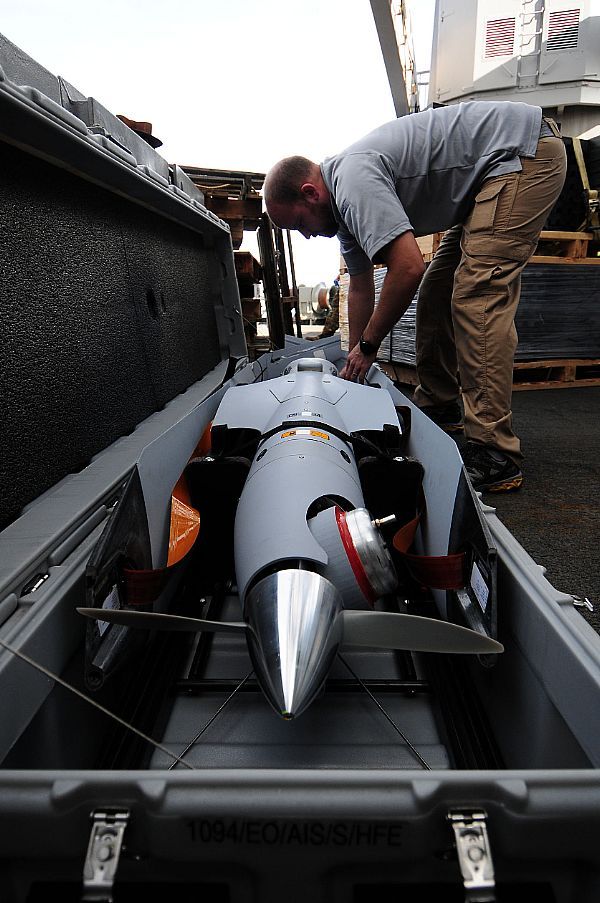
110225-N-RC734-011 PACIFIC OCEAN (Feb. 25, 2011) Guy Mcallister, from Insitu Group, performs maintenance on the Scan Eagle unmanned aerial vehicle (UAV) aboard the amphibious dock landing ship USS Comstock (LSD 45). Scan Eagle is a runway independent, long-endurance, UAV system designed to provide multiple surveillance, reconnaissance data, and battlefield damage assessment missions. Comstock is part of the Boxer Amphibious Ready Group, which is underway in the U.S. 7th Fleet area of responsibility during a western Pacific deployment. (U.S. Navy photo by Mass Communication Specialist 2nd Class Joseph M. Buliavac/Released)

110225-N-RC734-011
PACIFIC OCEAN (Feb. 25, 2011) Guy Mcallister, from Insitu Group, performs maintenance on the Scan Eagle unmanned aerial vehicle (UAV) aboard the amphibious dock landing ship USS Comstock (LSD 45). Scan Eagle is a runway independent, long-endurance, UAV system designed to provide multiple surveillance, reconnaissance data, and battlefield damage assessment missions. Comstock is part of the Boxer Amphibious Ready Group, which is underway in the U.S. 7th Fleet area of responsibility during a western Pacific deployment. (U.S. Navy photo by Mass Communication Specialist 2nd Class Joseph M. Buliavac/Released)