Mk20 mod1 Electro Optic Sensor System

Mk20 mod1 Electro Optic Sensor System (EOSS)

Mk20 Mod1 Electro Optic Sensor System (EOSS)

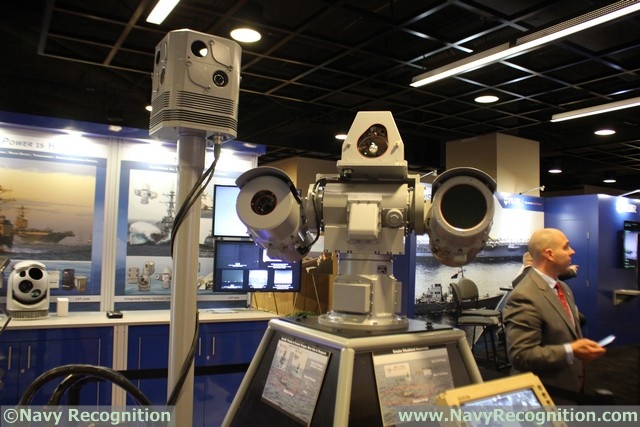
Two reports by NavyRecognition from the Surface Navy Symposium on the L3 Mk20 Mod1 Electro Optic Sensor System (EOSS). The video report above discusses the system from time 00:45 to 2:55, and there is this short written post reporting successful testing. Reportedly this EOSS will weigh half as much as the previous mk20 mod0 system, but have greater resolution and range. According to the report it is currently planned to be installed aboard U.S. Navy Cruisers/Destroyers and U.S. Coast Guard Cutters, presumably the Offshore Patrol Cutters (OPC).

The earlier Mk20 Mod0 is on the National Security Cutter.

The three parts visible are, I believe, a day light TV camera, a thermal imaging camera, and a laser range finder. I wonder if it could also function as a laser target designator?

Other than using it as a firecontrol for ASuW and AAW, this system can be used for:

– Spotting and kill assessment
– Target detection and identification
– Naval gunfire support
– Safety check-sight
– Location and track of man overboard
– Channel position and navigation


TRS-3D Baseline D Multi-Mode Radar for 9th NSC.

NavyRecognition reports, “Airbus Defense and Space, Inc., under contract with its affiliate Airbus DS Electronics and Border Security GmbH, will provide the TRS-3D Baseline D multi-mode radar (MMR) for the U.S. Coast Guard’s ninth National Security Cutter (NSC).”

The Bertholf Class have been equipped with the rotating Active Electronically Scanned Array (AESA) TRS-3D multi-mode (air search, surface search, helicopter control, and firecontrol) radars from the first. My understanding is that this is an improved version of the same radar that equips earlier National Security Cutters and the Freedom class LCS.

Airbus (formerly EADS) has an excellent multi-paged description of the system here.

It is not clear to me how this compares with the TRS-4D system, also from Airbus. The TRS-4D will equip Freedom Class LCS beginning with LCS-17, and I expected it to be used on the Offshore Patrol Cutter (OPC). (Late note: in fact the OPCs will have the SAAB Sea Giraffe multi-mode radar– Chuck) The TRS-4D appears to be very similar in many respects, but it looks at higher elevations and is lighter. Is it a replacement for the TRS-3D or is it a “junior” version of the same technology?

A Little More on the Offshore Patrol Cutter

OPC "Placemat"

OPC “Placemat”

MarineLink has a story on the OPC, and it includes a bit more detail, and it raises some questions. I’ve also seen a couple of stories about how they will be equipped that will be referred to below.

There is this:

“Zukunft’s budget suggests at least one cutter, or an immediate separate order, will be arctic capable, and Vard and Canadian engineering consultancy BMT Fleet are already understood to be working on project documents for a Canadian “arctic offshore patrol ship” of Vard 7 100 type.”

VARD 7-100 ICE, the Canadian AOPS

VARD 7-100 ICE, the Canadian AOPS

Vard actually has two designs designated “7-100,” an offshore patrol vessel (pdf) very similar to the OPC and the 7-100 ICE. Apparently, it is the 7-100 ICE they are referring to here. The VARD 7-100 ICE (pdf) is also known as the Canadian Navy’s Arctic Offshore Patrol Ship (AOPS). Does that mean the Coast Guard is looking at the Canadian AOPS as a possible Arctic Patrol Vessel, perhaps filling the role of one or two of the three medium icebreaker? They do have power similar to the old Wind class icebreakers.

We also have this indication the standard OPCs are still expected to patrol the Arctic. (Var refers to the OPC as the Vard 7 110.)

“…the Vard 7 110’s will also patrol the “increasingly accessible Arctic”, a theatre which might require a more closed superstructure, more akin to the Vard 7 100.”

The Vard 7 100 ICE has its ground tackle below the foc’sle deck to protect it from freezing. Perhaps that is what this means. This has also been done on some European Frigates.

Then there is this little bit of speculation about who will build follow on ships”

“Owned by the Italian state via Fintecna, Fincantieri doubled after its acquisition of Vard to become the fourth largest shipbuilder in the world and the largest in the Med. As we wrote these words, Financtieri’s Trieste-based minds were making a friendly offer for the 44 percent of Vard they don’t own. It’s worth noting that in January 2009, Fincantieri bought Manitowoc Marine Group and its two yards in Wisconsin, including the Marinette Marine that built the first Freedom Class littoral combat ship. So, Eastern, it seems, has a rival and a friend in Fincantieri, another maker of mid-sized vessels for the U.S. Navy. So, who knows what may be next from U.S. military-industrial strategists keen to share financial resources with capable NATO allies while also creating jobs at home. For now, all eyes will be on those remaining OPVs.

They are pointing out that there may be competition for the follow on contract. That is good for the Coast Guard.

I would also point out that it also means Marinette might make modified OPCs for the Navy, if the Navy ever realizes that the LCS is not going to make a very good “small surface combatant.”

Northrop Grumman Corporation reports they have been awarded a contract for the design of the C4ISR and machinery control systems (MCS).

“The systems being supplied include integrated bridge systems, command and control consoles, navigation and combat data distribution systems, ship-wide computer network systems, machinery control systems and propulsion control systems

“Included in the design phase of the OPC program is a MCS land-based test facility, as well as a C4ISR test and integration facility, both of which will be located in Charlottesville. Additional work will be conducted at company facilities in San Diego, and Ocean Springs, Mississippi. Northrop Grumman will also provide key C4ISR and MCS integration roles during production testing and shipboard trials to be held in Panama City, Florida.”

MarineLog identified the engines to be used.

Each 360 foot-long vessel will be powered by two FM-MAN 16V 28/33D diesel engines, each rated at 9,763 bhp at 1,000 rpm.

We have consistently seen the speed quoted as 22.5 knots sustained or 22 or more. I suspect they are being conservative. With almost 20,000 HP, the ship ought to make 24 or even 25 knots, in all but the most adverse conditions of load and bottom fouling.

I would have preferred the 20,000 KW (26820 HP) engines advertised for the VARD 7 1000 which would have assured 25 knots, but it’s not bad. If the 7 110 follows the pattern of the 7 100 OPV, than there will be hybrid propulsion, with electric motors on the shaft in addition to geared diesel drive from the main engines. For a cruising speed of 14 knots, that would require two electric motors of about 1,500 HP each.

 “In order to provide fuel efficiency and greater range, this vessel is powered by CODELAD (combined diesel and electric) which allows for instantaneous changeover.”

This would make a lot of sense, in that in addition to the fuel economy benefits it would improve the ships survivability. It could lose both main diesel engines and still have propulsion.

“Congress Must Re-Set Department of Homeland Security Priorities: American Lives Depend on It”–Heritage Foundation

US Capital West Side, by Martin Falbisoner

US Capital West Side, by Martin Falbisoner

The influencial Conservative think tank, Heritage Foundation, has issued a report on the Department of Homeland Security that will likely strongly influence the incoming administration and Congress.

It does not call for any radical increase in the Coast Guard budget for FY2017 ($10.85B). In fact it calls of less funding than was enacted in 2016 ($11.112B), but more than the current administration has requested ($10.322B).

It does support the Offshore Patrol Cutter (OPC) and Polar Icebreaker (PIB) programs and continued procurement of six Webber class (FRC) rather than the four currently requested.

For the future, it appears they support a more stable AC&I budget of at least $1.5B. To me it appears likely the AC&I budget will go higher as both the OPC and PIB enter the construction phase, and they spoke against imposition of a defacto ceiling.

The most significant new direction, seemed to be strong support for Unmanned Air Systems.

Unmanned Aerial Systems. The Coast Guard would also benefit greatly from procuring UASs to support NSC operations. According to the GAO, “Coast Guard officials acknowledged that the lack of [cutter-based] unmanned aircraft would create a gap between the NSC’s actual and planned capabilities.” Dr. William Posage, program manager for the Coast Guard Research and Development Center, explained that the lack of cutter-based UAS technologies “left the NSC with an enormous surveillance gap in her ability to perform her mission.” Notably, the operational effectiveness of the NSC without a UAS component would “be comparable to that of the 378-foot Hamilton class high-endurance cutter,” the very program it was designed to replace with capability enhancements.

The Coast Guard has successfully tested the FireScout and ScanEagle UAS platforms, both of which would significantly amplify the NSC’s surveillance, detection, classification, and prosecution capabilities. Widely used for similar naval operations, they have successfully contributed to a handful of at-sea Coast Guard demonstrations. According to an assessment by the Coast Guard Office of Aviation Forces, the presence of two vertical take-off FireScout UASs aboard an NSC would enable the cutter to cover three times the presence radius of an NSC without them. Similarly, according to a Senate Appropriations Committee report, “[t]he Coast Guard has reported…that its long standing plan to add vertical take-off unmanned aircraft systems to the National Security Cutters would result in an estimated 95- to 225-percent increase in surveillance coverage within an 800 nautical mile radius of the cutter and an estimated 95-percent increase in the number of prosecutions achieved by the cutter.”

The Coast Guard’s FY 2017 budget justification states that funding for the NSC program will in part “establish sUAS [small UAS] capability aboard one NSC, to include engineering analysis, non-recurring engineering, procurement and installation of sUAS components, and system testing and certification.” Admiral Zukunft testified before the House Transportation Committee in March 2016 that this activity would involve a “down select” for a sUAS capability “that will go on board” the NSC. The NSC will amplify its aerial ISR capabilities dramatically with the longer-term integration of sUAS, while the sea service should continue to evaluate the vertical unmanned aerial vehicle (VUAV) platform.

This seems to indicate a two pronged approach, first a small UAS (Scan Eagle or something similar) in the near future and a continued interest in evaluating a vertical takeoff unmanned system like Firescout or potentially DARPA’s TERN.

All the UAS discussion centers on the National Security Cutters. There is no discussion of the possibility of using UAS on any other classes.

Breaking Defense Interviews the Commandant

Coast Guard Commandant Adm. Paul Zukunft (right) meets with then-Southern Command chief Gen. John Kelly, now Trump’s nominee for Secretary of Homeland Security.

Coast Guard Commandant Adm. Paul Zukunft (right) meets with then-Southern Command chief Gen. John Kelly, now Trump’s nominee for Secretary of Homeland Security.

Breaking Defense’s Robbin Laird has an Interview with the Commandant and speculates on the prospects for the Coast Guard under the new administration and DHS selectee General John Kelly.

Trump, Kelly, & The Coast Guard: Exclusive Interview With Adm. Zukunft

Its a good one, and even the comments are worth reading. There is much of the same we have heard before. The Commandant has a clear and consistant message and agenda, but there is more detail about a possible role in the far Western Pacific.

“I have discussed with the CNO (Chief of Naval Operations Adm. John Richardson, the senior officer in the Navy) the concept that we would create a permanent USCG presence in the South China Sea and related areas,” Zukunft said. “This would allow us to expand our working relationship with Vietnam, the Philippines, and Japan. We can spearhead work with allies on freedom of navigation exercises as well.”

This is the first time I have seen the phrase “permanent USCG presence in the South China Sea and related areas.” Does that mean we will have a CG patrol squadron working out of Sinagpore or Okinawa (or Cam Ranh Bay), like the one in Bahrain? Or are we just looking at the Webber class WPCs we already know are going to Guam? (Must be more to it than that.) I do think we should put some OPCs in Guam, if only to patrol the EEZ in the Western Pacific.

Until recently we might have considered the possibility of basing in the Philippines, but that no longer looks like a possibility.

What ever you may think of the incoming administration, for the Coast Guard at least, it looks promising.

Thanks to Luke for bringing this to my attention. 

The Mk38 Gun Mount and Ballistics and Weapons Effectiveness Lessons from Pursuit of the Graf Spee, Part 1

hms-exeter-damaged-595x371

Photo: Heavy cruiser HMS Exeter seen after the battle, looking aft from the bow. Both forward twin 8″ gun turrets and the firecontrol system were disabled and the bridge destroyed by “splinters.”  

Introduction:

Note, this has been edited from the original, based on feedback particularly with regard to the ammunition remaining on Graf Spee after the engagement. I don’t believe the thrust of the post has been changed.  

This is the first of two parts. Part one will tell a story. Part two will talk about the implications of lessons learned, applied to how the Coast Guard might deal with the threat of terrorists using a medium to large merchant ship to make an attack.

These are themes that will be discussed in part 2 before looking at specific tactics to make the best use of what we have. Hopefully you will see these illustrated in the following story.

  • In comparing guns, at any given range, the longer ranged weapon generally enjoys an advantage in accuracy.
  • It is very difficult to sink a ship by gunfire alone.
  • Ships’ structure provide a degree of protection that makes it difficult to comprehensively target the crew of a ship without sinking the ship.
  • It is difficult to forcibly stop a ship with gunfire alone.
  • You can run out of ammunition before you accomplish your mission. The depth of your magazine may be important.

But first the story.

To the Germans, it is the story of a lone warrior, that by guile and deception, manages to evade the world’s largest navy for three months. Graf Spee is captained by an honorable and humane gentleman of the old school, Captain Hans Langsdorff, who after seeking a fight with the British and apparently besting them, does the unthinkable, retreating to a neutral port and sinking his own ship, but sparing the lives of his crew.

From the British perspective, it is a story of three little guys, lead by Captain (later Admiral) Henry Harwood, that work together, and despite severe damage, manage to corner a bully. Then by cleaver manipulation, the bully is convinced he has no chance of winning a second round and he self destructs rather than face the Royal Navy again.
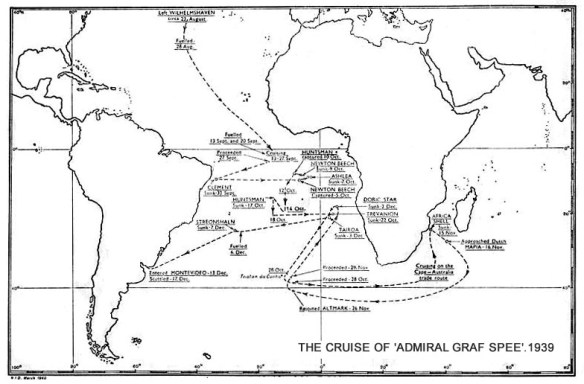
Graf Spee Cruise, 1939

Graf Spee Cruise, 1939

The story I will tell is one of how many hits, how many rounds expended, how many rounds remained, and unlikely, almost invisible, but critical damage.

The British had made the Deutschland Class, of which the Graf Spee was the third and last, something of a boogeyman, bestowing on them the description “pocket battleships.” In fact they lacked the protection implicit in the battleship description. The Germans called them simply “Panzerschiff,” (armored ships) and in 1940 reclassified the surviving ships as heavy cruisers. Graf Spee was little better protected than the ships she would fight. She was in fact a large heavy cruiser, but there were others that were larger and better protected, including the German Hipper class (the first commissioned in 1939) and the American Baltimore and later cruiser classes (the first commissioned in 1943). The Japanese and Italians, who were also cheating on their treaty commitments, had several cruiser almost as large.

(Note: the distinction between heavy cruisers and light cruisers was one of gun caliber, not displacement. Light cruisers’ heaviest guns were 6.1″ (155 mm) or smaller. Heavy cruisers carried guns larger than 6.1″; usually 8″ (205mm) guns which were the largest cruiser guns allowed signatories of the Washington Naval Treaty.)

On the other hand, the guns of the Deutschland class were exceptional. These ships were a very real tactical problem for the British, since no single cruiser could deal with them individually. The British considered they needed 70 cruisers to meet their needs and they never approached that number. If they had to double up, there would be many needs left unfilled.
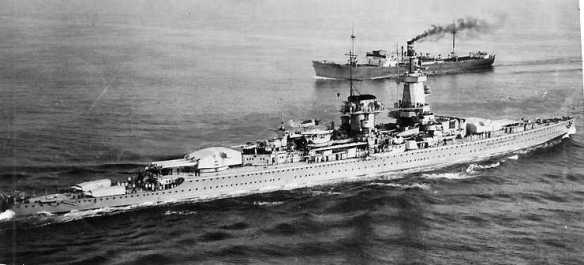
Admiral Graf Spee in the English Channel in April 1939. U.S. Naval Historical Center Photograph # NH 89566.

Admiral Graf Spee in the English Channel in April 1939. U.S. Naval Historical Center Photograph # NH 89566.

The Ships: 

  • Admiral Graf Spee, 16,200 tons (full load), 610 ft (186 meters) loa, six 11″, eight 5.9″, six 4.1″, eight torpedo tubes, 26 knots (reduced to 24 by a fouled bottom), crew 1,134.
  • HMS Exeter, (one of the smallest of the treaty heavy cruisers) 10,490 long tons (full load), 575 ft (175 meters) loa, six 8″ guns, four 4″, six torpedo tubes, 32 knots, crew 630.
  • HMS Ajax and HMNZS Achilles, 9,740 tons (full load), 555 ft (169 meters) loa, eight 6″ guns, four 4″, eight torpedo tubes, 32 knots, crew 570.

Note the total displacement of the three Commonwealth cruisers totaled 29,970 tons, almost twice the displacement of Graf Spee.
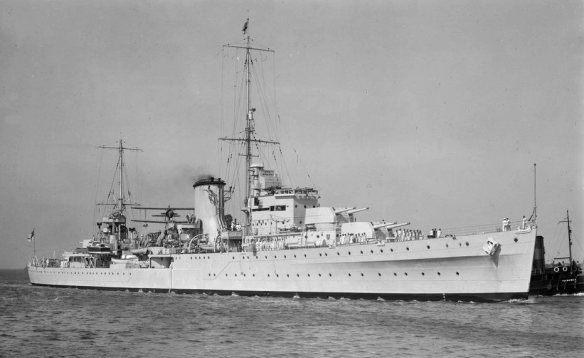
HMNZS Achilles,photo, State Library of Victoria - Allan C. Green collection of glass negatives.

HMNZS Achilles. Photo, State Library of Victoria – Allan C. Green collection of glass negatives.

The Guns:

Commonwealth:

  • British 8″/50 MkVIII (203mm), 256 lbs.(116.1 kg) projectile, 3-4 rounds/minute, range: 30,650 yards (28,030 m). Time of flight to 20,000 yards (18,290 m), 38.4 seconds, elevation for 20,000 yard range: 16.5 degrees
  • British 6″/50 BLMkXXIII (152mm), 112 lbs.(50.8 kg) projectile, 6-8 rounds/minute, range: 24,500 yards (22,400 m). Time of flight to 20,000 yards, 47.2 seconds, elevation 24.1 degreees.
  • British 4″/45 (102 mm), 31 lbs (14 kg), 10-15 rounds/minute, range: 16,300 yards (14,950 m)

German:

  • German 11.1″/52 (283mm), 661.4 lbs (300 kg) projectile, 2.5 rounds/minute, range: 39,890 yards (36,475 m) at 40 degrees elevation. Would have been more if 45 degrees elevation had been possible, elevation for 20,000 yard range: approximately 11 degrees.
  • German 5.9″/55 (149mm), 100 lbs. (45 kg) projectile, 6-8 rounds/minute,  range: 25,153 yards (23,000 m) at 40 degrees elevation, would have been slightly greater if 45 degree elevation had been possible.
  • German 4.1″/65 (105mm), 35 lbs (15.8 kg) projectile, 15 – 18 rounds/minute, range: 19,357 yards (17,700 m).at 45 degree elevation.

59-55_skc28_graf_spee_after_pic

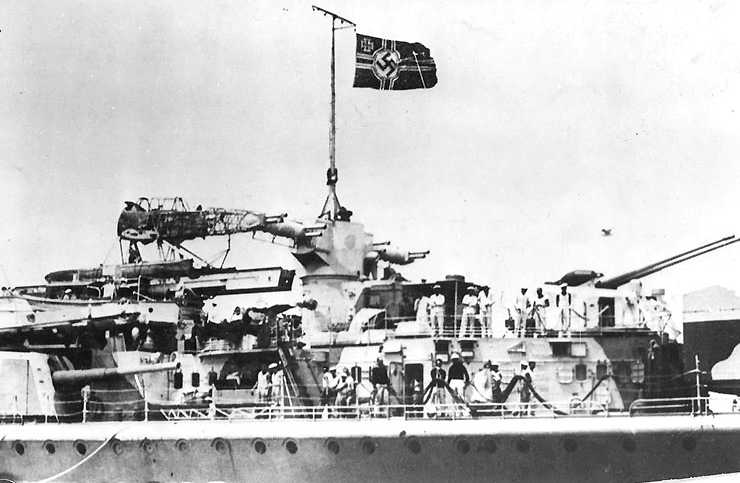
Photo: After superstructure of Admiral Graf Spee showing 15 cm/55 and 10.5 cm/65 guns. Note the burned-out Arado Ar 196A-1 floatplane on the catapult and the after main-director rangefinder. Photograph taken at Montevideo, Uruguay in mid-December 1939, following the Battle of the River Plate. U.S. Naval Historical Center Photograph # NH 80976.

How Deep Is Your Magazine?:

The number of rounds carried by each ship would become important as the engagement progressed and as options were weighed. Total weight of rounds available was also an important variable determining how much damage could be inflicted:

Graf Spee: 322.6 tons

  • 11.1″: 720 rounds, 661 lbs each: 475,920 lbs or 238 tons.
  • 5.9″: probably 800 rounds, 100 lbs each, 80,000 lbs or 40 tons
  • 4.1″, probably 2550 rounds, 35 lbs each, 89,250 lbs or 44.6 tons

British: 296.25 tons:

Exeter: (86.05 tons)

  • 8″: 600 rounds, 256 lbs each: 153,600 lbs or 76.8 tons
  • 4″  600 rounds, 31 lbs each, 18,500 lbs or 9.25 tons

Ajax & Achilles (210.2 tons)

  • 6″: 3200 rounds, 112 lbs each: 358,400 lbs or 179.2 tons
  • 4″, 2000 rounds, 31 lbs each, 62,000 lbs or 31 tons
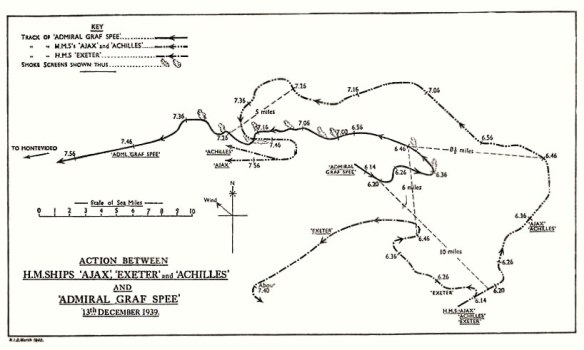
From official British report into the cruise of the Graf Spee and Battle of the River Plate. Published by HMSO (His Majesty's Stationery Office).

From official British report into the cruise of the Graf Spee and Battle of the River Plate. Published by HMSO (His Majesty’s Stationery Office).

Battle Before Breakfast:

It is 13 December 1939. In the Southern Hemisphere, this is one of the longest days of the year. As the sun comes up, Graf Spee sights masts on the horizon. Believing the ships to be a cruiser and two destroyers escorting a convoy she had hoped to attack, she turns toward them and accelerates.

6:10: Graf Spee’s increased speed results in more smoke and she in turn is seen by Commodore Harwood’s cruisers. In accordance with their previously planned response, the cruisers divide up, so that Graf Spee will have two separate groups to engage about 90 degrees apart. Heavy cruiser Exeter goes NW and the two light cruisers go NE. Additionally this should allow the two groups to spot fall of shot and provide range correction for each other.

06:18 Graf Spee opens fire at a little less than 20,000 yards. Exeter at 06:20, Achilles at 06:21 and Ajax at 06:23.

From the first, Graf Spee’s fire, targeting Exeter, is accurate. First salvo over, second salvo short, third salvo straddled. A near miss, bursting short, kills the crew on the starboard torpedo tubes and damages Exeter’s two spotter planes, which are jettisoned. It is textbook gunnery, the rocking ladder. Only one salvo of three is expected to yield any hits. Even then, dispersion of the rounds means, even if the fire control solution is perfect, it is unlikely more than one round out of a salvo would hit. Straddles that include no hits are common. So under ideal condition, if everything worked perfectly, the best one could expect would be that, one round of 18 would hit.

But the adversary is also doing everything he can to throw off the gunnery solution. Assuming the gun line is perpendicular to the base course, at 30 knots, a 30 degree course change for only thirty seconds will change the range 250 yards. At long range, this can be done between the time the guns fire and the shells impact. Both sides used smoke and evasive maneuvers to complicate the fire control problem.

At 06:26, Graf Spee scores a direct hit on the “B” turret (second turret on the bow). Splinters wipe out the entire bridge crew with the exception of the Captain and two others. The Captain is wounded but continues to command the ship. For the rest of the action, the ship is controlled by messenger to after steering.

06:37 Ajax launches her spotter plane to observe and provide correction of the cruisers’ gunnery.

06:38 Exeter is hit twice. One hitting the “A” (most forward) turret and putting it out of action, the other strikes the hull starting a fire.

“At this point, Exeter was severely damaged, having only “Y” turret still in action under ‘local’ control, with Jennings (Gunnery Officer–Chuck) on the roof shouting instructions to those inside. She also had a 7° list, was being flooded and being steered with the use of her small boat’s compass. However, Exeter dealt the decisive blow; one of her 8 in (200 mm) shells had penetrated two decks before exploding in Graf Spee′s funnel area, destroying her raw fuel processing system and leaving her with just 16 hours fuel, insufficient to allow her to return home.

“At this point, nearly one hour after the battle started, Graf Spee was doomed; she could not make fuel system repairs of this complexity under fire. Two-thirds of her anti-aircraft guns (two out of three mounts–Chuck) were knocked out, as well as one of her secondary turrets (one of eight guns–Chuck).

06:40 A near miss on Achilles–splinters kill four, wound several others, and temporarily disable the main fire control director.

07:25 An 11″ shell puts one of Ajax’s after turrets out of action and jams the other. She now has use of only half of her 6″ battery.

07:30 Flooding shorts out power to Exeter’s only remaining turret.

About this time, it appears Graf Spee begins to break off the engagement and heads for the River Plate.

07:40 Now listing heavily, with all major guns disabled and her speed reduced due to flooding in the bow, Exeter breaks off action and begins a long retirement to the Falklands where she will make temporary repairs before returning to Britain for a 13 month refit.

About the same time the Exeter turns to disengage and begin her transit to the Falkland, Commodore Harwood, having closed to close to 8,000 yards, hears reports he is running short of ammunition. He probably also realizes he is in a very dangerous position where his adversary’s shooting is much more accurate. He changes tactics, opens the range and plans to make a night attack when an effective torpedo attack is more likely.

Ajax and Achilles drop back and follow Graf Spee as it becomes obvious she is heading for the mouth of the River Plate. Some shots are exchanged, but these appear to be only Graf Spee warning the cruisers to maintain their distance.

Late in the evening Graf Spee anchors in Montevideo harbor.

The following day she releases her 62 merchant navy prisoners, transfers wounded to hospitals ashore, and buries her dead.

How accurate were they?:

The British light cruisers fired 2064 x 6″ projectiles and scored 17 hits or one hit for every 121 rounds fired or 0.82%. Of their original 3200 rounds 1136, 35.5%, remained.

Exeter fired 193 x 8″ rounds (possibly a few more) and scored three hits or one hit for every 64 rounds fired, 1.55%. This is all the more remarkable because 177 of these are fired by the after twin turret, most of which were fired under local control, and Exeter never closed the range to the degree the light cruisers did. It appears one of Exeter’s three hits was made while the gun was in local control.

Graf Spee fired 414 x 11.1″ rounds. Graf Spee’s 11.1″ hit Exeter at least seven times plus a particularly damaging near miss, along with several others that caused minor damage. These guns also made two hits on Ajax and a damaging near miss on Achilles. If we assume ten hits, that is one hit for every 41 rounds fired or  2.4%. Graf Spee had only 306 rounds, 42.5%, remaining. If she continued shooting with the same degree of accuracy, these could be expected to score at best eight more hits.

My primary source indicates that Graf Spee’s relatively powerful secondary armament fired 377 x 5.9″ and 80 4.1″ projectiles, but made not hits. They should have performed similarly to the British 6″. “It was not known until later that splinter damage to the director directing the 15 cm fire caused bearing track inaccuracy for the 15 cm fire…a small shell splinter entered the starboard director (of assume the forward conning tower FC station). But as luck would have it, the optic was left intact and the director function but little impaired, so the damage remained unknown until late in the evening. The casualty was not noticed by the operator during the battle at all. However, the director did not provide the proper fine bearing angle alignment to the battery, resulting in very poor on target performance.”

A Second Round?:

Diplomatic rankling begins almost as soon as Graf Spee anchors, with the Germans asking for two weeks in port to make the ship seaworthy enough to deal with the North Atlantic winter. The British first try to have Graf Spee’s stay limited to 24 hours, and then, realizing it will be several days before their heavy units arrive, they attempt to keep her in port without saying so.

The Uraguian authorities are unmoved and give the Graf Spee 72 hours.

Meanwhile the Royal Navy has ordered a battlecruiser, an aircraft carrier, and eight cruisers to converge on the River Plate to make sure Graf Spee does not escape.

22:00, 14 December, Heavy cruiser HMS Cumberland arrives, having steamed at full speed for 36 hours from the Falkland Islands. 28% Larger than Exeter (13,450 tons full load and 630 ft loa), with 33% more 8″ guns, she brings with her full magazines, 800 rounds of 8″.

17 December, Graf Spee sets sail, but a large portion of her crew has already left the ship. She stops, anchors, the rest of the crew leave the ship, transferring to waiting tugs. A series of explosions erupt and Graf Spee settles in shallow water, her guns and superstructure still out of the water.

Why did they do it?:

The British provided disinformation that the battlecruiser Renown and aircraft carrier Ark Royal were waiting outside and the Graf Spee crew members convinced themselves they saw the masts of these ships offshore.

Even an accurate view of the odds looked unfavorable for a successful sortie. After the arrival of HMS Cumberland, Graf Spee faced a force at least as powerful as the one engaged on the 13th. Additionally, the three cruisers waiting off shore did not have to sink Graf Spee to be successful. All they really had to do was shadow her until the heavy units could join them and Graf Spee’s fate would be sealed. With less than three quarters the ammunition she had used in the first engagement and her forward fire control director already disabled, Graf Spee’s chances of inflicting significant damage, escaping her tormentors in the South Atlantic, getting through the British blockade of Germany, and making it home appeared slim.

Then there is the matter of the fuel oil purifier. Without it, they could not expect to make it back to Germany, even if the Royal Navy were not in their way.

_________

Annex. Extracts from H. M Ships Damaged or Sunk By Enemy Action, 3 Sept 1939 to 2 Sept. 1945

EXETER during the “Battle of the River Plate”, came under shell fire from the German Pocket Battleship, ADMIRAL GRAF SPEE.

Hit No. l, struck the shelter deck just abaft “B” Turret and passed out through the superstructure side without exploding.

Hit No. 2, struck the front plate of “B’ Turret between the two guns and detonated on impact. “B” Turret was seriously damaged and put out of actions. Splinters caused damage and casualties on the bridge.

Hit No. 3,, struck on or very near, the fluke of the starboard sheet anchor and detonated on impact. The side plating was split and torn and much damage in the paint shop was caused by splinters.

Hit No. 4, struck the forecastle deck on the middle line just aft of the cable holders and exploded on impact. A hole 10 ft. by 10 ft. was blown in the forecastle deck and splinters penetrated the upper deck.

Hit No. 5, struck the jacket of the right gun of “A” Turret, and exploded on impact. “A” Turret was put out of action although it was found later that the turret could be trained and the left gun used. The forecastle deck was torn and the upper deck damaged by splinters.

Hit No. 6, passed through the whee!house, charthouse, out through the armament office and exploded just forward of the starboard 4 inch H.A. (High Angle-Chuck) Gun. Damage from splinters was widespread, ammunition in R.U. (Ready Use-Chuck) lockers was ignited, the lower bridge and 25% of the 4 inch armament was put out of action.

Hit No. 7, passed through the ship’s side just under the upper deck abreast “B” turret, travelled aft through the mess spaces on the lower deck and exploded abreast the E.R.A .’s (Engine Room Artificers-Chuck) mess. Damage from splinters was widespread, the fire main was fractured, communications seriously damaged and the lower deck holed. The 4 inch H.A. magazine and handing room were flooded by water escaping from the fractured fire main. Fire broke out in the mess spaces just aft of “B” turret supports.

Splinter Damage. EXETER suffered a great deal of superficial damage from splinters due to shells that burst short. Splinters on the ship’s side near the waterline caused a good deal of flooding. Most aerials were carried away and searchlights, signal projectors;, rigging etc. were badly damaged. One R.U. Ammunition locker was also ignited by splinters.

Fighting Efficiency = Seriously impaired. “A”, “B” and °Y° Turrets and 25% of the 4 inch H.A. armament was out of action. Slight loss of speed due to flooding and consequent heel and trim of the ship.

AJAX during the “Battle of the River Plate” came under shell fire from the German pocket battleship ADMIRAL GRAF SPEE. The direct hit struck the after superstructure port side passed thro’ “X” barbette and exploded in the Admiral’s cabin, starboard side causing slight structural damage. The shell did not detonate but burst with a mild explosion. Splinter damage caused, “Y” turret to jam.

(Ajax was again hit by a 283 mm (11.1 in) shell that destroyed her mast and caused more casualties, but damage was apparently not worth reporting–Chuck)

Fighting Efficiency = Impaired, “X” and “Y” turret were out of action due to the shell hit. “B” turret had one gun out of action due to failure of the hoist.

ACHILLES during the “Battle of the River Plate” came under shell fire from the German pocket battleship ADMIRAL GRAF SPEE. Splinters from shells bursting short pierced the ship’s side above the waterline, bridge screen etc, and also caused other slight damage. Minor damage was sustained in the director control tower but after casualties had been replaced it was able to continue in action.

Fighting Efficiency – Not impaired. Gun fire was not efficient until casualties in the D. C.T. (Fire Control Director–Chuck) were replaced. W/T (radio-Chuck) was out of action temporarily.

REMARKS The “Battle of the River Plate” revealed the following items.

  1. Increased protection to vital communications required.
  2. Additional portable telephones required,
  3. Improvement to look-out positions necessary,
  4. Need for increased protection for exposed personnel.
  5. Remote control of the smoke apparatus required.
  6. Square ports to be abolished.
  7. Automatic emergency secondary lighting to be introduced.
  8. Modifications required to telephone hand sets to prevent “jumping off”.
  9. Additional portable pumps to be supplied.
  10. Fire mains to be modified to provide for easier isolation and repair.

Print Sources:

  • Bennett, Geoffrey, Battle of the River Plate, Ian Allen, Ltd., 1972
  • Campbell, John, Naval Weapons of World War Two,  Conway Maritime Press Ltd, 1985
  • Chesneau, Roger, Conway’s All the World’s Fighting ships, 1922-1946, Conway Maritime Press Ltd, 1980

On Line Sources:

“AGAINST THE GROWING ANTI-SHIP MISSILE THREAT, ARE WE TRULY SEMPER PARATUS?”–CIMSEC

CIMSEC has a new post that is worth the read, “Against the Growing Anti-ship Missile Threat, Are We Truly Semper Paratus?” It is the first of two parts.

Pointing toward the increasing ubiquity of anti-ship missiles, it suggests that we install the SeaRAM system in place of the Phalanx on the Bertholf class National Security Cutters (NSC), and that we also install the system on the Offshore Patrol Cutters (OPC) and the new icebreakers.

With the Commandant’s proposal,  that the new administration send cutters to the Western Pacific to counter Chinese aggressiveness, better self-defense systems make more sense than ever.

Fitting the system to at least a couple of West Coast NSCs that might be available for WestPAC deployment should be relatively straight forward since the systems have much in common with the Phalanx system it would replace. SeaRAM would have the additional benefit of increasing the ships anti-surface capability as well.

Don’t Go Out Without Protection

U.S. Coast Guardsmen, assigned to Port Security Unit 309 in Port Clinton, Ohio, conduct security patrols during exercise Combined Joint Logistics Over-the-Shore (CJLOTS) 2015, at Anmyeon Beach, Republic of Korea, June 30. CJLOTS 2015 is an exercise designed to train U.S. and ROK service members to accomplish vital logistical measures in a strategic area while strengthening communication and cooperation in the U.S.-ROK alliance. (U.S. Navy photo by Mass Communication Specialist 1st Class Kori Melvin/Released)Photo: TPSB with ballistic protection,  Anmyeon Beach, Republic of Korea, June 30. Exercise CJLOTS 2015 (U.S. Navy photo by Mass Communication Specialist 1st Class Kori Melvin/Released)

Got an interesting link from Luke S. “Evaluation of Composite Armor for Coast Guard Vessels” (pdf) is a study from 1989, looking at how selected portions of the 110 foot WPBs might be protected from small arms fire. Here is the summary of their findings.

Up to a firing range of 100 yards, which was the limit of this study, personnel inside Island Class cutters are vulnerable to lethal rifle fire coming from drug smugglers. Test results showed that unconditional protection for personnel inside can be obtained by adding KRP (KEVLAR reinforced plastic–Chuck) armor panels to the cutter. This is also a more weight effective solution than increasing the thickness of the hull and superstructure. Although it was found that placing the KRP either in front of or behind the 1/8″ aluminum was equally effective, it should be noted that the aluminum by itself was overmatched by the threats. In general, it is more efficieut to place the KRP behind metal.

The USCG R&D Center defined three areas of the Island Class cuttfer that required protection in order to allow it to continue its mission if it came ander fire. These were the bridge and the communications room, both behind 1/8″ aluminum, and the magazine behind 5# steel. A visit was made to the USCGC Matinicus to take measurements and assess the feasibility of retrofitting KRP armor in those areas. Retrofitting them inside the bridge and communications room could be done by placing them in the space between the exterior aluminum skin and the interior trim panels. This might require some fit and trim but KRP panels can be cut and drilled so there should be no particular difficulty. Another option is to place the panels on the exterior of the bridge and communications room. This would appear to be an easier task but would present a different set of considerations. Since the KRP panels would have to be spaced 3″ in front of the aluminum, the panel supports would have to be designed to withstand green water loading. Environmental effects on these panels caused by exposure to seawater and UV radiation is not a problem for adequately sealed KRP. For the remaining area requiring armor, the magazine, mounting the panels against the steel hull inside the vessel did not appear to be difficult.

The amount of material and weight added in each of the critical areas is summarized in TABLE 6 for the worst case threat, the 7.62mm, M80 at point blank range.

TABLE 6 included the location to be protected, the total area to be armored, the weight per square foot for the armor, and the total weight for protection to that level. I have summarize the data below, but did not include the weight per sq.

  • Bridge 33′ x 4′ – 132 sq ft, 1056 lbs.
  • Communication rm. 14′ x 6′ • 84 sq ft, 672 lbs.
  • Magazine 6. x 6′ 36 sq ft, 180 lbs.
  • Total area covered: 252 sq. ft. weight: 1908 lbs.

These numbers are guidelines because the minimum armor density required was not determined in this study. Nevertheless, realizing these numbers are on the high side, the material cost from a commercial panel manufacturer for a KRP panel weighing 8 psf (lbs/sq ft–Chuck) with 20% resin would be about $40,000. This is basd upon a panel cost in the $20 to $24 per pound range.

Makes me wonder if anything was done about this, particularly for the WPBs based in Bahrain. Also, was anything included in the Webber class WPCs?

Even this relatively light armor would also provide a degree of protection against heavier .50 cal. and 14.5mm machine guns if fired from a greater range and/or if the round strikes at an oblique angle.

In addition to the bridge, comm space, and magazine, the gunners on open mounts could also use some protection as I’ve suggested before.

I have heard that ballistic protection for the Offshore Patrol Cutter has been deleted. This may be a mistake, particularly if it is as inexpensive as it appears.

Late addition:

Just found this. The photo below is Prince Charles boarding the HMS Middleton (a 32 year old, 750 ton mine countermeasures vessel) in Bahrain. The post is interesting regarding the situation in Bahrain, but I wanted to mention the gun crew protection visible between the stack and mast. The gun is an M134 “mini-gun,” a six barrel 7.62mm “gatling” gun. The additional pretection is apparent. Apparently the Brits recognize the need to protect their gun crews. It is not just about protecting the gunner, it is also about keeping the gun that is defending the ship operational.

hmsmiddletonm34

China Acknowledges Building Cutter to be Upgraded to Frigate in Crisis

type818ccgc

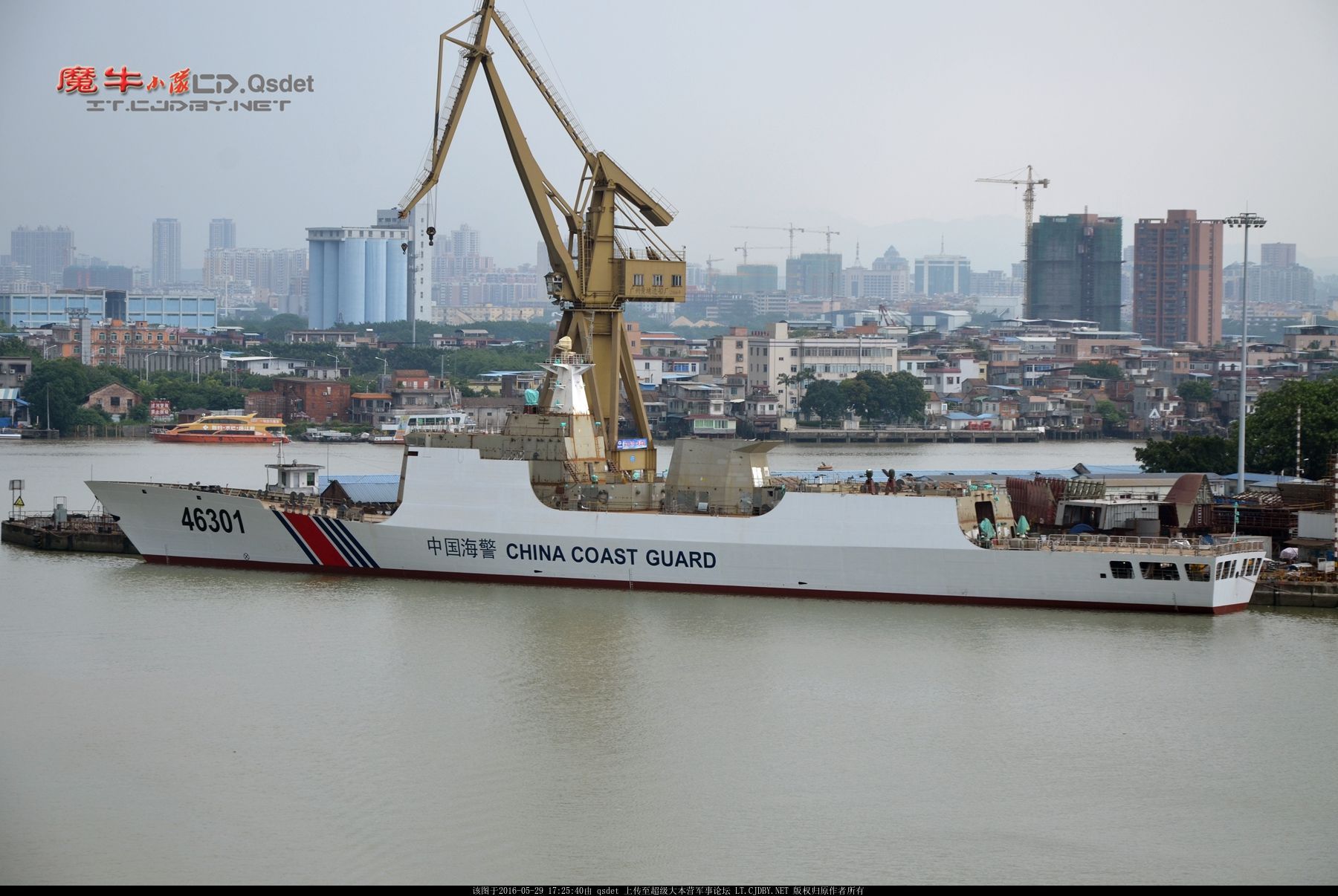
The National Interest reports that the Chinese have openly acknowledged that their newest Coast Guard cutter is being built with provision for upgrading to frigate status should a need arise.

Moreover they were apparently influenced by the example of the USCG during WWII.

In the same issue of this magazine, published by the major Chinese shipbuilding conglomerate China State Shipbuilding Corporation (CSSC), builder of the Type 818, there is not coincidentally a very detailed article about U.S. Coast Guard cutters in combat during the Second World War. That article explains that both USCGC Campbell and also USCGC Spencer were able to sink German U-boats (U-606 and U-175 respectively) during the pivotal Battle of the Atlantic. Most of the article examines the operations of 10 American USCG cutters that were 76.2 meters in length and built between 1928 and 1932. These ships were transferred to the hard pressed Royal Navy (RN) during 1941-42 and achieved an enviable war record in RN service, sinking both U-522 and U-954 – the latter with Germany Navy Commander Karl Donitz’s son aboard. The analysis notes that, according to UK naval records, the American cutters were viewed so favorably as to be rated as “surpassing each kind of comparable British designed frigate.” These ships are labeled as an “ideal anti-submarine escort ship” [理想的反潜护航舰] and the implications for the CCG going forward are obvious.

They actually sold the cutters a bit short. The 327s actually sank at least three and probably four U-boats and the ten 76.2 meter cutters, the 250 foot Lake Class, sank three submarines (two U-boats and an Italian). Six subs sunk by 17 ships may not sound particularly impressive, but in fact by comparison, it was spectacular.

The new Type 818 cutters are based on the Type 054 frigates. Its not too much of a stretch to expect them to be upgunned with the same weapons found on the “parent craft,” but if the time ever comes, there may be better systems available for upgrading the cutters or they might be given different capabilities to support emerging missions. That can be an advantage of having ships with unused upgadability.

The Type 054 are only slightly smaller than the Bertholf class, displacement 4,053 tons full load, length 134.1 m (440 ft), beam 16 m (52 ft), 30,400 HP, 27 knots, compared to the Bertholf’s 4,500 tons, 127.4 m (418 ft), 16.46 m (54 ft), 49,875 HP, and 28 knots. They actually appear to be the same size as the Offshore Patrol Cutters, but their design leans more toward higher speed. Their range is not as great as the OPC at about 8,000 miles compared to the OPCs’ 10,200, but it is a greater range than USN frigates enjoyed.

The Chinese have learned a lesson from USCG experience in World War II. I wonder if it is a lesson we may have forgotten.

Thanks to Luke for bringing this to my attention.