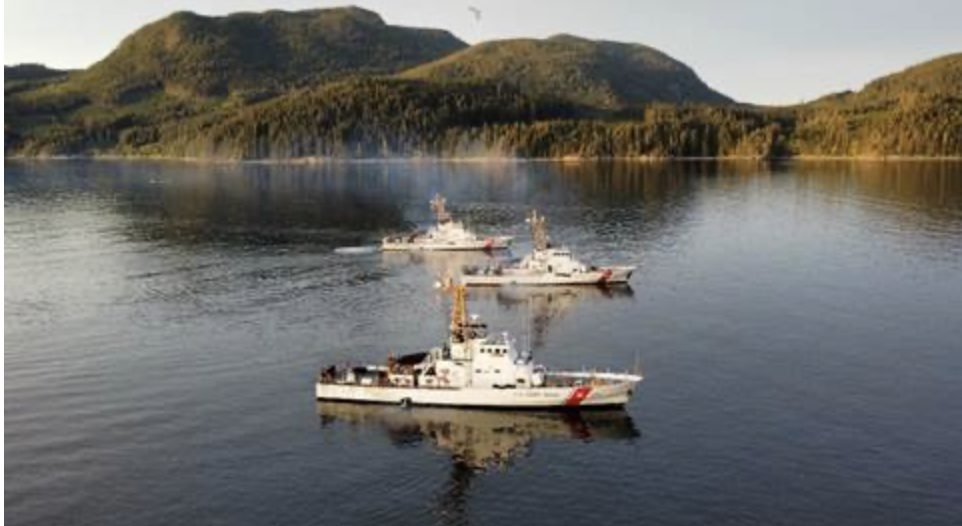
U.S. Coast Guard Cutters Naushon (WPB 1311), Mustang (WPB 1310), Liberty (WPB 1334) transit through Seymour Narrows in British Columbia, Canada, May 2025. Through the Excess Defense Articles program, these boats will find a second life with the Colombian navy. (U.S. Coast Guard photo courtesy of USCGC Mustang)
USCGC Naushon (WPB 1311) conducts a familiarization patrol in Glacier Bay, Alaska, Oct. 21, 2008. Patrols like this one demonstrate the Coast Guard’s dedication to ports, waterways and coastal security, regardless of the wind, water or seas. This photo won second place in the 2009 Coast Guard Photo Contest. (U.S. Coast Guard photo by Petty Officer 3rd Class Logan Wright)
France is set to provide 40 patrol vessels and logistical support to the Philippine Coast Guard following the approval of a $438 million aid project to enhance Manila’s maritime security capabilities across the country’s waters.
The French official development assistance-funded acquisition project of 40 Fast Response Crafts, approved during Tuesday’s National Economic and Development Authority Board meeting, will effectively quadruple the Philippine Coast Guard’s fleet.
The craft are reported to be 30-35 meters in length. 20 are to be built in France and 20 in the Philippines.
There are no specifications for the patrol boats included in the article, but it does state that OCEA is expected be the French shipbuilder that will provide the design and build the first 20. OCEA has already committed to building a shipyard in the Philippines and has previously built vessels for the Philippine Coast Guard (here and here).
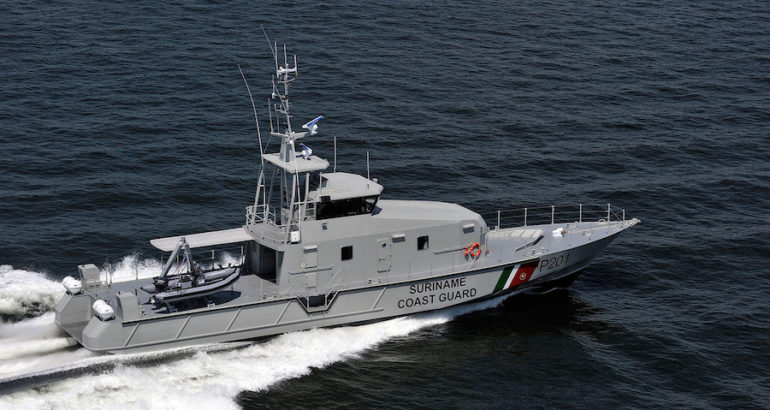
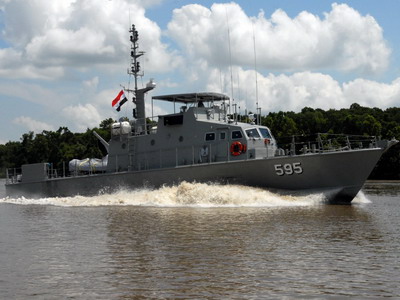
There is a good chance the new patrol boats will look a lot like the one pictured above, a class built for Suriname, Algeria, Ukraine, and French Customs. They are powered by two 3,660 HP Caterpillar diesels using waterjets. Specs on the Algerian boats as follows.
Displacement: 100 tons
Length: 31.8 meters (104’4″)
Beam: 6.3 meters (20’8″)
Draft: 1.2 meters (3’11”)
Speed: 30 knots
Range: 900 nmi @ 14 knots
Crew: 13
These will be faster and more maneuverable than most of the China Coast Guard and maritime militia vessels that contest Philippines sovereignty in the South China Sea. If they can stand up against Chinese water cannon, they should be a valuable asset.
The Philippine Coast Guard is still not arming even their largest vessels with anything larger than .50 caliber.
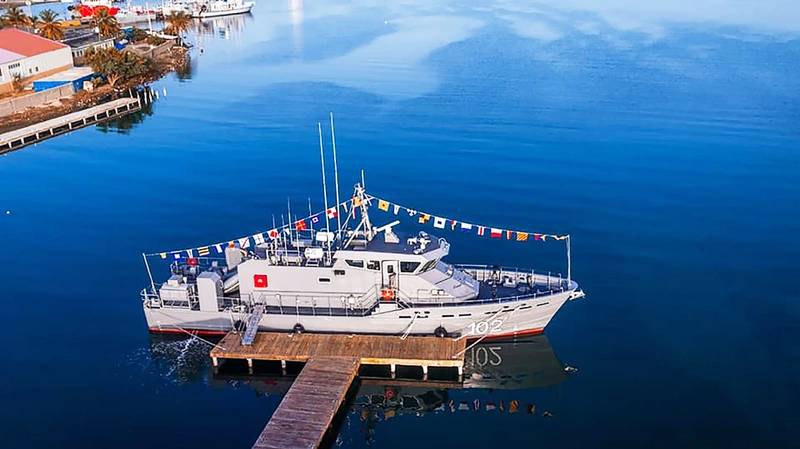
The NCPV Betelgeuse is docked during a ceremony at La Calderas naval base in Peravia, Dominican Republic, on August 6, 2020. The U.S. is delivering Near Coastal Patrol Vessel (NCPV)s to navies and coast guards in the U.S. Southern Command area of operations. The 85-foot NCPVs are built by Metal Shark at Franklin, La., for the Dominican Republic, El Salvador, Honduras, Costa Rica, Guatemala, and other United States partner nations. Photo courtesy Dominican Navy
“…potentially worth upwards of $54 million, Metal Shark will build up to thirteen 85-foot Defiant-class welded aluminum cutters for the Dominican Republic, El Salvador, Honduras, Costa Rica, Guatemala, and other United States partner nations. Additionally, Metal Shark will supply electro-optical infrared sensors, diagnostic equipment, in-country reactivation, crew familiarization, and test support to NCPV (Near Coastal Patrol Vessel–Chuck) operators.
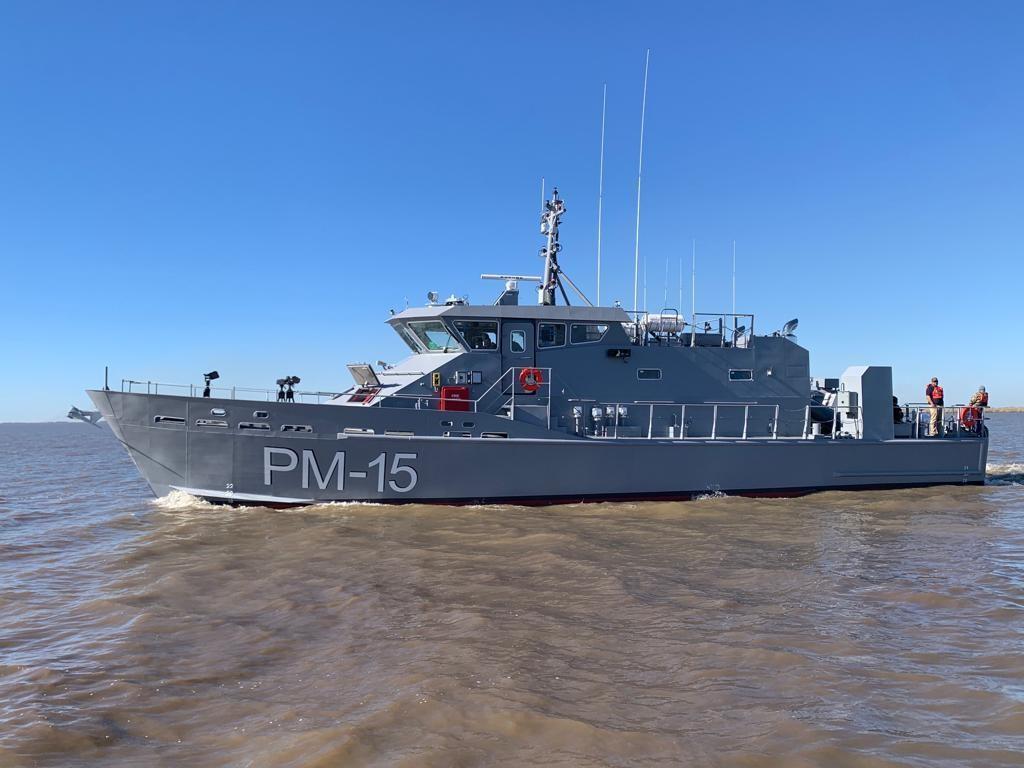
The PM-15, a Defiant class patrol vessel the USA gave to El Salvador, in 2021. US State Department photo.
It appears only five of the class were delivered, one each to the Dominican Republic, Honduras, Panama, El Salvador, and Costa Rica. No idea what happened to the contract for the remaining eight.
If it looks familiar, it is because it is an evolution of the Damen design that gave us the Marine Protector class 87 foot WPBs.
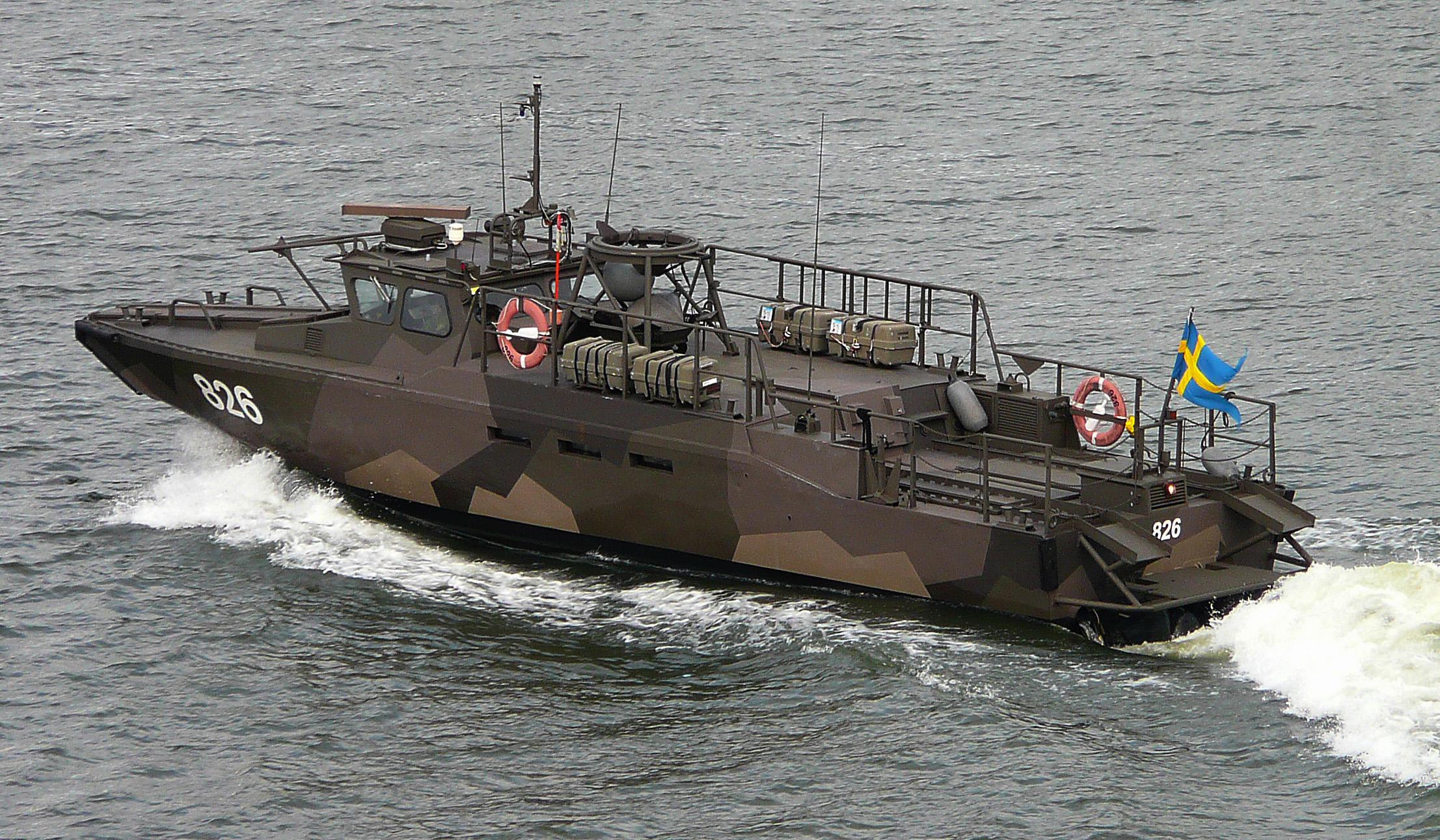
The Swedish modernization of their coastal troops is continuing, with the formal call for tenders for a new surface-to-surface anti-ship missile. The new weapon will receive the formal designation RBS 18, and unlike the current man-portable Hellfire-missile system used in the short-range anti-ship role by the Swedish marines will be mounted aboard the CB 90 combat boat.
“FMV (Försvarets materielverk), the Swedish Defence Materiel Administration, announced the signing of a contract for the delivery of mortar-armed boats as part of the Amfbat 2030 programme.”
The Amphibious Battalion operates between sea and land with the overall task of preventing enemy amphibious assaults. With the new maritime artillery, the fire controller on, for example, a Combat Boat 90 HSM can provide target data to the firing platform, enabling the firing of grenades at a high rate of fire while advancing, for indirect engagement of various types of ground targets. Image: FMV.
What we are seeing is a comprehensive overhaul of Sweden’s approach to littoral combat for their Amphibious Battalions (Amfibiebataljonen) of the Swedish Armed Forces from Stockholm and Gothenburg, assigned with defending the coastline, including numerous islands, against potential amphibious assaults.
While the mortars will be mounted on new construction boats, the new air defense and anti-ship missile systems will be mounted on existing CB90 (combat boat) assault craft.
The CB90 is a very popular product, used by at least nine different nations including the US, UK, and Ukraine. The Russian Navy even has what appears to be unlicensed copies of the craft. Mexico’s eight ship Oaxaca class Offshore Patrol Vessels carry a CB-90 HMN Patrol Interceptor in their well deck.
The CB90 displaces 23 tons and is 52 feet long with a 12.5 foot beam.
If a weapon system fits on a CB90 it will certainly fit on any of the US Coast Guard’s patrol boats and larger cutters.
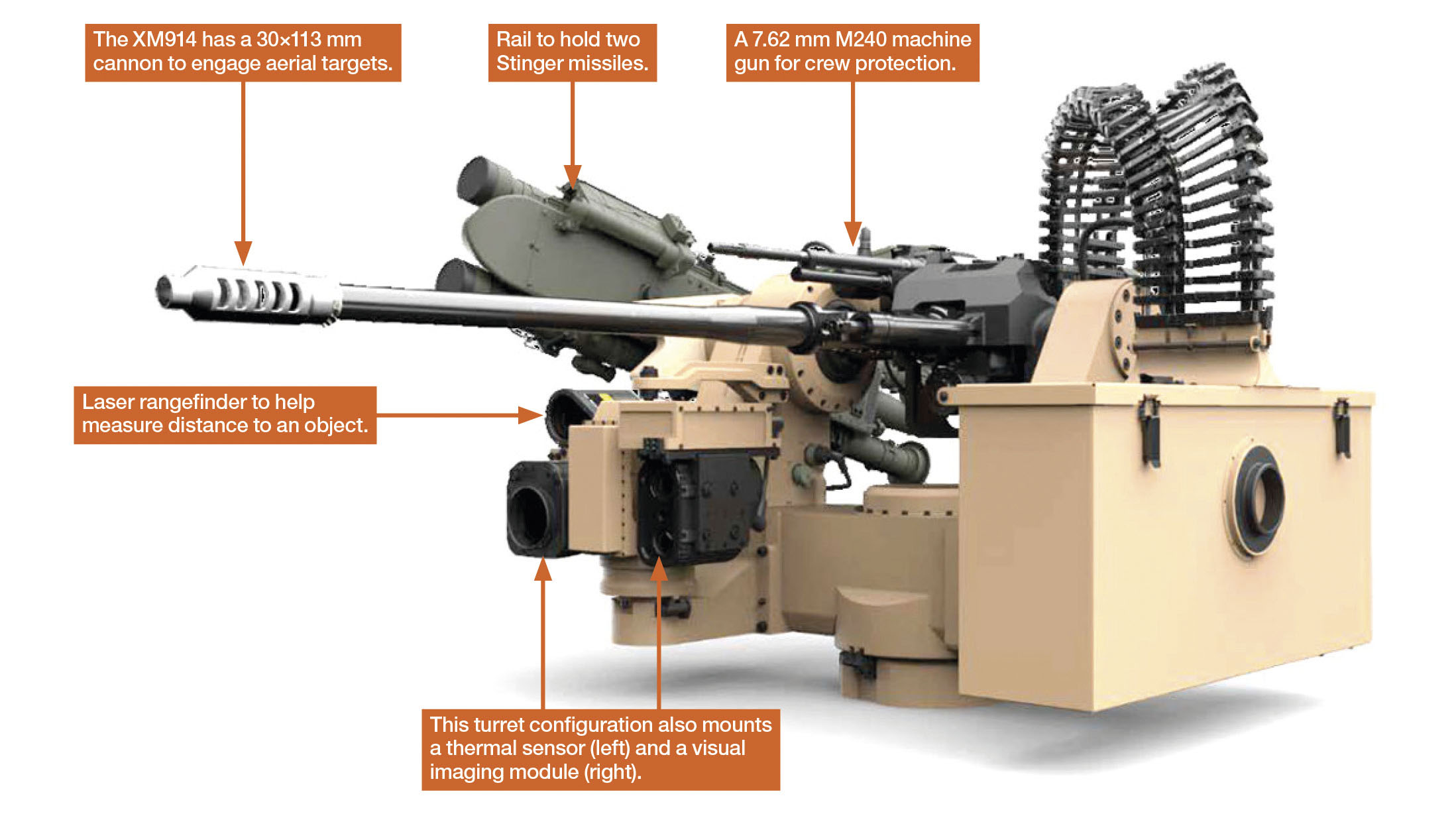
In all probability the AAW weapon system will include a 30mm chain gun. Short range AAW missiles are possible. Perhaps the APKWS.
The anti-ship missile may be something entirely new. The closest to the description I know of, other than the MARTE MK2/N mentioned in the article, is the Spike NLOS.
The 800 operational hours claimed for each vessel works out to 33.3 operational days out of 49 deployed, so I presume that means about 16 days in transit, there and back.
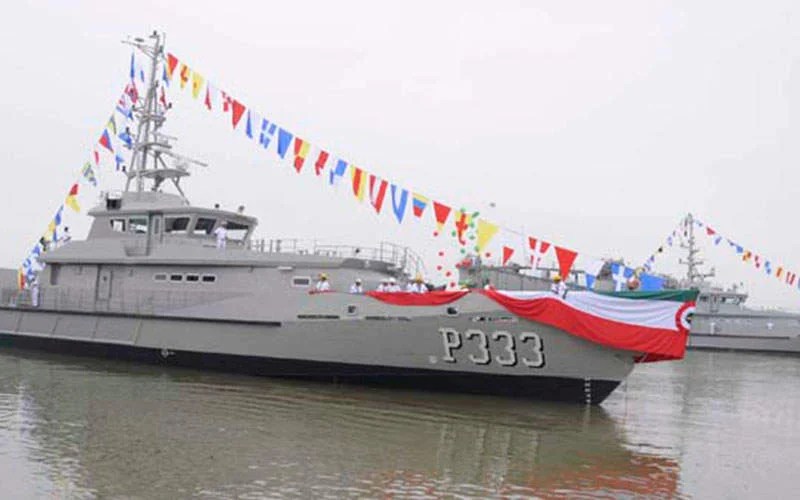
The Mexican Navy vessel mentioned, ARM PALENQUE, the third of ten Tenochtitlan-class patrol vessels, looks a lot like a Webber class Fast Response Cutter. It is also a Damen design, but a bit smaller (a Stan Patrol 4207 vs 4708 for the FRC). Damen has been very successful with this design. More than 50 have been built for more than a dozen agencies. (USCGC Blackfin and the other Marine Protector class patrol boats are also based on a Damen design.)
Mexican Navy ARM Palenque (PC-333) at launching March 2014. Credit Secrtaria de Marina.
June 10, 2024
U.S. Coast Guard Cutters return home after successful Central American deployment
SAN PEDRO, Calif. — U.S. Coast Guard cutters Forrest Rednour and Blackfin have returned to their homeports after a 49-day deployment in Central America, where they played a crucial role in multiple operations.
During this period, both cutters demonstrated outstanding readiness and operational capability, significantly contributing to international cooperation, search and rescue missions, and efforts to combat criminal activities. This deployment was part of a broader strategy to enhance regional security and strengthen partnerships. Throughout the mission, Forrest Rednour covered over 8,200 miles and logged 800 operational hours, while Blackfin covered over 8,300 miles and also logged 800 operational hours.
“The amount of effort and commitment from both crews during this 49-day deployment was remarkable,” said Rear Adm. Andrew Sugimoto, commander, Coast Guard District 11. “Their readiness and professional exchanges provided an invaluable experience to our partner nations and crews. The enthusiasm to lead multiple engagements with several international maritime organizations helped strengthen ties and fortify continued collaboration between all.”
Key Achievements:
Search and Rescue Exercises (SAREX):
Manzanillo, Mexico: Blackfin led a successful SAR operation, including helicopter rescue exercises with the Mexican Navy.
Puerto Quetzal, Guatemala: Hosted tours and conducted SAR exercises with the Guatemalan Navy, building stronger maritime partnerships.
La Union, El Salvador: Rednour led a SAR exercise and joint operations with the Salvadoran Navy, marking the first U.S. vessel visit to this port in two years.
Partnership and Training:
Amapala, Honduras: Engaged in discussions and training on maritime law enforcement and security with the Honduran Navy and Merchant Marine.
Golfito, Costa Rica: Shared knowledge on maritime governance with the Costa Rican Coast Guard, enhancing mutual understanding.
Rodman, Panama: Provided damage control and medical evacuation training to Panamanian forces, marking the first U.S.-Panama Coast Guard engagement in over two years.
PASSEX with ARM PALENQUE: Forrest Rednour and Blackfin conducted a passage exercise (PASSEX) with the Mexican Navy’s ARM PALENQUE. This included formation steaming, code exercises, and a crew exchange to enhance mutual operational understanding and cooperation.
“This patrol was truly an amazing experience and a testament to the incredible devotion to duty that the crews of the Forrest Rednour and Blackfin have,” said Lt. Kevin Ng, commanding officer of Coast Guard Cutter Forrest Rednour. “Both crews adapted and overcame several challenges leading up to and during the patrol, but never took their eyes off the main objective. As a result, the Coast Guard was able to strengthen the valuable relationships that the United States has with our international partners throughout Central America and unify our efforts to address critical maritime security initiatives in the Eastern Pacific. Thank you to crews on a job well done, District 11 and Sector Los Angeles/Long Beach for the coordination, and the families and friends of the crew for all of the support; the success of this historic patrol could not have been accomplished without them all.”
“I could not be prouder of both crews for the incredible amount of hard work they have dedicated to making this historic patrol possible. The success of this Surface Action Group is a testament to the Coast Guard’s ability to overcome dynamic challenges in the completion of unprecedented mission sets. It also signifies the Coast Guard’s steadfast commitment to advancing our vital maritime partnerships in the Eastern Pacific. The international relationships formed and strengthened during this deployment have set the groundwork for future engagements which I look forward to watching,” said Lt. j.g. James Morrison, commanding officer of Coast Guard Cutter Blackfin.
Commissioned in 2000, the USCGC Blackfin is one of the Coast Guard’s Marine Protector-class patrol boats homeported in Santa Barbara, California. Marine Protector-class patrol boats are 87 feet long and 19.5 feet wide and have a 100 long-ton displacement. They have a top speed of 25 knots and a range of 900 nautical miles. They can hold a crew of up to 10. The Blackfin is equipped with advanced electronics and navigation systems for multi-mission operations, including search and rescue, law enforcement, and homeland security. The Blackfin shares the name of the USS Blackfin (SS-322), a submarine that participated in World War II and the Korean War.
Today’s Force Protection boats purposely have less horsepower than their predecessors. MetalCraft photo.
WorkBoat reports on four different patrol boats from three different manufacturers, being made for the Navy, Santa Barbara (CA) Harbor Patrol, and the Palm Beach (FL) County Sheriff’s Department.
They are very different boats, but each has interesting characteristics.
Thanks to Eaglespeak for bringing this to my attention.
US Coast Guard / CENTCOM released photo of weapons seized aboard an Iranian dhow on February 15 2024. The seizure included UUV and USV components. The annotations, highlighting possible UUV parts, have been added.
“The Biden administration is expanding efforts to surveil and intercept Iranian weapons being smuggled to Yemen, where Houthi militants have staged a deadly campaign of violence against commercial shipping that has proved resilient to six weeks of military strikes, said U.S. officials familiar with the matter.
The initiative seeks to map seafaring routes used by Tehran and stop the arms shipments while in transit, an acknowledgment that the Houthis are likely to pose a significant security challenge for the foreseeable future. It is part of a broader strategy that also includes sanctions and diplomatic pressure but faces constraint as essential military resources are in short supply.
This sound, to an old Coastie, a lot like what lead to the creation of Coast Guard Squadron One (ultimately 26 Point class 82-foot patrol boats) and Squadron Three (five to seven High Endurance cutters) during the Vietnam War.
At the very least expect more Coast Guard boarding teams to be operating with the Navy.
The Webber class Fast Response Cutters (FRC) are the weapon of choice here. The Navy never bothers to produce small ships suitable for the interdiction of clandestine coastal shipping, while this has always been a type common in the Coast Guard fleet. Six FRCs are already operating with the 5th Fleet out of Bahrain. They are already intercepting arms smugglers, as well as drug smugglers that finance Iranian proxy movements. The Coast Guard already has 55 FRCs and is procuring at least ten more.
Will we see more cutters assigned to 5th Fleet? They are also short of air assets. Will we see Coast Guard fixed wing aircraft searching the Arabian Sea?
“A DSCA statement on 10 January reported the proposed sale of an undisclosed number of 28 metre patrol craft kits and related equipment was approved, at an estimated cost of $129 million.”
This would be the latest in an ongoing program of coproduction of Swiftship patrol boats assembled in Egypt.
I would question the claim that 49 vessels would make this “The World’s Most Serial Produced Vessel” since there are already 54 Webber class FRCs and there were 73 Coast Guard 87 footers.
Presumably these are going to the Egyptian Coast Guard which is a branch of the Egyptian Army.
A previous contract for 6 of these cost $22.1M or about $4M each. That would suggest that this $129M contract would buy 32 boats. The contract may include some additional equipment to backfit boats already completed or under contract, but still, this should at least bring their entire fleet up to about the 50 boats which is their reported requirement.
“Egypt and Swiftships have started co-market the 28-meter CPC to North African allied partners to the US.”
So, it is possible some of these vessels may go to other North African nations.
Israel Shipyards Shaldag MK V. Israel Shipyards Ltd. picture
For some time, I have thought that the Webber class, “Fast Response Cutter” (FRC), program was misnamed. Webber class cutters don’t generally sit in port waiting for some alarm to call them to rush to the scene. Rather they are used more like small Medium Endurance Cutters. This has proven especially fortuitous in view of the delays in replacing the existing WMECs. It is only because of the versatility of the Webber class that the Coast Guard will be able to maintain its drug and alien migrant interdiction efforts in the 7th District and extend fisheries protection and counter IUU efforts into the Western Pacific while decommissioning WMECs before their replacements are completed.
Still, I do believe there is a need for true Fast Response Cutters for those rapidly developing missions that require more range and capability than a Response Boat, Medium, for protection of high value units, and to respond in the event of a maritime terrorist attack–units for which SAR and particularly Ports, Waterways, and Coastal Security are their primary missions.
The “Marine Protector” 87-foot patrol boats have had this job, but they are approaching the end of their service life (the oldest are now 25 years old). Four of them are particularly tasks with protecting Fleet Ballistic Missile submarines during surface transit from their bases to open sea. They have never been well prepared to deal with terrorist threats and aren’t really particularly fast.
We have discussed characteristics for a WPB replacement, a true Fast Response Cutter, before (here and here) and why nothing we have currently is suitable for the mission. The Shaldag Mk. V looks like a good candidate for the job, but first let’s look at where and why we might need vessels of this type.
The Webber class as Fast Response Cutters:
In some places, the Webber class might take on the functions of a “fast response cutter.” Where there are three or more based in a single location, it should be possible to have one on standby virtually at all times. Though better armed than the 87 footers, they are not particularly well prepared to deal with the terrorist threat, but it is possible to increase their armament to make them more effective in the role.
Even if the Webber class could be used in the FRC role, their basing, concentrated as it is to improve maintenance, would leave many ports with no similar protection.
Where Do We Need Fast Response Cutters:
In an earlier post, “A Reevaluation, Ruminating on Homeports While Playing the Red Cell,” Part 1 and Part 2, I identified 31 critical ports that required protection from unconventional attack.
I will assume that if the Coast Guard recognizes the need for a true Fast Response Cutter, a well-armed interceptor, and does build such a class, that they will also increase the armament of at least some of the Webber class, so that they could also be effective in this role at critical ports where they are based.
Webber class are based in 9 of the 31 critical ports: Moorehead City/Atlantic Beach, NC; Miami; San Juan; Pascagoula; Galveston; LA/Long Beach/San Pedro; Honolulu; and Guam.
That leaves 22 port complexes without resident Fast Response Cutters:
CCGD1:
Bath, Me–Major Naval shipbuilder
Kittery, ME/Portsmouth, NH –Naval Shipyard
Groton, CT–Submarine base
Hudson River complex, New York, NY/Elizabeth and Bayonne, NJ–a major cultural target, #3 US Port by tonnage, #3 Container port, #4 Cruise ship port (NYC) and #13 cruise ship port (Cape Liberty, NJ)
CCGD5:
Chesapeake Bay Complex, VA–Base for aircraft carriers and submarines, Major naval shipbuilder, Strategic Port, #9 port by tonnage, #5 container port; plus water route to Washington, DC (major cultural target) and Baltimore, MD–#14 port by tonnage, #13 container port, #12 cruise ship port
Jacksonville complex, FL (including Kings Bay, GA)–SSBNs, Navy Base Mayport, #14 cruise ship port, Strategic Seaport/ Mayport, FL
Port Canaveral, FL–#3 Cruise Ship port/ Cape Canaveral, FL:
Port Everglades/Fort Lauderdale, FL–#11 container port, #2 Cruise Ship port
Tampa, FL–#7 Cruise Ship port/
CCGD8
Mobile, AL–major naval shipbuilder, #11 port by tonnage
Gulfport, MS–Strategic Seaport
Mississippi River Complex, LA–New Orleans #6 port by tonnage, #14 container port, +#10 Cruise Ship port; South Louisiana #1 port by tonnage; Baton Rouge #8 port by tonnage; Port of Plaquemines #13 port by tonnage.
Lake Charles, LA–#12 port by tonnage
Sabine Pass complex (Beaumont/Port Author/Orange, TX)–#4 port by tonnage (Beaumont), Strategic Seaport (both Beaumont and Port Author), It also has an LNG exporting terminal.
Corpus Christi, TX–#7 port by tonnage, Strategic Seaport
CCGD11:
San Diego, CA–Base for aircraft carriers and submarines, major naval shipbuilder (NASSCO), Strategic Seaport
San Francisco Bay complex,, CA–A major cultural target, #6 container port (Oakland), Strategic Seaport (Oakland and Concord)/Alameda, CA
CCGD13:
Puget Sound Complex, Seattle/Tacoma, WA–Base for aircraft carriers (Bremerton), SSBNs (Bangor), and submarines, major naval bases, #8 container port (Seattle), #10 container port (Tacoma), #8 Cruise ship port (Seattle), Strategic Seaport (Indian Island and Tacoma, WA)
CCGD17:
Anchorage, AK–Strategic Seaport
Assuming we need two boats to maintain one on standby or underway at all times this suggests we need 44 Fast Response Cutters. Fewer than the 73 patrol boats of the Marine Protector class.
The Shaldag MkV as a Fast Response Cutter:
Navy Recognition reports delivery of a third batch of Israeli built Shaldag Mk. V fast attack craft to the Philippine Navy. In the Philippine Navy, these are referred to as Acero class coastal patrol interdiction craft (CPIC).
The Shaldag Mk. V seems to be a true Fast Response Cutter that checks many (but not all) of the boxes that could make it effective in this role. The Shaldag Mk V shows what can be done on even a modest sized vessel. They are:
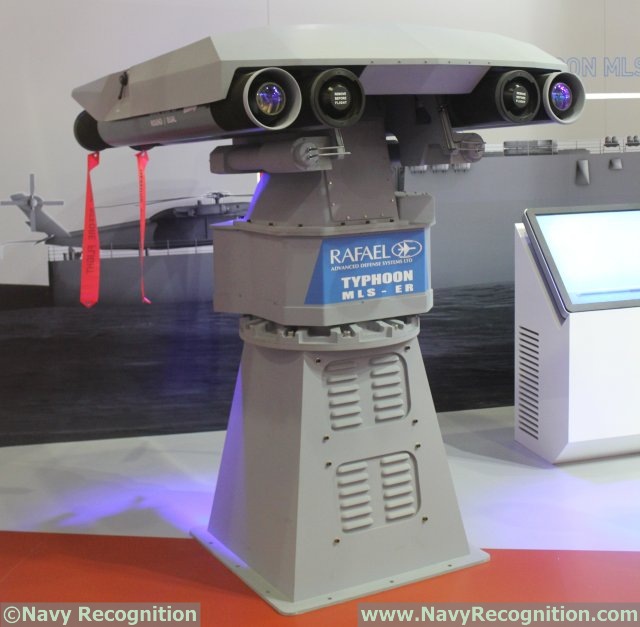
1 x Rafael Typhoon MLS-ER missile launcher for 4 x Spike ER surface-to-surface missiles, a weapon similar to Hellfire/JAGM (on at least four of the Acero class)
2 × M2HB Browning 12.7 mm/50-cal. heavy machine guns mounted on Rafael Mini Typhoon remote-controlled weapon stations
2 × M60 7.62 mm/30-cal. GP machine guns
What we might do differently:
The Shaldag Mk. V is certainly not the only possible solution for a true Fast Response Cutter, but its speed and equipment does represent some but not all the capabilities that should be incorporated in an FRC.
The Shaldag Mk. V has a capability against Unmanned Air Systems (UAS) and small, fast, highly maneuverable surface threats. As threat vessel increase in size their effectiveness diminishes substantially. They don’t need to sink large ships, but they do at least need to be able to immobilize them to keep terrorists from reaching their objective and to allow time for a DOD response.
The Shaldag’s boat handling facilities appear more difficult to use than those on the 87 foot cutters. We could do better, and it is likely we would need better boat handling equipment for day-to-day SAR missions.
The Missiles used on the Shaldag Mk. V are not used by the US Navy or Marine Corps, but comparable weapons–Hellfire, JAGM, or APKWS–could be used instead.
The 30mm Mk38 Mod4 would replace the Israeli 30mm Typhoon gun mount.
Ukrainian Navy Island-class patrol boats, formerly of the U.S. Coast Guard, conduct maritime security operations in the Black Sea off the coast of Odesa, Ukraine. UKRAINIAN NAVY
This was on the U.S. Department of Defense Daily Digest Bulletin for Aug. 7, 2023.
Safe Boats International LLC,* Bremerton, Washington, is awarded a $22,271,829 firm-fixed-price modification to previously-awarded contract N00024-21-C-2201 for the exercise of options for procurement and installation of six Gun Weapon Systems onto the Island Class patrol boats with spares. Work will be performed in Tacoma, Washington, and is expected to be completed by October 2024. Foreign Military Financing (Ukraine) funds in the amount of $22,271,829 will be obligated at time of award and will not expire at the end of the current fiscal year. The Naval Sea Systems Command, Washington, D.C., is the contracting activity. (Awarded Aug. 3, 2023)
This is reported as modification of an existing contract, so I presume at least one vessel has already been rearmed. Thinking two guns per vessel, then six gun systems will go on three additional vessels. So, at least four ships with two guns each. Presumably, they would be 25 or 30 mm guns, hopefully the new 30mm Mk38 Mod4.
The announcement does say, “Work will be performed in Tacoma, Washington, and is expected to be completed by October 2024.” If this is true, these are additional boats. The Coast Guard still has many available for transfer. It is also possible there might be only one gun per vessel. All we know for sure is in the quote above.
In Dec. 2019 there was a suggestion that these vessels might be fitted with anti-ship cruise missiles, but there has been nothing further to indicate it has or will happened.









 Chuck Hill's CG Blog