
Look, I know you are in trouble. As much as we might kid each other, when it is time to fight, I’m your best friend, and I want to help. But you seem in denial, or maybe you are just up to your ass in alligators, and too preoccupied to think about how I might help.
Numbers of ships is way down. You don’t even have enough escorts to protect the highest priority merchant shipping. You have had trouble bringing new classes on line. You are having trouble keeping the ships you have properly maintained, and you are having trouble manning the ships you have. Our shipbuilding industry has lost the ability to surge production of complex vessels. We don’t have enough trained mariners to man the shipping needed for a prolonged conflict.
It hasn’t mattered much since there has not been much competition, but that is changing.
The Chinese Navy is adding ships faster than you are. Their ships are starting to look very impressive. They have a robust ship building industry, and huge merchant marine and fishing fleets to backstop their Navy. They even have more Coast Guard ships than we do.
It that were not enough, the Russian Navy is rebuilding, although they are a long way from as capable as the old Soviet Navy, but, worst case, we might have to fight them both, along with some minor hangers-on who have their own scores to settle.
Meanwhile most of our allies, who may or may not help, have been coasting, letting their capabilities decline.
I know you are trying to fix this, but maybe I can help at least a little bit, if you will tell me what we can do.
——
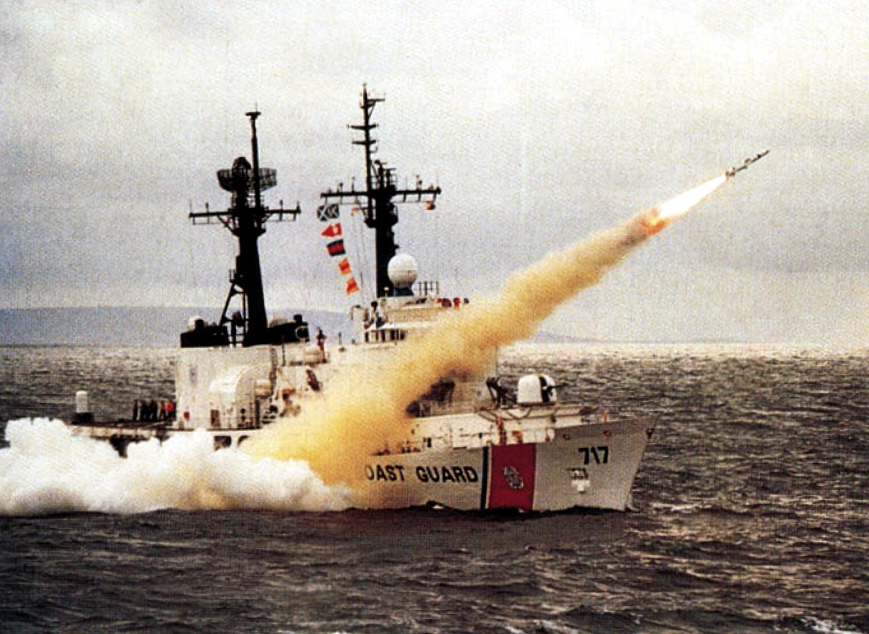
USCGC Mellon seen here launching a Harpoon anti-ship cruise missile in 1990.
The Coast Guard used to be an armed naval force prepared for war. We came out of World War II with an ASW mission, and while our assets got older, the mission continued. In the late 80s we cut the number of ASW assets, but modernized the best of our ships, upgrading their ASW equipment and adding anti-ship cruise missiles.
Then, we all got a break. The Soviet Union collapsed and the need for ASW escorts pretty much disappeared. The Navy downsized and the Coast Guard removed all ASW equipment and the anti-ship missile.
We had almost 30 years without a major naval threat, but it looks like that is changing.
The US Coast Guard is the US Navy’s closest ally, but it seems there is little coordination between the two in defining Coast Guard roles in a major conflict. We certainly don’t see any evidence in the way the cutters are currently being equipped.
In terms of personnel, the Coast Guard is larger than the UK’s Royal Navy or the French Navy. The new cutters are comparable in many respects to frigates or corvettes. Looks like we are going to have 64 Webber class patrol craft similar in capabilities to the Navy’s Cyclone class. Plus we have over 200 aircraft.
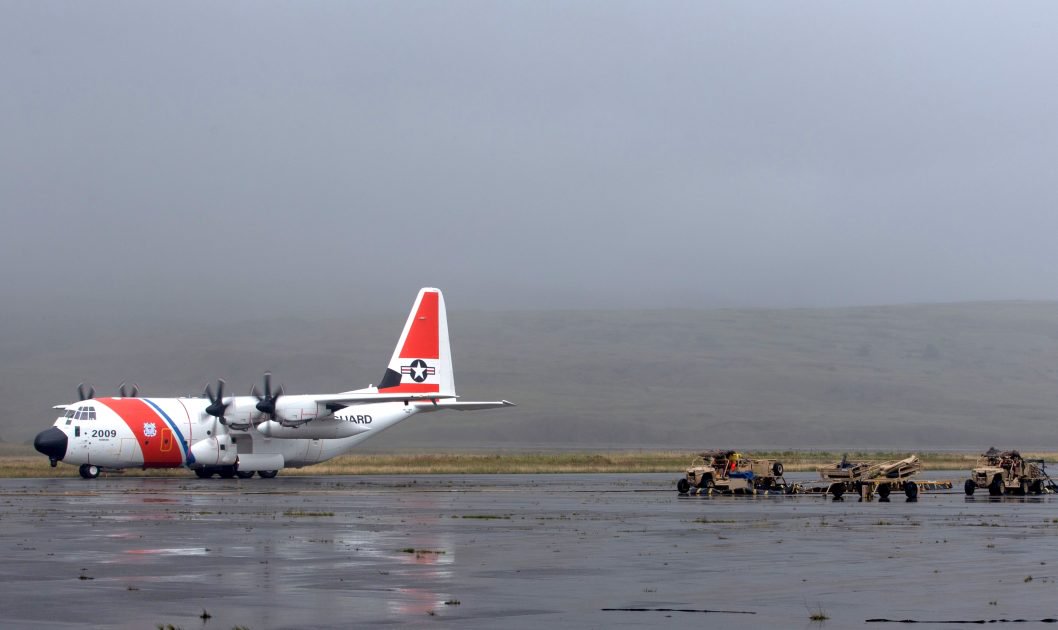
A U.S. Coast Guard C-130 participates in forward arming and refueling point (FARP) operations during Arctic Expeditionary Capabilities Exercise (AECE) in Adak, Alaska on Sept. 18, 2019. US Marine Corps Photo
Being combat ready is one of the Coast Guard’s eleven missions, but obviously we are not.
Though there has been some thought regarding the use of Coast Guard assets for limited wars in the tradition of their use in Vietnam and the Gulf Wars, consideration of the possibility of a larger conflict is nowhere evident in the way these assets are currently equipped. They may not even be adequately armed to deal with the full range of terrorist threats.
Upgrading the Bertholf class NSCs and the Offshore Patrol Cutters could add up to 36 light frigates to the national fleet. The Navy would need to provide some additional equipment, but that cost would be far less than the cost of adding similar ships to the Navy, and the difference in operating costs between ships with or without the upgrades is very small.
The Bertholf class National Security Cutters and the Offshore Patrol Cutters share systems with the Littoral Combat ships and the planned FFG(X). Exploitation of some of the additional systems developed for the LCS should be possible. Huntington Ingalls has already done basic design work on upgrades to the National Security Cutter class as part of a marketing effort.
There are opportunities for synergy between the Coast Guard and the Navy reserve such as flying Navy ASW helicopters from Coast Guard ships.
The first of the Offshore Patrol Cutters has yet to be completed. Significant upgrades should be possible. The program is just getting started with the first of a projected 25 expected to be delivered in 2021. It may be possible to develop a more capable, better armed “B”class.

OPC “Placemat”
Potential Missions:
- Upgraded NSCs and OPCs could escort priority shipping from the US coasts to the theater of operations. They may not be ideal, but they are ships we will have.
- They and the Webber class supported by Coast Guard aviation assets could sweep the seas of hostile merchant shipping and fishing vessels that might be used to provide intelligence, land agents, or lay mines.
- Those same assets could help enforce a blockade.
- We can do Combat SAR and provide rescue services for when vital supply ships are inevitably lost. We can’t afford to loose trained mariners.
- We can protect bases from unconventional attacks.
- Buoy tenders can place sensors on the sea floor to detect enemy activity or lay something like captor mines.
- Some of our ships can support unmanned systems for mine countermeasures.
If we go to war, “If it floats, it fights” will apply to Coast Guard vessels as well as Navy. They need to be ready. We need to be equipped and trained for whatever the Navy wants us to do.











 Chuck Hill's CG Blog