JMSDF Future Frigate to Feature Futuristic 360° Augmented Reality Wall” –Naval News

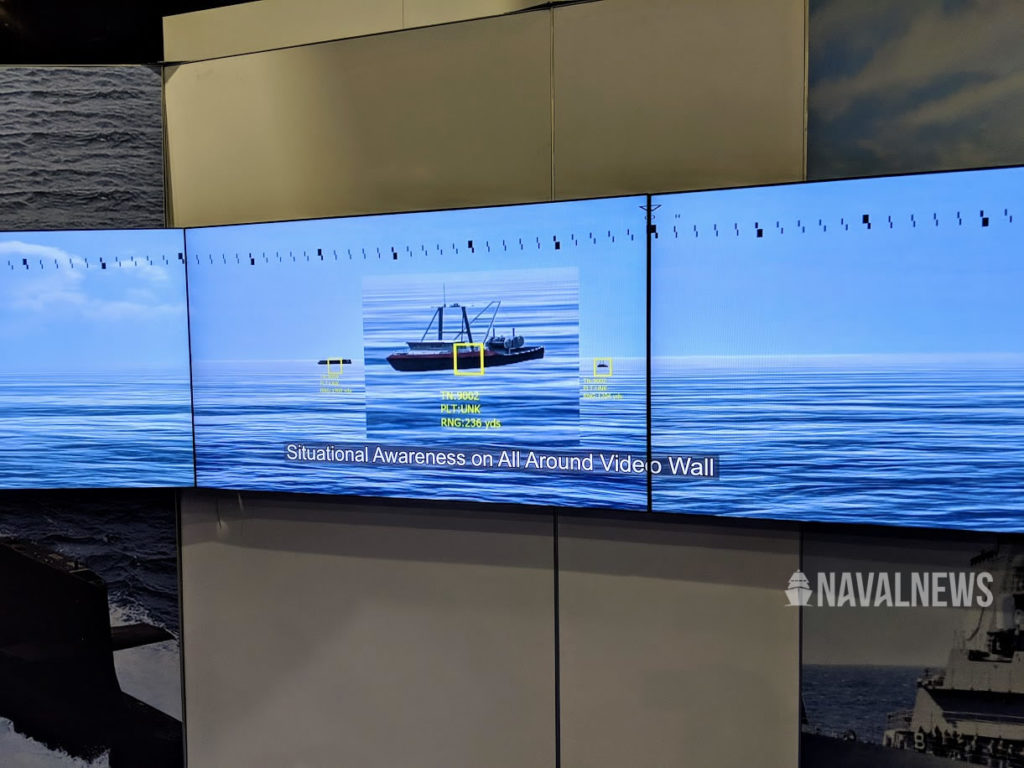
The CIC features the giant 360° wall and 14 + 4 multi function consoles + 2 large tactile tables.

Naval News reports that a new class off Japanese Maritime Self Defense Force frigate will feature a Combat Information Center (CIC) with a 360 degree augmented reality wall.

Situational awareness using the 360° augmented reality wall

Engineering control and damage control can be exercised from the CIC This is a further step in development of the CIC into data fusion center for the ship.

Notably this 5,500 ton ship is expected to have a crew of only 90.

Coast Guard Cutter Procurement: Background and Issues for Congress, Updated May 22, 2019

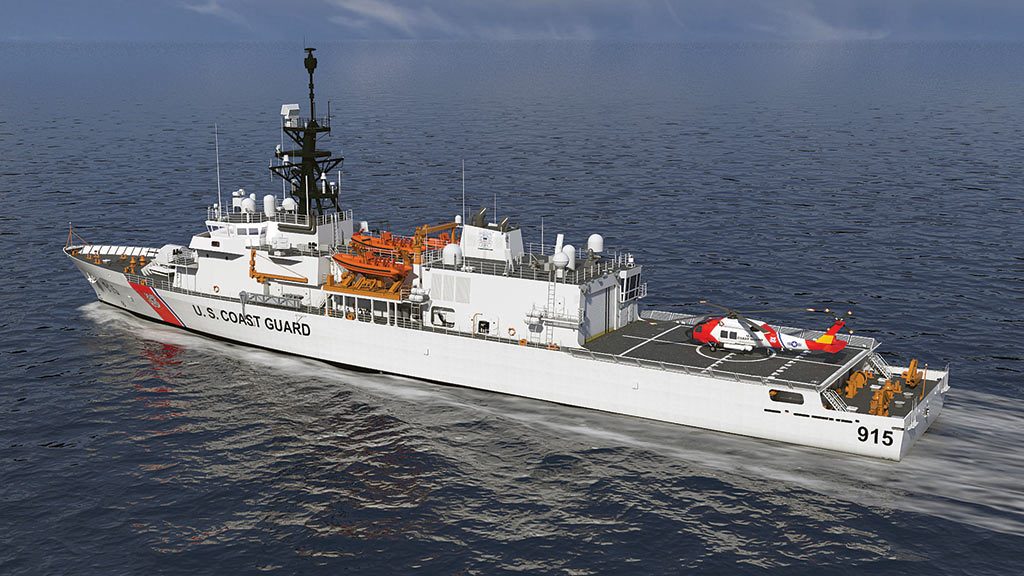
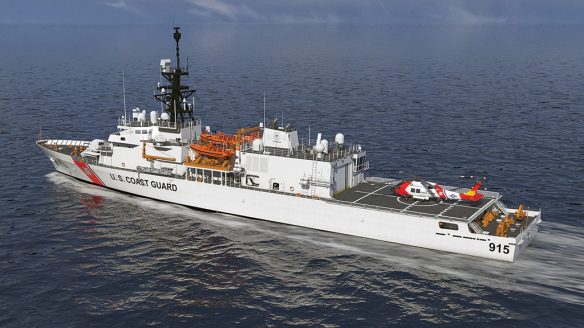
Offshore Patrol Cutter future USCGC ArgusThe Congressional Research Service has once again updated their look at Coast Guard Cutter procurement.

I have quoted the summary below and will comment on some of the questions.

The Coast Guard’s program of record (POR) calls for procuring 8 National Security Cutters (NSCs), 25 Offshore Patrol Cutters (OPCs), and 58 Fast Response Cutters (FRCs) as replacements for 90 aging Coast Guard high-endurance cutters, medium-endurance cutters, and patrol craft. The Coast Guard’s proposed FY2020 budget requests a total of $657 million in procurement funding for the NSC, OPC, and FRC programs.

NSCs are the Coast Guard’s largest and most capable general-purpose cutters; they are intended to replace the Coast Guard’s 12 aged Hamilton-class high-endurance cutters. NSCs have an estimated average procurement cost of about $670 million per ship. Although the Coast Guard’s POR calls for procuring a total of 8 NSCs to replace the 12 Hamilton-class cutters, Congress through FY2019 has funded 11 NSCs, including the 10th and 11th in FY2018. Six NSCs have been commissioned into service. The seventh was delivered to the Coast Guard on September 19, 2018, and the eighth was delivered on April 30, 2019. The ninth through 11th are under construction; the ninth is scheduled for delivery in 2021. The Coast Guard’s proposed FY2020 budget requests $60 million in procurement funding for the NSC program; this request does not include funding for a 12th NSC.

OPCs are to be smaller, less expensive, and in some respects less capable than NSCs; they are intended to replace the Coast Guard’s 29 aged medium-endurance cutters. Coast Guard officials describe the OPC program as the service’s top acquisition priority. OPCs have an estimated average procurement cost of about $421 million per ship. On September 15, 2016, the Coast Guard awarded a contract with options for building up to nine OPCs to Eastern Shipbuilding Group of Panama City, FL. The first OPC was funded in FY2018 and is to be delivered in 2021. The second OPC and long leadtime materials (LLTM) for the third were funded in FY2019. The Coast Guard’s proposed FY2020 budget requests $457 million in procurement funding for the third OPC, LLTM for the fourth and fifth, and other program costs.

FRCs are considerably smaller and less expensive than OPCs; they are intended to replace the Coast Guard’s 49 aging Island-class patrol boats. FRCs have an estimated average procurement cost of about $58 million per boat. A total of 56 have been funded through FY2019, including six in FY2019. Four of the 56 are to be used by the Coast Guard in the Persian Gulf and are not counted against the Coast Guard’s 58-ship POR for the program, which relates to domestic operations. Excluding these four, a total of 52 FRCs for domestic operations have been funded through FY2019. The 32nd FRC was commissioned into service on May 1, 2019. The Coast Guard’s proposed FY2020 budget requests $140 million in acquisition funding for the procurement of two more FRCs for domestic operations.

The NSC, OPC, and FRC programs pose several issues for Congress, including the following: 

  •     whether to provide funding in FY2020 for the procurement of a 12th NSC;
  •  whether to fund the procurement in FY2020 of two FRCs, as requested by the Coast Guard, or some higher number, such as four or six;
  •  whether to use annual or multiyear contracting for procuring OPCs;
  •  the annual procurement rate for the OPC program;
  •  the impact of Hurricane Michael on Eastern Shipbuilding of Panama City, FL, the shipyard that is to build the first nine OPCs; and
  •     the planned procurement quantities for NSCs, OPCs, and FRCs.

Bertholf Class National Security Cutters (NSCs):

If there is going to be a 12th NSC, it almost certainly has to be funded this year. Future years will see the Polar Security Cutters and OPCs further crowding the budget. Frankly I see little to choose between the NSC and OPC for peacetime missions, but the replacement of the legacy fleet is becoming urgent and the price of the NSCs has decreased as funding became more regular, so a 12th might be reasonable. If we had started the OPC program earlier, it might have offered a lower cost alternative to additional NSCs, but we will not be ready to start multi-ship procurements of the OPCs until FY2021 and then only at the rate of two per year if we follow current planning.

Argus Class Offshore Patrol Cutters (OPCs):

There is probably good reason to accelerate the OPC program beyond the two per year currently planned to begin in FY2021. If we maintain that rate, the last 210 foot WMEC will not be replaced until 2028, the last 270 not until 2034. I expect we may see some catastrophic failures that will result in either sidelining ships or unacceptably high repair costs, before the program of record is complete.

The Coast Guard should plan on expediting testing of the first OPC so that production could move from the current contract with options to a true Multi-Year contract as soon as the design has proven successful.

We probably will need more than 25 OPCs. The Coast Guard has operated more than 40 cutters of more than 1,000 tons for decades. It seems likely we are going to need more than 36 total NSCs and OPCs. (See the discussion about the Fleet Mix Study below.)

Webber Class Fast Response Cutters (FRCs):

We are nearing the end of the Webber class program with 52 of the 58 program of record vessels, plus four additional vessels for Patrol Forces South West Asia (PATFORSWA), already funded. Buying only two for FY2020 raises the unit costs of these vessels. Congress has consistently increased purchases to four or even six per year when only two have been requested. Adding the final two additional FRCs intended to replace the 110s assigned to PATFORSWA would bring the total buy to four. That would leave only four to be purchased in FY2021 which could wrap up the funding. The question is, will Congress stop the program at the 64 vessels total when there may be justification for more?

Impact of Hurricane Michael: 

The Coast Guard budget is not the place to provide disaster relief for businesses. Maybe they have insurance. Maybe the state or Federal Government wants to provide aid, but renegotiating the contract for OPCs is not the way to do it. No way should it come out of the Coast Guard budget.

If on the other had we do renegotiate the contract, it is not to late to make it a “Block Buy.”

One solution might be for the contract to be converted to a block buy, using purchase amounts no more than current contract with options. That would assure the contractor and its creditor that they would have a steady stream of work. The contract might even have options for production of additional ships at rates higher than two per year.

We Need a New Fleet Mix Study:

The number of OPCs and FRCs actually required to fulfill Coast Guard statutory missions was examined in a fleet mix study (see pages 19 and 20 of the report) that found that the Program of Record (8 NSCs, 25 OPCs, and 58 FRCs) fell far short of the number of vessels required to meet all statutory requirements. Phase One of the study (2009) found that the total “objective” requirement was 9 NSCs, 57 OPCs, and 91 FRCs. Phase Two found that only 49 OPCs would be required but found the same requirements for NSCs and FRCs (see page 22).

The problem is that the analysis is getting pretty old and its assumptions were wrong. The Coast Guard will have at least 11 NSCs. The FRCs appear to be more capable than anticipated. Perhaps most importantly, the study assumed the NSCs and OPCs would use the “Crew Rotation Concept,” resulting in an unrealistic expectation for days away from homeport. From my point of view, the study failed to even consider the requirement to be able to forcibly stop a medium to large size ship being used as a terrorist weapon. None of our ships are capable of doing that reliably, and even our ability to stop small fast highly maneuverable ships under terrorist control is far from assured, even if the objective fleet were available.

The Procurement, Construction, and Improvements FY2020 budget request is about $1.2B. Adding NSC #12 and a pair of FRCs using the costs in the CRS report ($670M/NSC plus 2x$58M/FRC) which are probably high for the current marginal costs, would still leave the PC&I budget under the $2B/year the Coast Guard has been saying they need and about $250M less than the FY2019 PC&I budget.

For the Future:

While we are thinking about cutters, with the FRC program coming to an end, it is not too early to think about the 87 foot WPB replacement. I think there might be a  window to fund them after the third Polar Security Cutter if we have our requirements figured out. That means preliminary contracts such as conceptual designs have to be done during the same period we are building PSCs, e.g. FY2022 and earlier. .

To avoid always being constantly behind the power curve, as we have been for the last two decades, we really need a 30 year shipbuilding plan. The Navy does one every year. There is no reason the Coast Guard should not be able to do one as well. The Congress has been asking for a 25 year plan for years now, but so far no product.

Thanks to Grant for bringing this to my attention. 

“Canada to build 18 more Coast Guard vessels” –Marine Log

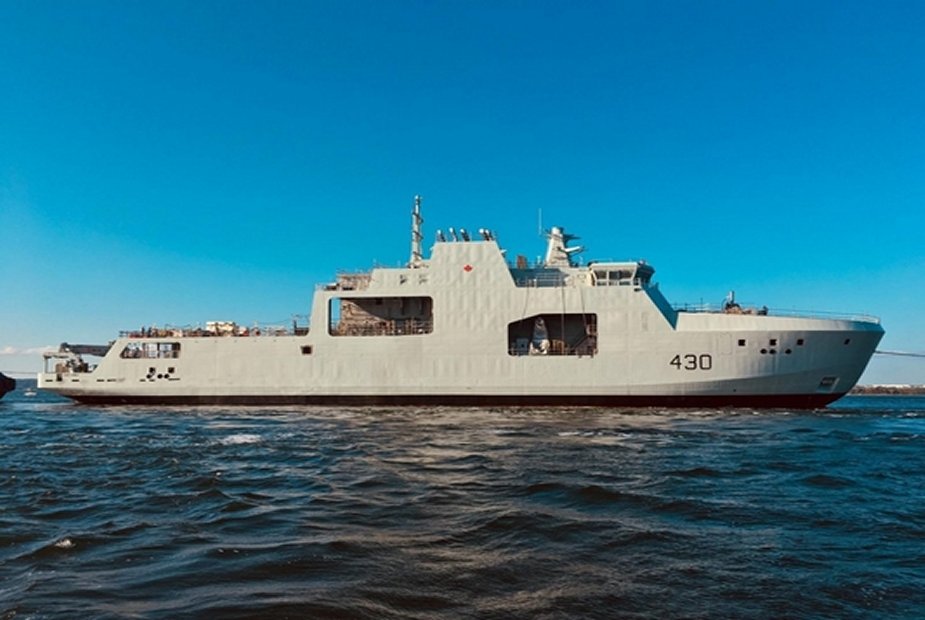
Arctic Offshore Patrol Ship (Royal Canadian Navy photo)

MarineLog is reporting that Canada is planning to build 18 additional ships for the Canadian Coast Guard including two additional Arctic Offshore Patrol Ships (AOPS, a type previously built for the Royal Canadian Navy).

They will also add a third shipyard to the national shipbuilding strategy.

The cost may appear out of line. The total for the 18 ships, C$15.7 billion (about US$11.7 billion) averages US$650M per ship. That is more than the average cost of the contract with options for three USCG Polar Security Cutters ($1.9B for three ships or $633M on average), but the price is not final and it appears it may include extended support.

The C$15.7 billion funding for the 18 large ships in represents early estimates of project budgets including construction, logistics and support, contingency, project management and infrastructure costs. The costs of each ship will be announced following contract negotiations.

Still there is likely to be some criticism.

There is also mention of an intention to also build some smaller vessels,

The Government of Canada will also proceed through a competitive process with the design of a new class of smaller ships, the new Mid-Shore Multi-Mission Ship, which would complement the work of the large fleet in shallow areas and deliver mid-shore science activities.

All in all, good news for the Canadian Coast Guard and an investment in ship building in Canada, assuming it actually happens. Like the US Coast Guard, they have had their problems. 

Coast Guard History Coming Back On-Line

The 83-foot Coast Guard cutter USCG 1 off Omaha Beach on the morning of D-Day, tied up to an LCT and the Samuel Chase

When the Coast Guard switched all of its on-line servers to the DOD system, now many months ago, it was frankly a disaster for those of us who frequently look for Coast Guard history information on line. It resulted in a large number of broken links on my “Heritage” page, and loss of access to many documents. I have not purged the broken links because I hope the titles will reemerge. Of course this information is still out there, but its just no longer available on-line.

It appears they have been working to rebuild the site on the new servers. They seem to have done a lot in preparation for the upcoming 75th D-Day Anniversary. Unfortunately there are still huge holes in the on-line presence. The cutter section is particular thin, including only Active and the Coast Guard manned LCI(L)s that participated in the Normandy invasion, but it does appear they are laying the ground work for more complete information.

While the site is certainly not comprehensive yet, it is at least getting more interesting.

A recent addition is listed as a chronology, but it is really more of a “This Day in Coast Guard History.” Below is a sample.

May 23

1928  CGC Haida and the USLHT Cedar rescued 312 passengers and crew from the sailing vessel Star of Falkland near Unimak Pass, Alaska after Star of Falkland had run aground in the fog the previous evening.  Both the cutter and the tender managed to save all but eight from the sailing vessel.  This rescue was one of the most successful in Coast Guard history and was also one of the few instances where the Coast Guard and one of its future integrated agencies worked together to perform a major rescue.

1930  Lieutenant Commander Elmer F. Stone received a medal from Congress for extraordinary achievement in making the first successful trans-Atlantic flight in 1919.  Stone was the pilot of the Navy’s NC-4.

1946  Commodore Edward M. Webster, USCG, headed the US Delegation to the International Meeting on Radio Aids to Marine Navigation, which was held in London, England.  As a result of this meeting, the principal maritime nations of the world agreed to make an intensive study of the World War II-developed devices of radar, LORAN, radar beacons, and other navigational aids with a view to adapt them to peacetime use.  This was the first time that the wartime technical secrets of radar and LORAN were generally disclosed to the public. [USCG Public Information Division News Release, 7 June 1946.]

1972  President Richard Nixon and the Chairman of the Presidium of the Supreme Soviet of the USSR, N. V. Podgorny, signed the “Agreement on Cooperation in the Field of Environmental Protection between the United States of America and the Union of Soviet Socialist Republics.”  Under the agreement, the U.S. Coast Guard was the lead U.S. agency, in association with the EPA and MARAD, for the Task Group on Prevention and Cleanup of Pollution of the Marine Environment from Shipping.

Meanwhile if you are looking for Coast Guard history, there may be more on-line information and certainly a huge number of photographs on the Naval History and Heritage web site. Here is a good example. Also Wikipedia can be a good source.

“Coast Guard Needs Congress for Budget Bailout” –National Defense

US Capital West Side, by Martin Falbisoner

National Defense reports that the Administration’s 2020 budget request makes deep cuts in the Coast Guard budget compared to recent years, but that there is a good chance Congress will make up at least some of the difference.

You can see a brief summary of the budget submission here.

We have Congress plus up the Coast Guard’s budget in the past, particularly in terms of increasing numbers of Webber class cutters funded. The 2020 budget includes only two. This is likely to be increased to four or even six.

Congress has also added three Bertholf class NSC to the program of record and there have been suggestions that a 12th is needed to fully replace the 378 foot WHECs. If we are to get a 12th NSC, it almost has to happen in FY2020 before we OPC construction goes to two per year and before we need to fund Polar Security Cutters 2-6.

The Commandant has been talking about maintenance backlogs recently. Unfortunately maintenance does not have the highly visible job creation impact of new construction, although the dollar for dollar impact may be as great. It seldom makes the evening news, so this may be a harder sell.


Sea-Air-Space 2019 Virtual Tour

Like most of you I did not make it to the Navy League’s 2019 Sea-Air-Space Exposition, so I have found some YouTube reports that can at least provide some of the information passed along at the event. The descriptions below each video are from the YouTube description.

Day 1 video coverage at the Sea Air Space 2019 exposition. In this video we cover:
– Boeing MQ-25 Stingray aerial refueling drone with Rear Admiral Corey
– Future USVs and XLUUV/Orca programs with Captain Pete Small
– Austal USA new range of medium and large size USVs
Textron Systems CUSV with surface warfare payload
– ST Engineering range of USVs

Day 2 video coverage at the Sea Air Space 2019 exposition. In this video we cover:
– Raytheon SPY-6 radar
– Raytheon / Kongsberg NSM for USMC
– Northrop Grumman PGK for naval 5 Inch and 155mm guns
– Lockheed Martin Freedom-class lethality and survivability upgrade
– Lockheed Martin FFG(X)
– Navantia / BIW FFG(X)

Day 3 video coverage at the Sea Air Space 2019 exposition. Washington-based naval expert Chris Cavas is our guest speaker for this third and final day at Sea Air Space 2019. Cavas covers the follow topics:
– Bell V-247 Vigilant VTOL tilt-rotor UAV in U.S. Navy configuration
– Austal USA USV concepts
– Austal USA FFG(X) Frigate
– Fincantieri FFG(X) Frigate
– GD Bath Iron Works FFG(X) Frigate
– Lockheed Martin Type 26 CSC
– Lockheed Martin hypervelocity missile
– Mic drop

Sea Machines, Hike Metal to Collaborate on SAR Autonomy” –MarineLink

Marine Link reports an attempt to build an unmanned rescue vessel.

Boston-based Sea Machines Robotics announced today a new partnership with Hike Metal, a world-class manufacturer of workboats based in Ontario, Canada, to integrate Sea Machines’ SM300 autonomous vessel control system aboard commercial vessels tasked with search-and-rescue (SAR) missions.

Unmanned is “all the rage,” but once you get on scene, you never know what you will find. The victim you are attempting to help may need medical assistance, they may not be able to move to shelter provided by the boat.

Automated systems could operate like a smart cruise control on your car, navigating to a designated position and even follow the rules of the road. Automated systems can reduce manning requirements, but when the SAR vessel gets on scene, you need the versatility of a human being to respond to the unexpected.

(Writing this feels some how wrong. Am I being reactionary? Isn’t this obvious to everyone? Still felt like I had to say something. Good systems could come out of this, but full autonomy is just too much to expect.)

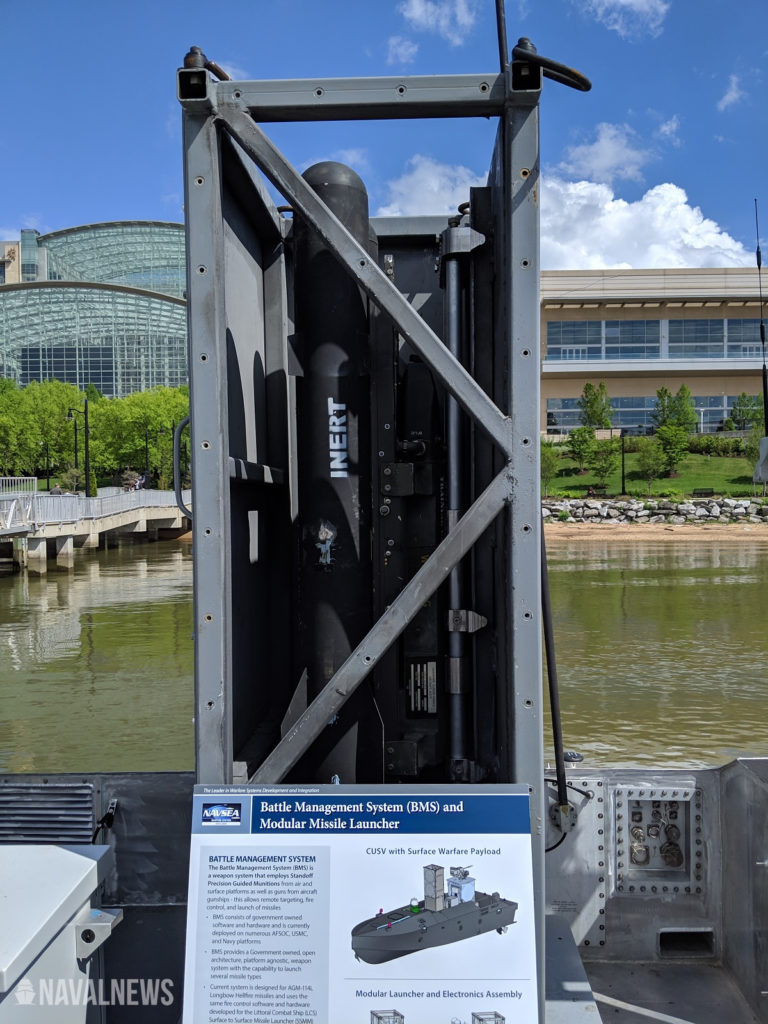
Small Vessel Hellfire Vertical Launch System

Photos: Above, Modular Missile Launcher, also seen below amidships on the Textron CUSV (Common Unmanned Surface Vehicle). Note relatively small size and innocuous appearance. 

Textron Systems’ CUSV with Surface Warfare payload at SAS 2019

Naval News reports that, at this year’s Sea-Air-Space Exposition, Textron showed one of their Common Unmanned Surface Vehicle (CUSV) craft equipped with a remote weapon station and a modular vertical launch system for the Longbow Hellfire.

I find the Hellfire VLS particularly interesting, as it might find application on Coast Guard cutters. The launcher appears to be about 2’x2’x7. The missile itself is 64″ long (1.6 meters), 7″ in diameter (17.8 cm), with a 13″ span (33 cm).

The CUSV is about 39′ (12 meters) in length. The CUSV’s load space is reportedly 20.5′ x 6.5′.

This earlier report indicates a missile shoot from a CUSV is expected in 2019. 

There would of course be concerns about how to mount these missiles on a cutter. The effects of the smoke at launch on he crew and the possible effects of the engines ingesting the smoke would have to be considered.

The planned transfer of six Webber class cutters to Bahrain, to replace the six Island class cutters assigned to PATFORSWA, might provide the incentive necessary to plan and test a Hellfire installation on this class.