“CHINA IS FIGHTING THE THIRD OPIUM WAR WITH FISH” –CIMSEC

Chinese fishing vessel fleet (Photo: The Maritime Executive)

CIMSEC has an interesting take on China’s use of its Distant Waters Fishing Fleet (DWF).

“If the U.S. is serious about “Great Power Competition,” it at least needs to stop scoring “own goals” by funding and emboldening the main competitor. But from the standpoints of both defense and security, these issues cannot be overlooked or marginalized. China is using its DWF globally in a manner that accrues tremendous benefits to the Chinese armed forces.”

The US Coast Guard is certainly trying to help other nations protect their EEZs from unauthorized exploitation by Chinese Fishing Vessels, but currently many nations license Chinese exploitation of their EEZ and there is no way we can prevent the Chinese from fishing in the waters beyond national boundaries. Even if the US stopped buying Chinese caught fish, there are other ready markets. The only result would be raising the cost of fish to US consumers.

What we need are alternative competitive provider of seafood. 

We could have a true win/win by helping the Compact of Free Association States, (Federated States of Micronesia (FSM), the Republic of the Marshall Islands (RMI), and the Republic of Palau) develop distant waters fishing fleets of their own. This would help keep their interests aligned with ours. Motivate them to keep the Chinese out of their EEZ, and direct more cash flow into these small, friendly and strategically important nations.

Buoy Tender, FRC, C-130 Used for International Fisheries Enforcement–Operation Southern Shield

PERU, 10.06.2023, Courtesy Photo, USCG District 11
San Francisco based USCGC Alder (WLB-216) raises the South Pacific Regional Fisheries Management Organization (SPRFMO) flag while patrolling the Eastern Pacific Ocean during Operation Southern Shield in October 2023. The Coast Guard recently completed the first high-seas boardings and inspections off the coast of Peru under a newly adopted multi-lateral agreement to monitor fishing and transshipment operations within the SPRFMO Convention Area, a region which encompasses nearly a quarter of the Earth’s high seas. (U.S. Coast Guard photo by Petty Officer 2nd Class Kenneth Honore)

Below is a District 11 news release. It came with 24 photos. I have included a few here. The captions are informative. I have edited some of the captions to include homeports and minimize duplication. I have also added a few links and the schematic below.

SPRFMO CONVENTION AREA
This schematic is available only to illustrate the Area of application of the SPRFMO Convention, which is described in legal terms in Article 5. The schematic is not part of the Convention text and has no legal status; it is not intended to reflect exactly the maritime spaces of adjoining coastal states.
PERU, 10.07.2023, Courtesy Photo, USCG District 11
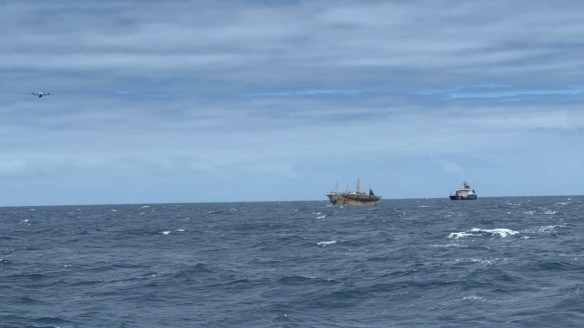
The Coast Guard Cutter Alder approaches a squid fishing vessel while CG-2007, a C-130 from Air Station Barbers Point in Hawaii, flies over (upper left) during Operation Southern Shield 2023, October 2023. The Coast Guard recently completed the first high-seas boardings and inspections off the coast of Peru under a newly adopted multi-lateral agreement to monitor fishing
and transshipment operations within the South Pacific Regional Fisheries Management Organization (SPRFMO)Convention Area. (U.S. Coast Guard photo)

LIMA, PERU, 10.06.2023, Courtesy Photo, USCG District 11
The aircrew of the Coast Guard 2007, an HC-130 based out of U.S. Coast Guard
Air Station Barbers Point, Hawaii, poses for a picture with observers from the Peruvian Navy and Air Force, in Lima Peru, October 2023. During the course of two weeks, Peruvian observers accompanied the USCG aircrew as they conducted overflights of the fishing fleet on the high seas during Operation Southern Shield 2023. (U.S. Coast Guard photo by pilot-in-charge, Lt. Zachary Hunter)

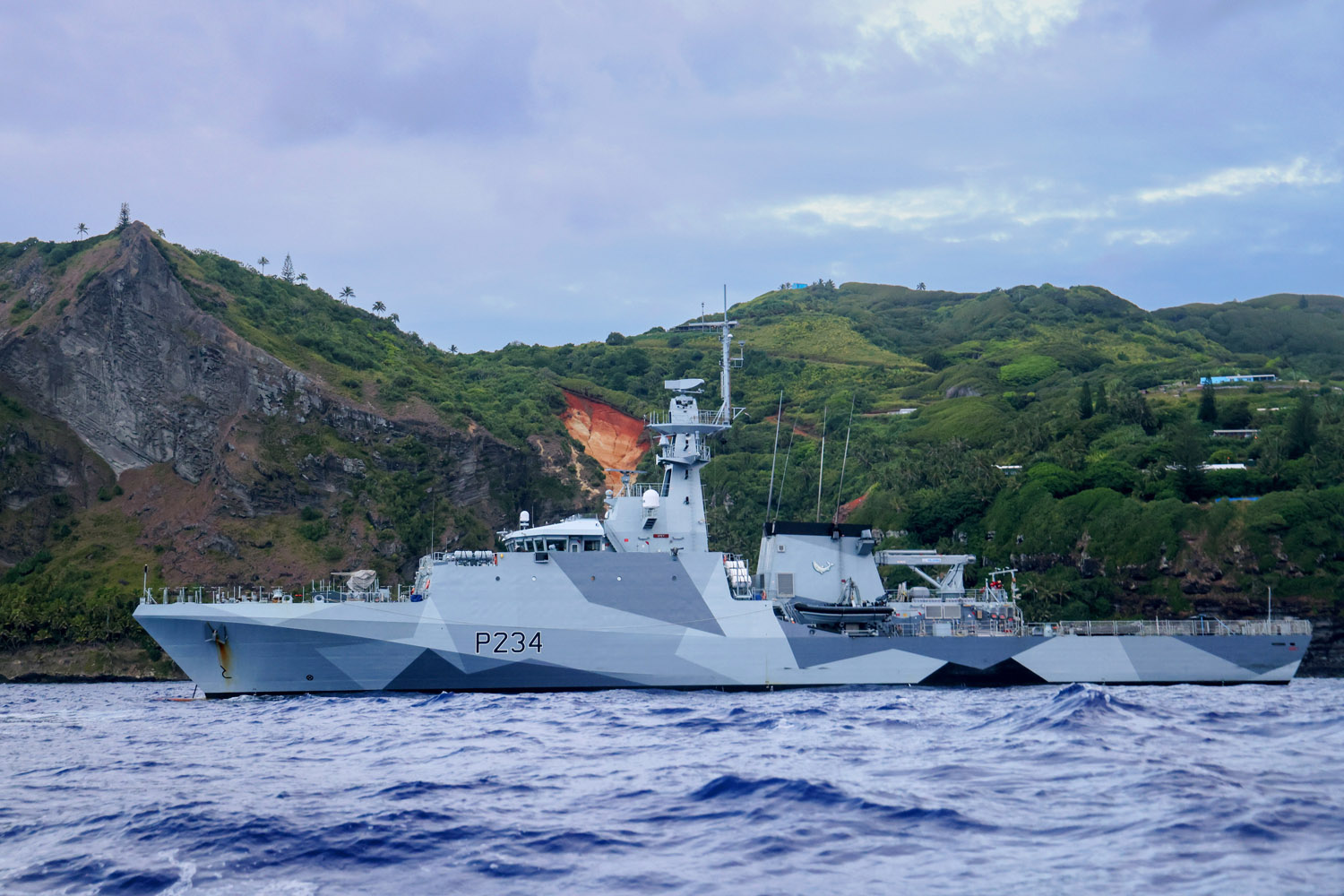
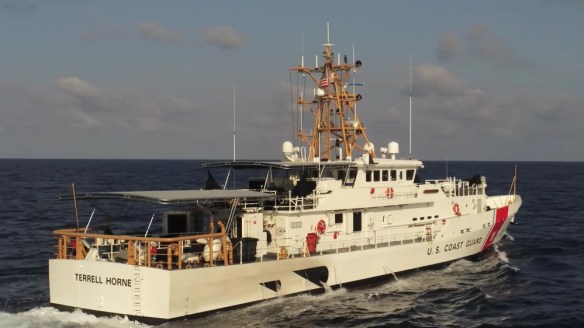
There was a Webber Class WPC involved as well. This follows the pattern of pairing a WLB with an FRC for distant operations that we have also seen in the Western Pacific.
PERU, 10.06.2023, Courtesy Photo, USCG District 11
The crew of San Pedro based USCGC Terrell Horne (WPC-1131) conducts a patrol in the Eastern Pacific Ocean in support of Operation Southern Shield 2023, October 2023. (U.S. Coast Guard photo)

These operations followed an international exercise, GALAPEX 2023.

09.23.2023, Courtesy Photo, USCG District 11
Participants in GALAPEX 2023 pose for a group picture following a law enforcement boarding exercise during GALAPEX 2023, Sept. 23, 2023. Coast Guard Cutters Alder and Terrell Horne conducted a boarding of Ecuador Bae Isla Floreana as the first major exercise and introduction to GALAPEX, a recurring multi-national maritime exercise led by Ecuador and included participation with delegates from Argentina, Brazil, Chile, Colombia, Costa Rica, the European Union, France, Italy, Mexico, Panama, Peru, the United Kingdom, and the United States. (U.S. Coast Guard photo by Lt. j.g. Kimberly Byron)
09.25.2023, Courtesy Photo, USCG District 11
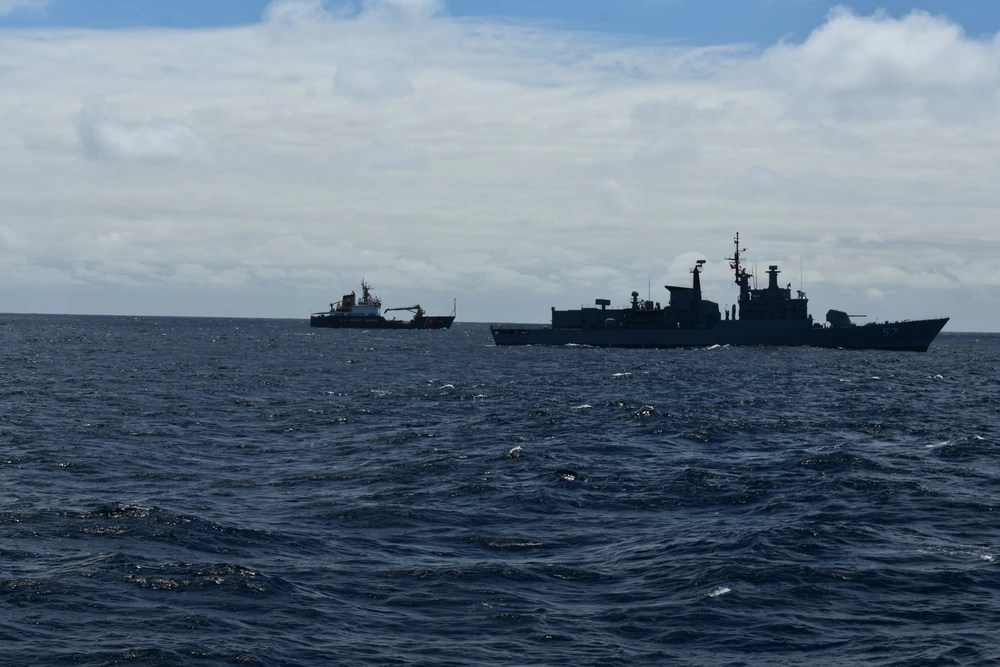
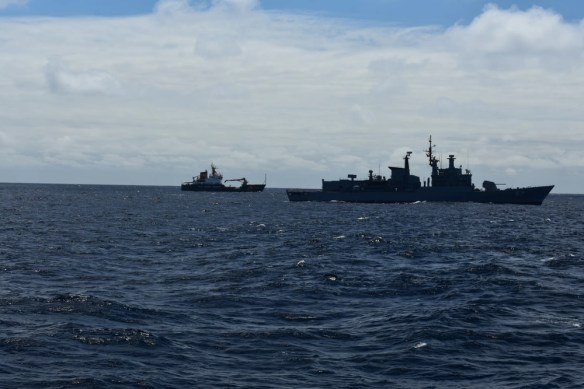
U.S. Coast Guard Cutter Alder (background) transits in formation alongside Peru BAP (Buque Armada Peruana) Bolognesi (FM-57) as it prepares for the next exercise during GALAPEX 2023, Sept.25, 2023. (U.S. Coast Guard photo)


 Oct. 16, 2023

Coast Guard Cutter crews conduct first high-seas boardings off the coast of Peru, under new SPRFMO measure

ALAMEDA, Calif. — The crews of the Coast Guard Cutters Alder, Terrell Horne and an HC-130 Hercules aircraft recently completed the first high-seas boardings and inspections, in the Eastern Pacific Ocean, under a newly adopted conservation and management measure to monitor and inspect fishing and transshipment operations at-sea in the South Pacific Regional Fisheries Management Organization (SPRFMO) Convention Area.

As part of Operation Southern Shield, the Coast Guard conducted boardings and overflights within the SPRFMO Convention Area on the high seas off the coast of Peru. For years, the Coast Guard has executed counter-illegal, unreported, or unregulated (IUU) fishing operations and participated in high seas boarding inspections (HSBI) around the globe. This operation was significant as it was timed to implement newly adopted rules in the SPRFMO Convention Area, which comprises nearly a quarter of the Earth’s high seas. The SPRFMO Commission consists of 17 members from Asia, Europe, the Americas, and Oceania, as well as two cooperating non-contracting parties. The primary species targeted in the Convention area are jack mackerel and jumbo flying squid.

Just prior to Operation Southern Shield, the Coast Guard participated in GALAPEX 2023, a recurring joint and multinational exercise hosted by Ecuador and executed in the vicinity of the Galapagos Islands. The Coast Guard conducted communications exercises, practiced counter-narcotics boarding scenarios, and hosted observers from Peru, Ecuador, and Brazil. GALAPEX culminated with full-scale exercises focused on a coordinated multinational response to counter IUU fishing. At the conclusion of the exercise, the Coast Guard patrolled south to focus on high seas boarding inspections off the coast of Peru.

“The U.S. Coast Guard remains committed to conducting combined maritime operations and exercises throughout the Eastern Pacific and will continue to capitalize on every opportunity to work with, learn from, and coordinate through our partners,” said Capt. James O’Mara, Chief of Enforcement for Coast Guard 11th District.  “The relationships our services build while planning and executing these operations are essential. The logistics required to enable these operations are significant, and it only happens with the tremendous support of partners like Ecuador and Peru.”

IUU fishing has replaced piracy as the leading global maritime security threat. Areas out on the high seas, beyond any country’s exclusive economic zone, can be exploited by fishermen engaged in IUU fishing, as they fish beyond the reach of most law enforcement entities. The Coast Guard’s actions provide inspection presence on the high seas among a distant water fishing fleet made up of more than 400 fishing and transshipment vessels. Much of the fishing in the Eastern Pacific is accomplished by these distant water fishing vessels, some which remain at sea for years at a time, and many of which are supported by transshipment vessels. The Coast Guard’s recent operation directly supported Central and South American partners and their desire to monitor and expand maritime domain awareness of fishing activity near their exclusive economic zones.

Each day during the operation a Coast Guard C-130 aircraft flew sorties over the fishing fleet on the high seas with observers from the Peruvian Navy and Air Force. The crew of the Coast Guard Cutter Terrell Horne also diverted to assist the Peruvian Navy in a search and rescue operation. The Terrell Horne located the vessel, then transported an injured fisherman back to shore to receive further medical care from local Peruvian officials.

“The U.S. Coast Guard is committed to working with our allies and partners to strengthen the international fisheries enforcement regime and stop the pervasive IUU fishing threat,” said Rear Adm. Andrew Sugimoto, commander, Coast Guard 11th District. “Operation Southern Shield is just the latest example of that commitment, and we will continue to model and support rules-based order. We applaud the SPRFMO Commission for adopting these latest inspection guidelines and hope to see additional management measures adopted in the future to ensure the sustainability of our ocean resources. Last year we operated off the Galapagos, this year off the coast of Peru, and we will continue to deploy aircraft, cutters, and personnel to support our partners and monitor these distant water fleets wherever they roam. These operations help bring like-minded countries closer together to protect vulnerable fish stocks, support the economic stability of coastal nations, the livelihoods of small-scale and artisanal fishermen, and safeguard ocean resources that fuel global populations and economies.”

“ASEAN kicks off its first-ever joint military drills in Indonesia” –Reuters

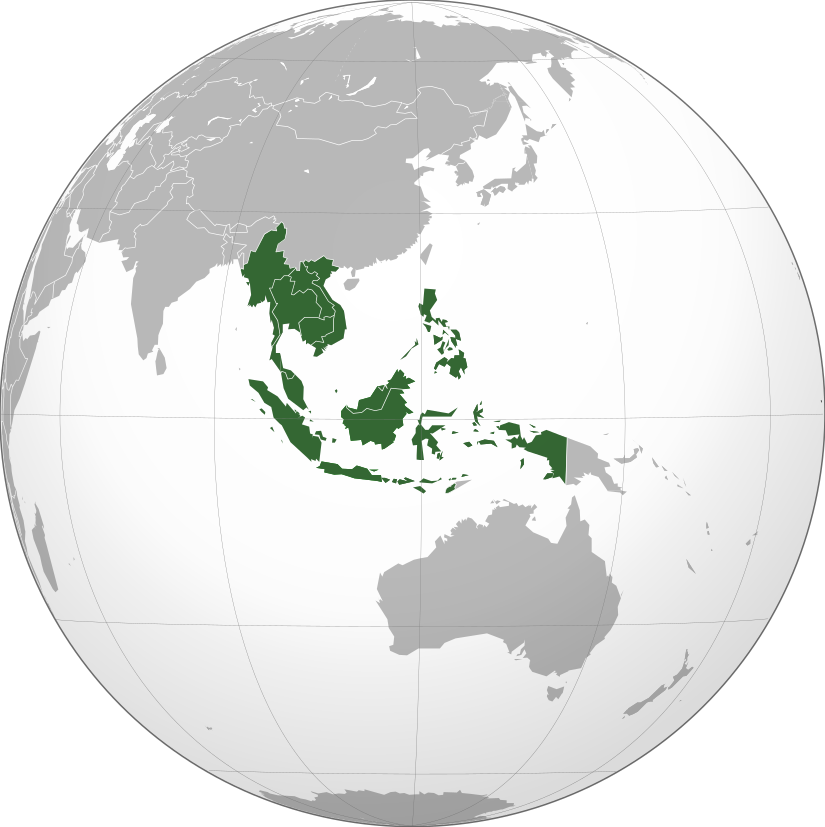
Association of Southeast Asian Nations in orthographic projection. Credit: Addicted04

Reuters reports,

“Units from the countries of ASEAN began their first ever joint military drills in Indonesia’s South Natuna Sea amid rising geopolitical tensions between major powers and protests against China’s activities in the South China Sea…The five-day non-combat operation is aimed at developing military skills, including maritime security and patrols, and the distribution of humanitarian assistance and disaster relief, the Indonesian military said in a statement.”

This is a step toward establishment of recognized norms and cooperative law enforcement by ASEAN members in the South China Sea.

Significantly Indonesia is taking a leadership role. Indonesia seems to be the most aggressive nation in ASEAN with regard to protecting their EEZ assets.

“Papua New Guinea leads joint maritime operations with U.S. Coast Guard” –Coast Guard News

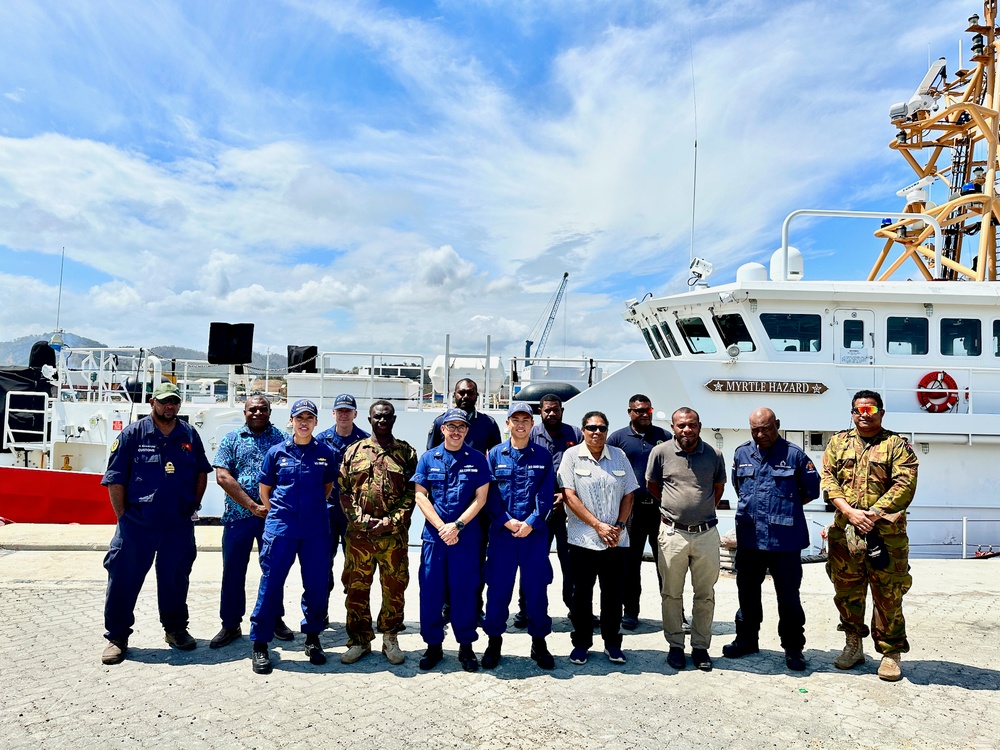
USCGC Myrtle Hazard (WPC 1139) hosts operational planning and subject matter exchange with partners in Port Moresby, Papua New Guinea

The USCGC Myrtle Hazard (WPC 1139) command stand for a photo with partners from the Papua New Guinea Defense Forces, Customs Services, National Fisheries Authority, and Department of Transport’s maritime security division following an operational planning and subject matter exchange with partners in Port Moresby, Papua New Guinea on Aug. 22, 2023. The U.S. Coast Guard is in Papua New Guinea at the invitation of the PNG government to join their lead in maritime operations to combat illegal fishing and safeguard maritime resources following the recent signing and ratification of the bilateral agreement between the United States and Papua New Guinea. (U.S. Coast Guard photo by Chief Warrant Officer Sara Muir) 

Passing along this from Coast Guard News. Like the fact that the Papua New Guinea government is taking the lead on this. We are helping them build capacity not doing the job for them.


Aug. 23, 2023

Papua New Guinea leads joint maritime operations with U.S. Coast Guard

Editor’s Note: For more images, please click here

PORT MORESBY, Papua New Guinea — Papua New Guinea (PNG) has invited the USCGC Myrtle Hazard (WPC 1139) to join their lead in maritime operations to combat illegal fishing and safeguard maritime resources during August 2023.

This collaborative effort marks the first time a joint patrol effort will be executed at sea since the signing and ratification of the recent bilateral defense agreement between PNG and the United States, which allows the U.S. to embark shipriders from PNG agencies aboard the ship to conduct at sea boardings on other vessels operating in the exclusive economic zone (EEZ) under their national agency authority. This is the U.S. Coast Guard vessel deployment first announced during Secretary of Defense Austin’s engagement with Prime Minister James Marape in July.

PNG’s lead in this mission aligns with their sovereign rights to protect the EEZ and emphasizes the country’s commitment to maritime domain awareness, fisheries regulation enforcement, and sovereignty protection. The PNG government requested the U.S. Coast Guard’s participation to utilize the platform and crew of the Guam-based 154-foot Fast Repones Cutter, currently on an expeditionary patrol, to expand coverage of the heavily trafficked maritime EEZ.

“Through our recent operational planning and subject matter exchange, the partnership between the Papua New Guinea Defence Force and the U.S. Coast Guard reached new heights. The spirit of collaboration and shared mission to ensure regional maritime security reflects our nations’ aligned values and commitment. This initiative fosters growth in our bilateral relationship and paves the way for innovative approaches to safeguard our waters and the sustainable use of our ocean resources. Working alongside the U.S. Coast Guard is an honor, and PNGDF eagerly anticipates our cooperative efforts’ continued growth and success,” said Commodore Philip Polewara, the Acting Chief of the PNG Defence Force.

The PNG-led patrol aims to observe activity and conduct boardings to reduce illegal fishing and illicit maritime activities in PNG’s EEZ. It’s part of a long-term effort to counter illegal maritime activity and safeguard the sustainable use of maritime resources.

This collaboration is vital to Operation Blue Pacific and augments ongoing efforts by the Pacific Islands Forum Fisheries Agency and Western and Central Pacific Fisheries Commission. It underscores the recent bilateral agreement, signed in May and ratified in the last few weeks, enabling the Myrtle Hazard crew to work collaboratively within PNG’s legal framework and strengthen relations with agencies with shared objectives.

The USCGC Oliver Henry (WPC 1140) crew was the first U.S. Coast Guard Fast Response Cutter to call on port in Papua New Guinea during their southern expeditionary patrol in the fall of 2022 to build relations, conduct engagements, and resupply.

The USCGC Myrtle Hazard’s crew is building on the work of their colleagues – already engaging with the PNG Defense Force through exchanges in the northern part of the country on this patrol, bolstering cooperation and understanding. This activity included subject matter exchanges with the PNG Defense Force Patrol Vessel Ted Diro crew and a port call in Rabaul, where the team engaged with the local community at the Rabaul Yacht Club. Additionally, the advance team and cutter crew conducted operations planning and subject matter exchanges across agencies in Port Moresby and ship tours for the embassy team and partners.

“We are deeply honored to collaborate with the Papua New Guinea Defense Force, Papua New Guinea Customs Services, Papua New Guinea National Fisheries Authority, and the Department of Transport’s Maritime Security Division at the invitation of the Papua New Guinea Government,” said Lt. Jalle Merritt, commanding officer of the USCGC Myrtle Hazard. “Our shared mission reflects PNG’s leading role in regional security, and we are committed to supporting their goals in this significant undertaking.”

For more information about this patrol and other related activities, please contact Chief Warrant Officer Sara Muir at sara.g.muir@uscg.mil or the respective agencies in Papua New Guinea.

“Coast Guard Cutter Bertholf returns home after 120-day Bering Sea patrol” –Coast Guard News

Aerial view of Kotzebue, Alaska, U.S. U.S. Army Corps of Engineers, photographer not specified or unknown

Below is a US Coast Guard News report. This was a “Bering Sea Patrol” or what we used to call an Alaska Patrol or ALPAT, but it actually went further North than the Bering Sea.

Northwest Arctic Borough Alaska incorporated and unincorporated areas Kotzebue highlighted. From Wikipedia by Rcsprinter123

When we used to do ALPATs, we spent a lot of time around Dutch Harbor and out toward Adak. We might have gone as far North as the Bering Strait but didn’t spend much time there. Going North of the Berring Strait, which is on the Arctic Circle, was very rare, and we made no port calls at Nome (just south of the Strait) or at any location North of the Strait.
In this case, Bertholf made a port call at Kotzebue (population about 3,100) which is not really in the Bering Sea, it is in the Chuckchi Sea, North of the Bering. Note Bertholf had to anchor out in the Sound. There was no place for them to moor. You can see virtually all of the town in the photo above. It is above the Arctic Circle. It is a tiny town, but it has become important for the Coast Guard as the location for a seasonally deployed Helicopter detachment. (I have not seen any report of a detachment being deployed to Kotzebue this year.)
Despite a lot of talk about the increasing importance of the Arctic, so far, US Navy Pacific Fleet surface ships operating North of the Aleutians, are very rare. They may have operated in the vicinity of Dutch Harbor during an exercise, but I think it is fair to say we are more likely to see Russian and Chinese warships. We did in 2021 and 2022.

Aug. 3, 2023

Coast Guard Cutter Bertholf returns home after 120-day Bering Sea patrol

ALAMEDA, Calif. – The Coast Guard Cutter Bertholf (WMSL 750) and crew returned to homeport, Thursday, to Coast Guard Island after a 120-day Bering Sea patrol in support of United States national security, U.S. fishing fleet safety and prosperity, and the protection of U.S. living marine resources.

While patrolling the Bering Sea, Bertholf’s crew members conducted 15 boardings of commercial fishing vessels, ensuring compliance with federal fisheries laws, and preserving the highly valuable U.S. living marine resources. These boardings also ensure that the U.S. fishing fleet have sufficient safety equipment to survive in the event of an at-sea emergency.

In a demonstration of the strong trusted partnership between Japan and the United States, Bertholf conducted major at-sea and shore side engagements with the Japan Maritime Self Defense Force (JMSDF) training ships Kashima and Hatakaze. During the at-sea engagement, Bertholf, Kashima and Hatakaze executed multiple formations, and during a farewell pass, the JMSDF personnel displayed a highly impressive drumline performance on their flight deck.

Afterward, the three ships moored up together in Dutch Harbor, Alaska, and continued to build relationships and shape partnerships. These engagements included reciprocal ship tours, a baseball game, a fun run up local mountain Ballyhoo, and a Dutch Harbor beach bonfire.

The next day, the Japanese and U.S. crews came together with the Unalaska community and officials from the Qawalangin Tribe during the 81st anniversary of the World War II Battle of Dutch Harbor ceremony to commemorate the lives lost, the community impacts, and to recognize the healing and partnership that has been built in the decades that followed. Rear Adm. Konno, JMSDF Training Squadron Commander, Rear Adm. Moore, commander of U.S. Coast Guard Seventeenth District, and Mayor Tutiakoff presided over the ceremony and exchanged official gifts.

Additionally, Bertholf crew guarded the boundary line between the U.S. and Russian Exclusive Economic Zone (EEZ), ensuring that the fish in U.S. waters were protected from illegal, unreported and unregulated fishing from foreign nations.

Later in the patrol, Bertholf and crew anchored in Kotzebue Sound and engaged in several events with the community members of Kotzebue, Alaska, including a color run and a softball game. In addition, Bertholf’s law enforcement operators engaged with local fishermen and fish processors to establish positive relationships and ensure awareness of boater safety regulations and salmon skiff exemptions in the region.

“Our accomplishments during this patrol would not have been possible without the amazing crew that we have aboard,” said Capt. Billy Mees, Bertholf commanding officer. The entirety of the crew and their families have my utmost respect for the sacrifices they make for their country.”

The Bertholf returned home on the eve of the 15th anniversary of its commissioning date; August 4th, 2008, which also coincides with the Coast Guard’s 233rd birthday. Since then, Bertholf has truly lived up to the storied past of her namesake, Commodore Ellsworth P. Bertholf, the first Commandant of the U.S. Coast Guard, and its motto, Legends Begin Here.

Coast Guard in Oceania in the News

The USCGC Oliver Henry (WPC 1140) crew arrives in Manus, Papua New Guinea, on Aug. 14, 2022, from Guam as part of a patrol headed south to assist partner nations in upholding and asserting their sovereignty while protecting U.S. national interests. The U.S. Coast Guard is participating with partners to support the Pacific Islands Forum Fisheries Agency-led Operation Island Chief and the larger Operation Blue Pacific through patrols in the Western Pacific in August and September 2022. (U.S. Coast Guard photo by SW3 Victor Villanueva, NMCB-FOUR)

A couple of recent articles about the US relations with Palau and Papua New Guinea.

Map of the exclusive economic zones in the Pacific.

There has long been interest in a US base on Manus, Papua New Guinea, but this is politically sensitive. Basing cutters there that protect an important economic resource and occasionally rescue the locals when they get in trouble, would probably be most welcome.

On the map above, Manus and Guam do not look that far apart, but Manus is 1,737.88 km (938 nautical miles) SSE of Guam. That is about the distance from Miami to New York City. 

Cutters based in Manus would be closer to parts Freely Associated States (FAS) of Palau and Federated States of Micronesia than cutters based in Guam and much closer to most non-FAS Micronesian nations. It might also be a good place to site a fixed wing forward operating base (CGAS Honolulu DET).

I am beginning to think we will see two new bases in the Western Pacific, one in American Samoa and one in Manus.

If we do end up with additional Webber class based outside Hawaii and Guam, we might need a squadron support organization similar to, and perhaps even larger than, PATFORSWA, to support all FRCs based in the Pacific South and West of Hawaii, e.g. a PATFORSWPAC.

“USCGC Spencer (WMEC 905) completes multinational maritime security patrol, arrives in Dakar, Senegal” –U.S. Naval Forces Europe and Africa/U.S. Sixth Fleet

DAKAR, Senegal – U.S. Coast Guard Lt. Cmdr. Nicholas Forni, executive officer aboard USCGC Spencer (WMEC 905) and Lt. Jacob Balchikonis, operations officer aboard Spencer, meet with Lt. Col. Sam Kunst, U.S. Marine Corps Attaché to Dakar, Senegal, Jan. 17, 2023. Spencer is on a scheduled deployment in the U.S. Naval Forces Africa area of responsibility, employed by the U.S. Sixth Fleet, to carry out joint training, exercises, and maritime security operations alongside AFRICOM partners in support of U.S. interests abroad, regional partnerships, and to strengthen international maritime governance. (U.S. Coast Guard photo)

The activities reported in the news release below have become a fairly routine deployment for Atlantic Area 270 foot WMECs. I expect Spencer will also participate in Exercise Obangame Express 2023.

Jan. 19, 2023

USCGC Spencer (WMEC 905) completes multinational maritime security patrol, arrives in Dakar, Senegal

By U.S. Naval Forces Europe and Africa/U.S. Sixth Fleet

The Famous-class medium endurance USCGC Spencer (WMEC 905) arrived in Dakar, Senegal for a scheduled port visit following a multinational maritime security patrol, Jan. 17, 2023.

Spencer’s visit to Dakar included meetings with Capt. Karim Mara, Senegalese deputy chief of naval staff, as well as leaders from the Senegalese Navy and the U.S. Office of Security Cooperation. Prior to the port visit, Spencer embarked maritime counterparts from Cabo Verde, Senegal and The Gambia for a security patrol to identify and deter illegal, unreported, unregulated (IUU) fishing as well as build living marine resource enforcement capacity with African partner nations.

“We were able to build maritime domain awareness with our partners by establishing an offshore law enforcement presence that demonstrated Cabo Verde’s, Senegal’s, and The Gambia’s commitment to maritime security and living marine resource enforcement. We did this by conducting combined maritime law enforcement operations and effectively communicating and coordinating with each country’s Maritime Operations Center,” said Cmdr. Corey Kerns, Spencer’s commanding officer.

This deployment demonstrates NAVAF and the U.S. Coast Guard’s commitment and longstanding partnership to work with our African partners to counter illicit maritime activity in the Atlantic Ocean. The U.S. Coast Guard regularly integrates and operates within the NAVAF area of operations. The U.S. Coast Guard’s authorities and capabilities provide the Joint Force with unique tools that bridge the cooperation-to-conflict continuum.

Senegal and the United States share a proud history of promoting peace and security in Africa. Later this month, Senegal will participate in the NAVAF-led exercise Obangame Express 2023, the largest annual maritime security exercise in Western Africa. These types of exercises strengthen partnerships and allow countries to work more closely on shared transnational maritime challenges.

“The United States and Senegal enjoy an exceptional security partnership that bolsters our shared efforts to promote peace and security in West Africa, combat illegal, unreported, and unregulated fishing, and protect marine resources,” said Mike Raynor, U.S. Ambassador to Senegal. “The arrival of USCGC Spencer to Dakar reflects that robust partnership.”

The U.S. shares a common interest with African partner nations in ensuring security, safety, and freedom of navigation on the waters surrounding the continent, because these waters are critical for Africa’s prosperity and access to global markets.

U.S. Coast Guard Atlantic Area, headquartered in Portsmouth, Virginia, oversees all Coast Guard operations east of the Rocky Mountains to the Arabian Gulf, spanning across five Coast Guard districts and 40 states.

For over 80 years, U.S. Naval Forces Europe-U.S. Naval Forces Africa (NAVEUR-NAVAF) has forged strategic relationships with allies and partners, leveraging a foundation of shared values to preserve security and stability.

Headquartered in Naples, Italy, NAVEUR-NAVAF operates U.S. naval forces in the U.S. European Command (USEUCOM) and U.S. Africa Command (USAFRICOM) areas of responsibility. U.S. Sixth Fleet is permanently assigned to NAVEUR-NAVAF, and employs maritime forces through the full spectrum of joint and naval operations.

Damen 5009 for Falklands Fisheries Protection

New Fishery Patrol Vessel (FPV) for the Falkland Islands provided under a 15-year contract by Seagull Maritime Ltd to begin patrols next year.@damen

There is not a lot here, just a bit on Twitter and a photo you can click on at the bottom of the page here. I have quoted the Twitter below.

Navy Lookout@NavyLookout
New Fishery Patrol Vessel (FPV) for the Falkland Islands provided under a 15-year contract by Seagull Maritime Ltd to begin patrols next year.

Stan 5009 Axe-Bow vessel built in Vietnam. To be named ‘Lilibet’ in honour of the late Queen.

The Brits do things differently. They have different fisheries protection agencies in different areas and in some cases, it is done by the Royal Navy. A Royal Navy River Class Batch II Offshore Patrol Vessel, HMS Forth, also patrols the Falklands, South Georgia, and South Sandwich Islands.
The Damen Stan Patrol 5009 basically replaced their Stan Patrol 4708 that was the basis of the Webber class WPCs in their product portfolio. (The number represents nominal length and beam in meters.) The 5009 is 50.1 meters in length and 9.4 meters of beam, so slightly larger than the Webber class. (More info here.)
Weather around the Falklands is not unlike that on Alaska Patrol, typically nasty. The “axe bow” would reduce pitch, but the bow might tend to be wetter.
We saw this class in an earlier post that may give some insight into how these little ships might be equipped.

“Coast Guard Cutter Midgett arrives in the Western Pacific” –PacArea

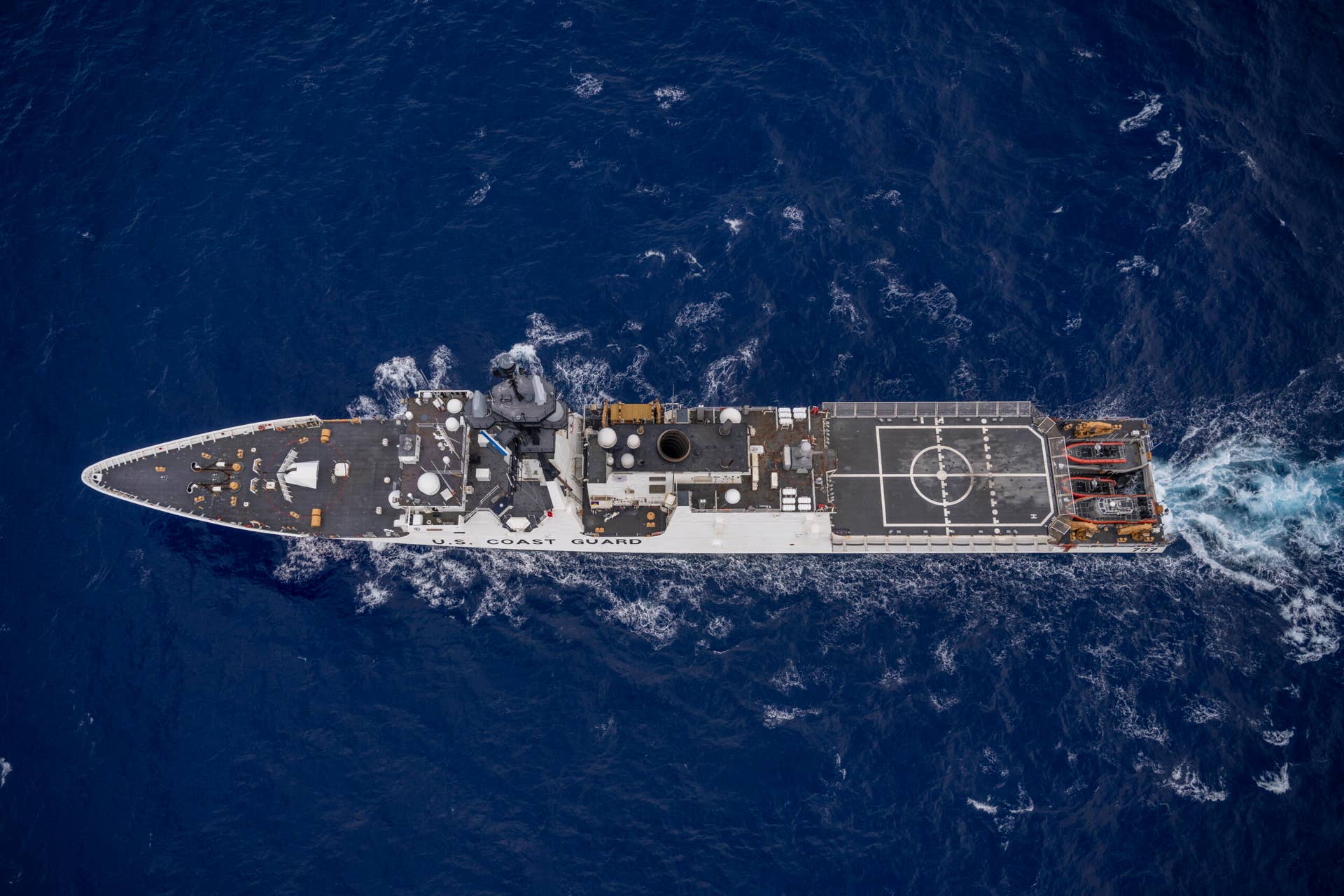
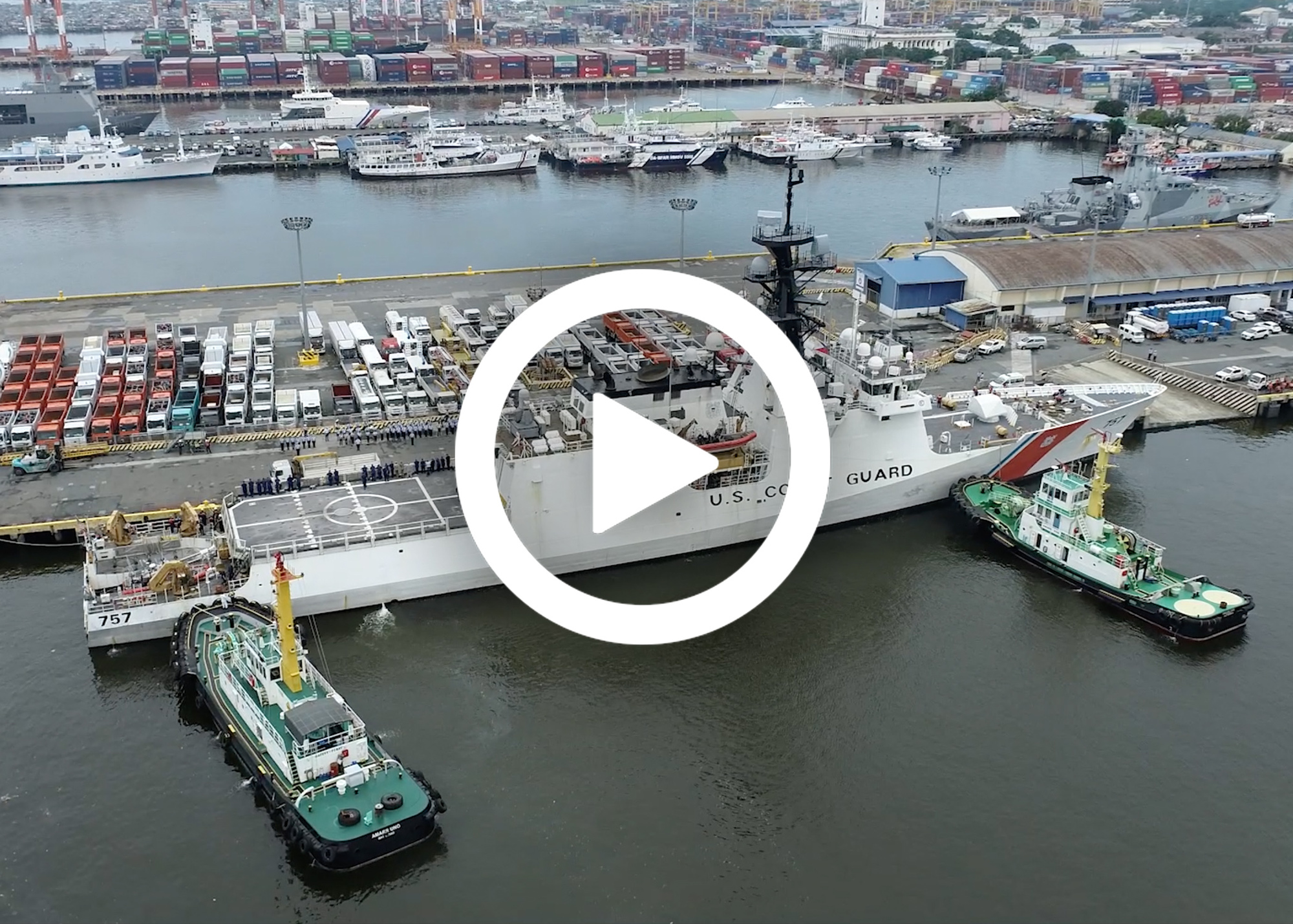
PACIFIC OCEAN (July 30, 2022) U.S. Coast Guard Legend-class cutter USCGC Midgett (WMSL 757) transits the Pacific Ocean during Rim of the Pacific (RIMPAC) 2022. Twenty-six nations, 38 ships, three submarines, more than 170 aircraft and 25,000 personnel are participating in RIMPAC from June 29 to Aug. 4 in and around the Hawaiian Islands and Southern California. The world’s largest international maritime exercise, RIMPAC provides a unique training opportunity while fostering and sustaining cooperative relationships among participants critical to ensuring the safety of sea lanes and security on the world’s oceans. RIMPAC 2022 is the 28th exercise in the series that began in 1971.(U.S. Coast Guard photo by Petty Officer 3rd Class Taylor Bacon)

Only weeks after having completed participation in RIMPAC2022, Honolulu based USCGC Midgett begins a “months-long” deployment in the Western Pacific.

News Release

August 31, 2022
U.S. Coast Guard Pacific Area

Coast Guard Cutter Midgett arrives in the Western Pacific

VIDEO: Coast Guard Cutter Midgett arrives in the Western Pacific

Coast Guard Cutter Midgett arrives in Manila, Philippines Coast Guard Cutter Midgett arrives in Manila, Philippines Coast Guard Cutter Midgett arrives in Manila, Philippines

Editors’ Note: Click on images to download high resolution version.

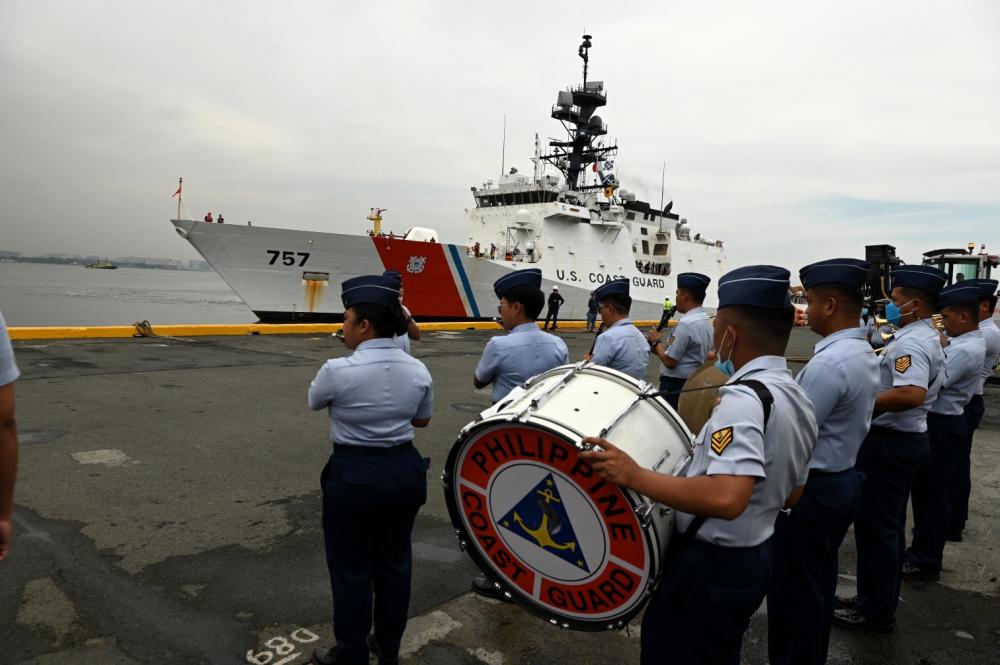
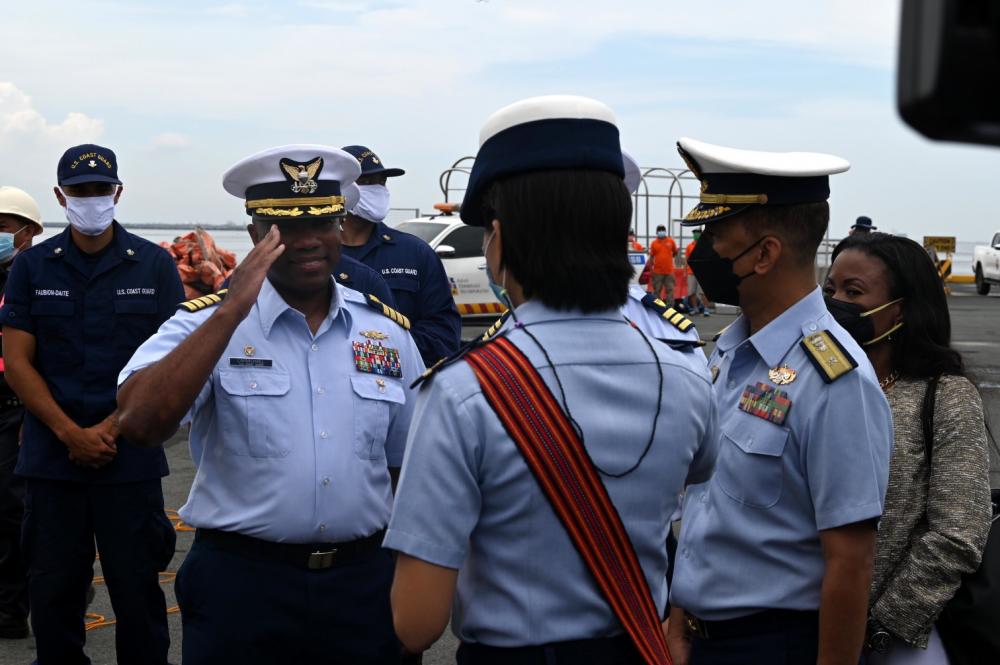
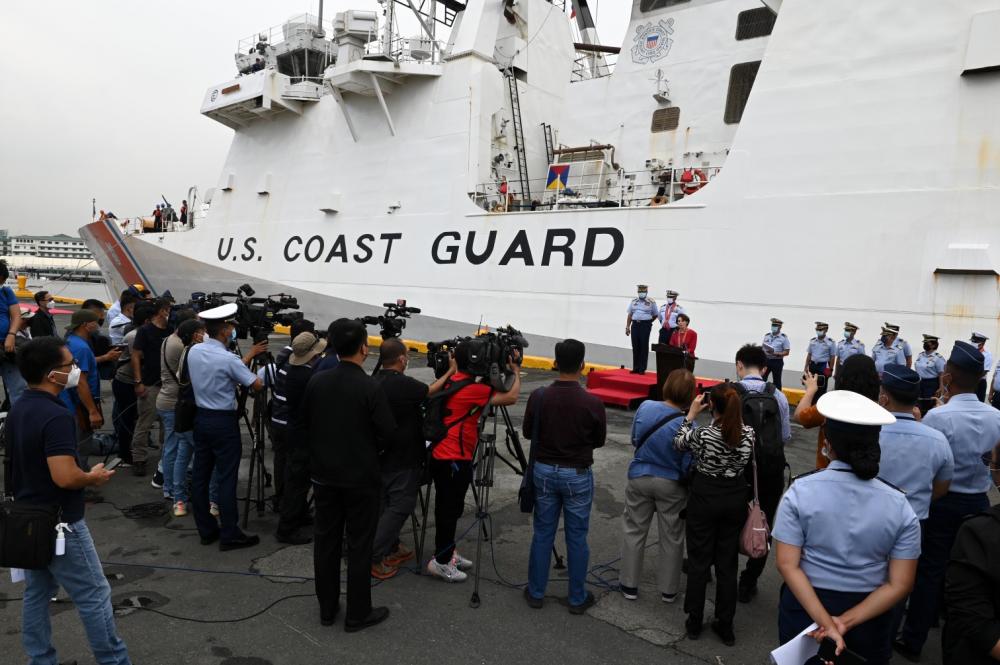
MANILA, Philippines – The U.S. Coast Guard Cutter Midgett (WMSL 757) arrived in Manila Tuesday for its first international port call during the crew’s months-long Western Pacific deployment to the region.

Midgett’s crew will conduct professional exchanges and operate with the Philippine Coast Guard as part of an at-sea search-and-rescue exercise while in Manila, building upon the strong partnership between the two nations.

Midgett is operating in support of United States Indo-Pacific Command, which oversees military operations in the region.

Operating under the tactical control of Commander, U.S. 7th Fleet, the cutter’s crew plans to engage in professional and subject matter expert exchanges with regional partners and allies and will patrol and operate as directed during their Western Pacific deployment.

The Coast Guard provides expertise within the mission sets of search and rescue; illegal, unreported and unregulated fishing; maritime environmental response; maritime security; maritime domain awareness; aviation operations; interoperability; and humanitarian assistance and disaster relief.

As both a federal law enforcement agency and a branch of the armed forces, the Coast Guard is uniquely positioned to conduct non-escalatory defense operations and security cooperation in support of combatant commanders on all seven continents. The service routinely provides forces in joint military operations worldwide, including the deployment of cutters, boats, aircraft and deployable specialized forces.

“Engaging with our Philippine Coast Guard partners is truly an honor,” said U.S. Coast Guard Capt. Willie Carmichael, commanding officer of the Midgett. “Together we will continue to build strong relationships and learn from each other. Our deep-rooted partnership will combine the best of both our Coast Guards and the planned search-and-rescue exercise and professional exchanges are a great opportunity for us keep the Indo-Pacific region open and free.”

The U.S. Coast Guard has a 150-year enduring role in the Indo-Pacific. The service’s ongoing deployment of resources to the region directly supports U.S. foreign policy and national security objectives in the Indo-Pacific Strategy and the National Security Strategy.

Since 2019, the Coast Guard Cutter Bertholf (WMSL 750), Stratton (WMSL 751), Waesche (WMSL 751) and Munro (WMSL 755) have deployed to the Western Pacific.

Commissioned in 2019, Midgett is one of two Coast Guard legend-class national security cutters homeported in Honolulu. National security cutters are 418-feet long, 54-feet wide, and have a 4,600 long-ton displacement. They have a top speed in excess of 28 knots, a range of 12,000 nautical miles, endurance of up to 90 days and can hold a crew of up to 170.

Midgett is the second cutter named after Rear Admiral John Midgett, whose family has a long legacy in the Coast Guard and our services precursor – the U.S. Life Saving Service.

National security cutters feature advanced command and control capabilities, aviation support facilities, stern cutter boat launch and increased endurance for long-range patrols to disrupt threats to national security further offshore.

“Solomon Islands doesn’t answer US Coast Guard’s request for port visit, US says” –CNN/Reuters

The USCGC Oliver Henry (WPC 1140) crew arrives in Manus, Papua New Guinea, on Aug. 14, 2022, from Guam as part of a patrol headed south to assist partner nations in upholding and asserting their sovereignty while protecting U.S. national interests. The U.S. Coast Guard is participating with partners to support the Pacific Islands Forum Fisheries Agency-led Operation Island Chief and the larger Operation Blue Pacific through patrols in the Western Pacific in August and September 2022. (U.S. Coast Guard photo by USCGC Oliver Henry)

CNN reports,

A United States Coast Guard vessel was unable to enter Solomon Islands for a routine port call because the Solomon Islands government did not respond to a request for it to refuel and provision, a US official said.

The vessel was USCGC Oliver Henry, hardly a symbol of American hegemony. HMS Spey, a larger offshore patrol vessel, was also reported to have had difficulty arranging a replenishment stop. Both were operating in support of the fisheries agency for the Pacific Islands Forum.

HMS Spey, River class Batch2 OPV

The difficulties may have been resolved,

“The U.S. Department of State is in contact with the Government of the Solomon Islands and expect all future clearances will be provided to U.S. ships”

Still it appears to be a symptom of growing Chinese influence in the Western Pacific.