A Conversation with Admiral Karl Schultz, Commandant of the U.S. Coast Guard–CSIS

CSIS and the United States Naval Institute (USNI) conduct an interview with Admiral Karl L. Schultz, the 26th Commandant of the United States Coast Guard, conducted 1 August, 2018.

Below I will attempt to outline the conversation, noting the topics and in some cases providing a comment.

The first question is about immigration. Coast Guard is the “away game.” minimizing the factors that push immigration to the US.

The Commandant does not expect a substantial increase in help from the Navy, because they are already heavily tasked, but would welcome any additional help.

06:30 Talk about Inland fleet. Congressional support is evident. $25M provided so far.

9:20 House Appropriations Committee decision to divert $750M from the icebreaker program to fund “the Wall” in their markup of the FY2019 budget bill. The Commandant is “guardedly optimistic”

11:30 Human capital readiness? Operating account has been flat and effectively we have lost 10% in purchasing power. Want to increase leadership training.

16:30 Support for combatant commanders.

18:00 Capacity building and partnering. Detachments working on host nation platforms.

21:00 Defense Force planning–Not going back to the MARDEZ model.

22:30 Situation in Venezuela/Preparation for dealing with mass migration.

24:30 Arctic forums–Need to project our sovereignty

29:00 UNCLOS

30:00 Maritime Domain Awareness (MDA)

32:30 Tracking cargo as an element of MDA

34:00 Cyber

36:15 High Latitude engagement/partnerships.

39:30 Perhaps the icebreaker should be the “Polar Security Cutter?”

40:00 International ice patrol, still an important mission.

41:00 CG role in response to Chinese aggressiveness in the South China Sea. In discussion with Indo-Pacific Command. Will see more CG presence there.

44:00 Offshore Patrol Cutter (OPC)–on track

46:30 Border issue — passed on that

48:00 Small satellites–we are looking at them

49:00 African Capacity building/cooperation. May send an MEC.

51:30 Tech modernization. Looking at it more holistically.

Other Coverage:

This interview prompted a couple of notable posts.

SeaPower’s coverage of the discussion is here. They focused on the growth of demands on the Coast Guard.

Military.com reported on the possibility of a greater Coast Guard role in South East Asia and capacity building in Africa. It probably should be noted that the title, “Coast Guard Could Send Ship to Pacific to ‘Temper Chinese Influence’,”is a bit deceptive in that the Commandant’s remark about tempering Chinese Influence was in regard to Oceania, the islands of the Central and Western Pacific. The Commandant was quoted in the Seapower post, “In the Oceania region, there are places where helping them protect their interests, tempering that Chinese influence, is absolutely essential.”

National Defense Authorization Act, 2019 Authorizes Six Icebreakers

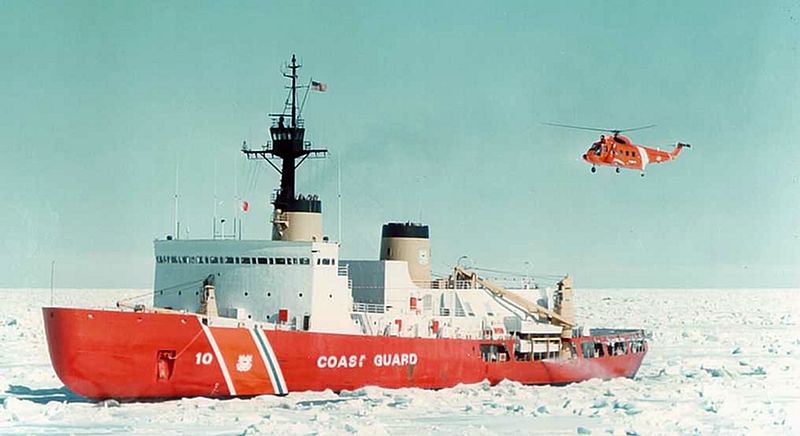
USCGC Polar Sea

The National Defense Authorization Act has been passed and forwarded to the President. It is too early for anyone to get too excited about this, since it is an authorization rather than an approved budget, but it does authorize up to six polar icebreakers.

SEC. 153. AUTHORITY TO PROCURE ADDITIONAL POLAR-CLASS ICEBREAKERS. Section 122 of the National Defense Authorization Act for Fiscal Year 2018 (Public Law 115–91) is amended— (1) in the section heading, by striking ‘‘ICE-BREAKER VESSEL’’ and inserting ‘‘AUTHORIZA-TION TO PROCURE UP TO SIX POLAR-CLASS ICEBREAKERS’’;  (2) by striking subsections (a) and (b); (3) by inserting before subsection (c) the following new subsection: ‘‘(a) AUTHORITY TO PROCURE ICEBREAKERS.—The Secretary of the department in which the Coast Guard is operating may, in consultation with the Secretary of the Navy, enter into a contract or contracts for the procurement of up to six polar-class icebreakers, including— ‘‘(1) polar-class heavy icebreakers; and ‘‘(2) polar-class medium icebreakers.’’; (4) by redesignating subsections (c) and (d) as subsections (b) and (c), respectively; and (5) in paragraph (1) of subsection (b), as redesignated by paragraph (4) of this section, by striking ‘‘subsection (a)(1)’’ and inserting ‘‘subsection (a)’’.

The bill also provides for a Selected Reserve end strength of 7000 Coast Guard Reservists, almost $40.9M for Coast Guard weapons, $40.7M for other Electronic support, $24.1M for Mobilization Support, $165M for Coast Guard mobilization support (presumably PATFORSWA?). There may actually be more that I may have missed. The bill is huge. I just used the “Control F” function to search for Coast Guard.

Thanks to the Bryant’s Maritime Consulting Blog for bringing this to my attention.

Report to Congress on U.S. Coast Guard Polar Icebreaker Program, July 9, 2018

USCGC Polar Star. An old USCG photo, note the HH-52.

The Congressional Research Service has issued a new edition of its Report to Congress on U.S Coast Guard Polar Icebreaker Program by specialist in naval affairs Ronald O’Rourke, this one dated July 9, 21018. You can see it here. 

I have reproduced the summary immediately below.  

The Coast Guard polar icebreaker program is a program to acquire three new heavy polar icebreakers, to be followed years from now by the acquisition of up to three new medium polar icebreakers. The Coast Guard wants to begin construction of the first new heavy polar icebreaker in FY2019 and have it enter service in 2023. The polar icebreaker program has received about $359.6 million in acquisition funding through FY2018, including $300 million provided through the Navy’s shipbuilding account and $59.6 million provided through the Coast Guard’s acquisition account. The Coast Guard’s proposed FY2019 budget requests $750 million in Coast Guard acquisition funding for the program.

The acquisition cost of a new heavy polar icebreaker had earlier been estimated informally at roughly $1 billion, but the Coast Guard and Navy now believe that three heavy polar icebreakers could be acquired for a total cost of about $2.1 billion, or an average of about $700 million per ship. The first ship will cost more than the other two because it will incorporate design costs for the class and be at the start of the production learning curve for the class. When combined with the program’s $359.6 million in prior-year funding, the $750 million requested for FY2019 would fully fund the procurement of the first new heavy polar icebreaker and partially fund the procurement of the second.

The operational U.S. polar icebreaking fleet currently consists of one heavy polar icebreaker, Polar Star, and one medium polar icebreaker, Healy. In addition to Polar Star, the Coast Guard has a second heavy polar icebreaker, Polar Sea. Polar Sea, however, suffered an engine casualty in June 2010 and has been nonoperational since then. Polar Star and Polar Sea entered service in 1976 and 1978, respectively, and are now well beyond their originally intended 30-year service lives. The Coast Guard has used Polar Sea as a source of spare parts for keeping Polar Star operational.

A Department of Homeland Security (DHS) Mission Need Statement (MNS) approved in June 2013 states that “current requirements and future projections … indicate the Coast Guard will need to expand its icebreaking capacity, potentially requiring a fleet of up to six icebreakers (3 heavy and 3 medium) to adequately meet mission demands in the high latitudes….”

The current condition of the U.S. polar icebreaker fleet, the DHS MNS, and concerns among some observers about whether the United States is adequately investing in capabilities to carry out its responsibilities and defend its interests in the Arctic, have focused policymaker attention on the question of whether and when to acquire one or more new heavy polar icebreakers as replacements for Polar Star and Polar Sea.

On March 2, 2018, the U.S. Navy, in collaboration with the U.S. Coast Guard under the polar icebreaker integrated program office, released a request for proposal (RFP) for the advance procurement and detail design for the Coast Guard’s heavy polar icebreaker, with options for detail design and construction for up to three heavy polar icebreakers.

Issues for Congress for FY2019 for the polar icebreaker program include, inter alia, whether to approve, reject, or modify the Coast Guard’s FY2019 acquisition funding request; whether to use a contract with options or a block buy contract to acquire the ships; whether to continue providing at least some of the acquisition funding for the polar icebreaker program through the Navy’s shipbuilding account; and whether to procure heavy and medium polar icebreakers to a common basic design.

Bollinger Wants to Build CG Icebreakers in Tampa

MarineLink provides what is almost certainly a quote of press release from Bollinger stating they hope to build the three heavy and three medium icebreakers the Coast Guard has been saying it needs in Tampa. They are reminding every one (hay, you guys in Congress) how many jobs this could mean for Florida.

This cannot hurt our case for building more than one icebreaker.

The nuclear-powered icebreaker Arktika in the Kara Sea. RIA Novosti archive, image #186141. Also keep reminding them how many icebreakers the Russians have and that the Chinese have one, are building one, and are planning a nuclear icebreaker. 


Chinese Nuclear Icebreaker Planned

China Defense Blog reports that China is has begun the process to design and build a nuclear powered icebreaker, as a prelude to building a nuclear powered aircraft carrier.

The post includes a quotation that is wrong on a couple of counts.

“The US and former Soviet Union used their experience with nuclear-powered icebreaker ships to build a nuclear-powered aircraft carrier, he noted.”

The US, of course, never built a nuclear icebreaker, and the Soviet Union never built a nuclear carrier. The Soviets did build some very large cruisers with a hybrid nuclear and conventional steam powerplants, but those were their only nuclear powered surface warships. Both nations built nuclear submarines before building nuclear surface warships. China has also already built several classes of nuclear submarines

“Canada taps Davie for three AHTS-conversion medium icebreakers”–Marine Log

Projresolvbig

Our resident icebreaker expert, Tups, told us in a comment this was coming. Marine Log confirms the official announcement.

“On behalf of the Canadian Coast Guard, Public Services and Procurement Canada has issued an Advanced Contract Award Notice (ACAN) to shipbuilder Chantier Davie of Lévis, Quebec, for the acquisition and conversion of three medium commercial icebreakers.

“… The three candidate ships proposed by Project Resolute for this role are the Viking Supply Ships AB vessels Tor Viking II, Balder Viking and Vidar Viking.

There was an earlier proposal to lease these three ships and the icebreaking anchor handling vessel Aiviq, but these three will be purchased and there is no mention of the Aiviq in the announcement.

Based on the accompanying illustration, conversion will add a helo deck and hangar. These ships are 82 meters (276 ft) in length, 18 m (59 ft) of beam, and 18,300 HP.

The first of these is expected to go to work this winter.

Maritime Transportation in the Arctic: The U.S. Role–House Subcommittee on Transportation and Infrastructure

Above you will find a video of a hearing held on June 7, 2018 regarding “Transportation in the Arctic”. You will find the subcommittee web page here. It includes the video, the list of witnesses which I have reproduced below, and the Chairman’s opening remarks.

The video does not actually start until time 21:45.

Witnesses:

  • Admiral Charles W. Ray, Vice Commandant United States Coast Guard | Written Testimony
  • Mr. David Kennedy, Senior Arctic Advisor, National Oceanic and Atmospheric Administration | Written Testimony
  • Ms. Heather A. Conley, Senior Vice President for Europe, Eurasia, and the Arctic, Center for Strategic and International Studies | Written Testimony
  • Dr. Lawson Brigham, Faculty and Distinguished Fellow, International Arctic Research Center, University of Alaska Fairbanks | Written Testimony
  • Ms. Molly McCammon, Executive Director, Alaska Ocean Observing System | Written Testimony
  • Rear Admiral David W. Titley, USN (Ret.), Professor of Practice, Department of Meteorology and Atmospheric Science, Pennsylvania State University | Written Testimony


As you may see, the new Vice Commandant, Adm. Ray is the first witness. He completes his prepared remarks at time 32:30.

Incidentally one of the Witnesses Lawson Brigham (prepared testimony begins at time 44:00 to 48:25) is a retired Coast Guard captain with extensive polar icebreaker experience.

Questioning begins at time 1:00:00 with the “trick question” explored further by the Washington Examiner Magazine, “The Next ‘Cold’ War: America May Be Missing the Boat in the Arctic.”

There are few surprises here. There is almost no infrastructure in the Arctic. Apparently there is a slow effort to provide better domain awareness. Only about 5% of the American Arctic waters are charted to international standards.

The most significant thing to come out in the hearing was that there is no National or Naval strategy for the Arctic Ocean. (This might be because NORTHCOM, which is air and ground oriented, has responsibility for the Arctic Ocean area.) Congress has added a requirement for development of an Arctic Strategy in the FY2019 DOD budget, and they certainly expect the Coast Guard to have a large role in the strategy.

If you don’t listen to anything else, particularly listen to John Garamendi’s remarks 1:41:30 to 1:43:30.


Coast Guard Polar Icebreaker Program: Background and Issues for Congress–23 May, 2018

USCGC Polar Sea

The latest edition of the Congressional Research Service report on Coast Guard Polar Icebreakers, by Ronald O’Rourke, was published on 23 May, 2018. You can see it here. 

I have reproduced the summary immediately below.  

The Coast Guard polar icebreaker program is a program to acquire three new heavy polar icebreakers, to be followed years from now by the acquisition of up to three new medium polar icebreakers. The Coast Guard wants to begin construction of the first new heavy polar icebreaker in FY2019 and have it enter service in 2023. The polar icebreaker program has received about $359.6 million in acquisition funding through FY2018, including $300 million provided through the Navy’s shipbuilding account and $59.6 million provided through the Coast Guard’s acquisition account. The Coast Guard’s proposed FY2019 budget requests $750 million in Coast Guard acquisition funding for the program.

The acquisition cost of a new heavy polar icebreaker had earlier been estimated informally at roughly $1 billion, but the Coast Guard and Navy now believe that three heavy polar icebreakers could be acquired for a total cost of about $2.1 billion, or an average of about $700 million per ship. The first ship will cost more than the other two because it will incorporate design costs for the class and be at the start of the production learning curve for the class. An April 13, 2018, Government Accountability Office (GAO) report on the polar icebreaker program states that the Coast Guard has reduced its estimated cost for the first heavy polar icebreaker to less than $900 million, which would imply an average cost of something more than $600 million each for the second and third icebreakers. When combined with the program’s $359.6 million in prior-year funding, the $750 million requested for FY2019 would fully fund the procurement of the first new heavy polar icebreaker and partially fund the procurement of the second.

The operational U.S. polar icebreaking fleet currently consists of one heavy polar icebreaker, Polar Star, and one medium polar icebreaker, Healy. In addition to Polar Star, the Coast Guard has a second heavy polar icebreaker, Polar Sea. Polar Sea, however, suffered an engine casualty in June 2010 and has been nonoperational since then. Polar Star and Polar Sea entered service in 1976 and 1978, respectively, and are now well beyond their originally intended 30-year service lives. The Coast Guard has used Polar Sea as a source of spare parts for keeping Polar Star operational.

A Department of Homeland Security (DHS) Mission Need Statement (MNS) approved in June 2013 states that “current requirements and future projections … indicate the Coast Guard will need to expand its icebreaking capacity, potentially requiring a fleet of up to six icebreakers (3 heavy and 3 medium) to adequately meet mission demands in the high latitudes….”

The current condition of the U.S. polar icebreaker fleet, the DHS MNS, and concerns among some observers about whether the United States is adequately investing in capabilities to carry out its responsibilities and defend its interests in the Arctic, have focused policymaker attention on the question of whether and when to acquire one or more new heavy polar icebreakers as replacements for Polar Star and Polar Sea.

On March 2, 2018, the U.S. Navy, in collaboration with the U.S. Coast Guard under the polar icebreaker integrated program office, released a request for proposal (RFP) for the advance procurement and detail design for the Coast Guard’s heavy polar icebreaker, with options for detail design and construction for up to three heavy polar icebreakers.

Issues for Congress for FY2019 for the polar icebreaker program include, inter alia, whether to approve, reject, or modify the Coast Guard’s FY2019 acquisition funding request; whether to use a contract with options or a block buy contract to acquire the ships; whether to continue providing at least some of the acquisition funding for the polar icebreaker program through the Navy’s shipbuilding account; and whether to procure heavy and medium polar icebreakers to a common basic design.

Icebreaker Communications Requirement

A 4ISRnet report confirms that the Coast Guard intends to have a full range of communications equipment on the new Heavy Polar Icebreaker, up to an including military secure satellite communications.

“Communication is severely degraded at higher latitudes, beyond 65 degrees north and south,” said Eric Nagel, a spokesman for the Coast Guard’s acquisition directorate. “Coast Guard polar icebreakers need to be able to communicate in Polar Regions with a wide range of groups from commercial shipping and recreational boaters to scientific researchers. The polar icebreakers also need to maintain network connectivity with the Department of Homeland Security, Department of Defense and other federal and international partners.”