Coast Guard Buying Up to 16,000 Personal Locator Beacons

gCaptain has reported that the Coast Guard will recommend that all lifejackets on ocean-going vessels be equipped with Personal Locator Beacons.

“In the United States Coast Guard’s upcoming El Faro investigation report, Captain Jason Neubauer USCG, Chairman of the Marine Board of Investigation, will recommend that all Personal Flotation Devices on oceangoing commercial vessels be outfitted with a Personal Locator Beacon.”

“The investigation report does not call for a second EPIRB equipped with GPS, as some marine safety experts have called for, but takes the additional step of recommending that PLB’s be attached to all lifejackets aboard oceangoing commercial vessels.”

Apparently the Coast Guard is taking the lesson to heart. Intelligent-Aerospace reports the Coast Guard has let a $3 million indefinite-delivery/indefinite-quantity contract with options for up to 16,000 McMurdo Fast Find 220 Personal Locator beacons.

According to the manufacturer,

The McMurdo FastFind 220 is small and light enough for you to carry on your person at all times. Using advanced technology, the FastFind 220 transmits a unique ID and your current GPS co-ordinates via the Cospas-Sarsat global search and rescue satellite network, alerting the rescue services within minutes. Once within the area, the search and rescue services can quickly home in on your location using the unit’s 121.5Mhz homing beacon and flashing LED SOS light.

These PLBs are available from a variety of sources including on-line for $190-$300. 16,000 PLBs for $3M would average $187.50 each.

Considering what we do, this looks like a good investment. Presumably every aircraft, boat, and cutter crewman will have one of these on their lifejacket or perhaps their work uniform.


Arctic Guardian 2017

This is all I have, from the German Navy Blog, “Marine Forum,”

6 September, ICELAND (multinational), Search & rescue exercise „Arctic Guardian 2017“ kicked off … first exercise of its kind under the auspices of the Arctic Coast Guard Forum (ACGF), with all eight Arctic nations (Denmark, Canada, Finland, Iceland, Norway, Russia, Sweden, USA) participating … scenario sees cruise ship with hundreds of passengers gone missing in the Danish Strait between Iceland and Greenland.

Surely, we will hear more.

New Zealand and Chile Agree on SAR responsibility

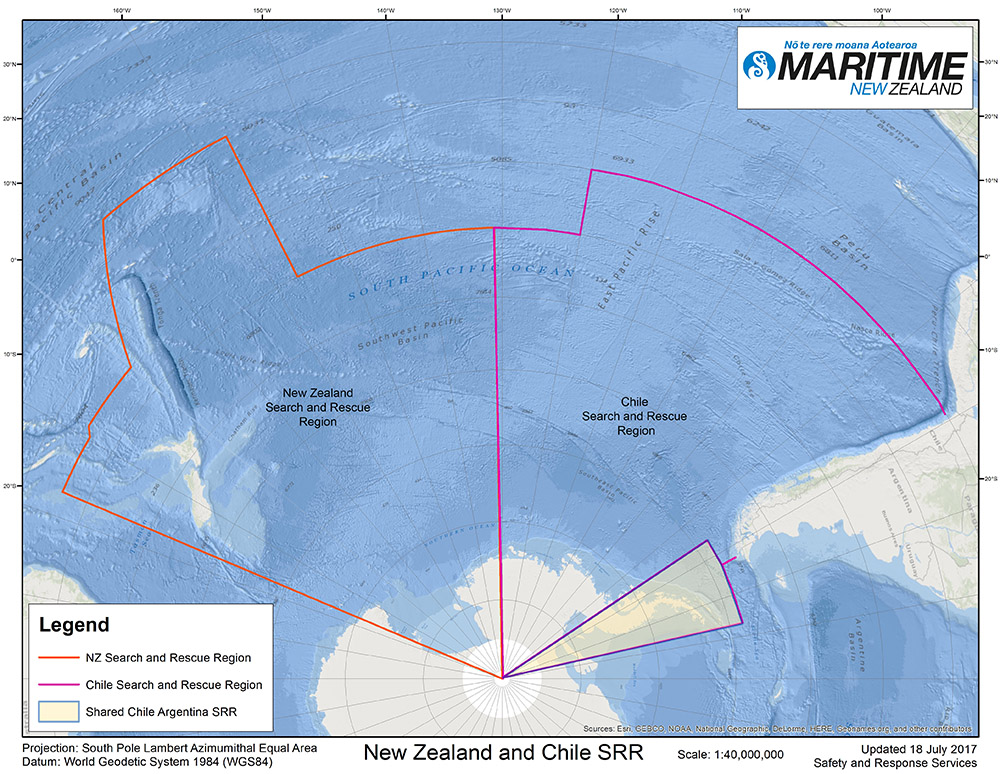
New Zealand and Chile agree on SAR responsibility

NavalToday reports New Zealand and Chile have concluded an agreement delineating SAR responsibility over an area of roughly 60 million square kilometers that extends all the way to the South Pole and includes area Coast Guard Polar Icebreakers will routinely transit on the way to Antarctica.

Ultimately this may have some impact on territorial claims to Antarctica.

Convoy SG-19 and the Sinking of USAT Dorchester–When Things Went Terribly Wrong

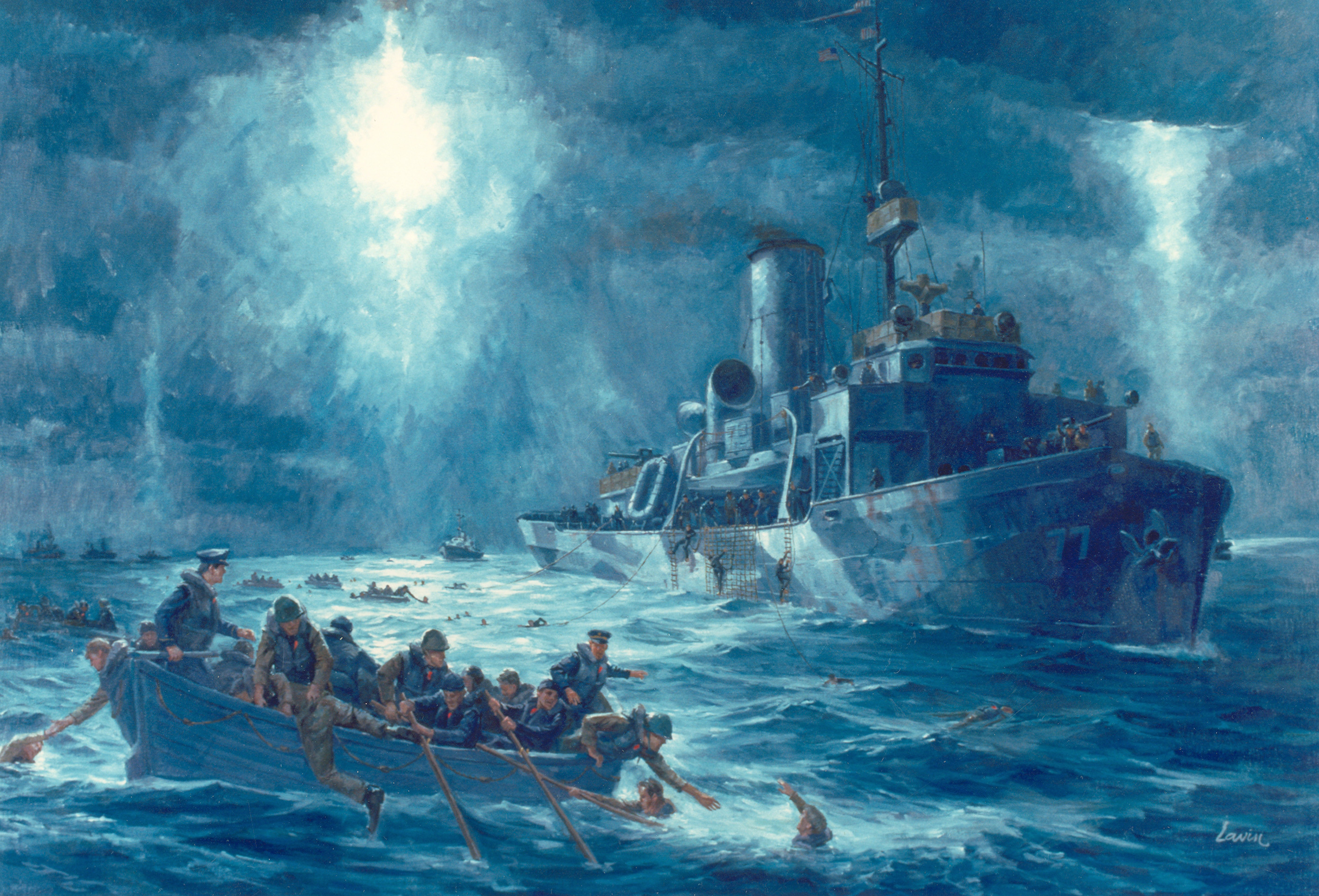
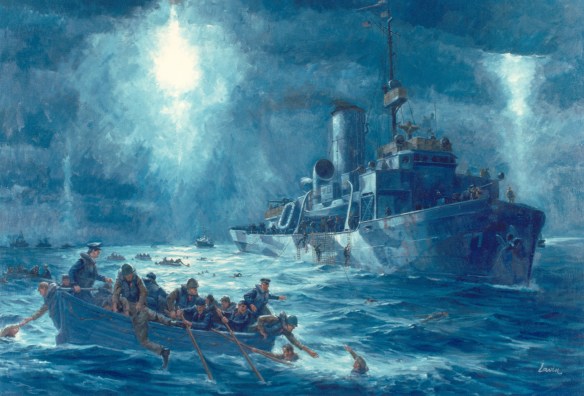
Escanaba rescuing survivors from USAT Dorchester. USCG Image.

Escanaba rescuing survivors from USAT Dorchester. USCG Image.

The following is based on Samuel Eliot Morison’s History of the United States Naval Operations in World War II, Volume I, The Battle of the Atlantic, 1939-1943, pp 330-334 and information from Uboat.net.

The current list of names selected for the Webber class WPCs includes the names of Charles Walter David Jr. and most recently Forrest O. Rednour. These two men are representative of about two dozen rescue swimmers who risk their lives to rescue survivors from the chartered US Army Transport Dorchester. torpedoed on February 3, 1943, 74 years ago.

These men did the best they could to mitigate a disaster, but it was still a disaster. This was the largest loss of personnel on a US flag merchant vessel during WWII.

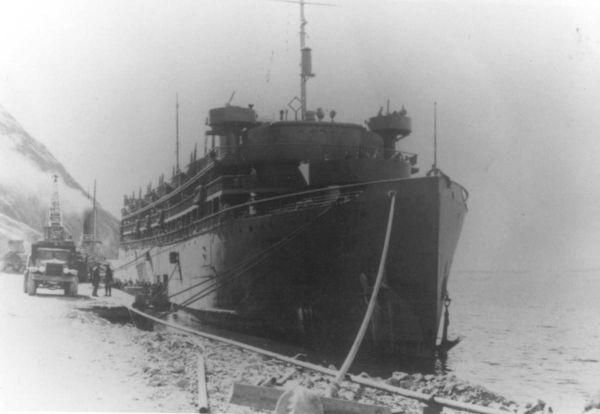
SG-19 was a small convoy bound from St Johns Newfoundland to Greenland, three ships, two merchantmen and the 5,252 ton Army transport Dorchester, with about 1000 tons of cargo, a crew of 130 men, an armed guard of 23, and 751 passengers, mostly Army reinforcements, and among them some 23 Coast Guard personnel, for a total of 904, of these only 229 would survive. As might be expected, the weather was cold and nasty as they approached Greenland.

The convoy was escorted by three cutters, the 240 foot Tampa (WPG-48) and two 165 foot “A” class cutters, Escanaba (WPG-77) and Comanche (WPG-76). The convoy escort was commanded by Capt. Joseph Greenspun, USCG. Tampa, commissioned in 1921, was fairly old, her speed, officially 15.5 knots but according to Morison actually 14.5, was less than that of a surfaced U-boat (17.7), but it was similar to that of the smaller Flower Class corvettes that made up the majority of convoy escorts and she was larger and better armed than a corvette.

The two 165 foot cutters, Escanba and Comanche, were really ill-suited for the mission. They were small with a low freeboard, and while credited with a speed of 12.8 knots, according to Morison their actual speed was 11.5 knots, and this was further reduced by icing, slowing the convoy. Icing also effected the escorts’ weapons. According to Morison, “At times they had to heave-to and remove ice with live steam; guns, depth charges and mousetraps (anti-submarine rockets–Chuck) sealed tight by thick ice, and excessive water noise rendered sound gear of little value.” Unable to do more than keep up with the convoy, the two smaller cutters struggled to maintain station on the flanks of the convoy.

US Army Tansport Dorchester

US Army Tansport Dorchester

The convoy was sailing at a speed of ten knots. The three merchant ships were in line abreast with Dorchester in the center. Tampa led 3,000 yards ahead of Dorchester, and Comanche and Escanaba were 5,400 yards on the flanks, to port and starboard respectively.

On Feb. 2 the weather had moderated, but the convoy was informed that there was U-boat activity in the area.

59 degrees 22′ N, 48 degrees 42′ W, 150 miles West of Cape Farewell, Greenland, during the night, very early on 3 Feb., a torpedo struck the Dorchester on the starboard side in the machinery spaces. About 20 minutes later the Dorchester had sunk.

U-223, on her first war patrol, had approached the convoy from starboard, probably on the surface in the dark, probably having passed between Tampa and the Escanaba. Even at this late date the Escanaba still had no radar.

The U-boat had loosed five torpedoes, meaning she had fired all four of her bow tubes and turned and fired the single stern tube as well. One of the first hit the Dorchester. All the rest missed.

There was confusion on the transport. Many never heard the order to abandon ship. “Three of the 14 lifeboats had been damaged by the explosion, the crew managed only to launch two more overcrowded boats and 33 men left with rafts, but many men evidently did not realize the seriousness of the situation, stayed aboard and went down with the ship.” Most went into the water with nothing more than a lifebelt.

Initially Escanaba and Comanche attempted to find the U-boat, but Escanaba then moved in to rescue survivors while Comanche attempted to protect Escanaba. Comanche joined the rescue effort about two hours after the torpedoing.

From Uboatnet,

“Escanaba … picked up 81 survivors from the water and rafts and 51 from one lifeboat. Comanche picked up 41 survivors from another lifeboat and 56 from rafts and the water. Hundreds of floating bodies or frozen to wreckage were checked for signs of life. The survivors were landed at Narsarssuak (Greenland) later the same day. 675 lives were lost: the master, three officers, 98 crewmen, 15 armed guards and 558 troops and passengers (including 16 Coast Guardsmen). The following were saved: three officers, 25 crewmen, 44 civilian workers, three Danish citizens, twelve armed guards, seven US Coast Guard personnel and 135 US Army personnel.”

U-223 was a reasonably successful U-boat being responsible for the loss of three merchant ships, a frigate, and a destroyer. She was sunk 30 March 1944 in the Mediterranean Sea, 60 nautical miles northeast of Palermo, Sicily, in a battle with four British destroyers in which she sank one of her pursuers, HMS Laforey.

Four months after the loss of Dorchester, 13 June, 1943, at 0510 Escanaba blew up and sank within three minutes in the North Atlantic.  All but two of her crew of 103 were lost.

Would the result have been any different if the cutters had been more capable? We will never know, but it suggest that if we are ever again in a general war, prepared or not, our cutters will be pressed into service even if they are unsuitable, poorly trained, or inadequately equipped.

All 512 POB Rescued from Burning Ferry.

I don’t usually talk about SAR cases but this is unusual. The Coast Guard and local agencies have managed to remove all 512 people on board a 561 foot passenger and vehicle ferry after it caught fire just of San Juan.

Caribbean Fantasy Fire San Juan Puerto Rico

Additional reports:

An interesting observation is that the ship apparently had slides similar to those on passenger aircraft that allowed personnel to go from an upper deck to the water. You can see one of these in the photo above.

1120 Miles Averaging 52.3 knots and Its Self Righting

MarineLog reports in part:

JULY 27, 2016 — The SAR 60, an 18 m high-speed search and rescue vessel prototype, set a new “Round Italy” record, July 12, completing the nearly 1,120 nautical mile voyage from Montecarlo to Venice in 22 hours, 5 minutes and 42 seconds, at an average speed of 52.3 knots.

The 18 meter boat was piloted by its designer, Fabio Buzzi, and built in his Annone Brianza, Italy, FB Design shipyard.

The boat, which has a near 60 knots top speed is powered by two 1,600 HP MTU 10V 2000M94 engines equipped with an additional “rough sea kit” that enables safe operation in the most extreme conditions.

The video above may be a bit confusing at first. Unfortunately it is in Italian. It includes more than one type of boat and record speed runs by the two different boat types reported in the MarineLog post. The boat that appears above, before you start the video, is not the one we are talking about, but once you get into it, it will be easy enough to recognize the 59 foot SAR60.

You can see the self righting experiment at 1m54s on the video.

There is also an interesting  demonstration of a way to recover a helpless person in the water at 2m45s.

EMILY the robotic lifeguard, “Emergency Integrated Lifesaving Lanyard”

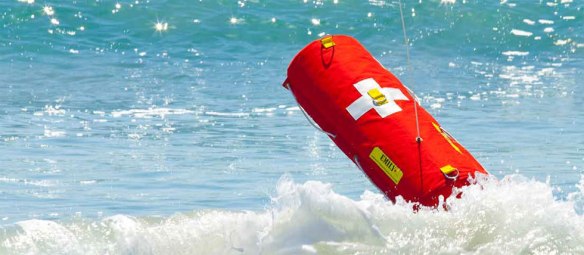
emily-surf-breaching

NavyRecognition is reporting, “The EMILY (Emergency Integrated Lifesaving Lanyard) robotic lifeguard will be showcased by the Office of Naval Research (ONR) during the Sea-Air-Space 2016 Exposition held May 16 to 18 at the Gaylord Convention Center in National Harbor, Maryland. The robot will also be displayed at the ONR’s booth (number 1004).”

“Outfitted in bright orange, red and yellow colors, each cylindrical EMILY buoy is 4-feet long and weighs 25 pounds. It’s powered by a jet engine system similar to a mini jet ski, shoots a water jet stream for propulsion and travels up to 22 mph. EMILY also has two-way communication radios, a video camera with a live feed to smartphones and lights for night rescues.

“‘EMILY is made of Kevlar and aircraft-grade composites and is virtually indestructible,’ said Mulligan, CEO of Hydronalix, a maritime robotics company. ‘The devices can be thrown off a helicopter or bridge and then driven via remote control to whoever needs to be rescued.'”

To me the description of its use and capabilities seems incomplete. For instance, could this be used to tow a rescue swimmer to a vessel in distress? and how was it “used to rescue nearly 300 Syrian migrants from drowning in the waters off the Greek Island of Lesbos”?

Looks like a piece of gear we should look into. If one of our readers gets a look at it, I would welcome first hand impressions.

Apparently it is already for sale to the general public.

Fatal Sinking, Five Dead–Response Delayed?

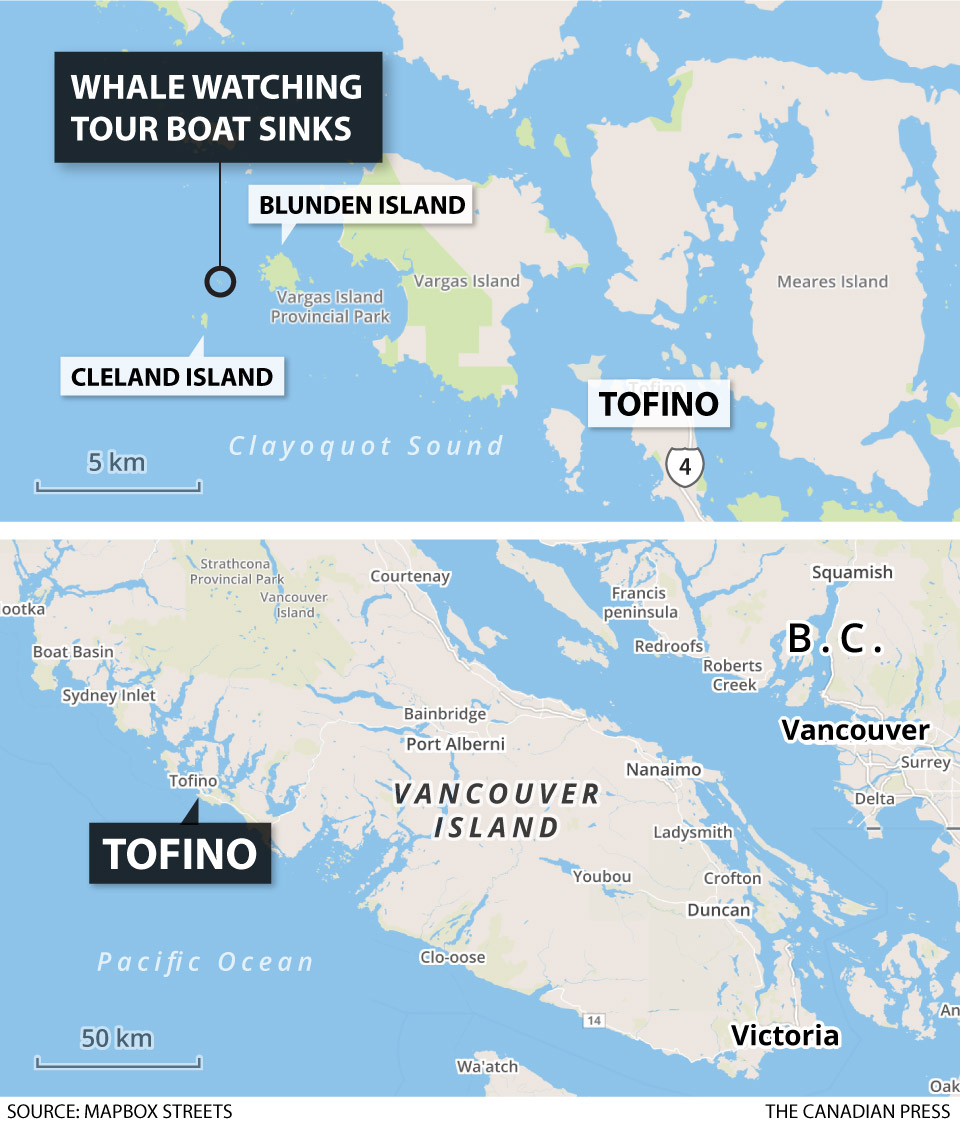
cp-bc-boat-sinking

CBC British Columbia is reporting the sinking of a whale watching tour boat that resulted in at least five deaths. Weather does not appear to have been the problem. There are reports that the Canadian Coast Guard response may have been delayed as a result of a fault in a recently remoted radio receiver.

Thanks to our Canadian friend Ken for bringing this to my attention. 

Document Alert: Cutter Procurement–Another Report to Congress

Once again, the Congressional Research Service’s Ronald O’Rourke has revised his “Coast Guard Cutter Procurement: Background and Issues for Congress” with the new edition issued April 15. This has got to be a hot topic because previous revisions were issued March 22, January 27, and December 14, 2015. That is four revisions in four months, on average every six weeks, but the latest is only 24 days after the previous edition. I have begun to sense, we may have turned a corner. The tone of the reports has changed over these four months, from, how long will it take us to reach the “Program of Record” (POR), to consideration of, if we should perhaps go beyond the POR.

The NSC, OPC, and FRC programs pose several issues for Congress, including the following:

“whether to fund the acquisition of a 10th NSC in FY2017;

“whether to fund the acquisition of four FRCs in FY2017, as requested, or some other number, such as six, which was the number projected for FY2017 under the Coast Guard’s FY2016 budget submission;

“whether to use annual or multiyear contracting for procuring FRCs;

“whether to use annual or multiyear contracting for procuring OPCs;

“planned procurement quantities for NSCs, OPCS, and FRCs;

“the cost, design, and acquisition strategy for the OPC;

“initial testing of the NSC; and

“rotational crewing of the NSC.”

The latest revision includes three substantial Appendices:

  • Appendix A. Planned NSC, OPC, and FRC Procurement Quantities (pp 17-22)
  • Appendix B. Funding Levels in AC&I Account (pp 23-26)
  • Appendix C. Additional Information on Status and Execution of NSC, OPC, and FRC Programs from March 2016 GAO Report (pp 27-34)

Appendix C is entirely new and appears to have been the reason for the revision.

Appendix A (p. 17-22) is a fairly detailed discussion of the results of the Fleet Mix Study and asks why we so seldom hear that the program of record is not enough to assure the Coast Guard to successfully accomplish its assigned missions.

The Fleet Mix Study was made public in 2012 long after its completion in 2009. It is due for a reexamination and the Commandant has said another will be done. When that happens, we seriously need to look at more than just more of the same assets. We need to look at additional technology, equipment, and weapons that might allow us to accomplish these missions without a major increase in personnel.

Looking at “Table A-3. Force Mixes and Mission Performance Gaps” (document page 18) I would note that if we get to Fleet Mix Analysis Phase 1 (FMA-1, an increase over the POR including 9 Bertholf class NSCs, 32 OPCs and 63 Webber Class FRCs, for a total of 104 vessels), we will have addressed all the “Very High Risk Gaps” found in the Fleet Mix Study that included SAR capability, “Defense Readiness Capacity,” and “Counter Drug capacity.” What will remain are “High” or lower risks in Ports, Waterways, and Coastal Security (PWCS) and Living Marine Resources (LMR), and a low to very low risk to the Alien Migrant Interdiction Operations (AMIO) mission. This total of more than 40 NSCs and OPCs certainly should not be out of the question, after all the Coast Guard has included over 40 ships larger than a thousand tons for the last several decades.

Still, I would note that, no matter how many ships we have, the Ports, Waterways, and Coastal Security (PWCS) mission will always be at risk, unless weapons are available to quickly and reliably stop terrorists’ exploitation of a larger merchant vessel to make an attack. Guns alone are simply not up to the task. I have identified two weapons that might address this threat, (1) equipping our WPCs and possibly WPBs with light weight torpedoes that target a ships propellers or (2) equipping our larger ships with the Long Range Anti-Ship Missile (LRASM) which might allow our larger cutter to effectively support our smaller cutters and respond to an attack, even if the large cutter 200 miles from the targeted port. Either would also make our ships much more capable of making a meaningful contribution to Defense Readiness.

Cruise Ship in the Arctic Raises SAR Fears

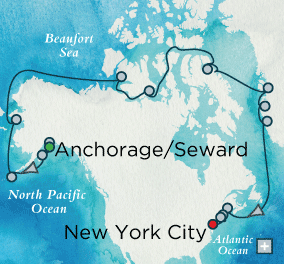
NorthWestPassageCruise

CBCNews reports that a cruise ship with a crew of 600 and an expected 1000 passengers is planning to make a cruise from Anchorage to New York City via the North West Passage, August 16 to September 17, 2016, and it is raising the specter of a mass casualty event far from any rescue assets.

I think the Russians require an escort for passage through the Northern Sea Route, for which they charge a fee.

“Plus, introducing our brand new Crystal Unexpected Adventures—your chance to explore this magnificent region on truly spontaneous excursions! This is the ultimate expedition for the true explorer!”

“Adventures make one late for dinner.”–Bilbo Baggins.

Thanks to Ken for bringing this to my attention.