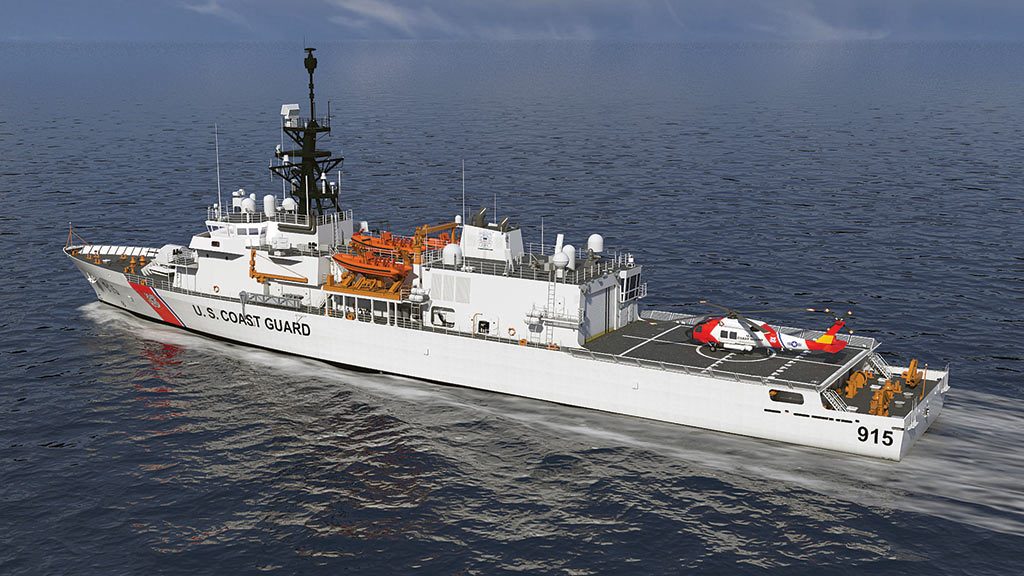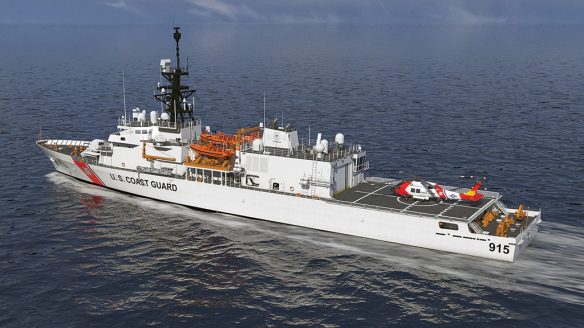
“Trinidad & Tobago Orders 2 Cape-class Patrol Boats from Austal” –Naval News

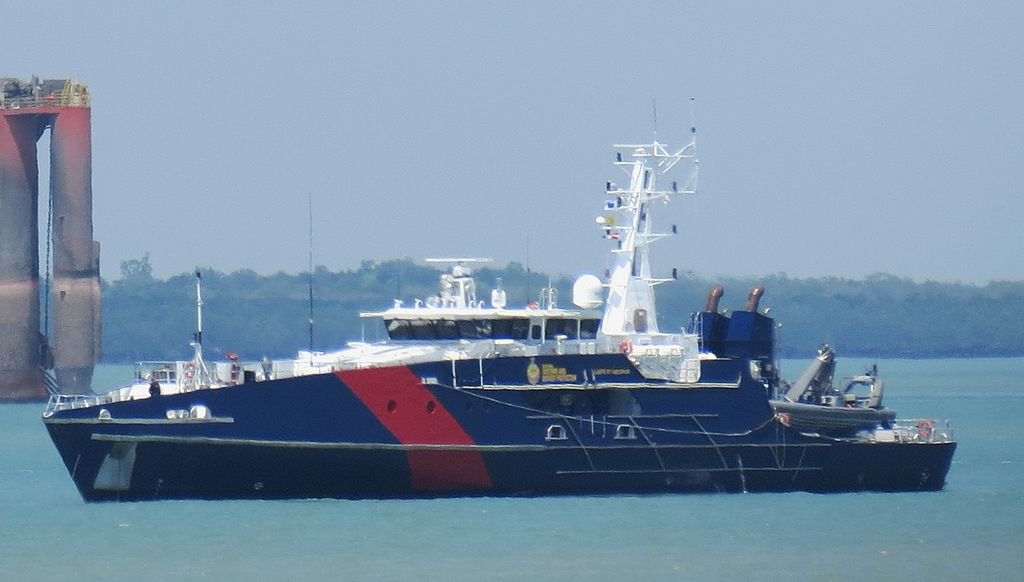
The Australian Customs patrol boat ACV Cape St George on Darwin Harbour in 2014, Photo by Ken Hodge

Naval News reports that Trinidad and Tobago has signed a deal for two Cape Class 58 meter patrol vessels from Austal in Australia. Contract is valued at 126M A$ or about $85.4M US. That is less than the cost of our Webber class cutters. Not that I think the USCG is in the market for anything like this right now. (Perhaps the Navy might consider it.) Still a comparison is interesting.

The Cape Class is a enlarged, improved version of the earlier Armidale class patrol vessels. The Cape Class was originally developed for the Australian Border Force, but the Australian Navy is currently also operating two of the class. Compared to the Webber class.

  • Displacement about twice as large: 700 tons vice 353
  • Length: 57.8 m (190 ft) vice 46.8 m (154 ft)
  • Beam: 10.3 m (34 ft) vice 8.11 m (26.6 ft)
  • Draft: 3 m (9.8 ft) vice 2.9 m (9.5 ft)
  • HP, less: 6,772 vice 11,600
  • Speed, slower: 25 vice 28
  • Crew, smaller: 18 vice 24
  • Boats: two on davits vice one in stern ramp

The dramatic difference seems to be range and endurance, 28 days and 4,000 miles vs five days and 2,500 miles, although I continue to believe the Webber class’ endurance could be improved with only a little effort. These little ships also have aluminum hulls, while the Webber class hull is steel. Also the Australian ships are armed with nothing larger than crew served machine guns. That appears to be just a matter of choice but it would increase the cost.

In some ways these look a lot like the French “La Confiance” PLG. meaning they are similar to the Cutter X concept, although I would favor something a little larger so that it might be able to operate a helicopter.

Our previous contributor on the Tinidad and Tobago Coast Guard, Sanjay Badir-Maharaj, questions the wisdom of this purchase, since The Trinidad and Tobago Coast Guard seems to be having trouble maintaining the vessels it has now. Some degree of maintenance is included apparently, we wish them luck.

“Coast Guard Ramps Up in Hawaii with 2 New Ships” –Military.com

The crew of USCGC Kimball (WMSL 756) arrive in Honolulu for the first time Dec. 22, 2018. Known as the Legend-class, NSCs are designed to be the flagships of the Coast Guard’s fleet, capable of executing the most challenging national security missions, including support to U.S. combatant commanders. (U.S. Coast Guard photo by Chief Petty Officer Sara Muir/Released)

Military.com reports that 14th district is getting a second National Security Cutter, the Future USCGC Midgett arriving on Friday, Aug. 16 (to be commissioned along with Kimball Aug. 24 in a rare dual commissioning) and a third Webber class, the William Hart.

It also discusses the Coast Guard’s increased activity in the Western Pacific and Oceana.

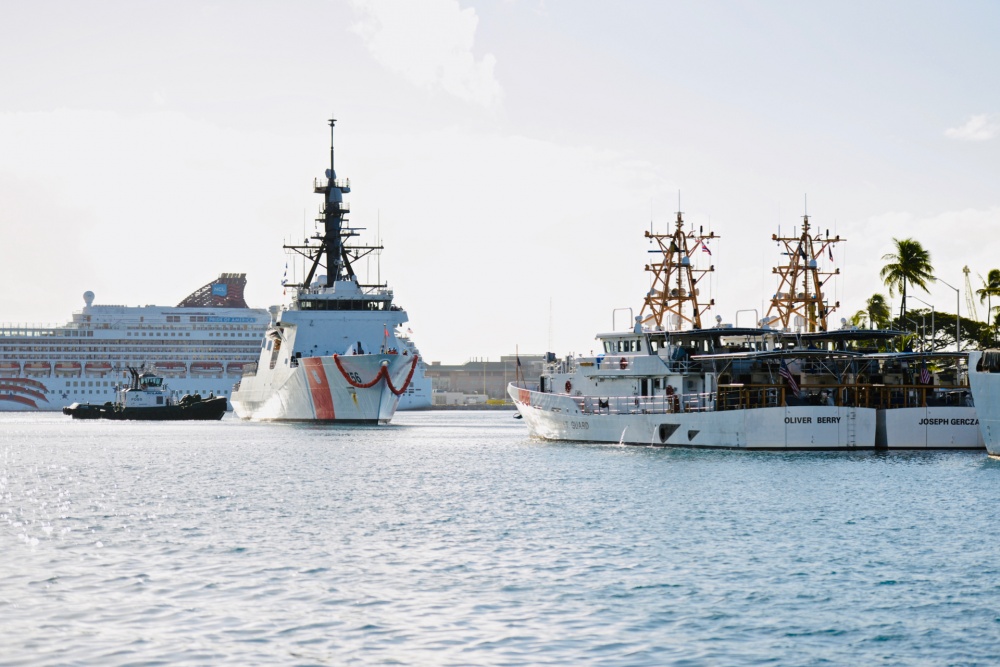
USCGC Joseph Gerczak (WPC 1126) arrives in American Samoa on patrol

The crew of USCGC Joseph Gerczak (WPC 1126) prepare to moor at the port of Pago Pago, American Samoa, Aug. 3, 2019. They will conduct a joint fisheries patrol with NOAA Fisheries and American Samoa Marine Police members. (U.S. Coast Guard photo by Chief Petty Officer Sara Muir/Released)

Below is a press release from District 14 (Hawaii). It suggest two things.

  • They are paying more attention to the threat of illegal, unregulated, and unreported (IUU) fishing in the Pacific, and
  • They are exploring the limits of recently arrived Webber class “Fast Response Cutters” (FRC).

The Joseph Gerczak is based in Honolulu. The distance from Honolulu to Pago Pago by air is 2259 nautical miles (4184 km). That is less than the nominal 2500 currently being reported as the range for the class and less than the 2950 miles that was claimed for the class earlier, but that appears to leave little in the way of reserve. The nine day transit referred to also exceeds the nominal five day endurance of the FRCs.

The news release also indicates that the USCGC Walnut (WLB-205) is also in the area, so the Walnut may have escorted the FRC and may have refueled and replenished it underway as was done when Walnut provided underway replenishment for Oliver F. Berry (WPC-1124) for a 2200 mile transit to the Marshall Islands.

I would welcome any comments about how the operation was actually done. But could an FRC make the trip unrefueled? As I recall the 2950 nmi range claim was based on a speed of 14 knots. Transiting at a lower speed should increase range. How fast did they go? Nine full days, 216 hours would have averaged about 10.5 knots. Still nine days may have meant a short day at the start and another short day on arrival so it may have been closer to eight 24 hour days or about 192 hours total that would equal an average speed of a little under 12 knots. In any case it is likely the transit could have been made unrefueled with a reasonable reserve. Even if that were the case, CCGD14 probably kept Walnut close in case they ran into trouble. They are pushing the envelope.

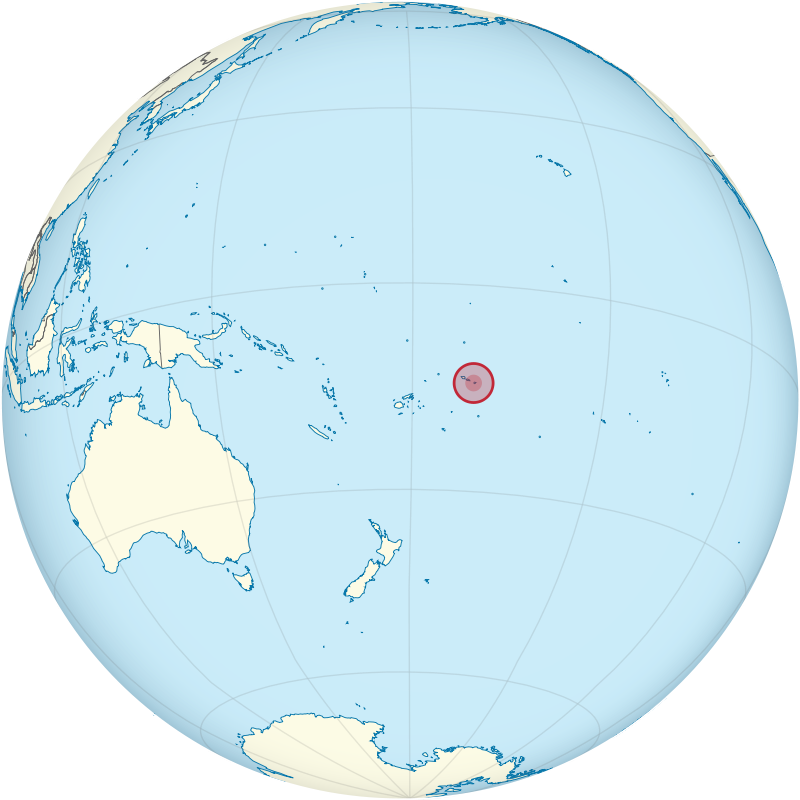
America Samoa location. Author: TUBS

The news release (more pictures here):

—-

PAGO PAGO, American Samoa — The Coast Guard Cutter Joseph Gerczak (WPC 1126) arrived in the Port of Pago Pago, Saturday.

The crew is participating in Operation Aiga to conduct fisheries law enforcement and strengthen partnerships in American Samoa and Samoa throughout August.

“It was a good transit, the longest we’ve conducted yet, nine days at sea and we’re proving the capabilities of these new cutters to operate over the horizon throughout the remote Pacific,” said Lt. James Provost, commanding officer of Joseph Gerczak. “This is the first time a Fast Response Cutter has come to Pago Pago. We’re looking forward to hosting our partners and the public during tours Monday from 1 to 3 p.m. here at the port.”

The U.S. Coast Guard is uniquely positioned to enforce U.S. federal laws and regulations in the territorial waters of American Samoa. Worldwide, tuna is a $7 billion dollar annual industry and roughly 70 percent of that tuna comes from the Western and Central Pacific. These pelagic fish migrate and it is essential the U.S. and its partners protect the resource from illegal, unregulated, and unreported fishing. Estimates place the value of IUU fishing around $616 million annually.

“After this port call, we will be working with NOAA fisheries and the American Samoa Marine Police to enforce fisheries regulations in the region while on patrol. Oceania countries adhering to the rule of law deserve and even playing field. Presence, partnerships, and regular enforcement can deter IUU fishing and safeguard these critical fish stocks,” said Provost.

The Coast Guard Cutter Walnut (WLB 205) crew will also be conducting a fisheries mission with shipriders from Samoa aboard to enforce sovereign laws in their EEZ and deter IUU fishing. This effort is being undertaken in coordination with Australia and New Zealand as Samoa transitions their organic patrol assets, upgrading their fleet. Both cutter crews will also respond to any emergent search and rescue needs in the area and seek out opportunities to work with partner nation assets.

The Coast Guard exercises 11 bilateral shiprider agreements with Pacific Island Forum nations to help ensure regional security and maritime sovereignty.

“The U.S. is committed to supporting our allies and neighbors in the Pacific, which is essential to a free and open Indo-Pacific.”

The Joseph Gerczak is a 154-foot Sentinel-Class Fast Response Cutter homeported in Honolulu. It is one of the newest patrol boats in the fleet, replacing the aging 110-foot Island-Class patrol boats serving the nation admirably since the late 1980s. Three Fast Response Cutters will be homeported in Honolulu, the third arriving in August. Three will also be stationed in Guam and are to begin arriving there in 2020.

USCGC Robert Ward (WPC-1130) Makes First Eastern Pacific Transit Zone Drug Bust by an FRC

A Coast Guard Cutter Robert Ward crew member inspects and prepares to test suspected contraband seized from a suspected drug smuggling boat in international waters of the Eastern Pacific Ocean, July 16, 2019. Commissioned March 2, 2019, Robert Ward’s interdiction marks the first drug interdiction in the Eastern Pacific Ocean by a Fast Response Cutter. U.S. Coast Guard photo.

A recent press release suggests that we will be seeing new, different, smaller ships engaged in drug interdiction in the Eastern Pacific drug transit zone. This could be precedence for a new kind of operation. I will only quote a part of it.

SAN DIEGO, Calif. — The crew of the Coast Guard Cutter Steadfast (WMEC-632) is scheduled to offload more than 26,000 pounds of seized cocaine in San Diego Friday.

The cocaine, worth an estimated $350 million, was seized in international waters of the Eastern Pacific Ocean. The contraband represents six suspected drug smuggling vessel interdictions and the recovery of floating cocaine bales by the crews of two Coast Guard cutters off the coasts of Mexico, Central and South America between late June and mid-July.

Six of the interdictions were carried out by the Steadfast’s crew, one of the Coast Guard’s oldest cutters commissioned in 1968. One interdiction was by the crew of one of the service’s newest ships, the Coast Guard Cutter Robert Ward (WPC-1130) commissioned in March, and is not only the cutter’s first drug bust, but the first drug bust by a Coast Guard Sentinel-class fast response cutter in the Eastern Pacific Ocean. (emphasis applied–Chuck)

We have had a problem having enough ships on scene to take advantage of all the intel available. I have long suggested that the FRCs might be used in the Eastern Pacific, possibly with a supporting vessel. The Navy used one of their Cyclone class PCs for drug interdiction in the Eastern Pacific in 2018, confirming that the use of these smaller vessels was probably viable.

I had really expected Atlantic Area to do this first, since they have so many Webber class in the Seventh District (19, soon to be 20 FRCs), and they got them first (since 2012). Still the Eastern Pacific Transit Zone is a Pacific Area show, perhaps that is why it is PACAREA, using the Robert Ward, only the second West Coast CONUS FRC, commissioned little over four months ago, that took the initiative.

It looks like the Steadfast may have provided some support to the Robert Ward. This might have been facilitated by the fact that Steadfast is also a PACAREA asset.

Hopefully, if there were no unanticipated problems, this will be the start of a pattern of successful FRC deployments to the transit zone. To take full advantage of the concept, we really need Atlantic Area participation. They have far more assets and are actually closer to the transit zone. Excluding FRCs in the 14th and 17th Districts (Hawaii and the Western Pacific and Alaska) PACAREA has only four WPCs. They could maintain perhaps one FRC in the Transit Area continuously, while LANTAREA could maintain at least three and probably more.

Something we really should look at is, what is limiting the endurance of the vessels to five days? For a vessel of this size, it should be more like ten days. Feedback on the post linked above, suggest they are limited by “their very small dry-stores and refrigerator units, and the crew’s laundry.” Perhaps a ShipAlt is in order.

“Schultz: Coast Guard Expanding Western Pacific Operations” –USNI

USCGC Bertholf (WMSL-750) crew members observe the stars from Bertholf’s flight deck as the cutter and crew patrol the South China Sea on April 21, 2019. US Coast Guard Photo

The US Naval Institute News Service is reporting,

KUALA LUMPUR – The U.S. Coast Guard will increase its presence and deployments to Asia – particularly around Oceania and U.S. Pacific territories – and test out a new operational deployment concept in the region, service head Adm. Karl Schultz told reporters on Thursday.

We have been seeing this happening. The Coast Guard has begun spending more time in and around the Western Pacific, particularly around US Western Pacific territories and Oceania.

The reference to use of a buoy tender as a mothership to support patrol craft operations looks like a test to see how useful the proposed basing of three Webber class cutters in Guam might be.

The Commandant suggested that the tender might partner with Australian, New Zealand, or Japanese vessels as well. He promised,

““In the face of coercive and antagonistic behavior, the United States Coast Guard offers transparent engagement and partnership,…”

There is no reason this should not work, hopefully it will lead to similar multi-unit operations in the Eastern Pacific drug transit areas where the Webber class could augment larger cutters.

“US Builds Global Coalition to Protect Gulf Shipping” –Global Security

USCG Monomoy (WPB-1326) and Adak (WPB-1333), elements of PATFORSWA

Global Security reports that the US is attempting to build a coalition to escort merchant ships through the Straits of Hormuz.

We would almost have to assume that the WPBs of PATFORSWA would be involved.

It would not be surprising to see the Coast Guard contribute up to six already commissioned Webber class WPCs in the near future. These could ultimately replace the current 110s stationed in Bahrain rather than waiting for FRCs specifically procured to replace the PATFORSWA WPBs, but for the duration of escort mission, they would augment them.

I would like to see some modifications done to these vessels before they go, but it is a question of urgency.

The Webber class could make the trip on their own bottoms if needed, especially if escorted by an National Security Cutter.


USCGC Kiska Visits YAP with Navy MkVI Patrol Boats

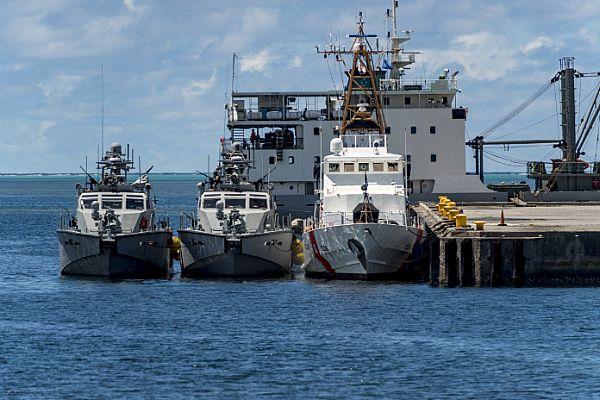
COLONIA, Yap (July 4, 2019) The U.S. Coast Guard Island-class patrol boat USCGC Kiska and Mark VI patrol boats assigned to Coastal Riverine Squadron (CRS) 2, Coastal Riverine Group 1, Detachment Guam, moored in the Micronesia port of Yap. CRG 1, Det. Guam’s visit to Yap, and engagement with the People of Federated States of Micronesia underscores the U.S. Navy’s commitment to partners in the region. The Mark VI patrol boat is an integral part of the expeditionary forces support to 7th Fleet, capability of supporting myriad of missions throughout the Indo-Pacific. (U.S. Navy photo by Mass Communication Specialist 2nd Class Jasen Moreno-Garcia/Released)

Wanted to pass along this photo (along with the Navy’s caption above). The Navy has a news release about the deployment..

Our 110s in Guam are going things that are a bit unusual for the Coast Guard. There are currently two of the Island class stationed in Guam. These are to be replaced by three Webber class WPCs. That should increase the Coast Guard presence in the Western Pacific.

Thanks to Lee for bringing this to my attention.

“Khulna delivers Bangladesh Coast Guard patrol boat trio, lays keels of two more” –Baird Maritime

CGS Sonar Bangla moments before being launched on May 23, 2018

Baird Maritime has reported that the Bangladesh Coast Guard has taken delivery of three new cutters.

These are based on the Bangladesh Navy’s Padma-class patrol vessels

They are similar in size to the Webber class Fast Response Cutters. Specs for the Bangladesh vessels are:

  • Displacement: 350 tons
  • Length: 165.35 ft (50.40 m)
  • Beam: 24.61 ft (7.50 m)
  • Draft: 13.45 ft (4.10 m)
  • Speed: 23 knots
  • Endurance: 7 days
  • Crew: 45

Armament for the Coast Guard versions of vessel is two Oerlikon 25mm, while that for the Navy version is two 37mm and two 20mm. They are also reported to be capable of minelaying.

Wikipedia indicates up to 23 of these indigenously produced craft are planned (presumably Navy and Coast Guard).

Coast Guard Cutter Procurement: Background and Issues for Congress, Updated May 22, 2019

Offshore Patrol Cutter future USCGC ArgusThe Congressional Research Service has once again updated their look at Coast Guard Cutter procurement.

I have quoted the summary below and will comment on some of the questions.

The Coast Guard’s program of record (POR) calls for procuring 8 National Security Cutters (NSCs), 25 Offshore Patrol Cutters (OPCs), and 58 Fast Response Cutters (FRCs) as replacements for 90 aging Coast Guard high-endurance cutters, medium-endurance cutters, and patrol craft. The Coast Guard’s proposed FY2020 budget requests a total of $657 million in procurement funding for the NSC, OPC, and FRC programs.

NSCs are the Coast Guard’s largest and most capable general-purpose cutters; they are intended to replace the Coast Guard’s 12 aged Hamilton-class high-endurance cutters. NSCs have an estimated average procurement cost of about $670 million per ship. Although the Coast Guard’s POR calls for procuring a total of 8 NSCs to replace the 12 Hamilton-class cutters, Congress through FY2019 has funded 11 NSCs, including the 10th and 11th in FY2018. Six NSCs have been commissioned into service. The seventh was delivered to the Coast Guard on September 19, 2018, and the eighth was delivered on April 30, 2019. The ninth through 11th are under construction; the ninth is scheduled for delivery in 2021. The Coast Guard’s proposed FY2020 budget requests $60 million in procurement funding for the NSC program; this request does not include funding for a 12th NSC.

OPCs are to be smaller, less expensive, and in some respects less capable than NSCs; they are intended to replace the Coast Guard’s 29 aged medium-endurance cutters. Coast Guard officials describe the OPC program as the service’s top acquisition priority. OPCs have an estimated average procurement cost of about $421 million per ship. On September 15, 2016, the Coast Guard awarded a contract with options for building up to nine OPCs to Eastern Shipbuilding Group of Panama City, FL. The first OPC was funded in FY2018 and is to be delivered in 2021. The second OPC and long leadtime materials (LLTM) for the third were funded in FY2019. The Coast Guard’s proposed FY2020 budget requests $457 million in procurement funding for the third OPC, LLTM for the fourth and fifth, and other program costs.

FRCs are considerably smaller and less expensive than OPCs; they are intended to replace the Coast Guard’s 49 aging Island-class patrol boats. FRCs have an estimated average procurement cost of about $58 million per boat. A total of 56 have been funded through FY2019, including six in FY2019. Four of the 56 are to be used by the Coast Guard in the Persian Gulf and are not counted against the Coast Guard’s 58-ship POR for the program, which relates to domestic operations. Excluding these four, a total of 52 FRCs for domestic operations have been funded through FY2019. The 32nd FRC was commissioned into service on May 1, 2019. The Coast Guard’s proposed FY2020 budget requests $140 million in acquisition funding for the procurement of two more FRCs for domestic operations.

The NSC, OPC, and FRC programs pose several issues for Congress, including the following: 

  •     whether to provide funding in FY2020 for the procurement of a 12th NSC;
  •  whether to fund the procurement in FY2020 of two FRCs, as requested by the Coast Guard, or some higher number, such as four or six;
  •  whether to use annual or multiyear contracting for procuring OPCs;
  •  the annual procurement rate for the OPC program;
  •  the impact of Hurricane Michael on Eastern Shipbuilding of Panama City, FL, the shipyard that is to build the first nine OPCs; and
  •     the planned procurement quantities for NSCs, OPCs, and FRCs.

Bertholf Class National Security Cutters (NSCs):

If there is going to be a 12th NSC, it almost certainly has to be funded this year. Future years will see the Polar Security Cutters and OPCs further crowding the budget. Frankly I see little to choose between the NSC and OPC for peacetime missions, but the replacement of the legacy fleet is becoming urgent and the price of the NSCs has decreased as funding became more regular, so a 12th might be reasonable. If we had started the OPC program earlier, it might have offered a lower cost alternative to additional NSCs, but we will not be ready to start multi-ship procurements of the OPCs until FY2021 and then only at the rate of two per year if we follow current planning.

Argus Class Offshore Patrol Cutters (OPCs):

There is probably good reason to accelerate the OPC program beyond the two per year currently planned to begin in FY2021. If we maintain that rate, the last 210 foot WMEC will not be replaced until 2028, the last 270 not until 2034. I expect we may see some catastrophic failures that will result in either sidelining ships or unacceptably high repair costs, before the program of record is complete.

The Coast Guard should plan on expediting testing of the first OPC so that production could move from the current contract with options to a true Multi-Year contract as soon as the design has proven successful.

We probably will need more than 25 OPCs. The Coast Guard has operated more than 40 cutters of more than 1,000 tons for decades. It seems likely we are going to need more than 36 total NSCs and OPCs. (See the discussion about the Fleet Mix Study below.)

Webber Class Fast Response Cutters (FRCs):

We are nearing the end of the Webber class program with 52 of the 58 program of record vessels, plus four additional vessels for Patrol Forces South West Asia (PATFORSWA), already funded. Buying only two for FY2020 raises the unit costs of these vessels. Congress has consistently increased purchases to four or even six per year when only two have been requested. Adding the final two additional FRCs intended to replace the 110s assigned to PATFORSWA would bring the total buy to four. That would leave only four to be purchased in FY2021 which could wrap up the funding. The question is, will Congress stop the program at the 64 vessels total when there may be justification for more?

Impact of Hurricane Michael: 

The Coast Guard budget is not the place to provide disaster relief for businesses. Maybe they have insurance. Maybe the state or Federal Government wants to provide aid, but renegotiating the contract for OPCs is not the way to do it. No way should it come out of the Coast Guard budget.

If on the other had we do renegotiate the contract, it is not to late to make it a “Block Buy.”

One solution might be for the contract to be converted to a block buy, using purchase amounts no more than current contract with options. That would assure the contractor and its creditor that they would have a steady stream of work. The contract might even have options for production of additional ships at rates higher than two per year.

We Need a New Fleet Mix Study:

The number of OPCs and FRCs actually required to fulfill Coast Guard statutory missions was examined in a fleet mix study (see pages 19 and 20 of the report) that found that the Program of Record (8 NSCs, 25 OPCs, and 58 FRCs) fell far short of the number of vessels required to meet all statutory requirements. Phase One of the study (2009) found that the total “objective” requirement was 9 NSCs, 57 OPCs, and 91 FRCs. Phase Two found that only 49 OPCs would be required but found the same requirements for NSCs and FRCs (see page 22).

The problem is that the analysis is getting pretty old and its assumptions were wrong. The Coast Guard will have at least 11 NSCs. The FRCs appear to be more capable than anticipated. Perhaps most importantly, the study assumed the NSCs and OPCs would use the “Crew Rotation Concept,” resulting in an unrealistic expectation for days away from homeport. From my point of view, the study failed to even consider the requirement to be able to forcibly stop a medium to large size ship being used as a terrorist weapon. None of our ships are capable of doing that reliably, and even our ability to stop small fast highly maneuverable ships under terrorist control is far from assured, even if the objective fleet were available.

The Procurement, Construction, and Improvements FY2020 budget request is about $1.2B. Adding NSC #12 and a pair of FRCs using the costs in the CRS report ($670M/NSC plus 2x$58M/FRC) which are probably high for the current marginal costs, would still leave the PC&I budget under the $2B/year the Coast Guard has been saying they need and about $250M less than the FY2019 PC&I budget.

For the Future:

While we are thinking about cutters, with the FRC program coming to an end, it is not too early to think about the 87 foot WPB replacement. I think there might be a  window to fund them after the third Polar Security Cutter if we have our requirements figured out. That means preliminary contracts such as conceptual designs have to be done during the same period we are building PSCs, e.g. FY2022 and earlier. .

To avoid always being constantly behind the power curve, as we have been for the last two decades, we really need a 30 year shipbuilding plan. The Navy does one every year. There is no reason the Coast Guard should not be able to do one as well. The Congress has been asking for a 25 year plan for years now, but so far no product.

Thanks to Grant for bringing this to my attention. 

Small Vessel Hellfire Vertical Launch System

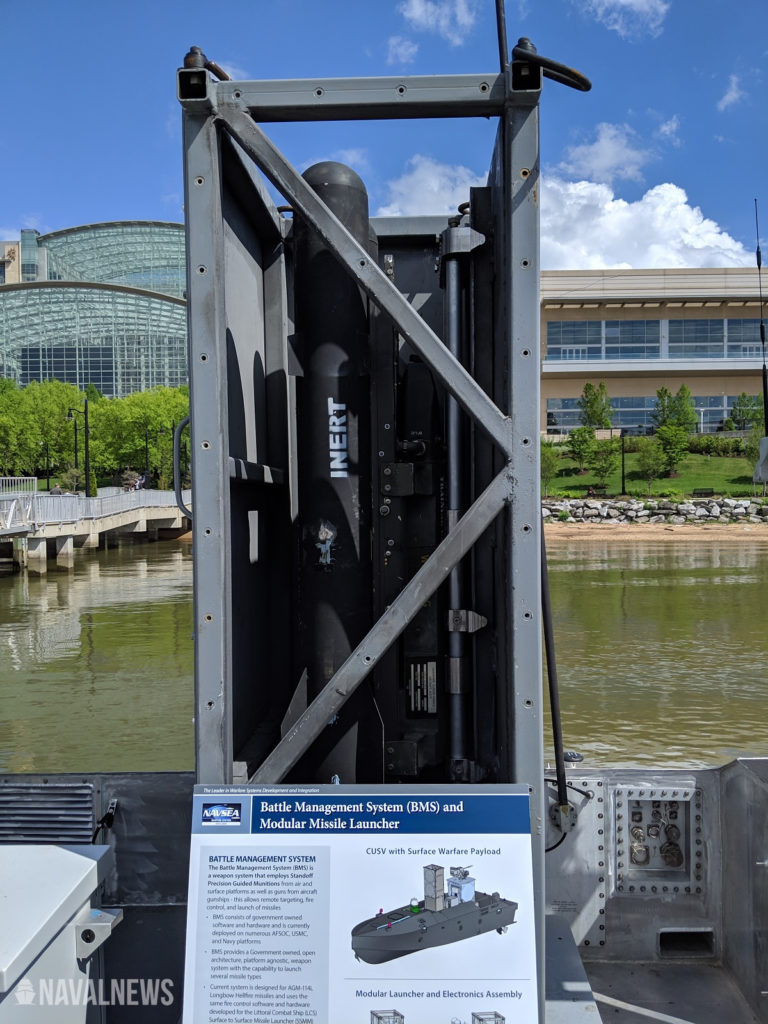
Photos: Above, Modular Missile Launcher, also seen below amidships on the Textron CUSV (Common Unmanned Surface Vehicle). Note relatively small size and innocuous appearance. 

Textron Systems’ CUSV with Surface Warfare payload at SAS 2019

Naval News reports that, at this year’s Sea-Air-Space Exposition, Textron showed one of their Common Unmanned Surface Vehicle (CUSV) craft equipped with a remote weapon station and a modular vertical launch system for the Longbow Hellfire.

I find the Hellfire VLS particularly interesting, as it might find application on Coast Guard cutters. The launcher appears to be about 2’x2’x7. The missile itself is 64″ long (1.6 meters), 7″ in diameter (17.8 cm), with a 13″ span (33 cm).

The CUSV is about 39′ (12 meters) in length. The CUSV’s load space is reportedly 20.5′ x 6.5′.

This earlier report indicates a missile shoot from a CUSV is expected in 2019. 

There would of course be concerns about how to mount these missiles on a cutter. The effects of the smoke at launch on he crew and the possible effects of the engines ingesting the smoke would have to be considered.

The planned transfer of six Webber class cutters to Bahrain, to replace the six Island class cutters assigned to PATFORSWA, might provide the incentive necessary to plan and test a Hellfire installation on this class.