Commandant’s Strategic Intent, Mid-Term Report

Coast Guard Capt. Douglas Nash, commanding officer of Coast Guard Air Sation Sacramento, salutes a Coast Guard C-27J pilot during a change of watch ceremony at Air Station Sacramento's hanger in McClellan Park, Thursday, July 1, 2016. The ceremony marked the final day that an HC-130 Hercules crew stood the watch at Air Station Sacramento and introduced the newest aircraft. Coast Guard photo by Petty Officer 3rd Class Loumania Stewart

Procurement of 14 C-27J aircraft was one of the achievements sited. C-27Js replace C-130s at CGAS Sacramento. 

The Commandant has issued a mid-term update on his earlier published “Strategic Intent, 2015-2019” (pdf). The new document is available in pdf format. You can find it here: “United States Coast Guard Commandant’s Strategic Intent, 2015-2019, Mid-Term Report.”

It is relatively short and readable at 21 pages. The recurring themes of the Commandant’s administration are all there, starting with TOC (transnational organized crime) and its deleterious effect on Western Hemisphere governance and prosperity. It does read a little like an Officer Evaluation Report input.

There is nothing particularly surprising here, but even for me, the enumeration of the scope the Coast Guard’s authorities, responsibilities, and international contacts is still mind boggling.

I am not going to try to summarize the report, but there were a few things that struck me.

The Commandant mentions service life extension programs for the seagoing buoy tenders (already begun), the 47 foot MLBs, and the 87 foot WPBs (in the future), but there is no mention of what we will do about the inland tender fleet. There will also be a life extension program for helicopters before they are finally replaced.

“Extend the service life of our rotary wing assets and align with DOD’s Future Vertical Lift initiative.”

There is mention of a program I was not aware of, the “Defense Threat Reduction Agency National Coast Watch System project.” The Defense Threat Reduction Agency attempts to track and reduce the WMD threat. It is not really clear what our role is here. We know about the container inspection programs in foreign ports. Is that it, or is there more to this? (that can be discussed at an unclassified level.)

Webber Class WPC Homeports

FRC-graphic

Click on the graphic to enlarge

The Acquisitions Directorate has a story on the commissioning of the 17th Webber class WPC, USCGC Donald Horsley (WPC-1117).

Included in the post was the graphic above, which gives us an indication of where future cutters will be homeported:

  • Ketchikan, AK
  • San Pedro, CA
  • Pascagoula, MS
  • Atlantic Beach, NC
  • Cape May, NJ

One more WPC is expected to go to San Juan, so in about six months we should see a Webber class go to Ketchikan. Certainly its improved sea keeping compared to the 110s will be appreciated.

This is not, I’m sure, a complete list of future homeports, given that we expect 41 more of this class. I’m not privy to the home porting plan or how many will be in each port, but this looks like it will cover at least the next 18 months. It may cover a much longer period if more than one Webber class will be assigned to some of these ports, and that seems likely.

I would note that these homeports look good from a Ports, Waterways, and Coastal Security perspective. Ketchikan and the inland passage has a lot of cruise ship traffic. San Pedro is near the huge Los Angeles port complex and the strategic ports of Long Beach and Port Hueneme. Pascagoula based ships potentially protect the ports of the Eastern Gulf of Mexico including the eastern approaches to the Mississippi River port complex and the strategic port of Gulf Port, MS. Atlantic Beach, NC is close to Cape Lookout and Cape Hatteras, but it is also close to the strategic ports of Morehead City, Sunny Point, and Wilmington. WPCs in Cape May, NJ could provide protection for Delaware Bay, including the strategic port of Philadelphia.

If any of our readers has access to the homeporting plan, and it is public knowledge, I would appreciate the information.

Document Alert: Cutter Procurement–Another Report to Congress

Once again, the Congressional Research Service’s Ronald O’Rourke has revised his “Coast Guard Cutter Procurement: Background and Issues for Congress” with the new edition issued April 15. This has got to be a hot topic because previous revisions were issued March 22, January 27, and December 14, 2015. That is four revisions in four months, on average every six weeks, but the latest is only 24 days after the previous edition. I have begun to sense, we may have turned a corner. The tone of the reports has changed over these four months, from, how long will it take us to reach the “Program of Record” (POR), to consideration of, if we should perhaps go beyond the POR.

The NSC, OPC, and FRC programs pose several issues for Congress, including the following:

“whether to fund the acquisition of a 10th NSC in FY2017;

“whether to fund the acquisition of four FRCs in FY2017, as requested, or some other number, such as six, which was the number projected for FY2017 under the Coast Guard’s FY2016 budget submission;

“whether to use annual or multiyear contracting for procuring FRCs;

“whether to use annual or multiyear contracting for procuring OPCs;

“planned procurement quantities for NSCs, OPCS, and FRCs;

“the cost, design, and acquisition strategy for the OPC;

“initial testing of the NSC; and

“rotational crewing of the NSC.”

The latest revision includes three substantial Appendices:

  • Appendix A. Planned NSC, OPC, and FRC Procurement Quantities (pp 17-22)
  • Appendix B. Funding Levels in AC&I Account (pp 23-26)
  • Appendix C. Additional Information on Status and Execution of NSC, OPC, and FRC Programs from March 2016 GAO Report (pp 27-34)

Appendix C is entirely new and appears to have been the reason for the revision.

Appendix A (p. 17-22) is a fairly detailed discussion of the results of the Fleet Mix Study and asks why we so seldom hear that the program of record is not enough to assure the Coast Guard to successfully accomplish its assigned missions.

The Fleet Mix Study was made public in 2012 long after its completion in 2009. It is due for a reexamination and the Commandant has said another will be done. When that happens, we seriously need to look at more than just more of the same assets. We need to look at additional technology, equipment, and weapons that might allow us to accomplish these missions without a major increase in personnel.

Looking at “Table A-3. Force Mixes and Mission Performance Gaps” (document page 18) I would note that if we get to Fleet Mix Analysis Phase 1 (FMA-1, an increase over the POR including 9 Bertholf class NSCs, 32 OPCs and 63 Webber Class FRCs, for a total of 104 vessels), we will have addressed all the “Very High Risk Gaps” found in the Fleet Mix Study that included SAR capability, “Defense Readiness Capacity,” and “Counter Drug capacity.” What will remain are “High” or lower risks in Ports, Waterways, and Coastal Security (PWCS) and Living Marine Resources (LMR), and a low to very low risk to the Alien Migrant Interdiction Operations (AMIO) mission. This total of more than 40 NSCs and OPCs certainly should not be out of the question, after all the Coast Guard has included over 40 ships larger than a thousand tons for the last several decades.

Still, I would note that, no matter how many ships we have, the Ports, Waterways, and Coastal Security (PWCS) mission will always be at risk, unless weapons are available to quickly and reliably stop terrorists’ exploitation of a larger merchant vessel to make an attack. Guns alone are simply not up to the task. I have identified two weapons that might address this threat, (1) equipping our WPCs and possibly WPBs with light weight torpedoes that target a ships propellers or (2) equipping our larger ships with the Long Range Anti-Ship Missile (LRASM) which might allow our larger cutter to effectively support our smaller cutters and respond to an attack, even if the large cutter 200 miles from the targeted port. Either would also make our ships much more capable of making a meaningful contribution to Defense Readiness.

Malaysia’s New Patrol Boat–UAS Ready

MalaysiaNewGenerationPatrolCraft

IHS Jane’s 360 is reporting on Malaysian Coast Guard’s six projected “New Generation Patrol Craft (NGPC).”

“The NGPC has been based on a design by Germany-based Fassmer Shipbuilding Company. According to specifications provided by Destini, the platform features an overall length of 44.25 m an overall beam of 7.7 m and a design draught of 1.95 m. Powered by two 1920 kW MTU engines, the vessel can attain a top speed of 24 kt and a standard range of 2,000 n miles at 12 kt. The ship displaces 297 tonnes and can accommodate a crew of 41.”

This means they will be similar to, but slightly smaller than the Webber Class WPCs.

The unique thing about this class is that they are built to use a mini-Unmanned Aerial System, in this case the Thales Fulmar. NavalToday reports the purchase of these systems. Fulmar looks similar in size and capability to the Scan Eagle.

This certainly suggest that we could probably operate Scan Eagle, or something similar from the Webber class.

Photo: The Thales Fulmar

SOUTHCOM CG PATRON

WPC Kathleen_Moore

SouthCom, actually two SouthComs in a row, and the Commandant have noted that while they have excellent intelligence on drug smugglers in the transit zone, they simply do not have adequate numbers of vessels to respond.  (Here, here, and here) There were never enough, but after decommissioning the Perry class frigates, the Navy’s contribution appears to have declined significantly. The Coast Guard seems to have upped their game, possibly more than making up for the Navy’s absence, but still–not enough ships.

There may be a way at least partially address this problem.

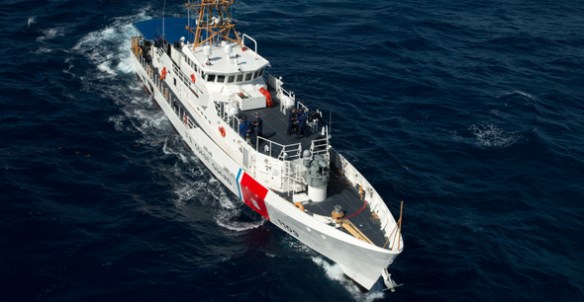
We now have 16 Webber class WPCs in three homeports in the Seventh District, six in Miami, six in Key West, and four, soon to be six, in Puerto Rico. These may be “Fast Response Cutters,” but clearly they are not all sitting in homeport waiting for SAR cases. These are law enforcement assets and they are meant to patrol. Could we perhaps, maintain as many as four in the Eastern Pacific by rotating cutters from the 7th District to fill this role in the transit zone? Obviously, it is not impossible, since the Navy is sending their similar sized Cyclone class PCs to the Eastern Pacific, but what would it take to make it work well?

Obviously they would need additional fuel and supplies while deployed. There is a good chance between Colombia, Panama, and Costa Rica, we could find a port willing to host these little white ships.

Aside from “beans and black oil” they might also need some administrative, maintenance, or medical support.

The Navy might make itself useful here by providing a simple MSC manned support vessel that could be as basic as an Offshore Support Vessel loaded with containerized offices and logistical support to provide support that the port cannot. The Navy has already chartered a number of ships of this type and could charter another.

We could start this small. First study the results of the Navy’s Cyclone class deployment. Then send a single ship from say Miami, a month later we get a second ship from Key West. Let them figure out what they need and how the problems they will inevitably encounter can be solved.

Because they cannot embark a helicopter, they will need a complementary fixed wing support, but this is already being done at least to some extent.

Once we get to a total of 18 Webber class in these three home ports, we could keep four ships assigned to SouthCom by sending two ships each month and rotating them back after two months. Seventh district would still four ships assigned to each home port, which would mean that even if two are down for maintenance they would still have two for SAR and local law enforcement.


More on the Navy’s New Design for Maintaining Maritime Superiority

Waesche Carat 2012

This is a post I wrote for CIMSEC. under the title “A Design for Maintaining Maritime Superiority”–A Coastie’s View.” It is an expanded version of an earlier post that appeared here. The rewrite really begins about half way down under the header, “What I Want to See.”

Recently the new Chief of Naval Operations issued a document “Design for Maintaining Maritime Superiority” that outlines how, hopefully, the US Navy can maintain a maritime superiority our foes will recognize and avoid confronting.

If you look for anything specifically regarding the Coast Guard here, you will not find it (other than the cutter in the formation on the cover). The Coast Guard is not mentioned even once, but it does talk about some things that are Coast Guard related. Perhaps the Coast Guard should not feel bad about this. It only mentions the Marine Corps once.

Three Forces that are Changing the Environment

  • The first global force is the traffic on the oceans, seas, and waterways, including the sea floor – the classic maritime system.
  • A second increasingly influential force is the rise of the global information system – the information that rides on the servers, undersea cables, satellites, and wireless networks that increasingly envelop and connect the globe.
  • The third interrelated force is the increasing rate of technological creation and adoption.

Obviously the Coast Guard facilitates and regulates marine traffic, and is tapped into the global information system. In wartime, these contacts will become essential since they will form the basis for naval control of shipping. He also talks about new trade routes opening in the Arctic. These will only be reliable if we have new icebreakers. He also talks about illegal trafficking.

“This maritime traffic also includes mass and uncontrolled migration and illicit shipment of material and people.”

A Document That Explicitly Recognizes the Competition

“For the first time in 25 years, the United States is facing a return to great power competition. Russia and China both have advanced their military capabilities to act as global powers. Their goals are backed by a growing arsenal of high-end warfighting capabilities, many of which are focused specifically on our vulnerabilities and are increasingly designed from the ground up to leverage the maritime, technological and information systems. They continue to develop and field information-enabled weapons, both kinetic and non-kinetic, with increasing range, precision and destructive capacity. Both China and Russia are also engaging in coercion and competition below the traditional thresholds of high-end conflict, but nonetheless exploit the weakness of accepted norms in space, cyber and the electromagnetic spectrum. The Russian Navy is operating with a frequency and in areas not seen for almost two decades, and the Chinese PLA(N) is extending its reach around the world.

“…Coupled with a continued dedication to furthering its nuclear weapons and missile programs, North Korea’s provocative actions continue to threaten security in North Asia and beyond.

“…while the recent international agreement with Iran is intended to curb its nuclear ambitions, Tehran’s advanced missiles, proxy forces and other conventional capabilities continue to pose threats to which the Navy must remain prepared to respond.

“…international terrorist groups have proven their resilience and adaptability and now pose a long-term threat to stability and security around the world.”

Recognizing Budgetary Limitations

“There is also a fourth ‘force’ that shapes our security environment. Barring an unforeseen change, even as we face new challenges and an increasing pace, the Defense and Navy budgets likely will continue to be under pressure. We will not be able to “buy” our way out of the challenges that we face. The budget environment will force tough choices but must also inspire new thinking.”

Throughout there is an emphasis on understanding history and the strategic concepts of the past. There is also a recognition of the need to work with partners.

“EXPAND AND STRENGTHEN OUR NETWORK OF PARTNERS: Deepen operational relationships with other services, agencies, industry, allies and partners – who operate with the Navy to support our shared interests.”

Other than the Marine Corps, the US Navy has no closer partner than the US Coast Guard. And while only about one eighth the size of the US Navy, in terms of personnel, the US Coast Guard is larger than Britain’s Royal Navy or the French Navy. The partnership has been a long and successful one, but I would like to see the Navy be a better partner to the Coast Guard. This is how the Navy can help the Coast Guard help the Navy.

What I Want to See

If we have a “run out of money, now we have to think” situation, one thing we can do is to try to get the maximum return from the relatively small investment needed to make the Coast Guard an effective naval reserve force.

WPC Kathleen_Moore

We need explicit support from the Navy at every level, particularly within Congress and the Administration, for Coast Guard recapitalization. While the Navy’s fleet averages approximately 14 years old. The Coast Guard’s major cutters average over 40. The proposed new ships, are more capable than those they replace. They are better able to work cooperatively with the Navy. The nine unit 4,500 ton “National Security Cutter”program is nearing completion with funds for the ninth ship in the FY2016 budget. The 58 unit, 154 foot, 353 ton Webber Class  program is well underway with 32 completed, building, or funded. But the Coast Guard is about to start its largest acquisition in history, 25 LCS sized Offshore Patrol Cutters. Unfortunately, it appears that while the first ship will be funded in FY2018 the last will not be completed until at least 2035. This program really needs to be accelerated.

We need an explicit statement from the Navy that they expect the Coast Guard to defend ports against unconventional threats, so that they can keep more forces forward deployed. This is in fact the current reality. The Sea Frontiers are long gone. Navy vessels no longer patrol the US coast. The surface Navy is concentrated in only a handful of ports. No Navy surface combatants are homeported on the East Coast north of the Chesapeake Bay. If a vessel suspected of being under the control of terrorists approaches the US coast the nearest Navy surface vessel may be hundreds of miles away.

We need the Navy to supply the weapons the Coast Guard need to defend ports against unconventional attack using vessels of any size, with a probability approaching 100%. These should include small missile systems like Hellfire or Griffin to stop small, fast, highly maneuverable threats and we need a ship stopper, probably a light weight anti-ship torpedoes that target propellers to stop larger threats. We need these systems on not just the largest cutters, in fact they are needed more by the the smaller cutters that are far more likely to be in a position to make a difference. These include the Webber class and perhaps even the smaller WPBs.

We need to reactivate the Coast Guard’s ASW program and ensure that all the new large cutters (National Security Cutters and Offshore Patrol Cutters) have an ASW capability, if not installed on all of the cutters, at least planned, prototyped, tested, and practiced on a few ships (particularly in the Pacific). The National Security Cutters and the Offshore Patrol Cutters are (or will be) capable of supporting MH-60R ASW helicopters. Adding a towed array likeCAPTAS-4 (the basis for the LCS ASW module) or CAPTAS-2 would give them a useful ASW capability that could be used to escort ARGs, fleet train, or high value cargo shipments. Towed arrays might even help catch semi-submersible drug runners in peacetime.

IMG_4128

The Coast Guard is the low end of America’s Naval high-low mix. It is a source of numbers when numbers are needed. The Coast Guard has more assets for low end functions like blockade than the Navy. The Navy has about 105 cruisers, destroyers, LCS, PCs, and is not expected to have more than 125 similar assets for the forseeable future. The Coast Guard has about 165 patrol cutters  including 75 patrol boats 87 feet long, about 50 patrol craft 110 to 154 feet in length (58 Webber class WPCs are planned), and about 40 ships 210 foot or larger that can be called on, just as they were during the Vietnam War, when the Coast Guard operated as many as 33 vessels off the coast in support of Operation MarketTime, in spite of the fact that the Navy had almost three times as many surface warships as they do now. The current program of record will provide 34 new generation cutters including nine 4500 ton National Security Cutters and 25 Offshore Patrol Cutters that should be at least 2500 tons.

The Coast Guard provides peacetime maritime security, but is currently under-armed even for this mission. A small investment could make it far more useful in wartime.

(Note there is another post on this looking at the “design” from a Navy point of view.)

Cost of German Built Patrol Boats for Saudi Arabia

NavalToday reports the Saudis are having 15 patrol boats built in Germany by boat builder Lürssen, famous for building missile and torpedo boats.

“German naval shipyard Lürssen has started construction of the 15 patrol vessels for Saudi Arabia under the €1.5 billion (approx $1.63b) contract despite of talks (sic) about cancelling the deal amidst the Middle Eastern country’s public executions early January 2016.”

That is about $109M each for craft of 35 and 38 meters. Our Webber class are 47 meters in length and cost typically $60M. Maybe not a bad deal.

Incidentally, these do not appear to be the 20 to 24 patrol boats 40 to 45 meters in length, discussed earlier as part of the Saudi Naval Modernization.

Document Alert: Coast Guard Cutter Procurement: Background and Issues for Congress

Samsung

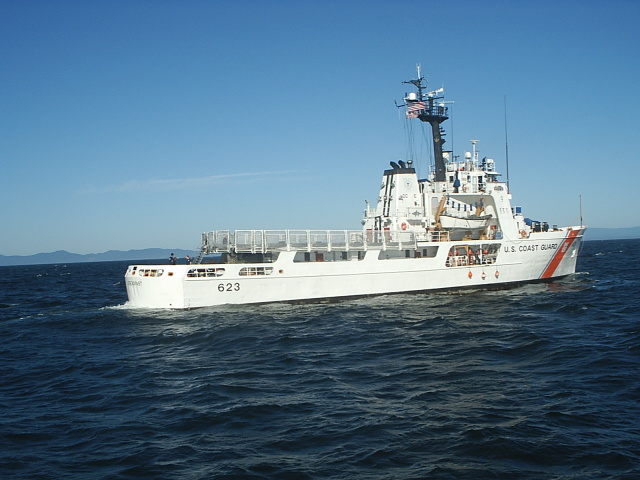
Photo: USCGC Steadfast, one of the newer 210 class, now about 48 years old. We don’t expect her replacement for at least another ten years.

The US Naval Institute has published the Congressional Research Services latest version of Coast Guard Cutter Procurement: Background and Issues for Congress, by their Naval Affairs Specialist, the ever prolific Ronald O’Rourke.

It is not quite up to date, because it does not reflect funding for a ninth National Security Cutter, but otherwise it nicely defines the issues the program has been faced with, most notably inadequate funding.

It also raises the question, should multi-year or block buy funding, with its potential for substantial savings, be pursued? We really should be doing this for the Webber class, which is a proven, mature design, approved for full rate production. In fact, we should have been doing this for a couple of years now.

The thing I found most disturbing was that the first Offshore Patrol Cutter (OPC) will not be funded until FY2018, although it looks like the detail design will be funded in FY2017. I am beginning to wonder if we will see the first OPC before 2022.

The FY2016 budget was a pleasant surprise with the addition of funds to build a ninth National Security Cutter. If this near $2B funding level is seen as a new norm (as I would hope) there will be room in the FY2017 budget for another major acquisition. It might be a tenth NSC. That would not be an altogether bad thing, but it would be outside the needs identified in the Fleet Mix Study. Unless another major project is injected into the FY2017 budget, we will loose the momentum for a larger AC&I budget.

If the FY2017 NSC, OPC, and FRC funding is as indicated in the document (see pdf page 14, marked at page 10), most of the shipbuilding funds will go for what looks like five or six more Webber class. There are smaller amounts for the OPC and NSC programs for a total of only $557M. There may, however, be the opportunity to fund a big part of the new polar icebreaker, as the Commandant has suggested, if the AC&I budget remains at least equal to the FY2016 level.

Navy PCs Support Operation Martillo, WPCs Next?

USS_Hurricane_(PC-3),_USS_Typhoon_(PC-5)_and_USS_Chinook_(PC-9)_underway_in_March_2015

Navy photo: The U.S. Navy Cyclone-class coastal patrol ships assigned to Patrol Coastal Squadron 1 (PCRON 1), USS Hurricane (PC-3), USS Chinook (PC-9) and USS Typhoon (PC-5), transit in formation during a divisional tactics exercise in the Persian Gulf.

The Navy has announced they have three 387 ton (fl) Cyclone class patrol craft based in Mayport, rotating through the 4th Fleet’s area in support of Operation Martillo, the counter drug operation off Central America.

We know there are not enough ships to respond to all the intelligence we have on drug trafficing in SouthCom’s area of responsibility.

These little ships are considerably smaller than those we normally send South, but they are very similar in size to the new 353 ton Webber class WPCs. We have six Webber class in Miami, six in Key West, and will soon have six in Puerto Rico. If we could rotate some of these through the Transit zones, they might make a difference.

Thanks to Lee for bringing this to my attention.


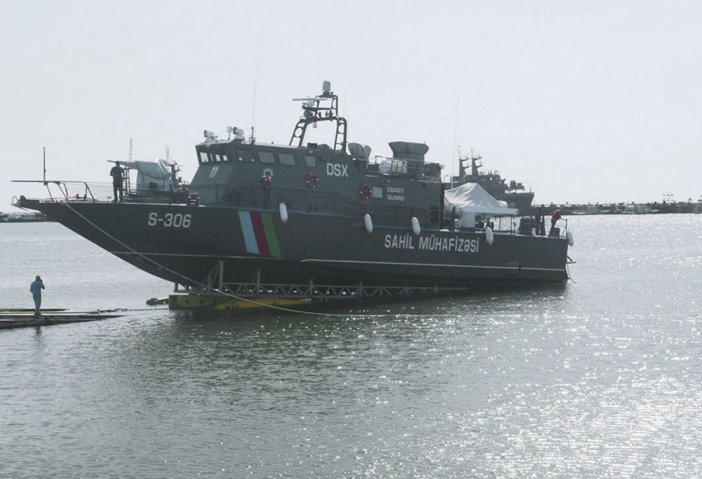
Azerbaijan CG’s New WPC and WPB

AzerbaijanSaar62

Photo: Azerbaijan Coast Guard’s first Saar 62. Source: President’s Office, Azerbaijan

We have talked about these before, but now we have more details, particularly about how they are equipped.

Janes 360 reports the launching of two new vessels for the Azerbaijan Coast Guard, the first of up to six helo deck equipped, 203 foot, 470 ton, 32 knot Sa’ar 62s based on the Israeli Sa’ar 4.5 missile boat, and a sixth 32.65 m-long, 95-ton Shaldag Mk V.

AzerbaijanShaldagMkVFAC

Photo: Azerbaijan Coastguard’s sixth Shaldag Mk V (Azerbaijan State Border Guard Service)

Both types use the Typhoon gun mount which is basically the same as the Mk38 mod2 used by the Coast Guard, except that, instead of using the 25 mm chain gun, these use a Soviet era 23 mm, with a higher rate of fire. Both use the Toplite Electro-Optic fire control system that is also part of the Mk38 mod2.

Most interesting, they are armed with small missile systems. the larger vessels will have an eight cell launcher for the 25 kM range Spike-NLOS.

TYPHOON MLS NLOS configuration has eight Spike NLOS missile launchers and integrated Toplite stabilized observation and target acquisition system. Photo: RAFAEL

TYPHOON MLS NLOS configuration has eight Spike NLOS missile launchers and integrated Toplite stabilized observation and target acquisition system. Photo: RAFAEL via defense-update.com

The smaller vessels have a four tube launcher for the 8 km range Spike-ER.

Azerbaijan’s neighbors on the Caspian Sea are Russia to the North, Iran to the South, and Turkmenistan and Kazakhstan on the other side of the water. They have a small navy in addition to their Coast Guard, but these will constitute a substantial reinforcement. There is appears to be a miniature naval arms race going in the Caspian Sea.