“HELGE INGSTAD REPORT ENGLISH 2021” –YouTube

A recent Marine Link report, “Norway Naval Officer Goes on Trial Over Oil Tanker Collision,” included the video above. Thought you might find it interesting.

Sure, there was a lot of sophisticated equipment that they apparently couldn’t get to work but it also looks like a lot of basics missing as well.

Was a collision alarm ever sounded?

The crew of 137 was extremely small for such a sophisticated ship. Did this mean there was no messenger and/or lookout assigned the bridge watch that might have been used to reestablish communications? It almost certainly means there was minimal redundancy in the skills of the crew.

Did the ship have sound powered phones for emergency communications?

There was a failure to close watertight fittings as spaces were evacuated.

The whole thing looks like a cautionary tale. Don’t put too much faith in high tech. Certainly use it, but don’t forget the basics of good damage control.

“New Sonar For Navy Frigates Could Turn Any Ship into Submarine Hunter, Maker Says” –Defense One

Combined Active Passive Towed Array Sonar, CAPTAS-4 in operation from a French Frigate. There are also smaller/lighter versions of the sonar. 

Defense One reports on a presentation at Surface Navy Association,

 “At the Surface Navy Association conference in Arlington, Virginia, this week, the company showed off a video of the technology being installed on a commercial ship within 48 hours, turning the vessel into an anti-submarine “asset,” Bock said.”

While mounting the sonar on merchant ships might be useful, wouldn’t it make sense to mount it first on Coast Guard National Security or Offshore Patrol Cutters that could also host an anti-submarine helicopter and are already equipped with Navy compatible secure communications?

On a cutter or a merchant ship there is the question of who would man it? Every year trained personnel, including sonar technicians and ASW helicopter flight crews, leave the active-duty Navy and become part of the Reserve. Upon mobilization, they can be recalled to active duty to man these systems.

“USCGC Decisive returns home from Eastern Pacific Ocean deployment, completing final patrol”

The Reliance-class medium endurance cutter USCGC Decisive (WMEC 629) conduct at sea engagements with the navy of Guatemala in the territorial seas of Guatemala on Oct. 25 – 26, 2021. The U.S. Coast Guard conducts routine deployments in the Southern Command area of responsibility, works alongside partners, builds maritime domain awareness, and shares best practices with partner nation navies and coast guards. (U.S. Coast Guard photo)

Below is a pretty standard East Pacific patrol news release, except for the fact that this is Decisive’s final patrol. The old girl, one of the newest of the 210s, is going out after a successful patrol.

I suppose after the numerous delays, this was inevitable, but the first Offshore Patrol Cutter, the future USCGC Argus, isn’t even in the water yet. With the loss of Decisive, we will be down to 36 patrol cutters of more than 1,000 tons, same as in the current program of record. (Original program of record would have given us 33 NSCs and OPCs plus 58 FRCs for a total of 91. Current total in commission is 84 or 85, NSCs, FRCs, and WMECs). With the OPC program extending 15 years into the future, we may see the number of large patrol cutters drop even further.

30 years ago:

The Coast Guard’s last spasm of patrol cutter construction ended in 1992 when the last 110 foot WPB was commissioned. The last 270 foot WMEC had been commissioned in 1991, but the program had still not replaced all the WWII construction. 30 years ago the Coast Guard had 47 large patrol cutters (12×378; 13×270; 16×210; 3×213; Storis; 1×205; 1×180 converted to MEC) in addition to 49 Island class for a total of 96.

I think we are now, and will be for the foreseeable future, seriously short of larger patrol cutters. Some of them may not have to be as big as OPCs, just need better range and seakeeping than the Webber class, but we will not have a good case unless we complete the new Fleet Mix study that reflects current mission requirement that Congress has been asking for. We really need to do this.

News Release

U.S. Coast Guard Atlantic Area


USCGC Decisive returns home from Eastern Pacific Ocean deployment, completing final patrol
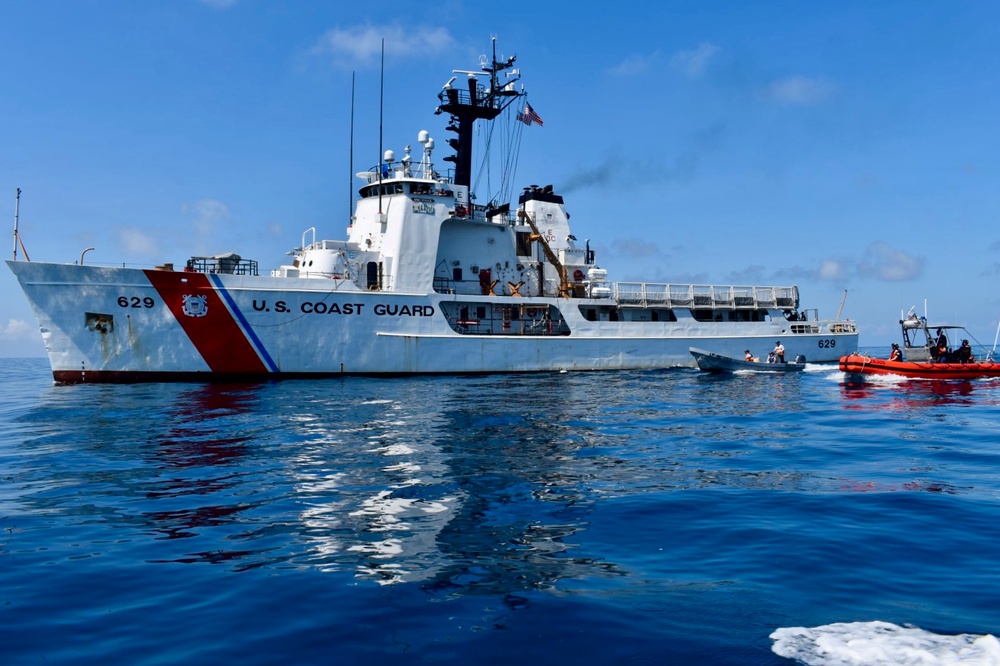
Stock Image of USCGC Decisive

Editors’ Note: To view the stock image above or download high-resolution imagery, click on the photo.

PENSACOLA, Fla. — The crew of the USCGC Decisive (WMEC 629) returned to their homeport in Pensacola, Friday, following a 33-day patrol in the Eastern Pacific Ocean, concluding 55 years of service to the Nation.

Decisive patrolled the Eastern Pacific Ocean in the Coast Guard Eleventh District’s area of operations. While underway, the Decisive’s crew supported the Coast Guard’s drug interdiction and search and rescue missions to promote safety of life at sea and deter the flow of illegal narcotics into the United States.  

While deployed, Decisive’s crew collaborated with Coast Guard assets and foreign military aircraft to detect, deter, and interdict illegal narcotics voyages. At one point, Decisive disrupted two vessels suspected of drug trafficking in the same night. Decisive also collaborated with the USCGC Alert (WMEC 630) to safely transfer three suspected smugglers. While aboard Decisive, the detainees received food, water, shelter and medical attention.

“The crew’s remarkable professionalism, competence and determination were on full display as we met the diverse challenges of operations at sea,” said Cmdr. Aaron Delano-Johnson, commanding officer of Decisive. “Whether it was conducting simultaneous boardings or our skilled engineers conducting voyage repairs in Panama, the crew exceeded expectations at every turn. After a successful, final patrol for Decisive, we are looking forward to returning home to our family and friends on shore.”

During the patrol, Decisive traveled more than 6,000 miles and traversed through the Panama Canal. By transiting the historic waterway, Decisive’s crew earned their Order of the Ditch certificates, a time-honored nautical tradition recognizing mariners who have crossed the Panama Canal between the Atlantic and Pacific Oceans.

Decisive is a 210-foot, Reliance-class medium endurance cutter with a crew of 72. The cutter’s primary missions are counter drug operations, migrant interdiction, and search and rescue in support of U.S. Coast Guard operations throughout the Western Hemisphere.

For information on how to join the U.S. Coast Guard, visit GoCoastGuard.com to learn about active duty and reserve, officer and enlisted opportunities. Information on how to apply to the U.S. Coast Guard Academy can be found here.

For more, follow us on FacebookInstagram and Twitter.

“Coast Guard, partners tracking Russian vessel off Hawaiian Coast” –D14

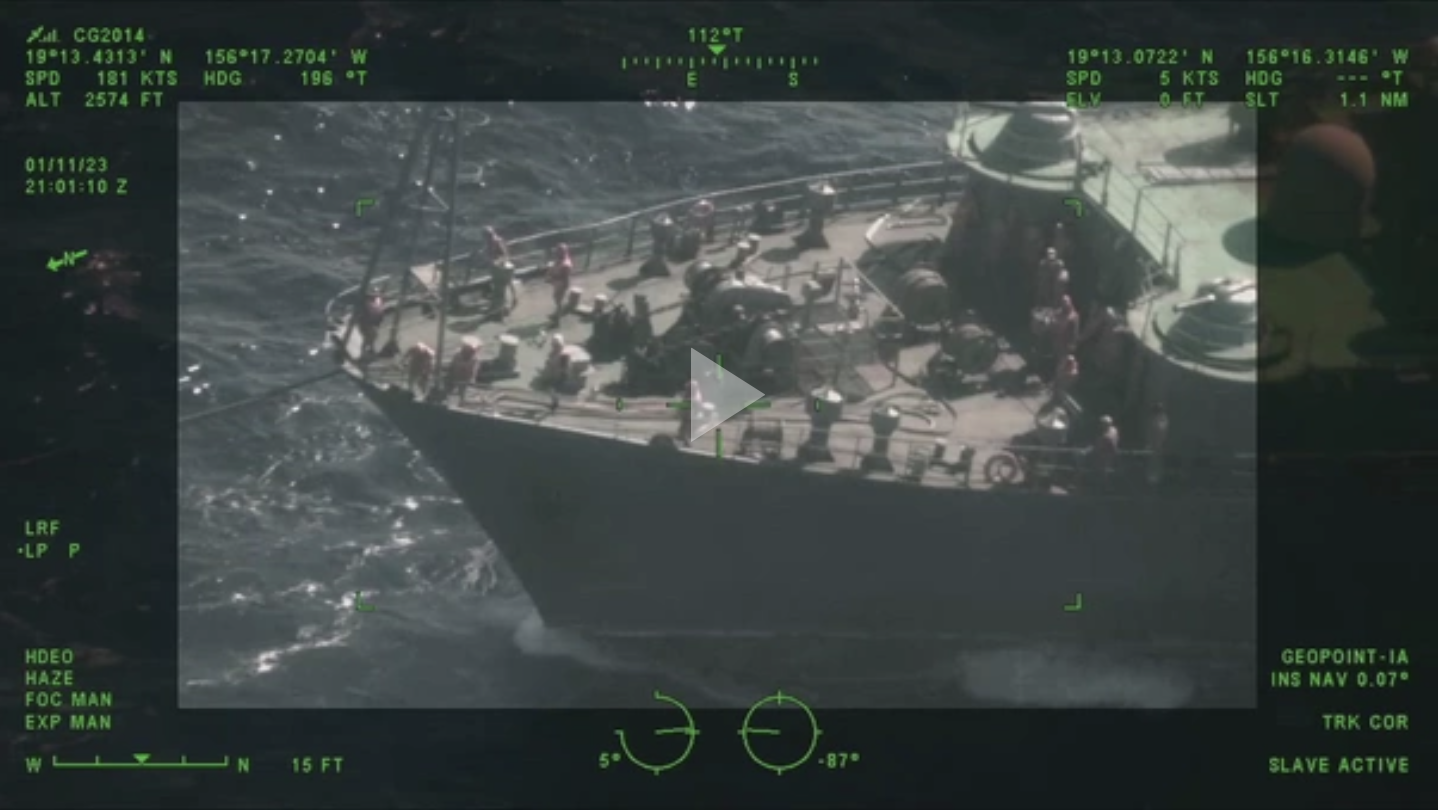
Vishnya class intelligence ship Kareliya (Picture source: Russian MoD)

Below is a news release from D14. The subject is a bit unusual. The accompanying video shows two vessels. One is a Russian Navy Vishnya class intelligence ship, presumably Kareliya, being either towed or perhaps receiving fuel from a ship that appears to be a merchant tanker. The tanker does have some unusual structures forward and amidships. It is not the first time this particular intelligence ship has operated off the coast of Hawaii.

The intelligence vessel (AGI) is probably there to observe missile tests from Barking Sands.

News Release

U.S. Coast Guard 14th District Hawaii and the Pacific

Coast Guard, partners tracking Russian vessel off Hawaiian Coast

Russia Spy

Editors’ Note: Click on video to download a high-resolution version.

HONOLULU — In recent weeks, the U.S. Coast Guard has continued to monitor a Russian vessel, believed to be an intelligence gathering ship, off the coast of the Hawaiian Islands.
 
While foreign military vessels may transit freely through the U.S. economic exclusive zone (EEZ), as per customary international laws, foreign-flagged military vessels have often been observed operating and loitering within Coast Guard District Fourteen’s area of response.
 
The Coast Guard continues to coordinate with Department of Defense partners, providing updates to foreign vessel movements and activities and to appropriately meet presence with presence to encourage international maritime norms.  
 
“The U.S. Coast Guard is currently monitoring the Russian vessel operating in the vicinity of Hawaii,” said Cmdr. Dave Milne, chief of External Affairs. “As part of our daily operations, we track all vessels in the Pacific area through surface and air assets and joint agency capabilities.
The Coast Guard operates in accordance with international laws of the sea to ensure all nations can do the same without fear or contest. This is especially critical to secure freedom of movement and navigation throughout the Blue Pacific.” 
 
As a part of the Department of Homeland Security, the Coast Guard is the lead federal agency for at-sea enforcement of U.S. fisheries laws; additionally, the Coast Guard assists in the enforcement of laws on the high seas subject to the jurisdiction of the United States’ exclusive economic zone. Law and treaty enforcement account for approximately 1/3 of the Coast Guard’s annual budget. 

For breaking news follow us on twitter @USCGHawaiiPac

Austal–OPC, EMS, and Saildrone

Above is a video of interviews with representatives of Austal Shipbuilding in regard to the Offshore Patrol Cutter (OPC) and the Expeditionary Medical Ship (EMS).

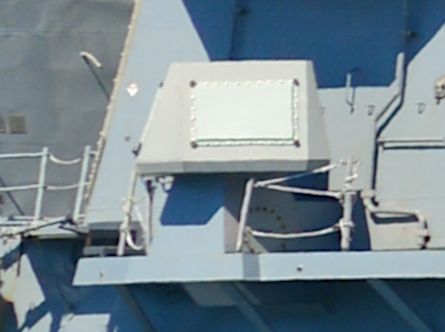
There isn’t much new here about the OPC, but there is an opportunity to get a good look at a model of the ship. Looking at the Mk38, mount atop the hangar, it appears the field of fire and, perhaps more importantly, field of view for its optics are severely limited. (Using the 30mm Mk38 Mod4 with its separately located optics might improve this situation.) It is also not clear where the .50 caliber remote weapon stations (and their associated optics) will be located since the model only includes crew served .50 mounts. Presumably at least one and probably both will be forward, below the bridge and above and behind the 57mm Mk 110 gun mount.

The EMS is a ship the Coast Guard is likely to work with during disaster response operations and possibly during capacity building efforts. Operating Coast Guard helicopters from these ships during a natural disaster would seem a natural partnership.

This video was included in a Naval News report, “Austal Diversifies Revenue Base, Announces New Contracts.” Perhaps also of interest to the Coast Guard, included in the report was the statement that Austal was now “…the exclusive manufacturer of Saildrone, Inc.’s wind and solar-powered Surveyor USV…”, a system the Coast Guard has extensively tested.

International Exercise Obangame Express 2023 Set to Begin

U.S. Coast Guard Cutter Spencer (WMEC 905) underway on patrol in the Eastern Pacific, January 2021. The crew covered over 11,000 miles seizing over $10 million of drugs and assisted in disrupting transnational crime organizations. (U.S. Coast Guard courtesy photo/Released)

Below is a US Navy press release. I anticipate USCGC Spencer will participate along with Coast Guard special teams.

International Exercise Obangame Express 2023 Set to Begin

09 January 2023

From U.S. Naval Forces Europe and Africa / U.S. Sixth Fleet Public Affairs

NAPLES, Italy – Exercise Obangame Express 2023 (OE23), the largest multinational maritime exercise in Western and Central Africa, will kick off its 12th year with 29 participating nations at an opening ceremony in Lagos, Nigeria, Jan. 23, 2023.

Conducted by U.S. Naval Forces Africa (NAVAF) and sponsored by U.S. Africa Command (AFRICOM), OE23 is designed to improve regional cooperation, information-sharing practices, and tactical interdiction expertise to enhance the collective capabilities of participating nations to counter Illegal, Unreported, Unregulated (IUU) fishing and other sea-based illicit activity.

AFRICOM assists African partners with protecting their maritime economy in order to ensure continued sustainable use of maritime resources and enable the security and stability of global maritime trade.

OE23, one of three NAVAF-facilitated regional exercises, provides collaborative opportunities for African and U.S. forces, and international partners to address shared transnational maritime concerns. NAVAF’s ongoing maritime security cooperation with African partners focuses on maritime safety and security through increased maritime awareness, response capabilities, and infrastructure.

“Exercise Obangame Express 23 provides an excellent opportunity to strengthen regional cooperation and share tactics, techniques and procedures for deterring transnational maritime security challenges,” said Rear Adm. Chase Patrick, director of maritime headquarters, NAVAF. “Together, we are creating a more secure, safe, and economically prosperous maritime environment for Africa’s coastal nations and the global community.”

Nigeria will host this year’s exercise in its capital city of Lagos. The exercise will also feature multiple at sea and ashore training events throughout the Gulf of Guinea and the Southern Atlantic Ocean, including exchanges on boarding techniques, search and rescue operations, medical casualty response, radio communication, and information management techniques.

The 29 nations scheduled to participate in OE23 include Angola, Benin, Brazil, Cabo Verde, Cameroon, Canada, Cote d’Ivoire, Democratic Republic of Congo, Denmark, Gabon, Gambia, Ghana, Guinea-Bissau, Italy, Liberia, Morocco, Namibia, Netherlands, Nigeria, Poland, Portugal, Republic of Congo, Sao Tome & Principe, Senegal, Sierra Leone, Togo, and the United States. Also participating will be the Economic Community of West African States (ECOWAS) and the Economic Community of Central African States (ECCAS).

For more than 80 years, U.S. Naval Forces Europe-U.S. Naval Forces Africa (NAVEUR-NAVAF) has forged strategic relationships with allies and partners, leveraging a foundation of shared values to preserve security and stability.

Headquartered in Naples, Italy, NAVEUR-NAVAF operates U.S. naval forces in the U.S. European Command (USEUCOM) and U.S. Africa Command (USAFRICOM) areas of responsibility. U.S. Sixth Fleet is permanently assigned to NAVEUR-NAVAF and employs maritime forces through the full spectrum of joint and naval operations.

Cuban Migrant Interdiction

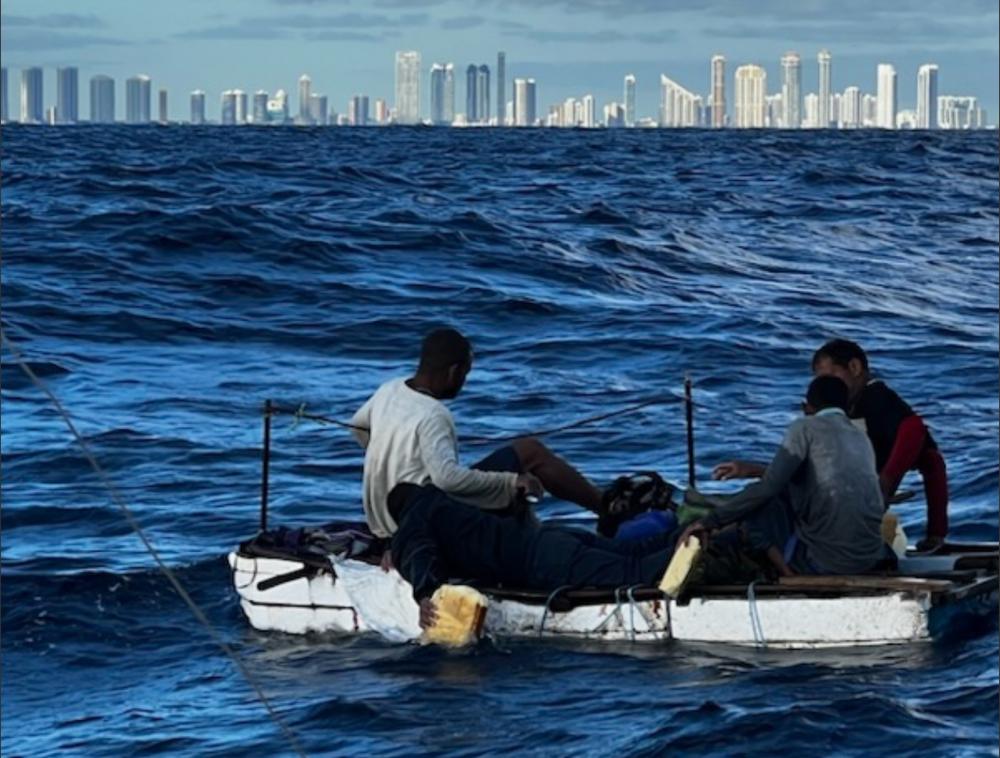
A good Samaritan notified Sector Miami watchstanders of a migrant vessel about 10 miles east of Sunny Isles, Florida, Jan. 8, 2023. The people were repatriated to Cuba on Jan. 16, 2023. (U.S. Coast Guard photo)

I don’t normally post press releases about migrant interdiction. It is a routine dirty job, with little reward, but something the Coast Guard does virtually every day. Just wanted to post the statistics below, that I lifted from a press release about a recent repatriation, to show the current trend to much higher frequency of interceptions.

Since Oct. 1, 2022, Coast Guard crews interdicted 4,962 Cubans compared to: 

  • 6,182 Cuban Migrants in Fiscal Year 2022
  • 838 Cuban Migrants in Fiscal Year 2021
  • 49 Cuban Migrants in Fiscal Year 2020
  • 313 Cuban Migrants in Fiscal Year 2019
  • 259 Cuban Migrants in Fiscal Year 2018
  • 1,468 Cuban Migrants in Fiscal Year 2017
  • 5,396 Cuban Migrants in Fiscal Year 2016

WMEC 210s and Webber class FRCs tend to be the workhorses of this effort, supported by aviation assets of both the Coast Guard and partner agencies.

For perspective, it is still nothing close to the Mariel Boatlift, 15 April and 31 October 1980, when 125,000 Cubans and 25,000 Haitians made it to the US.

“Global Piracy Incidents Fall to Lowest Level in Decades” –gCaptain

USCGC Mohawk sails alongside a Nigerian navy ship in the Atlantic Ocean, Aug. 22, 2022. Mohawk was on deployment in the U.S. Naval Forces Africa area of operations. (Jessica Fontenette/U.S. Coast Guard)

gCaptain reports,

“Incidents of maritime piracy and armed robbery attacks last year fell to the lowest recorded level in almost three decades…”

While incidents are up in Southeast Asia, there has been a notable drop in incidents in the Gulf of Guinea, where the Coast Guard has been actively engaged in capacity building.

“The Gulf of Guinea saw a continued and much needed reduction is attributed to an overall decrease of pirate activity, with the number of incidents falling from 35 in 2021 to 19 in 2022.”

Off Somalia there has been both a sustained counterpiracy effort and allied patrols to interdict arms bound for rebels in Yemen.

“For a fourth year in row, there were no incidents of piracy or armed robbery by Somali-based pirates…”


“SEWIP Roll-Out Continues To US Fleet / Northop Grumman Tests Ultra-Lite Electronic Attack System” –Naval News

Cropped version focusing on the AN/SLQ-32(V)6 suite, USS Porter (DDG-78). Photo by Johan Fredriksson CC-BY-SA

Naval News provides an update on Electronic Warfare (EW) modernization. The paragraph of particular interest to the Coast Guard is below.

A compact SEWIP Lite variant, known as AN/SLQ-32C(V)6, has been developed for smaller ships. Initial deliveries of this scaled version – designed to provide early detection, signal analysis and threat warning for small ships – are supporting the US Coast Guard Heritage class Offshore Patrol Cutter program and the navy’s Littoral Combat Ship.

There is a second Naval News report that may be related, “Northop Grumman Tests Ultra-Lite Electronic Attack System,”

The Ultra-Lite EA System is a scaled-down, onboard EA system for anti-ship missile defense for smaller ships.

Presumably, those smaller ships are again the Heritage (Argus) class Offshore Patrol Cutters and the Navy’s Littoral Combat Ships.

“U.S. Navy Intercepts More Than 2,000 Assault Rifles Shipped from Iran”

Thousands of AK-47 assault rifles sit on the flight deck of guided-missile destroyer USS The Sullivans (DDG 68) during an inventory process, Jan. 7. U.S. naval forces seized 2,116 AK-47 assault rifles from a fishing vessel transiting along a maritime route from Iran to Yemen. (Photo by U.S. Navy)

Below is a press release from U.S. Naval Forces Central Command reporting interdiction of an arms smuggling operation. The initial interception and boarding were done by, soon to be decommissioned, Cyclone class patrol ship USS Chinook. She was supported by another, soon to be decommissioned, Cyclone class USS Monsoon and destroyer USS The Sullivans.

At one time there were ten Cyclone class patrol ships based in Bahrain, along with six Island class patrol boats and for a while some MkVI patrol boats. Apparently, there are still five Cyclone class, based in Bahrain, doing useful work for the USN. Looks like soon, there will only be the six Webber class of Coast Guard Patrol Forces Southwest Asia.

Apparently, 5th Fleet expects the unmanned systems of Task force 59 to perform some of the patrol functions, but I have to wonder if six patrol craft are enough?


MANAMA, Bahrain —

U.S. naval forces intercepted a fishing vessel in the Gulf of Oman, Jan. 6, and discovered it smuggling 2,116 AK-47 assault rifles while transiting international waters along a maritime route from Iran to Yemen.

A U.S. Navy boarding team from patrol coastal ship USS Chinook (PC 9) initially discovered and seized the weapons with support from USS Monsoon (PC 4) and guided-missile destroyer USS The Sullivans (DDG 68). The intercepted vessel, which was sailing on a route historically used to traffic illicit cargo to the Houthis in Yemen, was crewed by six Yemeni nationals.

The direct or indirect supply, sale or transfer of weapons to the Houthis violates U.N. Security Council Resolution 2216 and international law. The transfer of the vessel and its crew for repatriation is in progress.

“This shipment is part of a continued pattern of destabilizing activity from Iran,” said Vice Adm. Brad Cooper, commander of U.S. Naval Forces Central Command, U.S. 5th Fleet and Combined Maritime Forces. “These threats have our attention. We remain vigilant in detecting any maritime activity that impedes freedom of navigation or compromises regional security.”

In the past two months, U.S. 5th Fleet has also intercepted two other fishing vessels in the Gulf of Oman smuggling lethal aid from Iran to Yemen.

Forces operating from expeditionary sea base USS Lewis B. Puller (ESB 3) seized more than 50 tons of ammunition rounds, fuses and propellants for rockets, Dec. 1. Weeks earlier on Nov. 8, The Sullivans, USS Hurricane (PC 3) and U.S. Coast Guard ship USCGC John Scheuerman (WPC 1146) intercepted more than 70 tons of ammonium perchlorate, a powerful oxidizer commonly used to make rocket and missile fuel, as well as 100 tons of urea fertilizer.

The U.S. 5th Fleet operating area includes 21 countries, the Arabian Gulf, Gulf of Oman, Red Sea, parts of the Indian Ocean and three critical choke points at the Strait of Hormuz, Bab al-Mandeb and Suez Canal.