“Trinidad & Tobago Orders 2 Cape-class Patrol Boats from Austal” –Naval News

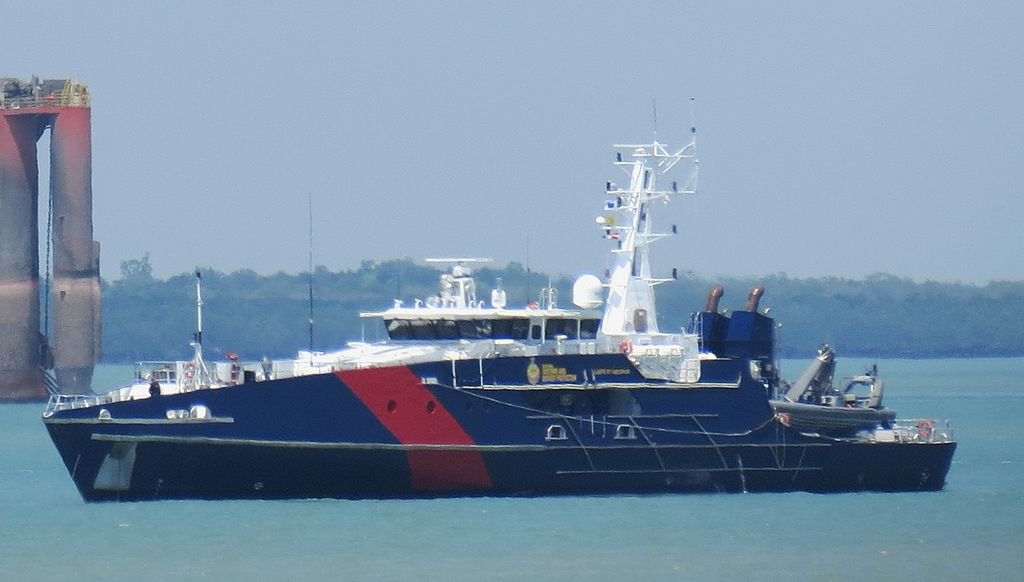
The Australian Customs patrol boat ACV Cape St George on Darwin Harbour in 2014, Photo by Ken Hodge

Naval News reports that Trinidad and Tobago has signed a deal for two Cape Class 58 meter patrol vessels from Austal in Australia. Contract is valued at 126M A$ or about $85.4M US. That is less than the cost of our Webber class cutters. Not that I think the USCG is in the market for anything like this right now. (Perhaps the Navy might consider it.) Still a comparison is interesting.

The Cape Class is a enlarged, improved version of the earlier Armidale class patrol vessels. The Cape Class was originally developed for the Australian Border Force, but the Australian Navy is currently also operating two of the class. Compared to the Webber class.

  • Displacement about twice as large: 700 tons vice 353
  • Length: 57.8 m (190 ft) vice 46.8 m (154 ft)
  • Beam: 10.3 m (34 ft) vice 8.11 m (26.6 ft)
  • Draft: 3 m (9.8 ft) vice 2.9 m (9.5 ft)
  • HP, less: 6,772 vice 11,600
  • Speed, slower: 25 vice 28
  • Crew, smaller: 18 vice 24
  • Boats: two on davits vice one in stern ramp

The dramatic difference seems to be range and endurance, 28 days and 4,000 miles vs five days and 2,500 miles, although I continue to believe the Webber class’ endurance could be improved with only a little effort. These little ships also have aluminum hulls, while the Webber class hull is steel. Also the Australian ships are armed with nothing larger than crew served machine guns. That appears to be just a matter of choice but it would increase the cost.

In some ways these look a lot like the French “La Confiance” PLG. meaning they are similar to the Cutter X concept, although I would favor something a little larger so that it might be able to operate a helicopter.

Our previous contributor on the Tinidad and Tobago Coast Guard, Sanjay Badir-Maharaj, questions the wisdom of this purchase, since The Trinidad and Tobago Coast Guard seems to be having trouble maintaining the vessels it has now. Some degree of maintenance is included apparently, we wish them luck.
“MTR100: #2 Admiral Karl Schultz, Commandant, USCG” –Marine Technology Reporter

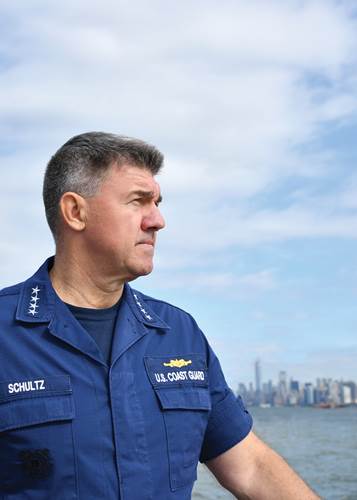
Coast Guard Commandant Adm. Karl Schultz visits with Coast Guard crews stationed in New York City. U.S. Coast Guard photo illustration by Petty Officer 1st Class Jetta Disco.

The Marine Technology Reporter has a short article about Admiral Schultz, largely based on an interview. It is primarily concerned with the Coast Guard’s relationship to the larger Maritime Industry and Infrastructure.

Keeping the commercial maritime waterways humming means business for the subsea community, and a quick ‘by the numbers’ look at the U.S. maritime industry is enlightening and puts the Commandant’s mission in perspective: 95,000 miles of shoreline, 25,000 miles of navigable channels, 361 ports, 50,000 federal aids to navigation, cumulatively support more than 30 million jobs and $5.4 trillion in economic activity.

The Commandant also discussed the cyber threat and what the Coast Guard is doing about it.

“Think about automated ships and facilities. With those automated ships and facilities comes risk, technical and cyber risk. With all of the technology comes increased vulnerability. We’re building out our cyber capability at the Coast Guard. I have about 300 positions today on cyber at the Coast Guard, and the 2020 budget has about another 60 bodies as we have to defend Coast Guard networks from attack and we have to bring a cyber regulatory face to the waterfront. We need to build our own technical experts in this area” and to that end there is a new cyber major at the Coast Guard Academy, with the class of 2022 being the first with graduates with a cyber degree.

Thanks to Lee for bringing this to my attention. 

“US Border Patrol boat damaged by gunfire in brief encounter on Rio Grande” –Baird Maritime

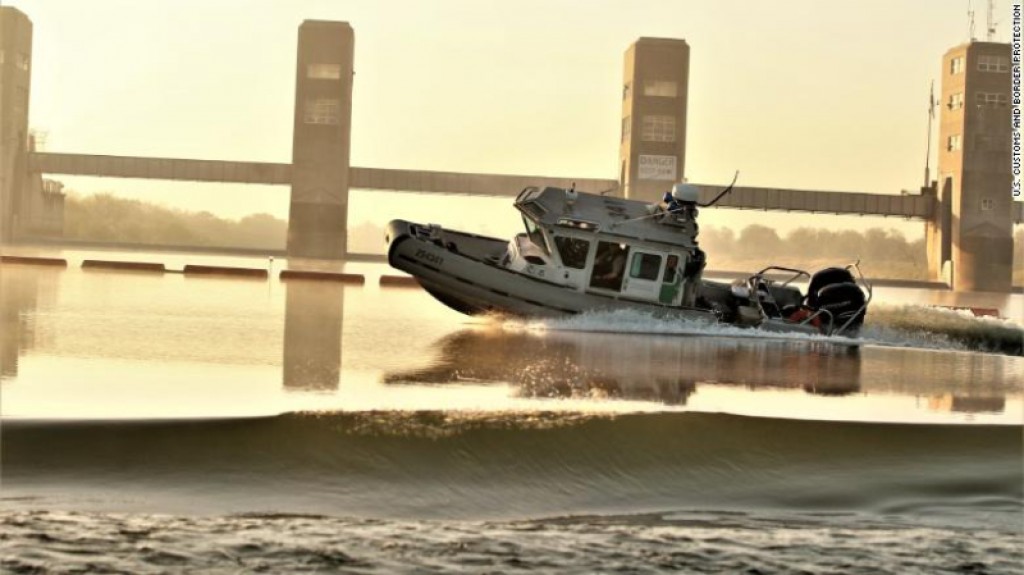
Baird Maritime is reporting that about 50 shots were fired at a Customs and Border Protection boat and its crew, operating on the Rio Grande near Fronton, Texas, on Friday, Aug. 9. The boat was hit several times, but there were no injuries.

This looks to be about ten miles below Falcon Lake. This recalls an incident in 2010. Blog discussion here.

“Coast Guard Ramps Up in Hawaii with 2 New Ships” –Military.com

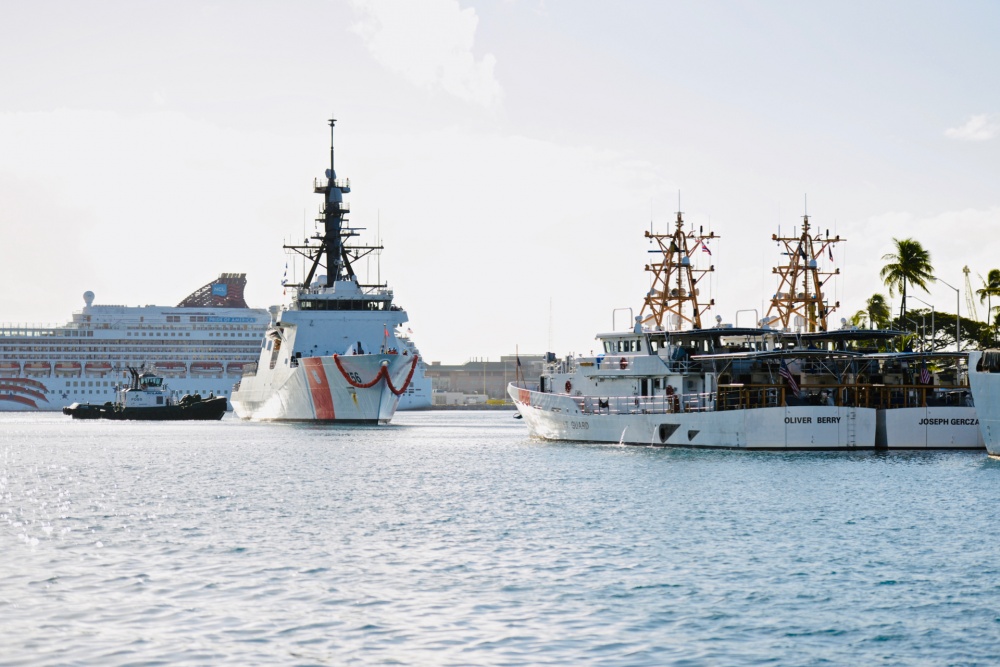
The crew of USCGC Kimball (WMSL 756) arrive in Honolulu for the first time Dec. 22, 2018. Known as the Legend-class, NSCs are designed to be the flagships of the Coast Guard’s fleet, capable of executing the most challenging national security missions, including support to U.S. combatant commanders. (U.S. Coast Guard photo by Chief Petty Officer Sara Muir/Released)

Military.com reports that 14th district is getting a second National Security Cutter, the Future USCGC Midgett arriving on Friday, Aug. 16 (to be commissioned along with Kimball Aug. 24 in a rare dual commissioning) and a third Webber class, the William Hart.

It also discusses the Coast Guard’s increased activity in the Western Pacific and Oceana.

“It’s Time for a ‘Quad’ of Coast Guards” –Real Clear Defense

A Japan Coast Guard helicopter approaches an Indian Coast Guard patrol vessel during a joint exercise off Chennai, India, January 2018 (Photo: The Asahi Shimbun via Getty)

Real Clear Defense has an article which first appeared in the Australian think tank Lowy Institute‘s publication “The Interpreter,” advocating greater cooperation between the Coast Guards of Australia, India, Japan, and the US.

“The so-called Quad group of Indo-Pacific maritime democracies – Australia, India, Japan, and the United States – is a valuable grouping, although it is still under utilized in many ways. One of the most effective ways that these countries could work together to enhance maritime security in the Indo-Pacific would be through coordinating the work of their coast guard agencies.”

While India in particular, is adverse to committing to a military alliance, these nations share a commitment to a rules based international system.

Quadrilateral cooperation through the countries’ coast guards could provide an answer to this political problem. As principally law-enforcement agencies, coast guards can provide many practical benefits in building a stable and secure maritime domain, without the overtones of a military alliance.

Using ship-riders, this sort of cooperation could go beyond capacity building and uphold the norms of international behavior. It might lead to the kind of standing maritime security task force I advocated earlier. When coast guards are in conflict, having multiple coast guards on scene could insure that instead of a “he said, she said” situation, we could have a “he said, we say” situation that would show a united front against bullying.

Given Bertholf and Stratton‘s stay in the Western Pacific and Walnut and Joseph Gerczak‘s support of Samoa, which was coordinated with Australia and New Zealand, it appears we may already be moving in this direction.


“Lighthouse Act – 7 August 1789” –BRYMAR

A little late, but I am passing this little tidbit of Coast Guard history along from BRYMAR consulting.

Lighthouse Act – 7 August 1789

C:\Users\User\Pictures\01Blog pix\USLHS-a.jpg
The Lighthouse Act was the ninth statute adopted by the First Congress of the United States. It provided for the voluntary cession by the various states of all lighthouses, beacons, buoys, and public piers to the federal government and tasked the Secretary of the Treasury with building and maintaining the aids to maritime navigation. The Lighthouse Establishment (later named the United States Light House Service) is the oldest of the various components of the present-day United States Coast Guard, joining in 1939.

“sUAS Extend Coast Guard Capabilities in the Inland Rivers” –USNI

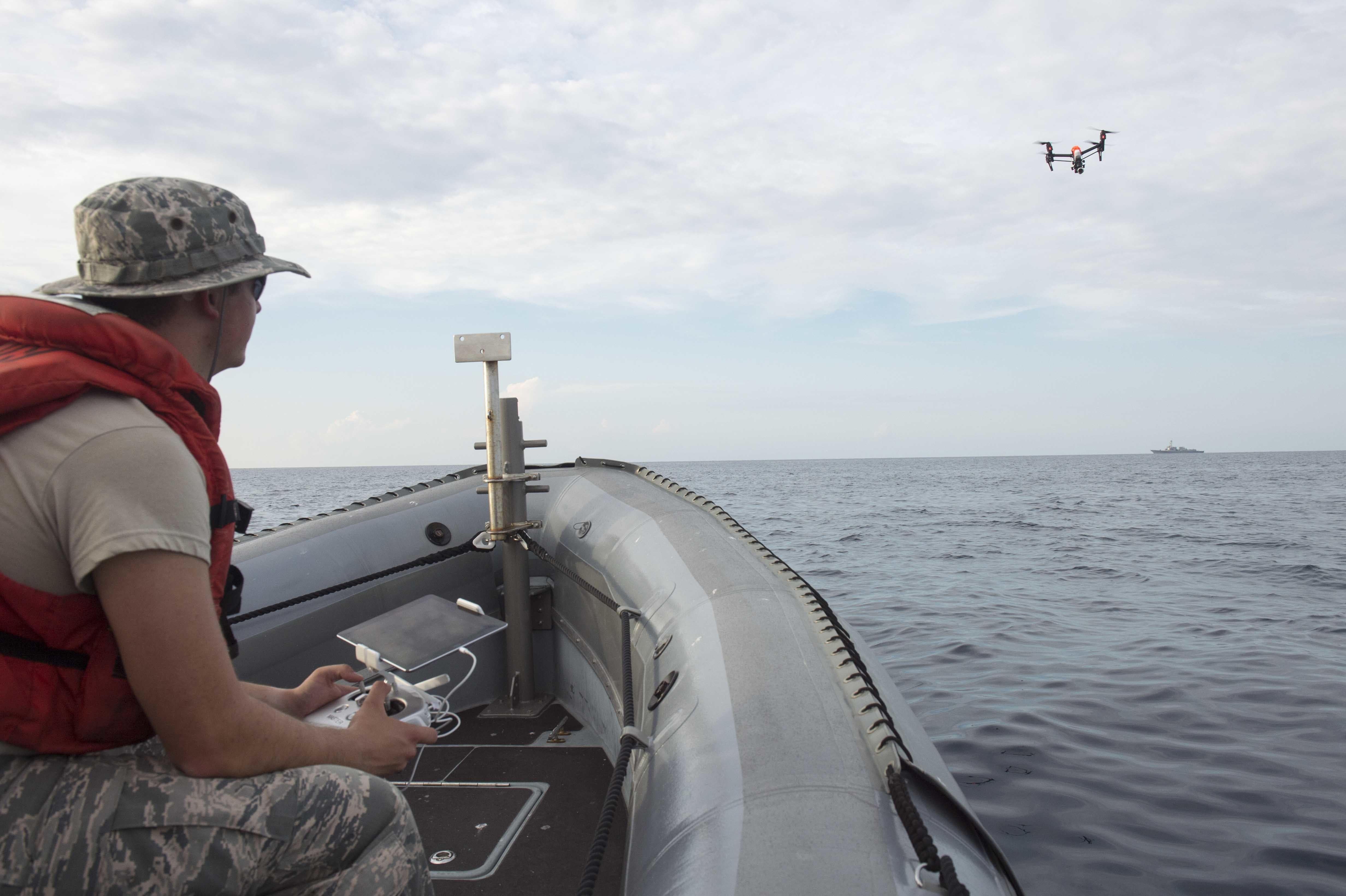
160919-N-AT101-177 GULF OF MEXICO (Sept. 19, 2016) Cadet 1st Class Hanson Oxford, a student at the U.S. Air Force Academy, operates an unmanned aerial system aboard a rigid hull inflatable boat during exercise Black Dart, Sept. 19. Black Dart is the largest Department of Defense (DoD) live-fly, live-fire, counter Unmanned Aerial Systems (UAS) technology demonstration. (U.S. Navy photo by Mass Communication Specialist 1st Class Maddelin Angebrand/Released)

A thought provoking article from the US Naval Institute looking at ways small unmanned air systems (sUAS) have been used, or might be used, in support of Coast Guard missions in inland areas.

The Coast Guard apparently includes systems as large as ScanEagle in the sUAS category. The USNI post notes,

“Individual Coast Guard units are currently prohibited from procuring and operating their own sUAS until the Coast Guard can establish a program to provide the appropriate systems and training to operators.”

The discussion here is not about systems as large as ScanEagle, but rather small, off the shelf systems, costing less than $5,000. The costs of these systems is so low, and the potential impact so great, perhaps the Coast Guard should have a program to procure a small number of these systems for units that can make a case for them, as prototypes for future deployment. Ground rules might specify a one year trial period and periodic feedback.

Marines are already starting to deploy these at the squad level. Presumably there must be a contract for them. Maybe they are already on GSA schedule.

Drugs Smuggling By Container

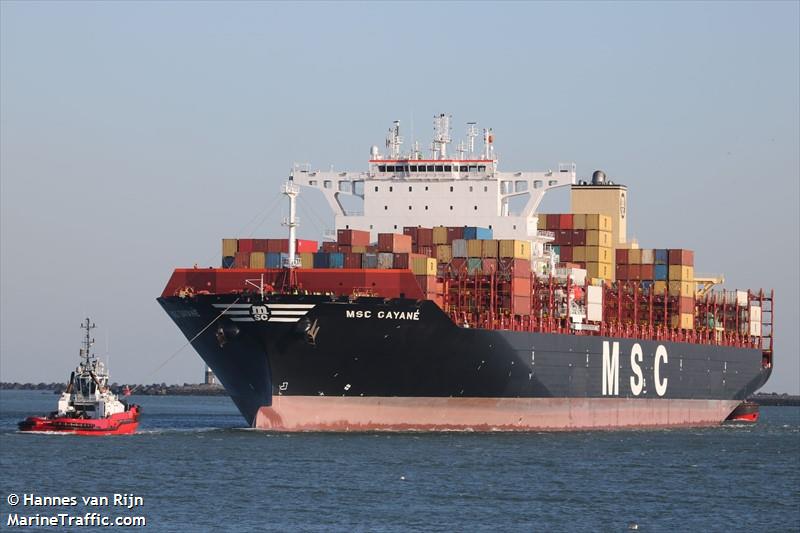
File photo shows the MSC Gayane. Photo: MarineTraffic.com

Three recent incidents of drugs being smuggled by containers aboard ship.

In the US:

June 18 (Reuters) – Federal authorities seized 16.5 tons of cocaine worth more than $1 billion from a ship in Philadelphia in one of the largest drug seizures in U.S. history, the U.S. Justice Department said on Tuesday.

Federal, state and local law enforcement agents on Monday boarded the MSC Gayane, a cargo ship docked in Philadelphia’s Packer Marine Terminal, and found cocaine in seven shipping containers, according to a criminal complaint filed in Philadelphia federal court.

Since then, four additional arrests have been made. The Customs and Border Protection news release is here. Crew members facilitated the loading of the drugs.

August 1, a vessel docked in Felixstowe, UK where the vessel was boarded and authorities found approximately 398 kilograms of heroin hidden among towels and bathrobes.

Germany seized 4.5 tonnes of cocaine from a container at the port of Hamburg, marking that nation’s biggest drugs haul to date. The shipping container in that case was loaded in Montevideo, Uruguay and bound for Antwerp.

“Coast Guard Awards Contract for 47-Foot Motor Lifeboat Service Life Extension Program” –CG-9

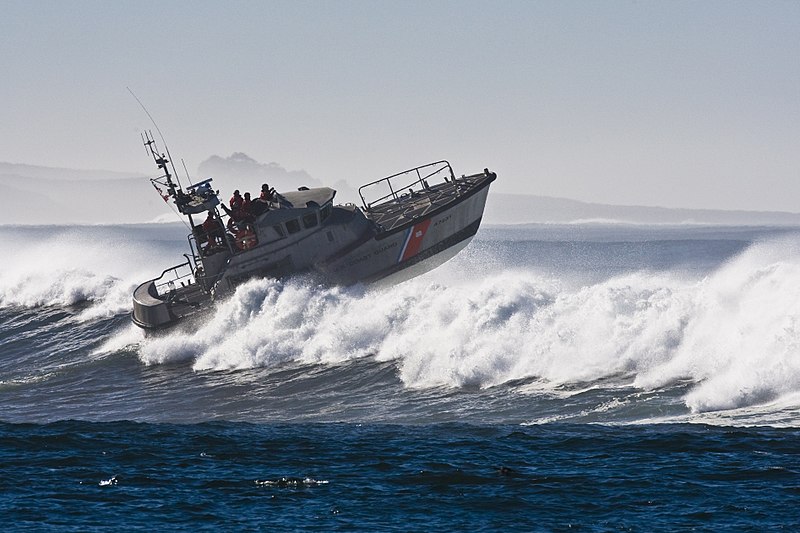
47-Foot Motor Life Boat (MLB) 47231 from Station Morrow Bay, 4 Dec 2007. Photo by Mike Baird

The Acquisitions Directorate (CG-9) reports award of a contract for service life extension work on its 47 foot motor lifeboats. 

—–

The Coast Guard on Aug. 5 awarded a firm fixed price indefinite delivery, indefinite quantity contract to Birdon America Inc. of Denver, Colorado, to perform work supporting the service’s 47-foot Motor Lifeboat (MLB) service life extension program (SLEP). The initial award to complete the detail design and service life extension work on the first vessel is valued near $6.5 million, with a total projected contract value of close to $190 million to complete the MLB SLEP over the 10-year contract period. The initial work for detail design and the first vessel will be performed at a subcontractor facility on the West Coast, Fred Wahl Marine Construction along the Umpqua River in Reedsport, Oregon. Once in full production, a second subcontracted work facility is planned to be opened on the East Coast.

The 47-foot MLB is the Coast Guard’s primary search-and-rescue platform operating in surf and heavy weather conditions. It has self-righting capability and the ability to operate in winds up to 50 knots, seas up to 30 feet, and surf up to 20 feet. The service’s fleet of more than 100 MLBs has been in service for 15 to 21 years and is approaching the end of its planned 25-year service life. The operational need for these unique capabilities in search-and-rescue, maritime law enforcement, and contingency response remains high.

The SLEP will extend the useful life of the MLB by 20 years; SLEP work will be performed on a minimum of 107 MLBs and a maximum of 117 MLBs. The main work will be on systems experiencing technical obsolescence: the main propulsion, electrical, steering, towing and navigation systems, as well as replacement of areas of the hull and structure that have demonstrated high failure rates. Additionally, efforts to enhance human system integration will be made where practical to do so. The original operational capabilities and characteristics of the 47-foot MLB will not change.

CG Exercises Option for Webber Class WPCs #51-56

The Coast Guard Cutter Lawrence Lawson crew mans the rail during sea trials off the coast of Miami, Florida, on Dec. 12, 2016. The ship will be the second fast response cutter stationed in Cape May, New Jersey, and is scheduled for commissioning in early 2017. (U.S. Coast Guard photo by Eric D. Woodall)

The Acquisitions Directorate (CG-9) reports the exercise of a contract with Bollinger for construction of six more Webber class WPCs (Fast Response Cutters or FRCs).

The Coast Guard exercised a contract option for production of six more Sentinel-class FRCs and associated deliverables worth just over $297.4 million with Bollinger Shipyards of Lockport, Louisiana, July 31.

This option brings the total number of FRCs under contract with Bollinger to 56 and the total value of the contract to approximately $1.23 billion. The contract has a potential value of $1.42 billion if options to procure all 58 cutters are exercised. The FRCs built under this option will be delivered beginning late 2022 into late 2023. To date, there are 33 FRCs in operational service.

Things to note.

  • The $1.23B referred to did not pay for all 56 vessels, only those purchased under the most recent contract.
  • Buying in quantity lowers the price. Since this is a long running contract and we have ordered the maximum number Bollinger can build in a year, increasing efficiencies have lowered the per ship price from over $60M to less than $50M.
  • While this program will likely continue to deliver vessels through at least 2024, we are nearing the end of this program, at least in terms of contracting. FY2020 may be the last year that will include money for WPC new construction, if it includes funding for six more vessels and 64 is final number constructed. This would include 58 in the program of record and six to replace the six WPBs in PATFORSWA (four of which have already been funded).