Will the CG Again Arm Icebreakers?

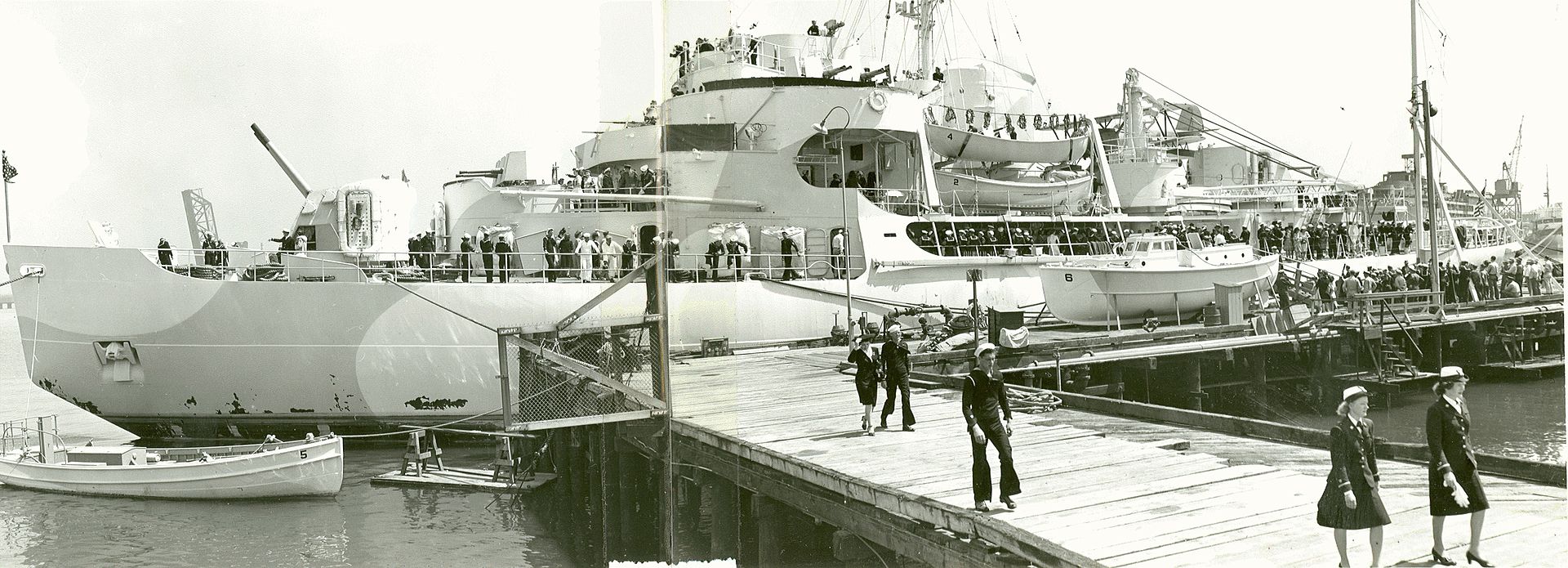
USCGC Southwind Commissioning. As built, their armament included two twin 5″/38 mounts, three quad 40mm mounts, six 20mm, depth charge racks and depth charge throwers, and hedgehog ASW rockets. (Wonder how long the sonar dome lasted?)

The Washington Examiner reports 

President Trump’s team could decide to arm future Coast Guard icebreakers in order to counteract Russian cruise missiles in the Arctic, the Coast Guard’s top admiral said following a meeting with the administration.

No statement from the administration, but the Commandant is quoted,

“They understand that it’s good that you have a U.S. Coast Guard that is a military service,” Adm. Paul Zukunft, the U.S. Coast Guard commandant, told the Center for Strategic and International Studies on Wednesday. “So what might an icebreaker of the 21st century need to be? You might want to reserve space, weight and power where you have an offensive and a defensive armed capability as a military service … that could be a future requirement for our icebreaking fleet.”

What Do they Need?:

This rethink seems to have been prompted by the Russian construction of the Project 23550 arctic patrol vessels which are capable of breaking up to 1.5 meters of ice (only one meter continuous) and which are armed with a 76mm gun and have been pictured hosting two containerized cruise missile launch systems. The Russians probably see these as replacements for the Ivan Susanin class, armed icebreakers, although cruise missiles would make a huge improvement in capability.

I have noted, the missile systems may be more for publicity than for actual usage. The first of class has emerged without the missiles installed, but after all, that is the point of the containerized cruise missile system. You can put them on almost anything.

In any case, these two ships, and their possible 16 missiles, do not substantially change the security situation in the Arctic. There have been a substantial number of Russian cruise missile launchers in the Arctic for decades. Their long range aircraft and submarines are far more dangerous. As has been noted, Russia gets a great deal of its wealth from the Arctic and consequently has strong motivation to put military assets in the Arctic. They have been respectful of international law in the region, settling disputes peacefully. Still, if it comes to a fight, they appear to have overwhelming strength in the Arctic, and the Canadians cannot help us very much.

The Arctic may be peaceful now, but these ships may be in service for 50 years and things change. We could even see a conflict over the Antarctic during the life of these ships.

The Commandant’s remarks seem to suggest that Icebreakers will be built “fitted for but not with” weapons. This is probably a wise choice, except that we need more than .50 caliber machine guns, if the Icebreaker is to perform its professed peacetime missions. Like all Coast Guard vessels it needs the ability to forcibly stop vessels of any size even if they refuse to stop. Beyond that, the question is, what do we want to be able to add?

We should recognize that these will be large ships, not just by Coast Guard standards, but by warship standards. The Polar Star is almost 14,000 tons full load. The Healy is over 17,000 tons.  Many Russian Icebreakers are much larger. I will be surprised if the new icebreaker is not at least 20,000 tons full load, so there are a lot of options. 20,000 tons is more than three times as large as the Wind Class icebreaker pictured above (6,500 tons), bigger than a WWII heavy cruiser, twice as large as a Burke class DDG (8,300 to 9,800 tons full load), a third larger than a Zumwalt class DDG (less than 15,000 tons). It may even approach the size of Huntington Ingalls Ballistic Missile Defense ship concept which at one point included 288 vertical launch missile cells (about 25,000 tons full load).

Huntington Ingalls LPD based Ballistic Defense Ship Concept

If we take the “fitted for but not with” approach, then the design process should start with some preliminary design for a fully armed ship, then see where and how much we want to back off. That will free up space for peacetime missions like scientific research. We can then decide how much additional space should be provided in the design for other peacetime purposes. There could be many opportunities for dual use of spaces provided for war fighting systems–magazine spaces as storage, additional birthing and messing, etc.

After a decision is made about systems to be included in the fully equipped design, we should of course figure crew size and provide hotel services accordingly, keeping in mind the crew may have to accept more crowding. It is entirely possible crew size may double as was the case with many warships designed before WWII, when they actually entered combat. Including extra hotel service capacity can also serve a dual purpose, the ability to support more passengers, or perhaps mitigate problems if the ship has to respond to a disaster such as a sinking cruise ship.

The following is a list of possible capabilities we might consider, in more or less, what I see as the priority of the systems, going from mild to wild, from gunboat to ballistic defense ship. All are feasible at this stage in the planning process. As the design develops, we will be closing off options. I will talk about each.

  1. Ship stopper weapons
  2. Navy type helicopters and their special equipment and weapons
  3. Electronic Warfare Systems/ECCM
  4. Self-defense missiles to counter anti-ship cruise missiles
  5. Multi-function radar system with fire control capability
  6. Towed array sonar system
  7. Anti-ship cruise missiles
  8. Local area AAW missile (Mk56 VLS and ESSM)
  9. Mk41/Mk57 vertical launch system
  10. Energy weapons
  11. Anti-Ballistic Missile Radar

Ship Stopper Weapons:

This is a requirement in both peace and war. We have to be able to forcibly stop a ship of any size, even if they refuse to stop, even after warning shots and being fired into. For very small vessels this might be done with a .50 caliber machine gun. If the vessel is a bit bigger maybe a 25 or 30mm gun might work. For any substantial ship we need something more.

Photo: Mk 46 30mm gun mount

As I have expressed several times, a light weight torpedo seems the least impactful effective way to achieve that. We may not need new torpedoes after all. Recently I have seen a statement that the Mk46 Mod5 has an anti-surface capability. The Navy must certainly have reserve stocks in storage given today’s much smaller surface fleet. If they do have an anti-surface capability, even if only against deep draft targets, torpedoes in combination with Mk38 mount(s) for warning shots, is the easiest solution. Before going to Antarctica, the torpedoes themselves could be removed. I doubt there is anything classified about the tubes. There is no requirement that icebreakers going to Antarctica be unarmed, only that they be open for inspection.
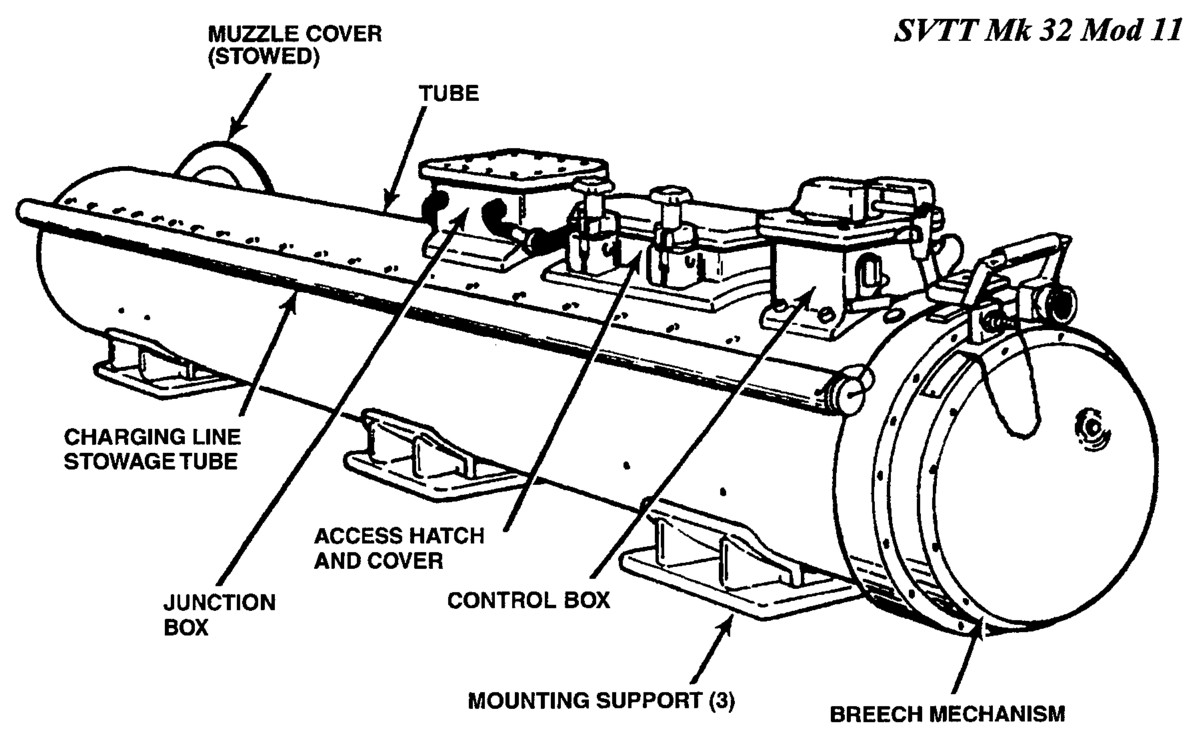
Surface Vessel Torpedo Tube, Mk32 mod11

The Mk32 mod 11 fixed single barrel torpedo tube illustrated above weighs only 1160 pounds loaded, is only about 11’4″ long and less than two feet wide. It does need 9’6″ clear space behind the breech for the loading tray. An Icebreaker would probably not have any problem handling these or the more familiar trainable triple torpedo tubes. (Incidentally, the torpedo tubes to include heating systems.)

While not as effective against really large targets, if an older version of the 5″ Mk45 has been declassified it might be paired with a simple electro optic fire control, we could put declassified weapons even the breakers going to Antarctica. Equipped this way, they could be upgraded relatively easily by adding a more sophisticated fire control system and by upgrading to the latest mod of the Mk45. Any ground combat in a polar region is likely to involve only small units. If a 5″ could be brought within range, it would likely dominate the field.

Navy type helicopters and their special equipment and weapons:

The Polar Icebreaker is of course expected to support a couple of Coast Guard helicopters and probably some type of drone. One of the most versatile weapons systems would be the ability to support a couple of Navy MH60s and MQ-8C drones. The flight deck and hangar requirements will not be much if any different from normal peacetime requirements, but we should not forget the requirement for storage of weapons, other expendables, and support equipment.

Planning for support of Navy helos will probably also facilitate support of Army or Airforce helicopters if contingencies require.

Electronic Warfare Systems/ECCM:

If combat requires access to polar regions, heavy icebreakers are likely to be prized and virtually irreplaceable assets that will justify significant investment in self-defense. Even if we have all three planned heavy icebreakers, we will have many more destroyers, big deck amphibs, and even aircraft carriers. Losing even one may become a strategically important loss.

We can not take ESM/ECCM systems to Antarctica now, but so far these have proven the most effective defense against anti-ship cruise missile. We need to plan to add them.

Self-defense missiles to counter anti-ship cruise missiles:

SeaRAM launcher

While soft kill systems have so far outperformed hard kill systems, this is likely to change. Anti-ship cruise missiles are increasing employing multiple sensors and target recognition systems that will be difficult to fool. A pair of SeaRAM launchers to provide 360 degree coverage and 22 ready rounds seems appropriate. Additionally, like the Phalanx CIWS they are derived from, they are stand alone systems that can engage threats without cueing from other sensors or human decision making.

Multi-function radar system with fire control capability:

A multi-function radar like those on the National Security Cutters and planned for the Offshore Patrol Cutter will improve situational awareness and improve employment of other systems.

Towed array sonar system:

Submarines are the primary warships of the ice covered Arctic region. Both for self defense and for the protection of accompanying vessels, the ability to deploy sonar systems, particularly passive ones could be extremely useful.

I have to wonder how effective long range torpedoes launched from submerged submarines under the ice would be against surface vessels operating in ice. There might be unseen ice ridges extending below the surface that might take the hit.

To me this suggest that subs may have to break through to the surface and launch cruise missiles to engage surface ships in ice fields (this is largely speculation so don’t take it as proven).

Anti-ship cruise missiles:

The concept of distributed lethality suggests putting cruise missiles on virtually everything (“If it floats, it fights.”) There is no reason that should not include icebreakers. Again not something we want to take to Antarctica, but an option that perhaps should be left open.
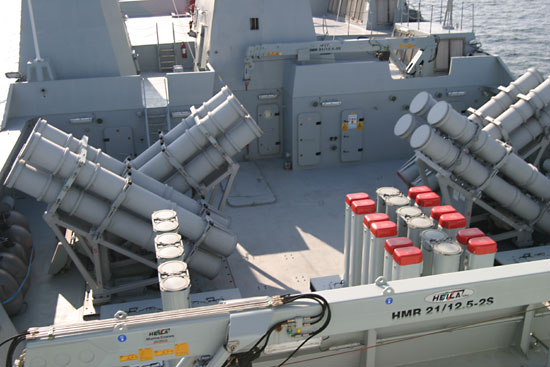
Harpoon and ESSM on Danish Navy Absalon class Support Ship. This area supports 16 Harpoon and 36 ESSM launchers.

It should not be too difficult to provide an open space like the one pictured above for the future mounting of weapons. In the mean time it could serve as a flex deck for mounting experiments and other modular systems.

Local Area AAW Defense (Mk56 VLS and ESSM):

Evolved Sea Sparrow Missile can extend a layered defense around own ship and provide a degree of protection for ships and facilities that may be near the ship.

Mk41/Mk57 vertical launch system:
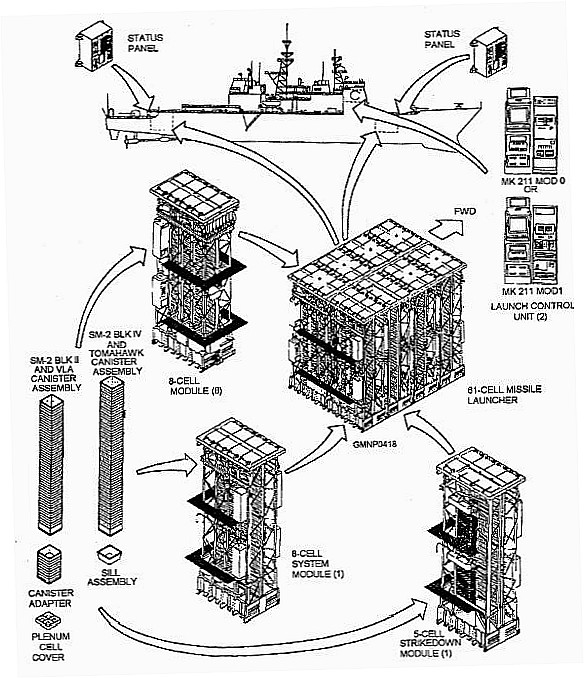
This is near the bottom of my priority list, but providing the space for this may require little more than converting a cargo hold. It doesn’t even have to be very deep. They are at most 26 feet high, meaning perhaps three decks down or only two decks deep and some protrusion above the deck. These can support Sea Sparrow, Evolved Sea Sparrow Missile (ESSM), Vertical Launch Anti-Submarine Rocket (VL–ASROC), all the various Standard Missiles, and Tomahawk cruise missile.

The strike length Mk41 and particularly the 57 VLS are likely going to be able to launch any future USN surface launched anti-ship or land-attack missile for the life of the new icebreakers. These ships could make a contribution to the concept of distributed lethality.

Unless we see my last possible system added, the icebreakers are unlikely to be able to use the capabilities of a Standard Missile independently, but systems are available that would permit cooperative engagement in which a unit, such as an airborne early warning aircraft, could make a detection and take control of a missile launched from a surface unit.

Energy weapons:

Certainly not something for the near future, but an electrically powered icebreaker might be a good candidate for high energy weapons like lasers and rail guns because they will generate so much electricity. Diverting power from propulsion to weapons sounds very “Star Trek” but it is being worked on right now

Anti-Ballistic Missile Radar:

The AN/SPY-6 (v) is the new generation Air and Missile Defense Radar. It is to be used on the Arleigh Burke Flight III destroyers. In this installation it is a major improvement over the existing AN/SPY-1 installations, but because it is scalable being made up of independent Radar Modular Assemblies (RMAs), it would actually benefit from a larger installation than will fit on the new Burke class ships. Consequently Huntington Ingalls has proposed using the LPD-17 class hull for a missile defense ship.

The Polar Icebreaker is likely to be much larger than the Burke Flight III ships and may approach the size of the LPD-17 class and could be designed to accept the radar if the needed.

Do we now or will we in the future require an icebreaking missile defense ship in the Arctic? Not my area, but if we are worried about Russian missiles coming across the pole, the geography looks favorable.

Conclusion:

At this point, “arming” Polar Icebreakers could mean a lot of things.

Hopefully these ships will live out their lives in a peaceful world and will never need to be substantially better armed than they come out of the building yard, but hedging our bets with reserved space, weight, and stability margins is smart.

Keeping some of these options open may cost very little. Hope we choose wisely.


The 2017 Budget

It seems a bit late to talk about the FY2017 budget, but here we are, eight months into the FY, and it is finally signed into law. This is a bit rambling, forgive me, but that is the budget process.

The Coast Guard’s description of the Obama administration’s original budget request is here. It is fairly detailed, but now obsolete.

A short summary of the Coast Guard budget, as part of a summary of the Department budget, contained in the Omnibus bill is here. It is quoted in full below.

Coast Guard – The bill contains $10.5 billion for the U.S. Coast Guard – an increase of $344 million above the previous Administration’s request and a decrease of $467.3 million below the fiscal year 2016 enacted level. Specifically, the bill:

  • Provides 1.6 percent military pay increase;

  • Provides $7.1 billion for operations and training, military personnel costs, aviation and cutter hours, and to reduce a maintenance backlog that can hinder readiness and response; and

  • Provides $1.37 billion – $233 million above the request – for modernization and recapitalization of vessels, aircraft, and facilities. This includes funding for the Polar Ice Breaking Vessel program, the acquisition of an Offshore Patrol Cutter, an HC130-J aircraft, six Fast Response Cutters, and facility improvements at multiple locations throughout the United States.

The good news here is that the Coast Guard will not see a dramatic cut to pay for “the Wall.” The bad news is that the total budget is down over $600M from the FY2016 enacted budget (I know this is different from the summary above, but that is what I got), most of which is an approximately $580M cut in AC&I which included NSC#9.

There is actually a small increase in operating budget from last year and from the initial budget request, a bit over $100M.

There is a pleasant surprise in the notes explaining budget reductions in the Coast Guard’s explanation of the initial budget request:

“National Security Cutter Energy Efficiency -$13.5M

(O FTE) Reflects savings from a re-calculation of National Security Cutter (NSC) energy costs based on observed energy expenditures during NSC operations, without impacting the ability to carry out those operations”

Apparently the big cutters are not costing a much to fuel as we expected. I suppose this could just reflect current oil prices.

There is also a note that there will be a permanent increase in the crew size for all NSCs.

You can see the actual bill here (pdf), the Coast Guard budget is on pages 28-32.

Unexpected items in the Operating Budget

  • Additional $4.49M for Cyber
  • $5M for the CG museum

Reserves: A total of$112,302,000 is provided for Reserve Training.

The AC&I Budget includes:

  • $2M for design work on Great Lakes icebreaking capacity
  • $1M for design work on Inland AtoN fleet
  • $99M for Shore and AtoN (Almost doubles original request of $51.1M) 
  • National Security Cutter. A total of $255,400,000 is provided for the National Security Cutter (NSC) program. The total includes $95,000,000 for procurement of long lead time materials associated with a tenth National Security Cutter, and $3,400,000 for post-delivery activities for the ninth NSC. In addition, $30,000,000 is included to support a necessary Structural Enhancement Dry-dock Availability (SEDA) for the second NSC.
  • $325M for six FRC (rather than four for $240M in the original request)
  • $55M total for the Polar Icebreaker program.
  • $90M for a missionized C-130J
  • $44.52M for shore facilities
  • Major Acquisition Systems Infrastructure. A total of $50,000,000 is provided, including $22,000,000 to support the Coast Guard’s plan to homeport OPCs in the arctic region to replace aging assets.
  • A total of $36,319,000 is provided for Research, Development, Test, and Evaluation (RDT&E). Includes $18M to evaluate long range shore based Unmanned Air Systems.

There is a change in ship procurement policy:

“The policy requiring the Coast Guard to obtain appropriations for the total acquisition cost of a vessel, including long lead time materials, production costs, and post-production costs, before a production contract can be awarded has the potential to create shipbuilding inefficiencies, force delays in the obligation of production funds, and require post production funds far in advance of when they will be used. The Office of Management and Budget is expected to give the Coast Guard the flexibility to acquire vessels, including the Offshore Patrol Cutter (OPC), in the most efficient manner within the guidelines of strict governance measures.”

Funding for Coast Guard OCO/GWOT activities ($162.7M) is provided directly through the Operating Expenses appropriation instead of through the Navy’s Operation and Maintenance account.

There are some requirements incorporated in the law.

“Not later than 90 days after the date of enactment of this Act, the Coast Guard shall brief the Committees on plans, including a funding strategy,  for improving the cybersecurity posture of the Coast Guard and balancing requirements of operating within the “.mil” domain while adhering to DHS cyber directives.”

“The Coast Guard is directed to submit to the Committees a Capital Investment Plan (CIP) for fiscal years 2018 through 2022 by June 30,2017.”

“The Coast Guard is directed to move quickly in approving additional Ballast Water Management Systems (BWMS)and shall work with the Environmental Protection Agency to reexamine whether the most probable number method can be used as an alternative for testing the effectiveness of treatment systems. The Coast Guard is further directed to brief the Committees on the status of its BWMS testing efforts as set forth in the House report.”

“Not later than 180 days after the date of enactment of this Act, the Secretary shall submit to the Committees a report on the Coast Guard’s plans to ensure long-term search and rescue coverage for the Arctic. This report shall also address the Coast Guard’s capability for conducting response missions throughout the Western Alaska Captain of the Port Zone, including the Bering Sea and Arctic Ocean. The report shall provide details on pollution response equipment; spill response organizations; spill prevention and mitigation methods; and response partnerships with federal, state, and local entities.”

“The Coast Guard is directed to brief the Committees not later than 30 days after the date of enactment of this Act on any changes expected in the funding requirement for OCO/GWOT activities during fiscal year 2017. Further, the Coast Guard is directed to include details of its current and future support to Central Command in the classified annex of the fiscal year 2018 budget request.”

“Under the new strategy, the IPO (Icebreaker Project Office–Chuck) will obtain detailed industry feedback through trade-off analyses to further refine and validate operational requirements. A report on polar icebreaker requirements, preferred design, overall acquisition strategy, and a breakout of funds necessary to support the acquisition shall be submitted to the Committees not later than 90 days after the date of enactment of this Act.” (I personally don’t think this is a realistic deadline–Chuck)

“The Senate report encouraged the Coast Guard to explore the use of water purification systems free of bromine. Within 90 days of the date of enactment of this Act, the Coast Guard shall brief the Committees on the costs, benefits, and feasibility of adopting this new type of system.”

“The Coast Guard is directed to examine the feasibility, costs, and benefits of conducting intelligence, surveillance, and reconnaissance missions in transit zones using long range/ultralong endurance, land based, unmanned aerial systems. Within the total provided for RDT &E, $18,000,000 is included for the Coast Guard, in collaboration with CBP and S&T to perform an analysts of alternatives (AoA) on available systems and mission equipment packages before conducting a proof of .. ~ concept demonstration of selected systems. The Coast Guard shall brief the Committees on its plans for conducting the AoA and proof of concept within 180 days after the date of enactment of this Act. Further, the Coast Guard, along with CBP and S&T, shall brief the Committees on the results of the demonstration within 90 days following its completion. “

Bill to Authorize Guard Commemorative Coin to Fund Museum

A pair of press releases concerning the planned Coast Guard Museum, both notably from Connecticut. First from Senator Chris Murphy.

WASHINGTON – U.S. Senator Chris Murphy (D-Conn.), U.S. Senator John Boozman (R-Ark.), U.S. Representative Joe Courtney (CT-2), and U.S. Senator Richard Blumenthal (D-Conn.) reintroduced on Wednesday the bipartisan United States Coast Guard Commemorative Coin Act, a bill to honor the men and women of the Coast Guard and support the National Coast Guard Museum in New London. The Coast Guard plays a broad and important role in homeland security, law enforcement, search and rescue, marine environmental pollution response, and the maintenance of river, intra-coastal and offshore aids to navigation. 

Under the United States Coast Guard Commemorative Coin Act, proceeds from the sale of the Coast Guard Commemorative Coin would be used to support the development and operation of the National Coast Guard Museum via the National Coast Guard Museum Association, a nonprofit association dedicated to improving public understanding of the history, service and missions of the Coast Guard. Once the museum is completed, each branch of the U.S. Armed Forces will finally have a national museum through which to share its history and legacy with the American public.

“The brave men and women of the United States Coast Guard represent the only branch of the Armed Forces that is not yet recognized with a national museum. We’re trying to right that wrong and just secured an important $5 million down payment of federal funding for the construction of the National Coast Guard Museum in New London. But we need more help,” said Murphy. “I hope our colleagues will support this bill and help ensure that the Coast Guard can share its over 225-years-worth of history with the American public at the museum.”

“Our Coast Guard plays a crucial role in protecting our borders, stopping the flowing of illegal drugs and keeping our shores safe. The men and women who serve in this capacity are called on during times of emergency, natural disasters and foreign conflict. I’m proud to recognize their service and sacrifice with a commemorative coin that will help in the efforts to build a museum that preserves and features the history of the Coast Guard,” Boozman said. 

“The Coast Guard has stayed true to their motto, Semper Paratus or ‘’Always Ready,’’ for nearly 227 years, and it’s about time we honored their service with a national museum dedicated to their work,” said Courtney. “Our bill will not only honor the Coast Guard with a commemorative coin, but will also provide critical resources to make the National Coast Guard Museum a reality. Although the Coast Guard is the smallest branch of the armed services today, it plays an outsized role when it comes to protecting our shores and our national security. The Coast Guard conducts a wide variety of missions to protect the public, the environment, and U.S. economic and security interests in maritime regions, including international waters and America’s coasts, ports and inland waterways. It is time that we honor the men and women of the Coast Guard with a proud home to tell their story and display objects from their history.” 

Blumenthal said, “New London has been a true leader in laying the groundwork for this landmark museum, and deserves full partnership from the federal government in its historic effort. I was proud to help lead the effort to secure the first $5 million in federal dollars for the Coast Guard Museum. The Coast Guard commemorative coin would be a valuable, additional source of ongoing critical funding—an important supplement to the $5 million appropriation. I look forward to standing with the Coast Guard community in New London when the museum opens its doors.”

Murphy, Boozman, Courtney, and Blumenthal have been longtime advocates of the U.S. Coast Guard and the National Coast Guard Museum. The Omnibus Appropriations bill released earlier this week includes the first federal funding – $5 million – for the museum. In the Appropriations Committee, Murphy first succeeded in including the provision in the U.S. Department of Homeland Security (DHS) Appropriations Act for Fiscal Year 2017, which passed the committee last May and served as the basis for the DHS portion of the current funding bill. Blumenthal, Courtney, and Murphy successfully eliminated the ban on federal funds within the Coast Guard Authorization Act, which was signed into law last year.

The second from Representative Joe Courtney:

WASHINGTON, DC – Congressman Joe Courtney (CT-02) made the following statement today on the bipartisan omnibus funding bill keeping the federal government for the remainder of Fiscal Year 2017. The legislation included $5 million in new funding for the National Coast Guard Museum:

“The Coast Guard occupies a special place in eastern Connecticut and our region is proud to be the future home of the National Coast Guard Museum,” said Courtney. “With nationwide fundraising efforts already underway to design and build the new museum, I am committed to ensuring that Congress do all it can to support this worthy project. I commend Senator Murphy for playing the pivotal role in securing this funding through his work on the Senate Appropriations Committee. This is a huge boost to the national effort to create the long overdue museum, and sends a powerful signal that this effort has strong backing of the Congress, the federal government and the Coast Guard.”

Prior to passage of the Coast Guard Authorization Act of 2016 with the support of the Connecticut delegation, the Coast Guard was prohibited from using federal funding to support the design and construction of the museum. While a national private fundraising campaign was underway to raise the funds necessary to build the museum, the old law limited the ability for the Coast Guard to support efforts to preserve and display artifacts from its 225-year history at the museum. Section 219 of the Coast Guard Authorization Act of 2016 amended the 2004 law to ensure that the Coast Guard can provide funding for “the design, fabrication, and installation of exhibits or displays in which such artifacts are included.

Courtney is a co-chair of the bipartisan House Coast Guard Caucus.

Both of these found thanks to Bryant’s Maritime Consulting Blog.

“Too Small to Answer the Call”–USNI Proceedings

The May issue of US Naval Institute Proceedings is the Naval Review issue. It includes updates on the Coast Guard as well as the Navy and Marine corps that are behind the membership pay wall, but it also has an article, “Too Small to Answer the Call,” by Capt. David Ramassini, future CO of USCGC Kimball (WMSL-756) that is accessible to all, and I think is worth a read.

Basically he is advocating using the Coast Guard internationally to build capacity and counter threats of lawlessness and poor governance in trouble spots all around the world. Below is his recommended building program.

Build a New Great White Fleet

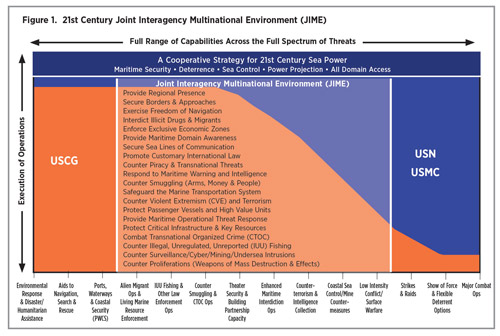
Enhancing regional security in partnership with willing nations requires a 21st-century Great White Fleet of forward deployable (or stationed) national security cutters (NSCs), offshore patrol cutters (OPCs), and fast response cutters (FRC). The mix of platforms and duration of presence would be tailored to the distinct geographies and vary based on the receptiveness of the host nation(s), problem sets to be addressed, and mutual goals of the combatant commands and partner nations. Building on a proven bilateral approach for counterdrug operations and EEZ enforcement, the Great White Fleet would leverage existing agreements—based on the extent to which partner governments are willing—to strengthen CTOC (counter transnational organized crime–chuck) and CT (counter terrorism–Chuck) across the JIME (Joint Interagency Multinational Environment–Chuck).

From an acquisition perspective, doubling the size of both the OPC (from 25 to 50) and FRC (from approximately 50 to 100) programs equates to the projected cost of one Gerald R. Ford (CVN-78)-class aircraft carrier (approximately $13 billion). Furthermore, procuring an additional seven NSCs over the nine planned would cost the equivalent of one Zumwalt (DDG-1000)-class guided-missile destroyer (approximately $4.2 billion). The NSC and OPC both offer more than three times the on-station time between provisioning than is afforded by a littoral combat ship (LCS).

Building more OPCs also could rapidly grow the National Fleet by leveraging commercial shipyards outside the mainstream industrial complex. These shipyards may be able to provide better value to the government during an economic downturn in the oil and offshore supply industry. Further leveraging this acquisition would continue to drive down the cost of the OPCs and provide an additional industrial base to build a 400-ship National Fleet of ships with far lower operating and maintenance costs than the LCS.

Redirecting proposed future LCS/frigate dollars (approximately $14 billion) to a Great White Fleet to modernize the U.S. National Fleet mix would provide a greater return on investment and more staying power abroad. For instance, building international security cutters—NSCs with Navy-typed/Navy-owned enhancements such as the SeaRAM antiship cruise missile—could offer combatant commanders a truly useful “frigate,” leveraging mature production lines that now operate at only 70 percent capacity. These estimates are for relative comparison and do not include the associated aviation, infrastructure, basing support agreements, and personnel plus-ups that are needed to provide a more credible and persistent presence across the JIME. But investing in a larger Coast Guard and the supporting infrastructure would return high dividends.

I’m not sure I agree, but it is worth considering. We should, however, keep in mind a sentiment expressed by friend Bill Wells that white paint is not bullet proof. We should not perpetuate the idea that only white painted ships can enforce laws, that is a uniquiely American concept and perpetuating it plays into the hands of the Chinese, who have more coast guard ships than any other country in the world.

Still I think there is merit to this concept. It seems to be working for PATFORSWA (Patrol Forces South West Asia). There has already been talk about a similar deployment to SE Asia. We might consider similar detachments of various sizes for West Africa, the Eastern Pacific, and the Marshall Islands.

The additional ships, 7 NSCs, and “doubling the size of both the OPC (from 25 to 50) and FRC (from approximately 50 to 100)” Is clearly arbitrary. There is very little the NSCs can do that the OPCs will not also be able to do cheaper, so I don’t see a need for more NSCs.

If we take on additional international roles it probably will not be done in one fell swoop. It will probably be done incrementally. Captain Ramassini is clearly looking at this as a near term possibility. Some movement in this direction is clearly possible, but it will take a radical change in the Administration, the Navy, and the Coast Guard for this to happen on the scale he envisions.

Meanwhile, if you look at the “Offshore and Aviation Fleet Mix Study,” the Coast Guard actually needs 9 NSCs, 57 OPCs, and 91 FRCs just to meet all of our statutory obligations. That is not far from his 16 NSCs, 50 OPCs, and 100 FRCs. The study and the “Great White Fleet” would both probide 66 large ships (NSCs and OPCs).

Actually the only way I see this happening is if there is a realization that keeping the USN constantly cycling through distant deployments may not be the best way to maintain readiness. That it wears out very expensive ships and drives people from the service, and that perhaps cutters can perform at least some of the presence missions.

Belated Recognition for a Coast Guard Hero. 

Image result

Representative Patrick L. Meehan of the 7th Congressional District entered a statement into the Congressional Record in recognition of Emlin Tunnell.

He had a proud Coast Guard history.

On April 27, 1944, the Coast Guard-manned cargo ship USS Etamin was unloading 6000 tons of explosives and gasoline while at anchor at Aitape Harbor, Papua New Guinea. Without warning, Etamin was attacked by Japanese aircraft and a torpedo blew a hole 27 feet by 27 feet in the ship’s starboard side.

With the shell plating and shaft alley of Etamin ruptured, gasoline sprayed over the after part of the ship, creating a dangerous situation for all aboard. It was Coast Guard Steward’s Mate Emlen Lewis Tunnel who came to the aid of Machinist’s Mate First Class Fred Shaver, who was on fire, pulling him to safety and severely burning his own hands in the process.

Two years later,

On March 17, 1946, Tunnell was nominated for the Silver Lifesaving Medal for once again saving the life of a fellow shipmate.

His shipmate, Alfred Givens, fell off the dock of the Coast Guard Cutter Tampa. Without regard to his own safety, Tunnell jumped into the 32-degree seas and rescued Givens. Tunnell saved his drowning shipmate, and despite being in the water for only fifteen minutes, suffered exposure and shock.

Unfortunately, probably because to the bias against African Americans, the award was not approved until 2011, after Tunnell’s death.

Tunnell had a very successful career in the NFL, but died at age 50.

Perhaps he is a candidate to be a a namesake for a Webber class.

Thanks to Terry A. for bringing this to my attention. 

New French Friends in the Caribbean Neighborhood

French Navy Guyana-based Light Patrol Vessel PLG La Confiance is Now on Active Duty

French Navy PLG light patrol vessel La Confiance in combined anti-drug training with US Coast Guard Cutter Winslow Griesser. French Navy picture.

NavyRecognition reports,

“The “La Confiance” PLG (Patrouilleur Léger Guyanais or French Guyana-based Light Patrol Vessel) is now on “Active Duty” and able to conduct operational missions following a ceremony held April 27th…”

It is the first of two small ships of a new class designed specifically for service in the French Atlantic EEZ in the Western Hemisphere. The size is a bit unusual.

They will replace two P400 class patrol craft currently based in French Guyana. The P400s are about the same size as the Webber class “Fast Response Cutters.”

The French do not have an ocean-going coast guard like ours, so their navy does many of the functions performed by the USCG. The new ships make an interesting comparison with the Webber class; I think they even look a bit alike. In many ways the PLG corresponds to what I suggested earlier as cutter X:

…taking the crew and equipment of a Webber class Fast Response Cutter (FRC) and putting them in a larger hull with more endurance and seakeeping, while accepting lower top speed than the FRC.

Comparing the “La Confiance” PLG to the FRCs:

  • Displacement: PLG 700 tons; FRC 354 full load
  • Crew: 24, same for both, PLG can also accomodate 14 people, special forces for example.
  • Dimensions: PLG  60 m (197 ft) x 9.50 m (31.2 ft) x 3.2 m  (10.5 ft); FRC 46.8 m (154 ft) x 8.11 m (26.6 ft) x 2.9 m (9.5 ft)
  • Power: PLG 6,000 KW (8,046 HP), FRC 8,600 KW (11,600 HP)
  • Speed: PLG 21, FRC 28
  • Range: PLG 3,500 nmi at 12 knots, FRC 2,950 at 14 knots
  • Endurance: PLG 12 days; FRC 5 days
  • Boats: PLG two, FRC one

La confiance PLG patrol vessel french navy 1

French Navy La Confiance PLG light patrol vessel arriving in Fort-de-France, Martinique. Picture: E.Mocquillon © Marine nationale

More from the builder here.

Littoral Challenges Addressed at OPTECH South 2017–DefenseMediaNetwork

littoral optech south

DefenseMediaNetwork reports on a conference organized by the Naval War College conducted in Colombia,

“With the theme of “transnational threats and cooperation in the littorals,” the objective of OPTECH South has been to develop cooperative and technologically advanced ways impede kidnappings, drug running, and prevent other transnational threats and crimes in the Western Hemisphere that are affordable and sustainable.”

Sounds like something the Coast Guard would be interested in.

There were representatives from SOUTHCOM, OPNAV, ONR, NPS, CJCS, Canada, Brazil, Australia, UK, and Mexico. Noted that I saw no mention of the USCG and inquired if there was USCG representation. Had an e-mail discussion with one of the organizers of the conference, Stephan Benson, and he confirmed that there was no US Coast Guard representation at the conference.

I know we are short of money but found this curious.

They are now looking for USCG representation at OPTECH North.

Thanks to Lee for bringing this to my attention. 

Webber Class WPC Homeport Update

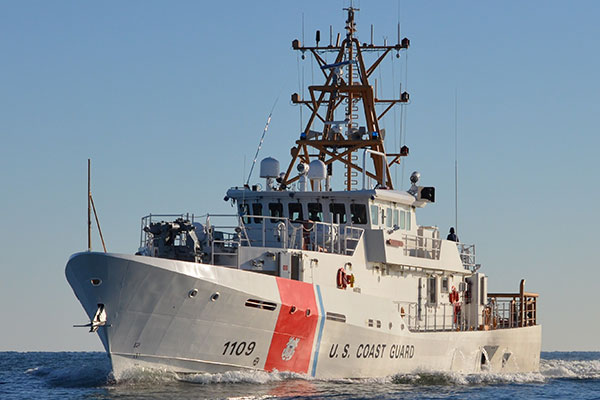
USCGC Kathleen Moore (WPC-1109)

Below is a news release quoted fully. “US Coast Guard to base 2 new cutters in Astoria, Oregon” (sent 04/28/2017 04:31 PM EDT) Note this will happen “starting in 2021.” My estimate is, the first WPC going to Astoria will be FRC #42 give or take one or two numbers. If so, the first Astoria based WPC will probably be funded in FY2017.  This news release may have been intended to asssure the Oregon Congressional delegation that they would be getting some benefit from the FY2017 CG budget.

WASHINGTON — The U.S. Coast Guard announced Friday it will homeport two of the service’s new Sentinel-Class 154-foot Fast Response Cutters (FRC) in Astoria, Oregon, starting in 2021. These two ships have not yet been named, but the FRCs are named after enlisted Coast Guard personnel who distinguished themselves in the line of duty.
Each of the two Astoria-based FRCs will provide the coastal maritime community with a 30 percent increase in annual operating hours on regional waters over the Coast Guard’s legacy 110-foot Island class patrol boats like the Coast Guard Cutter Orcas, homeported in Coos Bay, Oregon.
The FRC is equipped with improved command and control capability as well as increased sea-keeping abilities, operational range, a larger crew and higher transit speeds than the aging110-foot patrol boats. A larger, more capable stern launch cutter boat allows the FRC to conduct search-and-rescue and interdiction operations up to 50 miles away from the cutter, which greatly extends the vessel’s reach over the Coast Guard’s legacy patrol boat fleet.
The Orcas will continue to operate from its homeport in Coos Bay until its service is replaced by the first of the Astoria-based FRCs in 2021.
The Coast Guard is presently examining potential homeport sites within Astoria for the two as-yet-to-be-named FRCs.

Where are they now?

I have only seen definite homeports for ships through #23. There are 18 in D7 (six in Miami, six in Key West, and six in Puerto Rico), two in Cape May, two will be in Ketchikan, and one in Pascagoula. That leaves 35.

Where will they be going?

Wikipedia indicates USCGC Oliver F. Berry (WPC-1124) will go to Honolulu. (The Wiki entry lists the vessels by name and hull number and provides their homeports.)

Honolulu and Pascagoula will likely get at least one additional cutter. Other future homeports already identified are:

San Pedro, CA
Atlantic Beach, NC
Apra, Guam

I’ve seen indication we will have three in Apra. If we put three in San Pedro and two in Atlantic Beach (only a guesstamate) that only takes us to #34, with 24 still to allocate.

Where will the rest go?:

Homeports of the remaining 110 foot Island class WPBs is probably the best indication. Other than the ports already mentioned these include:

  • South Portland, ME
  • Gloucester, MA
  • Woods Hole, MA (two)
  • Bayonne, NJ
  • San Diego, CA
  • Port Angeles, WA
  • Hilo, HI
  • Auke Bay, AK
  • Homer, AK
  • Petersburg, AK
  • Seward, AK
  • Valdez, AK
  • Manama, Bahrain (six)

Looking at my earlier post, “Ruminating on Homeports While Playing the Red Cell,” other ports we might want to think about include:

  • Houston/Galveston/Texas City
  • San Francisco Bay
  • Anchorage, AK–a Strategic Seaport