“With the theme of “transnational threats and cooperation in the littorals,” the objective of OPTECH South has been to develop cooperative and technologically advanced ways impede kidnappings, drug running, and prevent other transnational threats and crimes in the Western Hemisphere that are affordable and sustainable.”
Sounds like something the Coast Guard would be interested in.
There were representatives from SOUTHCOM, OPNAV, ONR, NPS, CJCS, Canada, Brazil, Australia, UK, and Mexico. Noted that I saw no mention of the USCG and inquired if there was USCG representation. Had an e-mail discussion with one of the organizers of the conference, Stephan Benson, and he confirmed that there was no US Coast Guard representation at the conference.
I know we are short of money but found this curious.
They are now looking for USCG representation at OPTECH North.
Coast Guard Commandant Adm. Paul Zukunft (right) meets with then-Southern Command chief Gen. John Kelly, now Trump’s nominee for Secretary of Homeland Security.
Breaking Defense’s Robbin Laird has an Interview with the Commandant and speculates on the prospects for the Coast Guard under the new administration and DHS selectee General John Kelly.
Its a good one, and even the comments are worth reading. There is much of the same we have heard before. The Commandant has a clear and consistant message and agenda, but there is more detail about a possible role in the far Western Pacific.
“I have discussed with the CNO (Chief of Naval Operations Adm. John Richardson, the senior officer in the Navy) the concept that we would create a permanent USCG presence in the South China Sea and related areas,” Zukunft said. “This would allow us to expand our working relationship with Vietnam, the Philippines, and Japan. We can spearhead work with allies on freedom of navigation exercises as well.”
This is the first time I have seen the phrase “permanent USCG presence in the South China Sea and related areas.” Does that mean we will have a CG patrol squadron working out of Sinagpore or Okinawa (or Cam Ranh Bay), like the one in Bahrain? Or are we just looking at the Webber class WPCs we already know are going to Guam? (Must be more to it than that.) I do think we should put some OPCs in Guam, if only to patrol the EEZ in the Western Pacific.
Until recently we might have considered the possibility of basing in the Philippines, but that no longer looks like a possibility.
What ever you may think of the incoming administration, for the Coast Guard at least, it looks promising.
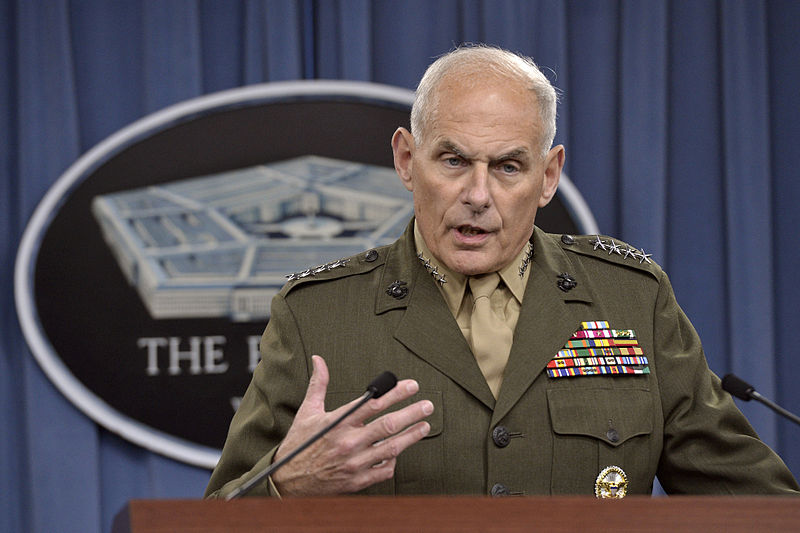
Marine Corps Gen. John F. Kelly, commander of U.S. Southern Command, discusses the latest developments in his command’s efforts to stem the flow of drugs from South and Central America while briefing reporters at the Pentagon, March 13, 2014.
DOD photo by Glenn Fawcett
BreakingDefense has a post on Trump’s pick to head the Department of Homeland Security. If you don’t already know about retired Marine General John Kelly and his tour as SOUTHCOM, its worth the read.
It leads me to believe, the Coast Guard will not be cutting its drug interdiction mission in the Eastern Pacific any time soon.
An earlier post pointed to his history of support for the Coast Guard.
Defense & Aerospace Report Editor Vago Muradian interviews the Commandant, Adm. Paul Zukunft, at the 2016 Reagan National Defense Forum.
The Commandant hit many of themes we have heard him discuss before, but there was also mention of beginning to replace the inland Aids to Navigation fleet. We were supposed to have had a joint program with the Corp of Engineers to develop a common design, but I haven’t heard anything about that for several years now. They are certainly due for replacement. It almost sounds like they just realized they needed to do something about this.
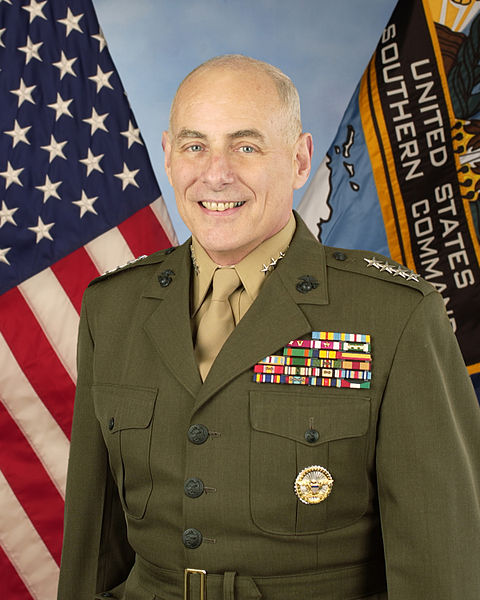
John Francis Kelly (born May 11, 1950, pictured here in 2012) is a retired United States Marine Corps general and the former commander of United States Southern Command.
The New York Times has reported that President-Elect Trump has chosen retired Marine General and former SOUTHCOM commander John Kelly to head the Department of Homeland Security.
General Kelly served as SOUTHCOM November 19, 2012 – January 16, 2016. That experience should make him extremely familiar with the Coast Guard. He has supported the Coast Guard in the past, and here.
As I understand it, he will need to have a waiver from the Senate to serve because he retired less than seven years ago, but it appears he will have broad bi-partisan support having received the endorsement of President Obama’s former Defense Secretary Leon Panetta.
Many of us have wondered about the apparent duplication of effort by the Coast Guard and Customs and Border Protection’s (CBP) Air and Marine Operations (AMO). Apparently the The U.S. House of Representatives, Committee on Homeland Security, Subcommittee on Border and Maritime Security had the same concern and asked for an audit by the Department of Homeland Security (DHS) Office of the Inspector General (OIG). This resulted in a report, “AMO and Coast Guard Maritime Missions Are Not Duplicative, But Could Improve with Better Coordination (pdf).”
Guess there is no suspense in what their findings were, but I find the methodology and conclusions less than complete and satisfying.
The recommendations of the audit were:
Recommendation #1: We recommend that the DHS Under Secretary for Management reestablish an oversight mechanism at the DHS level to ensure that AMO and the Coast Guard coordinate operations.
Recommendation #2: We recommend that the Coast Guard Commandant, CBP Commissioner, and U.S. Immigration and Customs Enforcement Director revise the Maritime Operations Coordination Plan to include requirements for coordination and information sharing at all levels, especially the local level.
So the response was equally predictable–form a committee.
I’m sorry, but my BS meter is off the scale. The alarm went off first, when they consistently called the territorial sea, “customs waters” lending a presumption that this is a Customs job.
While their conclusion may ultimately prove correct, they essentially failed to look at the most significant area of overlap–Maritime Patrol Aircraft. The audit concentrated exclusively on drug enforcement and failed to consider Alien Migrant Interdiction Operations (AMIO). And they failed to answer the most basic questions.
While coordination is always assumed to be a “good thing,” the only real reason you should want two agencies performing the same function would indicate less coordination, not more.
There is no doubt AMO does useful work, that is not the point. The question is, what is the most effective and economical way to distribute resources. Should DHS be working toward a different distribution of tasking and resources?
Unanswered questions:
Why does Customs need boats? The Revenue Cutter Service was Customs’ boat service. Why doesn’t the Coast Guard still fulfill that function? The Coast Guard operates boats. Boats are on standby with crews at the ready. When Customs needs a boat, why don’t they ride Coast Guard boats? What is the cost of an operating hour for comparable Coast Guard and Customs boats?
AMO does need aircraft to do several tasks, including interdiction of smuggling by air, but why does Customs need to have a fleet of maritime patrol aircraft for interdiction of surface vessels, when the Coast Guard also has to provide a similar fleet for a whole range of missions? The AMO operates a fleet of 14 P-3s including both Airborne Early Warning models and P-3 Long Range Trackers. They are over 40 years old and undergoing an extensive and expensive life extension program. AMO also operatesBombardier DHC-8, and Beach King Air 350ER equipped with marine search radars. What is the cost of an operating hour for comparable Coast Guard and Customs aircraft?
AMO regularly performs air interdiction. Perhaps they should be the ones doing the low speed air interdiction over DC.
Other missions:
In addition to drug enforcement, the two agencies seem to have overlapping missions in Alien Migrant Interdiction Operations (AMIO) and counter terrorism. Why weren’t these missions looked at as well?
AMO boats are suitable only for very short ranged AMIO missions while Coast Guard vessels a suitable for interception long before the approach the US coast.
It appears that AMO assets are limited to small arms. If the terrorist threat is anything much larger than a small boat, they are unlikely to be effective in countering it without assistance.
What about Jurisdiction?
AMO operates primarily within the customs waters, but it maintains the authority to pursue vessels fleeing the customs waters or hovering outside those waters as a means of avoiding AMO jurisdiction.
The Coast Guard is not similarly limited in the Marine environment. The effects of this on agency effectiveness was not considered.
Maybe AMO’s jurisdiction should be extended to cover the entire EEZ, but that is not the case now and AMO’s boats don’t seem suited for operations much beyond 12 miles. They are generally very fast, but probably short legged with minimal protection for the crew from the elements.
The characteristics of their boats don’t seem to square with the very long range character of their aircraft like the P-3s.
Why overlapping responsibility might be a good idea–coordination be damned:
There is one reason you might want two agencies responsible for the same law enforcement mission. That would be if you worry about the possibility that one of the agencies might be compromised. For instance if one agency is somehow compromised by a criminal organization. The law enforcement agency might still appear successful. The criminal organization might use the agency to eliminate its competitors, providing intelligence. A second independent agency might uncover this corruption.
Use of Force:
There is an interesting section comparing the two agencies’ use of force policies.
Approval for Employing Use of Force
Coast Guard crews must receive approval from the appropriate official in the chain of command, typically an Admiral, before using force to stop noncompliant vessels. According to the Coast Guard, the approval time can take from 10 minutes to several hours depending on the case. In contrast, AMO policy reflects a more traditional law enforcement approach and allows its agents to make use of force decisions.
According to the Coast Guard, it needs a use of force policy to cover a vast range of mission sets across a legally and jurisdictionally complex operating environment. Although the approval process has some level of risk mitigation, the Coast Guard designed the process to relieve on-scene officers of the need to access U.S. jurisdiction and legal authority to employ force against a noncompliant vessel, and allows those officers to focus on executing the tactics and procedures to safely and effectively employ that force.
We participated in use of force demonstrations for noncompliant vessels with both components and experienced the delay in the Coast Guard’s approval process. Although there are potential safety concerns for Coast Guard boat crews during a pursuit, the Coast Guard stated that it updated its law enforcement manual to “refine and streamline the process in every way possible” to reduce the time lapse from when the Coast Guard vessel is “overt” (known by the suspected vessel to be following) to when the necessary actions (use of force) are completed.
Hopefully if a Coast Guard CO sees a terrorist attack underway, he will have the flexibility to act on the knowledge, even if there is no time to get approval.
Using Statistics that do not correlate:
As noted, the report only looked at drug enforcement and only at a small part of the mission. Quoting from the report,
“There are 206 combined locations where AMO and the Coast Guard conduct operations in customs waters. Of the 206, there are 17 locations (8 percent) where AMO and the Coast Guard have similar capabilities and an overlapping area of responsibility.”
” In FY 2015, at the 17 overlapping locations, all of AMO’s drug seizures occurred on land or in customs waters, where marine units primarily conduct operations.”
“The Coast Guard is a multi-mission agency, including law enforcement that operates in both customs and international waters. In contrast to AMO, Coast Guard personnel assigned to drug and migrant interdiction do not conduct investigative or land operations. In FY 2015, 93 percent of Coast Guard drug seizures occurred in international waters (Transit Zone) (emphasis applied–Chuck). AMO only deploys aircraft in this area; it does not have the vessels to operate in these waters.”
“In the overlapping locations, 84 percent of reported drug seizures were from AMO operations. These seizures occurred, in part, because of the different activities of each agency. For example, while some of AMO operations were intelligence based, the Coast Guard conducts routine patrols looking for illegal activity. Although Coast Guard patrols are not as effective as intelligence-based operations, they show a presence and can deter illegal activity.” (Emphasis applied–Chuck)
First note that this compares Customs’ seizures both on land and on the water with the seizures of the Coast Guard, a multimission agency, on the water alone. This also seems to imply that Customs was not sharing their intelligence with the Coast Guard.
FY 2015 Drug Seizures from the 17 Overlapping Locations Agency Customs Waters (Drugs in Pounds) AMO 28,707 (land and water) (84%) Coast Guard 5,602 (16%) Total 34,309.
I doubt the Coast Guard units they looked at drug interdiction as their primary mission. Certainly the AMO units did.
Why the difference in statistics?:
According to Coast Guard statistics, Coast Guard drug seizures in FY2015 were 319,229.4 lbs of Cocaine and 78,262 lbs of Marijuana. Appendix C indicates that the Coast Guard had seized 199,749 lbs of Cocaine and 57,855 lbs of Marijuana. (Why the large difference in these figures?)
Figures reported for AMO in Appendix C were 243,387 lb of cocaine and 719,180 lb of Marijuana.
Pounds of drugs is not a very informative metric, if various types of drugs are aggravated. It also says nothing about its purity. After being cut there is less drugs in a pound of drugs.
Looking at this, I found a cost comparison of what the two agencies spend for their personnel interesting. The total AMO budget for FY2015 was $750M supporting 1,665 members, while the CG budget of $8,380M supported 41,700. Budget/Personnel equals $450,450 per AMO member and $200,959 per CG member. There are probably lots of reasons AMO cost more than twice as much per member, but it might have been worth some examination.
Conclusion:
Bottom line, this report failed to answer the question, “Why do both the Coast Guard and Customs have both boats and maritime patrol aircraft?”
What we got was a distorted comparison of the relative success of the Coast Guard and Customs drug interdiction efforts.
These distortions can have consequences and should not be allowed to pass unchallenged. I can understand the Coast Guard not wanting to offend people in the IG office, but I have no such problem, and neither should the subcommittee that requested the audit.


 Chuck Hill's CG Blog