“Australian Border Force crackdown nets 30 foreign fishers, destroys three boats off Kimberley coast” –ABC.net.AU

Map showing the Kimberley Marine Park. The shaded area is a National Park Zone (‘no take’ zone).

ABC.net.au reports the Australian Border Force has seized 30 Indonesian fishers and destroyed three boats in a crackdown against illegal fishing in the 74,469 km2 (28,753 sq mi) Kimberley Marine Park, established in 2018, off Northwestern Australia. The combined catch of the three fishing vessels was over a ton of trepang (sea cucumber).

Australian sea cucumber sells for about $350 (presumably Australian $) per kilogram.(ABC Midwest & Wheatbelt: Chris Lewis)

In addition to the loss of marine catch, there is fear that the fishermen, who frequently come ashore, may bring with them livestock diseases common in Indonesia but not present in Australia.

An illegal fishing vessel is destroyed at sea.(Supplied: Australian Border Force)

Australia has been seeing a resurgence of illegal fishing in their EEZ including Marine Parks, and there have been calls for more vigorous enforcement.

“Allies, partners tap into technology to monitor maritime domain” –Indo-Pacific Defense Forum

Winkel Tripel projection, WGS84 datum, central meridian : 150°E. Source Wikipedia Commons, Author: Eric Gaba

The Indo-Pacific Defense Forum reports,

“Maritime domain awareness (MDA) in the Indo-Pacific is moving from an abstract aspiration to a functional collective security approach for managing the region’s dynamic offshore spaces,” noted an April 2023 article in PacNet, a publication of Pacific Forum, a Hawaii-based foreign policy research institute. “Much of the cost-savings in maritime enforcement activities is due to emerging technologies including access to satellites that provide clearer and more accurate images, as well as artificial intelligence and big data platforms dedicated to vessel tracking, prediction, and anomaly detection.”

There are fusion centers in India, Singapore and Vanuatu. These fusion centers would be useful in wartime, but they are essentially a cooperative exchange of information among maritime law enforcement agencies. In addition to its importance in countering IUU and drug smuggling, better maritime domain awareness may give warning of a terrorist attack. Shouldn’t the US Coast Guard have a fusion center in Alameda under Pacific Area? Probably should be one on the West coast of South America too.

“Preserving Alaska’s living marine resources” –D17

USCGC Bertolf class National Security Cutter off Unimak Island, Aleutians, Alaska

Below is a summary of District 17’s Living Marine Resources conservation and management efforts. There is also information about the Magnuson-Stevens Fishery Conservation and Management Act (MSFCMA), 1976, that resulted in the expulsion of foreign fishing vessels from a 200 mile Exclusive Economic Zone even before the United Nations Convention on Law of the Sea and about the North Pacific Regional Fisheries Training Center (NPRFTC) (one of five such centers) that “teaches the enforcement of Conservation and Management Measures on behalf of four international fisheries commissions and 62 signatory nations across North and South America, Asia, Oceania, Europe, and Africa, covering over 80 percent of the Pacific Ocean​.”


April 20, 2023

Preserving Alaska’s living marine resources

ANCHORAGE, Alaska — Alaska supports some of the most abundant and diverse marine ecosystems in the world. With more than 46,000 miles of shoreline – more than all of the lower 48 U.S. states combined – the ocean is an integral part of Alaska’s ecosystems, economy, history and culture. According to National Marine Fisheries Service’s (NMFS) Fisheries of the United States 2020 report, U.S. commercial fisheries landed 8.4 billion pounds of seafood valued at 4.7 billion dollars, 199-million saltwater recreational fishing trips were taken, and recreational anglers caught one billion fish with 65 percent released alive. According to the 2019 report, commercial and recreational saltwater fishing supported 1.8 million. Alaska produces more than half the fish caught in waters off the U.S. coast, provides jobs and a stable food supply for the nation, and supports a traditional way of life for Alaska Natives and local fishing communities. Protection of the state’s 5.7-billion-dollar domestic fishery has never been more crucial.  

The living marine resources (LMR) mission is one of two missions focused on protecting fisheries in and outside U.S. waters. The Coast Guard is responsible for enforcing LMR regulations on domestic, commercial, recreational, and charter fishing vessels. Tasked with enforcing applicable fisheries laws in partnership with the NMFS, the Coast Guard’s goal is to provide the at-sea law enforcement presence necessary to reach national goals for LMR conservation and management. Vessel boardings are a critical component to accomplishing this mission providing an opportunity for teams to inspect a vessel’s catch, gear, and other items to ensure regulatory compliance as well as safety.

“The 17th Coast Guard District’s LMR mission is to promote a level playing field in Alaska’s extremely valuable commercial fisheries, protect resources, and ensure safety of life at sea,” said Lt. Cmdr. Jedediah Raskie, D17’s domestic fisheries enforcement chief. “The LMR enforcement mission is a complex operation requiring in-depth planning, multilateral partnerships and inter-agency collaboration. A continued at-sea presence is crucial, and this is only accomplished through dedication and teamwork with our enforcement partners.”

Those partners include:

Coast Guard – Coast Guard Cutters from Alaska, Washington, Hawaii, and California, Sector Anchorage, Sector Juneau, North Pacific Regional Fisheries Training Center, Maritime Safety and Security Teams (MSSTs)

State – Alaska State Troopers, Alaska Department of Fish and Game (ADF&G), local law enforcement

Other Federal – NOAA’s Office of Law Enforcement (OLE), Department of State, U. S. Drug Enforcement Administration, Customs and Border Protection (CBP)

Collectively in 2022, D17 patrolled 10,723 NMs, conducted 654 federal LMR enforcement boardings (11 on foreign-flagged vessels), detecting 30 violations on 26 vessels, and seizing catch on three fishing vessels. The top five fisheries violations include logbook discrepancies, no Individual Fishing Quota (IFQ) permit onboard, expired or no federal fisheries permit (FFP) onboard, sea-bird avoidance gear not onboard or improperly constructed, and improperly marked buoys on fishing gear.

“Right now, our teams are heavily involved with enforcement surrounding the opening of Pacific halibut and sablefish season,” said Lt. Cmdr. Jedediah Raskie. “The Pacific halibut and sablefish Individual Fishing Quota (IFQ) program is the largest catch share program in the U.S. and comprises 90 percent of D17’s total fisheries boardings.”

With the IFQ program, each fisherman has a catch quota that can be used during the open season from March to November. The North Pacific Fishery Management Council developed this program to address issues associated with the race-for-fish that had resulted from the open-access and effort control management of the halibut and sablefish fisheries. Top IFQ violations include: not having an official logbook onboard, no IFQ permit and/or FFP onboard, illegally retaining and/or mutilating halibut, and failure to retain and/or log retaining Pacific cod and rockfish.

Background

The Magnuson-Stevens Fishery Conservation and Management Act (MSFCMA) is the primary law governing mariner fisheries management in U.S. federal waters. The act’s keys objectives are to prevent overfishing, rebuild overfished stocks, increase long-term social and economic benefits, and ensure a safe and sustainable supply of seafood. Prior to the MSFCMA, waters beyond 12 NM were international waters and fished by fleets from other countries.

This 1976 law created eight regional fishery management councils responsible for the fisheries that require conservation and management in their region. The councils are charged with conserving and managing fishery resources from 3 to 200 miles off the coast while the State of Alaska manages fisheries that occur within 3 NM from shore. To learn more, visit  About the MSA — U.S. Regional Fishery Management Councils (fisherycouncils.org)).

The North Pacific Fishery Management Council (NPFMC) is one of the regional councils established to oversee fisheries in the 200-mile Exclusive Economic Zone (EEZ). With a jurisdiction of approximately 1,025,000 NM, the council manages more than 140 species within 47 stocks and stock complexes, primarily groundfish in the Gulf of Alaska, Bering Sea, and Aleutian Islands, targeting cod, pollock, flatfish, mackerel, sablefish, and rockfish species harvested by trawl, longline, jig, and pot gear. The council also makes allocation decisions for halibut in concert with the International Pacific Halibut Commission that biologically manages the resource for U.S.-Canada waters. Other large Alaska fisheries for salmon, crab, and scallops are managed jointly with the State of Alaska. More at North Pacific Fishery Management Council – Managing Our Nation’s Fisheries Off The Coast Of Alaska (menlosecurity.com).

To better enforce the fishery council’s management plans, the Coast Guard determined that region specific training was necessary to ensure boarding officers received adequate instruction in enforcing the increasingly complex laws that govern our nation’s living marine resources. The Coast Guard’s five fisheries training centers are dedicated to providing training in LMR and protected marine species law enforcement to eliminate natural resource degradation associated with recreational boating, recreational fishing, commercial fishing, and illegal incursions by foreign fishing vessels into our EEZ.

The North Pacific Regional Fisheries Training Center (NPRFTC) in Kodiak trains students operating across the vast and harsh environments of the Seventeenth Coast Guard District, to include the Arctic Ocean, Bering Sea, Aleutian Islands archipelago, Gulf of Alaska, and the Inside Passage, an area that encompasses 3,853,500 SQ NM of sea and more than 47,300 miles of coastline. NPRFTC also teaches the enforcement of Conservation and Management Measures on behalf of four international fisheries commissions and 62 signatory nations across North and South America, Asia, Oceania, Europe, and Africa, covering over 80 percent of the Pacific Ocean​. NPRFTC personnel provide instruction to surface and aviation law enforcement crews, command personnel and supporting staff, and deployable specialized forces units. Upon completion of the training, boarding officers are then charged with carrying out the LMR by performing at-sea boardings to ensure compliance.

The nation’s waterways and their ecosystems are vital to the country’s economy and health. The Coast Guard’s LMR mission is to assist in preventing the decline of marine proteced species populations, promote the recovery of marine protective species and their habitats, partner with other agencies and organizations to enhance stewardship of marine ecosystems and ensure internal compliance with appropriate legislation, regulations, and management practices.

“Coast Guard interdicts 87 lanchas off Texas coast in fiscal year 2022” –D8

A Station South Padre Island law enforcement boat crew stops a lancha crew engaged in illegal fishing in federal waters in the Gulf of Mexico April 30, 2020. Coast Guard law enforcement crews seized approximately 5,000 lbs of Red Snapper, 450 lbs of shark, and illegal fishing equipment from five lancha crews. (U.S. Coast Guard photo by Station South Padre Island) 

Below is a District 8 (HQ New Orleans) news release that provides a full year of data.

 News Release U.S. Coast Guard 8th District Public Affairs Detachment Texas

Coast Guard interdicts 87 lanchas off Texas coast in fiscal year 2022

CORPUS CHRISTI, Texas — Coast Guard law enforcement crews interdicted 87 lanchas, seized 15,809 pounds of catch and detained 373 fishermen off the Texas coast during fiscal year 2022.

Since the first recorded lancha interdiction in the late 1980s, the Coast Guard has seen a significant uptick in the detection of the vessels, recording an 11.5 percent increase in interdicted lanchas from fiscal year 2021.

A noteworthy case from this year occurred on Aug. 30, when Coast Guard crews interdicted three lanchas with a total of 14 Mexican fishermen, 2,425 pounds of red snapper and 440 pounds of shark aboard.

To counter illegal, unreported, and unregulated fishing, the Coast Guard utilizes a layered approach for operations through aircraft, small boats, and cutters.

Up to 27 million tons of fish are caught illegally each year throughout the world. IUU fishing accounts for 20 to 30 percent of global annual catch. Global losses from IUU fishing are estimated to be as much as $23.5 billion per year.

“We view the lancha issue as an immediate threat to our living marine resources, border security, and U.S. sovereignty,” said Lt. Cmdr. Brendan Dunn, assistant chief of enforcement, Coast Guard District Eight. “In recent years, the illegal trade of red snapper, grouper, shark and other reef fish species has become extremely lucrative for the transnational criminal organizations operating in Mexico. With the continual increase of at-sea lancha interdictions, we would like to recognize the tremendous efforts of our field units at Coast Guard Sector and Air Station Corpus Christi, Station South Padre Island, our fast response cutters and patrol boats. We also thank our regional, state and federal partners for their tenacious commitment, professionalism, and teamwork to support this mission.”

A lancha is a fishing boat used by Mexican fishermen that is approximately 20-30 feet long with a slender profile. They typically have one outboard motor and are capable of traveling at speeds exceeding 30 mph. Lanchas pose a major threat, usually entering the United States Exclusive Economic Zone near the U.S.-Mexico border in the Gulf of Mexico with the intent to smuggle people, drugs, or poach the United State’s natural resources.

If you witness suspicious activity or illegal fishing out to 200 miles offshore, please contact the U.S. Coast Guard at 361-939-0450.

For more information follow us on Facebook and Twitter.

“US, Japan coast guards formally expand cooperation” –PAC AREA News Release / “Royal Navy and US Coast Guard to Forge Closer Bonds”

Ships from the U.S. Coast Guard and Japan Coast Guard conducted exercises near the Ogasawara Islands of Japan, Feb. 21, 2021. The U.S. Coast Guard Cutter Kimball and Japan Coast Guard Ship Akitsushima, two of the respective services’ newest and most capable vessels, operated alongside helicopters and unmanned aerial vehicles to practice interdicting foreign vessels operating illegally inside Japanese waters. (U.S. Coast Guard photo courtesy of the Coast Guard Cutter Kimball/Released)

The Coast Guard has been busy increasing its international visibility. Below is a news release concerning increased cooperation with the Japanese Coast Guard that came out yesterday. Today, I see a SeaWaves report, also dated yesterday that,

“The Royal Navy and US Coast Guard have vowed to work more closely to fight crime and protect the planet. The two services already combine to stop drugs traffickers in the Caribbean and Middle East, assist each other with operations in the polar regions, run exchange programs for sailors and frequently work and train side-by-side around the globe.”

The new relationship with the Royal Navy includes expanded personnel postings that began back in 2014.

There are also plans to build on already successful exchange programs, which allows USCG engineers to work with the Royal Navy but will soon also allow pilots and aircrew to do the same. (emphasis applied–Chuck)

Perhaps we are not too far from exercising something like my proposed “Combined Maritime Security Task Force Pacific” with a US Coast Guard Cutter, a Japanese Coast Guard Cutter, and a Royal Navy River Class OPV working with navies and coast guards of SE Asia to protect their EEZ. Perhaps the Indian Coast Guard will join as well.

News Release

May 19, 2022
U.S. Coast Guard Pacific Area

US, Japan coast guards formally expand cooperation

US, Japan coast guards formally expand cooperation US, Japan coast guards formally expand cooperation

Editors’ Note: Click on images to download high resolution version.

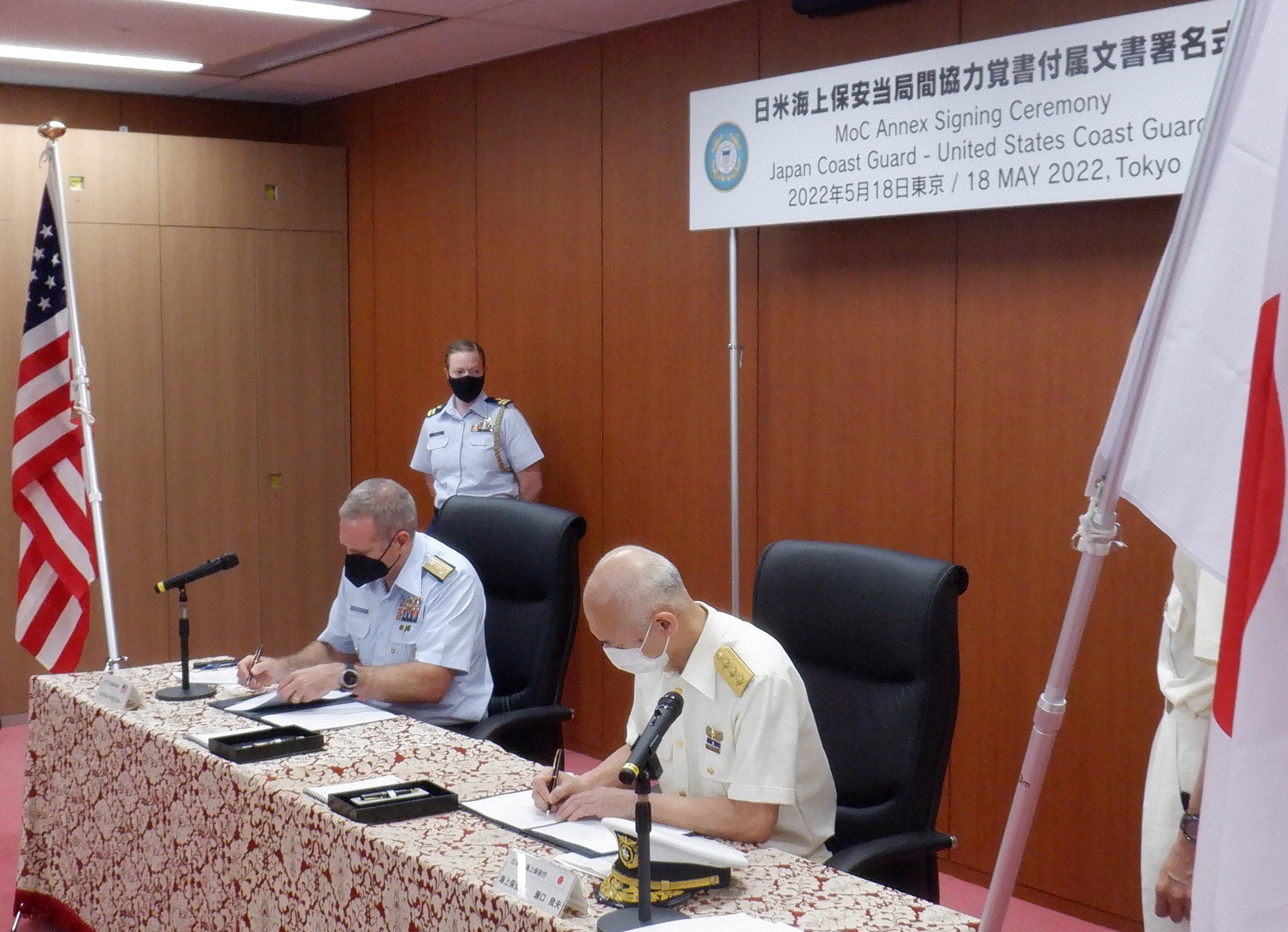
TOKYO — The United States and Japan coast guards formally expanded cooperative agreements and established a new perpetual operation during a ceremony Wednesday in Tokyo.

Vice Adm. Michael McAllister, commander of U.S. Coast Guard Pacific Area, and Vice Adm. Yoshio Seguchi, Japan Coast Guard vice commandant for operations, represented their respective services during the historic document signing ceremony and celebration at Japan Coast Guard Headquarters.

Although a memorandum of cooperation between the sea services has existed since 2010, strengthened relationships, increasing bilateral engagements and continued focus on maintaining a free and open Indo-Pacific necessitated expansion of the memorandum.

The new operation’s name, SAPPHIRE, is an acronym for Solid Alliance for Peace and Prosperity with Humanity and Integrity on the Rule of law based Engagement, and it honors the gem regarded as an emblem of integrity and affection found throughout the Indo-Pacific.

Operation Sapphire encompasses all the annual interactions between the Japan and U.S. coast guards, with the goal of increasing interactions over time.

To formalize the expanded cooperation, annexes were added to the existing memorandum of cooperation outlining Operation Sapphire to include standard operating procedures for combined operations, training and capacity building, and information sharing.

“We rely on our partners, allies, and like-minded nations to achieve our shared missions,” said McAllister. “As evidenced by this agreement, our relationship with the Japan Coast Guard is stronger than ever, and I am looking forward to many more decades of partnership and collaborative operations in the Indo-Pacific.”

“We will conduct smooth cooperation in the fields of joint operation, capacity building and information sharing by this agreement” said Seguchi. “Sapphire embodies the rule-of-law based engagement between the coast guards, and we will expand the principle of Free and Open Indo-Pacific to other nations.”


Status of (Fish) Stocks, 2015–NOAA

468px-NOAA_logo.svg

NOAA has published their annual report on the status of fish stocks for 2015 (pdf), and the news is generally good. The number of stocks “Over Fished” or subject to “Over Fishing” remain near all time lows. Some highlights:

  • Of 313 stocks with known status, nine percent are subject to overfishing (e.g. the harvest rate is too high).
  • Of 233 stocks with known status, 16 percent are over fished (e.g. the population is too small).
  • The number of stocks rebuilt to maximum sustainable yield since 2000 increased from 37 to 39 over the last year. Two Pacific coast groundfish stocks, canary rockfish and petrale sole have been found to have been rebuilt.
  • Forty-four stocks and stock complexes are currently under rebuilding plans.

The report is only seven pages and very readable with well done charts and graphics.

The report refers to their partners, but we know the Coast Guard should get a great deal of credit for making this success happen.

Still, US efforts have limits. “More than half of the stocks added to the overfishing list in 2015 were international stocks,” subject to fishing outside US jurisdiction.

Document Alert: Cutter Procurement–Another Report to Congress

Once again, the Congressional Research Service’s Ronald O’Rourke has revised his “Coast Guard Cutter Procurement: Background and Issues for Congress” with the new edition issued April 15. This has got to be a hot topic because previous revisions were issued March 22, January 27, and December 14, 2015. That is four revisions in four months, on average every six weeks, but the latest is only 24 days after the previous edition. I have begun to sense, we may have turned a corner. The tone of the reports has changed over these four months, from, how long will it take us to reach the “Program of Record” (POR), to consideration of, if we should perhaps go beyond the POR.

The NSC, OPC, and FRC programs pose several issues for Congress, including the following:

“whether to fund the acquisition of a 10th NSC in FY2017;

“whether to fund the acquisition of four FRCs in FY2017, as requested, or some other number, such as six, which was the number projected for FY2017 under the Coast Guard’s FY2016 budget submission;

“whether to use annual or multiyear contracting for procuring FRCs;

“whether to use annual or multiyear contracting for procuring OPCs;

“planned procurement quantities for NSCs, OPCS, and FRCs;

“the cost, design, and acquisition strategy for the OPC;

“initial testing of the NSC; and

“rotational crewing of the NSC.”

The latest revision includes three substantial Appendices:

  • Appendix A. Planned NSC, OPC, and FRC Procurement Quantities (pp 17-22)
  • Appendix B. Funding Levels in AC&I Account (pp 23-26)
  • Appendix C. Additional Information on Status and Execution of NSC, OPC, and FRC Programs from March 2016 GAO Report (pp 27-34)

Appendix C is entirely new and appears to have been the reason for the revision.

Appendix A (p. 17-22) is a fairly detailed discussion of the results of the Fleet Mix Study and asks why we so seldom hear that the program of record is not enough to assure the Coast Guard to successfully accomplish its assigned missions.

The Fleet Mix Study was made public in 2012 long after its completion in 2009. It is due for a reexamination and the Commandant has said another will be done. When that happens, we seriously need to look at more than just more of the same assets. We need to look at additional technology, equipment, and weapons that might allow us to accomplish these missions without a major increase in personnel.

Looking at “Table A-3. Force Mixes and Mission Performance Gaps” (document page 18) I would note that if we get to Fleet Mix Analysis Phase 1 (FMA-1, an increase over the POR including 9 Bertholf class NSCs, 32 OPCs and 63 Webber Class FRCs, for a total of 104 vessels), we will have addressed all the “Very High Risk Gaps” found in the Fleet Mix Study that included SAR capability, “Defense Readiness Capacity,” and “Counter Drug capacity.” What will remain are “High” or lower risks in Ports, Waterways, and Coastal Security (PWCS) and Living Marine Resources (LMR), and a low to very low risk to the Alien Migrant Interdiction Operations (AMIO) mission. This total of more than 40 NSCs and OPCs certainly should not be out of the question, after all the Coast Guard has included over 40 ships larger than a thousand tons for the last several decades.

Still, I would note that, no matter how many ships we have, the Ports, Waterways, and Coastal Security (PWCS) mission will always be at risk, unless weapons are available to quickly and reliably stop terrorists’ exploitation of a larger merchant vessel to make an attack. Guns alone are simply not up to the task. I have identified two weapons that might address this threat, (1) equipping our WPCs and possibly WPBs with light weight torpedoes that target a ships propellers or (2) equipping our larger ships with the Long Range Anti-Ship Missile (LRASM) which might allow our larger cutter to effectively support our smaller cutters and respond to an attack, even if the large cutter 200 miles from the targeted port. Either would also make our ships much more capable of making a meaningful contribution to Defense Readiness.

Good News–and Bad, from the Western Pacific

A great New York Times article , “Palau vs the Poachers,” looking at Palau’s attempts to police their waters as a microcosm of the problems created by poaching and overfishing.

I’ll repeat my oft stated contention that we do not spend nearly enough time in the Western Pacific where the US has a huge chunk of Exclusive Economic Zone (EEZ). There is a new Marine Reserve to protect. Plus we have an obligation to help former US territories that are now independent island nations struggling to effectively protect their own fisheries.

The work of “SkyTruth” and Google in crowd sourcing fisheries intelligence recounted here is encouraging, but there is simply to little enforcement. There were a couple of paragraphs that particularly stood out to me.

The oceans belong to everyone and no one, and the general perception is that they are too big to need protection. We also tend to think of fish as an ever-regenerating crop, there forever for our taking. But roughly 90 percent of the world’s ocean stocks are depleted or overexploited; one study predicts that by 2050, the sea could contain more plastic waste than fish. Though most governments have neither the inclination nor the resources to patrol the oceans, Palau is trying a different approach, and whether it succeeds or fails may have consequences for the entire planet.

In the span of one human lifetime, humankind has become brutally adept at plundering the seas. In the late 1940s, the annual global catch was roughly 16.5 million tons; now, after decades of innovation, this number is about 94 million tons. ‘‘That’s equivalent in weight of the entire human population at the turn of the 20th century, removed from the sea each and every year,’’ Paul Greenberg, an author of books about fish and seafood, told me.

US and Cuba Cooperate on Marine Conservation

BairdMaritime reports,

“The National Oceanic and Atmospheric Administration (NOAA) and the National Park Service (NPS) signed a Memorandum of Understanding (MOU) with Cuba’s Ministry of Science, Technology, and Environment (CITMA). The MOU aims to facilitate joint efforts concerning science, stewardship, and management regarding Marine Protected Areas (MPAs).”

Check it out for more detail.

Presumably, the Coast Guard will have some role in enforcing restrictions on operations in these areas. Apparently the CG has had good long term relations with their Cuban counterparts.