Homeports, 2035

 An email discussion with a reader got me to thinking about how our cutters might be homeported in the future. It started with a simple question, where would NSC #11 be homeported? Turns out it is not a simple question because first we do not yet know where nine and ten will go, but it also kicked off a lot of thought about how changes of fleet capabilities, mission, and maintenance philosophy will effect the future lay down of assets.
 This is not going to be a definitive document, but rather an exploration of considerations and possibilities.
Why 2035? If the shipbuilding plans proceed as expected, we will not see the last Offshore Patrol Cutter (OPC) delivered until 2034.
Fleet Capabilities:
To provide I baseline, I will look back on the fleet of WHECs, WMECs and Island class WPBs as it existed before the new generation started arriving and before we lost eight Island class to the 123 foot conversion disaster and six more to a continuing commitment to South West Asia. My reference is a 2000-2001 issue of “Combat Fleets of the World” which includes a notation of cutter homeports.
In 2035 we can expect to have 35 large patrol cutters, 36 if we get NSC#11. The fleet in 2000 had 44. The new ships are certainly far more capable, but quantity has a quality all its own. Fortunately we have another way to make up for numbers.
The FRCs are much more capable than the 110s and approach the capabilities of the 210 foot WMECs. Additionally they will be more numerous than the 110s they are replacing. Only 49 Island class 110 foot WPBs were built, but the program of record includes 58 Webber class WPCs. The Webber class should be able to do many of the fisheries enforcement missions currently done by 210s. They have the same ship’s boat as the larger cutters and they are as seaworthy as most of the fishing vessels. The Webber class are expected to be underway for 2500 hours per year compared to 1500 hours for the Island class. The Webber class are not just “fast response cutter,” which was what the Island class were, they are at least part time, patrol assets.
If we compare what we had in 2000, 49 Island class available 1500 hours/year for 73,500 hours, with what we are projected to have, 58 Webber class available 2500 hours/year for 145,000 hours, that is an increase of 71,500 hours. If we assume optimistically that a dedicated patrol ship is available 24 hours a day for 185 days/year, that is 4,440 hours/day so the additional 71,500 hours is the equivalent of 16.1 patrol cutters. If we give due consideration to when and where they can be used and provide land based air support, this more than makes up for the lower number of larger cutters.
The Offshore Patrol Cutters will be far more seaworthy than the WMECs. In fact they will be at least equal to, and probably superior to the 378 foot WHECs, in terms of seakeeping. Their cruising speeds will higher than that of the 378s and their effective range of operations will be similar. Unlike the 270 and 210 foot WMECs they will be usable for Alaska Patrol.
Mission Changes: 
I don’t expect any of our current missions to go away, but there will inevitably be a change of emphasis.
The Eastern Pacific drug interdiction effort will likely continue, but the drug of choice may be changing from cocaine to synthetic opioids which enter the US by other routes. The Navy will also likely join the Coast Guard in Eastern Pacific drug interdiction, which may reduce the need for cutters.
The island nations of Melanesia, Micronesia, and Polynesia will be under stress as a result of sea level rise and the effects of illegal, unregulated, and unreported fishing. The Coast Guard is likely to be called upon to assist them.
There will be a need to assist other coast guards and coast guard like organizations, particularly in Africa and South East Asia where they have problems with piracy, drug and human trafficking and illegal, unreported, and unregulated (IUU) fishing, and the Coast Guard will be increasingly asked to provide capacity building assistance.
Maintenance Philosophy:
The Coast Guard seems to have embraced the idea that there are benefits to basing ships in clusters. Clusters of at least three almost guarantees that there will be at least one vessel in port to benefit from the support facilities there. I think we may see many of  those ports that are currently expected to host two Webber class get a third when more become available. I don’t think we will see many, or perhaps any ports, with only one Bertholf, OPC, or Webber class homeported there.
In the Past:
In 2000 ships were split between the Atlantic and Pacific in ways that reflected fundamental differences in the two theaters. Looking at the WHECs, WMECs, and 110 foot WPBs as surrogates for the NSCs, OPCs’ and FRCs; LANTAREA had 63 vessels (two WHECs, 26 WMECs, and 35 WPB110s), PACAREA had 30 vessels (ten WHECs, six WMECs, and 14 WPB110s). Those 93 vessels were distributed among 38 ports, 15 in PACAREA and 23 in LANTAREA.
The Ports: 
In an earlier post, “Ruminating on Homeports While Playing the Red Cell,” I identified 30 critical ports or port complexes that are likely targets for those hostile to the US (23 in LANTAREA and seven in PACAREA), including 23 military outload ports (17 in LANTAREA and six in PACAREA). Only five of these ports have a significant Navy surface ship presence. It makes sense for us to homeport vessels, particularly the Webber class, in, near, or on the approaches to those ports where there is no Navy surface ship presence. Fortunately some of these ports are in close proximity to each other. This list of ports is repeated below. I have indicated where current planning indicates NSCs and FRCs are or will be homported in bold. This accounts for eight NSCs and 43 FRCs. 
LANTAREA

CCGD1:

  • Bath, Me–Major Naval shipbuilder
  • Groton, CT–Submarine base
  • Hudson River complex, New York, NY/Elizabeth and Bayonne, NJ–a major cultural target, #3 US Port by tonnage, #2 Container port, #4 Cruise ship port (NYC) and #13 cruise ship port (Cape Liberty, NJ), Strategic Seaport (Elizabeth)

CCGD5–four FRCs

  • Delaware Bay–Strategic Seaport (Philadelphia) –two FRCs at Cape May
  • Chesapeake Bay Complex, VA–Base for aircraft carriers and submarines, Major naval shipbuilder, #14 port by tonnage, #7 container port; plus water route to Washington, DC (major cultural target) and Baltimore, MD–#9 port by tonnage, #10 container port, #12 cruise ship port, Strategic Seaport (Norfolk and Newport News)
  • Morehead City, NC–Strategic Seaport –two FRCs at near by Atlantic Beach
  • Cape Fear River–Strategic Seaport (Sunny Point and Wilmington, NC)

CCGD7–Two NSCs, 18 FRCs (six in Key West in addition to those indicated below)

  • Charleston, SC–#9 container port, #15 cruise ship port, Strategic Seaport –two NSCs
  • Savannah, GA–#4 container port Strategic Seaport
  • Jacksonville complex, FL (including Kings Bay, GA)–SSBNs, Navy Base Mayport, #14 cruise ship port, Strategic Seaport
  • Port Canaveral, FL–#3 Cruise Ship port
  • Port Everglades/Fort Lauderdale, FL–#13 container port, #2 Cruise Ship port
  • Miami, FL–#11 container port, #1 Cruise Ship port–six FRCs
  • San Juan, PR–#5 Cruise Ship port, #15 container port–six FRCs
  • Tampa, FL–#7 Cruise Ship port

CCGD8–Five FRC

  • Mobile, AL–major naval shipbuilder, #12 port by tonnage
  • Pascagoula, MS–major naval shipbuilder –two FRCs replacing Decisive.
  • Gulfport, MS–Strategic Seaport
  • Mississippi River Complex, LA–#14 container port,#10 Cruise Ship port (NOLA), #1 port by tonnage (South Louisiana), #6 port by tonnage (NOLA), #8 port by tonnage (Baton Rouge), #10 port by tonnage (Port of Plaquemines)
  • Lake Charles, LA–#11 port by tonnage
  • Sabine Pass complex (Beaumont/Port Author/Orange, TX)–#4 port by tonnage (Beaumont), Strategic Seaport (both Beaumont and Port Author)
  • Houston/Galveston/Texas City, TX–#2 port by tonnage (Houston),  #13 port by –tonnage (Texas City), #5 container port (Houston), #6 Cruise ship port (Galveston)–Three FRC going to Galveston when Dauntless departs.
  • Corpus Christi, TX–#7 port by tonnage, Strategic Seaport

PACAREA

CCGD11–Four NSCs, two (assumption) FRCs

  • San Diego–Base for aircraft carriers and submarines, major naval shipbuilder (NASSCO), Strategic Seaport
  • Los Angeles/Long Beach/Port Hueneme, CA–A major cultural target, #5 port by tonnage (Long Beach), #9 port by tonnage (Los Angeles), #1 container port (Los Angeles), #3 container port (Long Beach), #9 cruise Ship port (Long Beach), #11 cruise ship port (Los Angeles), Strategic Seaport (Long Beach and Port Hueneme) –FRC(s)at San Pedro
  • San Francisco Bay complex–A major cultural target, #6 container port (Oakland), Strategic Seaport (Oakland and Concord) –Four NSCs

CCGD13–Two FRCs planned for Astoria, OR

  • Puget Sound Complex, Seattle/Tacoma, WA–Base for aircraft carriers (Bremerton), SSBNs (Bangor), and submarines, major naval bases, #8 container port (Seattle), #10 container port (Tacoma), #8 Cruise ship port (Seattle), Strategic Seaport (Indian Island and Tacoma, WA)

CCGD14–Two NSCs, Six FRCs, Two in Honolulu, + Four planned

  • Honolulu/Pearl Harbor–Major Naval base, including submarines–Two NSC, Two there now, Two FRCs + a third planned
  • Apra, Guam–Submarine Base, Strategic Seaport–Three FRCs planned

CCGD17–Six FRCs, Two in Ketchikan, + Four more planned

  • Anchorage, AK–Strategic Seaport

Next we will talk about where the remaining NSCs and FRCs, and where all the OPCs might be going.

Bertholf Class National Security Cutters:

In 2000 the twel

ve 378s were distributed ten to the Pacific and two to the Atlantic. Homeports in 2000 were Charleston (2), Seattle (2), Alameda (4), and Honolulu (2). The program of record was for eight National Security Cutters, but ten have been funded and it appears there may be an eleventh. Homeports for the first eight include four in Alameda, CA, two in Charleston, SC, and two in Honolulu, HI. I don’t expect that there will be any other homeports assigned. It is likely that numbers nine and ten will go to Honolulu and Charleston, bringing them to three each. This will give LANTAREA more very long range assets both to support drug interdiction and capacity building in West Africa. 

Number eleven will probably go to the Pacific. Alameda could probably accept it, but I suspect a growing recognition of responsibilities in the Western Pacific will mean, if procured, it will go to Honolulu, if not initially, at least by 2035. . 

Offshore Patrol Cutters:

I don’t think OPCs will go to the same ports as the NSCs. Based on where other WHECs or multiple WMECs were based (and an unused naval base at Corpus Christi), likely homeports for OPCs include:

  • Boston, MA
  • Portsmouth, VA
  • Key West, FL
  • St. Petersburg, FL
  • Corpus Christi (Naval Station Ingelside), TX
  • San Diego, CA
  • Kodiak, AK

If we assume at least three ships in each, that accounts for 21. What of the remaining four? They could be added to the ports above or perhaps added to other ports.

I think a case can be made for putting a higher percentage of the large cutters in PACAREA. After all, less than 16.2% of the US Exclusive Economic Zone is in LANTAREA’s area of operation. 

Currently there are only four medium endurance cutters in the Pacific and 24 in the Atlantic. There are only 25 OPCs in the program of record. Obviously this will not be a one for one replacement 

In the year 2000 PACAREA had 16 large patrol cutters (10 WHECs and six WMECs), currently they have 13 (five NSCs, four WHECs, and four WMECs). Considering the apparent growing responsibilities of PACAREA, the projected maximum of no more eight NSCs, and the ability of the Webber class to assume some of the fisheries protection duties of the WMECs in the Atlantic, it is likely PACAREA WMECs will be replaced with OPCs on a better than one to one basis that would have left PACAREA with only 12 large patrol ships. I suspect PACAREA will be assigned at least six OPCs, and that it should have at least nine (17 of the total of 36 large ships (8 NSCs and 9 OPCs), if we get 11 NSCs homeported as above).

It is extremely likely at least two OPC will go to Kodiak to replace 378 foot WHEC Douglas Munro and 283 foot WMEC Alex Haley. It seems likely that this could ultimately grow to three OPCs. Locating them close to ALPAT areas.

San Diego was homeport to two 378s. It is closer to the Eastern Pacific drug transit zones than other Pacific ports, and it has both excellent training facilities and shipyards.

Seattle seemed a likely location for OPCs but since it is the likely homeport for three new Heavy Polar Icebreakers as well as USCGC Healy (and/or other medium icebreakers) it appears they may not have the room.

Assuming three OPCs in Kodiak and three in San Diego, if additional OPCs go to the Pacific where would they go? Additional ships in San Diego or nearby Terminal Island in San Pedro (Long Beach) appear likely.

This leaves 16 to 19 OPCs to be assigned to LANTAREA. Three each in Boston, MA, Portsmouth, VA, Key West, FL, St. Petersburg, FL, Corpus Christi (Naval Station Ingelside), TX would account for 15, leaving only one to four to find a home. One more port, perhaps Miami, or just add ships to the ports above. Certainly there is space in Portsmouth and Little Creek, VA.

I will assume six in San Diego and/or San Pedro (Long Beach), four in Portsmouth, VA and three each in Boston, Key West, FL, St. Petersburg, FL, Corpus Christi, TX, and Kodiak, AK.

Webber class WPCs:
The program of record includes 58 Webber class. As noted above homeports for 39 have been identified, of the remaining 19 four will go to Alaska. Lets look at each in turn.
CGD1
In 2000 there were seven Island class in the First district, two in Portand, ME, two in Woods Hole, MA, one at Glouchester, MA, and two in Sandy Hook, NJ. I would presume there will be Six Webber class in the First District.
In order to cover all the Critical port in the First District, we will probably put two in Sandy Hook, NJ to protect the Hudson River port complex, two in S. Portland, ME that would cover Bath ME and two at the East end of Long Island Sound that would protect the Sub base at Groton. Woods Hole might work, but I would hope they would be based closer either at Newport, RI or in New London.
CGD5
In 2000 there were only thee Island class in the Fifth district, one in Portsmouth, VA and two in Atlantic Beach, NC. We already have four Webber class going to the District, two in Cape May, NJ, and two in Atlantic Beach, NC.
CCGD7
In 2000 there were 23 Island class based in the Seventh district, six in Miami, seven in Key West, six in San Juan, one in Port Canaveral, and three in St. Petersburg. We already have 18 Webber class assigned to the Seventh District, six in Miami, six in Key West, and six in San Juan. Notably there are no Webber class on the Seventh District’s Gulf coast, so I would anticipate we will see three more homeported in St. Petersburg. 
CGD8
In 2000 there were only two Island class WPBs homeported in the Eighth district, one in Mobile, AL and one in Corpus Christi, TX. We already know two will go to Pascagoula, MS, and three will go to Galveston, TX.  We probably want at least two more in Corpus Christi, TX to cover that Strategic Port and the Western Gulf of Mexico.
CGD11
In 2000 there were three Island class in the Eleventh District. All three were homeported in San Diego. We already know one or more Webber class will go to San Pedro. I anticipate there will ultimately be two in San Pedro, CA. It seems likely there will also be two based in the San Francisco Bay complex to cover this strategic port and the Northern California coast.
CGD13
 In 2000 there were two Island class in the Thirteenth district, one in Port Angeles, WA and one in Coos Bay, OR. We already know two will go to Astoria, OR. I think we also need two in Port Angeles, WA to cover the Puget Sound port complex and the Washington coast.
CGD14
IN 2000 there were four Island class WPBs in the Fourteenth district, two in Honolulu, HI, one in Hilo, HI, and one in Guam. We already know there will be three Webber class in Honolulu and three in Guam. I don’t anticipate any more.
CGD17
In 2000 there were five Island class WPBs in the Seventeenth district, one each in Seward, Ketchikan, Auke Bay, Petersburg, and Homer. We already have two Webber class in Ketchikan, and we know the district will get four more. I anticipate we will see at least two somewhere in Cook Inlet to cover the strategic port of Anchorage, either in Homer or in Anchorage itself. The last two will probably go to Auke Bay, Juneau or add one more to Ketchikan and Cook Inlet. 
The Overview:
I think this is fairly close to the way we will end up in 2035.
CGD1…three OPCs…six Webber class
  • S. Portland, ME: …two Webber class
  • Boston, MA: …Three OPCs
  • East end of Long Island Sound (Woods Hole, MA, Newport, RI , or New London)…two Webber class
  • Sandy Hook, NJ:…two Webber class

CGD5…four OPCs…four Webber class

  • Cape May, NJ…two Webber class
  • Portsmouth, VA…Four OPCs
  • Atlantic Beach, NC…two Webber class

CGD7…three NSCs…three OPCs…21 Webber class

  • Charleston, SC…three NSCs
  • Miami, FL…six Webber class
  • Key West, FL…Three OPCs…six Webber class
  • San Juan, PR…six Webber class
  • St. Petersburg, FL…Three OPCs…three Webber class

CGD8

  • Pascagoula, MS…two Webber class
  • Galveston, TX…three Webber class
  • Corpus Christi (Naval Station Ingelside), TX…Three OPCs…two Webber class

CGD11

  • San Diego and/or San Pedro (Long Beach),… six OPCs…two Webber class
  • San Francisco Bay/Alameda Complex…four NSCs…two Webber class

CGD13

  • Astoria, OR…two Webber class
  • Port Angeles, WA…two Webber class

CGD14

  • Honolulu…four NSCs…three Webber class
  • Apra, Guam…three Webber class

CGD17

  • Ketchikan…two Webber class
  • Auke Bay (Juneau)…two Webber class
  • Kodiak, AK…Three OPCs
  • Cook Inlet (Homer or Juneau)…two Webber class

How does this square with the list of critical ports? It is a good start, but there are too many ports between Pascagoula and Galveston. and between Charleston and Miami. Either we need more Webber class or we need the smaller WPBs that will replace the 87 foot Marine Protector class WPBs to also be able to also protect these ports.

Having ships in the right place is not enough. As I’ve noted several times, I don’t think any of our ships are adequately armed to perform the Maritime Security role, meaning they need to be able to counter both small, fast, highly maneuverable craft and larger vessels. I don’t really think the guns we have now are capable of reliably doing either. Hopefully sometime before 2035 our vessels will be properly equipped for the Homeland Security mission.
 

“Rewrite the Playbook on Maritime Homeland Defense”–USNI Proceedings

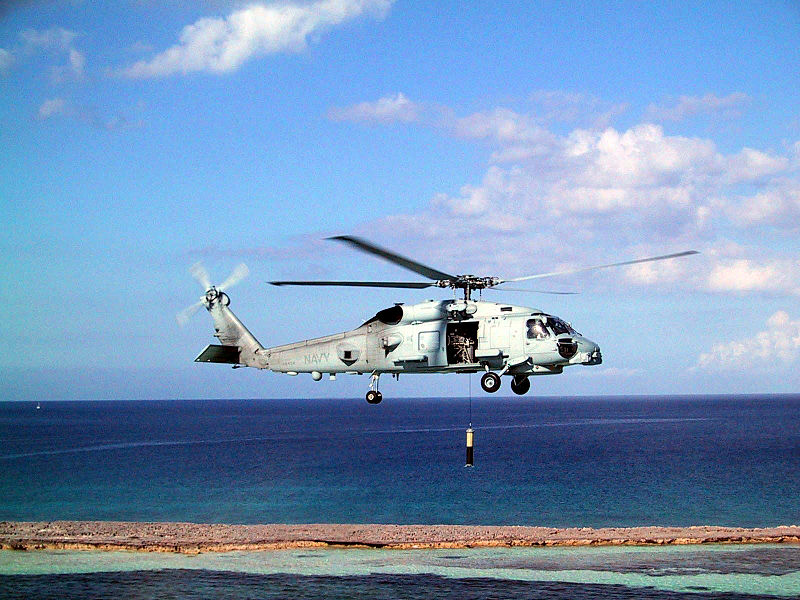
Navy photo. MH-60R “Knighthawk” helicopters conducts an airborne low frequency sonar (ALFS) operation during testing and evaluation

The March, 2018 issue of the US Naval Institute Proceedings has an article by Commanders Timothy Kerze and Dana Brooke Reid, USCG, that advocates reinstating the Coast Guard’s ASW mission.

Specifically they suggest that the ten National Security Cutters (NSC) and 25 Offshore Patrol Cutters (OPC) be equipped and configured to operate the MH-60R in the ASW role. They contend that all 35 ships in the program of record could be so equipped for $122.5M, far less than the cost of a single Navy frigate.

They also refer briefly to the possibility of adding a sonar. I feel adding a long range detection capability would be a necessity. The ASW helicopters would be much more useful if the cutters could provide an around the clock cueing. Even adding this capability, perhaps in the form of LCS ASW module components to be manned by Navy Reservists when the need arises, would still likely keep the total cost of the program less than that of a single FFG, now expected to cost $800M.

As for employment, surface ships patrolling for submarines has never been very effective. Escorting other ships has always been the most effective tactic for countering submarines, because it draws the submarines to the escorts and because the subs must frequently abandon their most stealthy mode of operation to make an attack. ASW equipped cutters could be assigned to escort duties in areas away from the enemy’s air and surface threats.

How the Coast Guard and Navy Could Plan to Mobilize the Cutter Force in a Major Conflict

The Coast Guard has a rich military history, but we should recognize that, while we may be an “armed service,” we are not prepared for war.

We took the opportunity presented by the apparent end of the Cold War in the early ’90s to cut cost and overhead by removing recently installed  anti-submarine warfare (ASW) and Harpoon launching equipment from the 378s and eliminating entire Sonar Tech (ST) rating.

Unfortunately, the holiday from worrying about a possible major conflict is over. China is challenging us, and Russia is resurgent. While it appears the Coast Guard has planned to provide some resources to address contingencies, it also appear we have no real direction as to what the Coast Guard will do if we have a major conflict. Certainly the new major cutters, the NSCs and OPCs, could be turned into credible escort vessels, but it would take months and their crews would need to be trained.

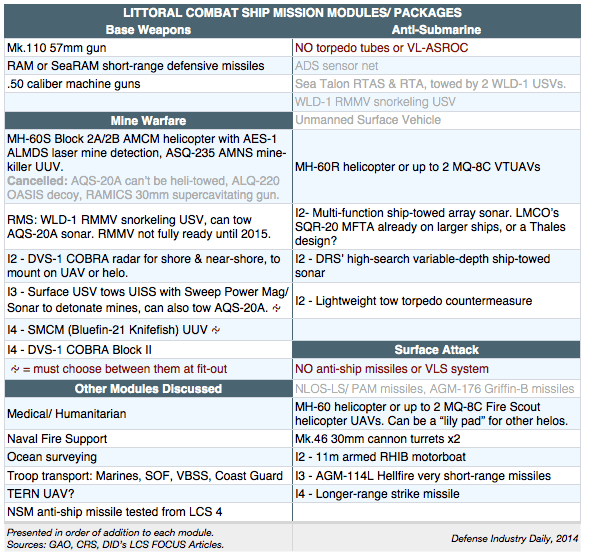
The development of modular systems for the Littoral Combat Ships (LCS) may provide a mechanism for rapidly upgrading our ships while Navy Reserves might provide the personnel and expertise to cut mobilization time from months to weeks.

The Navy currently has over 100,000 reservists, either Selected Reservists or Individual Ready Reservist, subject to recall. A number of them have expertise not resident in the Coast Guard, but useful upon mobilization. At one time these reservists might have gone to man Navy reserve frigates, but there are currently no navy combatants in reserve. As the number of LCSs increase the number of reservists with experience operating and maintaining the mission modules will increase. In addition all LCSs have two complete crews, so in wartime when they will presumably stop rotating crews, they will have an excess of active duty crews training in the mission module systems.

The primary mission modules planned for the LCSs are Anti-Submarine Warfare (ASW), Anti-Surface Warfare (SuW), and Mine Counter-Measures (MCM). It would not take much to make cutters capable of accepting all or parts of these mission modules, perhaps an OPC “B” class and during overhauls.

There is a very real possibility of inter-service synergy here.

A mission package of equipment, aircraft, sensors, and personnel could be loaded aboard for exercises, providing training for both the Navy and Coast Guard personnel.

The acoustic sensors from the ASW module might be deployed on a cutter bound for a drug interdiction mission in the Eastern Pacific, to help locate drug running semi-submersibles or if they are out there, submarines.

There are very few Navy mine counter measures assets in the US and those we have are not spread out geographically. If there were to be a peacetime mining incident in US waters, it might be possible to airlift an MCM module to the nearest cutter to allow the problem to be dealt with more quickly.

SNA Symposium, Virtual Tour

airbus ds trs 4D SNA 217

If you were unable to attend the Surface Navy Association Symposium, but would like to see what you missed, NavyRecognition offers a series of videos. They include a number of systems that have been discussed here including, smart projectiles for the 57mm, unmanned surface vehicles, the LRASM Long Range Anti-Ship Missile, SeaRAM as a replacement for Phalanx, TRAPS Towed Reelable Active Passive Sonar, MK20 Mod 1 Electro-Optical Sensor System (EOSS), TRS-3D Baseline D multi-mode radar (MMR) ordered for the ninth NSC.

If you want to look primarily at the frigate proposals as well as the proposed weapons modules for the LCS which might also be applicable to the icebreaker, there is this composite video. 

Incidentally why was there no mention of this symposium on the National Cuttermen Association Chapter, Surface Navy Association website?

Coast Guard Cutter Procurement: Background and Issues for Congress–Nov. 30, 2017

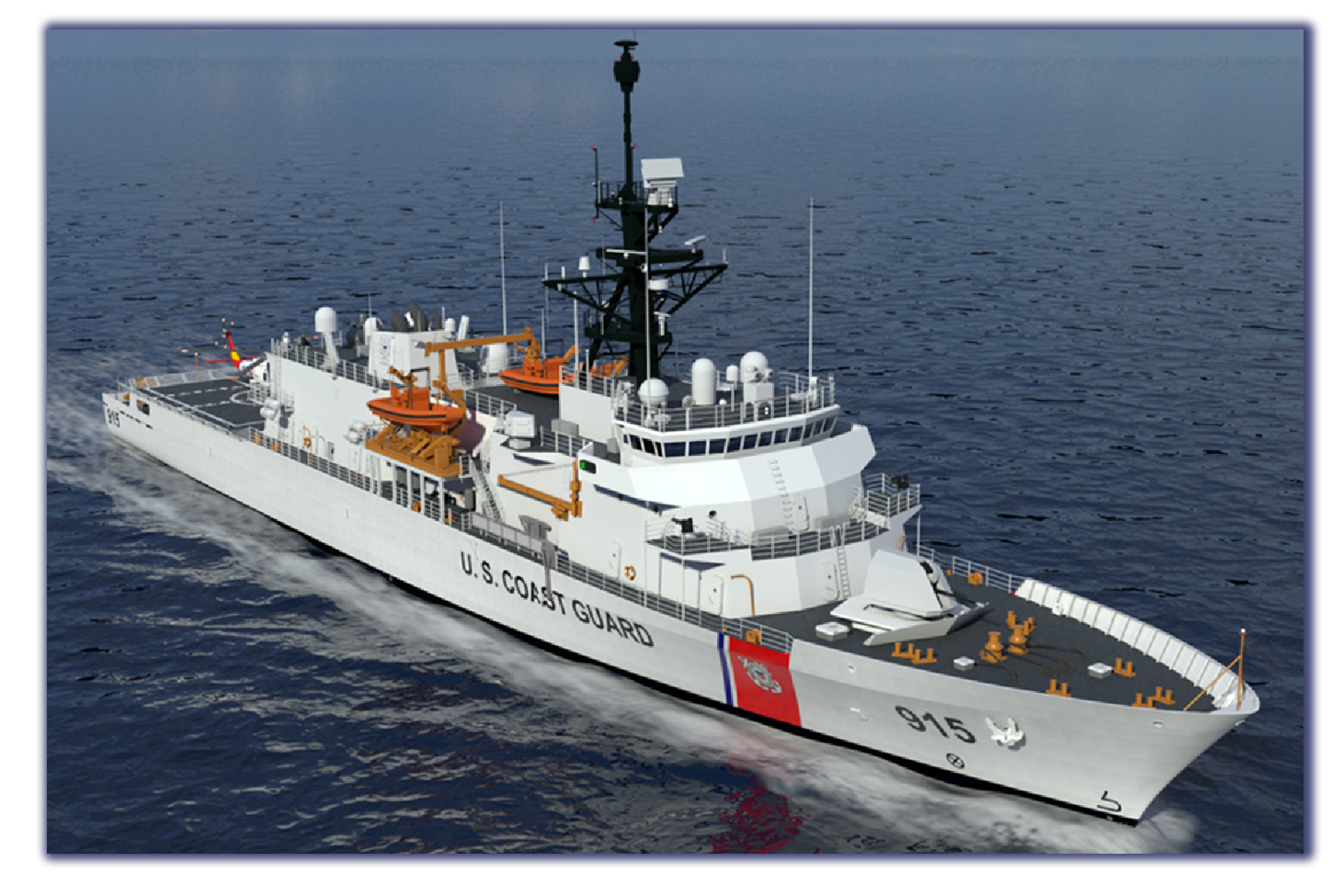
OPC “Placemat”

The Congressional Research Service has issued an updated report on Coast Guard Cutter procurement by Specialist in Naval Affair, Ronald O’Rourke. It is available in pdf format here or you can read it on the US Naval Institute site here.

Quoting from the Report,

Summary

The Coast Guard’s acquisition program of record (POR) calls for procuring 8 National Security Cutters (NSCs), 25 Offshore Patrol Cutters (OPCs), and 58 Fast Response Cutters (FRCs) as replacements for 90 aging Coast Guard cutters and patrol craft. The Coast Guard’s proposed FY2018 budget requests a total of $794 million in acquisition funding for the NSC, OPC, and FRC programs.

NSCs are the Coast Guard’s largest and most capable general-purpose cutters. They have an estimated average procurement cost of about $695 million per ship. The first six are now in service (the sixth was commissioned into service on April 1, 2017). The seventh, eighth, and ninth are under construction; the seventh and eighth are scheduled for delivery in 2018 and 2019, respectively. As part of its action on the Coast Guard’s FY2017 budget, Congress provided $95 million for procurement of long lead time materials (LLTM) for a 10th NSC. The Coast Guard’s proposed FY2018 budget requests $54 million in acquisition funding for the NSC program; this request does not include additional funding for a 10th NSC.

OPCs are to be smaller, less expensive, and in some respects less capable than NSCs. They have an estimated average procurement cost of about $421 million per ship. The first OPC is to be funded in FY2018 and delivered in 2021. On September 15, 2016, the Coast Guard announced that it was awarding a contract with options for building up to nine ships in the class to Eastern Shipbuilding Group of Panama City, FL. The Coast Guard’s proposed FY2018 budget requests $500 million in acquisition funding for the OCP program for the construction of the first OPC, procurement of LLTM for the second OPC, and certain other program costs.

FRCs are considerably smaller and less expensive than OPCs. They have an estimated average procurement cost of about $65 million per boat. A total of 44 have been funded through FY2017. The 24 th was commissioned into service on October 31, 2017. The Coast Guard’s proposed FY2018 budget requests $240 million in acquisition funding for the procurement of four more FRCs.The NSC, OPC, and FRC programs pose several issues for Congress, including the following:

  • whether to fully or partially fund the acquisition of a 10th NSC in FY2018;

  • whether to fund the acquisition of four FRCs in FY2018, as requested, or some other number, such as six, which is the maximum number that has been acquired in some prior fiscal years;

  • whether to use annual or multiyear contracting for procuring FRCs;

  • whether to use annual or multiyear contracting for procuring OPCs;

  • the procurement rate for the OPC program;

  • planned procurement quantities for NSCs, OPCS, and FRCs;

  • the cost, design, and acquisition strategy for the OPC; and

  • initial testing of the NSC.

Congress’s decisions on these programs could substantially affect Coast Guard capabilities and funding requirements, and the U.S. shipbuilding industrial base.

Interview with Commandant

https://1yxsm73j7aop3quc9y5ifaw3-wpengine.netdna-ssl.com/wp-content/uploads/2017/10/102017-dhs-15.mp3?_=1

Federal News Radio has an interview with the Commandant. There is a short written summary here or you can listen to it on their page or above. Some interesting developments with regard to drug interdiction in the Eastern Pacific. Sea story about actual employment of a sea based Unmanned Air System.

Interestingly he again refers to Russia arming Icebreakers so I think perhaps we may see some movement to arm or at least make provision for arming our new icebreakers.

LCS Progress, Coast Guard Implications

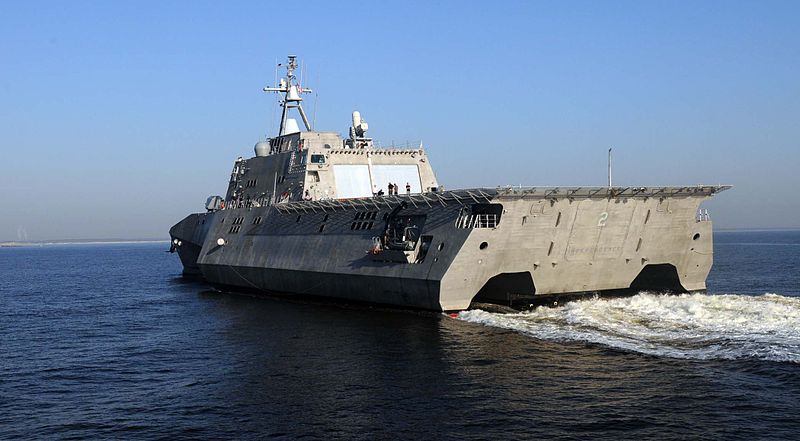
USS Independence (LCS-2)

USNI reports that the Navy is pushing harder than ever on getting the LCS mission modules operational. In wartime these systems would likely be used to upgrade cutters. Some of these systems might be applicable to Coast Guard’s NSCs and OPCs, including particularly UAS and ASuW systems, even in peace time, so they bear watching.

There is an interesting note that, “…Freedom also conducted its first Coast Guard helicopter landing on the flight deck earlier this year and hopes to do more interoperability testing with the Coast Guard going forward.” This suggest the Navy is at least thinking about sending LCS to assist the Coast Guard in its drug interdiction efforts.


U.S. Coast Guard: Priorities for the Future–CSIS/USNI

The video above records an recent event, a “Maritime Security dialogue” presented by the Center for Strategic and International Studies (CSIS) and the United States Naval Institute (USNI) featuring Admiral Paul F. Zukunft, Commandant of the U.S. Coast Guard, for a discussion on the “U.S. Coast Guard’s future priorities.”

Despite the title, don’t expect a recitation of Coast Guard priorities. Most of the material is familiar, but there were a few interesting comments, including some that might be surprising. A number of things the Commandant said here made news.

  • That the NSCs could be made into frigates.
  • That the Polar Icebreaker would cost less than $1B
  • His support of transgender CG personnel.

I’ll give a quick outline of what was talked about. At the end I will rant a bit about some of my pet peeves.

The Commandant’s prepared statement is relatively short beginning at time 2m45s and ending about 11m.

6m00 In our listing of missions, the Commandant said Defense Operations should be listed first. He noted that there are 20 ships chopped to Combatant Commanders including eleven  ships operating under SOUTHCOM.

Q&A begins at 11:00.

16m20s The Commandant noted there is a Chinese ship rider on a USCG cutter off Japan and that Coast Guard aircraft are flying out of Japan.

17m30s Boarder protection/drug interdiction

20m Called the OPCs “light frigates”

22m As for priorities the Commandant noted a need to invest in ISR and Cyber

23m Cyber threat.

24m Expect return to sea duty because of length of training.

26m30s “Demise of the cutterman”/Human Capital Plan–fewer moves–removed the stigma of geographic stability

29m25s Highest percentage of retention of all services–40% of enlisted and 50% of officers will still be in the service after 20 years

30m Law of the Sea. Extended continental shelf in the Arctic.

32m30s Need for presence in the Arctic.

36m ISR, 38m15s Firescout. An interesting side note was that the Commandant seemed to quash any possibility of using the MQ-8 Firescout. He noted when they deployed on a cutter 20 people came with the system.  He called it unoccupied but not unmanned.

40m Icebreakers

43m30s Comments on transgender members

45m15s Icebreakers–will drive the price down below $1B.

47m NSC as frigate–no conversations with the Navy about this. Performance of Hamilton.

49m50s Count the NSCs toward the 355 ship Navy.

50m30s Illegal migration and virulent infectious disease

53m35s CG training teams in the Philippines and Vietnam to provide competency to operate platforms to be provided by Japan. Two patrol boats going to Costa Rica. Other efforts to build capacity.

56m DHS is the right place for the CG.

The Commandant touched on a couple of my pet peeves, specifically

  • He called the OPCs “Light Frigates,” so why aren’t they designated that way? WMSM and WMSL are just wrong in too many ways.  Give our ships a designation our partners and politicians can understand. A WLB is a cutter and also a buoy tender. The OPC can be both a cutter and a light frigate. I have suggested WPF. Maybe WFF for the Bertholfs and WFL for the Offshore Patrol Cutters. If we want to be thought of as a military service, we need to start using designations that will be seen and understood as military.
  • He mentioned the possibility of including the Bertholfs in the 355 ship fleet total. Coast Guard combatants should be included when the country counts its fleet. No, the cutters are not aircraft carriers or destroyers, but the current fleet of about 275 ships includes about 70 ships that have no weapons larger than a .50 cal. These include eleven MCM ships and about 60 ships manned by civilian crews such as tugs, high speed transports, salvage ships, underway replenishment ships, and surveillance ships. Counting the Cutters as part of the National Fleet would raise  our profile as a military service. The Navy might not like it, but it does give a better idea of our actually available assets for wartime, which is the point of such a listing.


Coast Guard Sea, Land, and Air Capabilities, Part II, 25 July, 2017

The House Subcommittee on Coast Guard and Maritime Transportation hearing recorded above is a follow-on to one already discussed. The video does not actually begin until minute 10:40. It is basically done in two parts as indicated below.

Panel I

Panel II

  • Rear Admiral Michael J. Haycock, Assistant Commandant for Acquisition and Chief Acquisition Officer, United States Coast Guard | Written Testimony
  • Ms. Marie A. Mak, Director of Acquisition and Sourcing Management, Government Accountability Office | Written Testimony
  • Rear Admiral Richard D. West (Navy Ret.), Chair, Committee on Polar Icebreaker Assessment, National Academy of Sciences | Written Testimony
  • Mr. Ronald O’Rourke, Specialist in Naval Affairs, Congressional Research Service | Written Testimony

Elsewhere the Coast Guard reported on the Commandant’s testimony, but what we really need to listen to is what the Congressional Sub-Committee members are telling us. They seem to love and respect the Coast Guard (you may have noticed Congress keeps giving us more than we ask for), but they are not pleased with the planning documents they are getting from the Coast Guard. I would particularly recommend you watch the opening comments of Representatives Hunter (10:40 to 13:30), Garamendi (to 17:00), and DeFazio (to 21:20). It will probably make you mad. You should be mad. We have to identify the problem and fix it.

If you want only a taste, here is a short version: 

So what is discussed?:

  • 27:00 Great Lakes icebreakers, line item for design of a Great Lakes Icebreaker is being budgeted but no plan for buying one.
  • 29:30 Five Year plan “reflects Fiscal guidance.” That is, we are being told, we have to fit our budget request into predetermined ceilings, so it is less than we really need.
  • 35:00 We are asking DOD to fund six FRCs CENTCOM has requested to replace the 110s currently assigned.
  • 37:00 Graph comparing AC&I funding as requested, authorized, and funded.
  • 39:00 Twenty year plan which was due to Congress at the end of June has not been submitted to Department.
  • 44:00 DOD does not see icebreakers as a National Defense resource. Navy will not pay for the first icebreakers.
  • 54:00 Strong support for icebreakers among the representatives.
  • 57:30 Question on icebreaker lease. Ice trials issue still on the table.
  • 1h02:00 Discussion of Cyber.
  • 1h09 Why not a block buy on the first ship?
  • 1h18m Commandant’s testimony ended
  • 1h34m.Particularly watch Ronald O’Rourke’s testimony, he suggests accelerating the OPC program may be an alternative to WMEC life extension program.
  • 1h43m Sub-Committee liked getting the fleet mix study, but that was several years ago.
  • Block Buy Report due in Dec.
  • Expected cost of heavy icebreaker has dropped about $200M.
  • 2h07m again, “no military requirement for an icebreaker.” Representatives feel that question should be studied.
  • 2h15m if we wait a number of years between the first and second WAGB contract results in loss of expertise and additional cost.

The discussion was dominated by three topics,

  • Coast Guard long term planning,
  • block buys for the OPC and Icebreakers,
  • whether we should build three or four heavy icebreakers.

Three or four heavy icebreakers: The proposal to build four heavy icebreakers rather than three came from a study by the National Academies of Sciences, Engineering, and Medicine. It is largely based on the reasonable assumption that heavy icebreaker #4 will cost less than medium icebreaker #1, as a result of the learning curve savings on heavy icebreakers and first of class costs for the medium icebreakers. I have not read the study but they don’t seem to have addressed the question, of the need for a total of six icebreakers found in the high altitude study. Assuming we build four of a single class of icebreakers, should we then start on a new class of two medium icebreakers with its attendant start-up costs or should we go ahead and build six heavies?

Block Buys for OPC and Icebreakers: The Congress has authorized the Coast Guard to use “Block Buy” funding for its shipbuilding programs. The Coast Guard seems hesitant to even ask to do this. In the case of the OPC, it might save us more than $1B. We could have (and I believe should have) asked to use multi-year procurement for the second phase of the Webber class WPC buy, but we did not.

The National Academy of Sciences study recommends we use block buy procurement for four icebreakers. The current contract for the OPCs is a contract for the first with options for eight more to be funded through FY2023. Until the options are executed we have the option of seeking a block buy contract for future construction.

Block buys commit Congress to fully fund all vessels included in a program to the extent of the contract. If they back out there are penalties incurred. From the Coast Guard’s point of view it would seem a commitment from Congress would be a good thing.

Because of that commitment, shipyards are likely more willing to invest in productivity improvements, resulting in lower costs.

The Commandant’s remarks on the Icebreaker seem to indicate we will wait until we finish and evaluate operations of the first new Polar Icebreaker before seeking funding for a second. If that happens not only will we miss the potential savings of the a block buy, we will also lose the experience the shipyard gained building the first. Long delays between the first few NSCs was largely why we did not see a significant price drop after the first ship.

Coast Guard long term planning: Our current program of record is a continuation of the “Deep Water” program which originated in 2002 and updated in 2005 following 9/11. A fleet mix study (apparently completed in 2009) confirmed that the Program of Record, if executed, would be an improvement of the fleet as it existed in 2007, but it also showed that it fell well short of meeting all the Coast Guard’s statutory requirements with many missions at risk. Additionally the fleet mix study assumed 230 days away from homeport for both the NSCs and the OPC using the “Crew Rotation Concept.”

We still have a very long way to go before we can achieve the Program of Record. There has been no meaningful test of the “Crew Rotation Concept” in spite of the fact that virtually every test of rotating multiple crews among multiple ships has proven problematic and has failed to realize the claimed benefits. Aircraft are also not achieving utilization hours planned. The OPCs, if constructed as currently planned, will not be completed until 2034.

In short our planning is out of date and the current planning seems to be limited to answering the question, “What will fit in the predetermined, but inadequate budget?”

If five-year plan is subject to “fiscal guidance” then why would the 20 year plan not also be subject to “fiscal guidance.” If we are to provide a true picture of what we need we need to change what we are doing.

What do we need to do?:

  • We need to know what we need.
  • We need to know the consequences of not getting what we need.
  • We need to be able to communicate both what we need and the consequences of inadequate funding to the Congress and Administration.

As noted in the introduction to the executive summary of the Offshore and Aviation Fleet Mix Analysis.

To support its role as Systems Integrator (SI), the Coast Guard (CG) needs to establish and continually update a strategic plan for the acquisition, operation, and sustainment of capabilities necessary in achieving organizational goals. Key to this strategic plan is a repeatable, comprehensive process that identifies alternative capabilities and Fleet mix solutions that will meet future mission requirements in an efficient, effective, and affordable manner.

This should not be a one time thing. We need to do this regularly as a repetitive process that is improved over time. We also really need to look at alternatives, not just already chosen solutions.

Once we know where we want to go we can come up with a 20 year (or better yet a 30 year) plan, beginning with what are we going to lose.

It might be best if the long-term plan did not include cost figures. Then we don’t have to comply with preconceptions of cost limits. Identify generic platform types with the capabilities we need.

———

Copies of Acquisition and Operation of Polar Icebreakers: Fulfilling the Nation’s Needs are available from the National Academies Press on the Internet at www.nap.edu

Names of OPCs Announced on Coast Guard Day

Happy Coast Guard Day.

Names of the first eleven Offshore Patrol Cutters have been made official. The news release is quoted below.

WASHINGTON — The U.S. Coast Guard announced the names of the first 11 offshore patrol cutters:

  • USCGC Argus
  • USCGC Chase
  • USCGC Ingham
  • USCGC Pickering
  • USCGC Rush
  • USCGC Icarus
  • USCGC Active
  • USCGC Diligence
  • USCGC Alert
  • USCGC Vigilant
  • USCGC Reliance

The offshore patrol cutter is the Coast Guard’s highest investment priority. The offshore patrol cutter will bridge capabilities between the national security cutter, which patrols the open ocean, and the fast response cutter, which serves closer to shore. The offshore patrol cutter will replace the service’s 270-foot and 210-foot medium endurance cutters.

“The offshore patrol cutter will be the backbone of Coast Guard offshore presence and the manifestation of our at-sea authorities,” said Adm. Paul Zukunft, commandant of the Coast Guard. “It is essential to stopping smugglers at sea, for interdicting undocumented migrants, rescuing mariners, enforcing fisheries laws, responding to disasters and protecting our ports.”

The first offshore patrol cutter is scheduled for delivery in fiscal year 2021.

For the most updated acquisition information visit: http://www.dcms.uscg.mil/Our-Organization/Assistant-Commandant-for-Acquisitions-CG-9/Programs/Surface-Programs/Offshore-Patrol-Cutter/.