Changing Operational Priorities –The Coast Guard’s Force Posture Statement and an Aside on Area AORs

The Coast Guard Deputy Commandant for Operations has issued “United States Coast Guard Force Posture 2024.” Dated October 2024, it is reportedly the first of its kind and a new edition will be published annually. I have appended the Coast Guard News Release regarding the publication below.

“This posture statement informs all audiences about the U.S. Coast Guard’s operational priorities, initiatives, requirements and future challenges across its missions and geographic regions. It conveys how we are “Advancing Mission Excellence” in accordance with the 2022 Coast Guard Strategy and the Department of Homeland Security (DHS) Strategic Plan. This posture statement serves as a window into the breadth and depth of the Coast Guard’s commitments and how it is posturing our workforce, capabilities, and assets to deliver operational services that best serve the American people.

It is organized under four major topics rather than by the eleven statutory missions.

  • Operating Environment (p.3)
  • Guiding Principles (p.3/4)
  • Operating Posture (p.4-7)
  • Geographic Operating Areas (p.7-11)

I love it, but it does lack a clear summary of what we will do differently. I will try to interpret some of that. Below I provide a readers’ digest version with a few comments, looking first at the eleven Coast Guard missions as listed in 6 U.S. Code § 468, at select Geographic Operating Areas, and finally I will speculate on the long term implications. Given the increased use of the Coast Guard as a tool of foreign policy, I also suggest changes to the Area Commanders’ areas of responsibility (AOR) to make them fit more easily into the national command structure.

MISSIONS

Some of the missions are specifically addressed in the “Operating Posture” section, others are not. The Eleven missions are:

Non-homeland security missions:

  • Marine safety
  • Search and rescue
  • Aids to navigation
  • Living marine resources (fisheries law enforcement)
  • Marine environmental protection
  • Ice operations.
Homeland security missions: 
  • Ports, waterways and coastal security
  • Drug interdiction
  • Migrant interdiction
  • Defense readiness
  • Other law enforcement.

I will just address them in alphabetical order:

Aids to Navigation: 

Aids to Navigation is not called out under a separate heading.

  • “Our comprehensive approach (to the Marine Transportation System (MTS)) encompasses…Maintaining aids to navigation…” (p.4)
  • The Coast Guard is reinforcing actions to be “brilliant at the basics” that strengthen…aids to navigation.
  • The Coast Guard is in the early phase of recapitalizing an aging fleet of inland aids to navigation tenders with new Waterways Commerce Cutters, crucial to maritime commerce in our inland river system. These investments are central to maintaining service delivery in an increasingly complex MTS (Maritime Transportation System–Chuck).

Sounds like minimal changes in the near term but expect improving technology may reduce manpower requirements. Elsewhere there is indications buoy tenders may increasingly be used for non-AtoN missions. This suggests that the number of sea-going buoy tenders (WLBs) is unlikely to be significantly reduced, but their character may change–more on this below.

Defense Readiness

We are increasing attention on the Coast Guard’s defense readiness mission given the increasing threat posed by nation-state competitors. Through integration with Department of Defense efforts, refreshing defense-related plans, and preparedness exercises, we are sharpening readiness to support homeland defense requirements and force deployment commitments for major overseas contingencies. We continue to meet our commitments to North American Aerospace Defense Command (NORAD) for National Capital Region and deployable Rotary Wing Air Intercept and we are adjusting the structure of our Port Security Units (PSU) to address Reserve workforce shortages. We are also integrating PSU elements with DoD expeditionary units to increase their deployment readiness.

This is a welcome recognition of an increasingly hostile world and the emergence of non-state actors who, acting independently or as a proxy for hostile states, can impact national security.

Hopefully it also means we are considering adaptations to our cutter and air fleet to make them more useful early in a near peer conflict (i.e. with China).

Drug Interdiction:

Drug Interdiction is not called out as a separate topic. The only indication of a change is this statement under the section “Western Hemisphere,”

“We will maximize employment opportunities by conducting a mix of missions such as counter drug and combating illegal, unreported and unregulated fishing when appropriate.” (p.9)

Ice Operations: 

Ice operations is not called out as a separate mission, but it is addressed in the “Polar Regions” section (p.8/9) of the Geographic Operating Areas section.

Arctic and Antarctic Ice operation will get a big boost as we go from 2 polar icebreakers to eight. In the Arctic there will be a continuing need for non-icebreaking large cutters and we can expect increased exploitation of fixed wing aircraft and particularly satellite for communications and information.

Living Marine Resources

“We will increasingly favor shore-based law enforcement teams and our patrol boat fleet, supported by maritime domain awareness sensors, to ensure we best match this mission.”

Webber class WPCs have proven capable of assuming much of the fisheries protection mission. They can go anywhere fishing vessels can go and stand up to any weather they might be fishing in. So FRCs are stepping up to missions WMECs have traditionally done. Not mentioned, but on the other hand, in Alaska and the distant Pacific there is still a role for larger ships.

Marine Environmental Protection:

There was no section devoted to Marine Environmental Protection as a specific mission. MEP was referred to briefly in the Mission execution section (p.5) Arctic (p.8)

But there was this under Incident Management and Crisis Response” (p.6)

Management of large, complex incidents is a central Coast Guard competency. Employment of this capability enables success for the most consequential crises and events, builds trust, and supports DHS. However, the Coast Guard does not have a large contingency capacity “in garrison” for emergencies. We will continue to strengthen Coast Guard incident management capacity and proficiency to meet increasing demand, including in the Reserve workforce. The Coast Guard continues to respond to stakeholder requests for assistance for incident management while we prioritize incidents with a Coast Guard nexus and prevent overextending Coast Guard resources.

Marine Safety

There is a lot of activity here,

“The Coast Guard is reinforcing actions to be “brilliant at the basics” that strengthen marine inspection, investigation, Vessel Traffic Services, waterways management, and aids to navigation.”

Changes in the environment include autonomous vessels, offshore renewable energy installations, an emerging space launch and recovery industry, and alternative vessel fuels. All of which require determination of standards.

Migrant Interdiction

“The Coast Guard will deploy cutters and aircraft, and adaptive force packages where practical, sufficient to interdict migrant ventures, save lives, and deter maritime migration. We continue to prepare with partners to respond to a mass migration to mitigate a national crisis. We are also integrating new technology to better anticipate, detect, deter, and interdict migrant ventures.

No significant reprioritization here. This is an area where the Webber class WPCs (20 in D7 alone) have supplemented or replaced WMECs. It is an area where shore based Unmanned Air Systems and Unmanned surface vessels like saildrone could provide persistent initial detection and perhaps reduce demand for fixed wing search aircraft.

Other Law Enforcement

Not surprisingly there is no mention of this “mission” because the Coast Guard does it on an ad hoc incidental basis. The Coast Guard’s specific law enforcement missions, drug and migrant interdiction, marine environmental protection, and fisheries are addressed separately. It is a catchall for any illegal activities. So, no change.

Port, Waterways, and Coastal Security

The Coast Guard’s force posture for this mission was configured for the post 9/11 security environment and the Coast Guard is examining approaches to optimize our capabilities to meet emerging threats. For example, the proliferation of drones poses a growing risk to the MTS and we will continue to employ our counter-UxS technology in conjunction with DHS and other partners to prepare for this threat. We are also taking steps to ensure that our deployable specialized forces are configured for their role as threats and operational needs evolve.

Recognizing and preparing to counter the UxS threat is significant. I’ve already made several suggestions. I hope if we get a hard kill system, it will also improve effectiveness against other potential threats.

This was included under Defense Readiness,

“…we are adjusting the structure of our Port Security Units (PSU) to address Reserve workforce shortages. We are also integrating PSU elements with DoD expeditionary units to increase their deployment readiness.”

To me Ports, Waterways, and Coastal Security is a subset of Defense Readiness once you understand that Defense Readiness is a full time, 24/7 job that does not wait until war is declared or the Coast Guard is transferred to the Navy Department. Attacks like 9/11 or Pearl Harbor, will likely come as a surprise, there may be no time to mobilize before an attack, and our Maritime Transportation System is a likely target.

Search and Rescue:

“Search and Rescue is an enduring, no-fail mission that is deeply ingrained in the Coast Guard’s identity. As it remains a top priority, technical advances now allow us to perform the mission more effectively and with fewer resources.

SAR success standards are not being lowered, but technology is increasingly taking the search out of search and rescue. Individual units have greater capability so fewer dedicated units may be required. Expect fewer personnel to be assigned to less demanding SAR missions that are also covered by local government first responders.

GEOGRAPHIC OPERATING AREAS

The Operational Posture goes on to discuss specific operating areas. Some of this has been addressed in the mission summaries above, so I will say no more about the Arctic, Western Hemisphere, Middle East and Europe, Caribbean, and Atlantic basin that are discussed individually in the Operational Posture, but I will talk about the Indo-Pacific, Eastern Pacific, and Antarctica.

Indo-Pacific

The Indo-Pacific is a top regional priority given its geostrategic importance, criticality to global trade, and the threat contesting a free, open, and rules-based maritime commons.

Yes, we are paying more attention to the Pacific, the Indian Ocean not so much. We expect to have six Webber class WPCs in Guam. Harriet Lane (WMEC-903) has been moved from Atlantic Area to Hawaii and it looks like a second WMEC may also be moved. Two OPCs each are expected to go to Long Beach and Kodiak. Assuming Alex Healy stays in Kodiak and the last Pacific Area 210 is decommissioned or transferred to Atlantic Area, that will give Pacific Area 13 large patrol cutters–still fewer than the 16 that were in PacArea in 2000 and only 39.4% of the 33 large cutter total I think we have now and will have for the foreseeable future.

Given the great distances involved, the fact that 84% of the US EEZ is in Pacific Area, and because we have an obligation to the Compact of Free Associated States–Federated States of Micronesia, the Republic of the Marshall Islands, and the Republic of Palau–that together have additional EEZ equal to about 50% of the entire US EEZ, it makes no sense for 60% of the large cutters to be in Atlantic Area. More than half of all large patrol cutters should be in Pacific Area. 

Eastern Pacific:

“…with declining major cutter and maritime patrol aircraft availability, we will increasingly employ fast response cutters, ocean-going buoy tenders, and adaptive force packages supported by expeditionary logistics.” I am not surprised; this is something that was begun when Admiral Fagan was Pacific Area Commander.

“…we remain committed to supporting the Mexican Navy as they expand their Captain of the Port authorities through increased information sharing, joint training and exercises, and capacity building engagements. This expanded partnership will enhance maritime governance in the Western Hemisphere and contribute to the fight against illicit trafficking of fentanyl and precursor chemicals through Mexican ports into the U.S.”

—-Let’s talk about Areas of Responsibility–An Aside
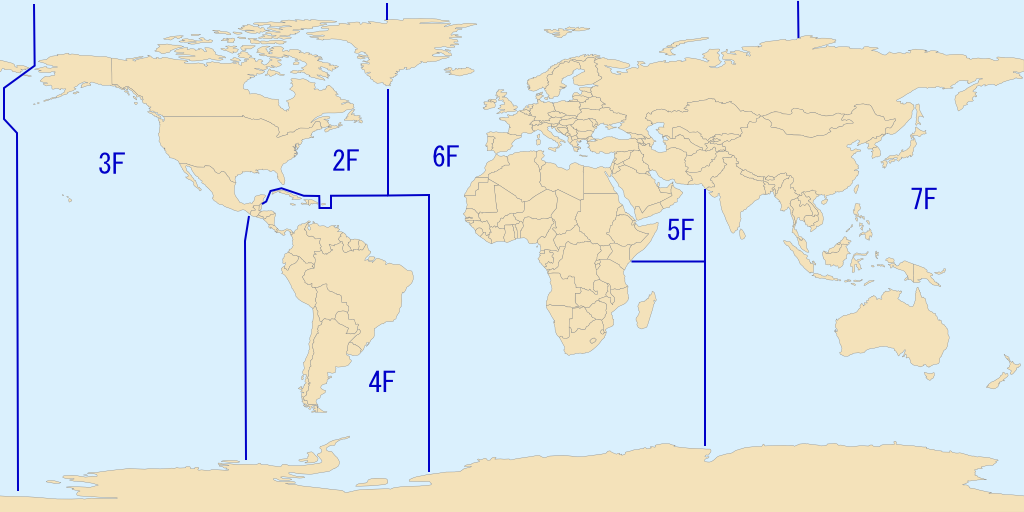
US navy fleets areas of responsibility. Source Wikipedia.

The only mitigating rationale I see for not transferring most of the large cutters to Pacific Area is that the Eastern Pacific drug transit zone is actually closer to Atlantic Area ports than to Pacific Area ports. This is why all of South America is under 4th Fleet, which is an Atlantic Fleet command. Probably an argument should be made for realigning the Coast Guard Area geographic descriptions to match those of the Atlantic and Pacific Fleets. A change of name to Eastern and Western Area might be appropriate and in fact a more accurate description.

Atlantic area includes not only the Atlantic coast but also the great lakes, inland areas, the Gulf of Mexico, Caribbean, and parts of the Arctic and Southern Oceans. Pacific Area also includes inland areas, the Indian Ocean (part of which is under Atlantic Fleet), and parts of the Arctic and Southern Oceans.

A realignment along Fleet dividing lines would also mean the dividing lines would more closely correspond to COCOM areas of responsibility and limit the number of cases where COCOMs would need to deal with both Coast Guard Areas to NORTHCOM. Currently there is also overlap in SOUTHCOM, AFRICOM, and CENTCOM. All three of those COCOMs would only need to deal with the Eastern (Atlantic) Area. That seems to be what is happening with AFRICOM and CENTCOM now anyway. PATFORSWA WPCs, Atlantic Area assets, operate routinely in the Indian Ocean, part of the PACAREA AOR. 

Unified Combatant Commander’s Areas of Responsibility.

As Pacific Area assumes more responsibility in the Western Pacific and potentially the Indian Ocean passing off responsibility for all Coast Guard operations in 4th Fleet’s Area of Operations to Atlantic Area might make sense.

Antarctic:

The U.S. priority for Antarctica remains maintaining “a continent reserved for peace and science in accordance with the provisions of the Antarctic Treaty of 1959.”

No real change expected other than more and better icebreakers, but not everyone thinks like the US.

We should have the agility to react to a change from the present “continent reserved for peace and science.” We really have no reason for confidence that Antarctica will not become a zone of Conflict. Fortunately, actions to increase capabilities in the Arctic may also serve us well in Antarctica.

Implications for the Future

Cutter Design:

Patrol Cutters: Moving from “Patrol and Interdict” to “Target and Interdict” suggests that cruise speed endurance may become less important, and that higher max speed and an economical loiter speed may become more important. Greater emphasis on Defense Readiness would also suggest the desirability of greater speed. This suggest that we may want to build fewer than the currently planned 25 OPCs and shift investment to a new design based on a different set of priorities that we can build in greater number; ships with greater speed and increased modularity to accommodate an uncertain future.

Buoy Tenders: Improved aids to navigation may mean tenders will spend less time on routine AtoN maintenance. Still, they will need to be geographically distributed to respond to critical outages. It seems these ships will become more multi-mission by design. They should continue to be able to operate in ice. Their increased use for non-AtoN missions suggest that they may need overflow berthing and more fuel and stores capacity when supporting WPC deployments and to make them more effective in law enforcement roles–more speed, a flight deck and hangar for UAS and a deck gun such as the Mk38 Mod4.

Deployable Teams

Sounds like we will be getting more deployable Law Enforcement Detachments given the proliferation of capacity building objectives. Increased specialization and a desire for continuity in this area may someday result in a new rating.

Thanks to Paul for bringing the video to my attention. 


Oct. 25, 2024

Coast Guard unveils first Operational Posture Statement

By Zach Shapiro, MyCG Writer

The Coast Guard just released its first Operational Posture Statement, which outlines the service’s operational priorities, including its plans to adapt to personnel and resource challenges. Vice Adm. Peter W. Gautier, Deputy Commandant for Operations (DCO), unveiled the document Friday during an event at the Center for Strategic and International Studies (CSIS) in Washington, D.C.

Think of the new annual Operational Posture Statement as a tactical annual document that supports the long-term Coast Guard Strategy by providing more specificity.

To improve operational efficiency and effectiveness, for example, the Coast Guard will increasingly use intelligence and data to shift its approach from “patrol and interdict” to “target and interdict.”

And to improve readiness, the Coast Guard will focus on three key elements: the workforce, capabilities, and assets. The Operational Posture recognizes the need to meet increasing demand while addressing workforce and resource shortages. The service will also continue to recapitalize cutters, boats, aircraft, and infrastructure.

The Operational Posture “is our effort to communicate with our stakeholders and be transparent with the American people on how we will confront all of these challenges, this increasing mission demand, and provide the kind of services that Americans deserve,” Gautier said.

Six guiding principles underpin the Operational Posture Statement:

  1. Balance current operations with future readiness
  2. Strengthen maritime governance
  3. Counter strategic competitors while fulfilling our primary responsibility to secure and defend the homeland
  4. Adjust force structure and posture to maximize operational effectiveness while maintaining a high level of support for our people, platforms, and infrastructure
  5. Employ resources holistically to meet growing demands
  6. Leverage intelligence, information, and improved maritime domain awareness to shift from a “patrol and interdict” to “target and interdict” model

These priorities reflect the increasing national and global demands for Coast Guard services. As 90 percent of global trade moves by sea, maritime security is the bedrock of national security and economic prosperity. In the face of rising global maritime tensions, the Coast Guard has a unique and critical role as a law enforcement entity and military agency.

Amidst this evolving environment, Gautier emphasized, the Coast Guard remains committed to its Search and Rescue (SAR) mission. That mission is “a sacred trust with the American people and a no-fail mission. It is our primary lifesaving mission. It defines us as a humanitarian service,” he said.

Moving forward, the Coast Guard intends to release a new Operational Posture Statement annually to outline the ways in which the service is adapting to new challenges and missions to best serve the American people.

  • To read the Operational Posture Statement in full, please click here.
  • To view Vice Adm. Gautier’s remarks, click here.

Resources: 
“America’s Coast Guard Faces Impossible Odds Without More Funding” –gCaptain

Coast Guard Chief Petty Officer Christian Seay, a chief boatswain’s mate on the Coast Guard Cutter Tampa, looks over to the Coast Guard Cutter Thetis, Key West, Florida. USCG photo by Lisa Ferdinando Sky digitally altered by AI

gCaptain’s John Konrad provides his reaction to the first ever U.S. Coast Guard, the 2024 Operational Posture (OP24). 

Perhaps because the Coast Guard has always been underfunded, he sees the Coast Guard’s current situation even more dire than I do (I will be publishing my own assessment soon), but he also adds an important additional view as a member of the Merchant Marine community.

It fails to address some other massive failures, such as the Coast Guard’s stringent training requirements for U.S. Merchant Mariners, the difficulty in advancing from seaman to officer ranks, and its substantial backlog of medical evaluations. These issues collectively contribute to a mariner crisis that has forced the U.S. Navy to sideline seventeen ships.

These issues should not be ignored.

“Q&A: Vice Admiral Andrew J. Tiongson, Commander, Pacific Area and Commander, Defense Force West, U.S. Coast Guard” –Seapower

Tiongson speaks at a press conference before the crew of the Coast Guard Cutter Waesche offloads 18,219 pounds of cocaine, worth more than $239 million, on Dec. 6, 2023. U.S. Coast Guard

The Navy League’s on-line magazine, Seapower, has an interview with the Pacific Area Commander. There is a lot of good information here.

HC-130Js (and C-27Js):

CGAS Sacramento will “transition” to HC-130Js. Pacific Area certainly needs the long range aircraft because, while 84% of the US EEZ is in Pacific Area they have only three fixed wing air stations (Kodiak, Barbers Point, and Sacramento) while Atlantic Area has five fixed wing air stations to cover only 16% of the US EEZ.

What will happen to the C-27Js? No mention was made of these. They might go to Guam. That would be helpful in providing fixed wing search aircraft in the Western Pacific. Recently there was a SAR case in the Western Pacific. A C-130 was dispatched from Barbers Point, but the flight was so long the crew needed a day’s rest before the aircraft could be used in the search. On the other hand, Guam might not be an optimal location since it is so far West. There are other options.

Fast Response Cutters:

As I read the statement, the intention is to have a total of six FRCs in Guam and add a fourth in Hawaii.

His discussion about these little ships clearly indicates that their nominal five-day endurance (same as the preceding 110 foot WPBs) is being exceeded regularly.

“The FRCs, first off, are game changers for the Coast Guard in general. Back in the day, we had patrol boats that were limited in terms of the sea states they could handle, the food that they could carry, the number of crew members and certainly their duration at sea. The FRCs have changed that.”

Six WPCs in the same port is not unusual. District 7 has three different ports, each homeport to six or seven Webber class, but this may be a move toward replicating a PATFORSWA type organization to support 7th Fleet in the Western Pacific.

Large Patrol Cutters:

There was a brief discussion of the Offshore Patrol Cutters, but no indication of when they are expected to arrive in PACAREA.

A second “Harriet Lane or Indo-Pacific support cutter” is on PACAREA’s unfunded priority list. For some reason, I think this may happen.

Commercial Icebreaker Procurement:

Plans for the commercial icebreaker (Aiviq) were discussed. It will be homeported in Juneau, as reported here in March, but still has not been purchased and it will take two years to complete changes to make it fully operational.

The admiral was asked, “Is the commercial icebreaker going to be crewed by Coast Guardsmen or by a contract crew?” and there was no definitive answer. Should the Coast Guard adopt a hybrid crew, as has been done by some Navy vessels it would be a major change in Coast Guard policy.

The Eastern Pacific Drug Transit Zone: 

Atlantic Area cutters are not assisting in Eastern Pacific drug transit zone interdiction efforts, as they normally would, because they are heavily engaged in migrant interdiction operations.

Trusted Partner:

The Area Commander talked a lot about what being a trusted partner meant, about partnerships with Asian coast guards, and the outsized effect of having a few good people in liaison positions.

“Coast Guard Goes All-In on Zero Trust Architecture” –National Defense

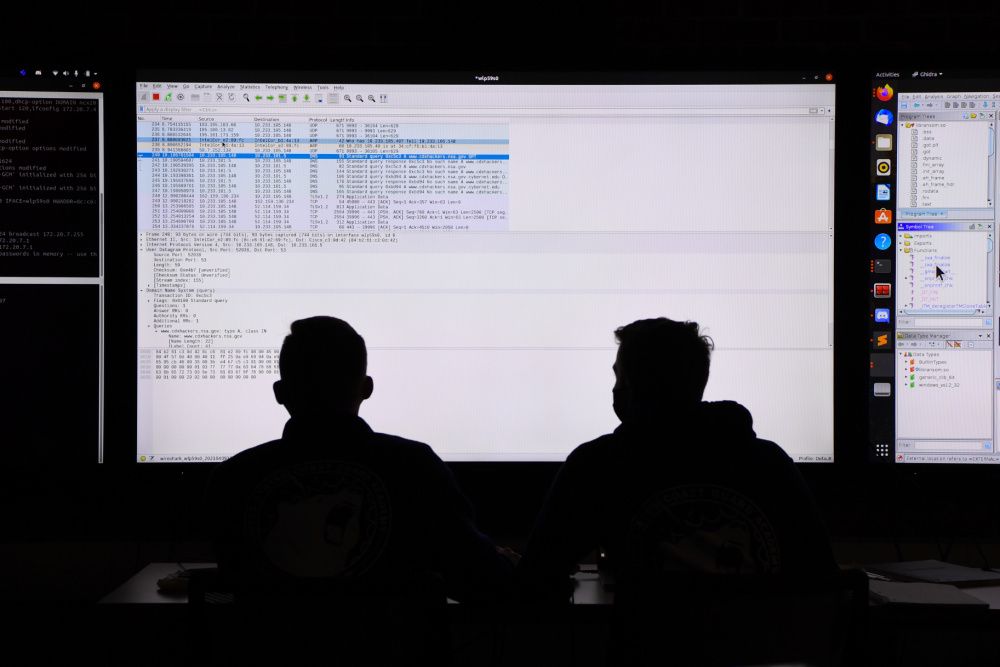
A team from the U.S. Coast Guard Academy participated in the National Security Agency’s 20th annual National Cyber Exercise (NCX), a three-day cyber competition that tests the offensive and defensive cybersecurity skills virtually, April 8-10, 2021. The Coast Guard Academy recently instituted a Cyber Systems degree to meet the needs of the services cyber security strategy of defending cyber space, enabling operations, and protecting infrastructure. (U.S. Coast Guard photo by Petty Officer 2nd Class Hunter Medley)

National Defense reports,

“We need to focus on better identity management, focusing on the data side of that,” Capt. Andrew Campen, engineering services division lead at the Command, Control, Communication, Computer, Cyber and Intelligence Service Center at the Coast Guard, said at a panel at the Eastern Defense Summit in December. “[We must] realize that data is the piece that’s important, not the system itself. Identity management is key for us. Understanding data is key for us.”

“Zero Trust” is a concept that is frequently talked about, but for me at least, little understood. I don’t think I have mentioned the topic here previously.

Zero trust architecture refers to evolving cybersecurity paradigms that prioritize protecting data by repeatedly authenticating, authorizing and validating system, application and data access.

There is, of course, a desire to prevent sensitive data being stolen and a desire for operational security. Conversely there is a desire to make information usable and to act quickly on time sensitive information.

Operationally we don’t want forces diverted from an actual case by false information, but we also do not want a desire for validated information to filter out time critical but incomplete early indicators–we don’t want to be like the Duty Officer at Pearl Harbor who wanted “confirmation” before reporting USS Ward’s attack on a small submarine early on Dec. 7, 1941.

It all just sounds like good opsec, but it has been complicated by access to multi-user data bases. As the post notes, “Successfully implementing a zero trust architecture is incredibly difficult.”

“USNI News Fleet and Marine Tracker: Aug. 28, 2023”

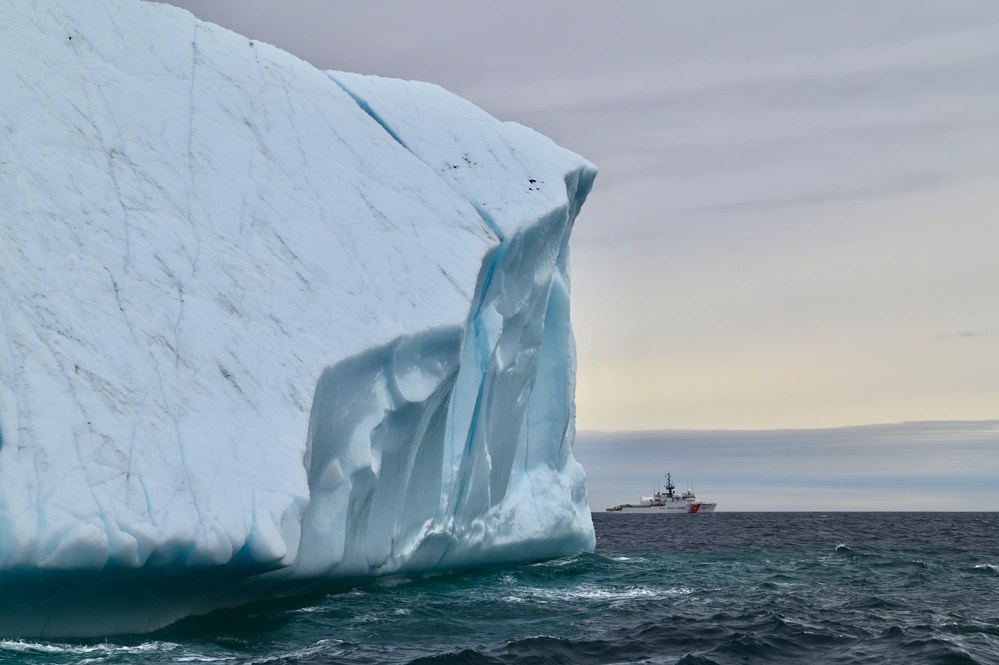
The U.S. Coast Guard Cutter Forward (WMEC 911) steams near an iceberg in the Atlantic Ocean, Aug. 22, 2023. Forward deployed in support of Op Nanook, an annual Canadian-led exercise that offers an opportunity to work with partners to advance shared maritime objectives. (U.S. Coast Guard photo by Petty Officer 3rd Class Mikaela McGee)

The US Naval Institute’s Fleet and Marine Tracker again reports three Navy ships are operating under 4th Fleet. This has been the case since the end of the UNITAS exercise. We will have to wait to see if this higher level of activity becomes a new norm.

As for Coast Guard activity, they note PATFORSWA in the Mid East, USCGC Healy (WAGB-20) in the Beaufort Sea, USCGC Forward (WMEC-911) participation in Operation Nanook, and, “Legend-class National Security Cutter USCGC Munro (WMSL-755) is in the South China Sea and is conducting joint training with the Malaysian Maritime Enforcement Agency (MMEA).”

There is good coverage of Coast Guard out of area operations. USNI is publishing what information they get from the Coast Guard, but apparently the Coast Guard does not provide anything comparable to the statistical information the Navy provides (as in the example below), so there is no information about routine Coast Guard operational tempo.

Ships Underway

Total Battle Force Deployed Underway
297
(USS 238, USNS 59)
100
(USS 67, USNS 33)
67
(39 Deployed, 28 Local)

Unfortunately, the Coast Guard frequently lacks visibility (particularly the larger cutters and fixed wing aircraft) because despite being an important component of the “National Fleet,” it is not included in the “Total Battle Force.” It could be argued that the battle force number is not very instructive because it includes everything from aircraft carriers to fleet tugs and research ships, but people, including people in Congress take the number seriously. They talk about it a lot.

The investment in high quality platforms that make the Coast Guard so effective in its peacetime missions is only fully justified by the fact that the Coast Guard serves as a naval auxiliary in wartime.

We cannot allow people to forget that the Coast Guard has wartime roles that justify additional investment in capabilities that might not be otherwise justified.

A revision to the statistical presentation, like the example above, that included Coast Guard major units, would demonstrate that Coast Guard units are underway at a relatively high rate. It would show that the government is getting what it paid for.

Brits To Keep Two OPVs In the Indo-Pacific

The Royal Navy is sending two of their River Class Batch II offshore patrol vessels to serve long term in the Indo-Pacific.

We have talked about the River Class Batch II ships and their close relatives several times, here, here, here, and here.

Interesting to see camouflage applied to these ships. I also note they are commanded by Lt. Commanders. The crews on these ships are about half what we would expect on a comparable Coast Guard Cutter. In all probability crews will be rotated as was done with the crew of the earlier River class OPV, HMS Clyde, stationed in the Falklands.

The video makes it sound like these will both be going to the Pacific, with no British bases in the area, but Indo-Pacific includes the Indian Ocean as well and the British have a base in Bahrain and while it is also a US base, Diego Garcia is a British possession. Still it sounds like they will be making the rounds showing the flag.

These ships will join Britain’s planned Indo-Pacific Littoral Response Group (LRG) when it is formed. Two such groups are planned, one in Northern Europe and a second to be based in Oman.

“SEA CONTROL 219 – USCG COMMANDANT ADMIRAL KARL SCHULTZ” –CIMSEC

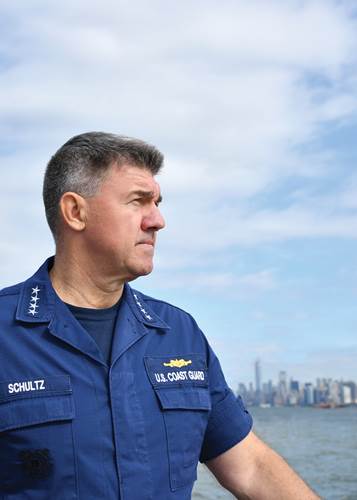
Coast Guard Commandant Adm. Karl Schultz visits with Coast Guard crews stationed in New York City. U.S. Coast Guard photo illustration by Petty Officer 1st Class Jetta Disco.

(I meant to cover this earlier, but perhaps still worth a listen)

CIMSEC’s Podcast “SEA Control,” had an interview with the Commandant, Dec. 27, 2020. You can find it here.

At first I thought I had heard it all before, but toward the end, there were some surprises.

He talked about  Arctic, Antarctic, and IUU. He talked about the Arctic Strategic Outlook and the IUU Strategic Outlook.

Illegal, Unreported, Unregulated fishing got a lot of attention. He related that it was gaining visibility and had become a national security issue since overfishing has created food security issues for many countries. He pointed to Coast Guard Cooperation with Ecuador in monitoring a fishing fleet off the Galapagos Islands. Internationally he sees a coordination role for the USCG.

Relative to the Arctic he mentioned the possibility of basing icebreakers in the Atlantic and the need for better communications.

He talked about the Tri-Service Strategy and the Coast Guards roles in it, particularly in less than lethal competition.

More novel topics started about minute 38 beginning with Unmanned systems. He talked about the recent CG experiments with unmanned systems and went on to note that the CG will also regulated Unmanned commercial vessel systems.

About minute 41 he talked about the Coast Guard’s role in countering UAS in the Arabian Gulf. He added that we have a lead role in DHS in counter UAS. “We are in the thick of that”

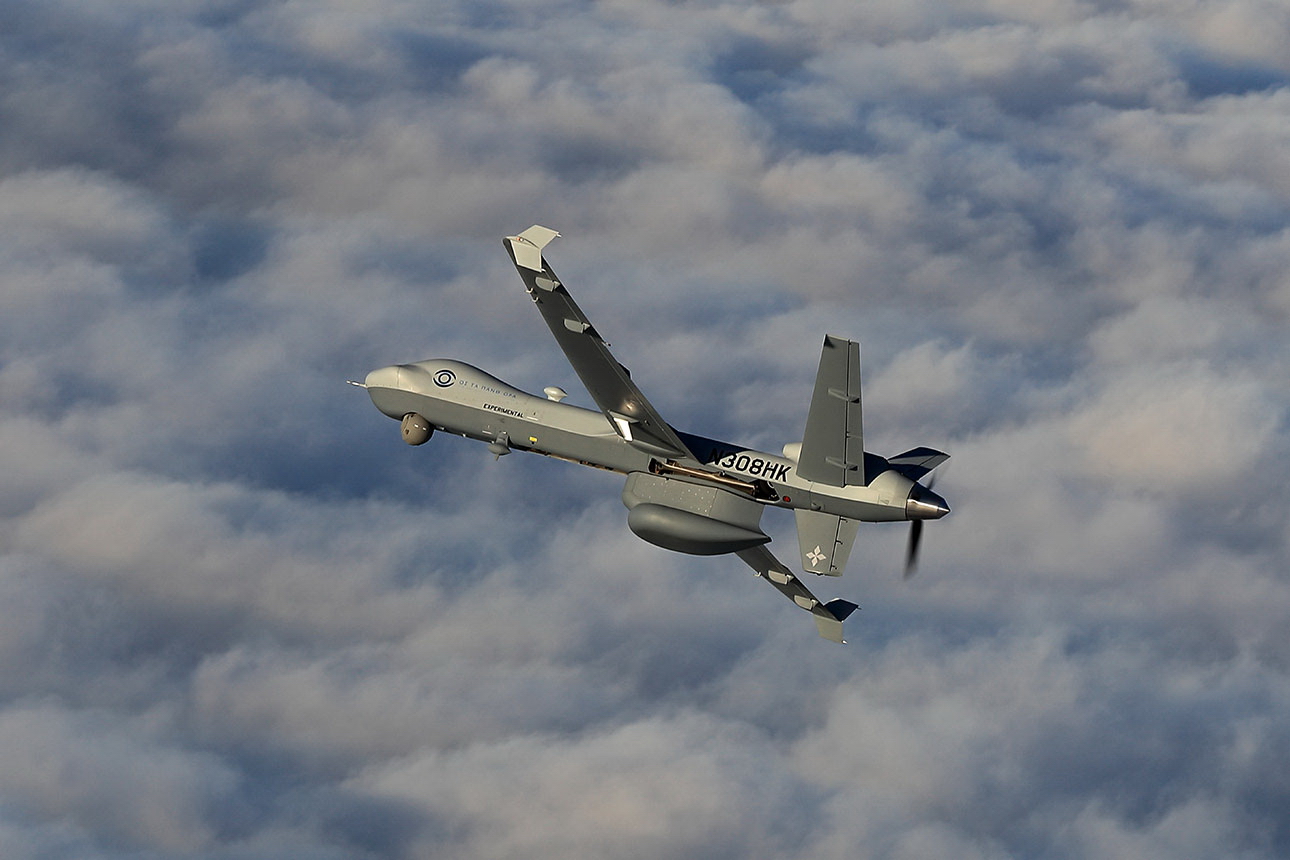
GA-ASI Concludes Successful Series of MQ-9 Demonstrations in Greece

He said the service was looking at MQ-9 maritime “Guardian” (minute 45)

When ask about reintroducing an ASW capability he said that while the Coast Guard was looking at it, the service would have to be cautious about biting off too much. (My suggestion of how the CG could have an ASW mission with minimal impact on its peacetime structure.)

He talked about balancing local and distant missions and concluded that the CG could do both (47), and that the Coast Guard was becoming truly globally deployable (48).

He noted that the first two FRCs for PATFORSWA would transit to Bahrain in Spring, followed by two more in the Fall, and two more in 2022. (49)

He noted technology is making SAR more efficient. “Hopefully we will put ourselves out of the Search and Rescue business.” 50

He talked about the benefits of “white hull diplomacy.” (52)

Asked about our funding for new missions he said it was sometime necessary to demonstrate the value of the mission first, then seek funding. (55)

He also talked about raising the bar on maintenance.

Two Articles on Coast Guard/Navy Cooperation/Coordination –CIMSEC and USNI

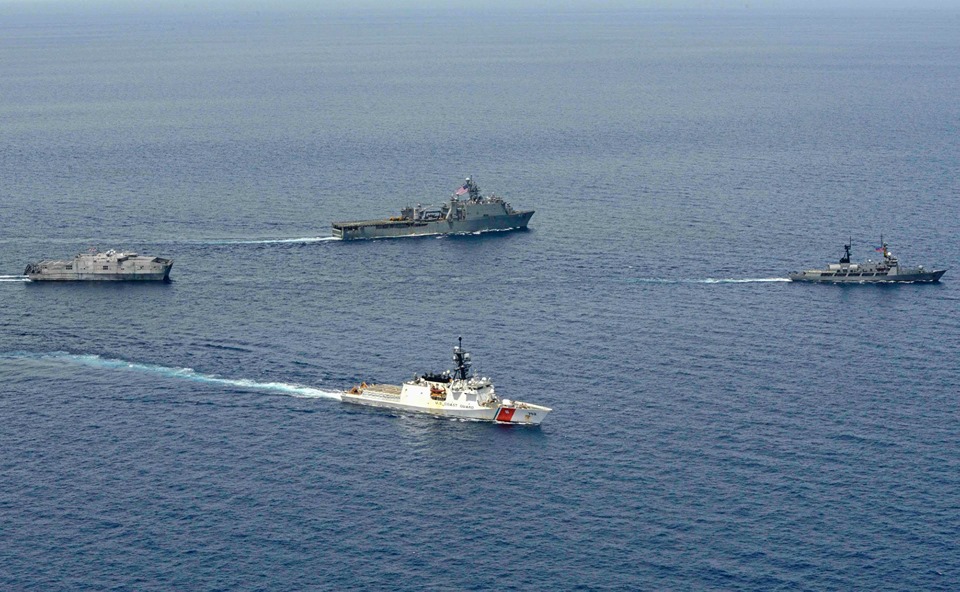
The Philippine Navy’s BRP Andres Bonifacio (PS 17), USS Germantown (LSD-42), USCGC Stratton (WMSL 752) and USNS Millinocket (T-EPF 3) break formation after steaming together this week in the Sulu Sea as part of Maritime Training Activity Sama Sama.

Two recently published articles suggest greater cooperation and coordination between the Navy and Coast Guard. Both were written by a Marine, Captain Walker D. Mills, USMC, an infantry officer currently serving as an exchange officer in Cartagena, Colombia.

The Proceedings article talks about ways the Coast Guard could contribute to a rules-based international order in the Western Pacific but points out that the Coast Guard is underfunded and points to this as a reason given for not assuming a greater role in the Western Pacific. I don’t think he is saying these arguments absolutely preclude a greater Coast Guard role in the Western Pacific, but he does present the argument.

The CIMSEC post, points out that the Chief of Naval Operations’ recent FRAGO (shortened form of fragmentary order. An abbreviated form of an operation order) directing increased coordination between the Navy and Marine Corps missed an opportunity to highlight the reality of continuing cooperation between the Navy and Coast Guard.

“Some observers have raised objections to including the Coast Guard in the U.S. response to Chinese belligerence and encroachment in the South China Sea – it has repeatedly been a focus of commentary without generating a consensus. Generally, these objections are based on the small size and meager funding that the Coast Guard has and how the Coast Guard would be unprepared if a shooting conflict broke out in the region. Both of these are reasons why the CNO needs to plan for and mention the inclusion of the Coast Guard in his guidance to the force and make them a part of the larger conversation. Ignoring the Coast Guard, minimizing their potential contribution, or leaving them out of the discussion entirely would only serve to exacerbate these two issues.”


Conclusion

The CNO dedicated part of his FRAGO to guidance on building “alliances and partnerships” internationally – but it is just as if not more important to build partnerships and interoperability between sister services and other U.S. agencies. The CNO’s FRAGO is a far cry from the level of Coast Guard inclusion that permeated the 2015 Cooperative Strategy for 21st Century Seapower. While CNO Gilday obviously does not have the statutory authorities to direct his FRAGO at the Coast Guard – he can make it clear to his sailors that he views the Coast Guard as playing a critical role in the Navy-Marine Corps-Coast Guard team. That would be moving toward a truly integrated national maritime architecture and force structure. This direction will be critical for preserving U.S. primacy at sea and enforcing rule of law in the global commons.

HMS Clyde, a Short but Remarkable Career

HMS Clyde (P257) has been decommissioned and is expected to be sold to the Brazilian Navy. By Coast Guard standards, she is almost new, not yet 13 years old. She is being replaced by a new ship of the more capable River Batch II class that evolved from HMS Clyde and three earlier River class Offshore Patrol Vessel.

As an OPV, Clyde’s design is largely unremarkable (specifications below), but her twelve year deployment on distant station, with reportedly only a single yard period, in spite of having a crew of only 40 on a ship slightly larger than a 270 foot WMEC, is quite unusual.

HMS Clyde was commissioned in 30 Jan. 2007 and decommissioned 20 Dec. 2019. In Brazil where she will join three newer, but similar type ships, also built in Britain.

Specifications:

  • Displacement: 2000 tons
  • Length: 81.5 m (267 ft 5 in)
  • Beam: 13.5 m (44 ft 3 in)
  • Propulsion: twin diesel, 11,280 HP total
  • Speed: 21 knots
  • Endurance: 21 days
  • Range: 5,500 nmi (10,200 km)
  • Flight Deck for helicopters up to and including Merlin
  • Armament: 30mm auto cannon, 2 miniguns

What Frustrates Me? –an Apparent Lack of Transparent Long Term Planning

A reader recently asked me, “What frustrates you, Chuck? … what is the one or two key areas that you think the USCG needs?  A new ship design, up-arming, or missiles?”
My answer, actually it is the apparent failure to plan.

Rant to Follow

Maybe there is a plan, but if there is, it has not been shared with the Congress or the public. Consequently there has been no opportunity to build support for the plan.

Despite direction from Congress to provide a 25 year shipbuilding plan, none has been provided. Is the hold up in the Coast Guard or the Department? Who knows.

Our shipbuilding “Program of Record” (POR) was last baselined in 2005, as part of the defuncted “Deepwater” program. It was based not on need, but on expected funding.

An examination of need was made, in the form of an “Offshore and Aviation Fleet Mix Study.” A report was completed in 2009. It was reevaluated in 2011, resulting in lower requirements that still indicated that we needed assets far in excess of the program of record. Results were not made public until 2012.
There has been no reexamination of our needs since then, in spite of the fact that the Fleet Mix Study was based on an assumption of the use of the “Crew Rotation Concept” on the National Security Cutter and Offshore Patrol Cutter. It also anticipated deployment of shore based Unmanned Air Systems (UAS), large vertical take off ship based UAS, and networking that would provide a common tactical picture. So far, no land based UAS, only a much smaller less capable ship based UAS, and no real common tactical picture. The only pleasant surprise has been the utility of the Webber class cutters.
I have a half assed Operations Research background. It pains me to see that we are apparently not using the planning tools that are available.
When we present a well considered and fact based plan, the Congress has been responsive. They have supported the program of record, and are funding icebreakers in response to the High Latitude Study.
  • We sorely need an updated Offshore and Aviation Fleet Mix Plan.
  • From this and consideration of other needs we need to develop a 30 year Shipbuilding and Aviation Procurement Plan.
  • We need to update these planning tools on a regular basis. We can expect that they will get better with each iteration.
Normally the leadership changes every four years. It is reasonable that we have a planning cycle that follows this pattern. We can give the new Commandant and his staff a year to work with his predecessor’s planning products before initiating a new cycle. A year in he should initiate a new Fleet Mix Plan. Using it and other inputs, a new 30 year Shipbuilding and Aviation Procurement Plan should be completed well before the new Commandant is selected. 
Only tangentially related, but a budget document we seldom see, is the Coast Guard’s unfunded priority list. Almost three years ago, I did one of my own. Not much has changed.
Thanks to Peter for kicking off this line of thought.