“BOLLINGER SHIPYARDS DELIVERS FINAL BAHRAIN-BOUND FAST RESPONSE CUTTER TO U.S. COAST GUARD” –News Release

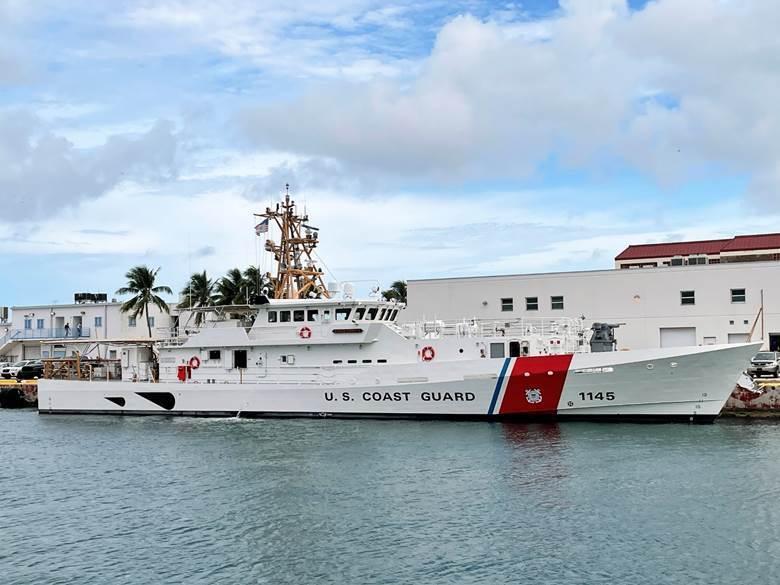
USCGC CLARENCE SUTPHIN (WPC 1147) is the sixth and final Webber class FRC planned for assignment to PATFORSWA, Manama, Bahrain.

Below is a news release from Bollinger Shipyards, 


LOCKPORT, La., — January 6, 2021 – Bollinger Shipyards LLC (“Bollinger”) has delivered the USCGC CLARENCE SUTPHIN to the U.S. Coast Guard in Key West, Florida. This is the 170th vessel Bollinger has delivered to the U.S. Coast Guard over a 35-year period and the 47th Fast Response Cutter (“FRC”) delivered under the current program.

The USCGC CLARENCE SUTPHIN is the final of six FRCs to be home-ported in Manama, Bahrain, which will replace the aging 110’ Island Class Patrol Boats, built by Bollinger Shipyards 30 years ago, supporting the Patrol Forces Southwest Asia (PATFORSWA), the U.S. Coast Guard’s largest overseas presence outside the United States.

“Ensuring that the brave men and women of the U.S. Coast Guard have the most state-of-the-art, advanced vessels as they work to build and maintain the necessary regional alliances to ensure maritime security in the region is a top priority,” said Bollinger President & C.E.O. Ben Bordelon. “Bollinger is proud to continue enhancing and supporting the U.S. Coast Guard’s operational presence in the Middle East and ensuring it remains the preferred partner around the world.”

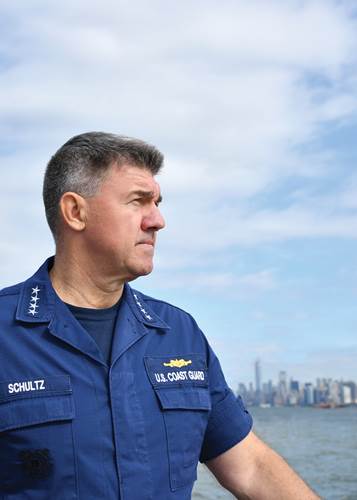
Earlier this year at the commissioning ceremony of the USCGC CHARLES MOULTHROPE, U.S. Coast Guard Commandant Admiral Karl Schultz lauded the “enhanced seakeeping” capabilities of the PATFORSWA-bound FRCs, saying “these ships are truly going to be game changing in their new theater of operations” and “offer increased opportunities for integrated joint operations with our Navy and Marine Corps colleagues” as the Coast Guard seeks to be part of the whole-of-government solution set in the region.

PATFORSWA is composed of six cutters, shoreside support personnel, and the Maritime Engagement Team. The unit’s mission is to train, organize, equip, support and deploy combat-ready Coast Guard Forces in support of U.S. Central Command and national security objectives. PATFORSWA works with Naval Forces Central Command in furthering their goals to conduct persistent maritime operations to forward U.S. interests, deter and counter disruptive countries, defeat violent extremism and strengthen partner nations’ maritime capabilities in order to promote a secure maritime environment.

Each FRC is named for an enlisted Coast Guard hero who distinguished themselves in the line of duty. Clarence Sutphin, Boatswain Mate First Class, USCG, was awarded the Bronze Star Medal for his courageous actions during the invasion of Saipan Island in 1944. His citation reads: “For heroic achievement in action against enemy Japanese forces during the invasion of Saipan, Marianas Islands, on June 15 and 16, 1944.  Swimming with a line through heavy surf to a tank lighter stranded on a reef, SUTPHIN remained aboard under mortar and artillery fire until the boat was salvaged.  Returning to the beach, he aided in salvaging another tank lighter under enemy fire and, when a mortar shell struck a group of eight Marines, promptly treated the wounded and moved them to a first aid station.  His courage and grave concern for the safety of others reflects the highest credit upon SUTPHIN and the United States Naval Service.”

About the Fast Response Cutter Platform

The FRC is an operational “game changer,” according to senior Coast Guard officials. FRCs are consistently being deployed in support of the full range of missions within the United States Coast Guard and other branches of our armed services.  This is due to its exceptional performance, expanded operational reach and capabilities, and ability to transform and adapt to the mission. FRCs have conducted operations as far as the Marshall Islands—a 4,400 nautical mile trip from their homeport. Measuring in at 154-feet, FRCs have a flank speed of 28 knots, state of the art C4ISR suite (Command, Control, Communications, Computers, Intelligence, Surveillance, and Reconnaissance), and stern launch and recovery ramp for a 26-foot, over-the-horizon interceptor cutter boat.

About Bollinger Shipyards LLC

Bollinger Shipyards LLC (www.bollingershipyards.com) has a 75-year legacy as a leading designer and builder of high performance military patrol boats and salvage vessels, research vessels, ocean-going double hull barges, offshore oil field support vessels, tugboats, rigs, lift boats, inland waterways push boats, barges, and other steel and aluminum products from its new construction shipyards as part of the U. S. maritime defense industrial base. Bollinger has 11 shipyards, all strategically located throughout Louisiana with direct access to the Gulf of Mexico, Mississippi River and the Intracoastal Waterway. Bollinger is the largest vessel repair company in the Gulf of Mexico region.

“Iran Boosts IRCG Navy’s Swarm Attack Capabilities” –Naval News

110 speed boats entered service with the IRGC Navy (IRIB News picture)

Naval News reports,

According to the Iranian news outlet IRIB News, the Islamic Revolution Guards Corps (IRGC) Navy received 110 indigenously made combat speedboats on December 11 during a ceremony in Bandar Abbas….

“This is the seventh delivery of such vessels. Their speed has climbed from 55 knots to 75 and 90 knots, with the next stage reaching 110 knots. The boats are equipped with missiles and rockets and are capable of operating efficiently under the IRGC’s indigenous radar network.”

It’s not impossible the Iranians are employing deception tactics and may be redelivering boats seen in previous delivery media events, but there is little doubt, they do have a lot of fast attack craft, making the Coast Guard’s PATFORSWA operating area a rough neighborhood. (More here, here, here, here, and here.)

Considering if PATFORSWA is ever in a fight with the Islamic Revolutionary Guard Corp Navy, the cutters will probably be protecting tankers or Navy high value units. In that case, frankly I think most of the smaller craft are intended as a diversion, the primary threats are the missile and torpedo equipped boats that will screened by a cloud of smaller boats. Still machineguns and rockets mounted on small boats could damage the cutters.

If you want to consider if we can deal with the Iranian tactics, you might want to look at this earlier post, Guns vs the Swarm.

“Video Shows U.S. Destroyer’s Very Intimate Standoff With Iranian Vessels Over Seized Oil Tanker” –Cutter there too

The Drive–War Zone has a post about an incident that reportedly occurred on October 24. The Iranian Revolutionary Guard Corp seized a Vietnamese flagged tanker in the Gulf of Oman and escorted it into an Iranian port.

The Iranian claim is that the tanker was carrying oil from a tanker the US had seized and they only boarded the vessel to protect it, and their oil, from being seized by the US.

Three short videos, published by the Iranians, accompany the post. The third clearly shows a Webber class cutter in the vicinity of the tanker.

In viewing the videos, I would note that, when the tanker is seized, no US assets are visible in the vicinity. The initial boarding is by troops with weapons at the ready, landed by helicopter–not normally the sort of boarding that would be used if their presence was welcomed. When additional Iranian personnel board by boat, again no US assets are visible in the area.

The videos only prove that at some point during the transit from the time of the seizure to the Iranian port, two US destroyers and the cutter closed with the tanker and its Iranian escort.

Hopefully the tanker and crew will be released in the near future. It will be interesting to hear their perspective on what occurred.

Task Force 59 Unmanned Surface Vessels Operate With PATFORSWA Cutter

US Navy TF59 Integrates MANTAS USV with Patrol Vessels

Two MANTAS T-12 unmanned surface vessels (USV), front, operate alongside U.S. Coast Guard patrol boat USCGC Maui (WPB 1304) during exercise New Horizon in the Arabian Gulf, Oct. 26. Exercise New Horizon was U.S. Naval Forces Central Command Task Force 59’s first at-sea evolution since its establishment Sept. 9. (U.S. Navy photo by Mass Communication Specialist 2nd Class Dawson Roth)

Naval News reports an exercise conducted by Task Force 59, Fifth Fleet’s Unmanned systems development group. As I thought they might, they have been working with Coast Guard Patrol Force South West Asia (PATFORSWA) as well as Navy Cyclone class and allied navies.

Coast Guard Commissions USCGC Emlen Tunnell (WPC-1145)

USCGC Emlen Tunnell in Key West, Florida.

Port News reports the commissioning of the 45th Webber class WPC. The commissioning was widely reported, but I found it interesting that a Russian news outlet would take note, including reporting on Tunnell’s football career. Other report here, here, and here.

Later this year, USCGC Emlen Tunnell will join her sister-ship USCGC Glen Harris (WPC 1144) and voyage to Bahrain as the second of three pairs of FRCs to replace the Island class cutter of Patrol Force South West Asia (PATFOSWA). Like the previous transit, the pair are likely to take the opportunity to conduct some training and joint operations along the way. Presumably there will also be a National Security Cutter along to provide support and also show the flag, conduct exercises, and build capacity.

USCGC Robert Goldman (WPC 1142), Bound for Bahrain, To be Commissioned 12 March, 2021

Phoro: Sister ship, the Charles Moulthrope (WPC 1141), delivered on Oct. 22, 2020, and commissioned on Jan. 21

Below is an Atlantic Area news release. USCGC Robert Goldman (WPC 1142) is the 42nd Webber class WPC and is expected to be one of the first two of six to join PATFORSWASIA, replacing six 110 foot WPBs currently homeported in Bahrain.

united states coast guard

News Release

U.S. Coast Guard Atlantic Area
Contact: Coast Guard Atlantic Area Public Affairs
Contact: (757) 452-8336
Atlantic Area online newsroom

U.S. Coast Guard to commission 42nd Fast Response Cutter

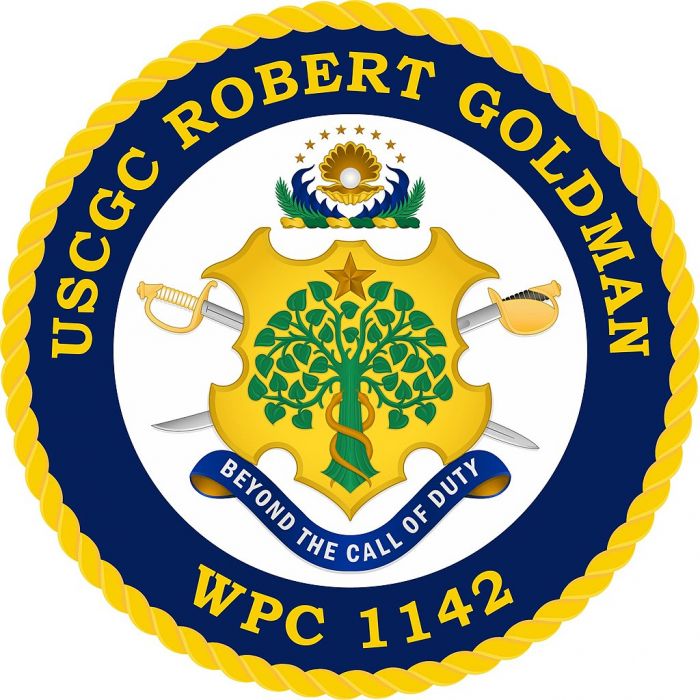
USCGC Robert Goldman Seal

Key West, Fla. — The U.S. Coast Guard will commission the USCGC Robert Goldman (WPC 1142), Patrol Forces Southwest Asia’s second Sentinel-class cutter, into service at Coast Guard Sector Key West, Friday at 10 a.m. EST.

Due to COVID mitigation, in-person attendance is limited. Anyone interested in viewing the ceremony livestream may do so at http://bit.ly/WPC1412Com, clicking on the image at the top, or by clicking here

Vice Adm. Scott Buschman, deputy commandant for operations, U.S. Coast Guard, will preside over the 42nd Sentinel-class cutter ceremony. Mrs. Eleanor Goldman is the ship’s sponsor.  

The Robert Goldman is the second of six FRCs planned for service in Manama, Bahrain. The cutter is named after Pharmacist’s Mate 2nd Class Robert Goldman, remembered for heroic and selfless actions as a member of the joint forces serving in the Pacific theater during World War II. 

The Coast Guard took delivery of Robert Goldman on Dec. 21, 2020, in Key West. They will transit to Bahrain later this year with their sister ship, the Charles Moulthrope (WPC 1141), delivered on Oct. 22, 2020, and commissioned on Jan. 21, in Portsmouth, Virginia.

FRC #43 Accepted

USCGC Frederick Hatch (WPC-1143) click on the photo for a larger version of photo.

After the recent look at a Webber class cutter bound for Bahrain, I thought I’d publish a photo of the latest FRC, Frederick Hatch (WPC-1143), provided by Bollinger. There is a lot of stuff on the mast I don’t recognize.

The Next four FRCs off the line, Glenn Harris (WPC-1144), Emlen Tunnell (1145), John Scheuerman (1146), and Clarence Sutphin (1147) will all be going to Bahrain to replace the 110 foot cutters of PATFORSWA, two in Fall 2021 and the last two in 2022. Generally Bollinger has been delivering five Webber class per year, so all four these should be delivered by the end of calendar 2021.

Coast Guard news release here:

Imagery Available: Coast Guard accepts Guam’s third fast response cutter

News Release

U.S. Coast Guard 14th District Hawaii and the Pacific
Contact: 14th District Public Affairs
Office: (808) 535-3230
After Hours: HawaiiPacific@uscg.mil
14th District online newsroom

Coast Guard accepts Guam’s third fast response cutter

USCGC Frederick Hatch USCGC Frederick Hatch USCGC Frederick Hatch

Editors’ Note: Click on images to download a high-resolution version.

SANTA RITA, Guam —The Coast Guard accepted delivery of its newest Sentinel-class fast response cutter (FRC), the Coast Guard Cutter Frederick Hatch (WPC 1143), from Bollinger Shipyards in Key West, FL, Thursday.
 
Frederick Hatch is scheduled to be the third FRC stationed in Guam and will arrive in Santa Rita during the summer. The cutter was placed in commission, special status, and will remain in Florida while the crew completes pre-commissioning trials and maintenance.
 
“The fast response cutters in the Pacific are a game changer for the Coast Guard,” said Cmdr. Josh Empen, deputy sector commander, Coast Guard Sector Guam. “Frederick Hatch will be the third fast response cutter in Guam, joining the Coast Guard Cutters Myrtle Hazard (WPC-1139) and Oliver Henry (WPC 1140) who have already saved mariners in distress at sea, intercepted narcotics, and boarded several vessels to deter illegal, unreported and unregulated fishing in Oceania. These cutters are conducting longer missions over greater distances than the older patrol boats they are replacing.”
 
Replacing the older 110-foot Island-class patrol boats formerly stationed in Guam, the Frederick Hatch represents the Coast Guard’s commitment to modernizing the service’s cutter fleet.
 
FRCs boast a wide array of improvements over its predecessors including advanced command, control, communications, computers, intelligence, surveillance, and reconnaissance systems designed to assist the cutter’s crew with their primary mission to patrol coastal regions.
 
These advanced capabilities greatly improve the Coast Guard’s ability to conduct missions ranging from Search and Rescue to national defense within Guam’s waters while also contributing to joint operations between the United States and its regional partners as they work towards common goals such as the preservation of Pacific fish stocks.
 
“All of our accomplishments to date are due to the tremendous amount of hard work our crew has put in to this process,” said the Lt. Craig Rooke, the Frederick Hatch’s commanding officer. “They continue to amaze me everyday with their great attitude and their tremendous effort that they have been putting into the pre-commission process. I know Frederick Hatch would be proud.”
 
In keeping with the tradition of naming new FRCs after Coast Guard enlisted heroes, the cutter is named in honor of Frederick Hatch, a two time recipient of the Gold Lifesaving Medal.
 
Hatch was awarded his first medal in 1884 while he was a surfman at the Cleveland Life-Saving Station for rescuing the crew of the schooner Sophia Minch during an October gale. During the rescue, Hatch volunteered to attempt to reach two men caught in the aft rigging of the vessel. At great risk to his own life he reached the two men and was able to bring them safely to shore.
 
Later Hatch transferred to the Lighthouse Service where once again he received the Gold Lifesaving Medal for his selfless act of courage as he rescued those on board the schooner Wahnapitae which grounded near the Cleveland Breakwater lighthouse in 1890.
 
Both the Lighthouse Service and the Life-Saving Service would later make up what we now know as the Coast Guard.
 
With the addition of Frederick Hatch’s 24-person crew there will be over 70 new Coast Guard FRC members stationed on Guam along with a projected 100 dependents and family members. Before the FRCs arrival, the Coast Guard presence on Guam was composed of approximately 250 active duty personnel and 40 reservists.

*All times are in Chamorro Time Zone

-USCG-

Bahrain Bound FRC gets Upgrades, LRAD and Short Range Air Search

(As we get into this, you may want to click on the photo to get an enlarged view.)

This Spring, the first two Webber class patrol craft are expected to go to Bahrain to start replacing the six 110 foot WPBs of Patrol Force South West Asia (PATFORSWA).  Two more will join them in the Fall and the last two in 2022. Back in 2018, I speculated on what might be done to modify them for duty in this more dangerous area. Apparently the Coast Guard leadership has had a few ideas of their own.

We have some very shape observers among the readers of this blog.

First Andy provided the photo of USCGC Charles Moulthrope (WPC-1141) above and pointed out the Long Range Acoustic Device (LRAD, the gray device mounted near rail on the O-1 deck just this side of the port forward corner of the bridge) and the four round sensors a short way up the mast two on each side. I note these systems were not on the ship when it was handed over by Bollinger (photo below).

The 41st fast response cutter (FRC), Charles Moulthrope, as delivered to the Coast Guard in Key West, Florida, Oct. 22, 2020. It is the first of six planned FRCs to be stationed in Manama, Bahrain. (U.S. Coast Guard photo)

Then Secundius identified the four round sensors on the mast as Sierra Nevada Modi RPS-42 S-Band Radar.

From the Company web site: “RPS-42 is an S-Band tactical hemispheric air surveillance radar system. It is a member of the non-rotating, solid-state, digital radar family Multi-mission Hemisphere Radar (MHR), developed by RADA Electronic Industries Ltd.
“The RPS-42 is a pulse Doppler, software-defined radar platform, that can detect, classify and track all types of aerial vehicles – including fighters, helicopters, UAVs, transport aircraft, etc. at tactical ranges. A single radar platform provides 90º azimuth coverage. Hemispheric coverage is achieved when four radars are employed as a system. Mobile or stationary, the system can be integrated with any C⁴I system and other radars and sensors. The software is able for On-the-Move (OTM) Operation. The radar can operate either as a stand-alone or as part of a large-scale surveillance system.
“The Antenna is an Active Electronically Scanned Array (AESA) based on Galliumnitrid (GaN) Amplifiers. Its diameter is 50.4 cm , the max width is 16.5 cm. (19.8″ x 6.5″ –Chuck)
“The achievable range for detection of the smallest drones (known as Nano UAV) is 3.5 km”

These radars use Galliumnitrid (GaN), the new technology in radar, that allows the AN/SPY-6 to significantly outperform the earlier AN/SPY-1 found on most Aegis equipped warships. (Reportedly a 3000% improvement)

You can get an appreciation of what this is about from this Popular Mechanics article. This Is the ATV-Mounted Jammer That Took Down an Iranian Drone.

There is more here: Light Marine Air Defense Integrated System [LMADIS] (globalsecurity.org)

I’m only guessing, but I would think the FRC would also have the same or equivalent complementary equipment as the LMADIS, e.g. small EO/IR camera, Skyview RF Detection system and Sierra Nevada MODi RF jammer (Photo below, I may be seeing the jammer–pictured below–located above and behind the port side RPS-42 radar arrays, visible between the radar arrays and the tripod legs). The cutters of this class are already normally equipped with electro-optic devices, both on the mast and on the Mk38 gun mount, which can provide a kinetic counter to UAVs.

Sierra Nevada MODi RF jammer. From the company web site, “SNC’s Modi II is the most modern & highly-capable dismounted EMC system in the DOD inventory.”

This was probably what the Commandant was talking about, when he said that Coast Guard PATFORSWA had a counter UAS role in a recent interview.

I am thinking, this radar might also be used on some of our other cutters as well, perhaps the 210s and the six 270s to be FRAMed, to provide them better control of their helicopters on approach in bad weather. The 210s have no air search radar and the 270s will almost certainly lose the Mk92 fire control system which provides their only air search radar currently. Reportedly the radar has a range of up to 30km and an instrumented range of 50km at altitudes from 30ft to 30,000 feet. Apparently the Marines are also using it to direct fire for their short range air defense systems. which includes a 30mm gun and Stinger missiles.

Thanks to Andy and Secundius for kicking this off.

“SEA CONTROL 219 – USCG COMMANDANT ADMIRAL KARL SCHULTZ” –CIMSEC

Coast Guard Commandant Adm. Karl Schultz visits with Coast Guard crews stationed in New York City. U.S. Coast Guard photo illustration by Petty Officer 1st Class Jetta Disco.

(I meant to cover this earlier, but perhaps still worth a listen)

CIMSEC’s Podcast “SEA Control,” had an interview with the Commandant, Dec. 27, 2020. You can find it here.

At first I thought I had heard it all before, but toward the end, there were some surprises.

He talked about  Arctic, Antarctic, and IUU. He talked about the Arctic Strategic Outlook and the IUU Strategic Outlook.

Illegal, Unreported, Unregulated fishing got a lot of attention. He related that it was gaining visibility and had become a national security issue since overfishing has created food security issues for many countries. He pointed to Coast Guard Cooperation with Ecuador in monitoring a fishing fleet off the Galapagos Islands. Internationally he sees a coordination role for the USCG.

Relative to the Arctic he mentioned the possibility of basing icebreakers in the Atlantic and the need for better communications.

He talked about the Tri-Service Strategy and the Coast Guards roles in it, particularly in less than lethal competition.

More novel topics started about minute 38 beginning with Unmanned systems. He talked about the recent CG experiments with unmanned systems and went on to note that the CG will also regulated Unmanned commercial vessel systems.

About minute 41 he talked about the Coast Guard’s role in countering UAS in the Arabian Gulf. He added that we have a lead role in DHS in counter UAS. “We are in the thick of that”

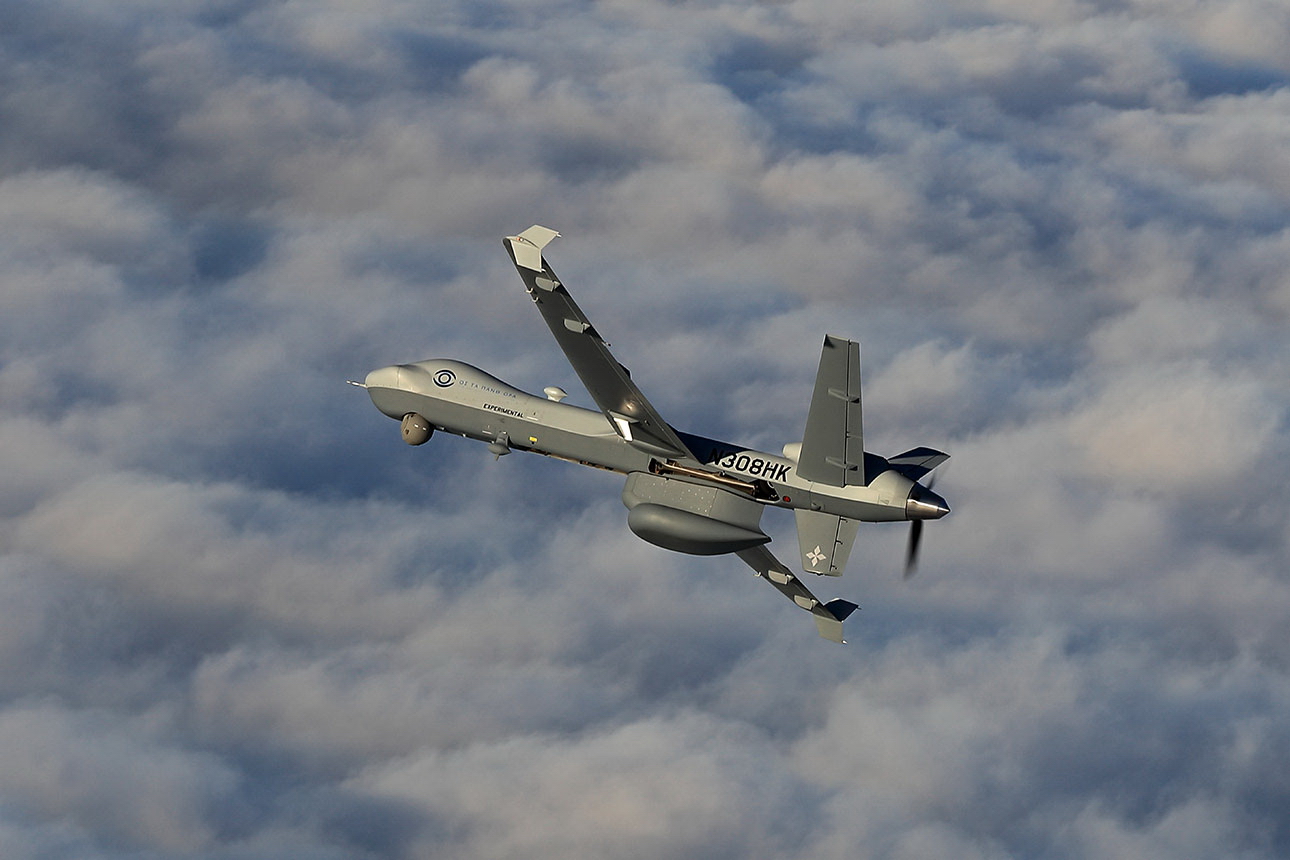
GA-ASI Concludes Successful Series of MQ-9 Demonstrations in Greece

He said the service was looking at MQ-9 maritime “Guardian” (minute 45)

When ask about reintroducing an ASW capability he said that while the Coast Guard was looking at it, the service would have to be cautious about biting off too much. (My suggestion of how the CG could have an ASW mission with minimal impact on its peacetime structure.)

He talked about balancing local and distant missions and concluded that the CG could do both (47), and that the Coast Guard was becoming truly globally deployable (48).

He noted that the first two FRCs for PATFORSWA would transit to Bahrain in Spring, followed by two more in the Fall, and two more in 2022. (49)

He noted technology is making SAR more efficient. “Hopefully we will put ourselves out of the Search and Rescue business.” 50

He talked about the benefits of “white hull diplomacy.” (52)

Asked about our funding for new missions he said it was sometime necessary to demonstrate the value of the mission first, then seek funding. (55)

He also talked about raising the bar on maintenance.

Advanced Precision Kill Weapon System (APKWS) –the Video

As I have suggested several times, there is a place for this system in the Coast Guard, here, here, and here, as a weapon that would allow even small units like patrol boats and FRCs to quickly and accurately deal with a range of threats, while minimizing the risk of collateral damage inherent in the use of our current weapons, e.g. 7.62mm, .50 cal., 25mm.

These weapons are not exotic. tens of thousands are produced annually.

Interesting to see how simply the pulse repetition frequency code is set to match it to the laser designator.

(I would also argue that the Coast Guard needs to have available laser designators in order to allow us to specifically identify threats for DOD aircraft that might be called in to help the Coast Guard deal with a threat.)

The first place to mount APKWS is on the FRCs going to PATFORSWA.

It is probably possible to mount launchers on the Mk38 gun mount. There is also the four round FLETCHER  launcher (see below) that can be fitted in place of a .50 cal.