From the LCS Mission Modules, What We Might Want, What We Might Need

The US Naval Institute News Service has provided access to the second “Annual Report to Congress for the Littoral Combat Ship (LCS) Mission Module Program.” Some of these systems should be of interest to the Coast Guard, either as regular equipment for peacetime law enforcement and counterterrorism missions, for temporary use, as in the case of a naval mining incident, or as wartime add-ons if the Coast Guard is mobilized for a major conflict.

Keep in mind, the procurement cost of these systems would presumably come out the Navy budget.

Mine Countermeasures Mission Package

The Mine Countermeasures (MCM) Mission Packages (MP) has already been addressed. 24 are planned including nine to be built for “Vessels of Opportunity.” These nine extra packages probably meet any peacetime augmentation requirement and provide a reserve for mobilization. Testing is expected to continue through FY 2022. Production is expected to continue well into the future as less than half the packages will have been delivered by FY2023.

ASW Mission Packages for NSCs and OPCs

An earlier post discussed the possibility of using mission modules and Navy reservist to augment large cutters. In a protracted conflict against a near peer naval power like Russia or China, our large patrol ships are most probably going to be needed to perform open ocean ASW escort duties.

Only ten ASW Mission Packages are planned. Initial Operational Capability (IOC) is expected in FY 2019, but testing will continue through 2020. The Multi-Function Array is already a fielded system. Deliveries are expected to begin in FY2021 at a rate of two systems per year. If that rate is continued, the ten planned systems will be complete in 2025.

At an estimated cost of less than $20M the ASW Mission Package is the least expensive of the three types of Mission Packages. Adding this system as a mobilization capability or perhaps even as a peacetime capability to 35 or more large cutters would provide a higher return on investment than just about any other Naval program.

It might even help us locate semi-submersibles.

Vertical launch Hellfire

As I have noted before, the Coast Guard has a potential need to be capable of countering terrorist efforts to use a wide spectrum of vessels to make an attack. These craft range between small, fast, highly maneuverable boats on one extreme, to large ocean going vessels at the other. Our ability to counter these threats must be widely available, quickly effective, and have both a probability of success approaching 100% and do so with minimal danger to innocents who may be in the vicinity. Guns do not meet these criteria.

Hellfire missile have the potential to meet these criteria, at least against the lower half of the threat spectrum, and, using more than one round, might have a degree of success even against the largest vessels.

Apparently the SSMM Longbow Hellfire testing is going well, with 20 out of 24 successful engagements, and there’s a software fix for the root cause of the 4 failures.

ATLANTIC OCEAN—A Longbow Hellfire Missile is fired from Littoral Combat Ship USS Detroit (LCS 7) on Feb. 28, 2017 as part of a structural test firing of the Surface to Surface Missile Module (SSMM). The test marked the first vertical missile launched from an LCS and the first launch of a missile from the SSMM from an LCS. (Photo by U.S. Navy)

A recent US Naval Institute News Service report quoted LCS Mission Modules Program Manager Capt. Ted Zobel “all of our mission packages…are finishing up development, proceeding into test, and then from test into production and ultimately deployment.”

“…surface-to-surface missile module (SSMM) will add a Longbow Hellfire missile to increase the lethality of the LCS. Testing begins this month on USS Milwaukee (LCS-5) and will move to USS Detroit (LCS-7) over the summer. Testing should wrap up by December, Zobel said, with Detroit planning to bring the SSMM with it on its maiden deployment about a year from now. Written testimony from the Navy at a March 6 House Armed Services Committee hearing states that IOC is planned for Fiscal Year 2019.”

The Surface to Surface Mission Module (SSMM) planned for the Littoral Combat Ship, seen above, can store and launch up to 24 missiles. 24 missiles would weigh about 2,500 pounds. As a very rough estimate, Its foot print appears to be about 9×12 feet (late note–a little photo analysis suggest the three mission module positions on each LCS are about 15-16′ square), probably not too large for an NSC, OPC, or icebreaker, but probably too large for the Webber class WPCs where I really think we really need the capability. They are after all, much more likely to be in the right place, at the right time. For them we probably need a smaller system.

In the video above, beginning at time 2m58s there is a model of a 12 meter unmanned surface vessel mounting a four tube Hellfire vertical launch system. Knowing that the Hellfire is only 7 inches in diameter and 64 inches long, it appears this installation would have a footprint of no more than 6×8 feet and probably would be no more than seven feet high. It seems likely we could find a place for one or two of these on each Webber class and at least one when we build the replacements for the 87 footers.

I have often seen missiles compared unfavorably to guns, based on the cost of the projectiles, but cost of providing a system like Hellfire pales in comparison to the cost of a medium caliber gun, its ammunition allowance, and the maintenance, training, and technicians required to keep it operational. Compared to the guns we have used in the past:

  • Maximum range of almost 9,000 yards is less than the maximum range of the 5″/38, 76mm, or 57mm, but it is very near the effective range of these medium caliber weapons. This range is likely more than enough to remain outside the effective range of improvised weapons installations that might be used in a terrorist attack.
  • Effective range is more than three times greater than that of the 25mm Mk38 mod2/3
  • Warhead appears to be more effective than even the 5″ rounds.
  • Every round will likely be a hit.
  • Those hits will come very quickly.
  • It may be possible to accurately target specific vulnerable areas on the target.
  • They require only minimal training and maintenance compared to medium caliber guns.
  • If the target is within range, its only real disadvantage is the limited number of rounds.

While I have never seen it claimed official, I have seen reports that Hellfire can be used against slower aircraft such as helicopters and UAVs.

 These small missiles could allow our patrol vessels to hit like much bigger vessels.

30 mm Mk46 Gun Mission Module (GMM)

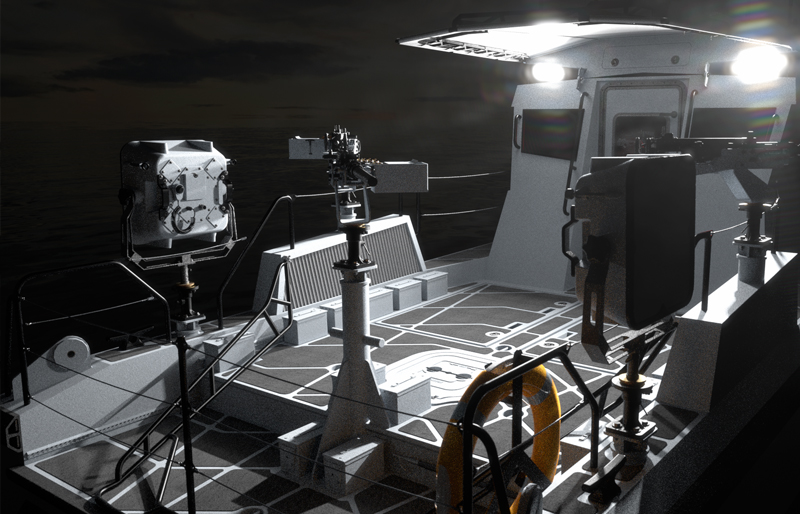
Gun Mission Module by Northrop Grumman

The “Gun Mission Module” (GMM) could be one way to arm the icebreakers relatively quickly when needed, while allowing the option of removing the weapons before going to Antarctica if desired.

Production of these units is quickly running its course, and if we want to use these on the icebreakers, it may be desirable to have our needs added to the production schedule before the production is shut down. The last two are expected to be delivered in FY2020.

How important this is will depend on the Coast Guard’s intentions and the alternatives.

Setting up the installations in the same format as found on the LCSs means improvements or alternative systems developed to LCS systems could be easily incorporated in the icebreakers as well.

On the other hand, the included 30mm Mk46 gun weapon system is not limited to the LCSs. It is or will be mounted on the three Zumwalt DDG-1000 class destroyers, 13 San Antonio (LPD-17) class, and probably 13 LX(R)/LPD-17 Flight II class still to be built, about 58 mounts in addition to the 20 planned for the LCSs.

It doesn’t look like it would be too difficult to remove or re-install just the gun mount (seen below) if that would meet our needs. It would of course require a dedicated space, permanent installation of supporting equipment, and a way to seal the opening for the mount long term when the mount is removed.

Although it is not as effective as the Mk46 mount, because of the smaller 25 mm gun currently used, the Mk38 Mod2/3 is also an alternative, and has the advantage of already being in the use with the Coast Guard. It is even more widely used, “As of 2016, 307 MK 38 MOD 2 systems have been delivered. There are 50 MK 38 MOD 3s on contract. The total POR (program of record–Chuck) is for 517 systems.”

Still the 25mm gun is markedly inferior to the 30mm in that its effective range is considerably less and the individual projectiles are far less potent. The Mk46 mount also has many more rounds on the mount compared to the Mk38 mod2/3. Upgrading the Mk38s to mount 30mm guns would address much of the current inferiority.

The inferiority of the Mk38 would also be much less of a concern if the Icebreaker had an additional, more powerful anti-surface weapon system, like the Hellfire Surface to Surface Missile Module or Anti-Surface Cruise Missiles. These might be useful if it is ever necessary to provide Naval Surface Fire Support (NSFS) in the Arctic or Antarctic.

“Restructure the Coast Guard Reserves into Support Roles”–USNI

The US Naval Institute Blog has a post recommending a restructuring of the Coast Guard Reserve, written by LCdr. Daniel L. Tavenier, USCG. His opening paragraph,

The time has come to examine and consider restructuring the role of Coast Guard Reserves within the service. Currently, there is not enough time for reservists to adequately serve operational roles unless they were active duty for at least two years following accession. Reservists have brought much to the table as far as their civilian skill sets and experience go, but we cannot pretend they are able to achieve proficiency in certifications to the level of an active duty member. There has been a role for reservists to operate, but history has proven those instances are few and far between. As budgets shrink, the entire reserve program needs to be significantly modernized. This includes expanding the maritime security and safety teams (MSSTs) role to cover overseas missions and decommissioning port security units (PSU) that are staffed with 130 reserves and only six active duty members. PSU staffing models are not set up to meet the high-level, tactical certifications required for outside continental U.S. (OCONUS) operations. MSSTs have undoubtedly filled overseas duties at much less expenditure.”

Along the way he also recommends that we “Ditch the MAW” (Mounted Automatic Weapon), i.e., remove the M-240 machinegun from the small boats that do Ports, Waterways, and Coastal Security (PWCS).

This is way outside my wheelhouse, so I am going to leave evaluation and comments to the readers. If you have strong feelings about this, you might want to comment on the original USNI blog post. Duplicate comments are of course also welcomed here.

Was Libya’s Sinking of a Tanker “Fake News?”

I have begun to suspect that the report of the Libyan Coast Guard sinking the Tanker GOEAST may have been more propaganda than reality.

Compare the Libyan video above with the video of USCGC ANACAPA sinking a much smaller derelict Japanese fishing vessel Ryou-Un Maru.

The Tanker was probably 20 times as large as the fishing vessel and had a crew on board and operating pumps to address flooding. USCGC ANACAPA began the operation at 13:00 and the RYOU-UN MARU sank at 18:15. It appears that the F/V may have been hit 100 times by 25mm projectiles, and at one point the ANACAPA used a hose to pour water into the fishing vessel.

.

On the video, the Libyan patrol boat fires no more than 20 rounds from its 30mm and I believe it was less than 15. At no time was there sustained fire directed at the tanker. The longest burst was perhaps four rounds.

At the end of the video, the tanker is pumping water, but it is also upright with no significant list and it appears to be making way. I am positive the tanker is underway at least as late as five minutes into the five minute 44 second video.

Perhaps things happened later, but if they recorded the opening shots, it seems they would have recorded the sinking.

This might have been an attempt at deception by the Libyans to discourage smuggling.

It might have been that the patrol boat skipper had been instructed to sink the tanker, and when he failed, he lied about the result of the attack.

It may be that a government information officer simply assumed that because they fired at the ship, that it was sunk. Capsized and sunk does make a much better story than shot at, was annoyed, and sailed away.

It is not impossible the entire thing was theater staged with the cooperation of the tanker, although I think that very unlikely.

Certainly the tanker’s owners may have reasons not to debunk the story.

  • They don’t want to confirm they were smuggling.
  • The report may discourage competing smuggling organizations.
  • They may even rename and reflag the tanker and file a bogus insurance claim.

Certainly, there was nothing in the video to indicate that this ship was sunk.

A final note. The patrol boat is seen firing into both sides of the tanker. If you want to sink a ship, it is usually better to concentrate as much damage as possible on one side. It is more likely to make the ship list and ultimately capsize. As the list increases holes initially made above water start to submerge and take on water.

Libyan Coast Guard Sinks Tanker

We have reports from NavalToday and Maritime-Executive that the Libyan Coast Guard, using a 30mm auto-cannon, opened fire on and sank a Russian owned, Comoros-flagged oil products tanker, the GOEAST, believed to have been smuggling Libyan oil.

It is not the first time the Libyan Coast Guard has used deadly force, and apparently not the first time the GOEAST’s parent company has been accused of smuggling.

I found this particularly interesting because it seemed to contradict my long held belief that the Coast Guard is unlikely to be able to forcibly stop, much less sink, a medium to large merchant ship in a timely manner with gun fire if it were employed in a terrorist attack. There are many questions about the sinking for which I have not seen answers. What might this incident say about our own ability to stop a terrorist attack using a merchant ship?

The GOEAST was a small and elderly tanker. Admittedly a terrorist organization is more likely to have control of a ship like this, than a larger and more modern vessel. It displaced 9700 tons and was built forty years ago in 1977. It would have been considered relatively large in WWII, but not now. We don’t know its state of maintenance, but it was probably poor. We don’t know how it was loaded, incomplete or asymmetrical loading, and the resulting free surface effect may have contributed to its loss. We don’t know how long it took to sink or how long it could steer and make way. Even after being damaged, could it have completed a terrorist mission before sinking?

The actions of the Libyan Coast Guard were probably an excessive use of force. We have no information about what happened to the crew of the amount of pollution that resulted. Whatever the justification for the attack on the GOEAST, it is good to see a degree of success in using a relatively small gun to stop a sink a ship, but there are reasons why we may not be able to take much comfort in this example.

The Libyan Coast Guard vessel appears to have been a former Italian Bigliani II  class patrol boat equipped with a twin Oto Melara-Mauser 30mm gun.

The Bigliani IIs are not big ships. They are 84.7 tons full load and 27 meters (88.6 feet) in length, 6.95 m (22.8 feet) of beam, with a draft of 1.26 m (4.13 feet). That is actually  slightly smaller than our 91 ton full load 87 foot Marine Protector class WPBs. This illustrates that even our small patrol boats could carry much heavier weapons.

The 30mm gun, visible in the video has a relatively high rate of fire, but that is largely irrelevant for our purposes (unless we are being shot at) since even our 180 round per minute chain guns can exhaust their ammunition in only a few minutes.

The 30mm gun fires common NATO rounds which include the armor piercing fin stabilized discarding sabot (APFSDS-T) round that A-10 Warhogs use against tanks. Compared to our 25mm gun’s corresponding APDS-T round, the 30mm has a higher muzzle velocity and weighs 71.6% more. This long rod tungsten penetrator is more likely to be able to disable a ship than even our 57mm rounds, which may penetrate the hull but will likely explode before reaching the engine.

The tanker was not returning fire, which could have kept the patrol boat at a distance, and radially reduced the accuracy of fire.

I still have doubts about the ability of a gun to reliably stop a medium to large merchant ship with a determined crew. There are other alternatives, but an upgrade to a 30mm gun on our patrol boats and larger vessels would certainly increase our chances of success.

Navy’s new 40 foot Force Protection Patrol Boat

Navy 40 foot PB(X) to be built by Metal Shark

The Navy has recently awarded Metal Shark a contract for a new “force protection” patrol boat.

The basic information is:

LOA: 43′ 11″app
HULL LENGTH: 40’ 3″
BOA: 11’ 10″
Metal Shark claims the boat is optimized for normal patrol speeds of 10-12 knots while capable of economical operation at higher speeds of 35+ knots.
It appears the expected weapons fit is a .50 caliber in a remote weapons station forward and three crew served .50 calibers aft. Two LRAD (long range audio devices) also appear to planned.

PB-X aft, LRAD and .50 cal.

Undoubtedly there will be comparisons drawn between these and the Coast Guard boats that also do escorting duties. After all, the Coast Guard probably does many more escort missions as part of the Ports, Waterways, and Coastal Security mission than the Navy ever will. The Coast Guard escorts passenger vessels, hazardous cargoes, Navy surface ships, and even Fleet Ballistic Missile Submarines.
Our closest comparable boat is the Response Boat, Medium. The RB-M may be a bit faster. It appears that this new Navy boat may be better equipped for the escort mission than the RB-M or even most 87 foot WPBs. The LRAD looks like a good idea to warn away the innocent, and if the use of deadly force is necessary, the Navy boat looks like it will have heavier weapons and the remote weapon station means greater accuracy and less chance of collateral damage.
I have quoted the Metal Shark news release below. In addition there is a lot more information about the boat here.

October 2, 2017: Metal Shark Wins U.S. Navy PB(X) Patrol Boat Contract

Jeanerette, LA – October 2, 2017: Louisiana-based shipbuilder Metal Shark has been awarded the contract to produce the U.S. Navy’s next-generation patrol boat, the PB(X).

This award is the culmination of a multi-year process by the Navy to select the replacement for the fleet of force protection boats currently in use with Navy Expeditionary Combat Command’s Coastal Riverine Forces (CRF). Subject to annual appropriations, the Navy intends to replace approximately 100 to 160 of its existing 25-foot and 34-foot CRF patrol boats with the larger and more modern PB(X) platform over the next fifteen years.

The Navy has placed an initial, immediate order for eleven of the new vessels. Under the terms of the award, potentially worth over $90 million, Metal Shark will build up to 50 PB(X) vessels for the Navy, along with trailers, spares and training packages, and technical support.

“PB(X) was one of the most challenging and most sought-after U.S. military boat procurement opportunities in recent history; the result of a years-long process pitting Metal Shark’s engineering and manufacturing capabilities against multiple leading U.S. naval architect firms and nearly all of our competitors,” said Metal Shark’s CEO Chris Allard. “The award of PB(X) to Metal Shark is the result of a tremendous team effort and I couldn’t be more proud of our people.”

The winning PB(X) design is a 40-foot, welded-aluminum pilothouse patrol boat designed by Metal Shark’s in-house engineering team. Leveraging its extensive experience with military patrol craft of similar size, Metal Shark designed a bespoke craft ideally suited to accommodate all mission parameters.

Immediately identifiable thanks to its chiseled, angular profile and a unique faceted hull, the PB(X) is powered by twin diesel inboards and water jets. Metal Shark designed a moderate aft deadrise, wide-waterplane, sharp-entry hull form that not only achieves 35+ knot sprint speeds while displaying superb dynamic stability in a range of conditions, but also offers enhanced handling and greatly reduced operating cost at the 10-15 knot escort and cruise speeds where the vessel will spend the bulk of its operational life. The PB(X) features ballistic protection and can be armed with a range of crew-served and remotely operated weapons systems.

In order to fully optimize the hull and propose a more mature design, Metal Shark built a PBX running prototype hull, designated PB(X)-P1, which was extensively tested in a wide range of operating conditions. This test platform became the basis for Metal Shark’s resistance, powering, and weight testing, and determined the final configuration proposed to the Navy.

“The testing of PB(X)-P1 validated our design choices, mitigated our areas of concern, and resulted in a design proven to perform exactly as expected under real-world loads and conditions,” explained Mr. Allard. “We made this up-front investment to eliminate any and all potential concerns and to deliver a thoroughly tested and proven, next-generation patrol boat platform to the U.S. Navy.”

The PB(X) will be built at Metal Shark’s Jeanerette, Louisiana production facility, which specializes in the rapid, serialized assembly of military patrol boats. Other significant military fleet builds currently underway at the facility include ongoing production of the Navy’s 32’ Force Protection Boat – Medium (FPB-M) and 26’ High Speed Maneuverable Surface Target (HSMST), and the U.S. Coast Guard’s 29’ Response Boat – Small (RBS).

This is the second major U.S. Navy contract awarded to Metal Shark in 2017. In June, Metal Shark was selected to build up to thirteen Near Coastal Patrol Vessels (NCPVs), for the Navy. These 85’ patrol boats are being produced at Metal Shark’s Franklin, Louisiana waterfront shipyard.

“Winning PB(X) is a crowning achievement for us, but there’s a lot of work ahead,” said Mr. Allard. “The Navy is a long-standing customer we’re extremely familiar with and whose needs we understand intimately. We are eager and ready to commence PB(X) production and to begin supplying the world’s greatest Navy with the world’s most advanced patrol boat.”


Metal Shark PBX Prototype

U.S. Coast Guard: Priorities for the Future–CSIS/USNI

The video above records an recent event, a “Maritime Security dialogue” presented by the Center for Strategic and International Studies (CSIS) and the United States Naval Institute (USNI) featuring Admiral Paul F. Zukunft, Commandant of the U.S. Coast Guard, for a discussion on the “U.S. Coast Guard’s future priorities.”

Despite the title, don’t expect a recitation of Coast Guard priorities. Most of the material is familiar, but there were a few interesting comments, including some that might be surprising. A number of things the Commandant said here made news.

  • That the NSCs could be made into frigates.
  • That the Polar Icebreaker would cost less than $1B
  • His support of transgender CG personnel.

I’ll give a quick outline of what was talked about. At the end I will rant a bit about some of my pet peeves.

The Commandant’s prepared statement is relatively short beginning at time 2m45s and ending about 11m.

6m00 In our listing of missions, the Commandant said Defense Operations should be listed first. He noted that there are 20 ships chopped to Combatant Commanders including eleven  ships operating under SOUTHCOM.

Q&A begins at 11:00.

16m20s The Commandant noted there is a Chinese ship rider on a USCG cutter off Japan and that Coast Guard aircraft are flying out of Japan.

17m30s Boarder protection/drug interdiction

20m Called the OPCs “light frigates”

22m As for priorities the Commandant noted a need to invest in ISR and Cyber

23m Cyber threat.

24m Expect return to sea duty because of length of training.

26m30s “Demise of the cutterman”/Human Capital Plan–fewer moves–removed the stigma of geographic stability

29m25s Highest percentage of retention of all services–40% of enlisted and 50% of officers will still be in the service after 20 years

30m Law of the Sea. Extended continental shelf in the Arctic.

32m30s Need for presence in the Arctic.

36m ISR, 38m15s Firescout. An interesting side note was that the Commandant seemed to quash any possibility of using the MQ-8 Firescout. He noted when they deployed on a cutter 20 people came with the system.  He called it unoccupied but not unmanned.

40m Icebreakers

43m30s Comments on transgender members

45m15s Icebreakers–will drive the price down below $1B.

47m NSC as frigate–no conversations with the Navy about this. Performance of Hamilton.

49m50s Count the NSCs toward the 355 ship Navy.

50m30s Illegal migration and virulent infectious disease

53m35s CG training teams in the Philippines and Vietnam to provide competency to operate platforms to be provided by Japan. Two patrol boats going to Costa Rica. Other efforts to build capacity.

56m DHS is the right place for the CG.

The Commandant touched on a couple of my pet peeves, specifically

  • He called the OPCs “Light Frigates,” so why aren’t they designated that way? WMSM and WMSL are just wrong in too many ways.  Give our ships a designation our partners and politicians can understand. A WLB is a cutter and also a buoy tender. The OPC can be both a cutter and a light frigate. I have suggested WPF. Maybe WFF for the Bertholfs and WFL for the Offshore Patrol Cutters. If we want to be thought of as a military service, we need to start using designations that will be seen and understood as military.
  • He mentioned the possibility of including the Bertholfs in the 355 ship fleet total. Coast Guard combatants should be included when the country counts its fleet. No, the cutters are not aircraft carriers or destroyers, but the current fleet of about 275 ships includes about 70 ships that have no weapons larger than a .50 cal. These include eleven MCM ships and about 60 ships manned by civilian crews such as tugs, high speed transports, salvage ships, underway replenishment ships, and surveillance ships. Counting the Cutters as part of the National Fleet would raise  our profile as a military service. The Navy might not like it, but it does give a better idea of our actually available assets for wartime, which is the point of such a listing.


Interview: Adm. Paul Zukunft demands Coast Guard respect–Defense News

DefenseNews had an interview with the Commandant. You can read it here. I will not repeat the Commandant’s responses here, but I will repeat one of the questions and add my own thoughts.

Admiral, you have said that the Coast Guard’s identity as an armed service is forgotten. Can you tell me what you mean by that?

The Commandant talks here about budget, but I think this starts with self image. We do SAR. We rescue sea turtles. Armed services are first and foremost ARMED. We are by law a military service, but we are currently inadequately armed for even our peacetime counter terrorism, DHS mission. We are less capable of forcibly stopping a ship than we were 90 years ago.

Do our people know what their role will be if there is a major conflict with the Chinese or Russians? You can bet Navy and Marine Personnel have a pretty good idea of their roles.

We have had a quarter century hiatus in a mono-polar world where no one could challenge American seapower. That is changing rapidly and it is time for the Coast Guard to see itself in a new light. Just as the nation has benefited from having two land forces (Army and Marines), it can benefit from having two sea forces. The Coast Guard is a substantial naval force. Certainly we will not replace the Navy’s sophisticated systems, but there is a need for a high low mix and the marginal cost of adding capability to Coast Guard vessels that are going to be built anyway is very small.

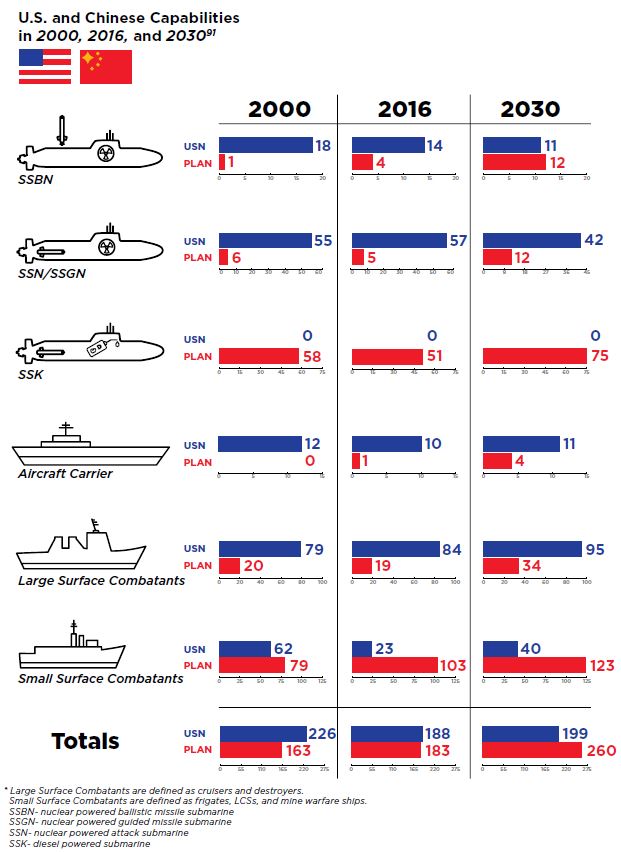
We are currently in an unrecognized naval arms race with China. It is time to give the Coast Guard back the ASW and ASuW capabilities it was building before the collapse of the Soviet Union.

When I reported to the academy in 1965, it had a gun lab, and we were taught ASW (badly) during swab summer. The Coast Guard had 36 ships equipped with sonar, ASW torpedoes and 5″ guns. The ships were old (not as old as now), but we were building a new fleet of 36 Hamilton Class WHECs equipped with a better sonar in addition to torpedoes and a 5″ gun. Being armed did not stop us from doing SAR, fisheries, or aids to navigation.

At that time (1965) in terms of personnel, the US Navy was about 25 times larger than the Coast Guard and had 287 cruisers, destroyers, and frigates. Now it is only eight times as large as the Coast Guard and has only 85 ASW equipped surface ships. We also had a powerful naval ally in Europe in the form of the Royal Navy. Now the Coast Guard is supplying personnel to the Royal Navy and in terms of personnel the Coast Guard is larger than the Royal Navy or the French Navy. Equipping our planned 33 to 35 large cutters as true surface combattants could make a real difference.

Even if we never go to war, preparation can make us better at our peacetime roles. Drug interdiction, migrant interdiction, and even SAR benefit from military grade ISR and C4I. Recognition of naval capabilities in the Coast Guard may justify additional resorces that have dual use for peacetime missions. Its a win-win.


Bit of Intel from the UK

The German Navy blog, Marine Forum, reports:

21 May, UNITED KINGDOM, Special Boat Service and Royal Navy commandos have been conducting covert underwater inspections of tankers transporting gas from the Middle East to Britain … growing fears that Al Qaeda or Islamic State terrorists might attach explosives to ships in the Middle East – and detonate them when they reach the UK.

Hearing: Coast Guard Requirements, Priorities, and Future Acquisition Plans (FY-2018)


May 18, the Commandant, Admiral Paul F. Zukunft, addressed the House Appropriations Homeland Security Subcommittee. The recorded testimony is above. It is fairly long (1h40m). The Commandant’s initial statement, following the introductions, begins at 8m40s and ends approximately minute 14.

The administration’s FY 2018 budget request was not available, but the Commandant was there to discuss future priorities, requirements, and programs. The Department Secretary, General Kelly, is expected to address the Subcommittee on May 24 at 3PM Eastern.

I will just mention a few of the items I thought significant.

Admiral Zukunft noted that Huntington Ingalls has begun cutting steel for NSC #9. Questioned about NSC#10, he said, if it were funded, the Coast Guard would of course use it, but that the Offshore Patrol Cutter (OPC) is the Coast Guard’s #1 priority. His response, that another NSC would have an effect on long-range operating cost, seemed to suggest anticipated significantly lower operating costs for the OPC. Significantly, there has been no mention of reducing the OPC program by one ship to offset the addition of NSC #9. (There is already a strong push to build more NSCs, a bill to authorized a multi-year buy of three more.)

He contended that the Coast Guard has taken a harder hit, due to budget restrictions, than other armed services and would need 5% annual growth and at least $2B annually for Acquisitions, Construction, and Improvements (AC&I). Later he stated that this annual AC&I appropriation would included about $300M annually for shore facilities. He pointed to a need to restore 1100 Reserve Billets and add 5,000 active duty military billets while retaining current levels of Civilian staff.

Apparently the FY2918 budget will begin a program to replace 35 Inland tenders at an estimated cost of approximately $25M each ($875M total). (Even if, in the unlikely event, this program were funded in only five years, that would only average $175M/year, so it is not a big program, but one that should have begun at least a decade ago.)

Cyber security for ports was discussed. The Commandant sees the Coast Guard role as decimating best practices, rather than imposing regulation. We now have a cyber program of record–still very small, two CG Academy graduates going directly into the program. The fact that two billets is worth mentioning, is probably the best indication of how really small the program is. A much smaller pre-World War II Coast Guard probably had more people working on breaking German and Japanese codes. 

Marine Inspection was addressed. The Commandant noted the increased demand for Inspections because 6,000 tugs have been added to inspection program. He noted a need for more stringent oversight of 3rd party inspectors, who in some cases have not been as meticulous as they should have been. He also noted that the US flag merchant fleet, notably the MSC’s Afloat Prepositioning Fleet, will need replacement, which will also raise demand for marine inspectors.

The Commandant also voiced his support for the Jones Act. He noted, we only have three shipyards building Jones Act ships in the US, and their loss would be short-sighted.

There was much discussion about the Arctic and the Icebreaker Fleet. Looks like follow-on funding for icebreaker program (at least after the first) will have to come from CG AC&I rather than the Navy budget. This may be difficult, but it is the way it should be. The chair of committee expressed his reservations about attempting to fund such big-ticket items through the DHS budget. The Commandant stated that the Coast Guard is still considering the acquisition of the commercial Icebreaker Aiviq (but apparently they are doing it very slowly–the chairman of the committee seemed a bit irritated about this).

The committee members seemed to latch onto the idea that the USCG, rather than the Navy, would be responsible for enforcing US sovereignty in the Arctic (which by US definition includes the Aleutians), and seemed to be asking if the Coast Guard was prepared to fight the Russians and/or Chinese in the Arctic. The Commandant suggested instead, that our role was to provide presence in the pre-conflict phase in order assert US sovereignty. He acknowledged that the National Security Cutters are only armed defensively and are not suitable for conventional naval warfare against an enemy combatant.

The Commandant acknowledged that, at some point it may be desirable to arm Polar Icebreakers, meaning they should be built with space, weight, and power reservations for additional weapons.

(I am all for keeping open the option of arming our icebreakers, so that they can defend themselves and do their part, if there is a conflict in a polar region, but there did not seem to be recognition among the Congression Representatives, that an Arctic conflict is most likely to be determined by submarines and aircraft. The icebreakers’ role is likely to be primarily logistical.)

The Commandant apparently does expect that there may be disagreements with regard to the extent of the US authority over certain areas of the Arctic.

In discussing the need for land based Unmanned Air Systems, there was a curious note at minute 40 about go-fast boats going south. Where are they going?

Alien Migrant Interdiction (AMIO). We have gone for seven weeks without a single Cuban Migrant being interdicted. This is because of the end of Wet Foot/Dry Foot Policy. This has allowed reallocation of resources to drug interdiction South of Cuba and human trafficking from the Bahamas

A Congressional Representative, from Texas pointed out there is no CG presence on the Rio Grande River, in spite of it being an international waterway. There was no mention of it, but perhaps he was thinking of the Falcon Lake incident in 2010 when an American was allegedly shot in the head by Mexican drug runners. Maybe something we should reconsider.

The Commandant promised the CG would have an unfunded priority list for FY2018.

ISIS Threat to Russian Ships in Turkish Straits

File:Latrans-Turkey location Marmara Region.svg

Illustration: Turkey with the Straits and Sea of Marmara area in red, by “The Emirr.” Dardanelles to West of the Sea of Marmara and Bosphorus to the East. 

Following from the German Navy blog, Marine Forum, 16 May,

“After Turkish intelligence learned of Islamic State plans for attacks on Russian warships from ashore, Turkish authorities have beefed up security along the Turkish Straits and augmented escorts by Turkish Coast Guard.”

A number of the Russian Navy transits carry supplies to the Syrian Government Forces and Russian forces operating in Syria.