The Yunarmeyets Kryma is a special boat built by the Zelenodolsk Shipyard in 2014. The Vympel Design Bureau in Nizhny Novgorod had developed the class to guard water areas and fight enemy naval commandos in the waters of naval bases and on close approaches to them. The boats in the class carry heavy machineguns, antidiver grenade launchers and man-portable air defense systems. Their radio electronics allow searching for underwater objects – both static and moving – while their diving system allows several divers to dive simultaneously.
It looks like a WPB so I looked up the class. They are 138 tons, 102 ft (31 m) in length, 23 knots, and a crew of eight. The Russians have built twelve and are building ten more.
Described as being anti-saboteur and anti-commando boats these are in intended for “force protection” which is included in the Coast Guard’s Ports, Waterways, and Coastal Security mission (PWCS). It is also one of the missions of the new US Navy MK VI patrol boat. We have detachments at Bangor and Kings Bay to protect Fleet Ballistic Missile subs while in transit that also perform this function.
Despite the similarities in mission, the Russian boat is armed and equipped much differently from their USN and USCG counterparts. It has a couple of sonars. In addition to a 14.5 mm (.60 cal.) machine gun, they have point defense anti-air missiles. Defense against swimmers is apparently much on their mind. They have two anti-swimmer weapon systems, the DP-64 a shoulder fired mini-depth charge thrower and the DP-65, a ten barrel, automated, sonar controlled mini-depth charge thrower.
“The 55mm DP-65 remotely controlled…grenade launching system is designed for protection of ships against attacks of underwater combat swimmers at external roadstead open anchor stops and bases, for protection against attacks of underwater combat swimmers at water-development works, sea platforms and other important sea and coastal installations.”
The US had a lot of trouble with Viet Cong combat swimmers during the Vietnam war. They even manage to sink a small WWII built aircraft carrier (CVE) being used as an aircraft transport. It is unclear how well prepared we are for this type of attack now.
An earlier post reported a plea by Representative Duncan Hunter, Chair of the Transportation Subcommittee on Coast Guard and Maritime Transportation, for the Coast Guard to provide an unfunded priority list to include six icebreakers and unmanned Air System.
Thought perhaps I would list my own “unfunded priorities.” These are not in any particular order.
PLATFORM SHORTFALLS
Icebreakers: We have a documented requirement for three heavy and three medium icebreakers, certainly they should be on the list. Additionally they should be designed with the ability to be upgraded to wartime role. Specifically they should have provision for adding defensive systems similar to those on the LPD–a pair of SeaRAM and a pair of gun systems, either Mk46 mounts or Mk38 mod 2/3s. We might want the guns permanently installed on at least on the medium icebreakers for the law enforcement mission. Additionally they should have provision for supporting containerized mission modules like those developed for the LCS and lab/storage space identified that might be converted to magazine space to support armed helicopters.
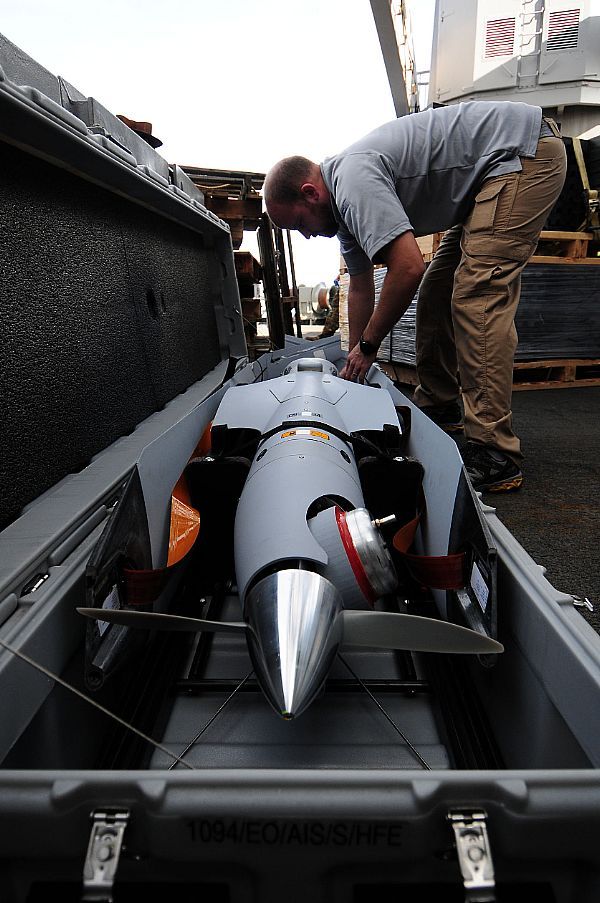
110225-N-RC734-011 PACIFIC OCEAN (Feb. 25, 2011) Guy Mcallister, from Insitu Group, performs maintenance on the Scan Eagle unmanned aerial vehicle (UAV) aboard the amphibious dock landing ship USS Comstock (LSD 45). Scan Eagle is a runway independent, long-endurance, UAV system designed to provide multiple surveillance, reconnaissance data, and battlefield damage assessment missions. Comstock is part of the Boxer Amphibious Ready Group, which is underway in the U.S. 7th Fleet area of responsibility during a western Pacific deployment. (U.S. Navy photo by Mass Communication Specialist 2nd Class Joseph M. Buliavac/Released)
Unmanned Air Systems (UAS): We seem to be making progress on deploying UAS for the Bertholf class NSCs which will logically be extended to the Offshore Patrol Cutters. So far we see very little progress on land based UAS. This may be because use of the Navy’s BAMS system is anticipated. At any rate, we will need a land based UAS or access to the information from one to provide Maritime Domain Awareness. We also need to start looking at putting UAS on the Webber class. They should be capable of handling ScanEagle sized UAS.
Photo: The Coast Guard Cutter Bluebell sits moored along the Willamette River waterfront in Portland, Ore., June 4, 2015. The Bluebell, which celebrated its 70th anniversary this year, is one of many ships participating in the 100th year of the Portland Rose Festival. (U.S. Coast Guard photo by Chief Petty Officer David Mosley.)
Recapitalize the Inland Tender Fleet: This is long overdue. The program was supposed to begin in 2009, but so far, no tangible results. It seems to have been hanging fire for way too long.
Expand the Program of Record to the FMA-1 level: The Fleet Mix Study identified additional assets required to meet the Coast Guard’s statutory obligations identifying four asset levels above those planned in the program of record. Lets move at least to first increment.
At the very least, looks like we need to add some medium range search aircraft (C-27J or HC-144).
Increase Endurance of Webber Class Cutters: The Webber class could be more useful if the endurance were extended beyond five days (currently the same as the 87 cutters, which have only one-third the range). We needed to look into changes that would allow an endurance of ten days to two weeks. They already have the fuel for it.
MISSION EQUIPMENT SHORTFALLS
Ship Stopper (Light Weight Homing Torpedo): Develop a system to forcibly stop even the largest merchant ships by disabling their propulsion, that can be mounted on our patrol boats. A torpedo seems the most likely solution. Without such a system, there is a huge hole in our Ports, Waterways, and Coastal Security mission.
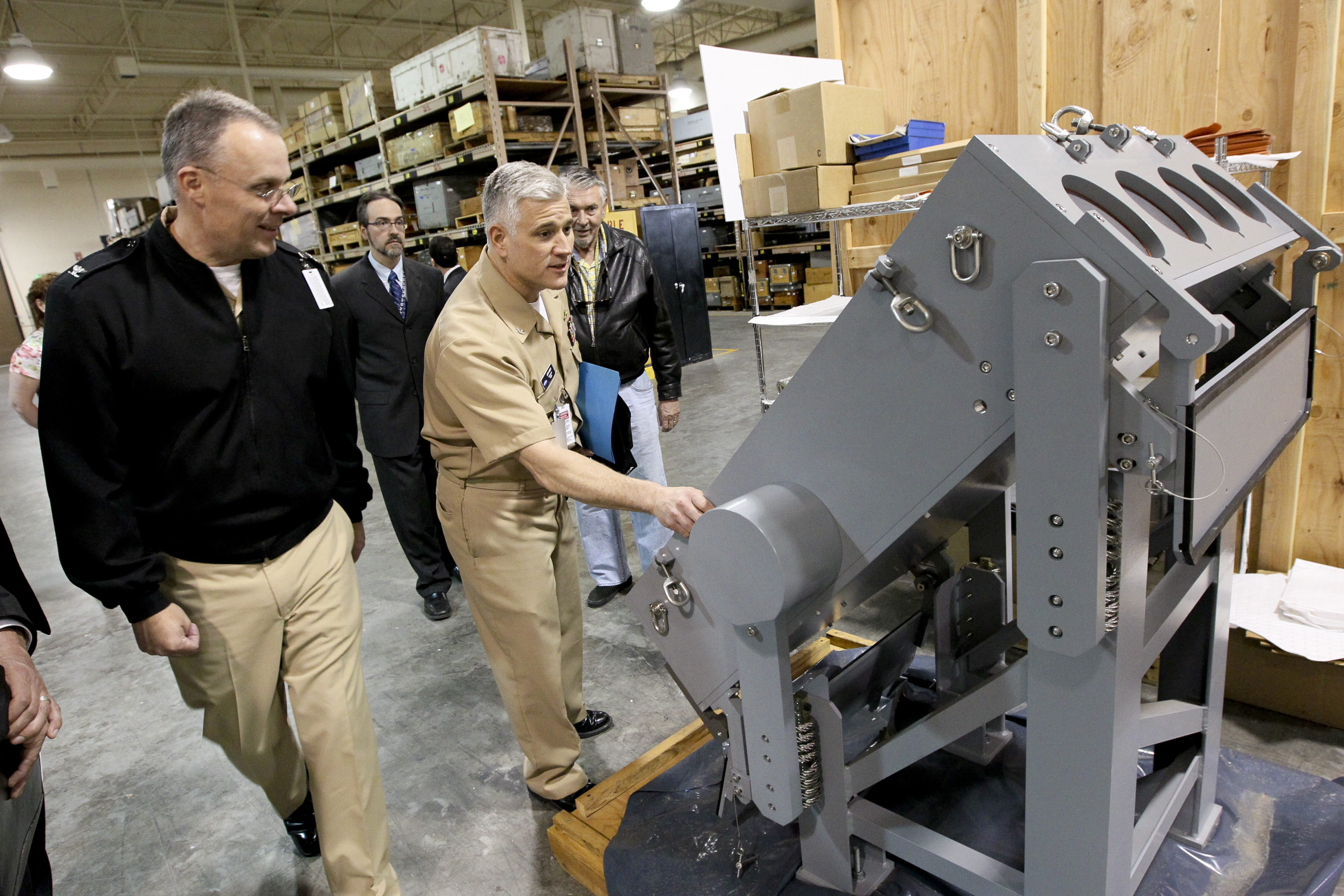
Photo: SeaGriffin Launcher
Counter to Small High Speed Craft (Small Guided Weapon): Identify and fit weapons to WPB and larger vessels that are capable of reliably stopping or destroying small fast boats that may be used as fast inshore attack craft and suicide or remote-controlled unmanned explosive motor boats. These weapons must also limit the possibility of collateral damage. Small missiles like SeaGriffin or Hellfire appear likely solutions.
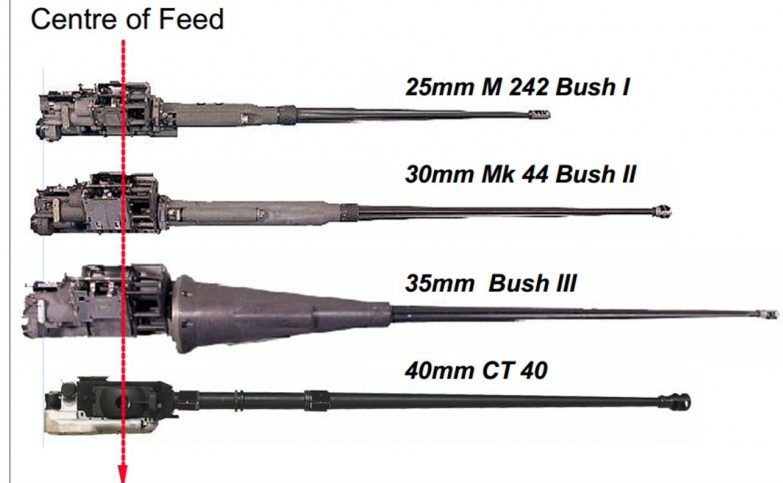
40 mm case telescoped gun (bottom) compared to conventional guns.
Improved Gun–Penetration, Range, and Accuracy: The .50 cal. and 25mm guns we have on our WPBs and WPCs have serious limitations in their ability to reach their targets from outside the range of weapons terrorist adversaries might improvise for use against the cutters. They have limited ability to reach the vitals of medium to large merchant vessels, and their accuracy increases the possibility of collateral damage and decreases their probability of success. 30, 35, and 40 mm replacements for the 25 mm in our Mk38 mod2 mounts are readily available.
Laser Designator: Provide each station, WPB, and WPC with a hand-held laser designator to allow them to designate targets for our DOD partners.
CONTINGENCY PLANNING SHORTFALLS
Vessel Wartime Upgrades: Develop plans for a range of options to upgrade Coast Guard assets for an extended conflict against a near peer.
Part one recounted an engagement in 1939 between the “pocket battleship” (heavy cruiser) Admiral Graf Spee and three smaller British cruisers. This part will discuss the implications.
So what does a 77 year old Naval battle have to do with the Coast Guard’s ability to stop a terrorist attack using a medium to large ship?
As I said in part one (in a different order), I think it shows:
It is very difficult to sink a ship by gunfire alone.
Ships’ structure provide a degree of protection that makes it difficult to comprehensively target the crew of a ship without sinking the ship.
It is difficult to forcibly stop a ship with gunfire alone.
In comparing guns, at any given range, the longer ranged weapon generally enjoys an advantage in accuracy.
You can run out of ammunition before you accomplish your mission. The depth of your magazine may be important.
What do we have to oppose this type of attack?:
We don’t really have a lot of options.
If we have enough warning, say 24 hours, we can ask for help, but as far as I can tell there is no system of rapid response to surface threats. (When 9/11 occurred, we had no system for rapid response to air threat.) Unless we have absolute proof that the vessel in question is hostile, the Coast Guard would almost certainly have to intercept the vessel to determine hostile intent before it could be attacked. If the threat is a 20 knot ship detected 200 miles from its target we will have only ten hours to deal with the threat, and we are likely to be considerably less.
We have one Maritime Security Response Team (MSRT) on each coast, but to mobilize them, brief, organize, transport, and then get them to where we want them to act may take considerable time. Additionally while they might be effective in retaking a hijacked merchant ship, where there are relatively few hostiles who also have to control the crew, attempting an opposed boarding of a ship crewed by armed terrorist as a first step toward stopping an attack may be suicidal. If we have time to get them into place then perhaps we would also have time to get help from other services.
I think it more likely we will have at best a few hours to deal with the threat and we will have to use forces already in the area. I’ve made suggestions about additional equipment we might use to address this threat (here and here), but this time I will discuss tactics using what we have, or plan to have, and limit equipment suggestions to minimal upgrades and choice of ammunition.
While I doubt we will have cutters armed with 57mm Mk110s or 76mm Mk75s, on scene when required, we will discuss their utility and limitations. The Mk38 seems to be the key system, widely available and potentially capable, if the right ammunition is available. Other systems, .50 caliber and smaller, appear ineffective in stopping medium to large ships, but they may have their uses.
It is very difficult to sink a ship by gunfire alone:
Each of the Graf Spee’s 11.1″ projectile weighed 125 times the weight of a 57mm shell or roughly the weight of all the projectiles in a 57mm Mk110 gun mount’s 120 round automatic feed system.
Graf Spee was hit 20 times, three times by 8″ and 17 times by 6″ for a total of 2,672 pounds of projectiles. That is roughly the equivalent of being hit 500 times by a 57mm. From a distance, other than the burned out scout plane she carried, it would have been difficult to tell that she had been hurt.
Exeter was hit at least seven times excluding damaging near misses. That was 4,627 pounds of projectiles, a weight, I believe, almost equal to the total weight of all the 57mm projectiles allowed on a National Security Cutter (about 5,300 pounds assuming 1,000 rounds). While heavily damaged, Exeter was still capable of making 18 knots and completing the approximately 1,000 nautical mile journey to the Falklands.
Neither of these ships would be considered large by current standards. We can conclude, we are unlikely to sink a medium to large merchant ship with any weapon in the Coast Guard inventory.
Ships’ structure can provide a degree of protection that makes it difficult to comprehensively target the crew of a ship without sinking the ship.
Personnel Casualties were relatively light. Out of the approximately 3,000 men on the four ships, there were only 108 killed and 88 wounded.
As severely damaged as Exeter was, less than one in ten of the crew was killed. Unless terrorists choose to expose themselves, gunfire, from either cutters or airborne use of force equipped helicopters, is unlikely to allow us kill enough terrorists to stop an attempt to use a medium or large ship to make an attack.
Can We Immobilize the Target?:
None of the four ships were immobilized.
Of the approximately 30 hits, only one hit a main machinery space and it appears this was not because armor kept rounds out. It was simply that the amount of machinery space above the water line is a very small percentage of the total exposed area.
The single projectile that entered a machinery space was an armor-piercing 8″ round, and it wrecked the Graf Spee’s fuel oil purifier. That made it virtually impossible for the ship to make it back to Germany without having work done in port over an extended period. That would have allowed Britain to guarantee that Graf Spee would never escape, but it did not stop her from transiting at full speed for about 14 hours.
A modern merchant vessel diesel engine.
The task of stopping a ship by gunfire actually may have become more difficult because of the size and toughness of modern large diesel power plants, and because the large size of modern vessels puts more of the engine below the waterline and provides more space between the ships sides and the propulsion machinery.
The ship featured in the video above is no longer particularly large. The new Panama Canal locks needed to be wider and deeper than the old ones to accommodate the larger ships that have now become common. The locks are now 180 feet (vs 110 feet) wide and 60 feet (vs. 42 feet) deep. Many ships now have sufficient draft such that the 40 foot tall engine in video could be entirely below the water line.
Fuel consumption for the engine in the video above was reported twice, first as 328 tons per day and later as 400 tons per day. If we assume only 300 tons per day, that is 12.5 tons per hour or 417 pounds /minute or about 7 pounds per second.
The explosions going off in this type of engine every second are more powerful than the explosion of a 57mm shell.
There is less than a pound of explosive in a 57mm projectile. 1 pound of TNT has 13.4 megajoules of energy. We may assume a more powerful explosive in the Mk110 projectiles, perhaps 20 megajoules. One gallon (about 7.1 pounds) of diesel (the amount consumed in one second) equals 146.5 megajoules.
The 57mm gun does not have a true armor-piercing round. The current 3P fuse has a semi-armor piercing function which I presume is similar to the previous semi-armor piercing (SAP) round, “The SAP round had a delayed action fuze which allowed the round to penetrate about 2 cm (0.8 inches) of armor and then explode after traveling a further 2 m (6 feet).” If that is the case, first it is uncertain that the round will penetrate, since the plating on large ships can considerably exceed 2 cm, but assuming it did, an explosion two meters inside the hull would still be a long way from a very tough engine.
The 76mm Mk75 is the most powerful gun in the Coast Guard inventory, but we have fewer of them every year, although it looks like we will not see the last of those on the 270s until 2034. It is still a relatively small projectile at about 14 pounds. Like the 57mm there is no true armor-piercing round for this weapon. Like the 57mm its projectile would likely explode shortly after penetrating the hull, rather than on or in the engine. The 57 and 76 mm guns might have more success against the steering gear, but that will also be very robustly built on any large ship, and hitting it will require great accuracy, suggesting a close approach.
The Mk38 25 mm, with a maximum shell weight of 1.1 pound or less, might be assumed to be even less likely to do damage, but they do have an option for an armor-piercing fin stabilized discarding sabot round (APFSDS) (pdf). It is intended for use against lightly armored vehicles like Armored Personnel Carriers. It may not be commonly available for the Mk38 (the Navy thinks of the Mk38 exclusively as a counter to small craft), but the APFSDS round is in the Navy system for use by Marine LAV-25 Light Armored Vehicle. It fires a 98 gram (3.5 oz) Solid Tungsten Penetrator at a very high velocity, 1390 m/sec (4560 ft/sec).
25MM TUNGSTEN APFSDS-T Armor Piercing Fin Stabilized Discarding Sabot-Trace
The .50 caliber, 7.62 and 5.56 mm weapons are simply too light to make much impression on a medium or large ship. The only other CG gun with a possibility of forcibly stopping one of these vessels is the Phalanx 20mm Close In Weapons System (CIWS). This system uses a discarding sabot round 12.7mm in diameter Solid Tungsten Penetrator with a 3,650 fps (1,113 mps) muzzle velocity. The Phalanx is only found only on WHECs and NSCs, so they will soon be home ported only in Charleston, Alameda, and Honolulu and it is unlikely these ships will be available to respond.
If we do detect a terrorist attack, the only likely Coast Guard counter to it, is likely to be equipped with a Mk38 mount. We are not going to sink a medium or large ship with the Mk38, but we might be able to disable it, if we can accurately penetrate both the ship’s hull and the ship’s engines or disable the steering.
In comparing guns, at any given range, the longer ranged weapon generally enjoys an advantage in accuracy.
I started thinking about the results of the Battle of River Plate after reading this pdf, Offshore Patrol Cutter (OPC) SUW Self-Protection Secondary Battery Study (which compared one and two-gun solutions using .50 cal., 25mm, and 30mm) and writing a post about a possible 40mm alternative for the Mk38 gun mount currently used on the Webber class WPCs and planned for the Offshore Patrol Cutter. It occurred to me that everyone may not understand my strong preference, when considering guns, for the longest ranged weapon available, even if I don’t expect it to be used at extreme ranges.
It is not just the potential of longer range, or the fact that the projectile is probably larger and more effective. It is also the fact that, all other factors being equal, the longer ranged weapon is also almost always more accurate.
Comparing any two weapons, fired at a target at the same range, the longer range weapon will generally fly a flatter trajectory (a more direct path) and have a shorter time of flight, meaning it will be effected less by uncertainties of environment and the actions of the target between firing and impact.
In the battle we see three gun with different ranges and can compare their accuracy. If we look at the British 6″ guns as a base line, how did the weapons compare?
The British 6″ gun had a maximum range of 24,500 yards (22,400 m). They got hits 0.82% of the time.
The British 8″ gun had a maximum range of 30,650 yards (28,030 m), 25% greater range, got hits 1.55% of the time, making them 89% more accurate than the contemporary 6″ guns.
The German 11.1″ had a maximum range of 39,890 yards (36,475 m), with 63% greater range than the 6″ guns, got hits 2.4% of the time, making them almost three times as accurate as the 6″ guns at the ranges the battle was fought (193% more accurate).
While it might be argued that the Graf Spee benefitted from superior fire control, the same cannot be said for the Exeter’s 8″ guns, that for most of the engagement were fired under local control. Additionally it appears that the light cruisers’ director controls were at least as sophisticated as that on Exeter. It appears the greater accuracy is due to the flatter trajectory and shorter time of flight of the longer ranged guns.
There are at least four different gun calibers that can be mounted on the Mk38 gun mount, 25, 30, 35, and 40mm. If we have the opportunity to upgrade the Mk38s to higher caliber weapons, we should take it, not just for the greater effectiveness of the projectile but also for the likely greater accuracy and effective range.
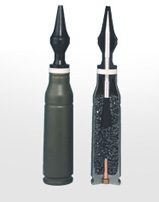
Case Telescoped 40 mm ammunition
Making the Best of the Mk38:
“No captain can do very wrong if he places his ship alongside that of the enemy.”–Horatio Nelson
When I looked at this problem earlier, I suggested that we should have systems that could disable a ship at ranges greater than 4,000 yards, so that weapons on the terrorist controlled vessel could not target specific systems on the defending cutter. With what we have now, we don’t really have that option. We are going to need to get a lot closer.
Not only is the effective range of the Mk38 less than 4,000 yards, we will need to get closer to increase accuracy to target specific parts of the terrorist vessel, and close the range to maximize the kinetic energy of the rounds.
If we are to have any chance of stopping a medium to large ship making a terrorist attack, we need to do what the British did. We need a team approach. We need to gang up on it.
The only ships we have that might have a chance are those with 25mm and larger weapons. There are relatively few of those. They would be the primary shooters. Hopefully you would have more than one to respond, but in many cases, perhaps most, there would be only one.
We can still use less capable units to take pressure off the primary shooter. These supporting units equipped only with .50 caliber and smaller weapons might be used to target the bridge, but their primary function should be to target any weapons that might endanger the more capable cutter(s).
Targeting the bridge is relatively simple, but if the terrorists plan properly they will not need to navigate from the bridge. They can use an autopilot or steer from after steering.
As we approach we will want to establish hostile intent as early as possible, preferably without putting a boarding party aboard that might become hostages.
We can demand that the vessel stop or change course away from the endangered potential target. The quickest way to do that might be with an Airborne Use of Force helicopter. Other supporting units might also be sent ahead of the primary shooter to attempt to stop or turn the suspect vessel.
After establishing hostile intent, supporting units should, if possible, precede the primary shooter and engage the threat with the idea of suppressing any weapons the vessel might employ against the cutters.
As it approached its target, before attempting to disable it, the primary shooter should probably put a few rounds into the bow of the target, in case it has been loaded with explosives.
Because the supporting units will need to stay out of the line of fire between the primary shooter and terrorists’ vessel, and because projectile will lose the minimum amount of kinetic energy if it strike normal to the target’s side, the primary shooter should move to a position on beam of the threatening vessel, while supporting units should be both forward and aft of the primary shooter’s line of fire, ready to engage any attempt to return fire.
If the supporting units include a unit with only one machine gun on the bow, like a Response Boat, Medium (RB-M) and a unit with machine guns both fore and aft, like an 87 foot WPB, the WPB should be positioned toward the bow of the target, so that it can parallel the target and still have weapons on target while the unit (RB-M) with only gun on the bow, can keep its weapon on target.
An airborne use of force helicopter could also be very useful as a supporting unit, taking out any terrorist who appeared on deck and keeping an eye out for their activities on the disengaged side of the vessel.
At some point the primary shooter is going to have to close alongside, so that it can shoot through the hull near the waterline, down and into the engine room below the waterline. The supporting units should get there first, shoot up the bridge, attempt to draw fire and suppress any return fire.
When the primary shooter comes alongside ready to attempt to disable the terrorist vessel it will need a lot of ammunition so it will need to exercise fire discipline during the approach.
If we are unable to disable the engine(s) or steering, as a last ditch effort, we can attempt to push the vessel into shoal water and run it aground. This would of course make the cutters easy targets for grenades and RPGs.
Conclusion:
The approach outlined above implies a desperate fight, with no guarantee of success. If the terrorists manage to knock out the few (or one) weapon capable of stopping them, we might have no chance of success.
This is not the kind of fight the Coast Guard should want. It puts our people, our mission, and the people we are supposed to protect in danger. Right now there is no assurance that 25mm can even do the job.
We really ought to do better.
The Future:
I would hope the Coast Guard would do some testing to find out if we have the weapons we need to stop the full range of possible maritime terrorist attacks.
That should help us pick the right ammunition. We really need to make sure we have the right types. of ammunition.
If tests show we cannot disable the largest ships, we need to insist that we get weapons that can, and they may not be standard US Navy weapons.
Alternately, we need to establish means to have other services deploy anti-ship weapons on short notice. (Coast Defense is still officially an Army mission.)
We noted earlier that a new Mk38 mod3 mount is on the way. It will have much more ammunition on the mount. While the mount appears designed for a 30mm gun, it appears we will be getting them equipped with 25mm guns. More ammunition is good, but a larger weapon would be better.
Guns may not be the answer, but any upgrade we can get in the caliber of the gun on the mount will permit it to be more effective against progressively larger ships and at longer range.
In the not too distant future we will need to start replacing the 87 foot Marine Protector class WPBs. The oldest are already 18 years old. As soon as the last Webber class is funded, we need to start funding 87 footer preplacements. Hopefully we will see fit to arm these vessels for this mission.
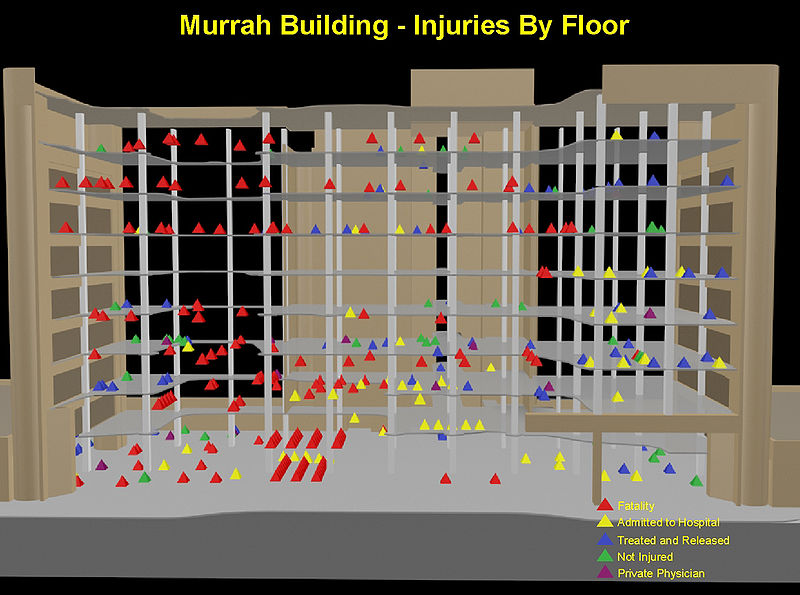
Photo: Floor-by-floor breakdown of the injuries/deaths in the Alfred P. Murrah Federal Building from the April 1995 Oklahoma City bombing. Red triangles indicates a fatality, a yellow one indicates a victim was admitted. Author: Sue Mallonee at Oklahoma State Department of Health Injury Prevention Service
gCaptain is reporting that Indonesian authorities on the resort island of Bali have detained a ship from Malaysia carrying around 30 tonnes of ammonium nitrate which police believe may have been intended for making bombs.
Ammonium nitrate was, you may recall, a primary igrediant in the truck bomb used in the attack on the Murrah Federal Building in Oklahoma City in 1995.
“…the bombing destroyed one-third of the building, killed 168 people, and injured more than 680 others. The blast destroyed or damaged 324 other buildings within a 16-block radius, shattered glass in 258 nearby buildings, and destroyed or burned 86 cars, causing an estimated $652 million worth of damage.”
Total weight of the explosives in that case was perhaps 7.000 pounds or less.
There is no indication that the ship itself was intended to be used as a bomb delivery system.
It has been over 30 years since the seizure of the Achille Lauro by Palestinian Terrorists. Are cruise ships better protected? You would like to think so, and it is certainly possible steps have been taken that are not obvious, but there are doubts. CuiseLawNews discusses the question.
This in particular caught my eye.
“Just last month, the Miami-Dade County Police Department said: ‘We ended up concluding that now they’re targeting the cruise industry. We’re the cruise capital of the world. It’s the same possibility of having two planes crash into the World Trade Center.'”
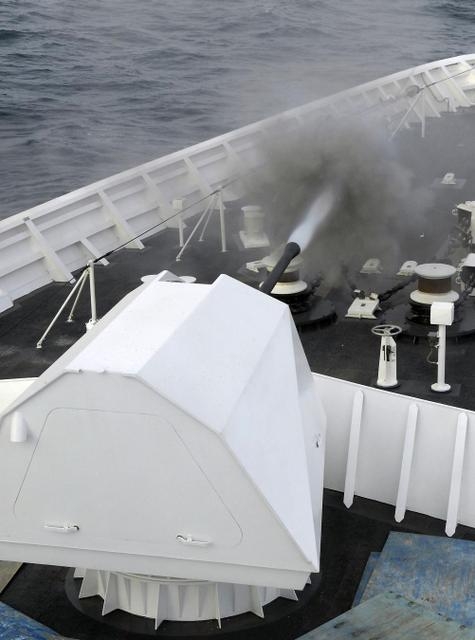
Test firing of the 57mm Bofors aboard USCGC Bertholf, photo by MMagaro
Are our weapons adequate for the Ports, Waterways, and Coastal Security Mission? Let’s find out.
The Navy Times is reporting that the Navy will have an unusually large number of ships available for “Sink-Ex” exercises in 2017.
The SINKEX fleet grew from five ships last year to seven ships available in 2017, including four frigates, the landing ship tank Racine and two attack cargo ships.
According to the source document, the Navy’s 30 year shipbuilding plan (pp 13/14), one of the stated purposes of a Sink-EX is weapons effectiveness evaluation. I think this might be a good opportunity for us to test out our weapons for the Ports, Waterways, and Coastal Security (PWCS) mission. This mission implies we must have the ability to forcibly stop a ship, regardless of its size. A Sink-Ex could be an opportunity to answer once and for all the question “Is the Coast Guard adequately armed for the mission?” Personally I don’t think so, and what little evidence we have seems to indicate that is the case.
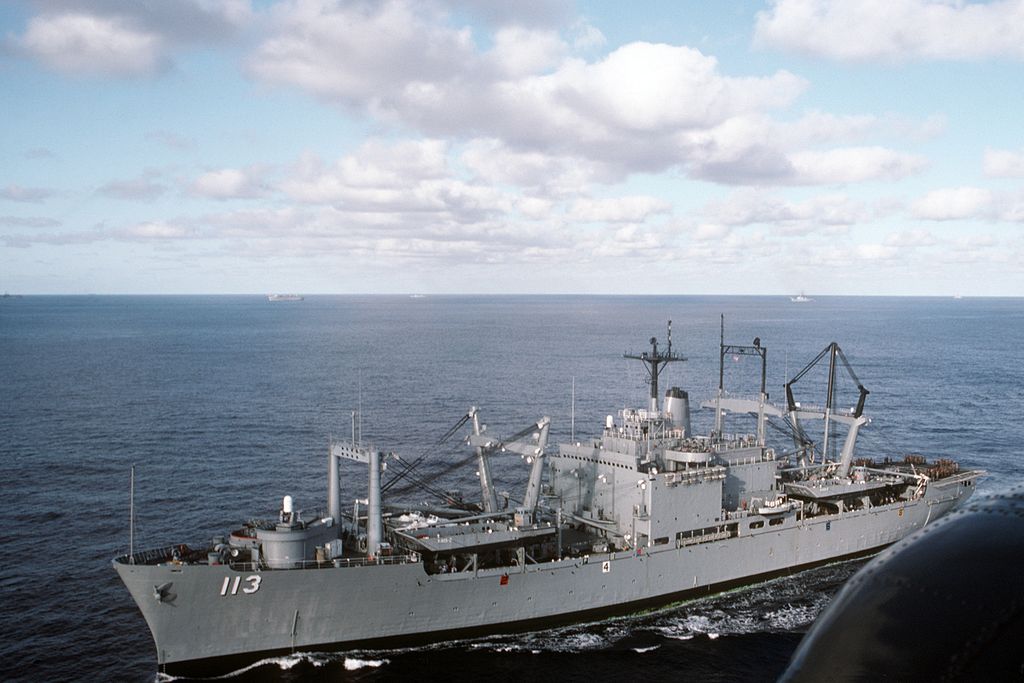
The two attack cargo ships are Charleston class LKAs, the ex-Durham (LKA-114) and ex-St. Louis (LKA-116), built in the late ’60s. These are medium sized auxiliary ships, 9,000 tons light and 18,500 tons fully loaded, 576 feet (176 meters) in length. Structurally they are not much different from merchant ships of the period. Unfortunately they don’t have the big diesel engines found on modern merchant ships, and the are far smaller than many current merchant ships but they are still, in most respects, representative of the target set the Coast Guard should be interested in.
Photo: USS Charleston (LKA-113)
We have four gun systems that might be tested. .50 cal., 25 mm, 57 mm, and 76 mm. The 25 mm and 57 mm are particularly important as the .50 cal is probably too small and short ranged and the 76 mm is going out of service. Still, we should still attempt to include the 76 mm because if the 57 mm proves inadequate, our next question should be, “Would the 76 mm have been successful?” Testing the 25, 57, and 76 mm guns would require use of at least two ships, a 378 for both the 76 and 25 mm, and a Bertholf class for the 57 mm. (Alternately an LCS might provide the 57 mm, a Bear class the 76 mm, and a 110 or Webber class the 25 mm.)
This could be a CG R&D project, but of course it would require Navy assistance, perhaps a joint project. Because our objective is to at least stop the target, rather than sink it, loss of power or steering would constitute a success. To determine if this is the case, we need information about what is happening inside the hull when the we get a hit. Will the round penetrate not only the hull but also critical systems, the loss of which would result in loss of power or control of the ship? Because it would probably be dangerous to go back on board the target after it has been shelled, the target would need to be instrumented with sensors and the results broadcast back. Aside from putting cameras inside the spaces, a technique might be to seal up and pressurize equipment like boilers, turbines, and steering gear and have them instrumented to detect any loss of pressure that would indicate a breach.
We would also want to conduct the exercise at a reasonable ranges. Since the real targets might be equipped with weapons that might be typically available to terrorist organizations, including anti-tank missiles and Soviet era antitank and anti-aircraft guns,that might target critical systems on the cutter, I believe the cutter should stand off at least 4000 yards, but for the 25 mm, we would probably need to close to 3,000 yards. A logical sequence might be,
378 closes to 3000 yards engages with 25 mm then withdraws
NSC closes to 4,000 yards and engages, then withdraws
378 closes to 4,000 yards and engages.
We would also want to fire a reasonable number of rounds, probably about 150 rounds of 25 mm, about 100 rounds of 57 mm, and about 80 rounds of 76 mm, basically shoot enough to exhaust the ammunition normally carried on the mount.
Realistically this would have to be part of a larger Sink-Ex with more than one target, but it might be reasonable to allow the Coast Guard a day to try their systems against one of the targets before the other firing units come on scene.
Should our current systems prove not up to the task, we would also want to know the results for possible candidate systems, so we might ask that these candidate systems be used against the target as well. These might include, APKWS, Griffin, Hellfire, the 5″ gun, and the light weight torpedo. I don’t think it has ever been tried, but with the right depth settings, is it possible to hit a deep draft surface target with our current light weight torpedoes?
Let’s at least find out if we have a chance of succeeding in this mission.
It is relatively short and readable at 21 pages. The recurring themes of the Commandant’s administration are all there, starting with TOC (transnational organized crime) and its deleterious effect on Western Hemisphere governance and prosperity. It does read a little like an Officer Evaluation Report input.
There is nothing particularly surprising here, but even for me, the enumeration of the scope the Coast Guard’s authorities, responsibilities, and international contacts is still mind boggling.
I am not going to try to summarize the report, but there were a few things that struck me.
The Commandant mentions service life extension programs for the seagoing buoy tenders (already begun), the 47 foot MLBs, and the 87 foot WPBs (in the future), but there is no mention of what we will do about the inland tender fleet. There will also be a life extension program for helicopters before they are finally replaced.
There is mention of a program I was not aware of, the “Defense Threat Reduction Agency National Coast Watch System project.” The Defense Threat Reduction Agency attempts to track and reduce the WMD threat. It is not really clear what our role is here. We know about the container inspection programs in foreign ports. Is that it, or is there more to this? (that can be discussed at an unclassified level.)
This is an expanded version of an earlier piece that was posted here. I rewrote it for the CIMSEC blog in hopes it would find a larger audience. Hopefully it is a clearer than the original.
The Coast Guard has a problem. It is not currently equipped to perform one of its missions, and it appears no other agency is prepared to cover the deficiency. The Long Range Anti-Ship Missile (LRASM) may be a possible solution.
“The PWCS mission entails the protection of the U.S. Maritime Domain and the U.S. Marine Transportation System (MTS)…prevention and disruption of terrorist attacks… Conducting PWCS deters terrorists from using or exploiting the MTS as a means for attacks on U.S. territory, population centers, vessels, critical infrastructure, and key resources.”
The Shortfall
Implicit in this mission is that the service should have the capability to forcibly stop a non-compliant ship, any ship, of any size. If a crew is motivated by simple greed, a .50 caliber machine gun is probably enough to convince them to take their chances in court rather than resist, but if the crew is motivated by a fanatical, or even suicidal belief in a cause, they become much harder to stop.
Terrorist targets are limited only by their imagination. They might include something like the Mumbai attack, an assault on a bridge, an LNG tanker or facility, a nuclear power plant, a passenger ship, an SSBN departing on patrol, or they might use a vessel to bring in a nuclear weapon.
The Coast Guard is an armed force at all times, but it is certainly not heavily armed. In fact, in terms of stopping a recalcitrant merchant ship, the Coast Guard seems relatively less capable now than they were eighty years ago.
This is because of the rapid growth in the size of merchant ships. Even the largest cutters with their 57 mm and 76 mm guns are far less capable of stopping today’s over 100,000 ton merchant vessels than the cutters of the 1930s, with their 5″ guns were against ships that were typically well under 10,000 tons.
Worse yet, the units that would actually be on scene to attempt to stop and board a ship suspected of being under the control of terrorists is unlikely to include any of the larger cutters because they seldom remain near harbor entrance. Rather, they are frequently sent well off shore.
The Coast Guard simply does not have the capability to deal with a terrorist attack using a medium to large sized merchant ship, and it currently appears that there is no other organization capable of answering this threat in the 30 or more port complexes terrorists might find worthwhile targets.
Our Friends
Navy surface forces, in U.S. waters, are too geographically concentrated. Navy ships tend to be either in homeport, working up in specific geographic areas, deployed, or in transit to deploy. There are no Navy surface warships homeported in the Gulf of Mexico, on the East Coast north of the New Port News/Norfolk complex, in Alaska, or on the West coast between San Diego and Puget Sound with weapons equal to or better than those on cutters. For many ports, the nearest Navy surface vessel is hundreds of miles away.
Air Force, Navy, Marine, and Army Air are not on standby around the U.S. armed with anti-ship weapons. Of the Air Force, only some strategic aircraft are training for the anti-shipping mission. Fighters and attack aircraft do not. The author suspects the U.S. would not get a timely response from the Air Force to a no notice requirement to stop a maritime target. Units that are not trained for an anti-shipping role cannot be easily pressed into that mission.
A Possible Solution
LRASM, with an over 200 nautical mile range and the ability to strike selected locations on a target ship, could possibly provide an answer. If the U.S. fielded LRASM on all nine National Security Cutters (NSC) and 25 Offshore Patrol Cutters (OPC) currently planned, its over 200 mile range could cover virtually all of these ports, and likely have a weapon on target within 20 minutes of launch.
When the maritime domain awareness system detects the approach of a suspicious vessel, a small patrol vessel (WPB or WPC) is assigned to intercept it and conduct a boarding to determine the vessel’s nature and intent.
When the patrol vessel is assigned the intercept, a larger cutter that may be at some distance, but within range, would be directed to provide support in the form of a LRASM launch if necessary.
The patrol craft will transmit video, position, course, and speed during its approach which will allow the start of mission planning for an LRASM launch should it become necessary. The results of the patrol craft’s attempt to board will allow determination of hostile intent.
Once a determination of hostile intent has been made, and deadly force authorized, the supporting cutter can launch its weapon. The patrol craft will continually update the supporting cutter before and during the flight of the LRASM. Navy, Joint, and/or Allied procedures would be used to call for a strike, and should also work with other service’s assets if they are available.
It is likely cutters could be equipped to carry eight missiles, but for peacetime purposes, two per ship would almost certainly meet the Coast Guard’s needs. Since some ships will always be in maintenance with ammunition removed, and others may be deployed where carrying the weapons would be counterproductive. The Coast Guard is unlikely to ever require more than about 50 missiles to meet its peacetime needs. A very rough estimate of LRASM unit cost would be something on the order of $2M to $5M each. That means the total cost of the missiles is likely between $100M and $250M. Adding launchers, control systems, and installations to cost would almost certainly be less than $500M. These costs would be spread over several years. This gives only an order of magnitude estimate, but it is several orders of magnitude less than the cost of other systems being deployed to protect the U.S. from attack.
Since the missiles, their launchers, and control systems are Navy type/Navy Owned equipment, the Navy would be responsible for paying for them. The cost of adding another four missiles per year for the Coast Guard to the Navy’s buy for LRASM could be lost in the rounding errors in the Navy budget.
For the Coast Guard, the program would probably require no more than 150 additional billets ashore and afloat. Not insignificant, but doable.
Conclusion
If the LRASM performs as advertised, its combination of range, warhead, and intelligent targeting may allow the Coast Guard’s small, but widely distributed force to effectively cover virtually the entire U.S. coast.
Late addition, LRASM deck mount launcher successful test.








 Chuck Hill's CG Blog