Once Again Argentine Coast Guard Fires on Chinese F/V

We have multiple reports  (here) (and here) that an Argentine Coast Guard vessel, PNA Doctor Manuel Mantilla, fired several shots into Chinese fishing vessel Hua Xiang 801

This is not the first time a Chinese fishing vessel refused to stop, attempted to ram an Argentine Coast Guard vessel, and was fired into. It happened in Mar. 2016 when the Chinese vessel was sunk. It happened again in Feb. 2018.

Chinese Actions:

The Chinese vessel was reportedly not using an Automatic Identification System (AIS). The vessel refused to stop when directed to do so. Ignored warning shots across the bow, followed by shots in the forward part of the ship. At one point it appeared they attempted to ram the Argentinian vessel.

Media in Argentina have not been able to identify who owns the Hua Xiang 801 and, China’s Fisheries Management Bureau at the Agricultural Ministry, which licenses China’s distant-water fleet, hasn’t divulged the ownership details of the Hua Xiang 801.

The Chinese claim that this was a result of Argentina not providing details of the coordinates for the limits of its EEZ. The fishing vessel was reportedly less than a mile inside the Argentine EEZ, but this sounds to me like an attempt to shift the burden of responsibility to Argentina. 

The Chinese have repeatedly shown a refusal to submit to boarding and seizure (and here).

Argentine Actions:

The Argentines clearly wanted to avoid killing anyone. They warned the Chinese vessel in Spanish, English, and what I presume to be Mandarin, that they would be firing into the vessel and where they intended to hit it. Shots were aimed at the bow and above the waterline.

Why couldn’t the stop this fishing vessel?:

Whatever you may think of the Argentine decision, they attempted to stop a fishing vessel and they failed. The cutter which is similar in size to a 210, is reportedly armed with a 40mm/70 mount like the one illustrated below, and a pair of .50 caliber machine guns.

Bofors SAK-40/L70-315 naval mounting. This was a fully manual mounting intended for light patrol craft. Picture copyrighted by Bofors Defence.

On a video of a ship of this class I observed that their 40mm had been replaced by a Nexter 20mm gun like the one below.


If they really needed to stop this fishing vessel they needed to hit it in the engineroom. They might have attempted this after warning the fishing vessel of their intention. Both weapons are probably accurate enough to ensure rounds go where intended if fired in a single shot mode.

Also don’t see why they would not fire at the waterline. Would have probably limited their ability to escape. The new 30 mm swimmer round might have helped in this regard if they had been so equipped.


Navy’s New Tug and Salvage Vessel –Navajo Class

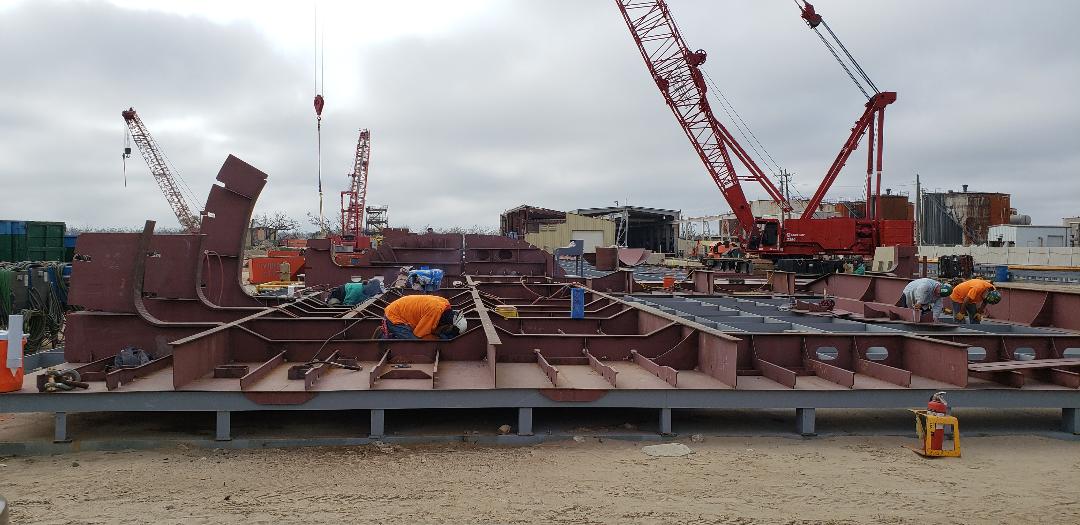
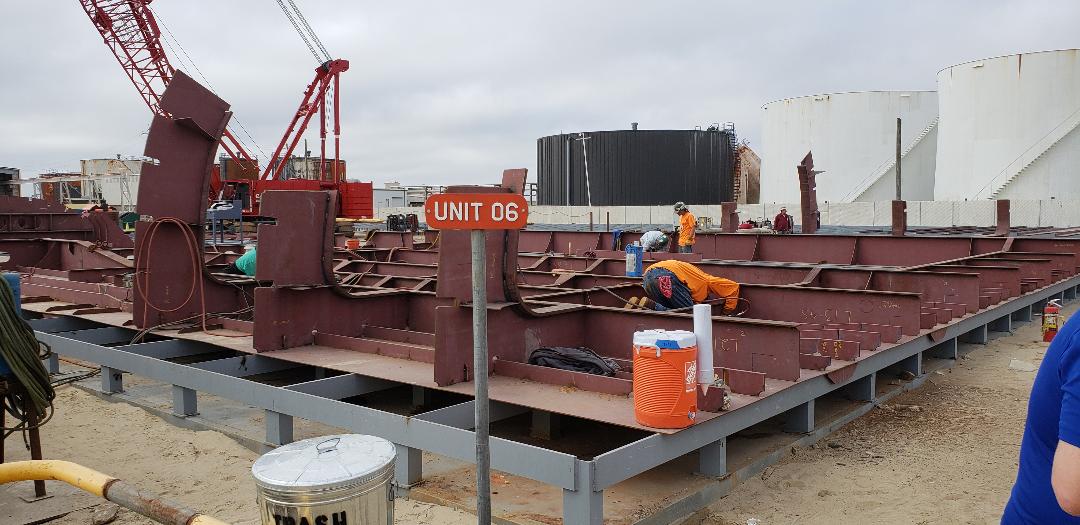
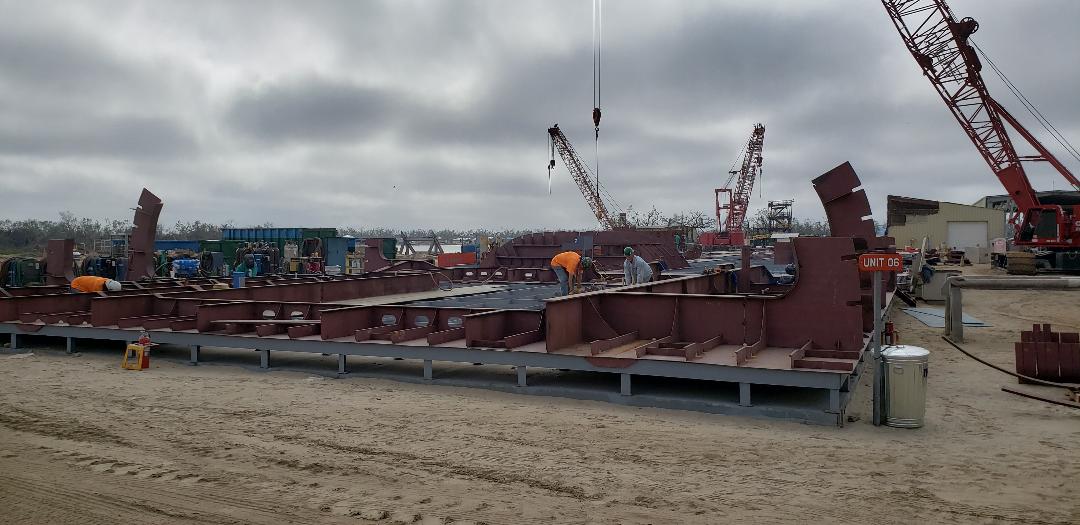
Designated as T-ATS(X) by the Naval Sea Systems Command (NAVSEA), the new class of vessels will be based on existing commercial towing offshore vessel designs . Gulf Island Shipyards rendering

Workboat reports on the Navy’s new towing and salvage ship. It is a brute capable of towing a nuclear powered carrier. The price is certainly right, $63.5M for a 263 foot vessel. It is on the slow side, but it might find some use in support of Coast Guard Law Enforcement operations.

“The 262.8’x59.06’x24.61′ vessel designated T-ATS, to be built at Gulf Island Shipyards, Houma, La., under a $63.5 million contract, will be based on an existing commercial offshore towing design, to replace the Navy’s current T-ATF and T-ARS 50 ships serving under the U.S. Military Sealift Command.

“The design by Gulf Island and Wärtsilä will have its main propulsion come from twin Wartsila 8L32 diesel engines, each producing 6,217 hp at 750 rpm. A pair of Wärtsilä 3700 mm (145″), controllable pitch, 4-bladed props and Wärtsilä marine gears will give the vessel a running speed of 13 knots.”

One of these might make a decent support vessel for Webber Class WPCs and Cyclone Class PCs operating in the drug transit zones.

“Top Coast Guard officer to outline future of service in San Pedro” –State of the Coast Guard News Release

Below you will find a CCGD11 news release quoted in its entirety. I find it significant that the address will take place in a Pacific port rather than in DC. Also note the bullet point, “Coast Guard deployments to the western Pacific Ocean in support of U.S. national security and foreign policy objectives.” It seems the Coast Guard is also “Pivoting” to the Pacific. Even the Arctic strategy and new icebreakers are PACAREA issues. Nice to see the Coast Guard recognizing the growing importance of the Pacific. As noted below, you can see the address live. (Presumably all times are Pacific Coast.) Once it shows up on YouTube I will post it here as well.

united states coast guard

News Release

U.S. Coast Guard 11th District PA Detachment LA/LB
Contact: Coast Guard PA Detachment LA/LB
Office: (310) 521-4260
After Hours: (310) 781-0619
PA Detachment LA/LB online newsroom

Top Coast Guard officer to outline future of service in San Pedro

Coast Guard Commandant Adm. Karl Schultz visits with Coast Guard crews stationed in San Diego, California, June 20, 2018. U.S. Coast Guard photo by Petty Officer 1st Class Jetta Disco.

Editors’ Note: Click on above image to download full-resolution version.

WHO: Adm. Karl Schultz, commandant of the United States Coast Guard

WHAT: The service chief is scheduled to give his first annual State of the Coast Guard address

WHEN: Thursday at 8:00 a.m.

WHERE: Coast Guard Base Los Angeles-Long Beach at 1001 S. Seaside Ave., San Pedro, CA 90731

HOW: Media may RSVP at (310) 781-0619 no later than Wednesday at 5 p.m. A government-issued identification and media credentials are required for access to Base Los Angeles-Long Beach. Media can access the event Wednesday at 7:30 a.m.

SAN PEDRO, Calif. — The Commandant of the United States Coast Guard will deliver his first State of the Coast Guard address Thursday at Coast Guard Base Los Angeles-Long Beach in San Pedro.

Speaking from the largest port in the nation, Adm. Karl Schultz will highlight Coast Guard security and marine safety operations, which facilitate $4.6 trillion in annual economic activity.

Adm. Schultz will also recognize the service and sacrifice of Coast Guard men and women deployed around the world ensuring global peace and prosperity, including servicemembers supporting U.S. Indo-Pacific Command and U.S. Central Command. He will also honor servicemembers in San Pedro, who help ensure the safety and timely movement of vessels operating in the Ports of Los Angeles-Long Beach.

Adm. Schultz is scheduled to make multiple policy and acquisition announcements:

  • The expansion of the Coast Guard’s presence in the Los Angeles area with a new base, vessels and support personnel.
  • An update to the Coast Guard’s Arctic Strategy and future Arctic operations.
  • Full funding and plans to award the contract for the construction of the Coast Guard’s first Polar Security Cutter.
  • Coast Guard deployments to the western Pacific Ocean in support of U.S. national security and foreign policy objectives.
  • New acquisitions to enhance maritime operations combatting dangerous criminal organizations off of Central and South America. These operations reduce violence and economic/political instability driving illegal immigration toward the U.S. Southern Border.

Detailed Schedule of Events:

  • 8:15 – 8:30 a.m.: Adm. Schultz will be available for media interviews
  • 8:30 – 9:40 a.m.: Displays and tours of Coast Guard assets will be available. Local Coast Guard members will be available for interviews
  • 9:50 – 10:45 a.m.: State of the Coast Guard address
  • 10:45 – 11:15 a.m.: Demonstrations of search and rescue and non-compliant vessel/use-of-force capabilities
  • 12:45 – 2:00 p.m.: Adm. Karl Schultz invites the media to get underway on a Coast Guard cutter. Adm. Schultz will be available for additional interviews aboard the vessel.

The event will also be live streamed at https://www.uscg.mil/alwaysready/ and www.dvidshub.net/webcast/19022.

“The Coast Guard Needs an Innovation Outpost in Silicon Valley” –USNI

A very interesting proposal from a very interesting young man.

There are no guarantees with this sort of proposal, but the cost is low, and the potential payoffs are huge.

Note the information on the author that was included in the US Naval Institute Proceedings Article I have included below.

Cadet Twarog is studying electrical engineering at the U.S. Coast Guard Academy.  He is interested in unmanned aircraft systems, remote sensing, and crisis mapping.  During Hurricane Harvey, he helped lead the Coast Guard’s first crisis mapping response, which ultimately collected over 1000 search-and- rescue cases posted to social media. Outside of school, he is a competitive cyclist and EMT.  He won third prize in the 2018 Naval Institute Coast Guard Essay Contest for his essay, “Hurricane Ready: The Coast Guard Adapts to the Social Media Storm.”

“Nation’s only heavy icebreaker returns home following 105-day Antarctic trip” –PACAREA

Below is a PacArea news release quoted in full. Sounds like a tough deployment, but they had the talent to pull it off.

united states coast guard

News Release

March 11, 2019
U.S. Coast Guard Pacific Area
Contact: Coast Guard Pacific Area Public Affairs
Office: (510) 437-3375
After Hours: (510) 816-1700
Pacific Area online newsroom

Nation’s only heavy icebreaker returns home following 105-day Antarctic trip

Nation's only heavy icebreaker returns from Antarctic mission Nation's only heavy icebreaker returns from Antarctic mission Nation's only heavy icebreaker returns from Antarctic mission
Coast Guard Cutter Polar Star at McMurdo Station Coast Guard Cutter Polar Star breaking nice near McMurdo Station, Antarctica Coast Guard Cutter Polar Star escorting the Ocean Giant

Editors’ Note: Click on images to download high resolution version.

SEATTLE — The 150-member crew of the U.S. Coast Guard Cutter Polar Star returned Monday to their homeport of Seattle following a 105-day deployment to Antarctica in support of Operation Deep Freeze.

Operation Deep Freeze is an annual joint military service mission in support of the National Science Foundation, the lead agency for the United States Antarctic Program. Since 1955, the U.S. Department of Defense and the U.S. Coast Guard have assisted in providing air and maritime support throughout the Antarctic continent.

This year marks the 63rd iteration of the annual operation. The Polar Star crew departed Seattle on Nov. 27 for their sixth deployment in as many years and traveled 11,200-nautical-miles to Antarctica.

Upon arrival in McMurdo Sound, Antarctica, the Polar Star broke through 16.5 nautical miles of ice, six to ten feet thick, in order to open a channel to the pier at McMurdo Station. Once the channel was open, the crew refueled Polar Star at McMurdo Station, the United States’ main logistics hub in Antarctica. At the conclusion of a three day port visit to McMurdo Station the ship provided a six-hour familiarization cruise to 156 McMurdo station personnel.

On Jan. 30, the Polar Star escorted the container ship Ocean Giant through the channel, enabling a 10-day offload of 499 containers with 10 million pounds of goods that will resupply McMurdo Station, Amundsen-Scott South Pole Station and other U.S. field camps for the coming 12 months. The Ocean Giant is an ice strengthened vessel contracted by the U.S. Navy’s Military Sealift Command for Operation Deep Freeze.

As in years past, getting the 43-year-old Polar Star to Antarctica was accomplished despite a series of engineering casualties aboard the ship. Commissioned in 1976, the cutter is operating beyond its expected 30-year service life. It is scheduled for a service life extension project starting in 2021.

During the transit to Antarctica, one of the ship’s electrical systems began to smoke, causing damage to wiring in an electrical switchboard, and one of the ship’s two evaporators used to make drinkable water failed. The electrical switchboard was repaired by the crew, and the ship’s evaporator was repaired after parts were received during a port call in Wellington, New Zealand.

The impact from ice operations ruptured the cutter’s centerline shaft seal, allowing water to flood into the ship. Ice breaking operations ceased so embarked Coast Guard and Navy Divers could enter the water to apply a patch outside the hull so Polar Star’s engineers could repair the seal from inside the ship. The engineers donned dry suits and diver’s gloves to enter the 30-degree water of the still slowly flooding bilge to effect the vital repairs. They used special tools fabricated onboard to fix the leaking shaft seal and resume ice breaking operations.

The Polar Star also experienced ship-wide power outages while breaking ice in McMurdo Sound. Crew members spent nine hours shutting down the ship’s power plant and rebooting the electrical system in order to remedy the outages.

On Feb. 10, the crew spent nearly two hours extinguishing a fire in the ship’s incinerator room while the ship was approximately 650-nautical-miles north of McMurdo Sound, Antarctica. The fire damaged the incinerator and some electrical wiring in the room was damaged by fire fighting water. There were no personnel injuries or damage to equipment outside the space. Repairs to the incinerator are already scheduled for Polar Star’s upcoming inport maintenance period.

Presently, the U.S. Coast Guard maintains two icebreakers – the Coast Guard Cutter Healy, which is a medium icebreaker, and the Polar Star, the United States’ only heavy icebreaker. If a catastrophic event, such as getting stuck in the ice, were to happen to the Healy in the Arctic or to the Polar Star near Antarctica, the U.S. Coast Guard is left without a self-rescue capability.

By contrast, Russia currently operates more than 50 icebreakers – several of which are nuclear powered.

Reserved for Operation Deep Freeze each year, the Polar Star spends the Southern Hemisphere summer breaking ice near Antarctica, and when the mission is complete, the Polar Star returns annually to dry dock in order to complete critical maintenance and repairs in preparation for the next Operation Deep Freeze mission. Once out of dry dock, the ship returns to Antarctica, and the cycle repeats.

The Coast Guard has been the sole provider of the nation’s polar icebreaking capability since 1965, and is seeking to increase its ice breaking fleet with six new polar icebreakers in order to ensure continued national presence and access to the Polar Regions.

In the fiscal year 2019 budget, Congress appropriated $655 million to begin construction of a new polar security cutter this year, with another $20 million was appropriated for long-lead-time materials to build a second.

In response to the demands of the region, the service is set to release an updated version of its Arctic Strategy, which Adm. Karl Schultz, the commandant of the Coast Guard, is scheduled to discuss March 21 during his annual State of the Coast Guard Address.

“The Coast Guard greatly appreciates the strong support from both the Administration and Congress for funding the polar security cutter program,” said Schultz. “These new cutters are absolutely vital to achieving our national strategic objectives in the Polar Regions – presence equals influence, and we must be present to meet the Nation’s national security and economic needs there in the future.”

“Northrop pitches optionally manned Firebird to monitor Australia’s coasts” –Defense News

As you may know, the Coast Guard is planning on procuring medium altitude, Long Range/Ultra Long Endurance (LR?ULE) Unmanned Air Systems to enhance Maritime Domain Awareness. I was surprised to find, there may be a contender I was not aware of, and it already has a US government customer, although who it is, is not clear at this time.

Defense News reports Northrop Grumman has proposed an optionally manned aircraft to meet an Australian  Border Force maritime surveillance requirement. The plane, the Firebird, is a product of Scaled Composites

“Firebird is a medium-altitude, long-endurance aircraft with a 30-hour endurance, with a nominal payload. Chappel said the aircraft has been tested with more than 24 different intelligence, surveillance and reconnaissance payloads, which can be swapped in 30 minutes. The initial customer is the U.S. government.”

Scaled Composites is a part of Northrop Grumman now, but originally it was Burt Rutan’s  company. Rutan was known “for designing light, strong, unusual-looking, energy-efficient aircraft. He designed the record-breaking Voyager, which in 1986 was the first plane to fly around the world without stopping or refueling, and the sub-orbitalspaceplaneSpaceShipOne, which won the Ansari X-Prize in 2004 for becoming the first privately funded spacecraft to enter the realm of space twice within a two-week period. With his VariEze and Long-EZ designs, Rutan is responsible for helping popularize both the canard configuration and the use of moldless composite construction in the homebuilt aircraft industry.” Now Scaled Composites functions as Northrop Grumman’s Skunk Works.

Meanwhile the Navy is also procuring unmanned systems with a similar capability in the form of another Northrop Grumman system, the MQ-4C Triton, which is a high altitude system. Hopefully there will be a sharing of information, but inevitably Navy and Coast Guard interests differ. Still the systems might prove complementary.

“ALCOAST 071/19 – MAR 2019 2019 SEA-AIR-SPACE (SAS) GLOBAL MARITIME EXPOSITION”

Below is an ALCOAST discussing Coast Guard participation in the “Sea-Air-Space (SAS) Global Maritime Exposition” March 6-8. This is an activity under the auspices of the Navy League. More event information can be found here. This is a big event and we can expect to see news of some new developments presented at the show. The exhibitor list runs to ten pages.

united states coast guard

R 051034 MAR 19
FM COMDT COGARD WASHINGTON DC//CG-092//
TO ALCOAST

UNCLAS //N05700//
ALCOAST 071/19
COMDTNOTE 5700
SUBJ: 2019 SEA-AIR-SPACE (SAS) GLOBAL MARITIME EXPOSITION
A: Military Assignments and Authorized Absences, COMDTINST M1000.8 (series)
1. The annual Sea-Air-Space (SAS) Global Maritime Exposition will be held 6-8 May 2019 at the Gaylord National Resort and Conference Center, located in National Harbor, MD. SAS was founded in 1965 as a means to bring the U.S. defense industrial base, private-sector U.S. companies and key military decision makers together for an annual innovative, educational, professional, and maritime-based event located in the heart of Washington, D.C. Sea-Air-Space is now the largest maritime exposition in the U.S. and continues as an invaluable extension of the Navy League’s mission of maritime policy, education, and sea service support.
2. In accordance with REF (A) subject to command approval, attendance is allowed for local participants at no cost to the government. Supervisors should ensure attendance aligns with an employee’s primary duties. Employees who wish to attend for personal interests may use annual leave, accrued compensatory time off or earned credit hours (if available), or leave without pay. Commands outside the National Capital Region may submit no-cost permissive orders for military members who attend.
3. A shuttle will run from Coast Guard Headquarters to the SAS and back on a regular basis throughout the three-day exposition. The shuttle schedule is available at the SAS website: www.seaairspace.org.
4. Registration information is available on the SAS website. There is no charge to attend the SAS for U.S. Coast Guard military members and civilian employees.
5. Uniform is Tropical Blue for attendees. Uniform is Service Dress Bravo for panelists,
moderators, and other presenters.
6. In conjunction with Sea-Air-Space 2019, the annual STEM Expo will be held at the Gaylord on Sunday, May 5. Anyone attending SAS is also welcome to the STEM Expo with the same caveats listed above for the main convention.
7. The COMDT (CG-0923) POC is CAPT Sean Carroll, 202-372-4562, Sean.M.Carroll@uscg.mil.
8. RDML Melissa Bert, Director, Governmental and Public Affairs, sends.
9. Internet release is authorized.

More on the Webber Class WMECs

The Coast Guard Cutter Robert Ward (WPC-1130) is shown shortly after mooring for the first time at its homeport at Coast Guard Base Los Angeles-Long Beach, Oct. 31, 2018. The Robert Ward is the second of four new Fast Response Cutters to be stationed in San Pedro, which will help to protect the people, ports and waterways of the region and maintain security for the global supply chain and critical infrastructure within California. (U.S. Coast Guard photo by Chief Petty Officer Brandyn Hill)

Attended the commissioning of the 30th Webber class cutter, USCGC Robert Ward (WPC-1130) today, March 2.. Eleventh District Commander and Commander Pacific Area were there, and their remarks made it clear that they will try to get the most out of these little ships.

They noted that one of the class was off Central America in the Eastern Pacific drug transit zone and another was in Kwajalein (about 2125 nautical miles from Oahu). As noted earlier these vessels are performing missions that previously would have required a medium endurance cutter.

I asked crew members about what seems to be a relatively limited notional endurance of five days. I was told that they had gone six or seven days between replenishment, but once again the limited capacity of the washer/dryer was mentioned as I had heard in a comment on an earlier post. Might be worthwhile to look into a higher capacity washer/dryer and finding a bit more food storage.

In any case, these vessels are doing things that no Coast Guard patrol boats have done before.