“Heart of the Service” Seapower Magazine Report on Inland Fleet Recapitalization

USCGC Smilax (WLIC-315)

Seapower Magazine has a report on efforts to recapitalize the Inland Fleet of tenders. You can read it on line here. It may be hard to read when it comes up, but there is a “slide” at the bottom of the page that allows you to make the text larger.

It seems the Congress has appropriated more money than we expected, $26M. Its not really a lot, maybe not even enough to buy the first new inland tender. I think they are expected to cost about $25M apiece and the first is always more expensive.

It almost seems we are complaining. “Its five year money, so unless you have a plan to spend it, it is hard. It is also a signal to get moving quicker on this.” I am sure Commander Boda is saying it is hard to optimize and get the most out of it,  but there have been studies of how best to replace these during the previous decade including a joint study with the Army Corps of Engineers, and I believe one at the Academy. There is almost certainly a backlog of maintenance, and we have five years to spend this money on a ship type that is not really that complicated. Come on guys, don’t tell the world you don’t know how you will manage to spend this little bit of money, we will certainly find a good use for it.

A request for information for a solution to our inland cutter needs went out Feb. 14, 2018. If we fund the first new tender by FY2023 presumably we will not see the new ship before 2024 with the Smilax will be 80 years old and the fleet average 61 years old. We are supposed to be flexible. We cannot say, “We did not see this coming.”

This reminds me of when Congress appropriated money for the ninth NSC and the press started quoting a warrant officer that the Coast Guard did not want or need it. We should never give the impression that we can’t use more money.

BAE/Bofors LEMUR, a Remote Control Weapon Station/Electro-Optic Sensor for Patrol Boats

This is a Remote Control Weapon Station comparable to the Mk38 mod2 used on the Webber Class WPCs. There are many such systems, but I am highlighting it because it is already in use on a boat much smaller than the Webber class. The Combat Boat 90 (time 7:10 in the video above) is only 53 feet (16.1 meters) long and 22.6 tons full load. That is about one quarter the displacement of the 87 foot Marine Protector class, less than one fifteenth the size of a Webber class. It actually displaces a little less than the 45 foot Response Boat, Medium (RB-M). I particularly like that this system has been mated with the 30mm M230 chain gun from the Apache Helicopter that is capable of penetrating light armor (see below). That could give us serious penetrating power.

Like most of these systems, they incorporate electro-optic devices which can be used for SAR, target identification, or to enhance navigation.

Thanks to Lee for bringing this to my attention. 

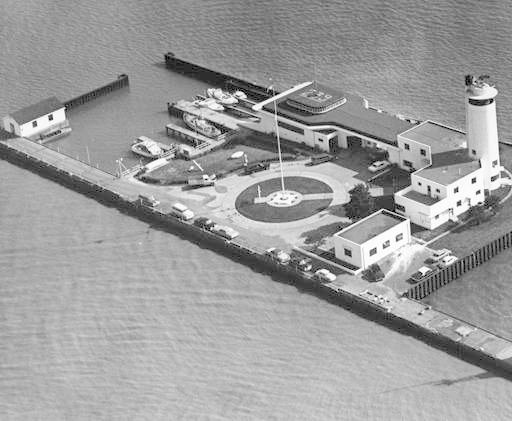
Cleveland Metroparks unveils historic Coast Guard renovation (photos)

Historic former CG station on the mouth of the Cuyahoga River, at the end of a 1,000-foot pier.Photo: John Petkovic, The Plain Dealer

Cleveland.com has a story about efforts to turn the former Coast Guard Station Cleveland, abandoned in 1976, into an attraction.

Lots of photos of how it was (like the one above) and how it is now, cleaned up, but with much work still to be done.

Photo: John Petkovic, The Plain Dealer

Coast Guard Contract for sUAS for Bertholf Class Cutters

Insitu ScanEagle small Unmanned Air System (sUAS)

The Acquisitions Directorate (CG-9) has announced a contract award to Insitu, to provide a capability to operate a small unmanned air system from the Bertholf class National Security Cutters.

“…The service contract covers installation and deployment of sUAS for approximately 200 hours per 30-day operational patrol period.

“Installations of sUAS capability on NSCs are planned at a rate of about two per year. Total value of the contract including the seven option years is approximately $117 million.”

It does not say which airframe Insitu will be providing. They have more than one, but it is likely to be Scan Eagle which was the small UAS used by Stratton during the trials.

200 hours per 30 day operational patrol period might be 20 sorties of 10 hours each or 25 sorties of 8 hours, but in all probability it will include a few shorter flights to provide documentation and over-watch during boardings. 

The Coast Guard is contracting out the operation and maintenance of the systems rather than training Coastguardsmen to perform these functions. Hopefully, in time that will change.

Also there is no reason these systems should not also operate off of smaller cutters and icebreakers. Operating from 210s should be relatively easy, although it might preclude operating a helicopter, and with a little engineering they could probably operate from Webber class WPCs.

If you want to trace some of the progress on this issue, here are some earlier posts.

RIMPAC 2018 Humanitarian Assistance/Disaster Relief

120727-N-VD564-015
PACIFIC OCEAN (July 27, 2012) Ships and submarines that participated in the Rim of the Pacific (RIMPAC) exercise 2012. (U.S. Navy photo by Chief Mass Communication Specialist Keith Devinney/Released)

RIMPAC is a huge exercise. 

Twenty-six nations, 47 surface ships, five submarines, 18 national land forces, and more than 200 aircraft and 25,000 personnel will participate in the biennial Rim of the Pacific (RIMPAC) exercise scheduled June 27 to Aug. 2, in and around the Hawaiian Islands and Southern California.

It normally includes Coast Guard participation, although I have not seen any announcement about which Coast Guard Units will play, you can be sure there will be some CG presence.

There are scenarios within scenarios, but perhaps of most immediate interest to the Coast Guard, is the Humanitarian Assistance/Disaster Relief (HA/DR) portion of the exercise. The US Naval Institute “Proceedings Today” online magazine has an interesting take on how to “Improve RIMPAC,” specifically the HA/DR portion. Given the Coast Guards outsized role in Disaster Relief, its world wide relationships, and its unique position as a military service in a predominately civilian department, it probably should be deeply involved.

Japan’s US-2 Amphibious Aircraft

ShinMaywa US-2

An Asia Times article advocating the US procure some of these aircraft, has promoted me to look again at a relatively unique aircraft, Japan’s US-2 amphibian built by ShinMaywa.

It has been a while since the USCG operated amphibious aircraft. Having been a passenger on an HU-16E during a water landing as a cadet, I can attest it was interesting. I would be hard put to justify Coast Guard procurement of these, even though they share engines and propellers with the C-130Js and C-27Js. The need for urgent rescue beyond the range of our helicopters or the in flight refueled range of ARRS helicopters is very rare. Water landings at sea are inherently dangerous and impose additional costs in maintenance due to corrosion. Amphibians also tend to have aerodynamic disadvantages that effect efficiency daily, while the likelihood of being forced down at sea is now much more remote.

Still the ability to land at sea or near small islands with no airports is intriguing.  Reportedly India is buying twelve of these. Both Russia (Beriev BE-200) and China (Harbin SH-5 and AVIC AG600) build or have built amphibious aircraft of similar size.

ShinMeiwa, now ShinMaywa, has a long history or building seaplanes and amphibious aircraft. Its corporate progenitor, Kawanishi Aircraft Company, built four engine seaplane patrol bombers (H6K “Mavis” and H8K “Emily”) used in WWII as well as what may have been the best Japanese fighter of WWII.

Combined Maritime Security Task Force Pacific

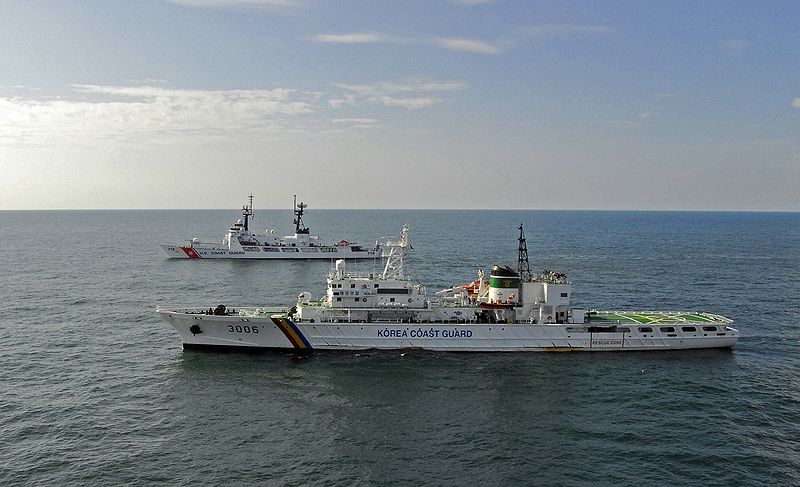
Republic of Korea Coast Guard vessel #3006 in company with U.S. Coast Guard cutter USCGC Boutwell (WHEC-719) during the North Pacific Coast Guard Forum in August 2007. This forum was created to increase international maritime safety and security in the Northern Pacific Ocean and its borders. The Boutwell worked with the Korean coast guard while on their way to Yokosuka, Japan. The Japanese coast guard is one of the six nations involved in the forum.

War on the Rocks offers a suggestion as to how to build greater cooperation and trust and support international norms in the Western Pacific.

“…establishment of a Combined Maritime Task Force Pacific that would be modeled off the Standing Naval Forces Atlantic construct that NATO operated in the 1970s and 1980s… It included 6-10 surface ships (destroyers, cruisers, frigates and support ships) that attached to the squadron for up to six months at a time…the real utility was that its permanent and consistent nature allowed contributing navies to work together to build interoperability during peacetime…it was always signaling contributing navies’ growing alignment and desire to work together.”

This seems like a pretty good idea, but I would suggest one change. Make the purpose of the force Law Enforcement (particularly fisheries), SAR, and Disaster Relief/Humanitarian Assistance and use primarily Offshore Patrol Vessels instead of conventional warships.

Signaling a shared belief in the norms of international behavior, and a determination to uphold those norms, would be the primary objective.

There are lots of potential participants beside the USCG, they might include navies or coast guards of Vietnam, Indonesia, Brunei, Singapore, Australia, India, Malaysia, Thailand, Japan, S. Korea, and the Philippines. COM7thFleet has already asked for a USCG presence, but this would not be under the COCOM. It would be a cooperative enterprise between participating nations, in most cases, coast guard to coast guard.

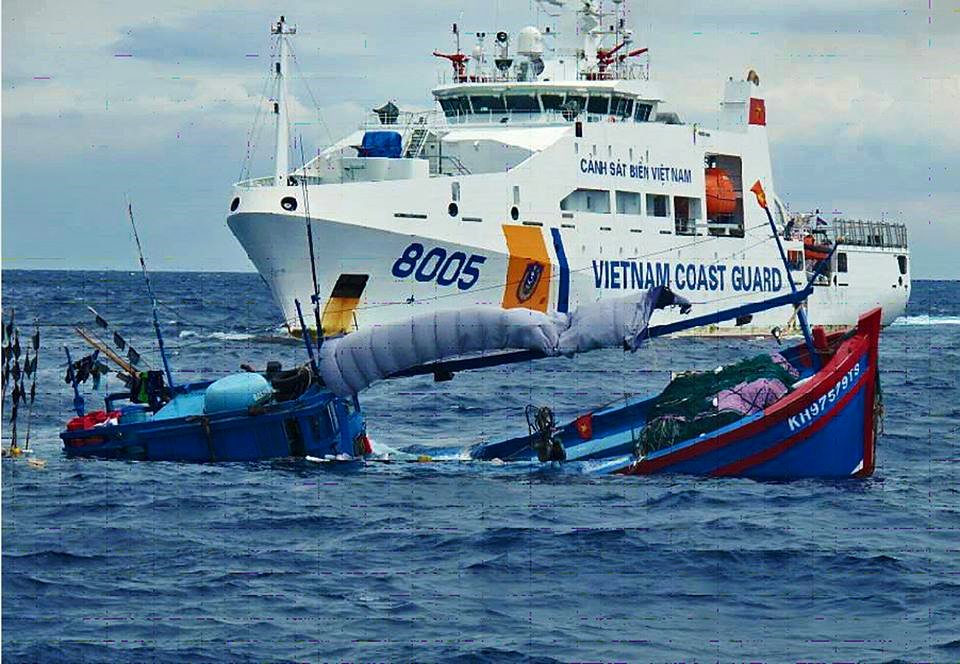
Vietnamese Coast Guard Damen 9014 Offshore Patrol Vessel. Photo: lancercell.com

All the vessels involved could host ship riders from the nation(s) where the force is operating.

We already plan to have most of the Bertholf class cutters in the Pacific, and putting three OPCs in Guam could further facilitate the arrangement.

This avoids the complications of a military alliance, but strengthens the hand of SE Asian nations that might otherwise be intimidated by China.

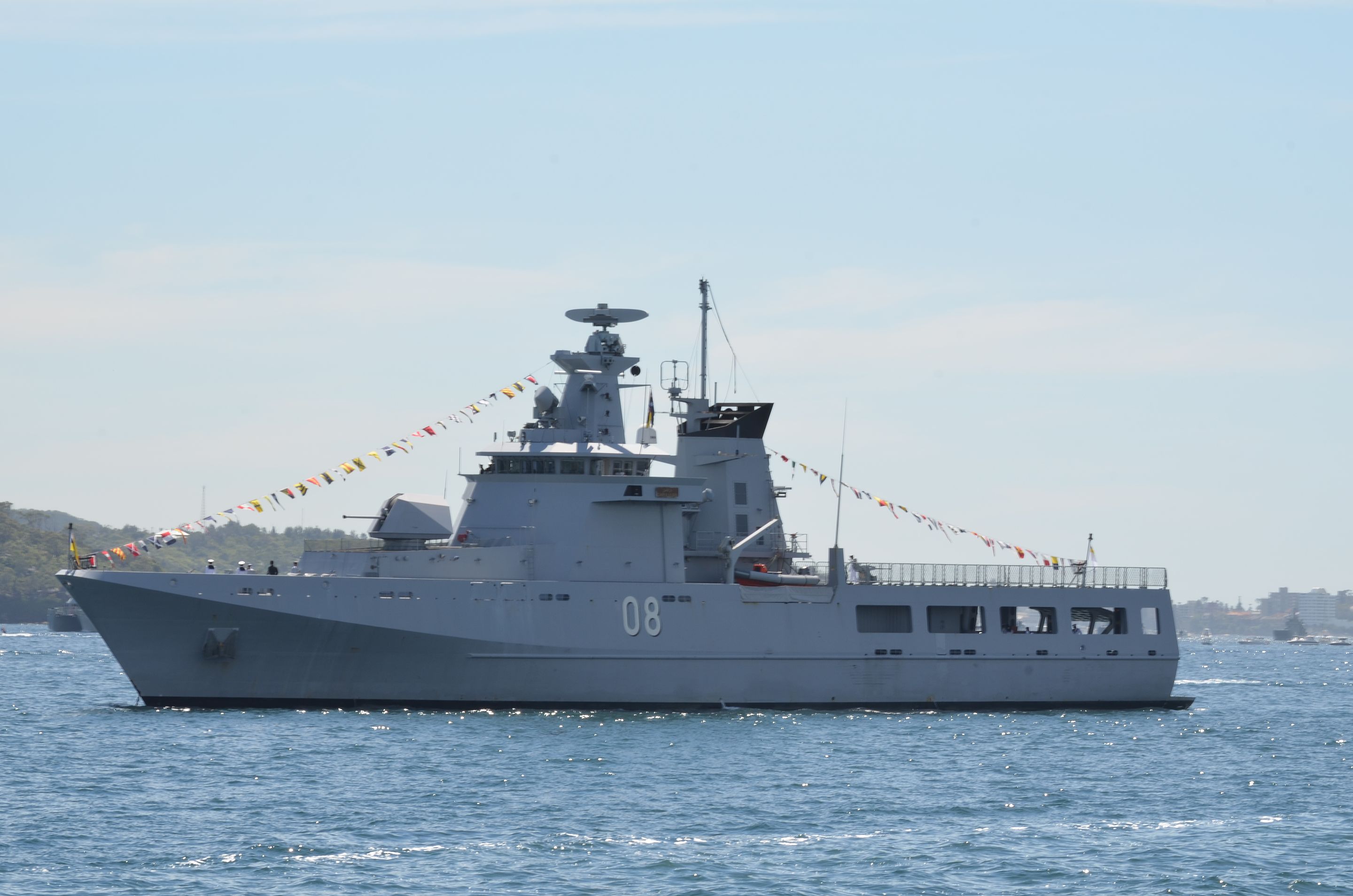
Photographs taken during day 3 of the Royal Australian Navy International Fleet Review 2013. The Bruneian patrol vessel Darulaman moored in Sydney Harbour. Australia is building 12 similar ships. Photo by Saberwyn.


Report to Congress on U.S. Coast Guard Cutter Procurement, 23 May 2018

OPC “Placemat”

Mr. O’Rourke has been busy, in addition to the report on Icebreakers, the latest edition of the Congressional Research Service report on Coast Guard Cutter Procurement, also by Ronald O’Rourke, was also published on 23 May, 2018. You can see it here. 

I have reproduced the summary immediately below.  Note that the price for the OPCs is already surprisingly low. 

The Coast Guard’s acquisition program of record (POR) calls for procuring 8 National Security Cutters (NSCs), 25 Offshore Patrol Cutters (OPCs), and 58 Fast Response Cutters (FRCs) as replacements for 90 aging Coast Guard high-endurance cutters, medium-endurance cutters, and patrol craft. The Coast Guard’s proposed FY2019 budget requests a total of $705 million in acquisition funding for the NSC, OPC, and FRC programs.

NSCs are the Coast Guard’s largest and most capable general-purpose cutters; they are intended to replace the Coast Guard’s 12 aged Hamilton-class high-endurance cutters. NSCs have an estimated average procurement cost of about $682 million per ship. Although the Coast Guard’s POR calls for procuring a total of 8 NSCs to replace the 12 Hamilton-class cutters, Congress through FY2018 has funded 11 NSCs, including two (the 10th and 11th) in FY2018. Six NSCs are now in service, and the seventh, eighth, and ninth are scheduled for delivery in 2018, 2019, and 2020, respectively. The Coast Guard’s proposed FY2019 budget requests $65 million in acquisition funding for the NSC program; this request does not include additional funding for a 12th NSC.

OPCs are to be smaller, less expensive, and in some respects less capable than NSCs; they are intended to replace the Coast Guard’s 29 aged medium-endurance cutters. Coast Guard officials describe the OPC program as the service’s top acquisition priority. OPCs have an estimated average procurement cost of about $391 million per ship. On September 15, 2016, the Coast Guard announced that it was awarding a contract with options for building up to nine ships in the class to Eastern Shipbuilding Group of Panama City, FL. The first OPC was funded in FY2018 and is to be delivered in 2021. The Coast Guard’s proposed FY2019 budget requests $400 million in acquisition funding for the OPC program for the construction of the second OPC (which is scheduled for delivery in 2022) and procurement of long leadtime materials (LLTM) for the third OPC (which is scheduled for delivery in 2023).

FRCs are considerably smaller and less expensive than OPCs; they are intended to replace the Coast Guard’s 49 aging Island-class patrol boats. FRCs have an estimated average procurement cost of about $58 million per boat. A total of 50 have been funded through FY2018. The 27th was commissioned into service on April 20, 2018. The Coast Guard’s proposed FY2019 budget requests $240 million in acquisition funding for the procurement of four more FRCs.

The NSC, OPC, and FRC programs pose several issues for Congress, including the following: 

  • whether to fully or partially fund the acquisition of a 12th NSC in FY2019; 
  • whether to fund the acquisition of four FRCs in FY2019, as requested, or some other number, such as six, which is the maximum number that has been acquired in some prior fiscal years; 
  • whether to use annual or multiyear contracting for procuring OPCs; 
  • the procurement rate for the OPC program; 
  • planned procurement quantities for NSCs, OPCs, and FRCs; and 
  • initial testing of the NSC.

Congress’s decisions on these programs could substantially affect Coast Guard capabilities and funding requirements, and the U.S. shipbuilding industrial base.

Coast Guard Polar Icebreaker Program: Background and Issues for Congress–23 May, 2018

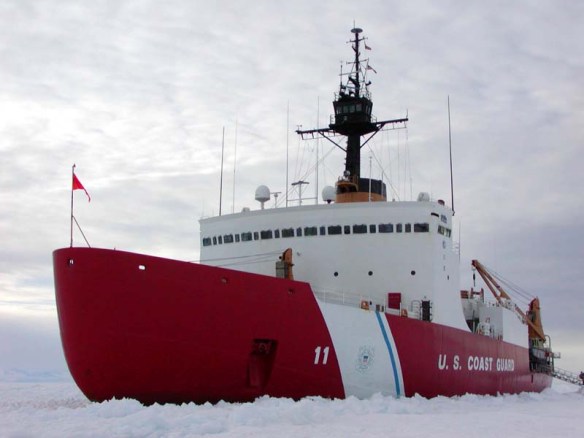
USCGC Polar Sea

The latest edition of the Congressional Research Service report on Coast Guard Polar Icebreakers, by Ronald O’Rourke, was published on 23 May, 2018. You can see it here. 

I have reproduced the summary immediately below.  

The Coast Guard polar icebreaker program is a program to acquire three new heavy polar icebreakers, to be followed years from now by the acquisition of up to three new medium polar icebreakers. The Coast Guard wants to begin construction of the first new heavy polar icebreaker in FY2019 and have it enter service in 2023. The polar icebreaker program has received about $359.6 million in acquisition funding through FY2018, including $300 million provided through the Navy’s shipbuilding account and $59.6 million provided through the Coast Guard’s acquisition account. The Coast Guard’s proposed FY2019 budget requests $750 million in Coast Guard acquisition funding for the program.

The acquisition cost of a new heavy polar icebreaker had earlier been estimated informally at roughly $1 billion, but the Coast Guard and Navy now believe that three heavy polar icebreakers could be acquired for a total cost of about $2.1 billion, or an average of about $700 million per ship. The first ship will cost more than the other two because it will incorporate design costs for the class and be at the start of the production learning curve for the class. An April 13, 2018, Government Accountability Office (GAO) report on the polar icebreaker program states that the Coast Guard has reduced its estimated cost for the first heavy polar icebreaker to less than $900 million, which would imply an average cost of something more than $600 million each for the second and third icebreakers. When combined with the program’s $359.6 million in prior-year funding, the $750 million requested for FY2019 would fully fund the procurement of the first new heavy polar icebreaker and partially fund the procurement of the second.

The operational U.S. polar icebreaking fleet currently consists of one heavy polar icebreaker, Polar Star, and one medium polar icebreaker, Healy. In addition to Polar Star, the Coast Guard has a second heavy polar icebreaker, Polar Sea. Polar Sea, however, suffered an engine casualty in June 2010 and has been nonoperational since then. Polar Star and Polar Sea entered service in 1976 and 1978, respectively, and are now well beyond their originally intended 30-year service lives. The Coast Guard has used Polar Sea as a source of spare parts for keeping Polar Star operational.

A Department of Homeland Security (DHS) Mission Need Statement (MNS) approved in June 2013 states that “current requirements and future projections … indicate the Coast Guard will need to expand its icebreaking capacity, potentially requiring a fleet of up to six icebreakers (3 heavy and 3 medium) to adequately meet mission demands in the high latitudes….”

The current condition of the U.S. polar icebreaker fleet, the DHS MNS, and concerns among some observers about whether the United States is adequately investing in capabilities to carry out its responsibilities and defend its interests in the Arctic, have focused policymaker attention on the question of whether and when to acquire one or more new heavy polar icebreakers as replacements for Polar Star and Polar Sea.

On March 2, 2018, the U.S. Navy, in collaboration with the U.S. Coast Guard under the polar icebreaker integrated program office, released a request for proposal (RFP) for the advance procurement and detail design for the Coast Guard’s heavy polar icebreaker, with options for detail design and construction for up to three heavy polar icebreakers.

Issues for Congress for FY2019 for the polar icebreaker program include, inter alia, whether to approve, reject, or modify the Coast Guard’s FY2019 acquisition funding request; whether to use a contract with options or a block buy contract to acquire the ships; whether to continue providing at least some of the acquisition funding for the polar icebreaker program through the Navy’s shipbuilding account; and whether to procure heavy and medium polar icebreakers to a common basic design.

Navy Selects Kongberg-Raytheon Naval Strike Missile for their “Small Surface Combatants”

Kongsberg Naval Strike Missile. Kongsberg Photo

The US Naval Institute News Service is reporting the Naval Strike Missile has been selected to provide the long range surface to surface capability for the Littoral Combat Ships (LCS) and presumably the new frigate as well. This is no surprise since the other two candidates had dropped out of the competition, “…Boeing Harpoon Block II Plus and the Lockheed Martin Long-Range Anti-Ship Missile (LRASM) were both withdrawn by their respective companies from the competition last year. Both Boeing and Lockheed complained that Navy requirements for the OTH missiles did not value the networking capability of their offerings, several sources confirmed to USNI News.”

There are a couple of points to look at here.

The initial contract is for $14,856,016. This reportedly includes, “…encanistered missiles (EM) loaded into launching mechanisms (LM); and a single fire control suite (FCS). This contract consists of EMs (tactical, telemetered and inert operational); FCSs; LMs; mission support equipment, training equipment and courses; engineering services; and travel and other direct costs. This contract includes options which, if exercised, would bring the cumulative value of this contract to $847,611,857.” So it appears the initial contract includes at least one full ship set. The cumulative value is 57 times greater. There are only 52 Small Surface Combatants planned including both LCSs and the projected frigates (FFGs). Given that we would expect the price to go down in a quantity buy, it looks like these missiles may also go on other platforms as well.

We don’t know how many missiles will go on each platform, but Raytheon seems to indicate each LCS will support two quad launchers. While reportedly launchers are available for one, two, three, four, or six missiles, all the installations so far have been in the quad format. “USNI News understands the Thursday award buys about a dozen missiles.” Presumably some missiles will be expended in tests.

Raytheon Image

NSM is smaller than Harpoon, comparing NSM vs surface launched Harpoon.

  • Weight: 900 lb (410 kg) vs 1,523 lb (691 kg) with booster
  • Length: 13 ft (3.95 m) vs 15 ft (4.6 m)
  • Warhead: 276 lb (125 kg) vs 488 pounds (221 kg)
  • Range: 100 nmi (185 km) vs in excess of 67 nmi (124 km)

It is in targeting where the NSM’s superiority shines compared to the legacy Harpoons..