“Littoral Combat Ships Conduct Joint Oceania Maritime Support Initiative” –Seapower

“Independence-variant littoral combat ship USS Oakland (LCS 24) stations behind a fishing vessel while Tactical Law Enforcement Team Pacific Coast Guardsmen conduct an Oceania Maritime Support Initiative (OMSI) vessel compliance boarding, Aug. 19, 2022. Oakland is deployed in support of the Oceania Maritime Support Initiative, a secretary of defense program leveraging Department of Defense assets transiting the region to increase the Coast Guard’s maritime domain awareness, and law enforcement operations in Oceania. (U.S. Navy photo by Mass Communication Specialist 2nd Class Ian Zagrocki)”

The Navy League’s on-line magazine, Seapower reports,

Independence-variant littoral combat ships USS Jackson (LCS 6) and USS Oakland (LCS 24) deployed to the Oceania region with embarked U.S. Coast Guard Pacific Tactical Law Enforcement Team detachments to conduct maritime law enforcement operations in support of U.S. and Pacific Island nations fisheries laws, August 2022, Commander, Littoral Combat Ship Squadron One Public Affairs Office said Sept. 7.

Certainly not the first time Navy combatants have embarked TACLETs, but the LCS do appear to be more appropriate than DDGs and it appears that, at least USS Jackson, is not just doing this while transiting some where else, “Jackson will continue the OMSI mission through September 2022.”


“U.S. Coast Guard arrives for planned port visit in Cairns, Australia” –Adventures in Paradise with the Webber Class

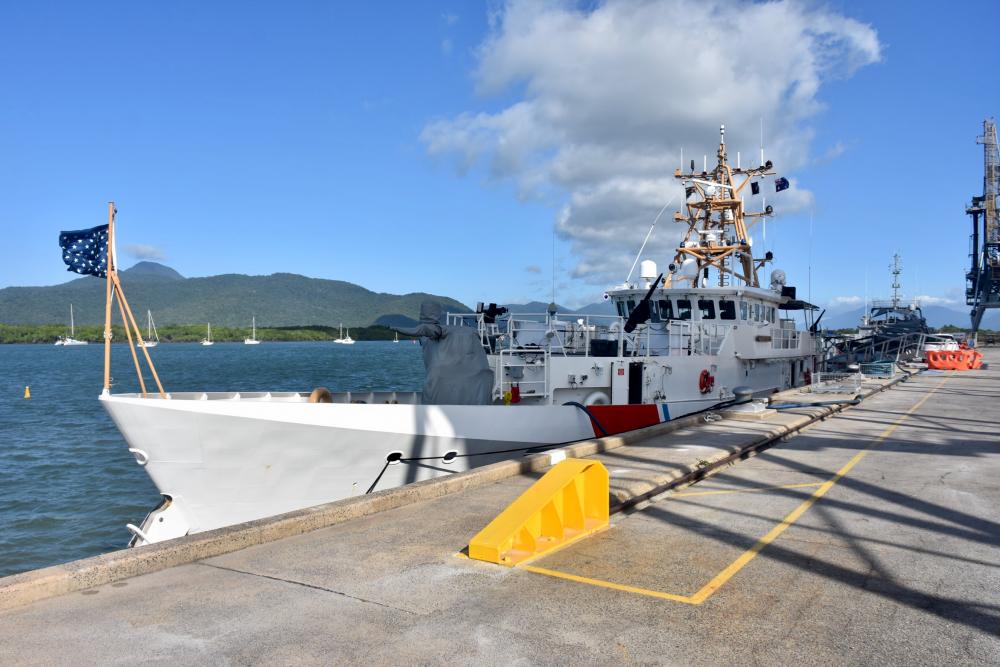
The Sentinel-class fast response cutter USCGC Oliver Henry (WPC 1140) arrive in Cairns for engagements with Australian Defence and Home Affairs partners and local representatives, Aug. 31, 2022. The U.S. Coast Guard is conducting a routine deployment in Oceania as part of Operation Blue Pacific, working alongside Allies, building maritime domain awareness, and sharing best practices with partner nation navies and coast guards. Op Blue Pacific is an overarching multi-mission U.S. Coast Guard endeavor promoting security, safety, sovereignty, and economic prosperity in Oceania while strengthening relationships with our regional partners. (U.S. Coast Guard photo courtesy USCGC Oliver Henry)

The six Hawaii and Guam based Webber class Fast Response Cutters do seem to get around. USCGC Oliver Henry made it to North Eastern Australia, mooring at Her Majesty’s Australian Station Cairns, which is home to some Australian Navy patrol, hydrographic, and survey vessels. Cairns looks like a delightful little city (population in June 2019 was 153,951). Not bad after no one tossed out the welcome mat in the Solomon Islands. The crew is going to have a lot of sea stories.

Cairns is a bit over 1800 nautical miles South of Oliver Henry’s homeport in Guam.

News Release

U.S. Coast Guard Forces Micronesia / Sector Guam

U.S. Coast Guard arrives for planned port visit in Cairns, Australia

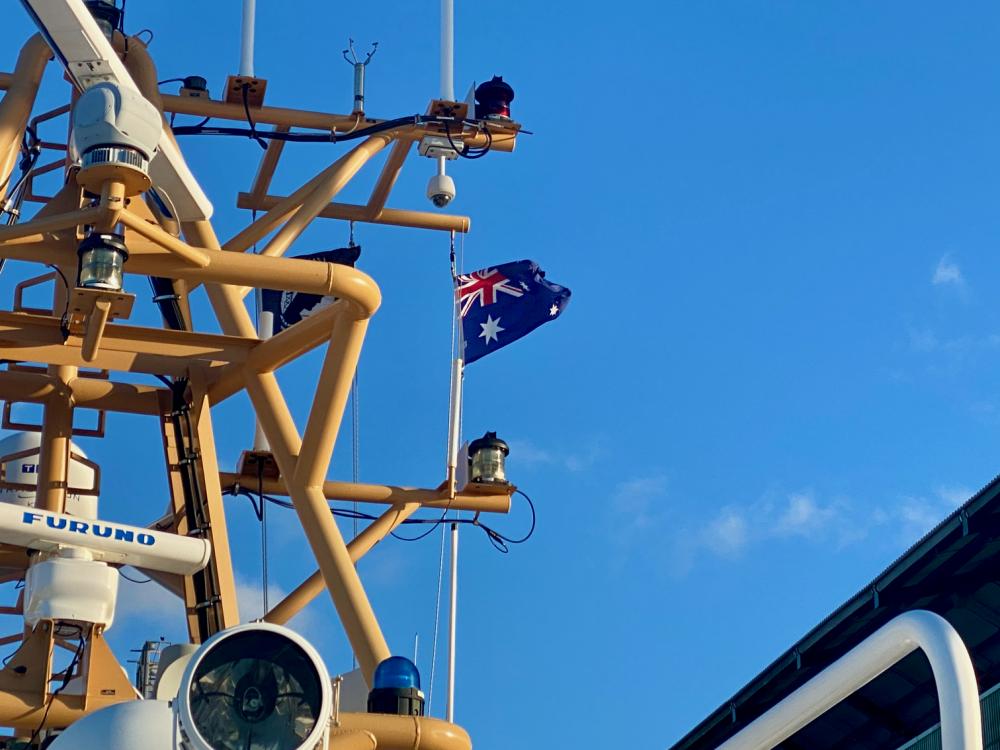
The Oliver Henry is the first U.S. Coast Guard fast response cutter ever to fly the Australian ensign.  The Sentinel-class fast response cutter USCGC Oliver Henry (WPC 1140) command stand for a photo with Cmdr. Alfonso Santos, commander of HMAS Cairns, and Capt. Toby Reid, U.S. Coast Guard representative to the defense attache office of the U.S. Embassy in Australia,
USCGC Oliver Henry meets with Cairns regional Council and mayor The Sentinel-class fast response cutter USCGC Oliver Henry (WPC 1140) arrive in Cairns for engagements with Australian Defence and Home Affairs partners and local representatives, Aug. 31, 2022

Editor’s Note: Click on the images above to view or download more.

CAIRNS, Australia — The Sentinel-class fast response cutter USCGC Oliver Henry (WPC 1140) crew arrived in Cairns for engagements with Australian Defence and Home Affairs partners and local representatives, Aug. 31.

“A cutter arrival to Australia is another first, not only for U.S. Coast Guard Forces Micronesia but also our fast response cutter fleet and is a reminder of our Service’s commitment to our partners and our enduring presence in the region,” said Capt. Nick Simmons, commander U.S. Coast Guard Forces Micronesia/Sector Guam. “The ship driver in me was envious when Lt. Hofschneider reported ‘OH transiting southbound along Inner Great Barrier Reef Passage enroute to Cairns. No issues or concerns.’ Not the kind of thing many Coast Guard members have ever written or said.”

Before arrival in port, Oliver Henry’s crew operated at sea with aerial support from the Australian Border Forces in the Torres Strait. While in port, the two nations will continue to build on the relationship forged at sea. Upon arrival, the crew was greeted by representatives from the Royal Australian Navy HMAS Cairns and the U.S. embassy. They were also guests of the Cairns Regional Council.

“It is an honor for Oliver Henry and her crew to visit and host our Australian friends,” said Lt. Freddy Hofschneider, the Oliver Henry commanding officer. “The U.S. and Australia have been standing side-by-side for more than 100 years. This is more than a partnership, it is mateship. The U.S. Coast Guard looks forward to more opportunities where we can work with the Australian Border Force, Royal Australian Navy, and other Australian partners to advance the rule of law at sea.”

During their stop in Cairns, members of Oliver Henry anticipate engagements with local officials and the community while also experiencing local culture.

The U.S. Coast Guard is conducting a routine deployment in Oceania as part of Operation Blue Pacific, working alongside Allies, building maritime domain awareness, and sharing best practices with partner nation navies and coast guards. Op Blue Pacific is an overarching multi-mission U.S. Coast Guard endeavor promoting security, safety, sovereignty, and economic prosperity in Oceania while strengthening relationships with our regional partners.

The Oliver Henry is the 40th Sentinel-class fast response cutter. The ship was commissioned along with its sister ships, Myrtle Hazard and Frederick Hatch, in Guam in July 2021. In the time since, the crew has participated in several search and rescue cases, completed a counternarcotics patrol off Guam with the Japan Coast Guard, and conducted sovereignty and fisheries patrols in the Forces Micronesia/Sector Guam area of responsibility.

For more U.S. Coast Guard Forces Micronesia/Sector Guam news, visit us on DVIDS or subscribe! You can also visit us on Facebook at @USCGForcesMicronesia.

For more U.S. Coast Guard Forces Micronesia/Sector Guam news, visit us on DVIDS or subscribe! You can also visit us on Facebook at @USCGSectorGuam.

“Coast Guard carves out strategic niche in Africa” –Stars and Stripes

USCGC Mohawk manns the rail as she sails alongside a Nigerian navy ship in the Atlantic Ocean, Aug. 22, 2022. Mohawk is on a scheduled deployment in the U.S. Naval Forces Africa area of operations. (Jessica Fontenette/U.S. Coast Guard)

Stars and Stripes reports on the Coast Guard’s latest capacity building and counter IUU efforts in West African waters.

Previous related reports:

The second link immediately above includes additional links regarding previous similar efforts.

“Coast Guard Cutter Midgett arrives in the Western Pacific” –PacArea

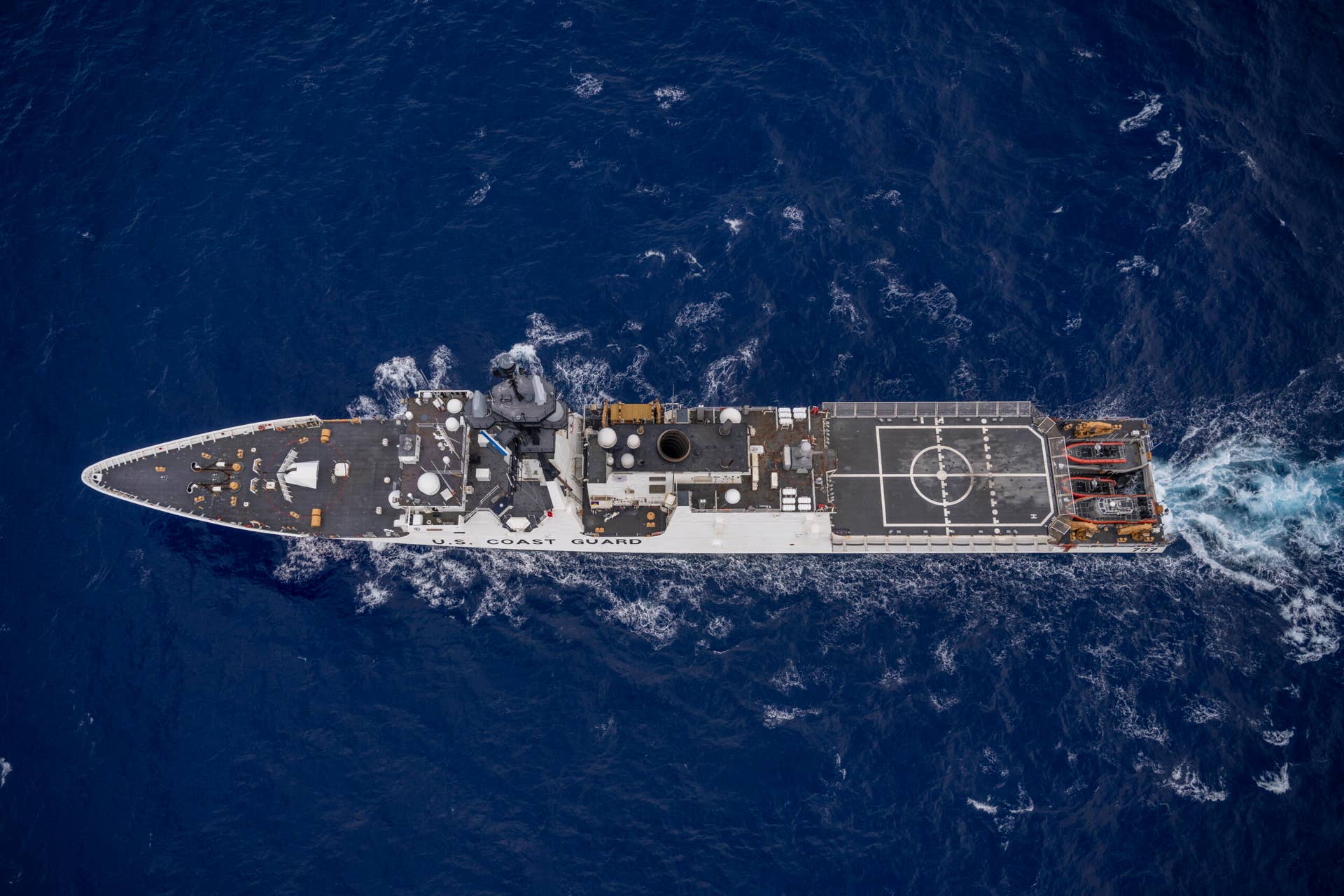
PACIFIC OCEAN (July 30, 2022) U.S. Coast Guard Legend-class cutter USCGC Midgett (WMSL 757) transits the Pacific Ocean during Rim of the Pacific (RIMPAC) 2022. Twenty-six nations, 38 ships, three submarines, more than 170 aircraft and 25,000 personnel are participating in RIMPAC from June 29 to Aug. 4 in and around the Hawaiian Islands and Southern California. The world’s largest international maritime exercise, RIMPAC provides a unique training opportunity while fostering and sustaining cooperative relationships among participants critical to ensuring the safety of sea lanes and security on the world’s oceans. RIMPAC 2022 is the 28th exercise in the series that began in 1971.(U.S. Coast Guard photo by Petty Officer 3rd Class Taylor Bacon)

Only weeks after having completed participation in RIMPAC2022, Honolulu based USCGC Midgett begins a “months-long” deployment in the Western Pacific.

News Release

August 31, 2022
U.S. Coast Guard Pacific Area

Coast Guard Cutter Midgett arrives in the Western Pacific

VIDEO: Coast Guard Cutter Midgett arrives in the Western Pacific

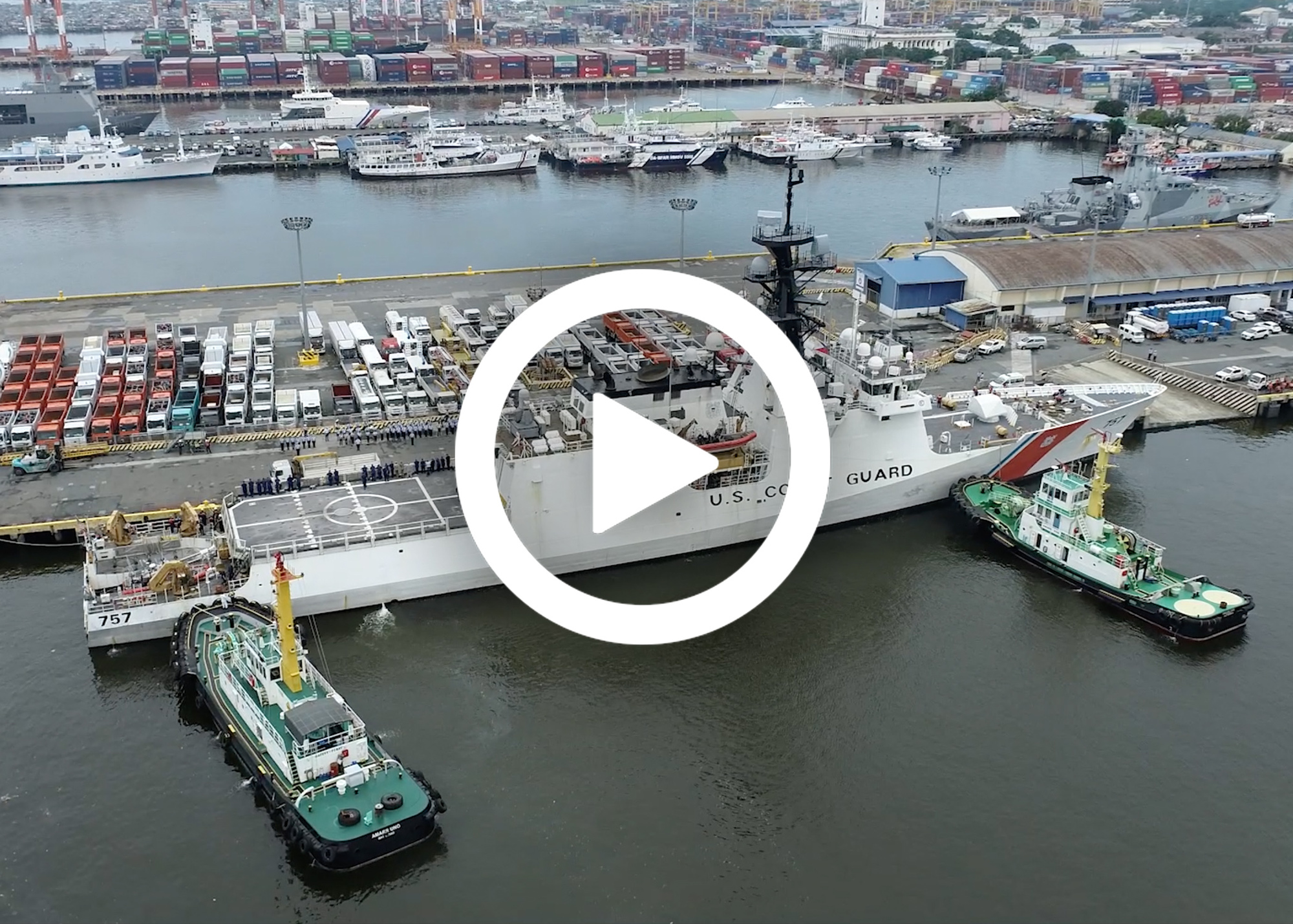
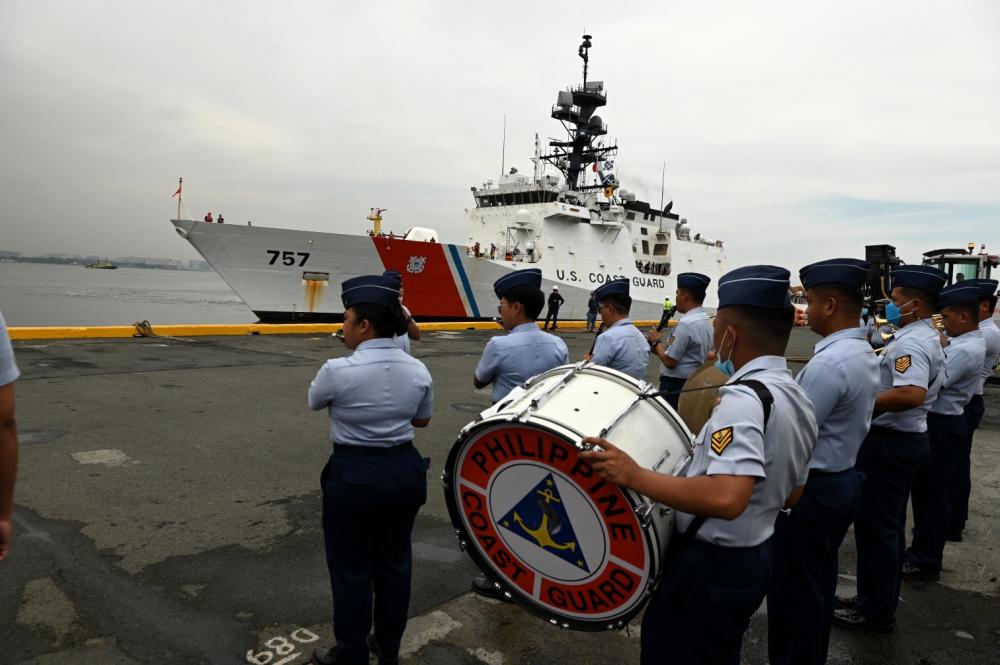
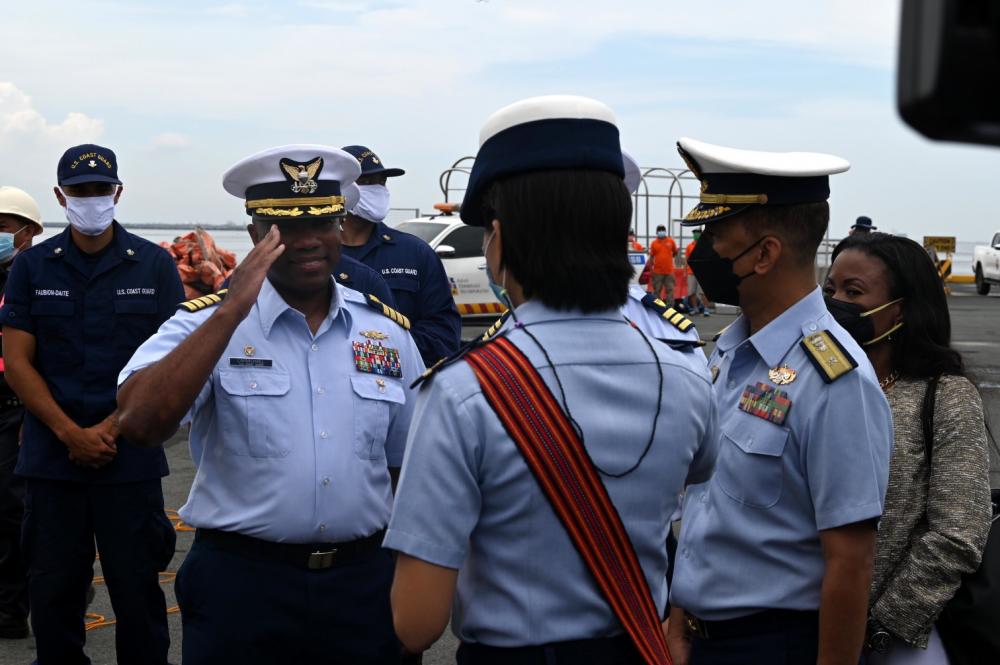
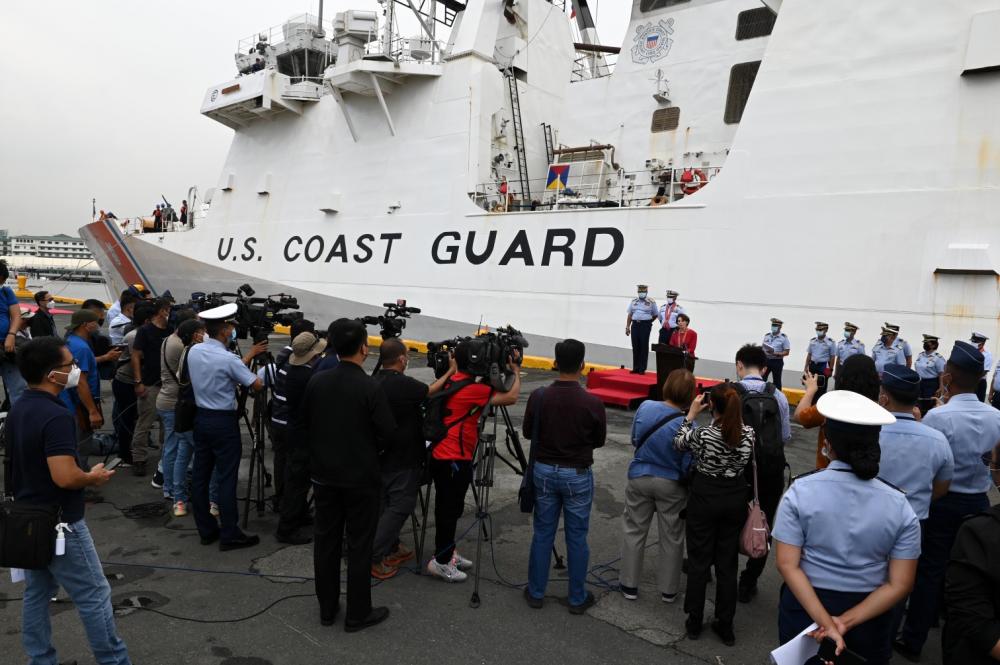
Coast Guard Cutter Midgett arrives in Manila, Philippines Coast Guard Cutter Midgett arrives in Manila, Philippines Coast Guard Cutter Midgett arrives in Manila, Philippines

Editors’ Note: Click on images to download high resolution version.

MANILA, Philippines – The U.S. Coast Guard Cutter Midgett (WMSL 757) arrived in Manila Tuesday for its first international port call during the crew’s months-long Western Pacific deployment to the region.

Midgett’s crew will conduct professional exchanges and operate with the Philippine Coast Guard as part of an at-sea search-and-rescue exercise while in Manila, building upon the strong partnership between the two nations.

Midgett is operating in support of United States Indo-Pacific Command, which oversees military operations in the region.

Operating under the tactical control of Commander, U.S. 7th Fleet, the cutter’s crew plans to engage in professional and subject matter expert exchanges with regional partners and allies and will patrol and operate as directed during their Western Pacific deployment.

The Coast Guard provides expertise within the mission sets of search and rescue; illegal, unreported and unregulated fishing; maritime environmental response; maritime security; maritime domain awareness; aviation operations; interoperability; and humanitarian assistance and disaster relief.

As both a federal law enforcement agency and a branch of the armed forces, the Coast Guard is uniquely positioned to conduct non-escalatory defense operations and security cooperation in support of combatant commanders on all seven continents. The service routinely provides forces in joint military operations worldwide, including the deployment of cutters, boats, aircraft and deployable specialized forces.

“Engaging with our Philippine Coast Guard partners is truly an honor,” said U.S. Coast Guard Capt. Willie Carmichael, commanding officer of the Midgett. “Together we will continue to build strong relationships and learn from each other. Our deep-rooted partnership will combine the best of both our Coast Guards and the planned search-and-rescue exercise and professional exchanges are a great opportunity for us keep the Indo-Pacific region open and free.”

The U.S. Coast Guard has a 150-year enduring role in the Indo-Pacific. The service’s ongoing deployment of resources to the region directly supports U.S. foreign policy and national security objectives in the Indo-Pacific Strategy and the National Security Strategy.

Since 2019, the Coast Guard Cutter Bertholf (WMSL 750), Stratton (WMSL 751), Waesche (WMSL 751) and Munro (WMSL 755) have deployed to the Western Pacific.

Commissioned in 2019, Midgett is one of two Coast Guard legend-class national security cutters homeported in Honolulu. National security cutters are 418-feet long, 54-feet wide, and have a 4,600 long-ton displacement. They have a top speed in excess of 28 knots, a range of 12,000 nautical miles, endurance of up to 90 days and can hold a crew of up to 170.

Midgett is the second cutter named after Rear Admiral John Midgett, whose family has a long legacy in the Coast Guard and our services precursor – the U.S. Life Saving Service.

National security cutters feature advanced command and control capabilities, aviation support facilities, stern cutter boat launch and increased endurance for long-range patrols to disrupt threats to national security further offshore.

“Ecuador combats Chinese fleet’s illegal fishing with Canadian satellite technology” –Indo-Pacific Defense Forum

Indo-Pacific Defense Forum reports,

The Ecuadorian government is using Canadian technology to monitor the Chinese fleet’s illegal, unreported and unregulated (IUU) fishing around the Galápagos Islands.  In early June 2022, the government detected 180 Chinese vessels near the islands’ exclusive economic zone (EEZ), fishing for large Humboldt squid and threatening the region’s biodiversity and economy.

The Ecuadorian Navy patrols to prevent illicit fishing in the protected zone. “As long as these vessels are far from the insular EEZ, more than 100 miles [more than 160 kilometers] away, we monitor them by satellite,” Ecuadorian Navy Rear Adm. John Merlo León, commander of naval operations, told Ecuadorian television network Teleamazonas.

Reportedly, Ecuador uses both space technology company MDA, based in Brampton, Ontario, to provice satellite tracking, remote sensing and the ability to synthesize large amounts of data and Global Fishing Watch, a Google-backed website that tracks commercial fishing and interprets vessel movements, including fishing in prohibited areas.

“The Pacific Islands” –Congressional Research Service (CRS) Report

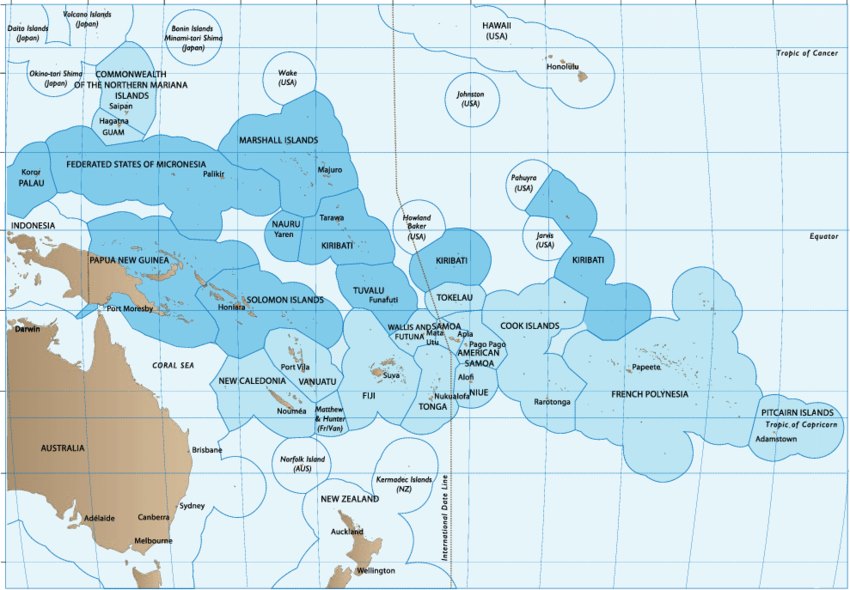
Estimated exclusive economic zones (EEZs) of Pacific Island countries and territories (PICTs). The EEZs of countries that are the Parties to the Nauru Agreement are shown in darker blue. Note that not all EEZs of PICTs have been officially delineated under the United Nations Convention on the Law of the Sea. Source: Patrick Lehodey

The Congressional Research Service (CRS) has published a two page “IN FOCUS” brief on “The Pacific Islands” of Micronesia, Melanesia, and Polynesia. Like all my links to CRS reports, this link will always take you to the latest version. It has already been updated at least once, 17 August, 2022.

Given the increased Coast Guard activity in the region, the report may provide useful background. The topics discussed are:

  • Overview
  • Geopolitical Context
  • The United States and the Region
  • The Freely Associated States
  • International Assistance
  • China’s Influence
  • Security Challenges
  • Self Determination

“U.S. Coast Guard participating in Operation Island Chief, Operation Blue Pacific 2022” –News Release

The USCGC Oliver Henry (WPC 1140) crew arrives in Manus, Papua New Guinea, on Aug. 14, 2022, from Guam as part of a patrol headed south to assist partner nations in upholding and asserting their sovereignty while protecting U.S. national interests. The U.S. Coast Guard is participating with partners to support the Pacific Islands Forum Fisheries Agency-led Operation Island Chief and the larger Operation Blue Pacific through patrols in the Western Pacific in August and September 2022. The other two patrol boats are Australian built Guardian class. (U.S. Coast Guard photo by USCGC Oliver Henry)

Just passing along this news release from U. S. Coast Guard Forces Micronesia/Sector Guam.


U.S. Coast Guard participating in Operation Island Chief, Operation Blue Pacific 2022

 The USCGC Oliver Henry (WPC 1140) gets underway on Aug. 8, 2022, from Guam for a patrol headed south to assist partner nations in upholding and asserting their sovereignty while protecting U.S. national interests.  The USCGC Oliver Henry (WPC 1140) crew, including ship riders from Papua New Guinea, the U.S. Marine Corps, and the U.S. Navy, take a moment for a photo aboard the ship off Manus, Papua New Guinea, Aug. 14, 2022.

Editor’s Note: Click on the images above to view more images and b-roll video
or download high-resolution versions.

MANUS, Papua New Guinea — The U.S. Coast Guard is participating with partners to support the Pacific Islands Forum Fisheries Agency-led Operation Island Chief and the larger Operation Blue Pacific through patrols in the Western Pacific in August and September 2022.

“Employing our unique authorities, capabilities, and access within Oceania is a privilege. We are eager to further integrate with our Allies and regional partners to protect national interests and combat illicit maritime activity such as illegal, unreported, and unregulated fishing,” said Capt. Nick Simmons, U.S. Coast Guard Forces Micronesia/Sector Guam commander. “Strengthening governance and modeling professional maritime behavior on the high seas and the surrounding waters is one way to counter predatory activity and reinforce the Pacific as a positive center of gravity and sustainable economy.”

The operation covers a substantial area of the Pacific on the high seas and the exclusive economic zones of the Federated States of Micronesia, Papua New Guinea, Australia, and the Solomon Islands, while renewing relationships bolstered by local knowledge and expertise.

The USCGC Oliver Henry (WPC 1140), a 154-foot Sentinel-class fast response cutter, and crew deployed from Guam are making their first port call of the patrol in Manus, Papua New Guinea. During the patrol, the cutter will also have aerial support from a forward deployed HC-130 Hercules airplane crew from U.S. Coast Guard Air Station Barbers Point and New Zealand Defence Force P3 Orion airplane crew. Where possible, the crew will also conduct subject matter expert exchanges and engagements.

Operation Island Chief is one of four operations conducted annually under FFA. It includes the Pacific waters of 11 participating FFA member nations – Fiji, Federated States of Micronesia, Kiribati, Palau, Papua New Guinea, Nauru, the Marshall Islands, Samoa, the Solomon Islands, Tuvalu, and Vanuatu.

“The Oliver Henry crew are committed to regional collaboration and sharing best practices to strengthen our relationships and information sharing,” said Lt. Freddy Hofschneider, commanding officer of Oliver Henry. “The U.S. Coast Guard has been a dedicated partner in the region for decades. We appreciate the support of our colleagues as we take this ship across vast distances in this region, making some transits and port calls for the first time.”

A significant emphasis of the operation for the U.S. Coast Guard is the ongoing emphasis on fisheries and resource protection.

“The Pacific Ocean is home to some of the world’s most abundant fisheries,” said Simmons. “These fisheries are living marine resources, part of the global food chain, representing food security and an economic engine for many of the Pacific Island Nations. By leveraging our cutters, aircraft, and intelligence professionals, the U.S. Coast Guard continues our strong partnership with the Pacific Islands Forum Fisheries Agency and its members to protect this vital marine ecosystem and ensure continued economic prosperity and a thriving ocean for future generations.”

According to FFA, partners are seeing increasing success through multilateral operations in the Pacific to tackle IUUF. These operations evolved from a focus on protecting against illegal boats entering the fisheries to policing the operations of licensed vessels that haven’t followed the rules and regulations governing their activities. The Pacific region is a vast expanse, and collaboration across the many partners, providing personnel and assets, is crucial to ongoing success.

The Oliver Henry is the 40th Sentinel-class fast response cutter. The ship arrived in Guam and was commissioned along with its sister ships, Myrtle Hazard and Frederick Hatch, in July 2021. In the time since, the crew has participated in several search and rescues cases, completed a counternarcotics patrol off Guam with the Japan Coast Guard patrol vessel Mizuho, and conducted sovereignty and fisheries patrols in the Forces Micronesia/Sector Guam area of responsibility.

For more U.S. Coast Guard Forces Micronesia/Sector Guam news, visit us on DVIDS or subscribe! You can also visit us on Facebook at @USCGSectorGuam.

-USCG-

Late Addition:The Sentinel-class fast response cutter USCGC Oliver Henry (WPC 1140) crew arrives in Port Moresby for a port visit on Aug. 23, 2022, following a patrol in parts of the Coral Sea, and the Solomon Islands and PNG Exclusive Economic Zones. The U.S. Coast Guard is conducting a routine deployment in Oceania as part of Operation Blue Pacific, working alongside Allies, building maritime domain awareness, and sharing best practices with partner nation navies and coast guards. (U.S. Coast Guard photo by USCGC Oliver Henry)

USNI Proceedings Coast Guard Issue

USCGC Mohawk (WMEC-913), Clarence Sutphin Jr. (WPC-1147), and John Scheuerman (WPC-1146)

Sorry this post is going to ramble a bit.

The Prize Winning Essays: 

The August issue of the U. S. Naval Institute Proceedings is again the “Coast Guard Issue,” and includes the three winning essays in their Coast Guard Essay contest.

First prize went to prolific author and repeat winner, Cdr. Craig Allen, Jr., USCG for his “Expeditionary Cutter Deployments Should Not Be a Mission to Mars.” It talks about some of the logistical difficulties encountered. His comments about the integrated C5ISR, navigation, and engineering systems and “controlled parts exchanges (taking working parts from one cutter and installing them in another) to deploy on schedule and/or remain underway” are partiuclarly troubling.

He offered three suggestions about how to make the Coast Guard more deployable.

  • Improved cutter self-sustainability.
  • Forward operating bases
  • Mission support cutter.

I would note that large cutters are probably already have more self-sustainability than their Navy counterparts making extended single ship deployments with minimal support easier for cutters than for Navy ships, but it does sound like we have made some choices that may put those capabilities at risk.

It is probably diplomatically easier to establish a Coast Guard forward operating base than one for the Navy, particularly in Latin America. Realistically we are probably only talking about a base in the Eastern Pacific, near the drug transit zone. To make that happen would probaby require some initiative from SOUTHCOM.

Elsewhere we could probably ride the coat tails of the Navy and our allies including Australia, New Zealand, Japan, the United Kingdom, France, and the Netherlands.

The mission support cutter, or, more generally, a floating base might be addressed in a number of ways. Presumably SOUTHCOM will get their own Expeditionary Sea Base. Wherever it is moored will become a defacto forward operating base. There should be room aboard for priority Coast Guard unique support requirements. Unfortunately I understand, dispite their tanker origins, they don’t carry fuel for tranfer to other ships. That is unfortunate, but probably something that could be fixed. Any kind of forward operating base could make Webber class deployments to the Eastern Pacific drug transit zones much more productive.

Effectively the Coast Guard has already been using buoy tenders as mission support cutters for Webber class in the Western Pacific.

One might think that a Navy owned MSC vessel might make a good mission support vessel, but the underway replenishment vessels they have currently, are far too large to be dedicated to supporting routine Coast Guard operations.

Something  to consider might be a routine teaming of Charleston based National Security Cutters (NSC) with District 7 Webber class Fast Response Cutters (FRCs). A NSC and a pair of FRCs could make a very effective team, with the NSC providing underway replenishment for the FRCs. There are three NSC in based in Charleston now and there are expected to be five when the program is completed. There are currently 20 FRCs based in district 7. These ships are the closest of their type to the Eastern Pacific Drug Transit Zones.

Second prize went to “The World’s Fishermen as a Maritime Sensor Network,” by Lieutenant Holden Takahashi, USCG, that suggest a cell phone based reporting system could provide additional eyes to Maritime Domain Awareness systems.

Third prize went to “Lost At Sea: Teaching, Studying, and Promoting Coast Guard History,” by Lt. Christopher Booth, USCG, and Mark Snell, U.S. Coast Guard Auxiliary contending,

“To foster pride in its heritage and promote its historic accomplishments to the public, the Coast Guard cannot continue to ignore its past. It must make a major shift in how it approaches, teaches, promotes, and preserves its history. The Coast Guard must rescue the history and heritage of “that long line of expert seamen” and their contributions to the nation, so they are no longer lost at sea.”

Other Posts of Interest:

There are also other posts that directly address the Coast Guard or at least would involve the Coast Guard.

A Campaign Plan for the South China Sea,” by Captain Joshua Taylor, U.S. Navy advocates for persistent low-end presence.

A South China Sea campaign that translates these principles into action in a resource- and diplomatically constrained—but feasible and effective—manner should be organized around the following lines of effort and accompanying messages:

  • Beat Cop. Persistent low-end presence—“The United States has skin in the game.”
  • Neighborhood Watch. Build a regional coalition— “We are stronger together.”
  • Vigilance. Information sharing—“We are always watching.”

ln terms of information sharing, also mentioned was this Maritime Domain Awareness program that I was not aware of.

Since 2016, the United States has invested more than $425 million through the Maritime Security Initiative to help Indo-Pacific countries develop the ability to “sense, share, and contribute” to a regional recognized maritime picture (RMP). While some of these funds have purchased secure communication systems, the standout success story has been the U.S. Department of Transportation’s unclassified web-based SeaVision maritime domain awareness and coordination tool. Drawing on government and commercially contracted datastreams, SeaVision fuses information from terrestrial and satellite Automated Identification System data, the satellite Visible Infrared Imaging Radiometer Suite, satellite synthetic aperture radar, and—soon—satellite electronic signal detection to form a high-quality unclassified RMP that could support a countercoercion campaign in the South China Sea. Indeed, naval services throughout Southeast Asia already use it—with the notable exception of the U.S. Navy.

(My own ideas for a persistent low-end presence are here, Combined Maritime Security Task Force Pacific.)

The Coast Guard’s Firefighting Fiction,” by Chief Boatswain’s Mate Phillip Null, U.S. Coast Guard (Retired) suggests the Coast Guard should take a more active role in marine fire fight.

“Recent tragedies have shown the need for the Coast Guard to revisit its stance on firefighting, not to supplant municipalities or absolve them of their responsibilities, but to support them with real capabilities and expertise and to provide capability in unprotected waters to avert tragedy. The Coast Guard trains and equips its cutter crews to combat fires on board their own vessels, the success of which was recently demonstrated on board the cutter Waesche (WMSL-751) during a Pacific transit.8 Now it needs only to increase the capacity and foam-delivery capability of the pumps carried on its boats, expand the training and equipment available to its boat crews who operate in coastal regions where fire poses the greatest threat, and revise policies that limit involvement and inhibit on-scene decision-making even in unprotected waters.

While on the topic of maritime firefighting, take a look at this post by Cdr Sal, “How Many Fireboats Can You Buy for $1.2 Billion?” that discusses the Navy’s lack of fireboats. In so many cases, a less than optimal resourse on scene in a timely manner is far better that the perfect resource arriving late. Perhaps Coast Guard assets could have helped.

Some people in the Coast Guard are thinking about major ship fires, “Coast Guard, Long Beach and LA fire departments train for maritime fires.

“U.S. embarks on ‘new chapter’ with Pacific island nations” –Indo-Pacific Defense Forum

Indo-Pacific Defense Forum reports on promised new initiatives…the U.S. will:

  • Establish U.S. embassies in Kiribati and Tonga.
  • Ask the U.S. Congress to commit U.S. $60 million annually for the next 10 years for fisheries assistance. That’s almost triple the current U.S. funding for the South Pacific Tuna Treaty.
  • Appoint a U.S. envoy to the PIF, which White House officials view as the region’s preeminent leadership body.
  • Establish a U.S. strategy on the Pacific Islands, which will complement the nation’s Indo-Pacific Strategy released in February 2022.
  • Return Peace Corps volunteers to the Pacific islands.
  • Work toward reestablishing a Pacific mission of the U.S. Agency for International Development (USAID) in Fiji.
  • Advance the Partners in the Blue Pacific, a multilateral bloc formed in 2022 and comprised of Australia, Japan, New Zealand, the United Kingdom and the U.S., to promote Pacific interests internationally.

(Seems like France should also be a member of Partners in the Blue Pacific.)

The US Coast Guard will certainly have a role in executing these initiatives, including continued cooperation in countering Illegal, Unregulated, Unreported (IUU) fishing, capacity building, and assignment of Coast Guard attaches to facilitate cooperation.

A base in American Samoa is looking more likely all the time.

“U.S. aims at PRC in new illegal fishing policy framework” –Indo-Pacific Defense Forum

Fijian law enforcement officers and U.S. Coast Guard personnel from USCGC MUNRO board a Chinese-flagged vessel off the coast of Fiji in April 2022 during patrols to counter illegal, unreported and unregulated fishing. IMAGE CREDIT: PO1 Nate Littlejohn, U.S. COAST GUARD

Indo-Pacific Defense Forum passed along an Associated Press report on US efforts to forge an international consensus to combat Illigal, Unreported, Unregulated (IUU) fishing, including  poor labor and environmental practices, first by applying a standard nationally,

It was expected to be followed quickly by new rules from the U.S. National Oceanic and Atmospheric Administration expanding the definition of illegal fishing to include related labor abuses, a first step to the eventual blacklisting of flag states that fail to comply.

Followed by work on an international treaty.

Significantly subsidies are now seen as unfair trade practice with disasterous impact on fish stocks. China has used subsidies to build the world’s largest fishing fleet, and they use it for more than just catching fish.

President Biden’s administration’s announcement came as the World Trade Organization (WTO) heralded a historic agreement, reaching a deal during its June 2022 conference in Geneva, Switzerland, to curb IUU fishing, reduce the strain on dwindling fishing stocks, and ensure more transparency and accountability through improved conservation and management measures. The WTO deal explicitly prohibits subsidies, considered by environmentalists to be the biggest contributing factor to depleting fish populations globally.