FLIR Maritime announced recently that it has been awarded a $50 million indefinite delivery, indefinite quantity contract to provide marine electronics systems under the U.S. Coast Guard’s Scalable Integrated Navigation Systems 2 (SINS-2) program over a five-year period providing the purchaser a right to extend delivery for an additional five years.
FLIR will provide electronics systems that will be standard fit on over 2,000 U.S. Coast Guard vessels, ranging from small-class boats through large cutter-class vessels. The systems include Raymarine multi-function navigation displays, radars, sonars, remote instrument displays, and autopilots.
Predator Unmanned Aerial Vehicle (UAV) flies on a simulated Navy aerial reconnaissance flight near the aircraft carrier USS Carl Vinson (CVN 70) off the coast of southern California on Dec. 5, 1995. The Predator provides near, real-time infrared and color video to intelligence analysts and controllers on the ground and the ship. This is the Predator’s first maritime mission with a carrier battle group. The UAV was launched from San Nicholas Island off the coast of southern California. DoD photo by Petty Officer 3rd Class Jeffrey S. Viano, U.S. Navy.
An earlier post reported a plea by Representative Duncan Hunter, Chair of the Transportation Subcommittee on Coast Guard and Maritime Transportation, for the Coast Guard to provide an unfunded priority list to include six icebreakers and unmanned Air System.
Thought perhaps I would list my own “unfunded priorities.” These are not in any particular order.
PLATFORM SHORTFALLS
Icebreakers: We have a documented requirement for three heavy and three medium icebreakers, certainly they should be on the list. Additionally they should be designed with the ability to be upgraded to wartime role. Specifically they should have provision for adding defensive systems similar to those on the LPD–a pair of SeaRAM and a pair of gun systems, either Mk46 mounts or Mk38 mod 2/3s. We might want the guns permanently installed on at least on the medium icebreakers for the law enforcement mission. Additionally they should have provision for supporting containerized mission modules like those developed for the LCS and lab/storage space identified that might be converted to magazine space to support armed helicopters.
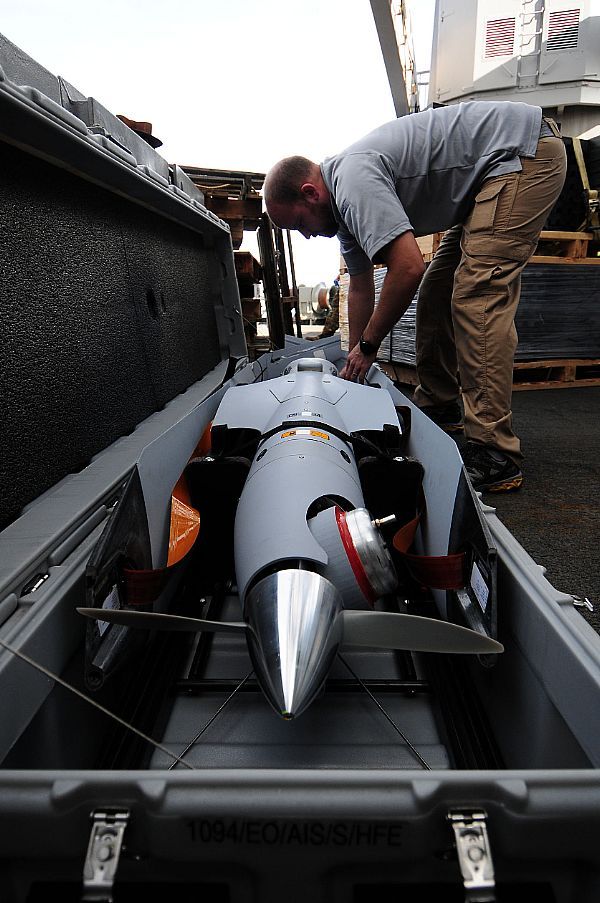
110225-N-RC734-011 PACIFIC OCEAN (Feb. 25, 2011) Guy Mcallister, from Insitu Group, performs maintenance on the Scan Eagle unmanned aerial vehicle (UAV) aboard the amphibious dock landing ship USS Comstock (LSD 45). Scan Eagle is a runway independent, long-endurance, UAV system designed to provide multiple surveillance, reconnaissance data, and battlefield damage assessment missions. Comstock is part of the Boxer Amphibious Ready Group, which is underway in the U.S. 7th Fleet area of responsibility during a western Pacific deployment. (U.S. Navy photo by Mass Communication Specialist 2nd Class Joseph M. Buliavac/Released)
Unmanned Air Systems (UAS): We seem to be making progress on deploying UAS for the Bertholf class NSCs which will logically be extended to the Offshore Patrol Cutters. So far we see very little progress on land based UAS. This may be because use of the Navy’s BAMS system is anticipated. At any rate, we will need a land based UAS or access to the information from one to provide Maritime Domain Awareness. We also need to start looking at putting UAS on the Webber class. They should be capable of handling ScanEagle sized UAS.
Photo: The Coast Guard Cutter Bluebell sits moored along the Willamette River waterfront in Portland, Ore., June 4, 2015. The Bluebell, which celebrated its 70th anniversary this year, is one of many ships participating in the 100th year of the Portland Rose Festival. (U.S. Coast Guard photo by Chief Petty Officer David Mosley.)
Recapitalize the Inland Tender Fleet: This is long overdue. The program was supposed to begin in 2009, but so far, no tangible results. It seems to have been hanging fire for way too long.
Expand the Program of Record to the FMA-1 level: The Fleet Mix Study identified additional assets required to meet the Coast Guard’s statutory obligations identifying four asset levels above those planned in the program of record. Lets move at least to first increment.
At the very least, looks like we need to add some medium range search aircraft (C-27J or HC-144).
Increase Endurance of Webber Class Cutters: The Webber class could be more useful if the endurance were extended beyond five days (currently the same as the 87 cutters, which have only one-third the range). We needed to look into changes that would allow an endurance of ten days to two weeks. They already have the fuel for it.
MISSION EQUIPMENT SHORTFALLS
Ship Stopper (Light Weight Homing Torpedo): Develop a system to forcibly stop even the largest merchant ships by disabling their propulsion, that can be mounted on our patrol boats. A torpedo seems the most likely solution. Without such a system, there is a huge hole in our Ports, Waterways, and Coastal Security mission.
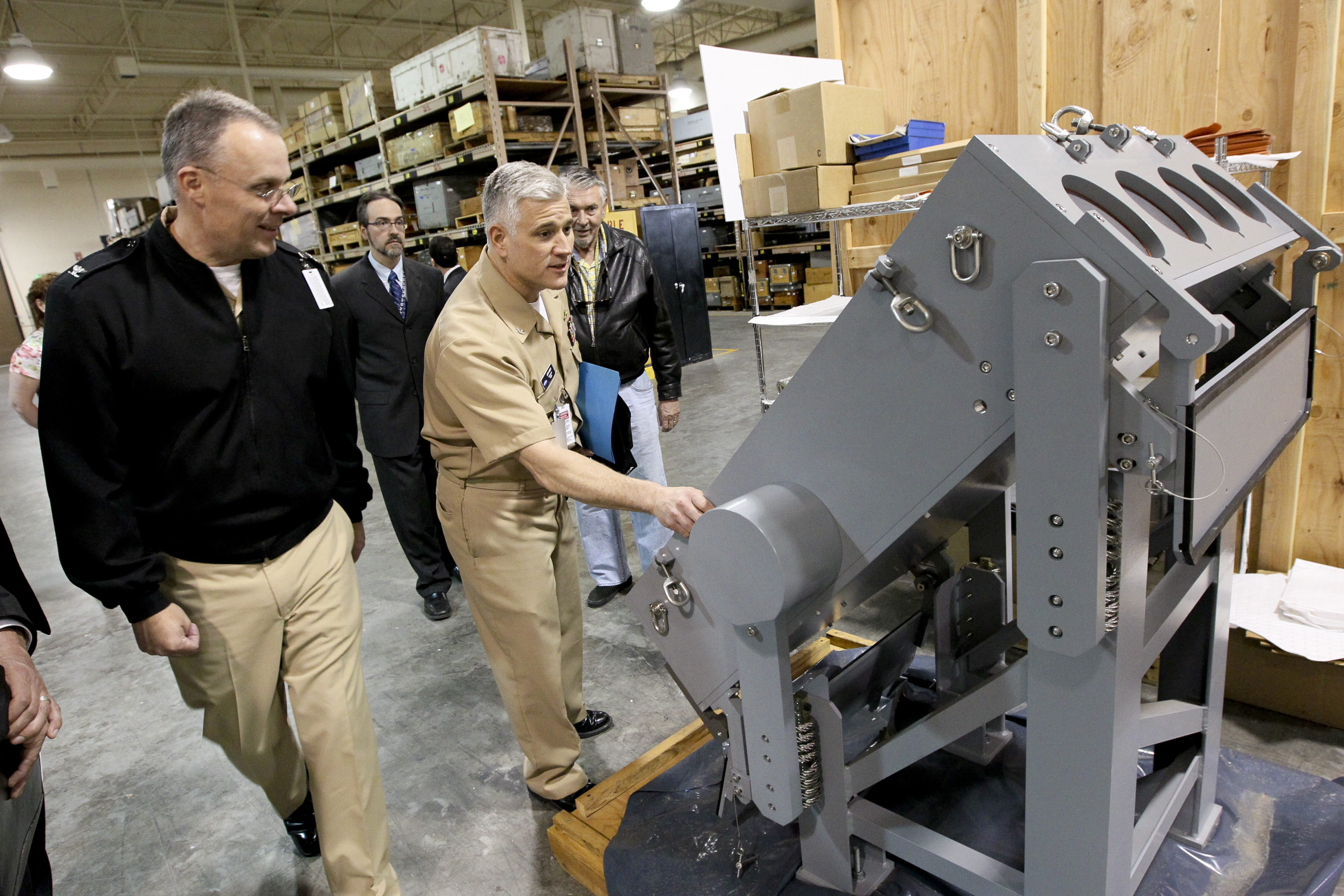
Photo: SeaGriffin Launcher
Counter to Small High Speed Craft (Small Guided Weapon): Identify and fit weapons to WPB and larger vessels that are capable of reliably stopping or destroying small fast boats that may be used as fast inshore attack craft and suicide or remote-controlled unmanned explosive motor boats. These weapons must also limit the possibility of collateral damage. Small missiles like SeaGriffin or Hellfire appear likely solutions.
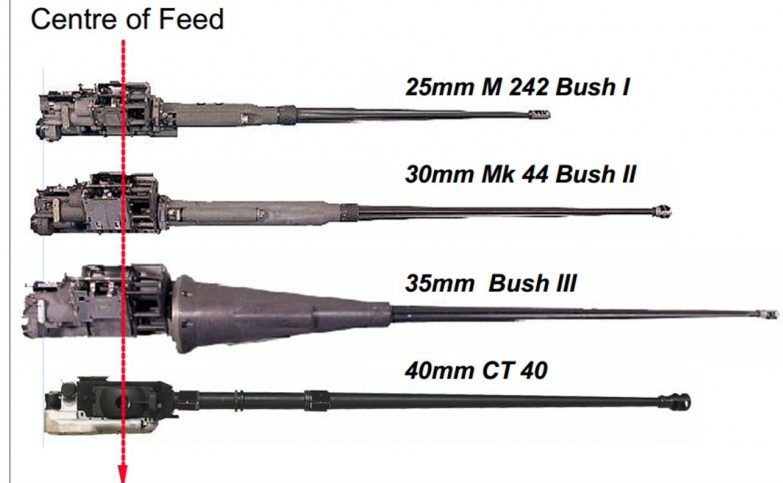
40 mm case telescoped gun (bottom) compared to conventional guns.
Improved Gun–Penetration, Range, and Accuracy: The .50 cal. and 25mm guns we have on our WPBs and WPCs have serious limitations in their ability to reach their targets from outside the range of weapons terrorist adversaries might improvise for use against the cutters. They have limited ability to reach the vitals of medium to large merchant vessels, and their accuracy increases the possibility of collateral damage and decreases their probability of success. 30, 35, and 40 mm replacements for the 25 mm in our Mk38 mod2 mounts are readily available.
Laser Designator: Provide each station, WPB, and WPC with a hand-held laser designator to allow them to designate targets for our DOD partners.
CONTINGENCY PLANNING SHORTFALLS
Vessel Wartime Upgrades: Develop plans for a range of options to upgrade Coast Guard assets for an extended conflict against a near peer.
NavyRecognition reports that high flying, fast, long endurance Triton MQ-4C Navy intelligence, surveillance, and reconnaissance data collection drones are being based at Mayport, FL.
Detachments will rotate to distant theaters, but they will of course fly missions out of Mayport if only to maintain proficiency. Hopefully we will see these used to support Coast Guard interdiction missions.
In referring to this video I will identify the position on the recording in the format h-hours (omitted for the first hour), m-minutes, and s-seconds (may be omitted) as 1h22m45s would indicate one hour, 22 minutes and 45 seconds into the video.
ADM. Charles Michel, Vice Commandant United States Coast Guard
Ms. Allison Stiller Principal Civilian Deputy Assistant Secretary of the Navy Research, Development and Acquisition United States Navy Department of Defense
Ms. Jennifer Grover Director Homeland Security and Justice Issues United States Government Accountability Offic
Mr. Ronald O’Rourke Specialist in Naval Affairs Congressional Research Service
Ms. Heather A. Conley Senior Vice President for Europe, Eurasia, and the Arctic Center For Strategic and International Studies
Mr. Matthew O. Paxton President Shipbuilders Council of America
Admiral Michel’s written statement for the subcommittee can be found here.
The possibility of a Mass Casualty incident in the Arctic
Single mission vs Multi-mission ships!
Military vs Civilian construction standards
I’ll try to comment on some of this. It is the nature of the hearing process that topics may be revisited at any point in the hearing, so it may a bit difficult to follow any particular topic.
Frustration
It was not a specific topic of discussion, but a high level of frustration was apparent throughout the proceeding. It was evident in Representative Hunter’s opening remarks. Check out the sarcasm at minute 13. This was followed shortly by Representative Garamendi’s remarks about the extent of planning that has failed to bear fruit. (15m30sec). There are more comments throughout the hearing. The comments between the representatives and the Vice commandant get particularly hot about 1h57m. One representative went so far as to call one of the Vice Commandant’s answers “bull shit.”
The “Gap(s)”
There was much talk about the gap. This usually referred to the expected gap between the projected end of service life for the Polar Star and the delivery of the new Polar Icebreaker (PIB), which may begin as early as 2020 or as late as 2023 and should end in 2026 with the delivery of the PIB. But if you consider the new PIB will be fully operational only in 2028, this gap may be anywhere from five to eight years. But this is not the only gap.
We want heavy icebreakers because of their capacity to operate in the Arctic year round. As long as we only have one heavy and one medium icebreaker, we will never do that, because the Heavy will always be sent to Antarctica during the Northern Hemisphere’s winter, while the medium icebreaker will be sent to the Arctic during the summer, so there will be a seasonal gap in the Arctic. We will never have “assured year round access to the Arctic” as long as we only have two icebreakers.
Because we deploy only one icebreaker to the Arctic and only one to the Antarctic there is always a gap in the capability to come to the aid of one of these icebreakers. This is a particularly serious concern with regard to sending the Polar Star to the Antarctic. There is of course great distance, and because it is probably the most capable icebreaker sent to Antarctica, it is also the most capable of getting itself in the deepest trouble. the Additionally the Polar class have never been particularly reliable.
The remaining gap that might be discussed is the difference between what we have and the three heavy and three medium icebreakers we have been saying we need.
Currently there is “No plan to address the gap” (58m). While the Vice Commandant says we are looking into alternatives, he suggests that a rolling life extension (spreading the work over successive yard periods) for Polar Star, rather than a renovation of Polar Sea appears the most likely way to retain a heavy icebreaker in service. That would of course be no improvement over our current situation (2h13m).
Three U.S. Navy icebreakers push an iceberg to clear a channel leading to McMurdo Station, Antarctica, 1965
Building Capacity:
Mr Paxton (President Shipbuilders Council of America) reported that there are ten US shipyards interested in building the PIB, and they have a demonstrated capability to work steel exceeding the thickness and quality required for Polar Icebreakers (m44-48).
Defense
Ms. Conely’s (Senior Vice President for Europe, Eurasia, and the Arctic Center For Strategic and International Studies) prepared testimony suggest that in terms of our defense posture in the Arctic, we have been living on good luck and borrowed time (m37-44). She heavily emphasized the need for infrastructure in the Arctic. I was a bit surprised at the apparent depth of concern among the Representatives for defense operations in the Arctic.
There were several unfavorable references to the comparison between our icebreaker fleet and the Russian’s, but that was mitigated somewhat by explanations for the Russian’s greater interest in the Arctic. Still the tone was that we were well behind. Additionally Representative Young expressed frustration that he had seen no progress in addressing his concern about military aspects of security (1h21m).
Discussion of Defense in the Arctic lead perhaps inevitably to questions of “Why isn’t this a Navy mission?” and a discussion of the need for Military specs for Icebreakers? (1h3m)
Infrastructure:
There was somewhat surprising support for creation of infrastructure in the form of a deepwater port and airfield (1h45m).
Leasing/Chartering
Can the Coast Guard operate leased or chartered vessels?
Ms Grover indicates that to perform certain Coast Guard mission, the vessel needs to be a “public vessel” meaning government owned or a demise (bare boat) charter (31m).
Demise charter is a contract whereby the ship owner leases its vessel to the charterer for a period of time during which the whole use and management of the vessel passes to the charterer. In such a situation, the charterer pays all expenses for the operation and maintenance of the vessel. Officers and crew become servants of the charterer. A demise charter whereby the charterer has the right to place its own master and crew on board of the vessel is called a bareboat charter.
The Vice Commandant reported that the Coast Guard had been unable to locate any heavy icebreakers available for lease or purchase and that while there were single misssion medium icebreakers built to commercial standards available there were no multi- mission icebreakers suitable for military service “without a major refit.” (55m)
There was also testimony that normally leasing would cost more than purchase over the long term. Mr O’Rourke clarified that a shorter term arrangement that he referred to as a charter was a possibility and it had been done in the past (1h53m).
It appears to me we find ourselves in an unusual circumstance. We definitely have a gap in our capabilities, and while I would agree that leasing is usually more expensive than ownership, we find ships sitting idle while their owners have abandoned the purpose for which they were built. They might be available at favorable terms.
Actually, we have a recent example of a civilian owned icebreaker being first chartered and then purchased outright for naval service.
The Royal Navy’s HMS Protector (A173) required a refit of only ten days to convert it from Norwegian civilian icebreaker. The ship was initially chartered for three years in 2011 but was then purchased outright in 2013. Over her relatively short life as a Royal Navy vessel in addition to icebreaking she has done SAR, fisheries patrols, inspection of research stations to ensure compliance with the Antarctic Treaty, resupply, hydrographic survey operations, performed training for humanitarian assistance, and patroled to demonstrate sovereignty in the waters around Britain’s South Atlantic Overseas territories.
The Navy has a lot of experience chartering ships, including having them modified for naval service.
Block Buy:
Mr. O’Rourke’s prepared testimony primarily addressed the possibility of a block buy purchase of two or more heavy icebreakers (33m to 37m). His opinion is that a block buy of two heavy icebreakers would save at least $100M and perhaps as much as $200M.
The Vice Commandant stated he could only support the construction of one heavy icebreaker (1h8m). I find it hard to understand why our leadership cannot simply state they would welcome additional resourses. (There is a pattern here, I saw the same thing happen in another hearing.) No one expects Coast Guard admirals to establish priorities across all government programs, that is the job of the civilian Administration and Congress, but when asked, if we would like more assets, and particularly if there is already an established requirement for more assets, why not say yes? It is after all other peoples’ job to decide if it will fit in the budget.
The idea of a block buy was generally well recieved. By the end of the hearing Representative John Garamendi stated that it appeared to make the most sense to proceed with block buy of two (or three) icebreakers (2h8m). He ask for assistance with the wording to be inserted into a bill to authorize a block buy. “I’m in the mode to make a decision.” (2h10m)
Canadian shipbuilder Davie’s proposal (pdf) to convert the Aiviq for the Canadian Coast Guard
Medium Icebreakers:
There is as yet, no idea when there will be a budget request for new construction medium icebreakers. The planning process is just beginning. We will build heavy icebreakers first, with the first completed by perhaps 2026. It will probably be four years more for the second and third. We probably cannot expect new construction medium icebreakers before 2032, sixteen years from now. We are not likely to see three medium icebreakers until 2034.
When the Vice Commandant stated that there were none available for lease or purchase suitable for military service without substantial refit (1h51m), that is not a final answer. It really just the start of a discussion. Considering the two potentially available domestically built icebreakers, what would be required to bring them up to our minimum standards? What would it cost? We should keep in mind that, we may have higher standard in mind for future icebreakers, but the icebreakers we currently have are not really built to current Naval Vessel Rules. If we were to assume that a new medium icebreaker will cost approximately $500M and last for forty years then, using simple math, we should be willing to pay at least $62.5M to have this capability for five years (actually it should be worth substantially more given the discounted value of money spent in out years). If we could get 20 years out of them, it should be worth $250M Apparently there is already a proposal on the table to convert the Aiviq (1h57m30s).
Single Mission vs Multi-Mission?
The Vice Commandant seemed to indicate that the Coast Guard only operates multi-mission vessels, and while I would agree that it is true, I would add that they are multi-mission because of there crews–their authorities, their skills, and their initiative.
In fact many of our vessels are single mission by design. In addition to buoy tenders and construction tenders I would include our existing icebreakers. That they incidentally do other missions as well, would also apply to any civilian owned vessel we might bring into Coast Guard service.
Does it take a military vessel?
There was a substantial discussion (1h59m30s) about whether we need a “military vessel” to do this job. I would start by saying any Coast Guard manned vessel is automatically a military vessel, by virtue of its crew. We have lots of vessels that don’t look very military, and are not built to military standards, but that does not mean they are not military.
If you have read much of my stuff, you would know that I would welcome ships with more military character, but I also recognize that the ships we have have doing icebreaking now are not particularly “military” by design. Shortly after the Polar Star was commissioned, she came down to Fleet Training Group San Diego, where I was the CG liaison officer, for a short training assist. Really her military characteristics were unimpressive at best. Additionally, the ability to launch a boat, so necessary for many CG missions was actually dangerous in anything other than relatively calm conditions.
Mass Casualties in the Arctic:
There was a great deal of interest in the preparations for the possibility of mass casualties if something should go wrong during the planned Northwest Passage cruise of the Crystal Serenity (1h14m).
Bringing the Polar Sea Back into Service:
As noted above, the Vice Commandant tentatively expects that in order to maintain a heavy icebreaker capability, the most likely solution appears to be a rolling life extension of the Polar Star, rather than renovation of the Polar Sea. He noted that the repair of the Polar Star cost $7M and that bringing back the Polar Sea would be a multiple of that.
Still, extending the life of Polar Star leaves with no improvement over the current situation:
no year round capability in the Arctic
no rescue capability in the Antarctic
a complete loss of Heavy icebreaker capability should the Polar Star suffer a major machinery casualty
To obtain those capabilities before the new PIB is operational, we need to bring Polar Sea back into service in addition to keeping Polar Star operational. Trying to restore the Polar Sea to her original condition is probably not realistic. The equipment is just too old.
Still it might be possible to do a major renovation that would make the ship as capable and more reliable than the Polar Star.
How much should it be worth to us. Logically, we would want to have it last until the third new PIB is operational (and keep the Polar Star on line until the second PIB is complete). That means the Polar Sea would need to last until at least 2030, maybe a bit longer.
If a heavy icebreaker with a service life of 40 years is worth $1B, then getting perhaps 15 years out of a major renovation may be worth up to $375M.
Expected Reports:
According to the testimony, by now, the Congress should have in their hands a new report on the condition of the Polar Sea and what it will take to fix it. For some reason I doubt that that will include the possibility of a major renovation.
By the end of the year, the Coast Guard has promised Congress a report that will include a suggested way to proceed, including a determination of what to do with Polar Sea.
Conclusion:
Is it any wonder the committee member’s patience is wearing thin?
It appears that we will continue to have only one heavy and one medium icebreaker until the new PIB is completed, hopefully in 2026, but even then it will not be fully operational until 2028.
Authorization for at least a two ship block buy appears likely.
Unless we change course, we are unlikely to reach a six icebreaker fleet until at least 2034.
What we might do:
If the Congress and and Administration really want to fix this, there are options, but it will take money. In addition to AC&I funds, it would also require additional operating funds and more personnel, both for the crews, and for support personnel, in addition to funding the ships themselves. We certainly should not sacrifice the Offshore Patrol Cutter program for this capability.
If the Congress and Administration want to get as close as possible to our professed need for three heavy and three medium icebreakers, we could conceivably have two heavy and three medium in six years of less.
That would require that keep Polar Star on line, that we bring back the Polar Sea, and that we obtain the two medium icebreakers currently available in the near term, the Aiviq and the still unfinished vessel that was being built by Edison-Chouest, and make those changes necessary to bring them into Coast Guard service.
What would this allow us to do?
Have a medium icebreaker available in the Arctic during the summer, as we do now.
Have a heavy icebreaker and a medium icebreaker available in the Arctic during the winter, something we do not currently do.
Have a heavy icebreaker in the Antarctic during the summer as we do now, but accompanied by a medium icebreaker.
A Warning:
Given the tone I heard from the Representitive, if we are not careful, and do not start showing more enthusiasm for the mission, we may find the icebreaking mission transferred, in whole or in part, to the Military Sealift Command.
There is an interesting bit of technology here, with implications for Maritime Domain Awareness.
The Wave Glider began its mission on November 27, 2015 in the South Pacific, where it helped the UK FCO protect the Pitcairn Island Marine Sanctuary against illegal fishing activities. After successfully completing its mission, the Wave Glider was remotely piloted more than 2,808 nautical miles (5200 km) — through strong equatorial currents, doldrums, and challenging sea states — back to port in Hawaii. Along the way, it collected 9,516 measurements of meteorological, oceanographic, and marine biodiversity data over expanses rarely traveled. This data was recently used to support the worldwide Fishackathon, a program sponsored by the U.S. Department of State to promote innovative ways to stop illegal and unregulated fishing. Altogether, the Wave Glider was continuously at sea, untouched, for 213 days while traveling a total of 7,205 nautical miles (13,344 km).
There is more about the Pitcairn Island mission here, but its potential is not limited to fisheries. Check out the segment of the video below beginning at 4m24s to 5m20s.
It is relatively short and readable at 21 pages. The recurring themes of the Commandant’s administration are all there, starting with TOC (transnational organized crime) and its deleterious effect on Western Hemisphere governance and prosperity. It does read a little like an Officer Evaluation Report input.
There is nothing particularly surprising here, but even for me, the enumeration of the scope the Coast Guard’s authorities, responsibilities, and international contacts is still mind boggling.
I am not going to try to summarize the report, but there were a few things that struck me.
The Commandant mentions service life extension programs for the seagoing buoy tenders (already begun), the 47 foot MLBs, and the 87 foot WPBs (in the future), but there is no mention of what we will do about the inland tender fleet. There will also be a life extension program for helicopters before they are finally replaced.
There is mention of a program I was not aware of, the “Defense Threat Reduction Agency National Coast Watch System project.” The Defense Threat Reduction Agency attempts to track and reduce the WMD threat. It is not really clear what our role is here. We know about the container inspection programs in foreign ports. Is that it, or is there more to this? (that can be discussed at an unclassified level.)
Navy Recognition is reporting a contract between the French Navy and a consortium of Airbus Defence and Space and Telespazio France that would provide “user-friendly” 24 hour a day access to satellite derived optical and radar imaging and AIS (Automatic Identification System) data to each maritime zone command.
Airbus Defence and Space and Telespazio France will be utilising a unique combination of satellites for the Trimaran 2 service, which supplements the range of resources already implemented by the French Navy and form an integral part of its operations concept. This contract, which runs from 2016 to 2020, will improve the effectiveness of the Navy’s missions on the world’s oceans: whether combating trafficking, preventing illegal immigration, performing search and rescue operations at sea, detecting pollution and toxic discharges, or monitoring protected maritime areas. (emphasis applied–Chuck)
France has a huge Exclusive Economic Zone, second only to that of the US and very nearly as large, but its Navy, which also does Coast Guard functions, is smaller than the US Coast Guard.
Apparently the same contractors are providing similar data to the Australian Border Force and the European Maritime Safety Agency (EMSA).
Once again, the Congressional Research Service’s Ronald O’Rourke has revised his “Coast Guard Cutter Procurement: Background and Issues for Congress” with the new edition issued April 15. This has got to be a hot topic because previous revisions were issued March 22, January 27, and December 14, 2015. That is four revisions in four months, on average every six weeks, but the latest is only 24 days after the previous edition. I have begun to sense, we may have turned a corner. The tone of the reports has changed over these four months, from, how long will it take us to reach the “Program of Record” (POR), to consideration of, if we should perhaps go beyond the POR.
The NSC, OPC, and FRC programs pose several issues for Congress, including the following:
“whether to fund the acquisition of a 10th NSC in FY2017;
“whether to fund the acquisition of four FRCs in FY2017, as requested, or some other number, such as six, which was the number projected for FY2017 under the Coast Guard’s FY2016 budget submission;
“whether to use annual or multiyear contracting for procuring FRCs;
“whether to use annual or multiyear contracting for procuring OPCs;
“planned procurement quantities for NSCs, OPCS, and FRCs;
“the cost, design, and acquisition strategy for the OPC;
“initial testing of the NSC; and
“rotational crewing of the NSC.”
The latest revision includes three substantial Appendices:
Appendix A. Planned NSC, OPC, and FRC Procurement Quantities (pp 17-22)
Appendix B. Funding Levels in AC&I Account (pp 23-26)
Appendix C. Additional Information on Status and Execution of NSC, OPC, and FRC Programs from March 2016 GAO Report (pp 27-34)
Appendix C is entirely new and appears to have been the reason for the revision.
Appendix A (p. 17-22) is a fairly detailed discussion of the results of the Fleet Mix Study and asks why we so seldom hear that the program of record is not enough to assure the Coast Guard to successfully accomplish its assigned missions.
The Fleet Mix Study was made public in 2012 long after its completion in 2009. It is due for a reexamination and the Commandant has said another will be done. When that happens, we seriously need to look at more than just more of the same assets. We need to look at additional technology, equipment, and weapons that might allow us to accomplish these missions without a major increase in personnel.
Looking at “Table A-3. Force Mixes and Mission Performance Gaps” (document page 18) I would note that if we get to Fleet Mix Analysis Phase 1 (FMA-1, an increase over the POR including 9 Bertholf class NSCs, 32 OPCs and 63 Webber Class FRCs, for a total of 104 vessels), we will have addressed all the “Very High Risk Gaps” found in the Fleet Mix Study that included SAR capability, “Defense Readiness Capacity,” and “Counter Drug capacity.” What will remain are “High” or lower risks in Ports, Waterways, and Coastal Security (PWCS) and Living Marine Resources (LMR), and a low to very low risk to the Alien Migrant Interdiction Operations (AMIO) mission. This total of more than 40 NSCs and OPCs certainly should not be out of the question, after all the Coast Guard has included over 40 ships larger than a thousand tons for the last several decades.
Still, I would note that, no matter how many ships we have, the Ports, Waterways, and Coastal Security (PWCS) mission will always be at risk, unless weapons are available to quickly and reliably stop terrorists’ exploitation of a larger merchant vessel to make an attack. Guns alone are simply not up to the task. I have identified two weapons that might address this threat, (1) equipping our WPCs and possibly WPBs with light weight torpedoes that target a ships propellers or (2) equipping our larger ships with the Long Range Anti-Ship Missile (LRASM) which might allow our larger cutter to effectively support our smaller cutters and respond to an attack, even if the large cutter 200 miles from the targeted port. Either would also make our ships much more capable of making a meaningful contribution to Defense Readiness.






 Chuck Hill's CG Blog