Building a 21st Century Infrastructure for America: Coast Guard Sea, Land, and Air Capabilities–House Subcommittee Hearing


The hearing recorded above was held 7 June. The original video was found here. That page also provides the chairman’s opening statement and links to the witnesses’ written statements that are also provided immediately below. The video does not actually start until time 4:30.

Below, you will find my outline of the highlights.

Witness List:

  • Vice Admiral Charles W. Ray, Deputy Commandant for Operations, United States Coast Guard | Written Testimony
  • Vice Admiral Sandra L. Stosz, Deputy Commandant for Mission Support, United States Coast Guard | Written Testimony Ms. Marie A. Mak, Director, Acquisition Sourcing & Management Team, Government Accountability Office | Written Testimony
  • Mr. John Acton, Chairman, Coast Guard Affairs Committee, Navy League of the United States | Written Testimony

The GAO’s written testimony is particularly comprehensive. They report that new assets (NSCs and FRCs) are not meeting planned availability. There have been an unexpected number of engine replacements. In the case of the National Security cutters it appears to me the down time was predictable, a normal part of introducing new ships and availability should return to planned levels as more ships join the fleet. The known defect, that when operating in waters 74 degrees or warmer, the NSCs cannot maintain maximum speed has apparently not been corrected. Max speed must be reduced two to four knots to allow adequate cooling.

Planning Documents:  The Congressional Representatives repeatedly complained that they were not getting an unsensored statement of the Coast Guard’s needs. It appears the Coast Guard is not being allowed provide this information. Rather it appears the GAO is telling the Coast Guard how much they will be getting and told to submit a budget that fits the predetermined amounts. Reportedly the Unfunded priorities list will be provided by the end of June. They also asked for the 5 year and 20 year plan (1h04:30). Coast Guard representatives were repeatedly told the Coast Guard does not say what they really need, that information provided by the Coast Guard is inadequate for the sub-committee to make decisions (1h48m).

It appears that the GAO continues to ask the Coast Guard to plan procurements based on historically low AC&I appropriations that were adequate for a time because of the sporadic character of Coast Guard ship building. They acknowledge that the current budget is not realistic. (43:45)

The Coast Guard is now consistent in requesting $2B in the AC&I annually and a 5% annual increase in its operating budget and that we need 5,000 additional active duty billets and 1,100 addtional reservists. There was a statement from one of the Representatives to the effect, We need you to fight for yourselves (1h50:30). The representatives were informed that the 5 year, 20 year plans and unfunded will be delivered together (1:56)

My opinion: we need a regularly revised Fleet Mix Study. That in turn should feed directly into a 30 year ship and aircraft procurement plan

Webber Class WPCs: The Coast Guard is reportedly pushing WPCs operations down as far as the coast of South America. (50:00) This confirms my earlier speculation that these ships would be operated in what had been WMEC roles. Six cutters for CENTCOM The representative confirmed that they had approved procurement of six Webber class requested by CENTCOM. Apparently their approval was in the form of the Coast Guard reauthorization bill which has still not been made law. Adm. Ray stated that these would be in addition to the 58 currently planned (9:30) and it is not clear how or when they would be funded. Adm Stosz indicated it was not certain six Webber class would be the Coast Guard’s choice in how to fill this requirement and the question required more study. (1h11)(1h41m).

Shore Facilities: Reportedly there is a $1.6B shore construction backlog. $700M shore facilities maintenance backlog. Some infrastructure improvements that directly support new operational platforms.are being accomplished under the platform programs (55:00) The representatives asked, why we have asked for only $10M if the total shore facilities backlog is $2.3B?(1h35)

Icebreakers: The possibility of leasing the commercial icebreaker Aiviq is still being considered. (1h27) The owners have offered a plan for Ice trials and the Coast Guard has said it would be interested in observing. (1h29:50)

Great Lakes Icebreaker: Rep. Lewis brought up icebreaker for Great Lakes.Adm Ray says for now we will address with the existing fleet. (1h00:30) Priority is still Polar Ice Breakers.

eLoran: There seems to be considerable interest in eLoran to deal with GPS vulnerabilities. (1:22) The Navy League representative supported the need. The Re-Authorization Bill directs Secretary of Transportation to initiate E-Loran testing. There was a clear anticipation that the Coast Guard would support implementation.

Coast Guard Health Care: Looks like the Coast Guard heath care records system which reverted to paper now may be able to piggy back on the VA’s conversion to the DOD system. (1h25)/(1h32:30) There is currently a major gap in funding for medical care of CG retirees

A Better Armed Coast Guard: Not that the Representatives were specific, but there was a statement, “We want to weaponize you.” (5:55) I think I heard essentially a second time as well. I’m not sure what that means.

Rising Sea Levels: There was concern expressed regarding rising sea level and how they might impact shore facilities (1h12:20)

WMEC Service Life Extension: The Coast Guard was given money several years ago to plan a service life extension program for 270. The Congress has not seen or heard any result and they questioned, why delay? (1:09) See fig. 4 on page 17 of the GAO’s written testimony

Operating Expenses: Replacement ships are costing more.(26:25)(50:55). This is becoming problematic without an increase in operating budget.

Changing the way we buy ships: Included in the Reauthorization Bill are changes in the way the Coast Guard can fund its shipbuilding, putting us on par with the Navy (5:50)

Cyber: Budget includes 70 additional billets. (19:45)  What are we doing for the ports? (1h13:45)

Inland Tender Fleet: Budget includes $!M to investigate alternatives. (52:30) (1h19)

It is remarkable that there seemed to be no sentiment that the Coast Guard budget should be cut, while there was considerable evidence the Representatives believe the Coast Guard is underfunded.

Hull Vane Claims Improved Performance

“Wake behind transom on patrol boat at 11 kn without Hull Vane® (left) and with Hull Vane® (right), leading to 25% lower fuel consumption”

NavyRecognition reports on Hull Vane’s presentation at the MAST-Asia 2017 Conference.

The new NSCs and FRCs are costing more to fuel than the ships they replace. The OPCs will almost certainly cost more in fuel than the 210s and 270s, they will be replacing. This should not be surprising. These ships are larger and have much greater installed horsepower. Since our operating budget has not been growing, the greater fuel used, as more of these ships come on line, is going to become a problem. Surely we will try to get increased operating funding, but in the mean time we need to work on operating more economically.

If we have not already evaluated this design modification, we probably should.

In addition to fuel savings, addtional side benefits are claimed.

While reducing the energy consumption is usually the main goal, the Hull Vane® has additional effects which are very desirable for naval ships. When a ship sails in waves, the Hull Vane® dampens the pitching and yawing motions, making helicopter landings safer and improving the performance of onboard systems and personnel. As the Hull Vane® reduces the stern wave, the propeller loading and the engine power for a given speed, the ship will also have a reduced acoustic (and visual) signature. On newbuild naval ships, the cost savings on engine power to reach a given speed are generally much higher than the cost of the Hull Vane. Retrofitting a Hull Vane® on existing naval ships typically has a payback period of one to three years.

We did discuss this innovation earlier. I am going reproduce comments from my previous post on this topic.

First a disclaimer: I am from the Hull Vane sales team and I have presented the paper at the FAST conference. You can download a copy of this paper on our website (www.hullvane.com) from the news section. That will clarify a lot.

Then to answer some of the comments here (and the email quoted, which is not from our team as far as I know):

1. The Hull Vane is very different from a trim tab, because it’s a hydrofoil. Actually the design is not so much speed-dependent, but hull-shape dependent. When it works, it works on quite a wide speed range, as long as the speed is high enough (Froude number in general above 0.2). On the Holland-Class, we achieve a positive result over the entire speed range (from 5 knots to 22 knots), but that’s in part because the Hull Vane allowed (and actually required) a reduction of the depth of the trim wedge which is currently installed.

2. The Hull Vane is a new and patented fuel saving device. Of course hydrofoils have been used before, but never on displacement vessels with the purpose of generating forward thrust and reducing the wavemaking resistance.

3. The angle of attack is more a function of the buttock angle of the bottom plating than it is of the speed. That’s why having an adjustable Hull Vane (we looked at it) gives you a very marginal performance increase, while adding a lot of complexity (hydraulics, control mechanism, maintenance, etc.). The fixed Hull Vane works really well and is not more complex than bilge keels or a bulbous bow. The design is indeed complex and requires both know-how and accurate CFD simulations, taking into account both frictional and pressure drag. From our 12+ years of experience, we know how to get it right, but we also know that it’s very easy to get it wrong. There are ship types where we can’t achieve a positive result, but on patrol vessels and naval vessels, we have consistently achieved very good results.

4. Just like the rudders, and propellers, you indeed want to avoid marine growth, which has a more detrimental effect on appendages than on the main hull. There are solutions to this (coatings), and furthermore the Hull Vane is easily accessible for cleaning without drydocking. On the vessels sailing with the Hull Vane, marine growth has not been an issue.

5. Regarding our “limited abilities to accurately predict the flow field below and aft of a bluff transom vessel”, I completely disagree on that. Our parent company Van Oossanen Naval Architects has used CFD (Fine/Marine) for many years with excellent results, confirmed both by model tests and sea trial results. This includes the results we have obtained for the Hull Vane performance. For stuff like the Hull Vane, where viscous effects (and the thickness of the boundary layer) are important, we believe CFD to be more accurate than model tests.

6. The Hull Vane is not limited to “short fat frigate territory”. We have achieved good results also on the DTMB 5415, a slender destroyer hull shape released for research purposes. The performance is better however on the fuller-bodied and wider-transomed hull shapes like the typical US Coast Guard cutters, which we would very much like to do some work on.

To sum it up briefly, the Hull Vane is very comparable with the bulbous bow, although it looks totally different. If the bulbous bow hadn’t been applied as widely as it is, people would also find it hard to believe that it can reduce the resistance. The bulbous bow also requires careful design to work well and has a speed range in which it works well. One of the main advantages of the Hull Vane is that it also improves the seakeeping (reduced pitching, heaving, yawing and rolling). There’s a video on our website explaining the working principles very clearly. If you have any questions, don’t hesitate to contact me.

Interview: Adm. Paul Zukunft demands Coast Guard respect–Defense News

DefenseNews had an interview with the Commandant. You can read it here. I will not repeat the Commandant’s responses here, but I will repeat one of the questions and add my own thoughts.

Admiral, you have said that the Coast Guard’s identity as an armed service is forgotten. Can you tell me what you mean by that?

The Commandant talks here about budget, but I think this starts with self image. We do SAR. We rescue sea turtles. Armed services are first and foremost ARMED. We are by law a military service, but we are currently inadequately armed for even our peacetime counter terrorism, DHS mission. We are less capable of forcibly stopping a ship than we were 90 years ago.

Do our people know what their role will be if there is a major conflict with the Chinese or Russians? You can bet Navy and Marine Personnel have a pretty good idea of their roles.

We have had a quarter century hiatus in a mono-polar world where no one could challenge American seapower. That is changing rapidly and it is time for the Coast Guard to see itself in a new light. Just as the nation has benefited from having two land forces (Army and Marines), it can benefit from having two sea forces. The Coast Guard is a substantial naval force. Certainly we will not replace the Navy’s sophisticated systems, but there is a need for a high low mix and the marginal cost of adding capability to Coast Guard vessels that are going to be built anyway is very small.

We are currently in an unrecognized naval arms race with China. It is time to give the Coast Guard back the ASW and ASuW capabilities it was building before the collapse of the Soviet Union.

When I reported to the academy in 1965, it had a gun lab, and we were taught ASW (badly) during swab summer. The Coast Guard had 36 ships equipped with sonar, ASW torpedoes and 5″ guns. The ships were old (not as old as now), but we were building a new fleet of 36 Hamilton Class WHECs equipped with a better sonar in addition to torpedoes and a 5″ gun. Being armed did not stop us from doing SAR, fisheries, or aids to navigation.

At that time (1965) in terms of personnel, the US Navy was about 25 times larger than the Coast Guard and had 287 cruisers, destroyers, and frigates. Now it is only eight times as large as the Coast Guard and has only 85 ASW equipped surface ships. We also had a powerful naval ally in Europe in the form of the Royal Navy. Now the Coast Guard is supplying personnel to the Royal Navy and in terms of personnel the Coast Guard is larger than the Royal Navy or the French Navy. Equipping our planned 33 to 35 large cutters as true surface combattants could make a real difference.

Even if we never go to war, preparation can make us better at our peacetime roles. Drug interdiction, migrant interdiction, and even SAR benefit from military grade ISR and C4I. Recognition of naval capabilities in the Coast Guard may justify additional resorces that have dual use for peacetime missions. Its a win-win.


Hearing: Coast Guard Requirements, Priorities, and Future Acquisition Plans (FY-2018)


May 18, the Commandant, Admiral Paul F. Zukunft, addressed the House Appropriations Homeland Security Subcommittee. The recorded testimony is above. It is fairly long (1h40m). The Commandant’s initial statement, following the introductions, begins at 8m40s and ends approximately minute 14.

The administration’s FY 2018 budget request was not available, but the Commandant was there to discuss future priorities, requirements, and programs. The Department Secretary, General Kelly, is expected to address the Subcommittee on May 24 at 3PM Eastern.

I will just mention a few of the items I thought significant.

Admiral Zukunft noted that Huntington Ingalls has begun cutting steel for NSC #9. Questioned about NSC#10, he said, if it were funded, the Coast Guard would of course use it, but that the Offshore Patrol Cutter (OPC) is the Coast Guard’s #1 priority. His response, that another NSC would have an effect on long-range operating cost, seemed to suggest anticipated significantly lower operating costs for the OPC. Significantly, there has been no mention of reducing the OPC program by one ship to offset the addition of NSC #9. (There is already a strong push to build more NSCs, a bill to authorized a multi-year buy of three more.)

He contended that the Coast Guard has taken a harder hit, due to budget restrictions, than other armed services and would need 5% annual growth and at least $2B annually for Acquisitions, Construction, and Improvements (AC&I). Later he stated that this annual AC&I appropriation would included about $300M annually for shore facilities. He pointed to a need to restore 1100 Reserve Billets and add 5,000 active duty military billets while retaining current levels of Civilian staff.

Apparently the FY2918 budget will begin a program to replace 35 Inland tenders at an estimated cost of approximately $25M each ($875M total). (Even if, in the unlikely event, this program were funded in only five years, that would only average $175M/year, so it is not a big program, but one that should have begun at least a decade ago.)

Cyber security for ports was discussed. The Commandant sees the Coast Guard role as decimating best practices, rather than imposing regulation. We now have a cyber program of record–still very small, two CG Academy graduates going directly into the program. The fact that two billets is worth mentioning, is probably the best indication of how really small the program is. A much smaller pre-World War II Coast Guard probably had more people working on breaking German and Japanese codes. 

Marine Inspection was addressed. The Commandant noted the increased demand for Inspections because 6,000 tugs have been added to inspection program. He noted a need for more stringent oversight of 3rd party inspectors, who in some cases have not been as meticulous as they should have been. He also noted that the US flag merchant fleet, notably the MSC’s Afloat Prepositioning Fleet, will need replacement, which will also raise demand for marine inspectors.

The Commandant also voiced his support for the Jones Act. He noted, we only have three shipyards building Jones Act ships in the US, and their loss would be short-sighted.

There was much discussion about the Arctic and the Icebreaker Fleet. Looks like follow-on funding for icebreaker program (at least after the first) will have to come from CG AC&I rather than the Navy budget. This may be difficult, but it is the way it should be. The chair of committee expressed his reservations about attempting to fund such big-ticket items through the DHS budget. The Commandant stated that the Coast Guard is still considering the acquisition of the commercial Icebreaker Aiviq (but apparently they are doing it very slowly–the chairman of the committee seemed a bit irritated about this).

The committee members seemed to latch onto the idea that the USCG, rather than the Navy, would be responsible for enforcing US sovereignty in the Arctic (which by US definition includes the Aleutians), and seemed to be asking if the Coast Guard was prepared to fight the Russians and/or Chinese in the Arctic. The Commandant suggested instead, that our role was to provide presence in the pre-conflict phase in order assert US sovereignty. He acknowledged that the National Security Cutters are only armed defensively and are not suitable for conventional naval warfare against an enemy combatant.

The Commandant acknowledged that, at some point it may be desirable to arm Polar Icebreakers, meaning they should be built with space, weight, and power reservations for additional weapons.

(I am all for keeping open the option of arming our icebreakers, so that they can defend themselves and do their part, if there is a conflict in a polar region, but there did not seem to be recognition among the Congression Representatives, that an Arctic conflict is most likely to be determined by submarines and aircraft. The icebreakers’ role is likely to be primarily logistical.)

The Commandant apparently does expect that there may be disagreements with regard to the extent of the US authority over certain areas of the Arctic.

In discussing the need for land based Unmanned Air Systems, there was a curious note at minute 40 about go-fast boats going south. Where are they going?

Alien Migrant Interdiction (AMIO). We have gone for seven weeks without a single Cuban Migrant being interdicted. This is because of the end of Wet Foot/Dry Foot Policy. This has allowed reallocation of resources to drug interdiction South of Cuba and human trafficking from the Bahamas

A Congressional Representative, from Texas pointed out there is no CG presence on the Rio Grande River, in spite of it being an international waterway. There was no mention of it, but perhaps he was thinking of the Falcon Lake incident in 2010 when an American was allegedly shot in the head by Mexican drug runners. Maybe something we should reconsider.

The Commandant promised the CG would have an unfunded priority list for FY2018.

The 2017 Budget

It seems a bit late to talk about the FY2017 budget, but here we are, eight months into the FY, and it is finally signed into law. This is a bit rambling, forgive me, but that is the budget process.

The Coast Guard’s description of the Obama administration’s original budget request is here. It is fairly detailed, but now obsolete.

A short summary of the Coast Guard budget, as part of a summary of the Department budget, contained in the Omnibus bill is here. It is quoted in full below.

Coast Guard – The bill contains $10.5 billion for the U.S. Coast Guard – an increase of $344 million above the previous Administration’s request and a decrease of $467.3 million below the fiscal year 2016 enacted level. Specifically, the bill:

  • Provides 1.6 percent military pay increase;

  • Provides $7.1 billion for operations and training, military personnel costs, aviation and cutter hours, and to reduce a maintenance backlog that can hinder readiness and response; and

  • Provides $1.37 billion – $233 million above the request – for modernization and recapitalization of vessels, aircraft, and facilities. This includes funding for the Polar Ice Breaking Vessel program, the acquisition of an Offshore Patrol Cutter, an HC130-J aircraft, six Fast Response Cutters, and facility improvements at multiple locations throughout the United States.

The good news here is that the Coast Guard will not see a dramatic cut to pay for “the Wall.” The bad news is that the total budget is down over $600M from the FY2016 enacted budget (I know this is different from the summary above, but that is what I got), most of which is an approximately $580M cut in AC&I which included NSC#9.

There is actually a small increase in operating budget from last year and from the initial budget request, a bit over $100M.

There is a pleasant surprise in the notes explaining budget reductions in the Coast Guard’s explanation of the initial budget request:

“National Security Cutter Energy Efficiency -$13.5M

(O FTE) Reflects savings from a re-calculation of National Security Cutter (NSC) energy costs based on observed energy expenditures during NSC operations, without impacting the ability to carry out those operations”

Apparently the big cutters are not costing a much to fuel as we expected. I suppose this could just reflect current oil prices.

There is also a note that there will be a permanent increase in the crew size for all NSCs.

You can see the actual bill here (pdf), the Coast Guard budget is on pages 28-32.

Unexpected items in the Operating Budget

  • Additional $4.49M for Cyber
  • $5M for the CG museum

Reserves: A total of$112,302,000 is provided for Reserve Training.

The AC&I Budget includes:

  • $2M for design work on Great Lakes icebreaking capacity
  • $1M for design work on Inland AtoN fleet
  • $99M for Shore and AtoN (Almost doubles original request of $51.1M) 
  • National Security Cutter. A total of $255,400,000 is provided for the National Security Cutter (NSC) program. The total includes $95,000,000 for procurement of long lead time materials associated with a tenth National Security Cutter, and $3,400,000 for post-delivery activities for the ninth NSC. In addition, $30,000,000 is included to support a necessary Structural Enhancement Dry-dock Availability (SEDA) for the second NSC.
  • $325M for six FRC (rather than four for $240M in the original request)
  • $55M total for the Polar Icebreaker program.
  • $90M for a missionized C-130J
  • $44.52M for shore facilities
  • Major Acquisition Systems Infrastructure. A total of $50,000,000 is provided, including $22,000,000 to support the Coast Guard’s plan to homeport OPCs in the arctic region to replace aging assets.
  • A total of $36,319,000 is provided for Research, Development, Test, and Evaluation (RDT&E). Includes $18M to evaluate long range shore based Unmanned Air Systems.

There is a change in ship procurement policy:

“The policy requiring the Coast Guard to obtain appropriations for the total acquisition cost of a vessel, including long lead time materials, production costs, and post-production costs, before a production contract can be awarded has the potential to create shipbuilding inefficiencies, force delays in the obligation of production funds, and require post production funds far in advance of when they will be used. The Office of Management and Budget is expected to give the Coast Guard the flexibility to acquire vessels, including the Offshore Patrol Cutter (OPC), in the most efficient manner within the guidelines of strict governance measures.”

Funding for Coast Guard OCO/GWOT activities ($162.7M) is provided directly through the Operating Expenses appropriation instead of through the Navy’s Operation and Maintenance account.

There are some requirements incorporated in the law.

“Not later than 90 days after the date of enactment of this Act, the Coast Guard shall brief the Committees on plans, including a funding strategy,  for improving the cybersecurity posture of the Coast Guard and balancing requirements of operating within the “.mil” domain while adhering to DHS cyber directives.”

“The Coast Guard is directed to submit to the Committees a Capital Investment Plan (CIP) for fiscal years 2018 through 2022 by June 30,2017.”

“The Coast Guard is directed to move quickly in approving additional Ballast Water Management Systems (BWMS)and shall work with the Environmental Protection Agency to reexamine whether the most probable number method can be used as an alternative for testing the effectiveness of treatment systems. The Coast Guard is further directed to brief the Committees on the status of its BWMS testing efforts as set forth in the House report.”

“Not later than 180 days after the date of enactment of this Act, the Secretary shall submit to the Committees a report on the Coast Guard’s plans to ensure long-term search and rescue coverage for the Arctic. This report shall also address the Coast Guard’s capability for conducting response missions throughout the Western Alaska Captain of the Port Zone, including the Bering Sea and Arctic Ocean. The report shall provide details on pollution response equipment; spill response organizations; spill prevention and mitigation methods; and response partnerships with federal, state, and local entities.”

“The Coast Guard is directed to brief the Committees not later than 30 days after the date of enactment of this Act on any changes expected in the funding requirement for OCO/GWOT activities during fiscal year 2017. Further, the Coast Guard is directed to include details of its current and future support to Central Command in the classified annex of the fiscal year 2018 budget request.”

“Under the new strategy, the IPO (Icebreaker Project Office–Chuck) will obtain detailed industry feedback through trade-off analyses to further refine and validate operational requirements. A report on polar icebreaker requirements, preferred design, overall acquisition strategy, and a breakout of funds necessary to support the acquisition shall be submitted to the Committees not later than 90 days after the date of enactment of this Act.” (I personally don’t think this is a realistic deadline–Chuck)

“The Senate report encouraged the Coast Guard to explore the use of water purification systems free of bromine. Within 90 days of the date of enactment of this Act, the Coast Guard shall brief the Committees on the costs, benefits, and feasibility of adopting this new type of system.”

“The Coast Guard is directed to examine the feasibility, costs, and benefits of conducting intelligence, surveillance, and reconnaissance missions in transit zones using long range/ultralong endurance, land based, unmanned aerial systems. Within the total provided for RDT &E, $18,000,000 is included for the Coast Guard, in collaboration with CBP and S&T to perform an analysts of alternatives (AoA) on available systems and mission equipment packages before conducting a proof of .. ~ concept demonstration of selected systems. The Coast Guard shall brief the Committees on its plans for conducting the AoA and proof of concept within 180 days after the date of enactment of this Act. Further, the Coast Guard, along with CBP and S&T, shall brief the Committees on the results of the demonstration within 90 days following its completion. “

“Too Small to Answer the Call”–USNI Proceedings

The May issue of US Naval Institute Proceedings is the Naval Review issue. It includes updates on the Coast Guard as well as the Navy and Marine corps that are behind the membership pay wall, but it also has an article, “Too Small to Answer the Call,” by Capt. David Ramassini, future CO of USCGC Kimball (WMSL-756) that is accessible to all, and I think is worth a read.

Basically he is advocating using the Coast Guard internationally to build capacity and counter threats of lawlessness and poor governance in trouble spots all around the world. Below is his recommended building program.

Build a New Great White Fleet

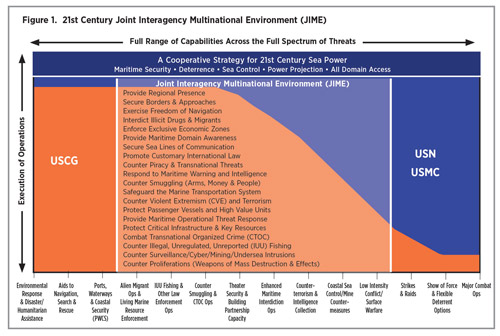
Enhancing regional security in partnership with willing nations requires a 21st-century Great White Fleet of forward deployable (or stationed) national security cutters (NSCs), offshore patrol cutters (OPCs), and fast response cutters (FRC). The mix of platforms and duration of presence would be tailored to the distinct geographies and vary based on the receptiveness of the host nation(s), problem sets to be addressed, and mutual goals of the combatant commands and partner nations. Building on a proven bilateral approach for counterdrug operations and EEZ enforcement, the Great White Fleet would leverage existing agreements—based on the extent to which partner governments are willing—to strengthen CTOC (counter transnational organized crime–chuck) and CT (counter terrorism–Chuck) across the JIME (Joint Interagency Multinational Environment–Chuck).

From an acquisition perspective, doubling the size of both the OPC (from 25 to 50) and FRC (from approximately 50 to 100) programs equates to the projected cost of one Gerald R. Ford (CVN-78)-class aircraft carrier (approximately $13 billion). Furthermore, procuring an additional seven NSCs over the nine planned would cost the equivalent of one Zumwalt (DDG-1000)-class guided-missile destroyer (approximately $4.2 billion). The NSC and OPC both offer more than three times the on-station time between provisioning than is afforded by a littoral combat ship (LCS).

Building more OPCs also could rapidly grow the National Fleet by leveraging commercial shipyards outside the mainstream industrial complex. These shipyards may be able to provide better value to the government during an economic downturn in the oil and offshore supply industry. Further leveraging this acquisition would continue to drive down the cost of the OPCs and provide an additional industrial base to build a 400-ship National Fleet of ships with far lower operating and maintenance costs than the LCS.

Redirecting proposed future LCS/frigate dollars (approximately $14 billion) to a Great White Fleet to modernize the U.S. National Fleet mix would provide a greater return on investment and more staying power abroad. For instance, building international security cutters—NSCs with Navy-typed/Navy-owned enhancements such as the SeaRAM antiship cruise missile—could offer combatant commanders a truly useful “frigate,” leveraging mature production lines that now operate at only 70 percent capacity. These estimates are for relative comparison and do not include the associated aviation, infrastructure, basing support agreements, and personnel plus-ups that are needed to provide a more credible and persistent presence across the JIME. But investing in a larger Coast Guard and the supporting infrastructure would return high dividends.

I’m not sure I agree, but it is worth considering. We should, however, keep in mind a sentiment expressed by friend Bill Wells that white paint is not bullet proof. We should not perpetuate the idea that only white painted ships can enforce laws, that is a uniquiely American concept and perpetuating it plays into the hands of the Chinese, who have more coast guard ships than any other country in the world.

Still I think there is merit to this concept. It seems to be working for PATFORSWA (Patrol Forces South West Asia). There has already been talk about a similar deployment to SE Asia. We might consider similar detachments of various sizes for West Africa, the Eastern Pacific, and the Marshall Islands.

The additional ships, 7 NSCs, and “doubling the size of both the OPC (from 25 to 50) and FRC (from approximately 50 to 100)” Is clearly arbitrary. There is very little the NSCs can do that the OPCs will not also be able to do cheaper, so I don’t see a need for more NSCs.

If we take on additional international roles it probably will not be done in one fell swoop. It will probably be done incrementally. Captain Ramassini is clearly looking at this as a near term possibility. Some movement in this direction is clearly possible, but it will take a radical change in the Administration, the Navy, and the Coast Guard for this to happen on the scale he envisions.

Meanwhile, if you look at the “Offshore and Aviation Fleet Mix Study,” the Coast Guard actually needs 9 NSCs, 57 OPCs, and 91 FRCs just to meet all of our statutory obligations. That is not far from his 16 NSCs, 50 OPCs, and 100 FRCs. The study and the “Great White Fleet” would both probide 66 large ships (NSCs and OPCs).

Actually the only way I see this happening is if there is a realization that keeping the USN constantly cycling through distant deployments may not be the best way to maintain readiness. That it wears out very expensive ships and drives people from the service, and that perhaps cutters can perform at least some of the presence missions.

Administration Considers Cancelling NSC#9

Stratton_111031-D-0193C-002

Stars and Stripes reports,

“President Donald Trump’s budget would eliminate a $600 million-plus state-of-the-art Coast Guard cutter that’s a priority of the powerful Republican chairman of the Senate Appropriations Committee.

“The proposal by Office of Management and Budget Director Mick Mulvaney is included in draft documents of the White House budget request. The documents, obtained by The Associated Press, ask the Department of Homeland Security to cancel its contract with Ingalls Shipbuilding, which is to construct the national security cutter at its shipyard in Pascagoula, Mississippi.”

This is of course the ninth Bertholf National Security Cutter. When funded, there was a loud outcry that the Coast Guard did not ask for it, which, because the Coast Guard leadership “supported the administration budget,” and failed to provide a list of unfunded priorities, was true, but the implication that we did not need it was not.

The unfunded priorities list has long been a sore point with me, here, here, here, and here. The Navy does one of these every year. The Congress asked for one from the Coast Guard every year. We can’t seem to get off our ass and provide one, or is it that the leadership is so cowed by the department that they are afraid to say what is needed?

The “Fleet Mix Study” showed the Coast Guard needed a ninth NSC to meet its statutory obligations and with its fleet rapidly aging and the Offshore Patrol Cutter program long-delayed, the Coast Guard is desperately in need of new ships. Terminating this ship at this stage would be very disappointing and a poor decision. But perhaps we have only ourselves to blame.

My Unfunded Priority List

An earlier post reported a plea by Representative Duncan Hunter, Chair of the Transportation Subcommittee on Coast Guard and Maritime Transportation, for the Coast Guard to provide an unfunded priority list to include six icebreakers and unmanned Air System.

Thought perhaps I would list my own “unfunded priorities.” These are not in any particular order.

PLATFORM SHORTFALLS

Icebreakers: We have a documented requirement for three heavy and three medium icebreakers, certainly they should be on the list. Additionally they should be designed with the ability to be upgraded to wartime role. Specifically they should have provision for adding defensive systems similar to those on the LPD–a pair of SeaRAM and a pair of gun systems, either Mk46 mounts or Mk38 mod 2/3s. We might want the guns permanently installed on at least on the medium icebreakers for the law enforcement mission. Additionally they should have provision for supporting containerized mission modules like those developed for the LCS and lab/storage space identified that might be converted to magazine space to support armed helicopters.

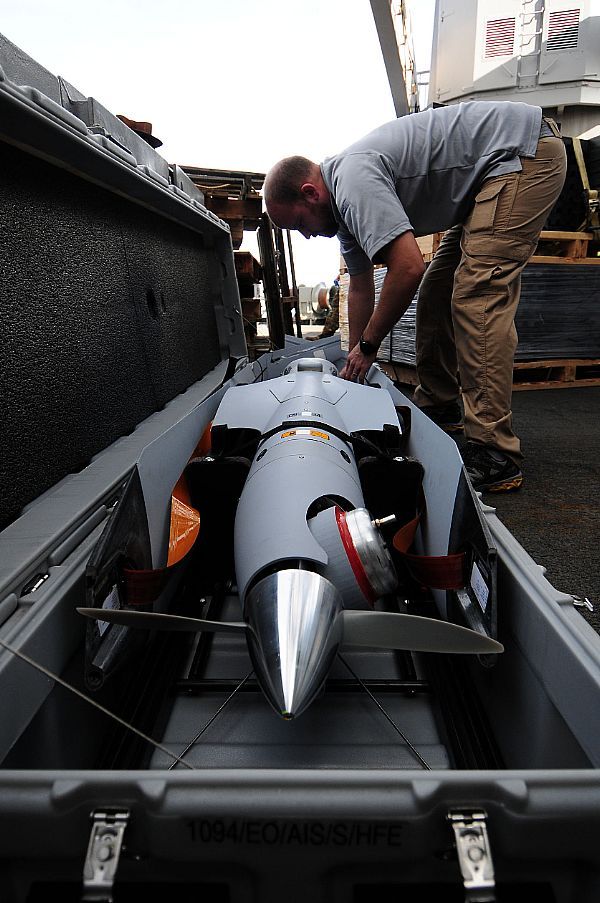
110225-N-RC734-011 PACIFIC OCEAN (Feb. 25, 2011) Guy Mcallister, from Insitu Group, performs maintenance on the Scan Eagle unmanned aerial vehicle (UAV) aboard the amphibious dock landing ship USS Comstock (LSD 45). Scan Eagle is a runway independent, long-endurance, UAV system designed to provide multiple surveillance, reconnaissance data, and battlefield damage assessment missions. Comstock is part of the Boxer Amphibious Ready Group, which is underway in the U.S. 7th Fleet area of responsibility during a western Pacific deployment. (U.S. Navy photo by Mass Communication Specialist 2nd Class Joseph M. Buliavac/Released)

110225-N-RC734-011
PACIFIC OCEAN (Feb. 25, 2011) Guy Mcallister, from Insitu Group, performs maintenance on the Scan Eagle unmanned aerial vehicle (UAV) aboard the amphibious dock landing ship USS Comstock (LSD 45). Scan Eagle is a runway independent, long-endurance, UAV system designed to provide multiple surveillance, reconnaissance data, and battlefield damage assessment missions. Comstock is part of the Boxer Amphibious Ready Group, which is underway in the U.S. 7th Fleet area of responsibility during a western Pacific deployment. (U.S. Navy photo by Mass Communication Specialist 2nd Class Joseph M. Buliavac/Released)

Unmanned Air Systems (UAS): We seem to be making progress on deploying UAS for the Bertholf class NSCs which will logically be extended to the Offshore Patrol Cutters. So far we see very little progress on land based UAS. This may be because use of the Navy’s BAMS system is anticipated. At any rate, we will need a land based UAS or access to the information from one to provide Maritime Domain Awareness. We also need to start looking at putting UAS on the Webber class. They should be capable of handling ScanEagle sized UAS.

File:USCGC Bluebell - 2015 Rose Festival Portland, OR.jpg

Photo: The Coast Guard Cutter Bluebell sits moored along the Willamette River waterfront in Portland, Ore., June 4, 2015. The Bluebell, which celebrated its 70th anniversary this year, is one of many ships participating in the 100th year of the Portland Rose Festival. (U.S. Coast Guard photo by Chief Petty Officer David Mosley.)

Recapitalize the Inland Tender Fleet: This is long overdue. The program was supposed to begin in 2009, but so far, no tangible results. It seems to have been hanging fire for way too long.

Expand the Program of Record to the FMA-1 level: The Fleet Mix Study identified additional assets required to meet the Coast Guard’s statutory obligations identifying four asset levels above those planned in the program of record. Lets move at least to first increment.

Alternative Fleet Mix Asset Quantities

————–POR       FMA-1      FMA-2      FMA-3       FMA-4
NSC                8             9                 9                 9                  9
OPC              25           32               43                50               57
FRC              58           63               75                80               91
HC-130         22            32               35                44               44
HC-144A       36            37               38                40               65
H-60              42            80               86                99             106
H-65             102         140             159              188            223
UAS-LB           4            19                21                21              22
UAS-CB        42            15                19               19               19

At the very least, looks like we need to add some medium range search aircraft (C-27J or HC-144).

Increase Endurance of Webber Class Cutters: The Webber class could be more useful if the endurance were extended beyond five days (currently the same as the 87 cutters, which have only one-third the range). We needed to look into changes that would allow an endurance of ten days to two weeks. They already have the fuel for it.

MISSION EQUIPMENT SHORTFALLS

Seagull_torpedo_trial_1

Ship Stopper (Light Weight Homing Torpedo): Develop a system to forcibly stop even the largest merchant ships by disabling their propulsion, that can be mounted on our patrol boats. A torpedo seems the most likely solution. Without such a system, there is a huge hole in our Ports, Waterways, and Coastal Security mission.

121211-N-HW977-692

Photo: SeaGriffin Launcher

Counter to Small High Speed Craft (Small Guided Weapon): Identify and fit weapons to WPB and larger vessels that are capable of reliably stopping or destroying small fast boats that may be used as fast inshore attack craft and suicide or remote-controlled unmanned explosive motor boats. These weapons must also limit the possibility of collateral damage. Small missiles like SeaGriffin or Hellfire appear likely solutions.

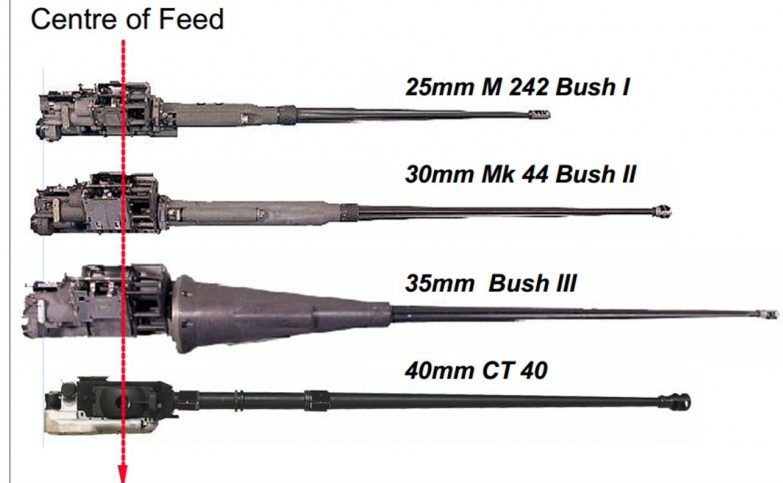
40 mm case telescoped gun (bottom) compared to conventional guns.

40 mm case telescoped gun (bottom) compared to conventional guns.

Improved Gun–Penetration, Range, and Accuracy: The .50 cal. and 25mm guns we have on our WPBs and WPCs have serious limitations in their ability to reach their targets from outside the range of weapons terrorist adversaries might improvise for use against the cutters. They have limited ability to reach the vitals of medium to large merchant vessels, and their accuracy increases the possibility of collateral damage and decreases their probability of success. 30, 35, and 40 mm replacements for the 25 mm in our Mk38 mod2 mounts are readily available.

Laser Designator: Provide each station, WPB, and WPC with a hand-held laser designator to allow them to designate targets for our DOD partners.

CONTINGENCY PLANNING SHORTFALLS

Vessel Wartime Upgrades: Develop plans for a range of options to upgrade Coast Guard assets for an extended conflict against a near peer.


Worried about the Size of the U.S. Navy? Rearm the Coast Guard–The National Interest

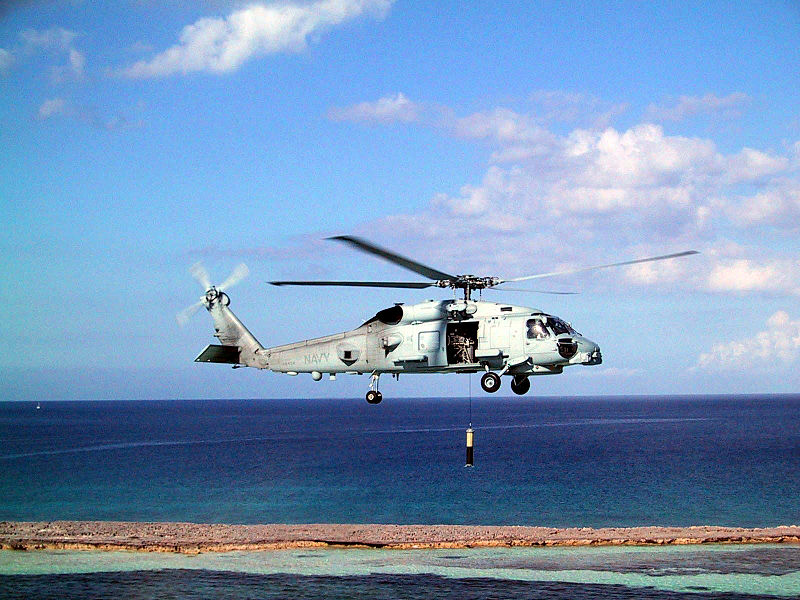
Navy photo. MH-60R “Knighthawk” helicopters conducts an airborne low frequency sonar (ALFS) operation during testing and evaluation

Navy photo. MH-60R “Knighthawk” helicopters conducts an airborne low frequency sonar (ALFS) operation during testing and evaluation

The National Interest has a post subtitled, “A new challenge for Trump: redefine the U.S. Coast Guard’s defense roles” you might find interesting.

The author, a Coast Guard Officer and Cutterman, wants to see our larger cutters better armed. He recommends specifically, provision for support of the Navy’s MH-60R

“The U.S. Coast Guard should explore adding the ability to embark, operate with, maintain and rearm these aircraft from both the National Security Cutter and Offshore Patrol Cutter. Only complete solutions that see cutters equipped with ordnance handling facilities, surge berthing for a full-maintenance detachment and sensor integration through data links should be considered.”

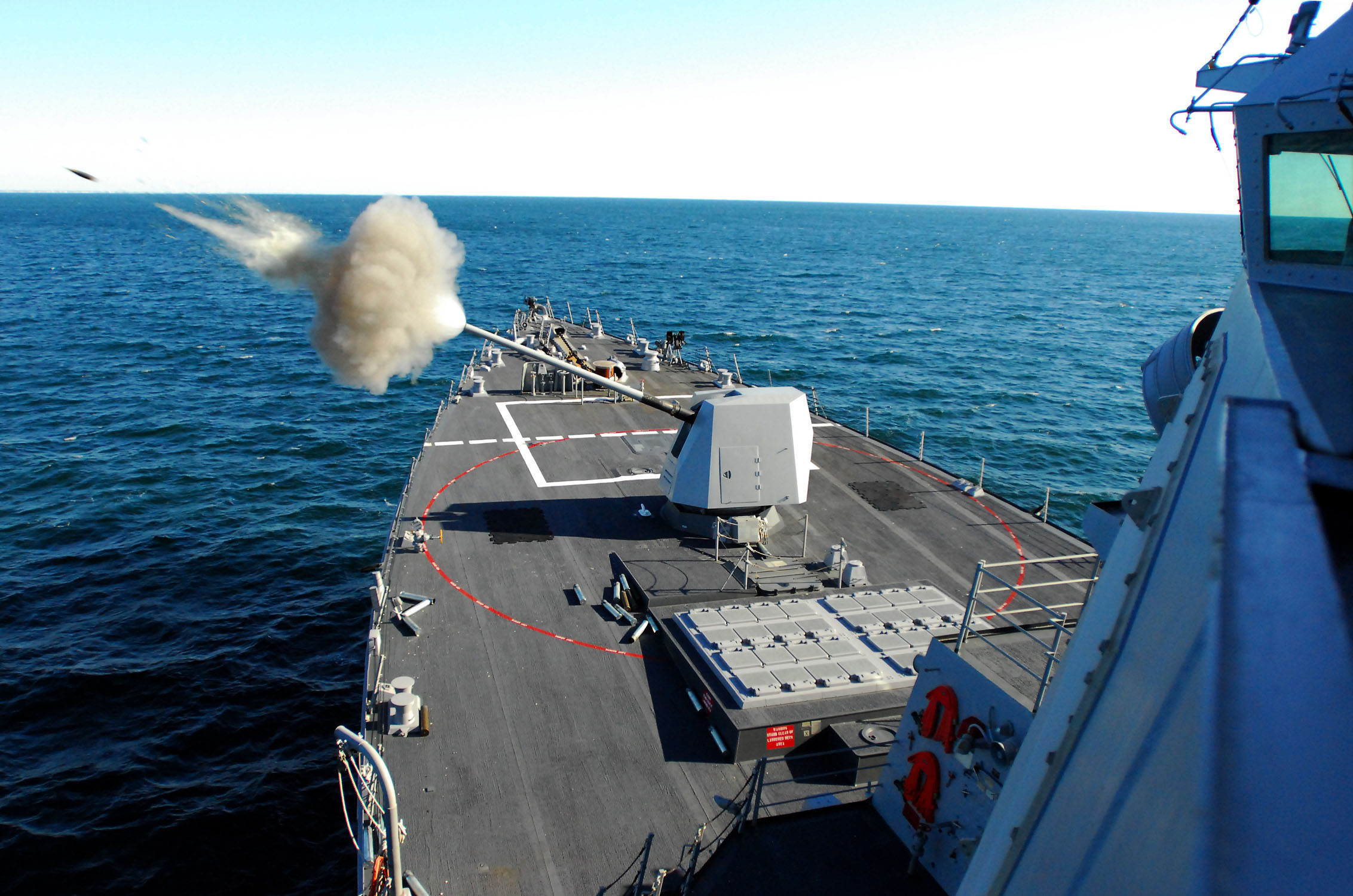
and the 5″ Mk45 for the National Security Cutter.

“The addition of a true major caliber-deck gun offers immediate utility, but the system’s real potential will be unlocked if efforts to develop hypervelocity projectiles bear fruit. If so, the National Security Cutter would emerge as a true utility warship capable of providing fires to forces ashore at substantial range and meaningfully contributing to air defense.”

070111-N-4515N-509 Atlantic Ocean (Jan. 9 2007) - Guided missile destroyer USS Forest Sherman (DDG 98) test fires its five-inch gun on the bow of the ship during training. The Sherman is currently conducting training exercises in the Atlantic Ocean. U.S. Navy photo by Mass Communication Specialist Seaman Apprentice Joshua Adam Nuzzo (RELEASED)

Atlantic Ocean (Jan. 9 2007) – USS Forest Sherman (DDG 98) test fires its five-inch Mk 45 mod4 gun during training.U.S. Navy photo 070111-N-4515N-509 by Mass Communication Specialist Seaman Apprentice Joshua Adam Nuzzo

He does, however, see the services culture as an impediment.

“The lesson of the twenty-five years following the Hamilton experience is that a challenge to maintaining the U.S. Coast Guard’s warfighting capability lies in managing the service’s perception of its character…

He also notes that previous concepts of the Coast Guards wartime environment may be unrealistic.

“Attempts to define the U.S. Coast Guard’s defense roles following the Cold War have been challenging. Published in 1998, Coast Guard 2020 proclaimed that the “Coast Guard will be prepared to operate in low-threat conflict environments, and to provide specialized functions at all levels of operation.” The notions of low-threat operations and service-unique specialization are obstacles to interoperability. While U.S. Coast Guard buoy tenders and icebreakers absolutely provide specialized capability, the major cutter fleet’s warfighting role was never—nor should it have ever been—unique to the U.S. Coast Guard. Rather, the major cutter fleet provided an active augmentation force trained and equipped to provide service in any theater of war. This should be the target for the fleet’s future employment as the community of nations returns to its more normal mode of great power competition. As for the limitation of a low-threat environment, U.S. Coast Guard cutters have deployed recently to Southeast Asia, the Black Sea, the Arctic and the Arabian Gulf. Saber rattling among great powers and the HSV-2Swift incident demand that we ask: which of these locations will qualify as a low-threat environment on the first day of a global or major regional war?

Generally I agree with the thrust,

“The immediate challenges are acquiring and integrating combat systems and training crews in their employment. These are not trivial tasks and will necessarily consume time and resources. Better to act with dark clouds forming on the horizon, however, than in the midst of the storm.”

It is a two page post. The first page is mostly history lesson on the Coast Guard’s participation in past conflicts, but if he gives the impression the Coast Guard was historically ready for these roles on day 1, that would be a mistake. The Coast Guard entered WWII terribly unprepared. The cutters had no sonar or radar and no depth charge racks. There is nothing new about our current lack of readiness for war, it is not the exception, it is the norm.

Trouble is, we tend to have a binary approach. Either we are at peace and could care less about war-time roles, or we are all in after an attack. We need a more measured approach that responds to changing circumstance.

We really need to do better at preparing for a transition from peace to war. 

I don’t necessarily think removing the ASW systems from the 378s following the collapse of the Soviet threat was a mistake. It was a rational response to rapidly changing circumstance. Since then, we have had a quarter century without a substantial ASW threat, and the 378s are now on their way out. We probably should have removed the CIWS too, unfortunately it did mean we lost all the Coast Guard’s accumulated expertise in ASW. Hopefully we can rebuild it with the Navy’s help if needed.

But circumstances have changed again.

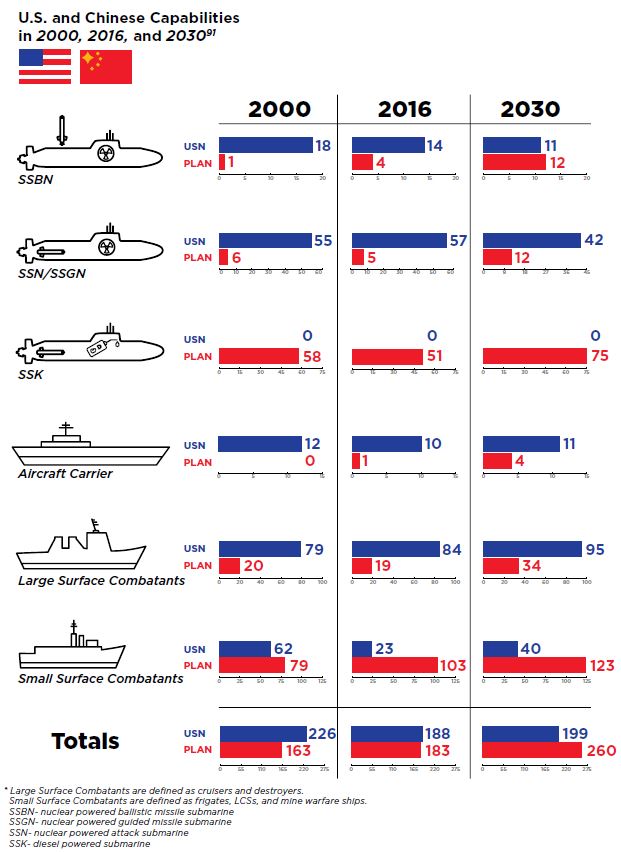
To me, a major conflict now appears more likely in the next ten to twenty years than at any time since I entered the Academy in 1965. We have a true peer challenger, with a chip on its shoulder and a belief in its inherent right to rule, in China. If that was not enough, Russia is rearming and acting increasingly obnoxious. Iran and North Korea may be annoying, but they are really not in the same league, at least in terms of a naval threat. Dealing with them would not stress our Navy, so would not really require Coast Guard assistance. China is the real threat, and if Russia sides with them, things could get dicey. Even without the Russians, the Chinese are building credible surface combattants at least as fast as the US. They already have a local superiority in the Western Pacific. We have to spread our fleet out, while they can concentrate their forces. To concentrate our forces in the Western Pacific, the US will be fighting at arm’s length with long vulnerable supply lines.

I don’t necessarily think war with China inevitable, but we need to recognize the possibility and plan for it.

Theoretically the process should start with an agreement between the Navy and the Coast Guard about what the Coast Guard, particularly its vessels and aircraft, will do in a general war. I see few indications that is happening. Certainly the OPC Concept of Operations did not include anything beyond a simple contingency operation.

I may be wrong about this, since I am way out of the loop, but if the service had an established general war mission focus to prepare for, it should be generally known. It should be reflected in our procurements. Perhaps the Navy thinks it would be presumptuous of them to assign the Coast Guard missions, and the Coast Guard does not want to push itself into Navy planning, but this is too important for delicate feelings to get in the way. Right now the Coast Guard is probably proportionately larger compared to the Navy than at any time in the last 100 years. When I entered the service, the Navy was 22 times larger than the Coast Guard in terms of personnel. Now it is only eight times larger. A combat ready Coast Guard may be the difference between victory and defeat.

Plans:

The Coast Guard has potentially important roles to fill in any general conflict. If the Navy cannot envision these roles, perhaps the Coast Guard should think for itself. Plans should include our aircraft as well as our vessels, but I will stick to the vessels for now.

What we need is not an overall strategy to defeat China, but a well developed range of options for employment and a good idea of what upgrades would be required.

In a major war, I see a major shortfall in open ocean escorts. Thirty years ago, when the threat was the Soviet Navy and the problem was projecting American power across the shorter distances of the Atlantic, the US had 36 cruisers, 69 destroyers, and 115 frigates (plus 12 WHEC 378s). Now they have 22 cruisers, 63 destroyers, and 8 LCS.

Then we had the advantage, that the Soviet Fleet was split into four parts and their egress to our supply lines was limited by the presence of powerful European Allied navies that restricted their access to our supply lines.

In a Pacific War with China, the distances are much greater, our allies fewer, and, with the exception of Japan and S. Korea, much weaker. Our Navy’s fleet, currently 274 ships, with ambitions of 355, is scattered across three oceans while China’s fleet, likely soon to be 500 ships, is geographically concentrated.

If we needed over a hundred frigates to cross the Atlantic, we probably need at least that many to push across the Pacific. As it is, the Navy cannot meet their current peacetime commitments, and replenishment ships cross the oceans unescorted and unarmed.

The Navy seems to have belatedly recognized this with moves toward a new frigate to be based on one of the LCS designs, but even if they complete all 52 small surface combattants currently planned, less than half will be completed as frigates, and if based on the LCS designs, they will have limited range, survivability, and crew size. The Independence class LCS will likely be permanently employed as mine countermeasures (MCM) vessels (There were 22 of those in 1987). The Freedom class will likely be employed in enforcing a blockade (perhaps with help from Webber class WPCs). Even with some backfitting of LCS  25-32, that leaves at most 28 frigates in the current plan. 35 ASW equipped cutters could make a huge difference.

The Cutters:

Cutters should be designed with wartime roles in mind, even if they will not be initially fully equipped with combat systems.

In the Bertholf class and Offshore Patrol Cutters, we will have most of the elements of modern warships. To not be prepared to add the few systems necessary to make them effective warships, if the nation were engaged in combat, would be criminal. If we do not already have plans to upgrade the Bertholf class National Security Cutters and the Offshore Patrol Cutters to give them significantly improved ASW, AAW, and ASuW capability we should start those plans.

At some point perhaps we should prototype an installation of these capabilities on at least one NSC and one OPC. Then we need to wring them out by deploying with the Navy and getting feedback on their performance, and periodically update plans for mobilizing their war-time potential.

The People: 

Just as we have marine inspection, fisheries, and drug enforcement specialist, the Coast Guard needs a cadre of officers in the Office of Counter Terrorism and Defense Operations Policy (CG-ODO) who have a deep understanding of the needs of modern naval warfare, who will advocate for naval capabilities consistent with both wartime missions and the Ports, Waterways, and Coastal Security (PWCS) mission. Likely this means revival or strengthening of officer exchange programs, Tactical Action Officer training, and War College education.

Perhaps the longest lead time item in mobilizing the Coast Guard for war would be the senior enlisted we would need for rating not currently found in the peacetime Coast Guard. It might be possible for the Navy to identify some reservist to augment the crews of Coast Guard cutters upon mobilization, but even a small cadre within the Coast Guard, founded on prototyping systems on at least a couple of cutters would provide valuable continuity and advice in defining required capabilities.

Bottom Line–When we get in trouble, we cannot make it up as we go along. Sweat now, saves blood later.

Thanks to Lyle for bringing this to my attention.