Defense News reports Northrop Grumman has proposed an optionally manned aircraft to meet an Australian Border Force maritime surveillance requirement. The plane, the Firebird, is a product of Scaled Composites
“Firebird is a medium-altitude, long-endurance aircraft with a 30-hour endurance, with a nominal payload. Chappel said the aircraft has been tested with more than 24 different intelligence, surveillance and reconnaissance payloads, which can be swapped in 30 minutes. The initial customer is the U.S. government.”
Scaled Composites is a part of Northrop Grumman now, but originally it was Burt Rutan’s company. Rutan was known “for designing light, strong, unusual-looking, energy-efficient aircraft. He designed the record-breaking Voyager, which in 1986 was the first plane to fly around the world without stopping or refueling, and the sub-orbitalspaceplaneSpaceShipOne, which won the Ansari X-Prize in 2004 for becoming the first privately funded spacecraft to enter the realm of space twice within a two-week period. With his VariEze and Long-EZ designs, Rutan is responsible for helping popularize both the canard configuration and the use of moldless composite construction in the homebuilt aircraft industry.” Now Scaled Composites functions as Northrop Grumman’s Skunk Works.
Meanwhile the Navy is also procuring unmanned systems with a similar capability in the form of another Northrop Grumman system, the MQ-4C Triton, which is a high altitude system. Hopefully there will be a sharing of information, but inevitably Navy and Coast Guard interests differ. Still the systems might prove complementary.
170327-N-VS214-002 SAN DIEGO (March 27, 2017) A MQ-8C Fire Scout helicopter sits in the hangar bay of the littoral combat ship USS Montgomery (LCS 8). (U.S. Navy photo by Mass Communication Specialist 3rd Class Zachary Eshleman/Released)
“What’s important to us right now is making sure we have the right sensors, a good multi-function radar, some kind of passive targeting capability and the right networks to push that information to the right people at the right times.”
When the Navy finally gets around to deploying LCS to the drug transit zones, these could be very useful.
Reportedly they will provide, “…a circle of influence and sea control out to about 300 miles” although probability of detection almost certainly depends on target size and characteristics.
Leonardo’s Osprey AESA radar. The two panel configuration allows 240 degree coverage. A three panel configuration allows 360 degree coverage as on Norway’s AW101 SAR helicopters. Configurations of up to four panels are possible (Photo by Leonardo)
“Each antenna contains 256 Transmit and Receive Modules (TRM) – 25% more than that the single array on the Seaspray 7500E radar fitted to U.S. Coast Guard HC-130J Hercules search aircraft (also a Leonardo product–Chuck). The antennas, which can be used in several different modes including surface search, air-to-air and synthetic aperture radar and moving target indication, are controlled through a single processing unit which collects the data and displays it as presenting a single radar picture.”
Ultimately as more of the “C” models are built, we might see them on Coast Guard cutters. There is also the possibility that as more of the larger “C” models come on line, the Coast Guard may be able to get some of the smaller “B” models. The “B” model did operate for Bertholf for two weeks.
The larger C model, with its higher speed, greater payload, better sensors, and 11+ hour endurance, would certainly be an improvement over the ScanEagle currently planned for the National Security Cutters. Whether the “B” model‘s presumably better sensors but shorter range/endurance would allow a greater effective search area compared to the ScanEagle I could only speculate, but I suspect it would also be an improvement, using perhaps two flights per day.
The National Security Cutters could certainly support both an H-65 and an MQ-8C, since they can support two H-65s. It is less clear if the OPC could support both. They reportedly can support an MH-60 or an H-65 and a UAS, but what size UAS?
These systems suggest that at some point, at least on our largest cutters, we may be able to relieve shipboard manned helicopters the routine search function.
USCG Monomoy (WPB-1326) and Adak (WPB-1333), elements of PATFORSWA
Defense Media Network has an interesting post about the operations of Task Force 55 which includes the Coast Guard’s Patrol Forces Southwest Asia, a Maritime Security Response Team (MSRT), Advanced Interdiction Teams (AIT), and a Maritime Engagement Team (MET).
There are also brief comments on the 25mm Mk38 mod2, the Puma small UAV, and the Griffin small surface to surface missile system.
I found the Joint Explanation easiest to wade through. The Budget breakdown is found on pages 65 to 69 of the 612 page pdf.
Note in some cases I have rounded to the nearest $0.1M
Our total Coast Guard FY2019 budget is $12,015,921,000. This is $91,803,000 less than last year, but $577,720,000 more than the budget request.
The Operations and Support allocation is $7,808.2M. That is $434.9M more than last year (a 5.6% increase), and $215.1M more than requested.
I have provided information on the PC&I budget below including a complete list of line items that I was unable to provide before.
PROCUREMENT, CONSTRUCTION, AND IMPROVEMENTS (PC&I) $2,248.26M
Vessels and Boats
Survey and design: 5.5M
In service vessel sustainment: 63.25M
National Security Cutter: 72.6M (Follow up on ships already funded)
Offshore Patrol Cutter: 400M (Second of class + LLTM for third)
Fast Response Cutter: 340M (Six Webber class including two for PATFORSWA)
Cutter boats 5M
Polar Security Cutter: 675M (First of class + LLTM for second)
Waterways Commerce Cutter: 5M
Polar sustainment: 15M (Polar Star Service Life Extension)
—-Vessels Subtotal: $1,581.35M
Aircraft
HC-144 Conversion/Sustainment: 17M
HC-27J Conversion/Sustainment: 80M
HC-1330J Conversion/Sustainment: 105M
HH-65 Conversion/Sustainment: 28M
MH-60 Conversion/Sustainment: 120M
Small Unmanned Aircraft: 6M
—Aircraft Subtotal: $356M
Other Acquisition Programs:
Other Equipment and System: 3.5M
Program Oversight and Managemen: 20M
C4ISR 23.3M
CG-Logistics Information Management System (CG-LIMS): 9.2M
—Other Acquisitions Programs Subtotal: $56M
Shore Facilities and Aids to Navigation:
Major Construction; Housing; ATON; and Survey and Design: 74.51M
Major Acquisition Systems Infrastructure: 175.4M
Minor Shore 5M
—Shore Facilities and Aids to Navigation Subtotal: $254.91M
The PC&I total, $2,248.26M, was $446.48M less than FY2018, but it was $361.51M above the budget request.
—
R&D was cut by almost a third. This is probably a place to spend more not less.
Reserve Training disappeared as a separate line item, so I can’t tell what happened there.
Also included in the new budget is $5M for the National Coast Guard Museum
Incidentally, the total amount appropriated for the polar security program includes $359.6M (FY2018 and prior) + $675M (FY2019), or $1,034.6M, of which $20M is for Long Lead Time Material for the second ship, and the remainder is for the first ship and other program-related expenses.
With Operations and Support up more than 5% over 2018 and Procurement Construction &Improvement (PC&I) over $2B for the second year in a row, this is the kind of budget we can live with. It just needs to keep happening.
Like many of you, I was unable to attend the Surface Navy Association Conference, but I did find a number of videos which may provide some of the information that would have been available there. The Coast Guard Commandant had been scheduled to speak but cancelled, apparently in response to the partial government shutdown.
I have provided three videos, each about ten minutes, that may be of general interest, and links to four others, typically 20-25 minutes. The descriptions are from their respective YouTube pages.
The second and third videos have specific Coast Guard content, which I have identified by bold typeface with the beginning time in parenthesis. Some of the other equipment may have Coast Guard applications in the future.
Day 1 video coverage at SNA 2019, the Surface Navy Association’s national symposium. In this video we cover:
– Austal latest frigate design for FFG(X)
– Raytheon DART Variable Depth Sonar (VDS)
– Raytheon / Kongsberg Naval Strike Missile (NSM)
– Lockheed Martin Long Range Anti Ship Missile (LRASM)
Day 2 video coverage at SNA 2019, the Surface Navy Association’s national symposium.
In this video we cover:
– Fincantieri Marine Group FREMM frigate design for FFG(X)
– General Dynamics NASSCO John Lewis-class T-AO (New Oiler)
– Raytheon SM-2 restart
– Raytheon SM-3 – Leonardo DRS Hybrid Electric Drive for U.S. Coast Guard’s Offshore Patrol Cutter (OPC) (time 11:10)
Day 3 video coverage at SNA 2019, the Surface Navy Association’s national symposium. In this video we cover:
– Atlas North America’s solutions for mine counter measures, harbor security and unmanned surface vessels
– Lockheed Martin Canadian Surface Combatant (Type 26 Frigate, Canada’s Combat Ship Team)
– Insitu ScanEagle and Integrator UAS (time 4:30)
– Raytheon SPY-6 and EASR radar programs
Vice Adm. Tom Moore, USN, the commander of the Naval Sea Systems Command, discusses US Navy efforts to increase public and private ship repair capabilities, lessons learned from repairing USS John S. McCain and Fitzgerald, the new Ford-class aircraft carrier, getting the Littoral Combat Ship on regular deployments and more with Defense & Aerospace Report Editor Vago Muradian at the Surface Navy Association annual conference and tradeshow in Northern Virginia.
George Awiszus, military marketing director of GE Marine, discusses the outlook for the company’s LM2500 engine that drives warships in more than 30 nations and the future of shipboard power with Defense & Aerospace Report Editor Vago Muradian at the Surface Navy Association’s annual conference and tradeshow in Northern Virginia.
Adm. Bill Moran, USN, the vice chief of naval operations, discusses dialogue with China, improving the surface force in the wake of 2017’s deadly accidents, refining Navy culture, increasing ship repair capabilities, harnessing data, improving information sharing across the force and the new Design for Seapower 2.0 with Defense & Aerospace Report Editor Vago Muradian at the Surface Navy Association’s annual conference and tradeshow in Northern Virginia.
Maj. Gen. David “Stretch” Coffman, USMC, the US Navy’s director of expeditionary warfare (N95), discusses new expeditionary warfighting concepts, the recent deployment of Littoral Combat Group 1 — composed of USS Wayne E Meyer (DDG-108) and USS Somerset (LPD-25) — to South America, new formations to replace the current Amphibious Ready Group and Marine Expeditionary Unit, unmanned ships, the performance of the F-35B Lightning II and more with Defense & Aerospace Report Editor Vago Muradian.
This is not going to flow well, I apologized for the mishmash. The video above is of a House Sub-Committee hearing that occurred on July 24. I think it is still worth a look. The video does not actually begin until just before time 19:55
Before watching the video, I would suggest a look at the “Summary of Subject Matter.” This is what the Congressional Representatives are looking at.
End of Service Lives for Medium Endurance Cutters (MEC) with Planned Offshore Patrol Cutter (OPC) Delivery Dates:
Check out the charts on page 2. The second chart shows “End of Service Lives for Medium Endurance Cutters (MEC) with Planned Offshore Patrol Cutter (OPC) Delivery Dates.” It illustrates the risks and loss of capacity that appears likely, if OPCs are funded at the planned rate of no more than two ships a year. It is unclear why the WMECs are to be retired in the order intended since it is not the order of their completion. Presumably it is based on an assessment of the condition of the ships, but it is very clear that they will all be well over aged. The 210s will retire first. The youngest retirement would be at age 53 and some would qualify for Social Security before replacement. (Diligence, 66)
How they arrived at the expected service life shown is hard to understand, because every 210 is going to be 53 years old or older at the end of projected service life plus 15 year life extension. The 210s were, of course, substantially reworked during a “Major Maintenance Availability” 1986 to 1990, but no further life extension work is apparently planned based on the testimony in the video.
It may appear we are in much better shape with respect to the 270s, but these more complex ships may actually be harder to keep operational. We saw this in the number of breakdown experienced after the Haitian Earthquake eight years ago. They were commissioned between 1983 and 1991 and are expected to be replaced between 2130 and 2135. Legare, second to newest, is planned to be the first replaced, and would be “only” 40 years old. Harriet Lane one of the earliest completed is expected to be one of the last replaced and would be 50 years old. The rest fall within that range. SLEP for 270s beginning 2021, but it is not certain it will be applied to all 13 ships.
Because ships are not being replaced as quickly as they were originally built, we see a growing gap between the end of the ship’s projected service life, even with a 15 year service life extension, and the projected date of replacement.
Cutter Capability (by operating hour):
See also Appendix A, which illustrates the current shortfall in cutter hours available compared to the “Legacy Fleet” the recapitalization program was intended to replace. The “Legacy Fleet” is based on 12 WHECs, 29 WMECs, and 49 island class WPBs. (Not sure why they used 29 WMECs, since we had 32 as recently as 2001.)
There are two charts, the first includes WPBs and Webber class WPCs as well as WHECs, WMECs, NSCs, and OPCs. The second considers on the only the larger vessels, excluding WPCs and WPBs.
The first chart shows that we are currently down 20,450 hours (8.6%) relative to the legacy fleet, but that when the recapitalization is complete the total will be 31,970 hours (13.4%) greater than the legacy fleet. This increase is all due to the greater number Webber class and the greater number of hours each is expected to operate annually compared to 110s.
The second chart looks only at the larger ships, leaving aside the Webber and Island class WPCs and WPBs. It shows we are currently down 13,950 op hours (10%) and further, that when the program is completed, we will be down 15,030 hours (10.7%)reflecting the smaller number of large patrol cutters. If we could view this as a chart of actual cutter available on a yearly basis, it suggest that we will never be down by more than the 10.7% that shows upon completion of the program. Actually that is unlikely to be the case. The aging fleet means a higher probability of unplanned maintenance and even catastrophic failure that may result in WMECs being decommissioned prematurely and becoming parts donors like the Polar Sea.
At some point Coast Guard leadership is going to have to tell Congress the ugly truth that we have started the OPC/WMEC replacement program much too late, and we need to double down on the production rate. As soon as the first ship is completed and tested we need to issue a Multi-Year Procurement contract and it should include building up to four ships a year, at least until all sixteen 210s are replaced and at least three ships a year until all the WMECs are replaced.
We need to tell the Congress this as soon as possible, because bad news does not get better with age. Unfortunately it did not happen in this hearing. In fact when asked about the possibility of accelerating OPC production, time 1:10:00, VAdm McAllister seemed to dismiss the possibility saying we had other higher priorities. This was the wrong answer. You don’t always get to decide how money is spent. If we should get the opportunity to accelerate OPC construction, as has happened with the FRCs, we should welcome it.
Mission Needs Statement:
You can see the “Mission Needs Statement” referred to here. It is 70 pages plus about 45 pages of Appendices, but as noted, “… it does not identify asset gaps or a material solution to meet Coast Guard’s mission needs.”
GAO findings, failure to plan long term:
The GAO has taken the Coast Guard to task because their acquisition portfolio planning has been limited to apparently short term planning using the annual budget and five year Capital Investment Plan (CIP). That this has resulted a bow wave of unfunded requirements being pushed progressively further into the future.
“When you are up to your ass in alligators, it is difficult to remember that your initial objective was to drain the swamp.”
I have to think GAO has a point here.
We still have not provided a 20 year acquisition plan that the Coast Guard said they would provide in 2014, much less the 30 year plan I have suggested that would parallel the Navy’s planning process.
We have only done one fleet mix study. It was completed in 2007 and included the apparent assumption of applying the now rejected Crew Rotation Concept to both the NSCs and OPCs. Even so, it is still being used as a basis for critiquing the program of record that was last re-baselined in 2005. Things change, we now have better information about how our assets actually function. It is long past time for updated planning.
The Video:
Witnesses were:
Vice Admiral Daniel Abel, Deputy Commandant for Operations, United States Coast Guard | Written Testimony
Vice Admiral Michael McAllister, Deputy Commandant for Mission Support, United States Coast Guard | Written Testimony
Ms. Marie A. Mak, Director of Acquisition and Sourcing Management, Government Accountability Office | Written Testimony
Here is a brief outline of the topic discussed. Video actually begins 19:55.
23:00 Administration and CG leadership priorities do not demonstrate a commitment to rebuild infrastructure.
42:00 Appropriation deleted $1.4B including $750M for the Heavy Polar Icebreaker and the rest from an account to repair of replace hurricane damaged infrastructure.
46:00 Icebreaker schedule is overly optimistic.
47:00 WMEC gap.
49:00 No service life extension program for 210s. Some, but not all 270s, will have 10 year life extension.
51:00 Capabilities vs hours.
55:30 WMECs are operating at higher than anticipated tempo. Anticipate catastrophic failures within in the WMEC fleet. 5 out or 14 WMEC 210s are at high risk.
59:30 Maintenance backlog.
1:08:00 Still no 20 year plan has been provided since it was requested in 2014.
1:10:00 accelerate OPC procurement?
1:12:30 OPC homeports, of the first four, two will go to Kodiak and two to LA
1:14:00 Great Lakes icebreaking, Mackinaw replacement? SLEP of 140′
1:15:45 Will be doing a fleet mix study for the Great Lakes.
1:20:00 Homeport for icebreakers has not been decided. Working on homeport decisions for the entire fleet.
1:23:00 UAS
1:24:00 Counter UAS capability. The six WPBs in CENTCOM have some capability.
1:25:00 Manpower analysis
—-
Opening Statement of the Sub-Committee Chair:
The Subcommittee is meeting today to review how the Coast Guard is integrating their acquisition, manpower, and maintenance plans to align to their mission needs and assure the Service has the assets, personnel, and expertise needed to carry out its missions.
On June 1, 2018, Admiral Karl Schultz became the 26th Commandant of the Coast Guard. His guiding principles for the Service are: Ready, Relevant, and Responsive. He said, “These guiding principles frame my direction and will support the Department of Homeland Security, the Secretary of Defense and Combatant Commanders, and other national and global maritime interests.” Admiral Schultz and his senior leadership team are in the midst of reviewing the status of the Coast Guard and making changes to align the Service with those guiding principles. Today, we will hear from two members of that team, and look forward to better understanding their perspectives on the status of the Coast Guard.
The ongoing recapitalization of the Service’s cutters was planned two decades ago to address mission demands at that time. The world and the demands on the Coast Guard have since changed and it is critical that the Service be ready to respond to the demands of today, as well as those that will exist in decades to come. It is also important that the Coast Guard is prepared to manage capability gaps that are occurring and likely to continue to occur as recapitalization continues.
The decisions being made today will shape the Coast Guard of the future. The cutters being built today have a planned 30-year service life and will probably serve longer, and the final OPC is projected to be patrolling the seas until 2064. Like Admiral Schultz, Congress wants to ensure the Coast Guard is Ready, Relevant, and Responsive for years to come. In order to do so, we need accurate information from the Service to determine whether current plans will provide the capabilities to meet future demands.
Even more important than Coast Guard ships and aircraft are the people who operate them. The Coast Guard’s active duty workforce is only slightly larger than that of the New York City police department and less than ¼ the size of the next smallest U.S. Armed Force. Congress has encouraged the Coast Guard to better understand and articulate its workforce needs to meet current and emerging needs. Looking forward, it is likely that the Service will need to make tough, strategic decisions regarding how Coast Guard personnel are allocated. Even before the advent of a new cybersecurity operating domain, the Coast Guard was struggling to meet mission demands; creating a cybersecurity workforce while also conducting legacy operations poses an additional challenge that must be addressed immediately.
In addition to our focus on Coast Guard assets and personnel, this Subcommittee has continually pushed the Service to improve its shore infrastructure made up of approximately 43,400 assets nationwide. Unfortunately, even after several years of us stressing the need for action, much of that property is in dire need of rebuilding or repair. While Coast Guard leaders consistently stress the importance of investing in shore infrastructure, the budgetary trade-offs being made within the Coast Guard and the Administration do not reflect a genuine commitment to address this need. For example, despite a shore infrastructure backlog of more than $1.5 billion, the Coast Guard’s Fiscal Year 2019 budget request only includes $30 million to address those projects.
Shore infrastructure is critical to every Coast Guard mission – cutters need piers, aircraft need runways, inspectors need buildings, etc. – and if the Service truly desires to remain Ready, Relevant, and Responsive, it needs to find ways to address these critical needs.
The Government Accountability Office (GAO) has issued a number of reports since 2012 reviewing Coast Guard acquisition programs and providing recommendations to improve those programs. Over the years, the Coast Guard has agreed with many of those recommendations and agreed to take action on them. However, the new GAO report released today notes that the Coast Guard has not fully implemented those prior recommendations. Hopefully, today’s hearing will help us understand why that is.
A new senior leadership team brings new perspectives, new ideas, and new priorities. I look forward to hearing from our witnesses today on how they see the Coast Guard and how we can best position the Service for success going forward.
Members of the Coast Guard Research, Development, Test and Evaluation Program (CG-926) and the Research and Development Center are in Prudhoe Bay, Alaska, to test usage of unmanned systems in the Arctic in Arctic Technology Evaluation 2018. U.S. Coast Guard photo by Alexandra Swan.
Coast Guard Kicks Off Arctic Technology Evaluation 2018
July 25, 2018
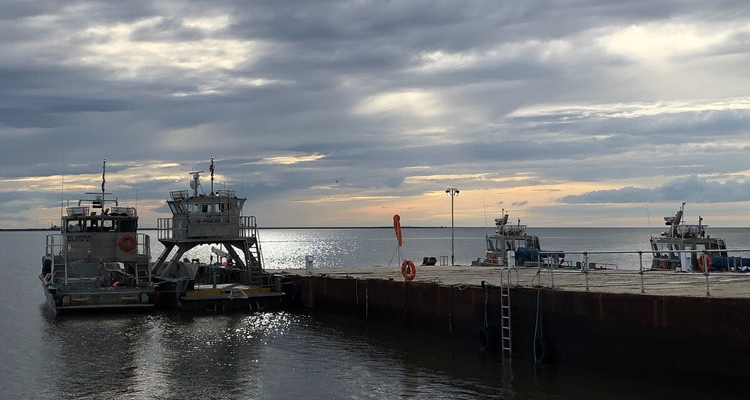
The Coast Guard is conducting its 2018 Arctic Technology Evaluation July 21-Aug. 3, 2018, in Prudhoe Bay, Alaska.
This year’s Arctic research will focus on evaluating how unmanned aircraft systems (UAS), unmanned surface vehicles (USV) and an aerostat balloon can work together as a network. The Coast Guard’s Research, Development, Test and Evaluation (RDT&E) Program and Research and Development Center (RDC) are partnering with Alaska Clean Seas for this year’s activities.
The research team will conduct a number of search and rescue and environmental testing scenarios, including using the unmanned systems to detect a life raft and evaluating capabilities to detect and sample a simulated oil spill. The unmanned systems will be integrated with Persistent Systems Man Pack Unit 5 radios (MPU5) to test the potential communication relay. The research team will also compare UAS sensor performance at high latitudes with data gathered through the RDT&E Program’s Robotic Aircraft Sensor Program for Maritime.
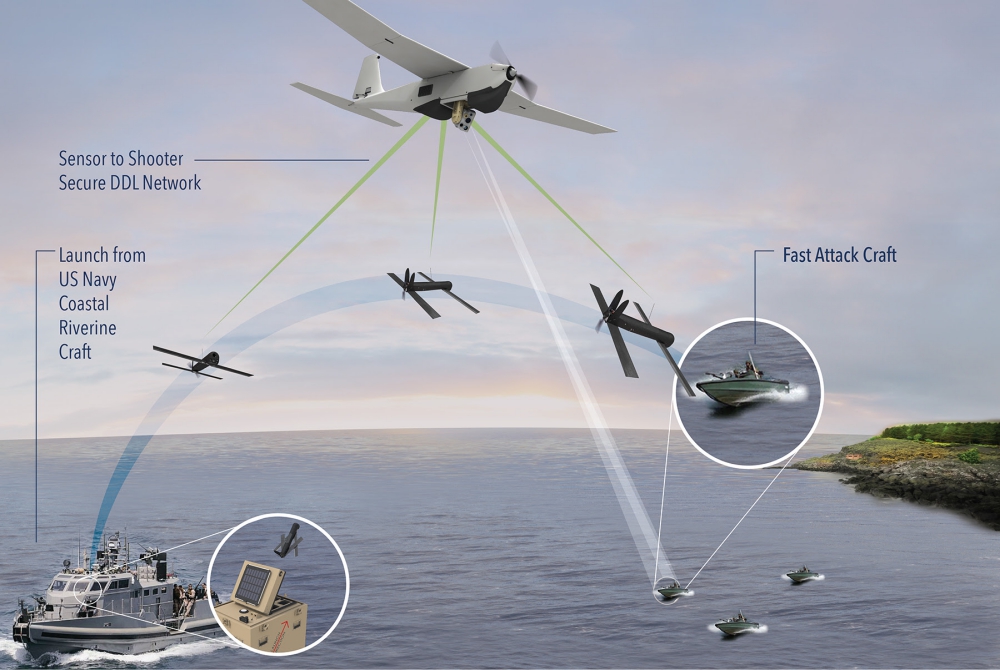
AeroVironment recently conducted a demonstration for the Navy, of how its systems might counter swarming Fast Inshore Attack Craft (FIAC). If the combination of systems works as advertised, it may be exactly what the Coast Guard needs to counter the small, fast, highly maneuverable end of the terrorists surface vessel attack threat spectrum. It is also small enough that it might fit on something as small as a Response Boat-Medium (RB-M). It would certainly fit on a WPB.
It appears to be precise and have minimal chance of collateral damage. It also has a man in the loop, allowing an attack to be aborted or redirected. It is also supposed to have a capability against other drones, presumably smaller, slower ones at low altitude. The combination consists of a Puma UAS to provide target detection, classification, and targeting, and the Switchblade “Lethal Miniature Aerial Missile System” (LMAMS). Switchblade is a missile but a very different one. It is an electric-powered, propeller driven, suicide drone.
The Puma and Switchblade both use the same control system.
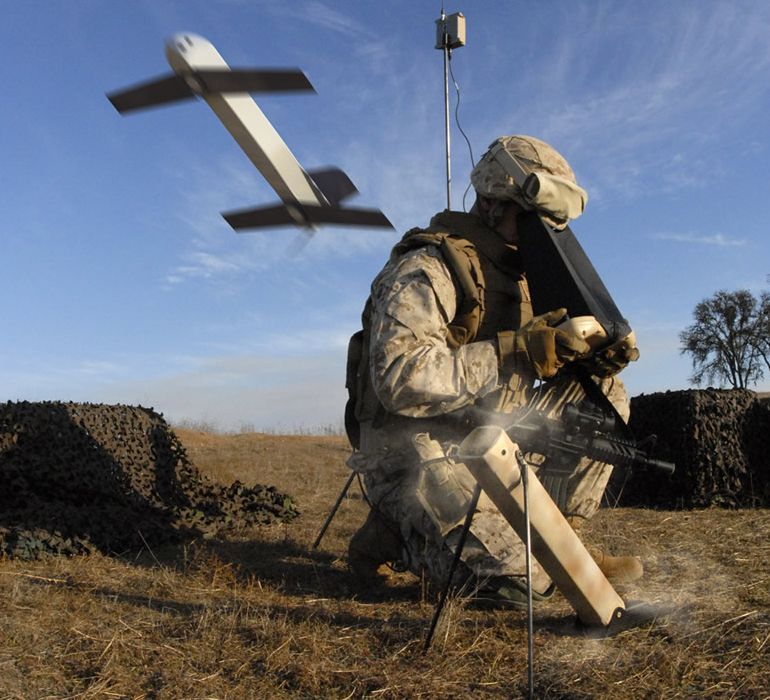
The Switchblade, seen being launched in the photo below, is very small. It is less than two feet long and weighs less than six pounds. The manufacturer’s data sheet is here.
Switchblade loitering munition
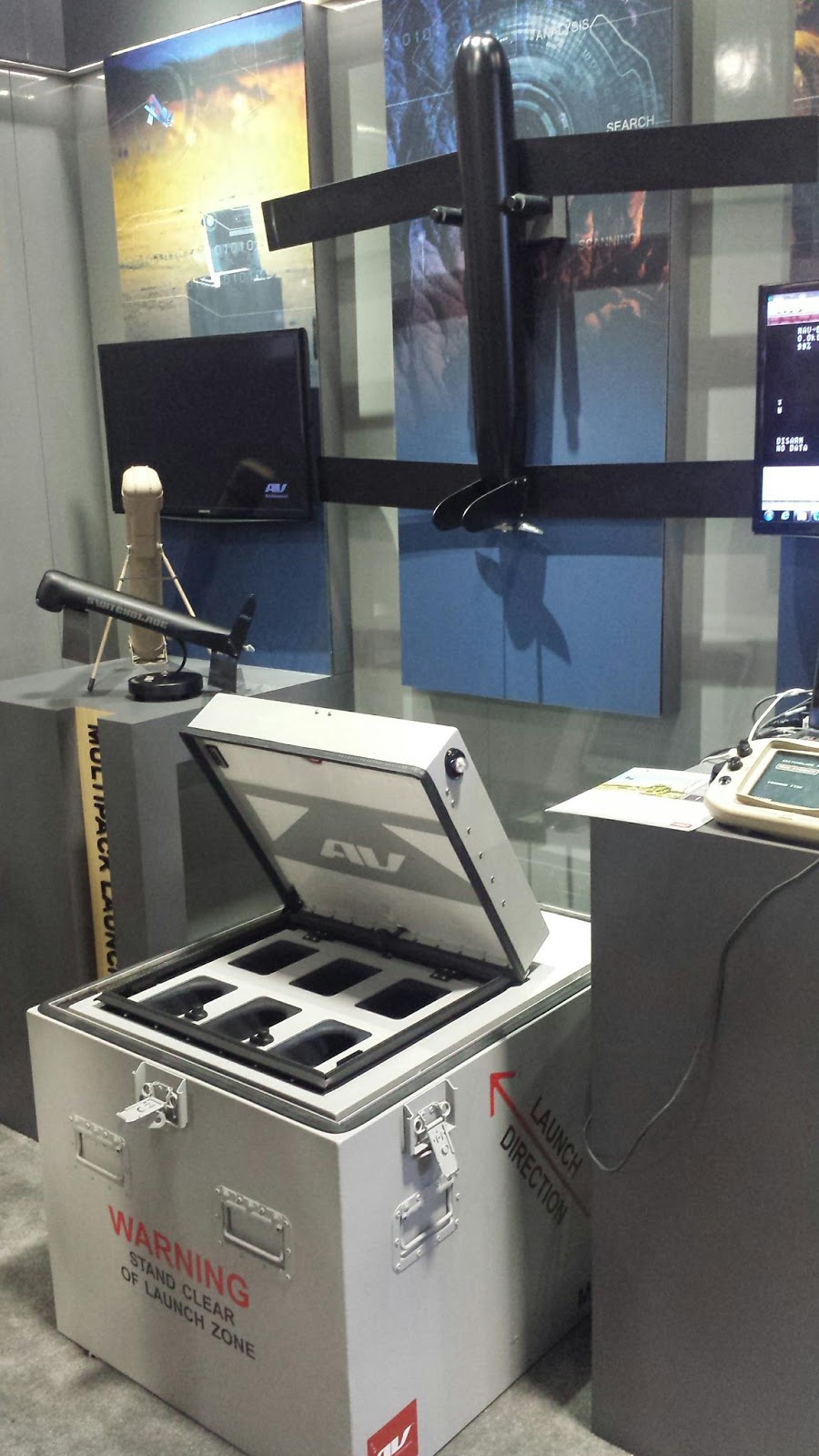
They have introduced a six-pack launch system. It weighs only 160 pounds fully loaded and is only 28″ wide, 34″ deep, and 28″ tall.
AeroVironment six cell Switchblade Launcher
Where might we use these? While these systems might become ubiquitous, if they work as advertised, there are a couple of units that stand out as having the most immediate need.
“…The service contract covers installation and deployment of sUAS for approximately 200 hours per 30-day operational patrol period.
“Installations of sUAS capability on NSCs are planned at a rate of about two per year. Total value of the contract including the seven option years is approximately $117 million.”
It does not say which airframe Insitu will be providing. They have more than one, but it is likely to be Scan Eagle which was the small UAS used by Stratton during the trials.
200 hours per 30 day operational patrol period might be 20 sorties of 10 hours each or 25 sorties of 8 hours, but in all probability it will include a few shorter flights to provide documentation and over-watch during boardings.
The Coast Guard is contracting out the operation and maintenance of the systems rather than training Coastguardsmen to perform these functions. Hopefully, in time that will change.
Also there is no reason these systems should not also operate off of smaller cutters and icebreakers. Operating from 210s should be relatively easy, although it might preclude operating a helicopter, and with a little engineering they could probably operate from Webber class WPCs.
If you want to trace some of the progress on this issue, here are some earlier posts.
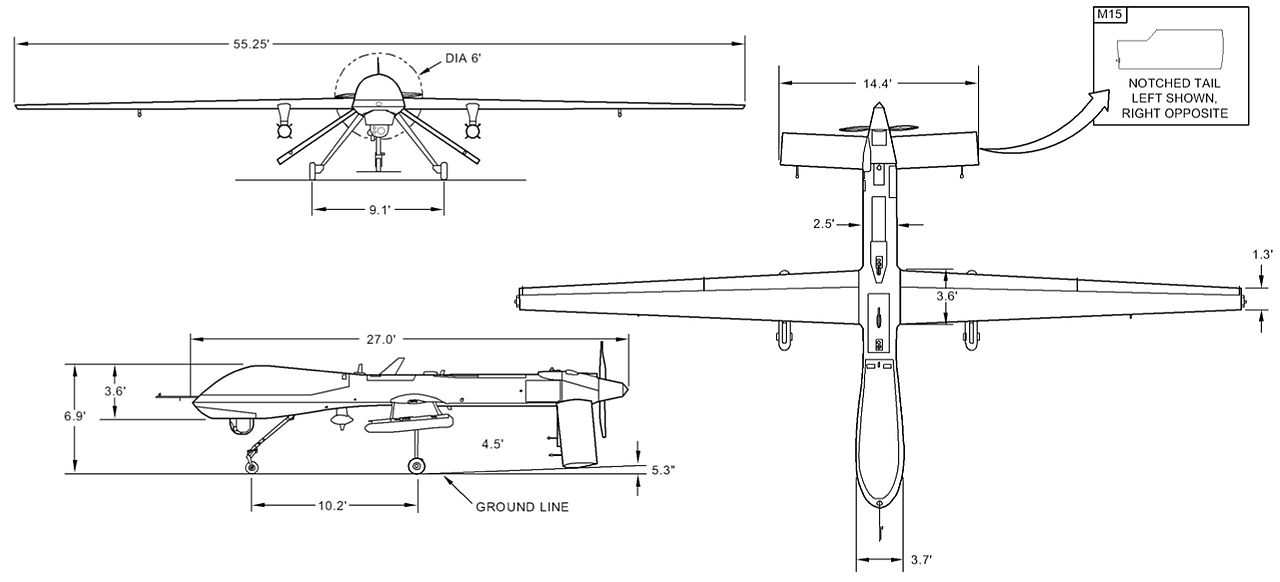
3-View line drawing and dimensions of MQ-1B Predator UAV, – Department of the Air Force, Engineering Technical Letter (ETL) 09-1: Airfield Planning and Design Criteria for Unmanned Aircraft Systems (UAS), 28 Sept 2009
The Statement of Work (Attachment_1_-_Statement_of_Work_.pdf) indicates demonstration is expected to take place at Eglin Air Force Base. “The period of performance will be one year from the date of award which is estimated to occur in September 2018.”
The Requirements
The sensor package will include Electro-optical (EO) and Infrared (IR) Full Motion Video (FMV), Maritime Surveillance Radar, Radio Frequency/Direction Finding (RF/DF) sensor, with tactical communications radio/data link.
Minimum airframe performance in the full up configuration include 50 knot patrol speed, 15,000 foot ceiling, 24 hour endurance.
Takeoff and Recovery Wind Limits are 20 knot headwind, seven knot crosswind, and up to five knot gusts.
For identification the airframe will be equipped with Air Traffic Control Radar Beacon System, Identification Friend or Foe, Mark XII/Mark XIIA, Systems (AIMS) certified (AIMS 03-1000A) Mode 3 A/C transponder with “IDENT” capability.
Commentary
Presumably this will result in a RFP for a land based LR/U-LE UAS, but probably not before FY2021.
I would note that the demonstration provides no slack for trade-offs between search width, speed, and endurance to determine total area searchable. The 24 hour endurance is fixed. There is also no dash speed requirement. To me this suggest that the system is more for tracking than searching, although it could also do that as well.
There is also no mention of ViDAR as an alternative to Radar.
Given distance to operating area and the relatively slow speed of these assets, to maintain an asset on scene is going to require more than one sortie per day, probably more like two per day. That suggest that a 24/7/365 on scene capability will require five or six airframes.





 Chuck Hill's CG Blog