The following from the German Navy blog, Marine Forum, 13 March, “IVORY COAST, Islamist terrorists (reportedly al Qaida affiliated) stormed a beach resort in Ivory Coast … attack beaches and three hotels and kill at least 16 people … six attackers also killed … … unconfirmed reports allege US government delegation may have been targeted.
Sensor Hosting Autonomous Remote Craft (SHARC)
These little Unmanned Surface Vehicles (USVs) may be one way to enhance our Maritime Domain Awareness. They have already traveled a million nautical miles.
NavyRecognition has the story.
I could see a line of these in the Eastern Pacific, used to detect drug smuggling semi-submersibles.
Perhaps we will also see them used to cue Anti-Submarine Warfare Continuous Trail Unmanned Vessels.(ACTUV) or maritime patrol aircraft to the presence of submarines. It might not be too expensive to provide a line of them covering an entire trans oceanic route.
There will almost certainly be a war time role for launching these or something similar. Maybe a role for our buoy tenders.
Loss of the Leopold, 9 March 1944
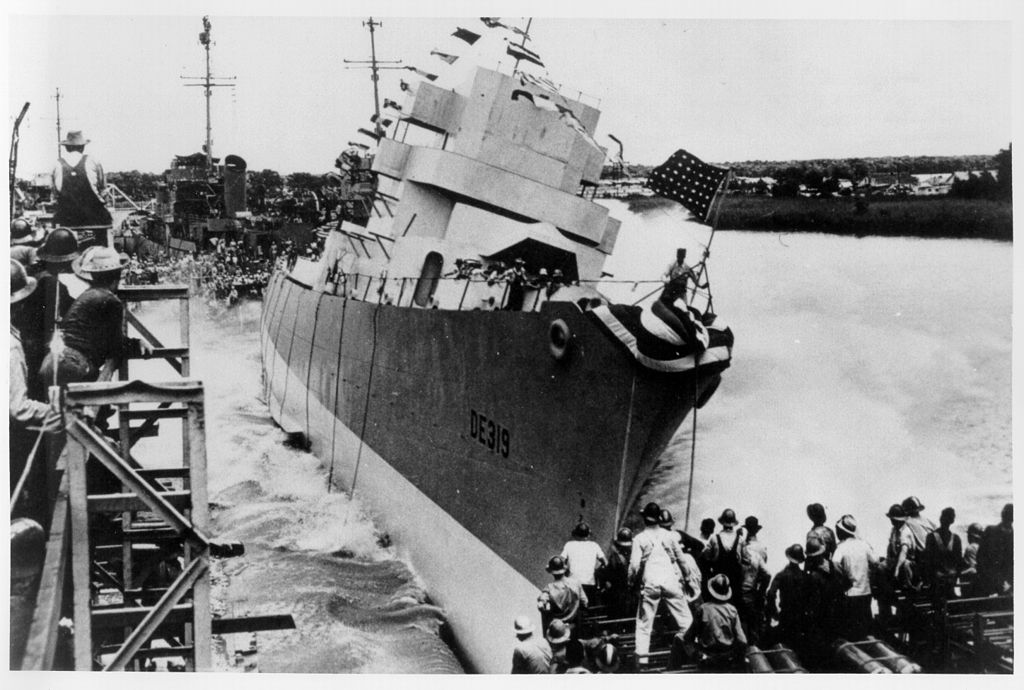
On 9 March 1944, one of the 30 destroyer escorts the Coast Guard manned during WWII, USS Leopold (DE-319), was sunk south of Iceland, in the midst of a Gale, by what was then a new, cutting edge weapon, an acoustic homing torpedo.
All of the Leopold’s 13 officers and 158 of her complement of 186 enlisted men were lost. There were only 28 survivors.
This was the second largest loss of life (171) in a single incident in Coast Guard history, exceeded only by the Explosion of the USS Serpens (AK-97) which killed 196 Coastguardsmen. It is more than the USCGC Tampa (111), the Escanaba (103), or the USCGC Muskeget (116) and many more than D-Day of the Normandy invasion (13).
USS Joyce (DE-317), also Coast Guard manned, was Leopold’s sistership. She rescued 28 survivors from a crew of 199.
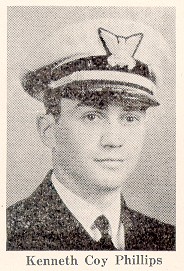
Photo: Leopold’s CO, LCdr Phillips
Specifications for the Leopold and Joyce. Edsall Class Destroyer Escort
- Displacement: 1,253 tons standard; 1,590 tons full load
- Length: 306’ (93.3 m) oa
- Beam: 36’7” (11.2 m)
- Draft: 10′ 5′ (3.2 m) full load
- Machinery: 2-shaft Fairbanks Morse diesels, 6,000 bhp
- Range: 10,800 nmi at 12 knots
- Top Speed: 21 knots
- Complement: 186
- Armament: 3 x 3”/50; 2 x 40mm; 8 x 20mm; 3 x 21″ torpedo tubes; 2 x depth charge tracks; 8 x depth charge projectors; 1 x hedge hog.
Twelve of this class were transferred to the Coast Guard 1951 to 1954 for service as Ocean Station Vessels. Ten of those had been Coast Guard manned during WWII. This class had the logistics and training advantage, that they had the same engines as the 311 foot cutters
Seems Like We Have Seen This Before
Maritime Security Review reports HMAS Darwin has seized large shipment of arms being smuggled into Somalia.
This sounds sort of like the way ended up sending cutters to Vietnam.
Rogue Wave Prediction
gCaptain reports that MIT claims to have developed an algorithm that can provide warning of incoming rogue waves two to three minutes before they arrive.
“Rogue waves can measure eight times higher than the surrounding seas and can strike in otherwise calm waters, with virtually no warning … To put the algorithm into practice, he says ships and offshore platforms will have to utilize high-resolution scanning technologies such as LIDAR and radar to measure the surrounding waves.”
Having been on the old Mackinaw on a relatively calm day and suddenly taking a 53 degree role without any warning, I am a believer.
Enlisted Memorial at Cape May

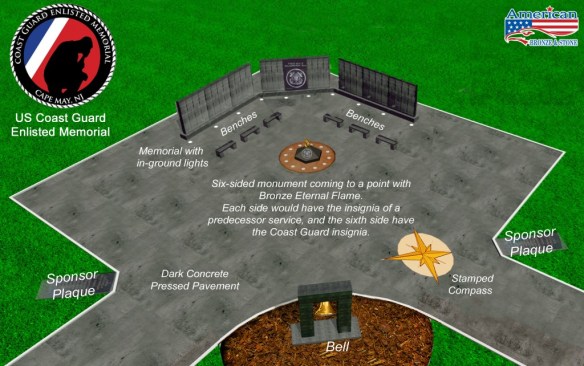
CoastGuardNews brought to my attention, a planned memorial for the approximately 1500 enlisted Coast Guardsmen who have died on duty since the establishment of the service in 1915.
Unfortunately this was the first I had heard of the project. You can see more information about the design of the memorial here. The home page for the CG Enlisted Memorial Foundation is here.
The Enlisted Memorial Foundation also maintains a data base. The Combat Deaths section was particularly interesting, although it did fail to include the men from the Seneca that were lost in WWI, it did bring to my attention an element of Coast Guard participation in WWII, I was not aware of. Six Coast Guardsmen were lost on the Navy destroyer transports (APD) Colhoun, Little, and Gregory during the early phase of the Guadalcanal campaign. These ships were WWI vintage destroyers that had boilers, weapons, and all their torpedoes removed so that they could serve as high speed transports. Presumably the Coastguardsmen were boat crew for the landing craft the destroyer transports used to land supplies and Marine Raiders.

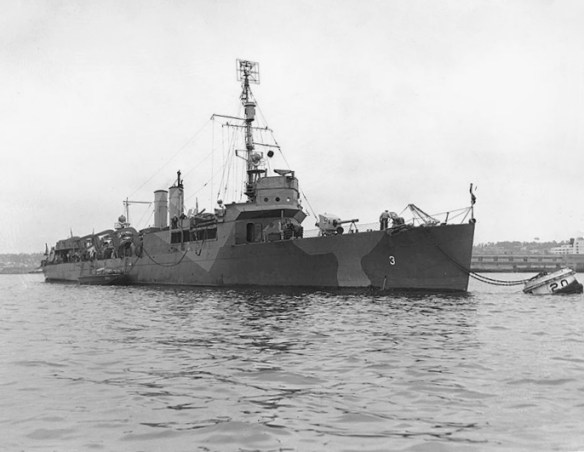
USS Gregory (APD-3) early 1942, US Navy photo. Four of this class supported the early Guadalcanal campaign. Three were sunk, Colhoun by aircraft, Little and Gregory by Japanese destroyers.
FY2017 Budget Fact Sheet
There is an FY2017 Budget Fact Sheet here. Notably it does include long lead time items for the OPC and funding for four more Webber class Fast Responce Cutters.
There is also a Coast Guard provided “Appropriation Summary” table comparing “FY2015 revised enacted,” “FY2016 enacted,” and the “FY2017 President’s budget” here. In an earlier post I tracked how the 2016 budget had changed.
Perhaps not surprisingly the AC&I request ($$1.14B) is way down from the FY2016 budget ($1.95B) which funded a ninth National Security Cutter and accelerated the OPC and icebreaker programs, but it is a bit more than the original FY2016 request ($1.02B). The total 2017 budget ($10.32B) appears to be down significantly compared to the 2016 appropriation ($11.1B) but this is attributable primarily to the decline in the AC&I account.
I would hate to see AC&I funding, again drop well below a reasonable sustained funding rate, which is about $2-$2.5B. Would love to see some of the funding for the OPC or Icebreaker moved forward into the FY2017 budget so that a $2B AC&I budget would be seen as the new norm. The Acquisitions Directorate really needs to work to make that an option.
FY2017 Budget Priorities–Commandant
Photos: Eastern’s proposal for the Offshore Patrol Cutter (left), We still have not seen much of Bollenger’s proposal, but I suspect it may look something like the photo on the right, but with a more conventional mast.
US Naval Institute News reports on the Commandant’s testimony before the House Appropriations Homeland Security Sub-committee.
“Adm. Paul Zukunft said the service will be looking again at its force-mix analysis, taking into account the money appropriated for a ninth national security cutter for this fiscal year. He said he had “the utmost confidence” the Coast Guard will down-select to one shipbuilder this year for the offshore patrol cutter.
The budget request for Fiscal Year 2017 includes $100 million for long-lead procurement for the offshore patrol cutter program.
I am a little concerned to see the statement below. Note shipbuilder (singular, not plural).
“Zukunft said that the Coast Guard is in “very emotional discussions” with the shipbuilder over the contracts for the last of the fast response cutters. “We need to come to closure on this” in the next few months to clear the way for the construction of the offshore patrol cutters.”
I was under the impression we were to have a competition for construction of the remaining ships. The Coast Guard paid for the design rights so that we could put the remained out for competitive bids. This should have happened a couple of years ago. What happened? And why is this not a multi-year buy?
There is also $150M in the budget for long lead time items for the new Icebreaker. This seems a bit odd, since the builder has not been selected, although I suppose Huntington Ingalls is the foregone conclusion.
————————————————————————–
For more on the previous Force Structure (Fleet Mix) Studies:
- https://chuckhillscgblog.net/2011/04/25/fleet-mix-where-are-the-trade-offs/
- https://chuckhillscgblog.net/2012/05/28/offshore-and-aviation-fleet-mix-study-published/
- https://chuckhillscgblog.net/2012/06/13/gao-responds-to-fleet-mix-studies-part-1-the-report/
- https://chuckhillscgblog.net/2012/08/05/gao-responds-to-fleet-mix-studies-part-2-commentary/
- https://chuckhillscgblog.net/2012/10/01/dhs-cutter-fleet-study/
- https://chuckhillscgblog.net/2012/10/12/the-dhs-cutter-study-trade-offs-and-the-case-for-cutter-x/
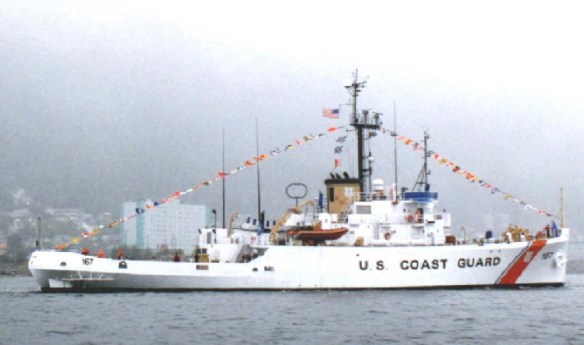
Sea Cadets Hope to Buy Former USCGC Acushnet

Stars and Stripes is reporting that Minnesota Sea Cadets are attempting to raise money to purchase the former USCGC Acushnet (WMEC-167) which also saw service as the USS Shackle(ARS-9), a Diver-class rescue and salvage ship.
She would probably be a good choice. Not only only does the ship have a long and notable history, this class was robustly built.
North Korea Embargo
From the German Navy blog, Marine Forum, “2 Mar., The UN Security Council unanimously (!) decided on new sanctions on North Korea … a.o.t. closing gaps in the arms embargo that had allowed small arms and light weapons to be sent to North Korea; now full embargo on all weapons as well as any items that could directly support the North Korean armed forces (e.g. trucks that could be modified for military purposes) … all (not just suspicious) ships coming from or going to a North Korean port have to be inspected for embargoed materials.“
While CG LEDETs will probably be involved, I cannot help but think that if we had enough ships, this would be a job better done by cutters than the Navy.