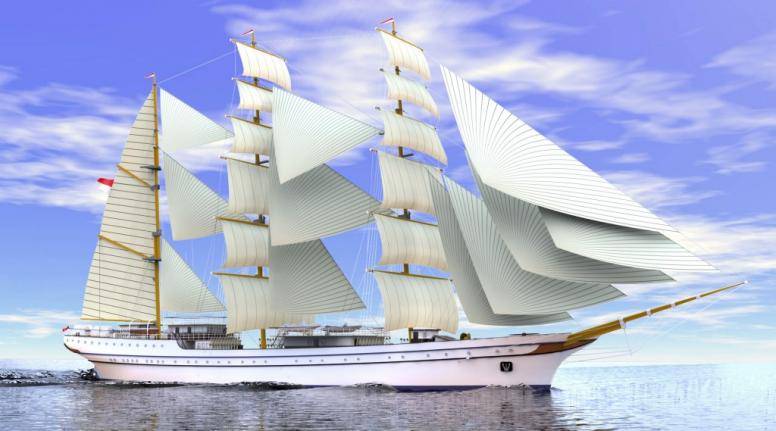
Chilean Icebreaker/Supply Vessel, plus Other News From Chile

ChileanIcebreaker

Photo: New Chilean Icebreaker/Antarctic Supply Vessel.  

I recently had an exchange of emails with Andrés Tavolari, a lawyer and Chilean Marine Reserve Officer, who wrote one of our most popular posts, Three Nations Share German OPV Design.

He tells me Chile is building an icebreaker/supply ship. In terms of horsepower, it will be more powerful than the old Wind class icebreakers and only slightly less powerful than the Glacier. Our resident icebreaker expert, Tups, talked about this ship in a comment on an earlier post.

VARD is designing an icebreaker for the Chilean Navy:

http://www.marinelink.com/news/icebreaker-antarctic404371.aspx

One thing that puzzles me is the performance. 14.5 MW for 2 knots in 1 m ice? I mean, the bigger South African research vessel S. A. Agulhas II can do 5 knots with just 9 MW propulsion power (12 MW installed power).

My initial comment was that “Some times they just call out the minimum contract specs. Does not mean they might not be capable of more.” While that might be the case, there is an alternate possibility, perhaps the hull will not be strong enough to break heavier ice or to break one meter of ice at a faster rate. If you look at where Chile has their Antarctic stations, they are all about as far from the Pole as you can get and still be in Antarctica. Perhaps they do not need great icebreaking performance to accomplish their mission. Shaping very thick steel plate is undoubtably difficult and one of the more demanding aspects of building an icebreaker. Perhaps lighter plate is seen as a reasonable compromise.

512px-Antarctica_CIA_svg

Antarctic claims. This chart from Wikipedia Commons. 

Chile’s current icebreaker is the former Canadian Icebreaker CCGS Norman McLeod Rogers, which entered service originally in 1969.

Also of interest, the Chilean Navy magazine has published a special edition with some nice pictures regarding several naval and maritime activities. The text is written in Spanish, but it is mostly pictures and graphics. So the language doesn’t preclude understanding much of it.

Andres pointed out, on pages 36 and 37, there is a graphic with the ships and aircraft of the Navy. Among others there are 3 OPVs, 18 Protector class boats, 4 Grumete / Dabur class boats, 26 Archangel boats and 15 Defender boats, and 3 C-295 Persuader MPA and 8 HH-65 Dolphin helicopters. All in all, there are 22.000 men and women in the navy, including some 2.800 marines. The icebreaker is illustrated on page 44.

On page 45 there is some information regarding the OPVs project called “Danubio”. This is a continuation of the OPV project Andres posted about earlier.

Andres also sent along some information about their Navy’s Shipyard, in the form of a power point presentation including some pictures of the damage suffered by the 2010 tsunami, and its reconstruction (slides 19 – 26). Slide 39 covers the icebreaker.

We also talked a little about the organization of Chile’s Coast Guard counterpart, DIRECTEMAR. It is a part of the Navy organization. While heads of DIRECTEMAR have gone on to head the Navy, these officers have not come up through the ranks in DIRECTEMAR, they have been regular Navy officers.

DIRECTEMAR’s counterpart to our WPBs are the 16 Danubio Class, delivered 1999-2004.

  • 125 tons fl
  • 25 knots
  • 33.1×6.6×1.9 meters or 109x22x6.2 feet
  • one 12.7mm
  • 2 MTU 16V2000 M90 diesels 3,200HP
  • 2 off, 8 enlisted
Many of DIRECTEMAR’s small boats will look familiar. They have a number of USCG type boats procured through Foreign Military Sales, which have proven effective in countering illegal fishing activities.

Document Alert: World Wide Threat Assessment of the US Intelligence Community, 2/9/16

We have a statement for the record (pdf) from James R. Clapper, Director of National Intelligence, dated February 9, 2016. Perhaps it is the nature of the beast, but there is no good news, and much that is bad.

Smuggling of every type appears to be on the rise including drugs and people. We can expect an increase in illegal immigration as a result of violence, poverty, and disorder in Latin America and particularly Cuba and Central America.

It is a relatively compact document. There are sections on Terrorism (pp 4-6), transnational organized crime (pp 11-12), Arctic (p 13), Environmental Risks and Climate Change (pp 13-14), health (including potential pandemics) (pp 14-15), and Global Displacement, “These 60 million consist of approximately 20 million refugees, 38 million internally displaced persons (IDPs), and approximately 2 million stateless persons, also according to UNHCR statistics.” (p.15)

There are also regional assessments including one on Latin America and the Caribbean (pp 28-29).

There is no regional assessment for the US. In terms of direct terrorist threats to the US, while there is a recognition of an aspiration on the part of various groups to attack the US, but the emphasis seems to be on “homegrown violent extremists” (HVEs) and there is nothing about the possibility of a maritime attack on the US. Is that because none exist?

Return of the Coast Artillery–and Ramblings on Weapons


Since the “Pivot to the Pacific” and Russia’s increasing aggressiveness in Europe, the Army has been reconsidering its roles.  One possibility is to turn the concept of Anti-Access/Area Denial (A2AD) against the Chinese and fortify the “First Island Chain” with Army provided Anti-Ship and Anti-Air Systems. It has been proposed that the Army use mobile Anti-Ship Cruise Missile (ASCM) launchers for this purpose, particularly in the vacinity of vital Straits providing access to the South China Sea and East China Sea, but it looks like they are going a different way.

BreakingDefense reports that the Army is looking at how they might use existing systems to provide these capabilities. If the Army develops these capabilities, and they are still based in the US, it might be possible to develop relationships that would allow the Coast Guard to call on them, if there is a threat to the US Coast. In US law, Coastal Defense is still an Army mission. The capability might be particularly useful in Alaska where available forces are at a minimum and the Coast Guard constitutes a substantial part of the military/naval presence and transportation capability.

The BreakingDefense post talks about the use of guided projectiles for the 155mm howitzer and Multiple Rocket Launcher System (MRLS) and use of the 30mm gun with air burst ammunition to provide a basic anti-aircraft (AAW) capability. Since the Coast Guard is or will be using the Mk38 mod2/3 on a the Webber class and the Offshore Patrol Cutter and this mount can also accept the 30mm gun, it might also provide the cutters with additional AAW capability.  

Shipboard use of the 155mm Howitzer and the Multiple Rocket Launcher System has been considered many times. They would provide a great Naval Surface Fire Support (NSFS) capability, but no naval systems have been actually developed. The additional capability to use these systems in an anti-ship mode might provide the motivation necessary to actually field one of these systems.

Japan, U.S., Australia, Philippines coast guards to huddle over China activities–Japan Times

WHEC.ChinaCutter

We have a report from the Japan Times that, ”

“The United States and Japan plan to hold a meeting of coast guard commanders with Australia and the Philippines as part of their efforts to forge a unified front against China’s maritime activities, according to diplomatic sources.”

with the meeting likely to take place in the Philippines.

Australia’s coast guards are volunteer organizations, more like the CG auxiliary, so their representative is likely to be Royal Australian Navy. I would think the Philippine Navy might have a role here as well. Although the Philippine Coast Guard is being reinforced, it is still not up to the task of facing down the Chinese Coast Guard. Even their Navy would have a hard time with that. There is also a Philippino fisheries management agency which is likely to be a player.

Interestingly recently Reuters reported that the US was “open” to joint patrols with the Philippines. Apparently the US is also talking Joint Patrols with India.

What does all this mean for the Coast Guard?

It appears the most likely outcome is USCG and perhaps Japanese and/or Australian ship-riders on Philippine ships and perhaps USCG ship-riders on Japanese cutters. If something happens between Chinese and Philippine units that might prompt the US to intercede, we would certainly want to know what actually happened. We don’t want to be dragged into a war because a Philippine unit acted improperly and then blamed the Chinese. Good documentation would also be useful in influencing domestic and world opinion. Ship-riders would also mean that if the Chinese attempt to bully the Philippines or Japan by the use of deadly force, it would mean they would have to consider the prossible consequences of US and/or Australian casualties as well.

There are other, less likely possibilities, we might, as 7th Fleet has suggested, send a cutter to patrol with the Philippine Coast Guard, or with Philippine Coast Guard representatives embarked, allowing the cutter to provide transportation and support for Philippine Authorities. Also possible, but probably more provocative and therefore less likely, would be putting Coast Guard LEDET and Philippine authorities on US Navy vessels to enforce Philippine law.

I suspect these consultations are in anticipation of a favorable decision on behalf of the Philippines by the International Tribunal on Law of the Sea.  If the Tribunal decices the Chinese are imposing themselves on territory that should be under Philippine administration, what will be done about it?

US and Cuba Cooperate on Marine Conservation

BairdMaritime reports,

“The National Oceanic and Atmospheric Administration (NOAA) and the National Park Service (NPS) signed a Memorandum of Understanding (MOU) with Cuba’s Ministry of Science, Technology, and Environment (CITMA). The MOU aims to facilitate joint efforts concerning science, stewardship, and management regarding Marine Protected Areas (MPAs).”

Check it out for more detail.

Presumably, the Coast Guard will have some role in enforcing restrictions on operations in these areas. Apparently the CG has had good long term relations with their Cuban counterparts.

Document Alert: Jan.27, 2016 Congressional Research Service report, Coast Guard Cutter Procurement: Background and Issues for Congress

capitol

Only been six weeks after the issuance of Dec. 14, 2015 Congressional Research Service report, Coast Guard Cutter Procurement: Background and Issues for Congress” there was already a 27 January, 2016 update, but this one is very different, because it incorporates the content of the FY2016 Appropriations Act which the President is expected to sign. Hopefully this marks a turning point in Coast Guard Procurement. 

There is a nice summary of how the budget battle developed in Table 7. “Summary of Appropriations Action on FY2016” on page 28. The biggest part of the jump from request to Appropriation was $640M for a ninth Bertholf Class, but there were other increases in both the OPC and NSC programs.

  • The NSC program went from a request for $91.4M to a final figure of $743.4M. A delta of $653M
  • The OPC program from a request for $18.5M to $89.0M permitting the award of the OPC down select contract in FY2016.
  • The FRC program began and ended as $340.0M (six more boats, a total of 38 funded through FY2016).
  • The TOTAL for all three programs went from 4449.9M to $1,172.4M

It does look like we have some friends on both sides of the aisle in Congress.

There are some significant provisions in the bill, that should change the way the Coast Guard does business and reports to the Congress.

  • There is a requirement for long range acquisition planning. They did not quite go to 30 years as the Navy has done, but to 20 years.(p.34 &37)
  • There is a requirement to track operational ship days as opposed to Days Away From Homeport which may include maintenance as well as operations. (p. 37)
  • There is a 10 year requirement to maintain a continuous ship presence in the Bering Sea and Arctic using ships at least as capable as the ones currently used. (p.30).

The Congress did seem to take the service to task for being slow in completing evaluation and implementation of the Crew Rotation Concept (CRC) and Unmanned Air Systems.

The Congressional Research Service also questions why the Coast Guard has not attempted to take advantage of the potential estimated 7% saving that typically result from Multiyear and/or Block Buy contracting. I have been wondering about this for some time myself, especially with regard to the Webber Class Fast Response Cutters which are a mature, proven program approved for full rate production. (p. 20)

Coast Guard Authorization Act for 2016/2017

A two year authorization is now on the way to the President’s desk, and there is little reason to expect he will not sign it. You can find the bill here.

It looks, good, but it is not a budget. We will have to wait and see.

It does include provision to begin planning for new polar and Great Lakes icebreakers.

Perhaps most notably it includes a near $2B AC&I budget for 2017 as well as 2016. Hopefully that will hold up.

“For the acquisition, construction, renovation, and improvement of aids to navigation, shore facilities, vessels, and aircraft, including equipment related thereto, and for maintenance, rehabilitation, lease, and operation of facilities and equipment—

(A) $1,945,000,000 for fiscal year 2016; and

(B) $1,945,000,000 for fiscal year 2017.”

Cost of German Built Patrol Boats for Saudi Arabia

NavalToday reports the Saudis are having 15 patrol boats built in Germany by boat builder Lürssen, famous for building missile and torpedo boats.

“German naval shipyard Lürssen has started construction of the 15 patrol vessels for Saudi Arabia under the €1.5 billion (approx $1.63b) contract despite of talks (sic) about cancelling the deal amidst the Middle Eastern country’s public executions early January 2016.”

That is about $109M each for craft of 35 and 38 meters. Our Webber class are 47 meters in length and cost typically $60M. Maybe not a bad deal.

Incidentally, these do not appear to be the 20 to 24 patrol boats 40 to 45 meters in length, discussed earlier as part of the Saudi Naval Modernization.