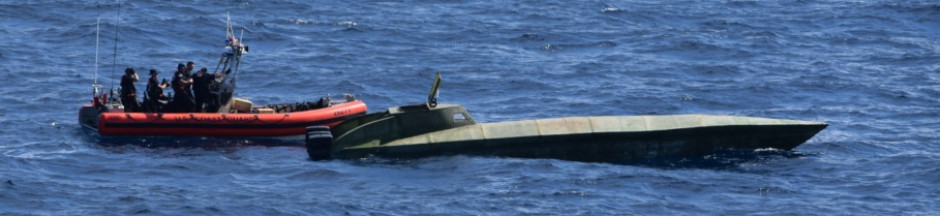
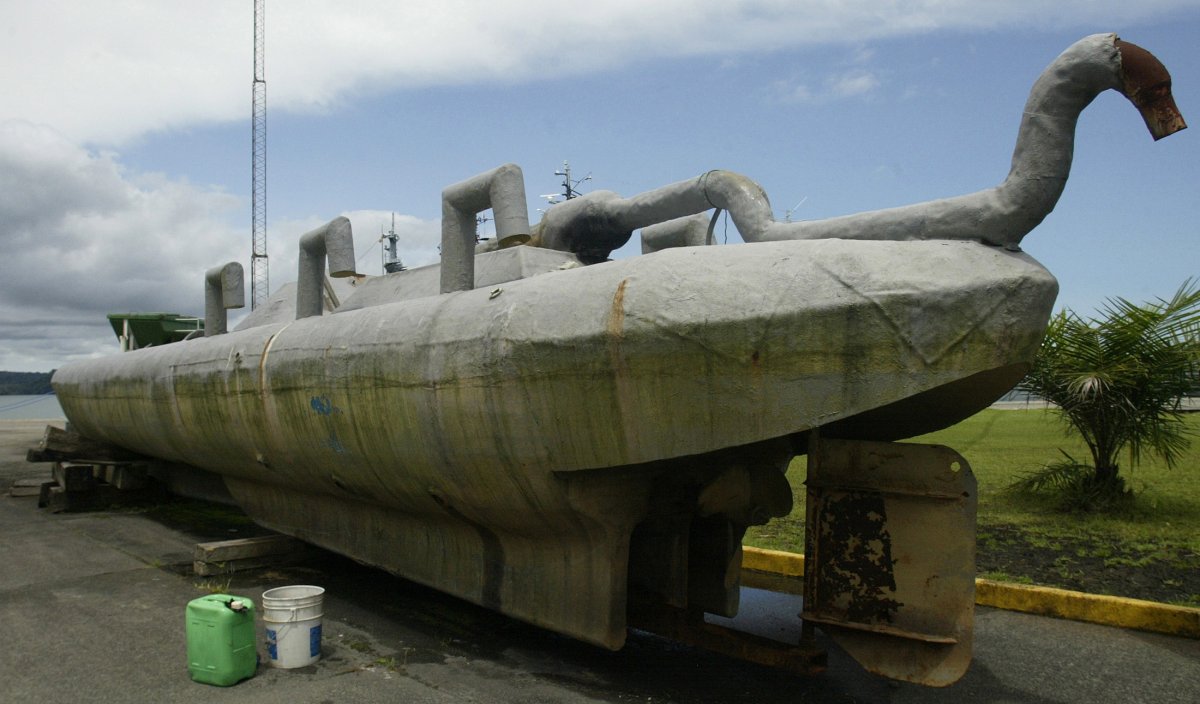
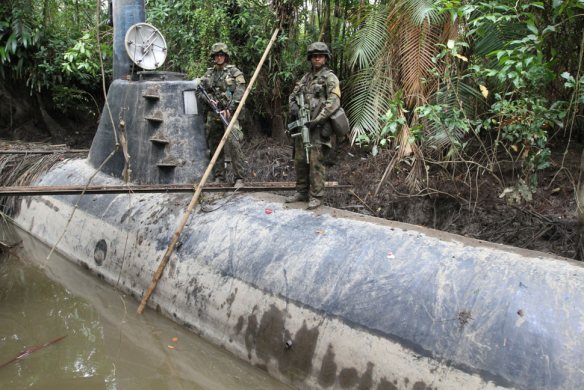
What is striking about the photos of the smuggling vessels is how similar they are, and how different from many of the preceding craft. They are not identical, so they are not being made on an industrial scale, but they are all of a common concept. The post calls them narcosubs, but they don’t have the extensive effort to minimize observability that earlier narcosubs had, and they don’t run decks awash. They have made some attempt at stealth, but the attempts to cool their exhaust to minimize Infrared signature are gone, along with the inboard diesel engines replaced by multiple outboards. They have more freeboard, and are probably a great deal faster. Looks like they have combined features from go-fasts, Very Slender Vessels, Low Profile Vessels, and semi-submersibles.
CSIS and the United States Naval Institute (USNI) conduct an interview with Admiral Karl L. Schultz, the 26th Commandant of the United States Coast Guard, conducted 1 August, 2018.
Below I will attempt to outline the conversation, noting the topics and in some cases providing a comment.
The first question is about immigration. Coast Guard is the “away game.” minimizing the factors that push immigration to the US.
The Commandant does not expect a substantial increase in help from the Navy, because they are already heavily tasked, but would welcome any additional help.
06:30 Talk about Inland fleet. Congressional support is evident. $25M provided so far.
9:20 House Appropriations Committee decision to divert $750M from the icebreaker program to fund “the Wall” in their markup of the FY2019 budget bill. The Commandant is “guardedly optimistic”
11:30 Human capital readiness? Operating account has been flat and effectively we have lost 10% in purchasing power. Want to increase leadership training.
16:30 Support for combatant commanders.
18:00 Capacity building and partnering. Detachments working on host nation platforms.
21:00 Defense Force planning–Not going back to the MARDEZ model.
22:30 Situation in Venezuela/Preparation for dealing with mass migration.
24:30 Arctic forums–Need to project our sovereignty
29:00 UNCLOS
30:00 Maritime Domain Awareness (MDA)
32:30 Tracking cargo as an element of MDA
34:00 Cyber
36:15 High Latitude engagement/partnerships.
39:30 Perhaps the icebreaker should be the “Polar Security Cutter?”
40:00 International ice patrol, still an important mission.
41:00 CG role in response to Chinese aggressiveness in the South China Sea. In discussion with Indo-Pacific Command. Will see more CG presence there.
44:00 Offshore Patrol Cutter (OPC)–on track
46:30 Border issue — passed on that
48:00 Small satellites–we are looking at them
49:00 African Capacity building/cooperation. May send an MEC.
51:30 Tech modernization. Looking at it more holistically.
Other Coverage:
This interview prompted a couple of notable posts.
Military.com reported on the possibility of a greater Coast Guard role in South East Asia and capacity building in Africa. It probably should be noted that the title, “Coast Guard Could Send Ship to Pacific to ‘Temper Chinese Influence’,”is a bit deceptive in that the Commandant’s remark about tempering Chinese Influence was in regard to Oceania, the islands of the Central and Western Pacific. The Commandant was quoted in the Seapower post, “In the Oceania region, there are places where helping them protect their interests, tempering that Chinese influence, is absolutely essential.”
Fiberglass four-man craft is typical of recent LPVs. Seized by Steadfast in the Eastern Pacific. Source: Dvids
The website “Covert Shores” has a couple of posts that purportedly show the latest fashion in drug smuggling vessels, here and here. Some great photos.
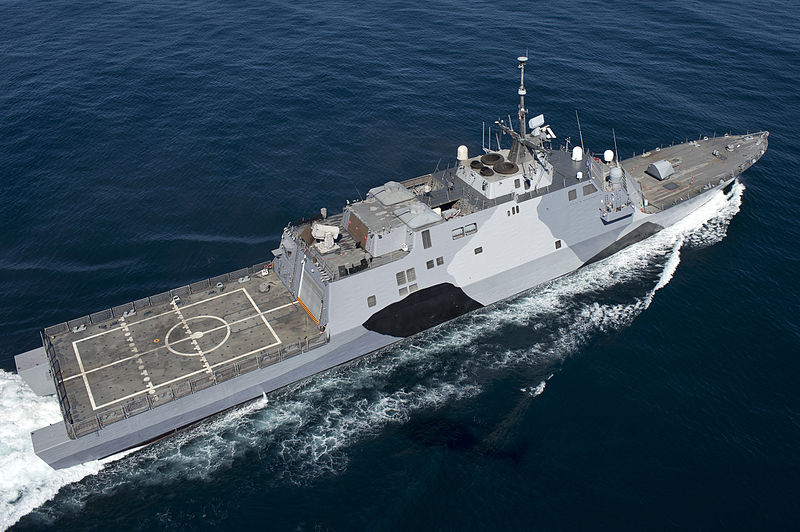
“The military is poised to decide whether it will use the littoral combat ship to stop illegal drug shipments from South and Central America to the United States.
“The move, amid pressure from lawmakers and the military command covering the Southern Hemisphere, would signal a new intensity in combating the importing of illegal drugs amid a tidal wave of opioid deaths in the U.S. It would also mean a program that has seen near-constant churn as the Navy has struggled to integrate the ship into the fleet may see more changes ― if it does have to gear up for a new mission.
There are some surprising remarks by a retired Navy Captain, reflecting what many of us believe.
“…Ultimately, if the Congress was serious about combating drugs in SOUTHCOM, he said, it should adequately fund the Coast Guard.
“What they oughta do is take a few billion from the Defense Department’s budget and give it to the Coast Guard,” Hoffman said.
“Operating Navy ships is expensive, and, at that cost, it may not be practical to send gray hulls,” he said, adding that the Coast Guard can do the job cheaper and better.
This may also reflects a desire among many in the Navy to avoid this mission.
As a side note, I would observe that the frequent assertion that the Navy is being run ragged bears some examination as to why. It does not seem to be because the ships are underway that much. The US Naval Institute News service provides a weekly “Fleet and Marine Tracker.” You can see the most recent here. Among other things it provides a number of ships in the fleet and number of ships underway. Generally the number underway is only a little over one quarter of the fleet total, and it almost never exceeds one third.
Note, I am not saying the crews are not overworked, I am just saying, it is not because they are underway too much of the time. As I recall my days afloat, we got a lot done while underway, away from the inport distractions.
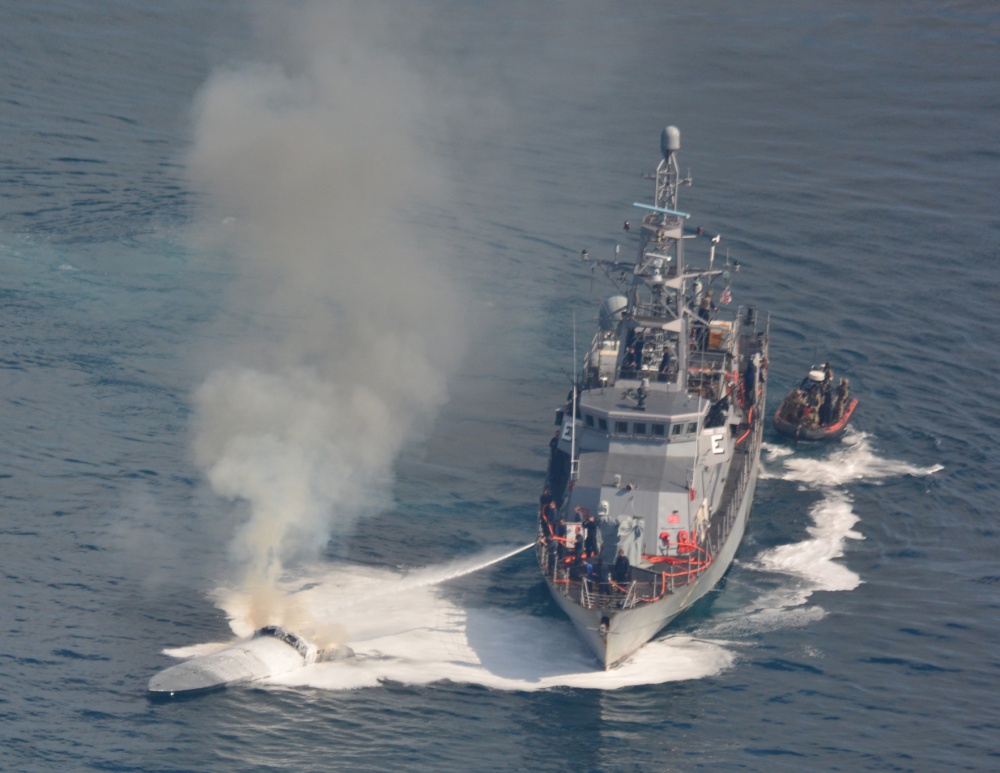
Cyclone-class patrol coastal USS Zephyr (PC 8) crew conducts ship-to-ship firefighting to extinguish a fire aboard a low-profile go-fast vessel suspected of smuggling in international waters of the Eastern Pacific Ocean April 7, 2018. Photo by Petty Officer 1st Class Mark Barney
CoastGuardNews reports a drug interdiction incident that occurred in the Eastern Pacific on April 7. I don’t usually talk about individual drug busts, but this was a bit unusual.
The vessel involved wasn’t a cutter, it was a Navy Cyclone class patrol craft, the USS Zephyr (PC-8). Using Navy vessels for drug interdiction has become rare, but that was not what I think makes this significant, it is that the vessel was essentially the same size as the Webber class WPCs (387 tons full load for the Zephyr, after it was lengthened, and 353 tons for the Webber class).
If the Navy can run a PC from Florida to the Eastern Pacific transit zones, so can the Coast Guard.
We don’t have enough large cutters to exploit all the intel we have on the target rich transit zone. Perhaps we could use Webber class.
We have 18 of the class in 7th District, with six each homeported in Miami, Key West, and San Juan.
This suggest that we could keep at least three Webber class in the Eastern Pacific transit zone by rotating one from each port
Following is a news release quoted in its entirety.
———–
Media Advisory: U.S., Canadian officials to address emerging threat from drug traffickers (photos available)
U.S. Coast Guard sent this bulletin at 01/23/2018 03:15 PM EST
News Release
January 23, 2018
U.S. Coast Guard 11th District PA Detachment San Diego Contact: Coast Guard PA Detachment San Diego Office: (619) 278-7025 After Hours: (619) 252-1304 PA Detachment San Diego online newsroom
Media Advisory: U.S., Canadian officials to address emerging threat from drug traffickers (photos available)
To view and download photos, please click the above thumbnails
WHAT: U.S. forces and international partners continue to see new smuggling tactics by transnational organized crime networks in the eastern Pacific Ocean including vessels specifically constructed for purposes of smuggling narcotics and other illicit contraband.
WHO: Senior officials from the U.S. Coast Guard, U.S. Southern Command and the Canadian Armed Forces will be available to discuss the tactics of transnational crime networks and international efforts to combat the threat posed by these criminal organizations. These senior officials include:
U.S. Coast Guard Vice Adm. Fred Midgette, commander, Pacific Area
Royal Canadian Navy Rear Adm. Art McDonald, commander, Maritime Forces Pacific
Mr. Adam Braverman, U.S. Attorney, Southern District California
U.S. Navy Rear Adm. Daniel B. Hendrickson, director, Network Engagement Team, U.S. Southern Command
WHEN: Jan. 25, 2018, at 9:30 a.m. Attending media is requested to arrive by 8:30 a.m. to gain access to the facility. Government-Issued ID and media credentials are required. To RSVP, please contact Public Affairs Detachment San Diego at 619-252-1304.
WHERE: B-Street Pier (Cruise Ship Terminal) in San Diego, 1140 N. Harbor Drive, San Diego, CA 92101.
WHY: On the heels of a record year of drug interdiction, the U.S. Coast Guard and its international partners are seeing historic drug flow from cocaine producing countries in South America coupled with new tactics and varying smuggling routes. Gangs vying over drug smuggling routes and influence have led to epidemic murder rates in Central America. The Centers for Disease Control reported another rise in drug overdose deaths in the U.S. with more than 64,000 people reportedly killed by drug overdose in 2017. Of those, over 10,000 were killed by cocaine overdose, an approximately 35 percent rise from 2016.
HOW: Transnational organized crime networks smuggle more than 97 percent of cocaine bound for the U.S. and Canada via some kind of illicit maritime conveyance in the first stage of movement from the source zone. The drugs are smuggled in large quantities from source countries in South America to transshipment points in Central America and southern Mexico. The cocaine is then broken down into smaller loads for secondary and tertiary transits to smuggle across the U.S. Southern Border.
U.S. and international forces have seen the emergence of a variety smuggling vessels specially designed and constructed by transnational organized crime groups like self-propelled semisubmersibles and, more recently, low profile go fast vessels, which are a variant design from traditional go fast vessels. These smuggling vessels are designed to elude authorities using a low profile radar signature, camouflage and, in the case of low profile go fast vessels, speed. These vessels also carry massive quantities of illicit cargo. For example, an SPSS can carry up to 16,000 pounds of cocaine. A network of international and interagency partners constantly patrol the approximately six million square mile drug transit zone used by smugglers using aircraft and vessels.
There is decent post on CIMSEC looking at the possibility of terrorists using the vehicles developed by drug smugglers to carry out an attack. The author also does a pretty good job of explaining why smugglers might be unlikely to cooperate. There is also a worthwhile bibliography associated with the post that appears to have been an academic treatise.
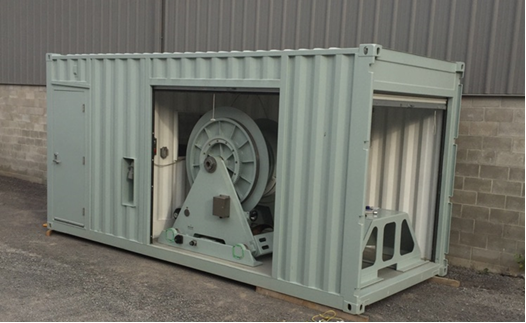
TRAPS containerized active/passive towed array from GeoSpectrum Technologies.
We talked about the possibility of using TRAPS earlier. I had an email discussion with a GeoSpectrum Technologies representative, Geoff Lebans. He tells me the Canadian Navy will test TRAPS from a Kingston class ship in March.
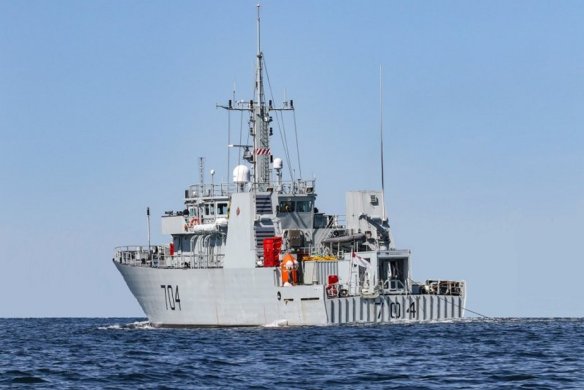
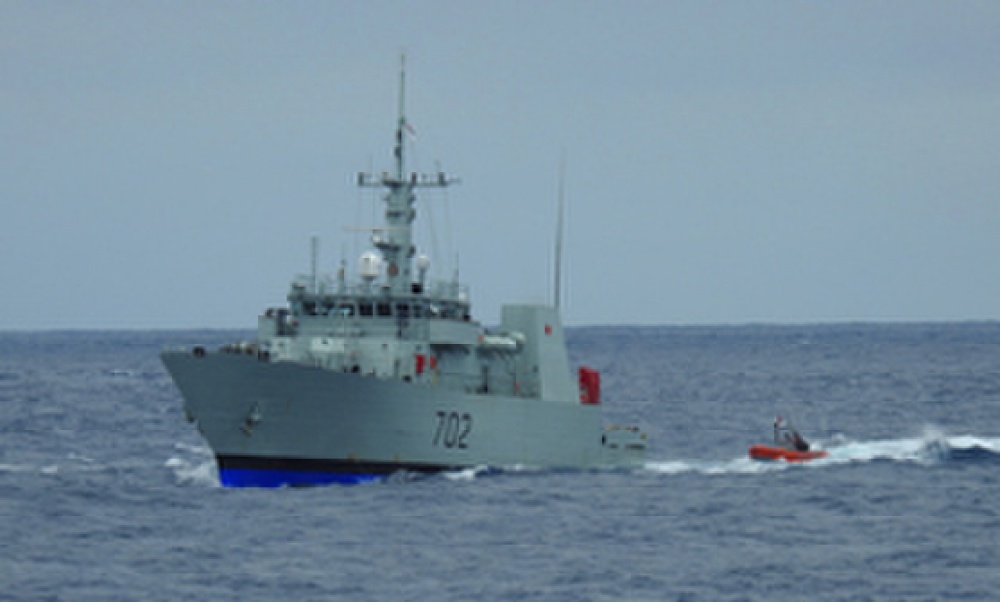
The Kingston class are a little smaller and slower than the 210 foot WMECs, but they have regularly assisted the Coast Guard in drug interdiction.
Would love to see how effective this system might be in detecting semi-submersibles.
The Coast Guard has expressed an interest in having unmanned systems providing networked sensors and GeoSpectrum makes a much smaller towed acoustic directional sensor that they believe would work with the Liquid Robotics™ Wave Glider™ and other small autonomous vehicles. Frankly, I could see the drug cartels putting a bounty on recovery of unmanned surface vessels and their sensors. Still the Navy might also be interested in this sort of network for ASW and they could probably fund the program out of loose change they might find in the sofa. Forth Fleet would probably more than happy to test it in the Eastern Pacific and cutters could probably deploy them.
TRAPS, towed reel-able Active Passive Sonar, deployed from HMCS Shawinigan, a 970 ton Kingston-class coastal defense vessel (photo added 7/03/2020)
Hopefully the Canadians will send their TARPS equipped ship down to the Eastern Pacific transit zones. If they do not, it might make a good Coast Guard R&D project to mount one on the back of a WMEC and use it to help define competitive contract requirements.
An acoustic system like this should be good for detection of something like a semi-submersible out to at least the first convergence zone, well beyond the visual and radar horizon. Mounted in a container they could be placed on WMECs bound for the Eastern Pacific and then transferred to the OPCs as they replace the MECs.
HMCS Nanaimo, a Royal Canadian Navy maritime coastal defense vessel operating in support of Operation Martillo
They will certainly need Coast Guard Law Enforcement Detachments aboard, but the mention of Scan Eagle makes me wonder about the aviation support planned. No mention of helicopter or the larger MQ-8 UAS. Are they going to want a Coast Guard Airborne Use of Force helicopter detachment?
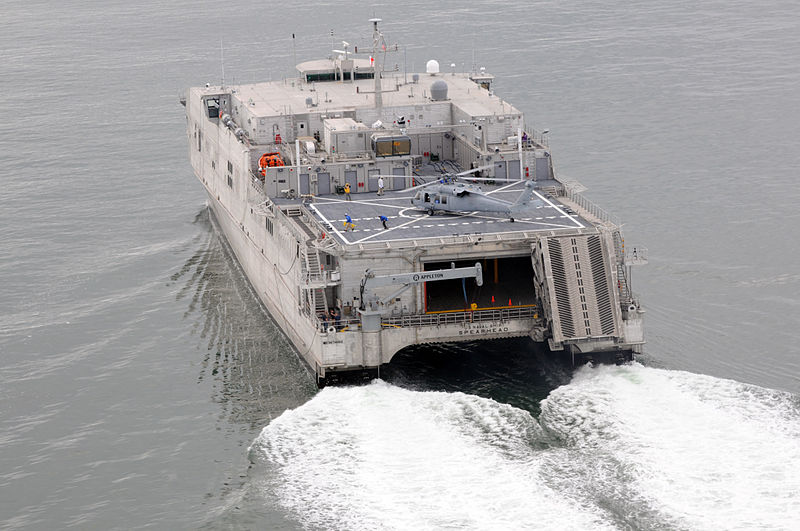
The Military Sealift Command joint high-speed vessel USNS Spearhead (JHSV 1) (Now T-EPF-1)conducted high-speed trials, reaching speeds of approximately 40 knots off the coast of Virginia. (U.S. Navy photo by Mass Communication Specialist 1st Class Phil Beaufort/Released) 130820-N-ZO696-135
Federal News Radio has an interview with the Commandant. There is a short written summary here or you can listen to it on their page or above. Some interesting developments with regard to drug interdiction in the Eastern Pacific. Sea story about actual employment of a sea based Unmanned Air System.
Interestingly he again refers to Russia arming Icebreakers so I think perhaps we may see some movement to arm or at least make provision for arming our new icebreakers.






 Chuck Hill's CG Blog