Will There be Surplus MQ-1 Predators?

Predator Unmanned Aerial Vehicle (UAV) flies on a simulated Navy aerial reconnaissance flight near the aircraft carrier USS Carl Vinson (CVN 70) off the coast of southern California on Dec. 5, 1995. The Predator provides near, real-time infrared and color video to intelligence analysts and controllers on the ground and the ship. This is the Predator's first maritime mission with a carrier battle group. The UAV was launched from San Nicholas Island off the coast of southern California. DoD photo by Petty Officer 3rd Class Jeffrey S. Viano, U.S. Navy.

Predator Unmanned Aerial Vehicle (UAV) flies on a simulated Navy aerial reconnaissance flight near the aircraft carrier USS Carl Vinson (CVN 70) off the coast of southern California on Dec. 5, 1995. The Predator provides near, real-time infrared and color video to intelligence analysts and controllers on the ground and the ship. This is the Predator’s first maritime mission with a carrier battle group. The UAV was launched from San Nicholas Island off the coast of southern California. DoD photo by Petty Officer 3rd Class Jeffrey S. Viano, U.S. Navy.

DefenseNews appears to be telling us that the AirForce is replacing the MQ-1 Predator with the more capable MQ-9 Reaper.

Does that mean there will be surplus MQ-1s?

We have a need for shore based Unmanned Aircraft to enhance Maritime Domain Awareness. Perhaps surplus Air Force Predators could be an interim step.

My Unfunded Priority List

An earlier post reported a plea by Representative Duncan Hunter, Chair of the Transportation Subcommittee on Coast Guard and Maritime Transportation, for the Coast Guard to provide an unfunded priority list to include six icebreakers and unmanned Air System.

Thought perhaps I would list my own “unfunded priorities.” These are not in any particular order.

PLATFORM SHORTFALLS

Icebreakers: We have a documented requirement for three heavy and three medium icebreakers, certainly they should be on the list. Additionally they should be designed with the ability to be upgraded to wartime role. Specifically they should have provision for adding defensive systems similar to those on the LPD–a pair of SeaRAM and a pair of gun systems, either Mk46 mounts or Mk38 mod 2/3s. We might want the guns permanently installed on at least on the medium icebreakers for the law enforcement mission. Additionally they should have provision for supporting containerized mission modules like those developed for the LCS and lab/storage space identified that might be converted to magazine space to support armed helicopters.

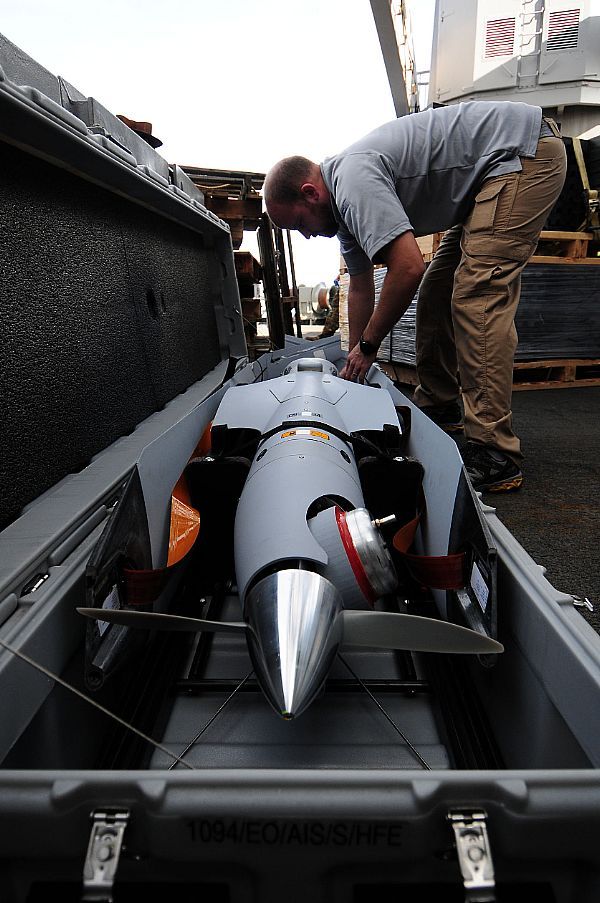
110225-N-RC734-011 PACIFIC OCEAN (Feb. 25, 2011) Guy Mcallister, from Insitu Group, performs maintenance on the Scan Eagle unmanned aerial vehicle (UAV) aboard the amphibious dock landing ship USS Comstock (LSD 45). Scan Eagle is a runway independent, long-endurance, UAV system designed to provide multiple surveillance, reconnaissance data, and battlefield damage assessment missions. Comstock is part of the Boxer Amphibious Ready Group, which is underway in the U.S. 7th Fleet area of responsibility during a western Pacific deployment. (U.S. Navy photo by Mass Communication Specialist 2nd Class Joseph M. Buliavac/Released)

110225-N-RC734-011
PACIFIC OCEAN (Feb. 25, 2011) Guy Mcallister, from Insitu Group, performs maintenance on the Scan Eagle unmanned aerial vehicle (UAV) aboard the amphibious dock landing ship USS Comstock (LSD 45). Scan Eagle is a runway independent, long-endurance, UAV system designed to provide multiple surveillance, reconnaissance data, and battlefield damage assessment missions. Comstock is part of the Boxer Amphibious Ready Group, which is underway in the U.S. 7th Fleet area of responsibility during a western Pacific deployment. (U.S. Navy photo by Mass Communication Specialist 2nd Class Joseph M. Buliavac/Released)

Unmanned Air Systems (UAS): We seem to be making progress on deploying UAS for the Bertholf class NSCs which will logically be extended to the Offshore Patrol Cutters. So far we see very little progress on land based UAS. This may be because use of the Navy’s BAMS system is anticipated. At any rate, we will need a land based UAS or access to the information from one to provide Maritime Domain Awareness. We also need to start looking at putting UAS on the Webber class. They should be capable of handling ScanEagle sized UAS.

File:USCGC Bluebell - 2015 Rose Festival Portland, OR.jpg

Photo: The Coast Guard Cutter Bluebell sits moored along the Willamette River waterfront in Portland, Ore., June 4, 2015. The Bluebell, which celebrated its 70th anniversary this year, is one of many ships participating in the 100th year of the Portland Rose Festival. (U.S. Coast Guard photo by Chief Petty Officer David Mosley.)

Recapitalize the Inland Tender Fleet: This is long overdue. The program was supposed to begin in 2009, but so far, no tangible results. It seems to have been hanging fire for way too long.

Expand the Program of Record to the FMA-1 level: The Fleet Mix Study identified additional assets required to meet the Coast Guard’s statutory obligations identifying four asset levels above those planned in the program of record. Lets move at least to first increment.

Alternative Fleet Mix Asset Quantities

————–POR       FMA-1      FMA-2      FMA-3       FMA-4
NSC                8             9                 9                 9                  9
OPC              25           32               43                50               57
FRC              58           63               75                80               91
HC-130         22            32               35                44               44
HC-144A       36            37               38                40               65
H-60              42            80               86                99             106
H-65             102         140             159              188            223
UAS-LB           4            19                21                21              22
UAS-CB        42            15                19               19               19

At the very least, looks like we need to add some medium range search aircraft (C-27J or HC-144).

Increase Endurance of Webber Class Cutters: The Webber class could be more useful if the endurance were extended beyond five days (currently the same as the 87 cutters, which have only one-third the range). We needed to look into changes that would allow an endurance of ten days to two weeks. They already have the fuel for it.

MISSION EQUIPMENT SHORTFALLS

Seagull_torpedo_trial_1

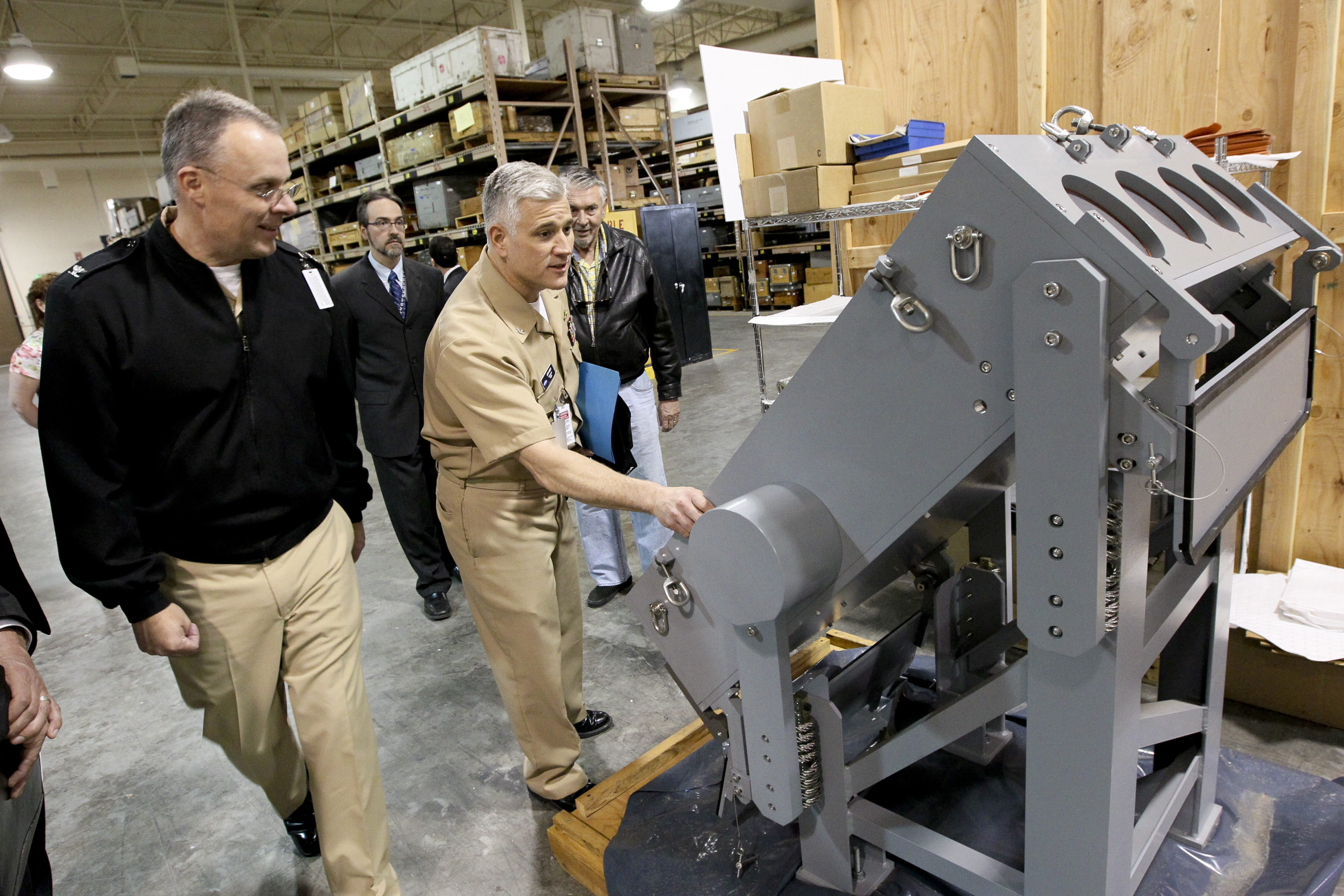
Ship Stopper (Light Weight Homing Torpedo): Develop a system to forcibly stop even the largest merchant ships by disabling their propulsion, that can be mounted on our patrol boats. A torpedo seems the most likely solution. Without such a system, there is a huge hole in our Ports, Waterways, and Coastal Security mission.

121211-N-HW977-692

Photo: SeaGriffin Launcher

Counter to Small High Speed Craft (Small Guided Weapon): Identify and fit weapons to WPB and larger vessels that are capable of reliably stopping or destroying small fast boats that may be used as fast inshore attack craft and suicide or remote-controlled unmanned explosive motor boats. These weapons must also limit the possibility of collateral damage. Small missiles like SeaGriffin or Hellfire appear likely solutions.

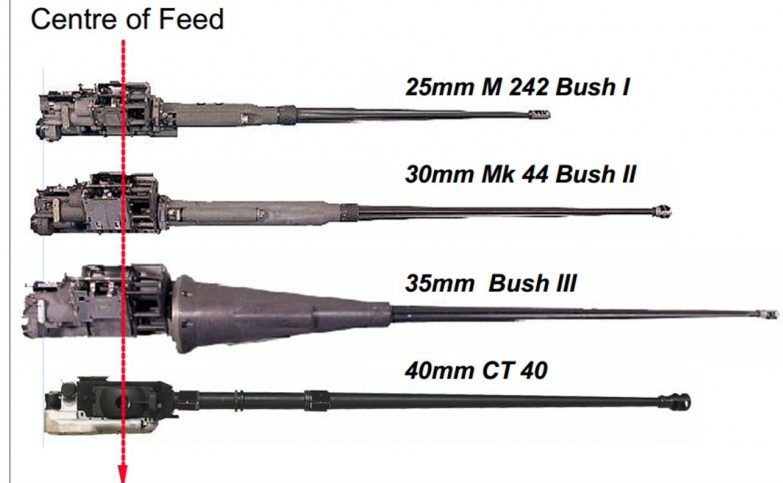
40 mm case telescoped gun (bottom) compared to conventional guns.

40 mm case telescoped gun (bottom) compared to conventional guns.

Improved Gun–Penetration, Range, and Accuracy: The .50 cal. and 25mm guns we have on our WPBs and WPCs have serious limitations in their ability to reach their targets from outside the range of weapons terrorist adversaries might improvise for use against the cutters. They have limited ability to reach the vitals of medium to large merchant vessels, and their accuracy increases the possibility of collateral damage and decreases their probability of success. 30, 35, and 40 mm replacements for the 25 mm in our Mk38 mod2 mounts are readily available.

Laser Designator: Provide each station, WPB, and WPC with a hand-held laser designator to allow them to designate targets for our DOD partners.

CONTINGENCY PLANNING SHORTFALLS

Vessel Wartime Upgrades: Develop plans for a range of options to upgrade Coast Guard assets for an extended conflict against a near peer.


Malaysia Builds 6 WPC w/sUAS, 3 Cutter X, and Gets 2 JCG cutters

Malaysia‘s counterpart of the USCG, the Malaysia Maritime Enforcement Agency (MMEA), or APMM in Malay, was formed in 2005 and has approximately 7,000 members.

Malaysia has an EEZ of 334,671 sq km, or about 3% of that of the US. In addition they have a substantial continental shelf of about the same size. The country itself is in two main parts, one on the Malay Peninsula and one part on the island of Barneo. It borders the busiest waterway in the world, the Straits of Malacca.

They have recently begun to replace the vessels incorporated in the service when the agency was formed.

The first new class is the “New Generation Patrol Craft.”

Malaysia's New Generation Patrol Craft.

Malaysia’s New Generation Patrol Craft (NGPC)

It is in many ways similar to the Webber class in size and function. It is a FASSMER design. It is a little smaller (44.5 meters or 146 feet) and a little slower at 24 knots, but it is a bit better armed, having a 30mm gun and it has one trick we do not. It will have a small Unmanned Air System and associated launch and recovery system.

The Malaysian Maritime Enforcement Agency has selected to the Fulmar UAV to equip their NGPC. The Fulmar is similar in most respects to the ScanEagle.

Aerovision Fulmar UAV, 5 May 2008, by Txema1

Aerovision Fulmar UAV, 5 May 2008, by Txema1

MalaysianDefence reports they expect to build three Offshore Patrol Vessels, at least 80 meters in length.  The RM740 Million reported allocated equates to about $167M each .

Reportedly the new OPVs will be a version of the Damen 1800 (ton) design (similar to those being built for South Africa, but with a conventional bow) 83 meters (272 feet) in length and 22 knots from 4×2350 kW diesels providing 12,600 HP.

Damen 1800 OPV, from the rear.

Damen OPV 1800 Concept Illustration

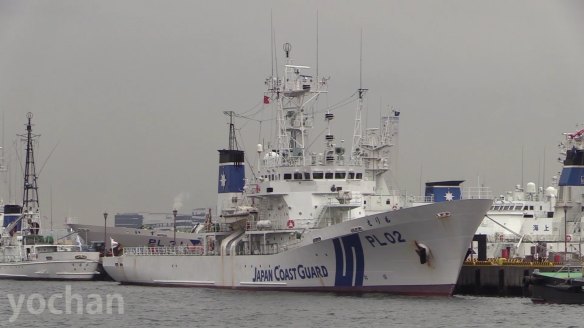
As part of their effort to build capacity among their neighbors, the Japanese are transfering two Japan Coast Guard cutters to the MMEA. The first of these, Erimo (PL-02) is, by USCG standards, still young, having entered service in 1991. She is 91.4 meters in length over all, 2,006 tons full load and capable of 20 knots with a crew of 38. The second ship wll be of the same class.

Japan CG Cutter Erimo (PL-02)

Japan CG Cutter Erimo (PL-02)

References:


Navy Bases MQ-4C in Mayport–LE Role?


NavyRecognition reports that high flying, fast, long endurance Triton MQ-4C Navy intelligence, surveillance, and reconnaissance data collection drones are being based at Mayport, FL.

Detachments will rotate to distant theaters, but they will of course fly missions out of Mayport if only to maintain proficiency. Hopefully we will see these used to support Coast Guard interdiction missions.

“Congress Must Re-Set Department of Homeland Security Priorities: American Lives Depend on It”–Heritage Foundation

US Capital West Side, by Martin Falbisoner

US Capital West Side, by Martin Falbisoner

The influencial Conservative think tank, Heritage Foundation, has issued a report on the Department of Homeland Security that will likely strongly influence the incoming administration and Congress.

It does not call for any radical increase in the Coast Guard budget for FY2017 ($10.85B). In fact it calls of less funding than was enacted in 2016 ($11.112B), but more than the current administration has requested ($10.322B).

It does support the Offshore Patrol Cutter (OPC) and Polar Icebreaker (PIB) programs and continued procurement of six Webber class (FRC) rather than the four currently requested.

For the future, it appears they support a more stable AC&I budget of at least $1.5B. To me it appears likely the AC&I budget will go higher as both the OPC and PIB enter the construction phase, and they spoke against imposition of a defacto ceiling.

The most significant new direction, seemed to be strong support for Unmanned Air Systems.

Unmanned Aerial Systems. The Coast Guard would also benefit greatly from procuring UASs to support NSC operations. According to the GAO, “Coast Guard officials acknowledged that the lack of [cutter-based] unmanned aircraft would create a gap between the NSC’s actual and planned capabilities.” Dr. William Posage, program manager for the Coast Guard Research and Development Center, explained that the lack of cutter-based UAS technologies “left the NSC with an enormous surveillance gap in her ability to perform her mission.” Notably, the operational effectiveness of the NSC without a UAS component would “be comparable to that of the 378-foot Hamilton class high-endurance cutter,” the very program it was designed to replace with capability enhancements.

The Coast Guard has successfully tested the FireScout and ScanEagle UAS platforms, both of which would significantly amplify the NSC’s surveillance, detection, classification, and prosecution capabilities. Widely used for similar naval operations, they have successfully contributed to a handful of at-sea Coast Guard demonstrations. According to an assessment by the Coast Guard Office of Aviation Forces, the presence of two vertical take-off FireScout UASs aboard an NSC would enable the cutter to cover three times the presence radius of an NSC without them. Similarly, according to a Senate Appropriations Committee report, “[t]he Coast Guard has reported…that its long standing plan to add vertical take-off unmanned aircraft systems to the National Security Cutters would result in an estimated 95- to 225-percent increase in surveillance coverage within an 800 nautical mile radius of the cutter and an estimated 95-percent increase in the number of prosecutions achieved by the cutter.”

The Coast Guard’s FY 2017 budget justification states that funding for the NSC program will in part “establish sUAS [small UAS] capability aboard one NSC, to include engineering analysis, non-recurring engineering, procurement and installation of sUAS components, and system testing and certification.” Admiral Zukunft testified before the House Transportation Committee in March 2016 that this activity would involve a “down select” for a sUAS capability “that will go on board” the NSC. The NSC will amplify its aerial ISR capabilities dramatically with the longer-term integration of sUAS, while the sea service should continue to evaluate the vertical unmanned aerial vehicle (VUAV) platform.

This seems to indicate a two pronged approach, first a small UAS (Scan Eagle or something similar) in the near future and a continued interest in evaluating a vertical takeoff unmanned system like Firescout or potentially DARPA’s TERN.

All the UAS discussion centers on the National Security Cutters. There is no discussion of the possibility of using UAS on any other classes.

Brookings Institute–A conversation with Commandant of the U.S. Coast Guard Admiral Paul F. Zukunft

Another video, this one almost an hour.

Hobby Drones as Terrorist Weapons

Since ISIS’s successful weaponization of a commercially available “drone,” as a flying improvised explosive device (IED), there has been a lot of discussion about the possibility of using hobby drones, or the technology associated with them, as a sort of poor man’s guided missile.
War on the Rocks’ “The Democratization of Air Power: the Insurgent and the Drone,” by T.  X. Hammes, Oct. 18, 2016, does a great job of outlining the potential dangers. In particular I can see that his suggestion that they could be used to employ a small explosively formed projectile to attack the wing tanks of parked aircraft could be very effective.
As a beginning drone pilot (I have both an FAA licence for drones and FCC radio amateur radio license to allow use of transmissions of more than 25 milliwatts) I thought perhaps I could put some of this into context, but I found another post, also from “War on the Rocks,” that probably does a better job than I could. “Why the IED Threat Has Barely Started” by Mark Jacobsen.
Still I would like to make some small points:
Capabilities:
When they think of drones, many, perhaps most people, will think of multi-rotors, those strange new aircraft that fly on, usually four, electric motors, but they can have amost any number three or more. They can pack an amazing degree of electronic sophistication into very small and relatively cheap packages. These can include auto pilots with GPS navigation with waypoints. The Phantom 4 is an example of the state of the art. The FAA now considers all radio controlled aircraft as “drones.”
File:DJI Phantom 4 in Flight March 2016.jpg
 Photo: DJI Phantom 4, by Doobybutch
Multi-rotors are all electric powered. Their range is limited and usually they are controlled by 2.4 GHz radios of limited output. Their visual systems that allow real time control are usually 5.8 GHz. These are short range, line of sight and can be blocked by trees and terrain.  In fact all the frequencies that are used to control and provide video for hobby UAVs (910MHz, 1.2-1.3GHz (1200-1300MHz), 2.4 GHz, and 5.8 GHZ in the US) are line of sight systems.
The are not the only potential platforms. Autopilot and navigation systems can also be applied to fixed wing aircraft or surface vessels as well as multi-rotors, and if internal combustion engines are used, they can have very long ranges. At least one fixed wing drone has crossed the Atlantic. On the other hand internal combustion systems are generally noisy and sacrifice the advantage of quiet approach enjoyed by electric systems.
Implications:
Range against moving targets like ships is limited. Fixed targets with a known geographic position can, at least theoretically, be attacked at much longer ranges.
(gCaptain has a series of ship chase videos, including the one above, that illustrate what can be done in terms of piloting a drone out to intercept a ship. The videos are all about ten to twelve minutes long. That is a typical quadcopter endurance. The Phantom 4 now claims an endurance of 28 minutes. This is a round trip and an attack would only require one way. Still the range may be less than the two way range shown because of limits on the reach of the control systems)
Reliably extending real time control beyond a couple of milles may require special transmitting antenna.
Payloads for hobby systems are very small. Most are designed for, at most, a camera like a “Go-Pro” (about 6 oz. while a typical hangrenade is about 14 oz.). Carrying greater weight will generally require a trade-off in reduced range.
Countermeasures:
The DOD is taking the small UAS threat seriously, as evidenced here and here.
For attacking moving targets, the operator requires a controlling signal from the control transmitter and, if the target is beyond the operators ability to observe both the target and the relatively small drone, a video signal from the drone. Neither of these signals is encrypted, though the typical 2.4 GHz control signal is usually frequency agile. Disrupting either signal for an extended period may result in loss of control. Early command guided missiles during were defeated relatively easily using electronic countermeasures. The presence of these signals may serve to alert the possibility of an attack.
Attacking fixed targets at a known position requires only GPS, but this signal can be rendered inaccurate with GPS blocking or spoofing.
A directed electro-magnetic pulse may be able to fry internal circuits that are built with no apparent reason for hardening.
What does it mean to us?:
The threat to parked aircraft is real, but our own aircraft are unlikely to be a target, except perhaps for those working in SOUTHCOM.
The Navy might reasonably worry about one of these taking off from a dhow or near shore in the Straits of Hormuz or Bab-el-Mendab, as a carrier passes through and having a drone attack a plane on deck in hopes of causing a major conflagration. Of course, the drone is more likely just trying to get a video from an unusual angle. We don’t really have to worry about that happening in a US port, because carriers fly off their airwings before returning to homeport.
There is the possibility of a drone attacking the bridge of a ship as it approaches a turn in a narrow channel, and the ship running aground or colliding with a bridge or another ship in the resuting confusion.
The Future:
Battery technology has been advancing very rapidly and likely will continue to do so, giving electric drones greater range.
There is some concern that future development may allow target recognition allowing the drones to pursue a moving target without operator control.

“We cannot afford to be complacent and should not infer too much from the relative absence of flying IED attacks thus far. Yes, small drones have proliferated rapidly, but the technology is still in its toddler years, and today’s widely available consumer drones are not ideal weapons. It is the next generation of drone technology that has me worried, and it will be here soon.”

ViDAR Test

ViDAR is a high resolution, large area, computer aided, optical search system we looked at earlier. Reportedly the CG tested this system in 2014.

Sentient demonstrates ViDAR optical radar to the US Coast Guard

The following is a press release from ViDAR’s developer Sentient Vision Systems recporting a recent test done with the Coast Guard.

Melbourne, Australia, 29 September, 2016

Sentient today announced the successful completion of its live demonstration of ViDAR with the US Coast Guard. The trial was conducted off Cape Cod, MA, over a week with a team from the USCG Research and Development Centre, Hood Technologies and TacAero. The demonstration highlighted ViDAR’s capability to find objects of interest at great distance, whilst searching over wide tracts of ocean from a small UAS.

The demonstration was part of the Coast Guard’s continuing evaluation of small UAS technologies and sensors currently available in the commercial market.

“Detection is critical to bringing reliability to the surveillance task. With limited size and power, small and tactical UAS are heavily constrained in what they can carry and are often therefore limited to observing what has already been found” said Simon Olsen, Sentient’s Director of Business Development, Strategy and Partnerships.  “ViDAR is the first technology with the ability to conduct wide area search from a small/tactical UAS”

The US Coast Guard demonstration of ViDAR involved an exhaustive series of search flights designed to find vessels and objects representative of Coast Guard missions. The targets were placed in the search area at locations unknown to the ViDAR operator.

Highlights from the demonstration include ViDAR successfully, and autonomously, detecting a fast boat at 17.7nm, a life raft at 3.7nm, a person in the water at 1.9nm and a shipping vessel at over 33nm. Each time ViDAR detected an object, a small image was sent to the ground automatically; allowing the operator to move from initial detection, to classification and identification in seconds.

ViDAR comprises a high-resolution digital camera that continuously scans the ocean in a 180-degree arc in front of the air vehicle. The ViDAR software autonomously detects any object on the surface of the ocean, providing the ground control station with an image and location coordinate of each object detected in real time. The zoom-able spotter sensor can then be cross-cued to the object for closer inspection, while ViDAR continues to provide ongoing situational awareness.

Operating in effect like an optical radar, ViDAR enables a wide field of view, resulting in over 80 times ocean coverage compared with existing optics.

Looks like this system has been used on Scan Eagle. Recently the Coast Guard signed its first contract to provide a Scan Eagle for operation from USCGC Stratton. The Coast Guard has been hesitant to employ UAVs that did not have radars because optical systems were not very good at search. But even radars are probably not very good at detecting semi-submersible. Perhaps this might actually be better.

If it works as advertised, hopefully see we will more of this system.

Mexico Using Drone to Protect Endangered Porpoise

The NZHerald reports,

“Mexican authorities have used drones to detect and catch six vessels fishing within an area where gill nets are banned to protect the endangered vaquita porpoise.”

all in the Gulf of California over a three day period. It is believed that only 60 of this species remain.

Would be nice to know what kind of drone they were using. I suspect it is probably a Scan Eagle.

Thanks to Mike R. for bringing this to my attention. 


Bell V-247 Vigilant tiltrotor–The Eagle Eye Look-a-Like

v-247_island-coastal-overwatch-scene_render_160916-r00-768x509

Photo: V-247 Vigilant, Bell Helicopter artist rendering

Earlier we talked about the possibility of a new tilt-rotor UAS with a configuration similar to the Eagle Eye concept that was part of the original DeepWater program. Now we have a Bell Helicopter news release which provides more information on this program and its capabilities, plus a designation, V-247, and a name, Vigilant.” A Breaking Defense post puts the program in context relative to the V-22, the Marines intended use, and the Air Force’s long endurance MQ-9 Reaper UAS.

As noted earlier, this is a much larger aircraft than the Eagle Eye would have been. Bell states that its wing and rotor folded foot print is equivilent to that of a UH-1Y (latest version of the Huey) which is much larger than an MH-65 and only slightly smaller than an H-60. It uses a single 6,000 HP engine. If deployed on a cutter it would replace a manned helicopter.

Below is the Bell news release quoted in full:


FORT WORTH, Texas (Sept. 22, 2016) – Speaking before an audience of aviation and military experts assembled at the National Press Club in Washington, D.C., Bell Helicopter, a Textron Inc. (NYSE: TXT) company, today unveiled the Bell V-247 Vigilant tiltrotor.

To download renderings of the Bell V-247 Vigilant tiltrotor, please follow this link.

The Bell V-247 tiltrotor is an unmanned aerial system (UAS) that will combine the vertical lift capability of a helicopter with the speed and range of a conventional fixed-wing aircraft.  The revolutionary UAS is designed to provide unmatched long-endurance persistent expeditionary and surveillance capability and lethal reach, as well as runway independence to operate successfully in maritime environments and locations without secure runway availability.

The Bell V-247 Vigilant satisfies the comprehensive spectrum of capabilities outlined in the 2016 Marine Corps Aviation Plan, and could be available for production as early as 2023. The Bell V-247 Vigilant is a solution designed to address the evolving demands of the military and transportation sectors for unmanned aircraft for a shipborne UAS platform, including:

  • The ability to operate successfully without a runway, such as in maritime environments
  • Seamless performance in locations without secure runway availability, such as at shrinking land bases in contested areas
  • Significant reduction of the logistical footprint while retaining the superior operational performance by combining the vertical lift capability of a helicopter with the speed and range of a conventional fixed-wing aircraft
  • The capacity to control the battle space effectively with 24-hour intelligence provided by unmatched long-endurance persistent expeditionary and surveillance capability

A Group 5 UAS, the Bell V-247 Vigilant is designed to combine unparalleled capability with unprecedented flexibility to execute a wide array of mission sets, including electronic warfare, ISR (Intelligence, Surveillance and Reconnaissance), escort, C4 (Command, Control, Communications, and Computers), persistent fire missions and tactical distribution. The UAS is expected to accomplish all of this with the benefits of extended endurance through plug-and-play mission packages.

“The Bell V-247 Vigilant is the next leap in innovation making the future of aviation a reality today – it’s a testament to the power and versatility of tiltrotor flight,” said Mitch Snyder, president and CEO at Bell Helicopter. “At Bell Helicopter, we are constantly challenging the traditional notion of what it means to fly by staying on the leading edge of aviation and technological development. The unmanned tiltrotor is the latest example of how we are changing the way the world flies, taking our customers into the dynamic world of next-generation aircraft.”

The Bell V-247 Vigilant’s design boasts a number of unrivaled capabilities and transformational features, including:

  • A sea-based platform, which can be sized for compatibility with DDG guided missile destroyers shipboard applications
  • Single engine tiltrotor unmanned aerial system
  • 24-hour persistent ISR with a two aircraft system
  • Speed: 250 knots cruise speed; 180 knots endurance speed; >300 knots at maximum continuous power
  • Combat range: 450 nautical miles mission radius
  • Time on station: 11 hours
  • Size: 16,000 pounds empty weight / 29,500 pounds max gross weight; 65-feet wing span; 30-feet rotor diameter
  • As it sits on the deck, the V-247 Vigilant can hold a combination of fuel, armament, and sensors, up to 13,000 pounds
  • Blade Fold Wing Stow makes V-247 Vigilant DDG hangar compatible
  • Expeditionary capability with small logistical footprint
  • Open architecture and interfaces
  • Air-to-air refueling
  • Modular payload system to provide maximum flexibility
  • Power distribution system to provide maximum mission capability
  • Redundant flight control system
  • Electro Optical System and Targeting System

The Bell V-247 Vigilant offers a dynamic profile that is uniquely suited to complete highly versatile operations and support missions. It is designed to provide extended range flying from land or ship, matchless expeditionary capabilities and to remain on-station with heightened loiter times for extended periods. With its signature blade fold wing stow design, it will fit inside a DDG hangar space, and two can be loaded on a C-17 aircraft. The open architecture of the modular payload system enhances flexibility for aircraft customization by mission type. The bays on the Bell V-247 Vigilant are designed to carry high definition sensors, fuel, sonar buoys, light detection and ranging (LiDAR) modules, 360-degree surface radar modules, an MK-50 torpedo or Hellfire or JAGM missiles optimally. Regardless of the need, the Bell V-247 Vigilant easily integrates into priority mission sets to complete multiple airborne requirements.

“Leveraging lessons learned from our extensive history and experience with tiltrotors, we have found the best available solution to fulfill the Marine Corps need for a Group 5 UAS,” said Vince Tobin, vice president, advanced tiltrotor systems at Bell Helicopter. “The Bell V-247 Vigilant will give military customers the capabilities needed to reduce the complexity of deployment, increase speed of employment, reduce mission times and increase response time – all critical elements to completing missions to save lives and protect our freedom.”

Bell Helicopter utilized its decades of applied tiltrotor experience to develop this next generation UAS. The Bell V-247 Vigilant design and capabilities bring to bear experience from the V-22 tiltrotor program and UH-1Y/AH-1Z programs, capturing the V-280 Valor’s unmatched design and performance standards in order to provide unparalleled competency to support ship-board compatibility.

Press Contact:
ANDREW WOODWARD
+1 817-280-3100
mediarelations@bh.com