More on the DHS-Select

Marine Corps Gen. John F. Kelly, commander of U.S. Southern Command, discusses the latest developments in his command's efforts to stem the flow of drugs from South and Central America while briefing reporters at the Pentagon, March 13, 2014.

Marine Corps Gen. John F. Kelly, commander of U.S. Southern Command, discusses the latest developments in his command’s efforts to stem the flow of drugs from South and Central America while briefing reporters at the Pentagon, March 13, 2014. 

DOD photo by Glenn Fawcett

BreakingDefense has a post on Trump’s pick to head the Department of Homeland Security. If you don’t already know about retired Marine General John Kelly and his tour as SOUTHCOM, its worth the read.

It leads me to believe, the Coast Guard will not be cutting its drug interdiction mission in the Eastern Pacific any time soon.

An earlier post pointed to his history of support for the Coast Guard.

Commandant Talks Prospects for Next Administration

Defense & Aerospace Report Editor Vago Muradian interviews the Commandant, Adm. Paul Zukunft, at the 2016 Reagan National Defense Forum.

The Commandant hit many of themes we have heard him discuss before, but there was also mention of beginning to replace the inland Aids to Navigation fleet. We were supposed to have had a joint program with the Corp of Engineers to develop a common design, but I haven’t heard anything about that for several years now. They are certainly due for replacement. It almost sounds like they just realized they needed to do something about this.

Where is that 30 year shipbuilding plan?

Brookings Institute–A conversation with Commandant of the U.S. Coast Guard Admiral Paul F. Zukunft

Another video, this one almost an hour.

SOUTHCOM CG PATRON

WPC Kathleen_Moore

SouthCom, actually two SouthComs in a row, and the Commandant have noted that while they have excellent intelligence on drug smugglers in the transit zone, they simply do not have adequate numbers of vessels to respond.  (Here, here, and here) There were never enough, but after decommissioning the Perry class frigates, the Navy’s contribution appears to have declined significantly. The Coast Guard seems to have upped their game, possibly more than making up for the Navy’s absence, but still–not enough ships.

There may be a way at least partially address this problem.

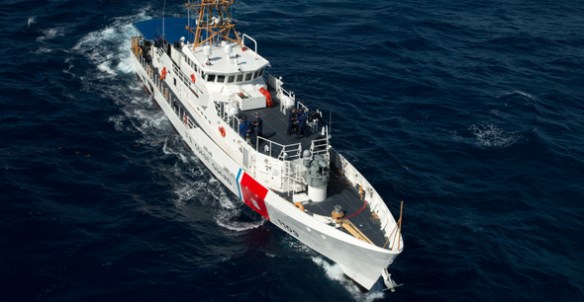
We now have 16 Webber class WPCs in three homeports in the Seventh District, six in Miami, six in Key West, and four, soon to be six, in Puerto Rico. These may be “Fast Response Cutters,” but clearly they are not all sitting in homeport waiting for SAR cases. These are law enforcement assets and they are meant to patrol. Could we perhaps, maintain as many as four in the Eastern Pacific by rotating cutters from the 7th District to fill this role in the transit zone? Obviously, it is not impossible, since the Navy is sending their similar sized Cyclone class PCs to the Eastern Pacific, but what would it take to make it work well?

Obviously they would need additional fuel and supplies while deployed. There is a good chance between Colombia, Panama, and Costa Rica, we could find a port willing to host these little white ships.

Aside from “beans and black oil” they might also need some administrative, maintenance, or medical support.

The Navy might make itself useful here by providing a simple MSC manned support vessel that could be as basic as an Offshore Support Vessel loaded with containerized offices and logistical support to provide support that the port cannot. The Navy has already chartered a number of ships of this type and could charter another.

We could start this small. First study the results of the Navy’s Cyclone class deployment. Then send a single ship from say Miami, a month later we get a second ship from Key West. Let them figure out what they need and how the problems they will inevitably encounter can be solved.

Because they cannot embark a helicopter, they will need a complementary fixed wing support, but this is already being done at least to some extent.

Once we get to a total of 18 Webber class in these three home ports, we could keep four ships assigned to SouthCom by sending two ships each month and rotating them back after two months. Seventh district would still four ships assigned to each home port, which would mean that even if two are down for maintenance they would still have two for SAR and local law enforcement.




Chilean Icebreaker/Supply Vessel, plus Other News From Chile

ChileanIcebreaker

Photo: New Chilean Icebreaker/Antarctic Supply Vessel.  

I recently had an exchange of emails with Andrés Tavolari, a lawyer and Chilean Marine Reserve Officer, who wrote one of our most popular posts, Three Nations Share German OPV Design.

He tells me Chile is building an icebreaker/supply ship. In terms of horsepower, it will be more powerful than the old Wind class icebreakers and only slightly less powerful than the Glacier. Our resident icebreaker expert, Tups, talked about this ship in a comment on an earlier post.

VARD is designing an icebreaker for the Chilean Navy:

http://www.marinelink.com/news/icebreaker-antarctic404371.aspx

One thing that puzzles me is the performance. 14.5 MW for 2 knots in 1 m ice? I mean, the bigger South African research vessel S. A. Agulhas II can do 5 knots with just 9 MW propulsion power (12 MW installed power).

My initial comment was that “Some times they just call out the minimum contract specs. Does not mean they might not be capable of more.” While that might be the case, there is an alternate possibility, perhaps the hull will not be strong enough to break heavier ice or to break one meter of ice at a faster rate. If you look at where Chile has their Antarctic stations, they are all about as far from the Pole as you can get and still be in Antarctica. Perhaps they do not need great icebreaking performance to accomplish their mission. Shaping very thick steel plate is undoubtably difficult and one of the more demanding aspects of building an icebreaker. Perhaps lighter plate is seen as a reasonable compromise.

512px-Antarctica_CIA_svg

Antarctic claims. This chart from Wikipedia Commons. 

Chile’s current icebreaker is the former Canadian Icebreaker CCGS Norman McLeod Rogers, which entered service originally in 1969.

Also of interest, the Chilean Navy magazine has published a special edition with some nice pictures regarding several naval and maritime activities. The text is written in Spanish, but it is mostly pictures and graphics. So the language doesn’t preclude understanding much of it.

Andres pointed out, on pages 36 and 37, there is a graphic with the ships and aircraft of the Navy. Among others there are 3 OPVs, 18 Protector class boats, 4 Grumete / Dabur class boats, 26 Archangel boats and 15 Defender boats, and 3 C-295 Persuader MPA and 8 HH-65 Dolphin helicopters. All in all, there are 22.000 men and women in the navy, including some 2.800 marines. The icebreaker is illustrated on page 44.

On page 45 there is some information regarding the OPVs project called “Danubio”. This is a continuation of the OPV project Andres posted about earlier.

Andres also sent along some information about their Navy’s Shipyard, in the form of a power point presentation including some pictures of the damage suffered by the 2010 tsunami, and its reconstruction (slides 19 – 26). Slide 39 covers the icebreaker.

We also talked a little about the organization of Chile’s Coast Guard counterpart, DIRECTEMAR. It is a part of the Navy organization. While heads of DIRECTEMAR have gone on to head the Navy, these officers have not come up through the ranks in DIRECTEMAR, they have been regular Navy officers.

DIRECTEMAR’s counterpart to our WPBs are the 16 Danubio Class, delivered 1999-2004.

  • 125 tons fl
  • 25 knots
  • 33.1×6.6×1.9 meters or 109x22x6.2 feet
  • one 12.7mm
  • 2 MTU 16V2000 M90 diesels 3,200HP
  • 2 off, 8 enlisted
Many of DIRECTEMAR’s small boats will look familiar. They have a number of USCG type boats procured through Foreign Military Sales, which have proven effective in countering illegal fishing activities.

Document Alert: World Wide Threat Assessment of the US Intelligence Community, 2/9/16

We have a statement for the record (pdf) from James R. Clapper, Director of National Intelligence, dated February 9, 2016. Perhaps it is the nature of the beast, but there is no good news, and much that is bad.

Smuggling of every type appears to be on the rise including drugs and people. We can expect an increase in illegal immigration as a result of violence, poverty, and disorder in Latin America and particularly Cuba and Central America.

It is a relatively compact document. There are sections on Terrorism (pp 4-6), transnational organized crime (pp 11-12), Arctic (p 13), Environmental Risks and Climate Change (pp 13-14), health (including potential pandemics) (pp 14-15), and Global Displacement, “These 60 million consist of approximately 20 million refugees, 38 million internally displaced persons (IDPs), and approximately 2 million stateless persons, also according to UNHCR statistics.” (p.15)

There are also regional assessments including one on Latin America and the Caribbean (pp 28-29).

There is no regional assessment for the US. In terms of direct terrorist threats to the US, while there is a recognition of an aspiration on the part of various groups to attack the US, but the emphasis seems to be on “homegrown violent extremists” (HVEs) and there is nothing about the possibility of a maritime attack on the US. Is that because none exist?

President Signs Illegal, Unreported and Unregulated (IUU) Fishing Enforcement Act.

Source NOAA: Albecore, Bluefin, Skipjack, Yellowfin, and Bigeye Tuna

Source NOAA: Albecore, Bluefin, Skipjack, Yellowfin, and Bigeye Tuna

BairdMaritime reports, that “US President Barack Obama has signed the Illegal, Unreported and Unregulated (IUU) Fishing Enforcement Act. The bi-partisan act promotes the sustainable management of eastern Pacific fisheries, tackles seafood fraud and prevents illegally harvested fish from entering the US.”

“In addition, the measure will allow the United States to ratify the Antigua Convention and fully participate in the work of the Inter-American Tropical Tuna Commission, which manages tunas and other highly migratory species in the eastern Pacific Ocean.”

Navy PCs Support Operation Martillo, WPCs Next?

USS_Hurricane_(PC-3),_USS_Typhoon_(PC-5)_and_USS_Chinook_(PC-9)_underway_in_March_2015

Navy photo: The U.S. Navy Cyclone-class coastal patrol ships assigned to Patrol Coastal Squadron 1 (PCRON 1), USS Hurricane (PC-3), USS Chinook (PC-9) and USS Typhoon (PC-5), transit in formation during a divisional tactics exercise in the Persian Gulf.

The Navy has announced they have three 387 ton (fl) Cyclone class patrol craft based in Mayport, rotating through the 4th Fleet’s area in support of Operation Martillo, the counter drug operation off Central America.

We know there are not enough ships to respond to all the intelligence we have on drug trafficing in SouthCom’s area of responsibility.

These little ships are considerably smaller than those we normally send South, but they are very similar in size to the new 353 ton Webber class WPCs. We have six Webber class in Miami, six in Key West, and will soon have six in Puerto Rico. If we could rotate some of these through the Transit zones, they might make a difference.

Thanks to Lee for bringing this to my attention.