An Intuitive Pointing Device (IPD) will be installed and tested aboard one of the French Navy’s PAG type patrol vessels.
We talked about this device earlier, I thought it might be used for more than just its designed purpose, perhaps even replacing our alidades.
I wanted to provide the video above, that explains some of the features of the device and better shows how it is installed.
The PAG vessels referred to in the report all operate in the Western Hemisphere, based in Martinique and French Guyana, so there is a good chance Coasties will have an opportunity to see this system, and discuss their use with their French counterparts.
According to the video the device is currently used by nine different navies, those of the UK, France, Italy, Saudi Arabia, Egypt, Malaysia, Morocco, Korea, and Norway, so we might have other opportunities to take a look at it.
French Navy PLG light patrol vessel La Confiance in combined anti-drug training with US Coast Guard Cutter Winslow Griesser. French Navy picture.
HMAS Success (AOR-304) refuelling probe goes in for a hook-up with the US Coast Guard Cutter USCGC Waesche (WMSL-751) as the Royal Australian Navy Auxilliary Oiler Replenishment Ship conducts a dual RAS (Replenishment at Sea) off the coast of Hawaii during the Sea Phase of Exercise RIMPAC 2014, 19 July 2014. (RAN Photo by Leading Seaman Brenton Freind RAN)
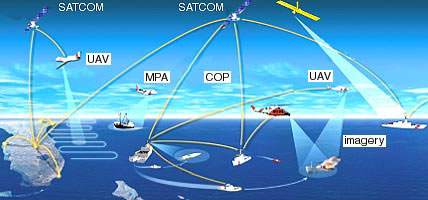
Despite the title, connectivity on other Coast Guard platforms was also discussed.
The discussion on cutter connectivity doesn’t actually start until about time 10:05. Earlier in the podcast they talk about the Midshipmen and Cadets Essay Contest (deadline 31 Oct. 2019).
He mentions specifically difficult to share UAS data and images. Even so it sounds like the most significant difficulty is that operational data is crowding out administrative data that now can no longer be done offline.
Sounds like there are three paths that might be pursued that might ease the situation.
First of course is to increase band width, but if that were easy I presume it would have already been done.
There was not discussion of tactical data links, like Link 16, but this is one way to a common shared tactical picture. Reportedly Link16 “supports the exchange of text messages, imagery data and provides two channels of digital voice (2.4 kbit/s and/or 16 kbit/s in any combination).” I am pretty sure the NSC has Link 16, but most Coast Guard units including Webber class, aircraft, and District and Area Commands do not. Moving the tactical information to data links could free bandwidth for administrative tasks. In addition if we ever want our district and area commands to be able to call on DOD assets to respond to a terrorist attack, having access to data link could make it a lot easier.
Third, it sounds like we may have shot ourselves in the foot by eliminating previously acceptable ways to handle administrative matters. Sounds like we are forcing operational units to make it easy for administrative support units, instead of the other way around, as it should be. The extreme measures he describes as required to get the job done should be an embarrassment to the Coast Guard. The administrative system worked before internet. It can work without it. There are ways around these problems.
In the August 2019 issue of US Naval Institute Proceedings, their annual “Coast Guard focused” issue, you will find the three prize winning Coast Guard themed essays. First prize went to Cdr. Craig Allen, USCG. The essay contrasts the promise of Networked assets, that was a major feature of the Deepwater Program and still being touted, with the disappointing reality he sees in the actual implementation.
Put bluntly, in the past several years cutter connectivity has climbed in urgency from concern to crisis. The negative impact of poor connectivity on current mission execution already is cause for alarm, but the more important concern is the constraint it will place on the Coast Guard’s ability to shape future operations.
The whole essay is well worth the read.
The common operational picture promised is no where to be found.
As I have been pointing out since at least 2011 (also here), there is no reason our units should not have Link 16. The Navy puts it on helicopters, and I believe on the 85 foot MkVI patrol boat, so it would certainly fit on Coast Guard patrol boats, fixed wing aircraft, and our helicopters. It would improve interoperability not only with other Coast Guard units but also other US armed forces and Allies. It is a proven, widely used system. Link 16 would be very useful if we ever do become part of the US Fleet’s distributed lethality or if we need to call in Navy assets to assist the Coast Guard.
Aerostat being tested by the Hellenic Coast Guard for FRONTEX.
Naval News reports that the Hellenic Coast Guard is doing something of a 28 day comparison test between land based and Aerostat based surveillance systems on the island of Samos.
Putting a radar at 1000 meters should provide a radar horizon of about 70 nautical miles and allow detection of a 50 foot high target at up to 79 miles.
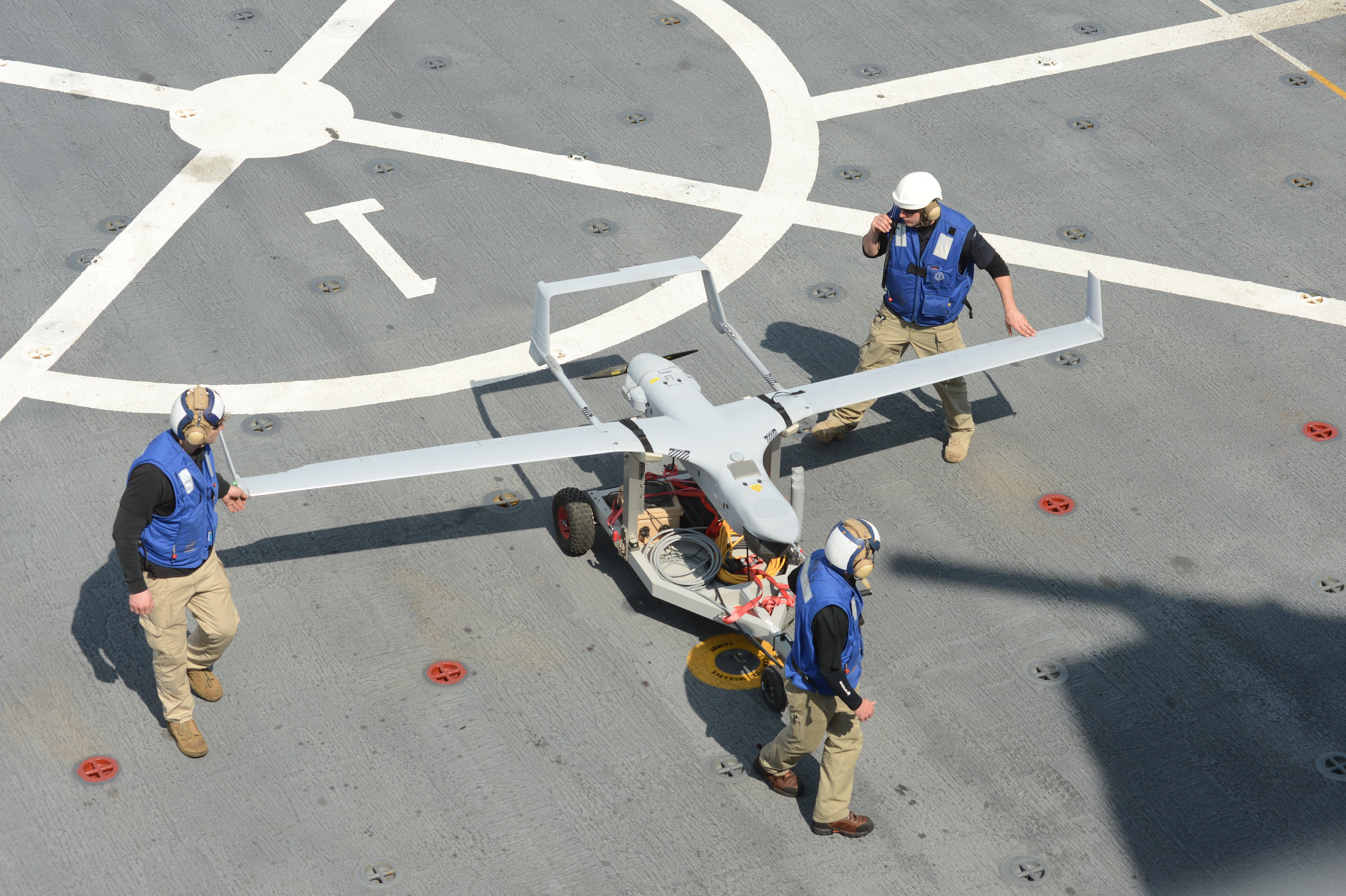
GULF OF MEXICO (Feb. 10, 2013) Members of the RQ-21A Small Tactical Unmanned Air System (STUAS) test team transport the RQ-21A across the flight deck of the amphibious transport dock USS Mesa Verde (LPD 19) after its first flight at sea. (U.S. Navy photo by Mass Communication Specialist 3rd Class Sabrina Fine/Released) 130210-N-NB538-195
The Navy League’s Magazine Seapower reports that “a synthetic aperture/ground moving target Indicator Radar Payload and has been given the prototype designation AN/DPY-2()” for the MQ-21 Blackjack.
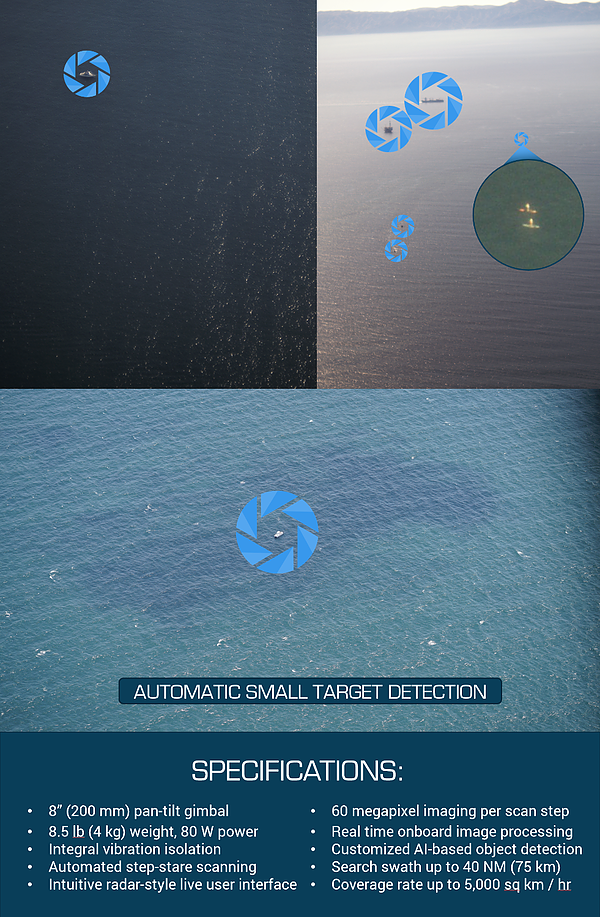
The Coast Guard has always wanted their unmanned air system (UAS) to have a radar system and the Scan Eagle that the Coast Guard has contracted for has been tested with a radar from this manufacturer. I am not sure if Coast Guard Scan Eagles are radar equipped, but, if not, it appears that radar equipped small UAS are a definite possibility.
The RQ-21 Blackjack is, like the Scan Eagle, made by Boeing Insitu. It is heavier, 135 lb (61 kg) vs 48.5 lb (22 kg) max takeoff weight, with a correspondingly larger payload weight, but like the Scan Eagle it launches from the same launch and recovery systems.
The radar may be a bit large for Scan Eagle, but apparently not for the Blackjack.
The NSP-5 delivers high-performance capabilities despite its small size, weight and power characteristics. Commercially, the NSP-5 is available in a standard pod configuration that measures 5.4 inches (13.7 centimeters) in diameter and 45.3 inches (115 centimeters) in length, weighs 16 pounds (7.3 kilograms) and consumes 150 watts of power.
I found the Joint Explanation easiest to wade through. The Budget breakdown is found on pages 65 to 69 of the 612 page pdf.
Note in some cases I have rounded to the nearest $0.1M
Our total Coast Guard FY2019 budget is $12,015,921,000. This is $91,803,000 less than last year, but $577,720,000 more than the budget request.
The Operations and Support allocation is $7,808.2M. That is $434.9M more than last year (a 5.6% increase), and $215.1M more than requested.
I have provided information on the PC&I budget below including a complete list of line items that I was unable to provide before.
PROCUREMENT, CONSTRUCTION, AND IMPROVEMENTS (PC&I) $2,248.26M
Vessels and Boats
Survey and design: 5.5M
In service vessel sustainment: 63.25M
National Security Cutter: 72.6M (Follow up on ships already funded)
Offshore Patrol Cutter: 400M (Second of class + LLTM for third)
Fast Response Cutter: 340M (Six Webber class including two for PATFORSWA)
Cutter boats 5M
Polar Security Cutter: 675M (First of class + LLTM for second)
Waterways Commerce Cutter: 5M
Polar sustainment: 15M (Polar Star Service Life Extension)
—-Vessels Subtotal: $1,581.35M
Aircraft
HC-144 Conversion/Sustainment: 17M
HC-27J Conversion/Sustainment: 80M
HC-1330J Conversion/Sustainment: 105M
HH-65 Conversion/Sustainment: 28M
MH-60 Conversion/Sustainment: 120M
Small Unmanned Aircraft: 6M
—Aircraft Subtotal: $356M
Other Acquisition Programs:
Other Equipment and System: 3.5M
Program Oversight and Managemen: 20M
C4ISR 23.3M
CG-Logistics Information Management System (CG-LIMS): 9.2M
—Other Acquisitions Programs Subtotal: $56M
Shore Facilities and Aids to Navigation:
Major Construction; Housing; ATON; and Survey and Design: 74.51M
Major Acquisition Systems Infrastructure: 175.4M
Minor Shore 5M
—Shore Facilities and Aids to Navigation Subtotal: $254.91M
The PC&I total, $2,248.26M, was $446.48M less than FY2018, but it was $361.51M above the budget request.
—
R&D was cut by almost a third. This is probably a place to spend more not less.
Reserve Training disappeared as a separate line item, so I can’t tell what happened there.
Also included in the new budget is $5M for the National Coast Guard Museum
Incidentally, the total amount appropriated for the polar security program includes $359.6M (FY2018 and prior) + $675M (FY2019), or $1,034.6M, of which $20M is for Long Lead Time Material for the second ship, and the remainder is for the first ship and other program-related expenses.
With Operations and Support up more than 5% over 2018 and Procurement Construction &Improvement (PC&I) over $2B for the second year in a row, this is the kind of budget we can live with. It just needs to keep happening.
There have been numerous improvement since the introduction of the S-100 over a decade ago. It has been integrated with more sensors including a synthetic aperture radar. A heavy fuel engine compatible with JP-5, Jet A-1 or JP-8 jet fuels is now optional, as a replacement for the original gasoline engine. Using an auxiliary fuel tank it now possible to extend its normal six hour endurance to up to 10 hours.
The S-100 is very widely used. Operators or those who are buying the system include the German Navy, the French Navy, the Italian Navy, the Australian Navy, and the Chinese Navy. The Russian Coast Guard uses a license built version.
The S-100 at 440 pounds max take-off is about nine times greater than that of the 48.5 pound ScanEagle, but less than a seventh that of the MQ-8B Fire Scout (3,150 lb). It doesn’t have the endurance of the ScanEagle, but with a ten times larger payload (75 lb vice 7.5 lb), given better sensors, it may be able to search a larger area per sortie. With a higher speed (120 knots max vice 80) it can get to a probability area and search it faster.
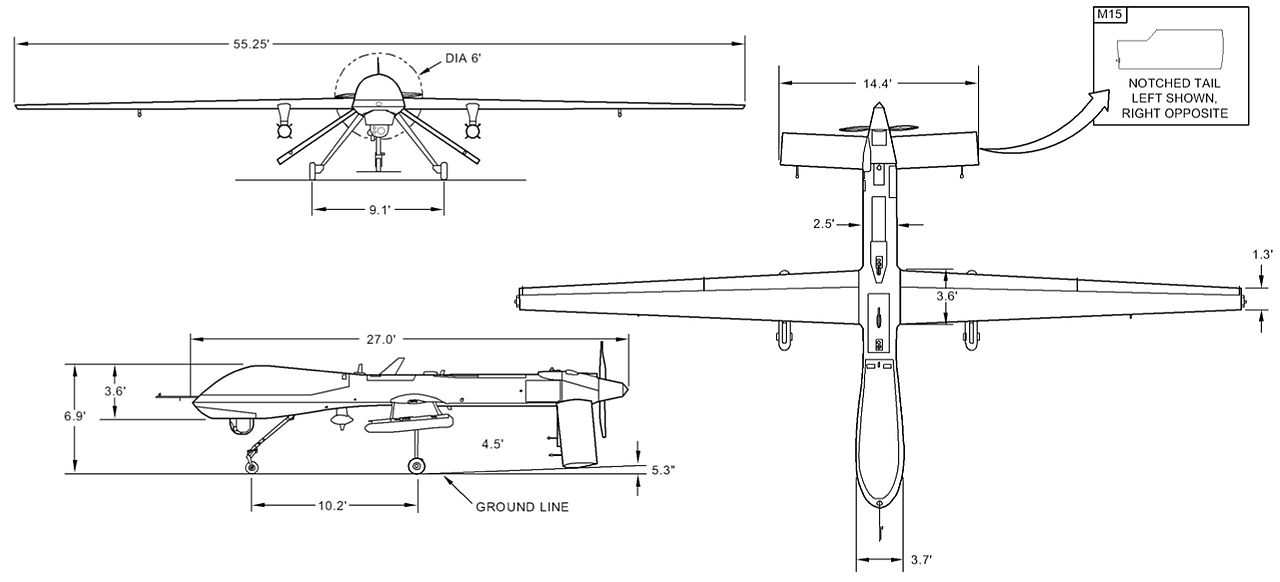
3-View line drawing and dimensions of MQ-1B Predator UAV, – Department of the Air Force, Engineering Technical Letter (ETL) 09-1: Airfield Planning and Design Criteria for Unmanned Aircraft Systems (UAS), 28 Sept 2009
Note the video does not really start until approximately time (17m08s).
This is going to be a hodgepodge, but it is all about the 2019 budget. There is a video above. There will be my own observations on the video. There will be a brief outline of the Procurement, Construction, and Improvement (formerly AC&I) portion of the budget copied from the “Summary of Subject Matter.” At the tail end I have reproduced the Commandant’s prepared statement that was presented at the hearing
You can look here for the FY2018 budget request. I haven’t found the actual final FY2018 as enacted.
ABOUT THE VIDEO
Above is a video of a 14 March, 2018, House Coast Guard and Maritime Transportation Subcommittee. The commandant testified as well as Master Chief Steven W. Cantrell, Master Chief Petty Officer of the Coast Guard, United States Coast Guard, Rear Admiral Mark H. Buzby, USN, Ret., Administrator, Maritime Administration, and The Honorable Michael A. Khouri, Acting Chairman, Federal Maritime Commission
You can find more information including all the prepared statements and the subcommittee chairman’s opening remarks here.
MY OBSERVATIONS
This subcommittee has been highly supportive of the Coast Guard, and we see the same in this hearing. The chairman, Duncan Hunter (R, CA), (17m30s) expressed his opinion that the Coast Guard was not fairing well under the Department of Homeland Security (DHS). He also noted the apparent obstruction of measures of effectiveness by DHS.
Ranking member, John Garamendi (D, CA), (22m) noted that there had been a welcomed significant bump in Coast Guard funding, but questioned if this would continue or would it prove an anomaly. He noted that attempting to stop drug trafficking would be better served by putting more money into the Coast Guard than by building a border wall.
(29m30s) The Coast Guard’s unfunded priority list, submitted long ago is still hung up in the administration.
(33m30s) MCPO Cantrell addressed quality of life concerns.
(55m30) Ranking member Garamendi noted the addition of $720M added to the budget for Heavy Polar Icebreaker(s) (HPIB) in addition to $30M already in the budget, and stated that he saw this as money for the second icebreaker because the DOD was not relieved of their obligation to fund a HPIB.
(1h03m) Commandant expressed his confidence in the helicopter life extension programs expected to keep them in operation until 2033 when the Coast Guard would be able to join in the Army lead Future Vertical Lift program. He suggested that a single helicopter type might be able to replace both the MH-65 and MH-60s.
(1h07m) Commandant answering a question about AMIO in the Caribbean noted that the Webber class Fast Response Cutters (FRC) we working well in this role, but there is a shortage of ISR assets that he believed might be addressed by land based unmanned air systems (UAS).
(1h17m) In answer to a question about replacement of the Island Class six 110 foot Island class cutters currently assigned to CENTCOM as PATFORSWA, the Commandant, noting the 110s would time out in 2022, said this has been discussed at the highest levels with the Navy and there was a possibility that Webber class replacements could be funded by the Navy. Interestingly, he also noted that the Navy’s Cyclone class patrol craft would time out in 2023 suggesting to me perhaps he believes the Navy is considering a version of the Webber class.
(1h39m) Concern was expressed that while the Commandant has consistently expressed a need for $2B annual in the AC&I account (now PC&I) and $1.8B was provided in FY2018 and $1.9B in FY2019, that the current projection is only $1.4B in FY2020.
There is also a note on a change in accounting procedure.
In FY 2019, the Coast Guard will transition to the DHS Common Appropriations Structure (CAS). Accordingly, activities funded through the previous Operating Expenses, Reserve Training, Environmental Compliance and Restoration, and Medicare Eligible Retiree Health Care Fund Contribution are included as part of the new Operations and Support (O&S) account. In addition, acquisition personnel costs previously funded through the Acquisition, Construction, and Improvements account ($118.2m in the FY2018 budget request–Chuck) are included as part of the O&S account. The Acquisition, Construction, and Improvements account transitions into the Procurement, Construction, and Improvements account and the Research, Development, Test and Evaluation account becomes the new Research and Development account.
Below is the summary information on the PC&I section that replaces the AC&I portion of the budget.
Procurement, Construction, and Improvements (previously Acquisitions, Construction, and Improvements)The President requests $1.89 billion for the Procurement, Construction, and Improvements (PC&I) account, a $516.7 million (or 37.7 percent) increase over the FY 2017 enacted level. The PC&I account funds the acquisition, procurement, construction, rebuilding, and physical improvements of Coast Guard owned and operated vessels, aircraft, facilities, aids-to-navigation, communications and information technology systems, and related equipment.The FY 2019 budget request includes $1.76 billion for the acquisition of aircraft, vessels, and the continued build-out of Command, Control, Communications, Computer, Intelligence, Surveillance, and Reconnaissance (C4ISR) systems. This represents an increase of $597.1 million (or 51.7 percent) from the FY 2017 enacted level. The budget request includes:$30 million for the construction of a Heavy Polar Icebreaker. The FY 2019 Budget Addendum included an additional $720 million, for a total of $750 million;
$65 million to conduct Post Delivery Activities on National Security Cutters (NSC) 7 through 9;
$240 million for the production of four Fast Response Cutters (FRC);
$400 million for the construction of the second Offshore Patrol Cutter (OPC) and to facilitate evaluation of the Long Lead Time Materials for OPC 3. The OPCs will replace the Service’s aging 210-foot and 270foot Medium Endurance Cutters (MEC);
$80 million to fund the requirement to establish logistics for 14 newly acquired HC-27J aircraft. The request funds HC-27J Asset Project Office activities, logistics, training, and engineering studies to assess and resolve aircraft obsolescence issues;
$20 million for the continued modernization and sustainment of the HH-65 Dolphin helicopter fleet;
$23.3 million for C4ISR design, development, and integration; and
No funding for the Alteration of Bridges program in FY 2019. The program did not receive funding in FY 2017 or FY 2016. Established by the Truman-Hobbs Act of 1940 (33 U.S.C. 511 et. seq.), the Alteration of Bridges program authorizes the Coast Guard to share with a bridge’s owner the cost of altering or removing privately or publicly owned railroad and highway bridges that are determined by the Service to obstruct marine navigation.
The budget requests $135 million to construct or renovate shore facilities and aids-to-navigation. This request is a $35.5 million (or 26.3 percent) increase over the FY 2017 enacted level. The Coast Guard currently has a backlog of 95 prioritized shore facility improvement projects with an estimated combined cost of over $1.5 billion
____
THE COMMANDANT’S PREPARED TESTIMONY
Below you will find “TESTIMONY OF ADMIRAL PAUL F. ZUKUNFT COMMANDANT, U.S. COAST GUARD ON “THE COAST GUARD’S FISCAL YEAR 2019 BUDGET REQUEST” BEFORE THE HOUSE COAST GUARD AND MARITIME TRANSPORTATION SUBCOMMITTEE” which I have copied in full.
Introduction
Mr. Chairman and distinguished members of the Committee, I appreciate the opportunity to testify today. Thank you for your enduring support of the United States Coast Guard, particularly the significant investments provided in the FY 2017 Consolidated Appropriations Act, recent Hurricane Supplemental, and ongoing deliberations to support our FY 2018 and FY 2019 President’s Budget requests.
As the world’s premier, multi-mission, maritime service, the Coast Guard offers a unique and enduring value to the Nation. The only branch of the U.S. Armed Forces within the Department of Homeland Security (DHS), a federal law enforcement agency, a regulatory body, a first responder, and a member of the U.S. Intelligence Community – the Coast Guard is uniquely positioned to help secure the maritime border, combat transnational criminal organizations (TCO), and safeguard commerce on America’s waterways.
The Coast Guard’s combination of broad authorities and complementary capabilities squarely aligns with the President’s national security and economic prosperity priorities; furthermore, it offers an agile toolset to address the Nation’s most pressing challenges. Appropriately positioned in DHS, the Coast Guard is a military service and a branch of the Armed Forces of the United States at all times.1 We are also an important part of the modern Joint Force2 and currently have forces assigned to each of the five geographic Combatant Commanders, as well as Cyber Command.
As demonstrated in the 2017 record hurricane season, the Coast Guard is the Nation’s “maritime first responder” and plays a leading role in executing the National Response Plan (NRP) for disaster situations. Our ability to rapidly surge in response to emerging threats or contingencies are critical to success across the spectrum of missions we prosecute.
We live in an increasingly volatile, uncertain, complex, and ambiguous world. Rapid technological advancement, increasing globalization, and intensifying threats from state and nonstate actors alike challenge international norms and threaten global governance.
To ensure we meet the demands of today while preparing for tomorrow, the Coast Guard is guided by a five-year Strategic Intent and suite of regional and functional strategies that drive our Service’s operations and investments.
These strategic efforts are informed by the National Security Strategy and applicable DHS strategies, and are coordinated to augment Department of Defense (DoD) priorities. Using these strategies as guideposts, leveraging the intelligence community, and employing a risk-based approach to focus our limited resources allows us to address maritime threats with the greatest precision and effect.
Strategic Effects
Fueled by the Service’s unique authorities and capabilities, our Western Hemisphere Strategy continues to yield large-scale successes in our counter-drug mission. The Coast Guard’s persistent offshore presence and associated interdiction efforts sever the supply lines of criminal networks where they are most vulnerable—at sea. Leveraging over 30 multilateral and bilateral agreements with a host of government organizations, the Coast Guard’s long-term counter-TCO efforts promote stability and strengthen the rule of law throughout these regions. Working with interagency partners, the Coast Guard seized 223 metric tons of cocaine and detained and transferred 606 smugglers for criminal prosecution in FY 2017. Highlighting our record-breaking mission performance for drug interdiction was the STRATTON’s offload of over 50,000 pounds of illicit narcotics, with an estimated street value of over $6.1 billion. This was a result of collaborative efforts between four U.S. Coast Guard cutters, DHS maritime patrol aircraft, and a U.S. Navy ship in over 25 separate interdictions. Beyond the important task of removing cocaine from the illicit system that gets it to U.S. streets, prosecuting smugglers facilitates deeper understanding of TCOs and ultimately helps our unified efforts to dismantle them.
Without question, National Security Cutters (NSC) have been a game-changer not only for our drug interdiction and counter-TCO operations in the southern maritime transit zone, but also in contributing to other national security priorities, such as supporting DoD Combatant Commander requirements across the globe and projecting sovereign rights in the Arctic.
Looking forward, the Offshore Patrol Cutter (OPC) will provide the tools to more effectively enforce Federal laws, secure our maritime borders, disrupt TCOs, and respond to 21st century threats. Continued progress on this acquisition is absolutely vital to recapitalizing our aging fleet of Medium Endurance Cutters (MECs), some of which will be over 55 years old when the first OPC is delivered in 2021. In concert with the extended range and capability of the NSC and the enhanced coastal patrol capability of the Fast Response Cutter (FRC), OPCs will be the backbone of the Coast Guard’s strategy to project and maintain offshore presence.
As one of the five Armed Forces, the Coast Guard deploys world-wide to execute our statutory Defense Operations mission in support of national security priorities. On any given day, 11 cutters, two maritime patrol aircraft, five helicopters, two specialized boarding teams, and an entire Port Security Unit are supporting DoD Combatant Commanders on all seven continents. In the Middle East, our squadron of six patrol boats continues to police the waters of the Northern Arabian Gulf in close cooperation with the U.S. Navy, promoting regional peace and stability. Likewise, as one of the principal Federal agencies performing detection and monitoring in the southern maritime transit zone, the Coast Guard provides more than 4,000 hours of maritime patrol aircraft support and 2,000 major cutter days to DoD’s Southern Command each year.
In the high latitudes, the Arctic region is becoming increasingly accessible at a time when global interests in energy, clean water, and subsistence continue to intensify. The Coast Guard is committed to the safety, security, and environmental stewardship of the Arctic, and we will remain closely engaged with our partners, including Russia, via the Arctic Coast Guard Forum. By focusing on collaboration over conflict, we are promoting governance and building a shared approach to prevention and response challenges in the region.
Meanwhile, the 42-year old POLAR STAR recently completed another Operation DEEP FREEZE patrol in Antarctica. Just one major casualty away from leaving the Nation without any heavy icebreaking capability, POLAR STAR supported U.S. strategic interests and the National Science Foundation by breaking a navigable shipping lane to deliver fuel and critical supplies to the U.S. base at McMurdo Sound.
I appreciate your support for the $150 million appropriated in Shipbuilding and Conversion, Navy (SCN) funding in the FY 2017 Omnibus. This is a great step forward to secure our future in the Polar Regions and finally recapitalize the Nation’s icebreaker fleet. This funding coupled with the $750 million in the FY 2019 President’s Budget, would enable the Coast Guard to award a contract for detail design and construction and deliver the first new heavy polar icebreaker in 2023. These critical investments reflect our interests and standing as an Arctic Nation and affirm the Coast Guard’s role in providing assured access to the Polar Regions.
At the same time the Service was conducting counter-drug missions in the Eastern Pacific and projecting sovereign rights in the Arctic, the Coast Guard also launched one of the largest responses in history during a historic 2017 hurricane season. Over a five week period, Hurricanes HARVEY, IRMA, MARIA, and NATE impacted over 2,540 miles of shoreline3, and Coast Guard men and women in helicopters, boats, cutters, vehicles and on foot rescued over 11,300 people and over 1,500 pets.
During our 2017 hurricane response, the Coast Guard resolved over 1,269 aids to navigation discrepancies, handled 290 pollution cases, located and assessed more than 3,623 grounded vessels, with more than 1,585 removed to date. Within hours after each storm’s passage, Coast Guard damage and recovery assessment teams were on-scene determining the status of ports and waterways, leveraging electronic aids to navigation when feasible to facilitate the rapid reopening of key ports and waterways, and assessing impacts to Coast Guard facilities and capabilities. This enabled a vital portion of the country’s waterways to reopen, helping maintain our Maritime Transportation System (MTS) which contributes $4.6 trillion annually to our Gross Domestic Product.
The daily activities of Coast Guard men and women are heroic, as they support nearly every facet of the Nation’s maritime interests, protect our homeland, and secure our economic prosperity. In addition to the hurricane responses, the Coast Guard prosecuted over 16,000 search-and-rescue cases and saved more than 4,200 lives; interdicted more than 2,500 undocumented migrants; completed over 9,100 Safety of Life at Sea safety exams on foreign vessels; and responded to over 12,200 reports of pollution incidents.
Beyond operations, we earned our fifth consecutive clean financial audit opinion – the only Armed Service that can make such a claim. Further, our major acquisition programs and product lines are delivering new assets on schedule and on budget that have proven to meet our operational requirements. To better guide our modernization, we developed a Long Term Major Acquisitions Plan (LTMAP), a roadmap to field modern platforms to address 21st century threats. We have been working with the Administration to finalize the details of the LTMAP and are committed to delivering this report to Congress as soon as possible.
Our greatest strength is undoubtedly our people. Coast Guard operations require a resilient, capable workforce that draws upon the broad range of skills, talents, and experiences found in the American population. In FY 2019, the Coast Guard will maintain a proficient, diverse, and adaptable workforce that responds effectively to changing technology, an increasingly complex operating environment, and dynamic partnerships. Together, modern platforms and a strong, resilient workforce will maximize the Coast Guard’s capacity to meet future challenges.
Conclusion
History has proven that a responsive, capable, and agile Coast Guard is an indispensable instrument of national security. Funding 21st century Coast Guard platforms and people are especially prudent investments given today’s challenging fiscal environment. I firmly believe no other investment will return more operational value on every dollar than the extraordinary men and women of the U.S. Coast Guard—which includes 48,000 Active Duty and Reserve members, 8,500 civilians, and over 27,000 volunteer members of the Coast Guard Auxiliary. As illustrated by our sustained response to an historic hurricane season, another record year removing illicit narcotics from the maritime approaches, and unique support to Combatant Commanders around the globe; our ability to rapidly surge resources to emerging threats continues yield unprecedented results for the Nation.
With the continued support of the Administration and Congress, the Coast Guard will continue to live up to our motto – Semper Paratus – Always Ready. Thank you for all you do for the men and women of the Coast Guard.
HMCS Saskatoon, a Kingston class Coastal Defence Vessel, near Esquimalt, British Columbia and A CH-149 Cormorant helicopter that is practicing personnel transfers. Date March 2007 Photo by Rayzlens
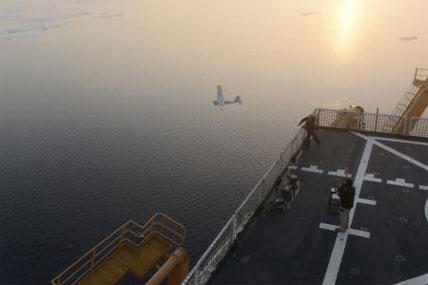
John Ferguson and Chris Thompson, Unmanned Aircraft System operators for AeroVironment, release a Puma All Environment UAS from the flight deck of the Coast Guard Cutter Healy during an exercise in the Arctic Aug. 18, 2014. (U.S. Coast Guard Photo)
Below can be seen the Mantis i45 sensor as installed on the Puma sUAS
Mantis i45 sensor
This might be a candidate for a sUAS to operate from the Webber class WPCs. I can see some useful scenarios, such as providing overwatch while doing a law enforcement boarding, but I still think we need something more capable of providing a more persistent and more wide-ranging search. Still a combination of a sUAS like this and the TALONS (Towed Airborne Lift of Naval Systems) might be very effective. The recovery methods I have seen so far, for this system, either landing on the flight deck of an icebreaker or landing in the water don’t seem satisfactory.
Still I would suggest we take a look at what the Canadians are doing. We might want to send an R&D rep who has participated in our previous examination of sUAS to ride one of these ships during the last half of a drug interdiction patrol, so they can get input from both the Canadians and the LEDET.






 Chuck Hill's CG Blog