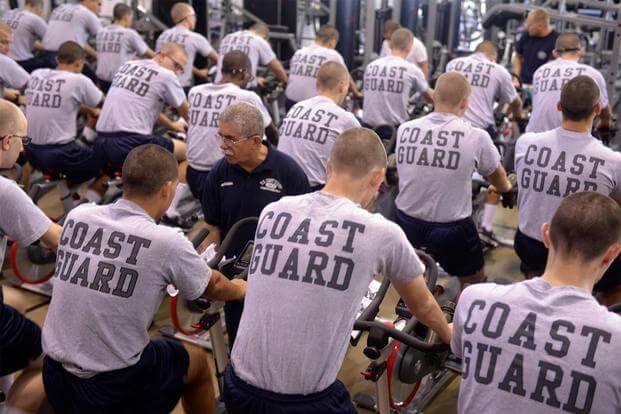
I found this report from Military.Com encouraging. Not directly Coast Guard related, but good to see more scientific methods being used.

I found this report from Military.Com encouraging. Not directly Coast Guard related, but good to see more scientific methods being used.

Some of you might be interested in responding to this. It also seems to suggest the future USCGC Argus is pretty far along.
Maybe something similar was done earlier, but it seems late in the game to do this sort of design review. Even so, seems like a good idea. Maybe not too late to incorporate ideas in the “B class” OPCs.
As you all probably know by now, I don’t think any current or planned cutter meets the implicit requirement of being able to forcibly stop any ship, regardless of size, and my belief this is entirely possible for cutters as small as patrol boats (WPBs).
R 241556Z AUG 22 MID200080150110U
FM COMDT COGARD WASHINGTON DC
TO ALCOAST
BT
UNCLAS
ALCOAST 307/22
SSIC 5102
SUBJ: SOLICITATION FOR SUBJECT MATTER EXPERTS (SME) TO ASSESS
THE OFFSHORE PATROL CUTTER
1. This ALCOAST solicits volunteers to participate in a six-day
Offshore Patrol Cutter (OPC) Operational Assessment (OA) in Panama
City, FL from 31 October to 05 November 2022. The OA is a review
and analysis of cutter design data to determine the operational
capability and effectiveness expected to be delivered by an OPC.
2. Background: The OPC will constitute a significant percentage of
the USCG’s major cutter fleet, and is designed to have new
capabilities for maritime homeland security, law enforcement and
national defense missions. OPCs, designated as the Maritime
Security Cutter, Medium (WMSM), will replace existing Medium
Endurance Cutters (WMECs) and fill a critical operational gap
between the USCG’s Fast Response Cutter (FRC) and the National
Security Cutter (NSC). The first OPC will be delivered in FY 2023.
3. The OA, facilitated by the Operational Test and Evaluation Force
(OPTEVFOR), is primarily a tabletop documentation review by
experienced active duty members who are currently serving, or have
recently served on WMECs, WHECs, WSMLs, or have experience with
planned OPC systems and major cutter support. The OA will also
provide SMEs an opportunity to walk an OPC currently in production
to supplement their assessment of capabilities. SME input will
assist OPTEVFOR in assessing suitability of systems on an OPC and
will culminate in an OA report submitted to the Vice Commandant and
DHS’ Office of Test and Evaluation to assess OPC capabilities.
4. Following are the OPC assessment groups and the corresponding SME
experience needed for the OA:
a. DECK – Current or recent major cutter First Lieutenant (BOSN).
Boatswain’s Mate with current or recent major cutter experience as
Deck Leading Chief Petty Officer. Enlisted ratings with current or
recent major cutter experience as coxswain, boarding officer, boat
deck operator/supervisor/safety, flight deck crew, and underway
replenishment crew/supervisor/safety.
b. ENGINEERING – Current or recent major cutter Engineer Officer,
Main Propulsion Assistant, and Damage Control Assistant. Senior
enlisted with current or recent experience as Engineering Leading
Chief Petty Officer. Machinery Technicians, Electrician’s Mates,
Electronics Technicians, and Damage Controlmen with current or
recent major cutter experience.
c. OPERATIONS – Current or recent major cutter Commanding
Officer, Executive Officer, Operations Officer, and Electronic
Materials Officer. Boatswain’s Mates with current or recent major
cutter experience with navigation duties and visual signaling.
Operations Specialists with current or recent major cutter
experience with Sea Commander and electronic warfare systems.
Electronics Technicians with current or recent major cutter
experience with electronics systems maintenance. Information
Systems Technician with current or recent major cutter experience.
Intelligence Specialist with recent major cutter intelligence
support experience.
d. SUPPORT – Current or recent major cutter Support Officer.
Storekeeper, Yeoman, Culinary Specialist, and Health Services
Technician with current or recent major cutter experience. Port
Engineer, Asset Manager, Availability Project Manager, and Logistics
Specialist with current or recent experience in supporting major
cutters.
e. WEAPONS – Current or recent major cutter Weapons Officer, and
Tactical Action Officer or Combat Systems Officer. Electronics
Technicians with current or recent major cutter experience as Mk 48
GWS operators/maintainers. Gunner’s Mates with current or recent
major cutter experience maintaining and operating Mk 110, Mk 38, and
small arms maintenance.
f. AVIATION – Current or recent major cutter Helicopter Control
Officer and Landing Signals Officer. Helicopter pilots with current
or recent shipboard deployments as Senior Aviator or HITRON pilot.
Enlisted aviation ratings with current or recent experience in major
cutter deployments with responsibilities for aircraft maintenance.
5. Volunteers must be available for the entire six-day event and be
free of normal duties to allow focus on this Operational Assessment.
Participants can anticipate travel on 30 October and 06 November.
SMEs will be provided read-ahead documents in preparation for their
role to ensure the OA is completed within the allotted time. A
detailed schedule of events will be provided via email after
participants have been identified.
6. Interested participants should contact the OPC Sponsor’s
Representative, LT Sam Williams, by 19 September 2022 via email,
noting relevant experience and desired mission area from paragraph
7. Members must include a copy of their employee summary sheet from
CGBI in-board view as an attachment. Email must be forwarded from
your unit CO or XO to demonstrate command approval for
participation. COMDT (CG-9322) will issue travel orders to members
selected to participate.
8. Point of contact: LT Sam Williams, COMDT (CG-751), 202-372-2324,
Samuel.N.Williams@uscg.mil.
9. RADM Todd C Wiemers, Assistant Commandant for Capability (CG-7),
sends.
10. Internet release is authorized.

220822-A-KS490-1182 STRAIT OF HORMUZ (Aug. 22, 2022) From the left, U.S. Coast Guard fast response cutters USCGC Glen Harris (WPC 1144), USCGC John Scheuerman (WPC 1146), USCGC Emlen Tunnell (WPC 1145) and USCGC Clarence Sutphin Jr. (WPC 1147) transit the Strait of Hormuz, Aug. 22. The cutters are forward-deployed to U.S. 5th Fleet to help ensure maritime security and stability across the Middle East. (U.S. Army photo by Spc. Noah Martin)
The planned six Webber Class contingent for PATFORSWA is now complete. See the press release below.
MANAMA, Bahrain – Two U.S. Coast Guard fast response cutters arrived in Bahrain, Aug. 23, marking the arrival to their ultimate destination after departing Key West, Florida in June.
USCGC John Scheuerman (WPC 1146) and USCGC Clarence Sutphin Jr. (WPC 1147) are two of the Coast Guard’s six newest Sentinel-class fast response cutters (FRC) now stationed in Bahrain where U.S. 5th Fleet is headquartered.
“This arrival represents the culmination of years of tireless effort and exceptional teamwork,” said Capt. Eric Helgen, commander of Patrol Forces Southwest Asia (PATFORSWA). “These newest FRCs bring us to our full complement of six ships and mark the beginning of a new era of extraordinary maritime capability supporting U.S. 5th Fleet.”
The Sentinel-class cutters in Bahrain are overseen by PATFORSWA, the Coast Guard’s largest unit outside of the United States. The ships are forward-deployed to U.S. 5th Fleet to help ensure maritime security and stability across the Middle East.
“We are extremely excited to be here and look forward continuing to work with international partners in the region,” said Lt. David Anderson, commanding officer of Clarence Sutphin Jr. “Completing this more than 10,000-nautical-mile transit to Bahrain has been a once-in-a-lifetime opportunity.”
John Scheuerman and Clarence Sutphin Jr. were commissioned in February and April 2022 respectively. The 154-foot long vessels feature advanced communications systems and improved surveillance and reconnaissance equipment.

Indo-Pacific Defense Forum reports,
The Ecuadorian government is using Canadian technology to monitor the Chinese fleet’s illegal, unreported and unregulated (IUU) fishing around the Galápagos Islands. In early June 2022, the government detected 180 Chinese vessels near the islands’ exclusive economic zone (EEZ), fishing for large Humboldt squid and threatening the region’s biodiversity and economy.
The Ecuadorian Navy patrols to prevent illicit fishing in the protected zone. “As long as these vessels are far from the insular EEZ, more than 100 miles [more than 160 kilometers] away, we monitor them by satellite,” Ecuadorian Navy Rear Adm. John Merlo León, commander of naval operations, told Ecuadorian television network Teleamazonas.
Reportedly, Ecuador uses both space technology company MDA, based in Brampton, Ontario, to provice satellite tracking, remote sensing and the ability to synthesize large amounts of data and Global Fishing Watch, a Google-backed website that tracks commercial fishing and interprets vessel movements, including fishing in prohibited areas.
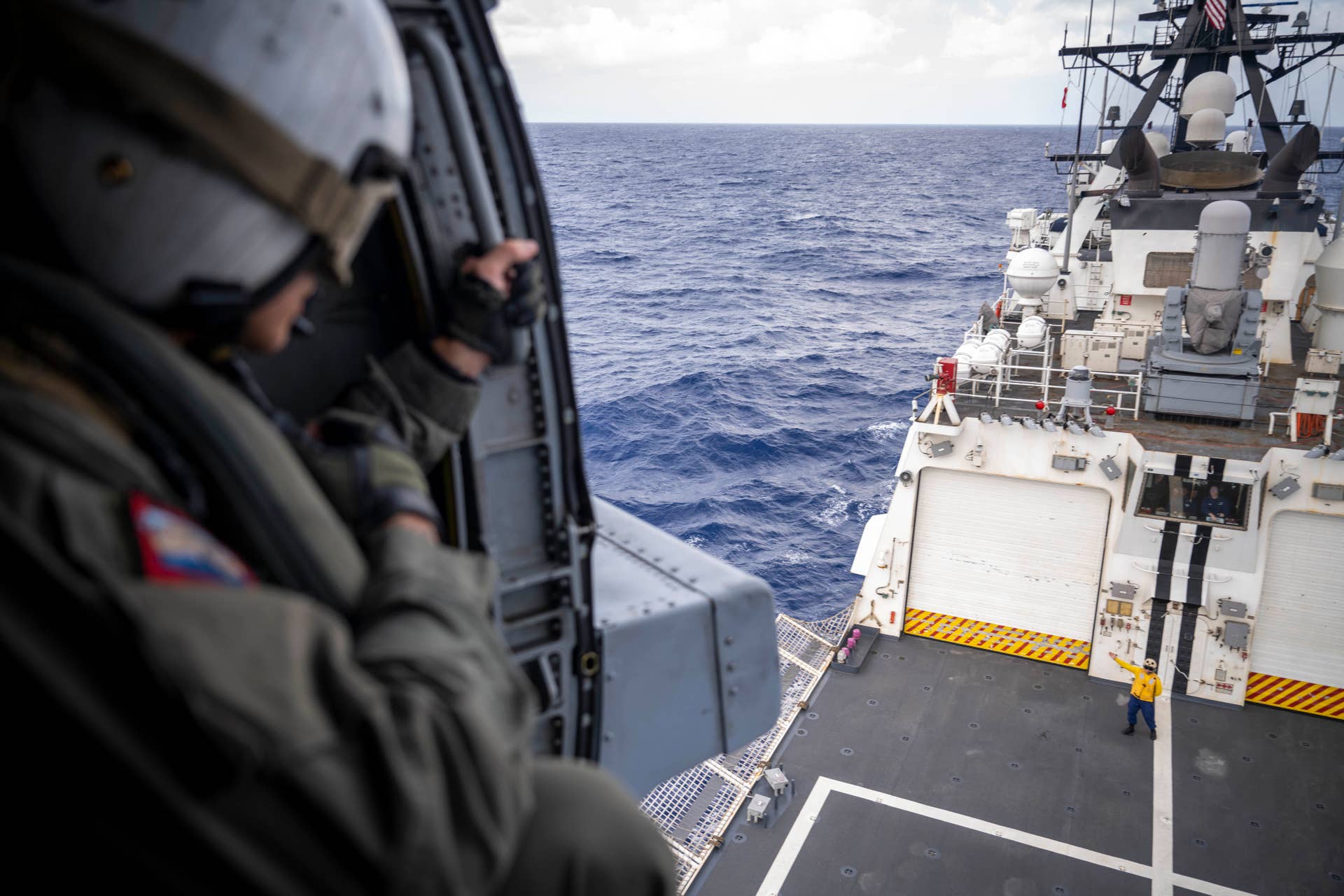
PACIFIC OCEAN (July 30, 2022) U.S. Navy Petty Officer 1st Class Humberto Alba, a naval aircrewman tactical-helicopter, attached to Helicopter Maritime Strike Squadron (HSM) 37, deployed on U.S. Coast Guard Legend-class cutter USCGC Midgett (WMSL 757), looks down at a USCGC crewmember after taking off during flight operations during Rim of the Pacific (RIMPAC) 2022. (U.S. Coast Guard photo by Petty Officer 3rd Class Taylor Bacon)
The Drive reported on Cutter Midgett’s participation in RIMPAC 2022 with a look at flying Navy MH-60R ASW helicopters from the National Security Cutters. I wanted to talk about why this might have been done, but first let’s clarify something.
This and other reports may have left the impression that a Coast Guard Officer leading a task force at RIMPAC was a first and that it was the first time a Navy H-60 had flown from an NSC. Neither is not really the case.
Since NSCs are skippered by Captains, while the US Navy and our allies captain Burke class DDGs and similar ships with commanders, it is not uncommon for the Coast Guard commanding officer to be the senior officer among the captains of a group ships, if there is no commodore assigned. So, frequently, the Coast Guard CO is task force commander by default. This happened to 327 skippers early in WWII as well. For a period, Spencer’s CO was an escort group commander until the Navy assigned a Commodore. Fortunately Spencer got some good training allowing her to sink two of the less than 40 U-boats sunk by US surface ships.
So what was the reason an ASW helicopter was embarked on Midgett? The Coast Guard’s motivation and the Navy’s?
Could be as simple as because they could, but I don’t think so. Both services expected to get something out of this.
Interoperability is always nice, so Navy helo on CG cutter allows both to get some training. Still think there must be more to it than that.
The Navy wants to more widely distribute their forces so this might have been something of a dry run to see what they could do in terms of command and control from a Frigate sized ship and crew.
For the Coast Guard, it could have been an opportunity to get used to operating an H-60 with folding tail from a Bertholf class. It was certainly a rare opportunity to exercise LINK 16. We might have wanted to find out if a system included in the MH-60R should also be included in Coast Guard H-60s.
Or it might have been a first small step toward reviving a Coast Guard ASW mission. Unless the National Security Cutters could operate an ASW helicopter there would be no point in trying to add an additional ASW capability such as a towed array. Confirming ship/helo compatibility would be a first step, along with identifying what changes might be necessary to provide for the helicopters’ additonal needs for weapons, sonobuoys, etc.
Maybe Supporting MH-60R helicopters is reason enough
The US Navy has alot of H-60s. The numbers I have seen are 237 MH-60S (the surface warfare and logistics type) and 291 MH-60Rs (the multi-mission/ASW type). It is probably a bit less than that now, but about 500 plus the MQ-8 helicopter drones that they will also want to take to sea.
The Navy obviously does not have as many ships capable of hosting H-60s as they would like. Every US Navy surface combatant commissioned in the 21st century (DDG and LCS–there have been no cruisers or frigates) has had the capability to hangar two H-60s, and the planned FFGs will have this capability as well.
Navy requirements seem to be always changing,
Let’s say a minimum of 116 ASW capable escorts, probably about 120. Right now they have about 90 with no ASW capable LCS, 22 cruisers all now 22 to 36 years old (five of which are slated for retirement in the current budget), and about 70 Burke class DDGs of which 13 will reach 30 years old by the end of 2025 while the first FFG is not expected until 2026. Clearly the number is ASW capable escorts is unlikely to increase significantly any time soon and number may actually decline.
So how many MH-80R/MQ-8 spots are there?
The ten carriers typically host about six MH-60R. The cruisers and Burke class flight IIA and III have two each, but 28 of the Burke class DDGs (Flights I and II), almost a third of our large surface combatants, have flight decks and LAMPS ASW electronics, but no hangar. So roughly 72 ships with 204 spots. Eleven National Security Cutters would provide 22 additional spots, about a 11% increase. The Offshore Patrol Cutters protentially offer another 25 spots about 12% more.
With the Navy hoping to more widely distribute their surface combatants, rather than keeping them firmly attached to a carrier, a couple of additional MH-60Rs could substantially improve ASW capabilities of a small surface action group (SAG).
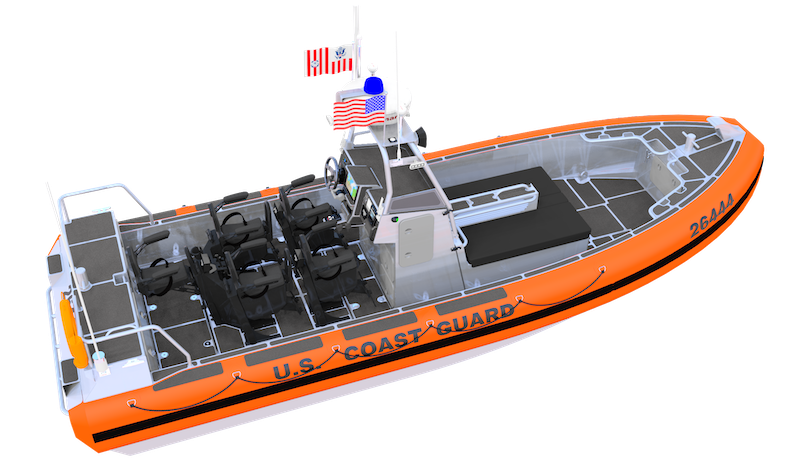
New Over the Horizon boat design. Inventech Marine Solutions rendering
WorkBoat reports on the award of a contract for construction of up to 200 “Over The Horizon Cutter Boats” (CB-OTH V) to Inventech Marine Solutions (IMS) of Bremerton, WA.
We had a Coast Guard news release on this contract award earlier, that talked about the selection process and where the boats will go, but the Workboat article gives much more detail about the tech that went into the boat and why it was chosen. Perhaps most significantly,
The performance of the boat during the in-water demonstration event was noteworthy in that it averaged 30 knots in SS3, the highest of any of the boats, while eliciting comments from the operators that it was the most comfortable and capable.
Thanks to Paul for bringing this to my attention.

RIBCRAFT will build up to 278 of the 7-Meter rigid inflatable boats worth approximately $80 million. This is purported to be the largest single contract based on number of boats ever awarded by the U.S. Navy.
Each vessel is powered by a single Steyr SE266E40 diesel engine with Bravo Two X Mercruiser outdrive and equipped with a Briartek man overboard indicator system (MOBI), and forward M60/M240 weapon foundation. With a full load of 18 sailors, the 7-meter RIB will have a sprint speed of 25 knots.
These boats will be built alongside the U.S. Navy Expeditionary 11-Meter RIB that RIBCRAFT is currently building at its Massachusetts facilities. Together these contracts have a total value of over $120 million, making the company New England’s most significant boat manufacturer.
These appear a bit less capable than the water jet powered Coast Guard 8 meter “Over the Horizon” cutter boat, more like the Cutter Boat, Large, employed on WMEC210s and 225 foot buoy tenders.
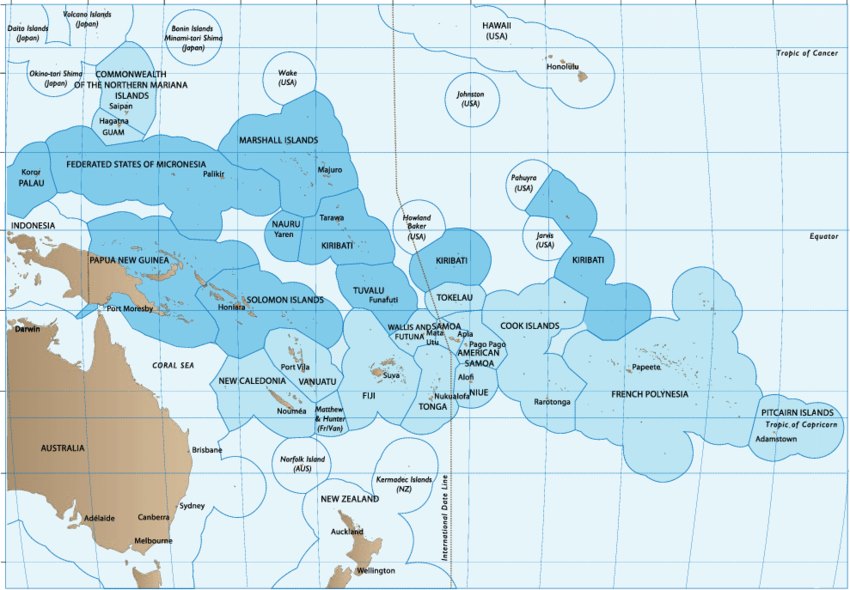
Estimated exclusive economic zones (EEZs) of Pacific Island countries and territories (PICTs). The EEZs of countries that are the Parties to the Nauru Agreement are shown in darker blue. Note that not all EEZs of PICTs have been officially delineated under the United Nations Convention on the Law of the Sea. Source: Patrick Lehodey
The Congressional Research Service (CRS) has published a two page “IN FOCUS” brief on “The Pacific Islands” of Micronesia, Melanesia, and Polynesia. Like all my links to CRS reports, this link will always take you to the latest version. It has already been updated at least once, 17 August, 2022.
Given the increased Coast Guard activity in the region, the report may provide useful background. The topics discussed are:

Guadalcanal, Solomon Islands, edited by M.Minderhoud
The Navy League’s Magazine “Seapower” reports on a ceremony to commemorate the 80th anniversary of the start of the Guadalcanal campaign, held in Honiara, Solomon Islands. Quite properly Vice Admiral Andrew Tiongson, Commander, U.S. Coast Guard Pacific Area, was there representing the Coast Guard.
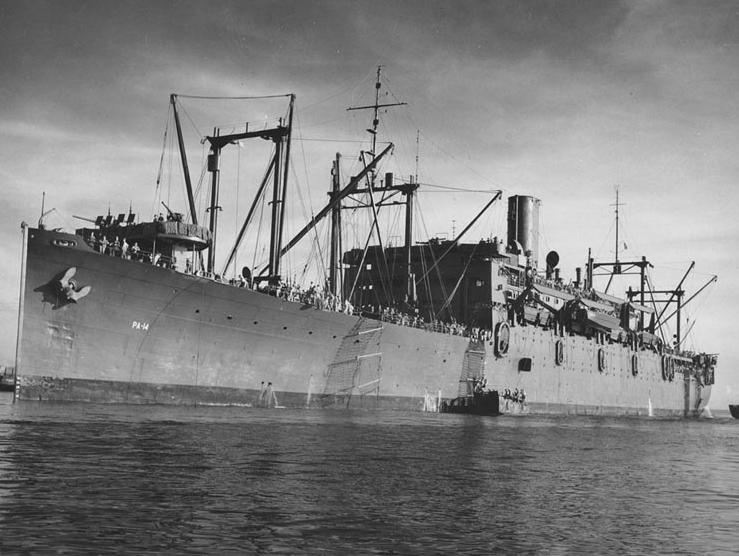
USS Hunter Liggett (APA-14) c. 1943-44
The Coast Guard manned transport USS Hunter Liggett was flagship of Task Force 62.1 which transported the 1st Marine Division, with Maj. Gen. Alexander A. Vandegrift, USMC, Commander ground forces, embarked. The story of Douglas Munro is well know, but there were other Coast Guard heros there as well. Ultimately the Coast Guard would suffer its largest single loss of personnel in the waters of Guadalcanal, when the Coast Guard manned ammunition ship USS Serpens (AK-97) exploded on January 29, 1945, while anchored off Laguna Beach.
Some stories:
The Long Blue Line: Tulagi’s Coxswains–the services 1st Silver Star recipients
The Long Blue Line: The “Green Hell” of Guadalcanal 80 years ago!

Gold Dust Twins: The Two Coast Guardsmen Who Saved Chesty Puller’s Marines on Guadalcanal
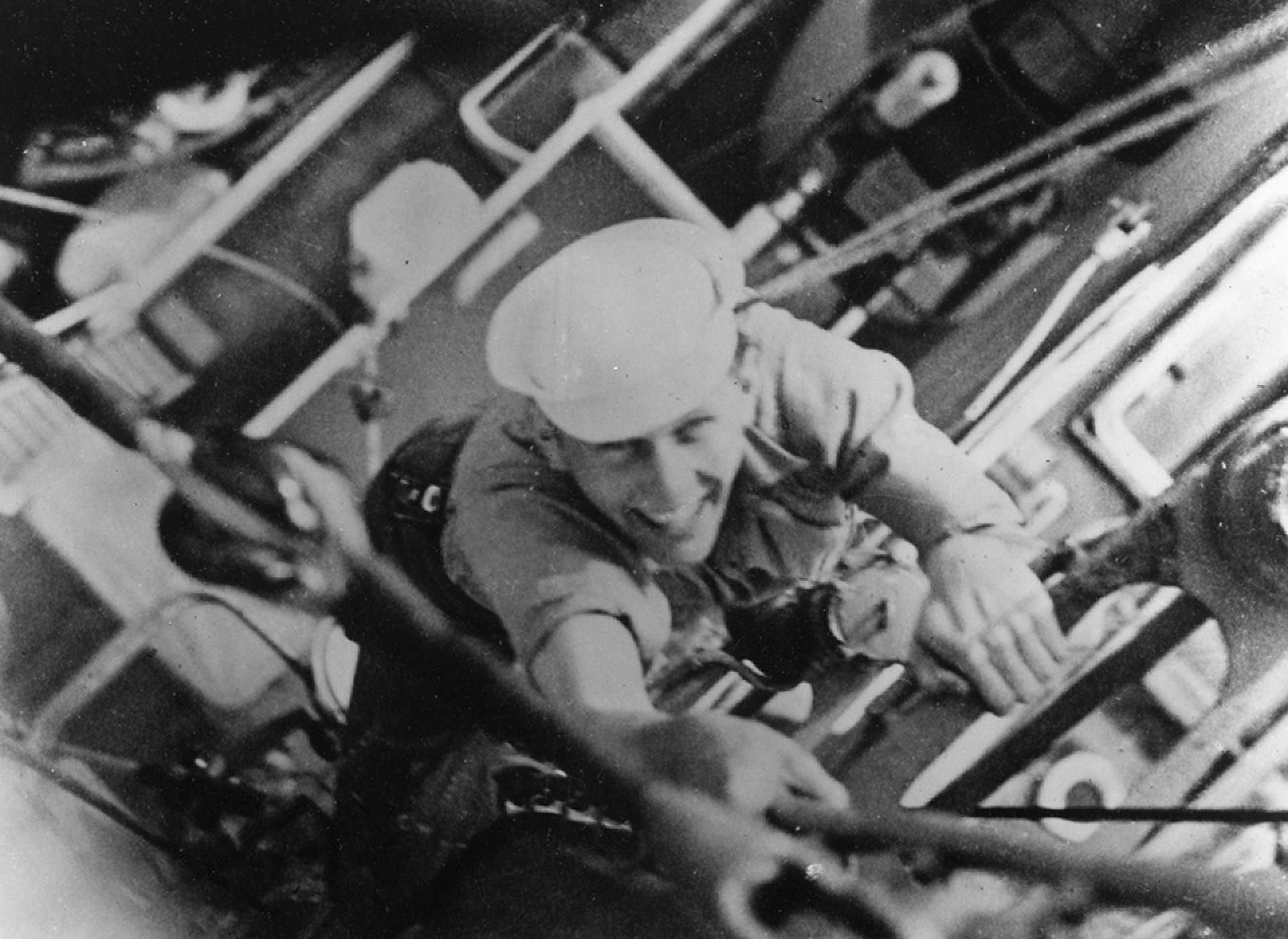
“The Marines were being driven back to the beach and many did not have radios to request assistance. A single “HELP” spelled out in T-shirts on the ridge near the beach sent a loud and clear signal to those looking on.”
“This man is the only US Coast Guard recipient of the Medal of Honor”
Joseph Toahty, Pawnee Warrior Of Guadalcanal
Loss of USS Serpens (AK-97), Jan. 29, 1945


USCGC Mohawk (WMEC-913), Clarence Sutphin Jr. (WPC-1147), and John Scheuerman (WPC-1146)
The Famous-class medium endurance cutter USCGC Mohawk (WMEC 913) arrived in Abidjan, Côte d’Ivoire for a scheduled port visit August 12.
The visit demonstrates the strengthening security cooperation relationship between the United States and Côte d’Ivoire. While in Abidjan, the Mohawk crew will exchange with Côte d’Ivoire maritime forces, including medical response treatment, close quarters combat and casualty care, illegal contraband collection and handling, and Visit, Board, Search and Seizure (VBSS) demonstrations.
Mohawk is forward-deployed to the U.S. Naval Forces Africa (NAVAF) area of operations, while employed by U.S. Sixth Fleet. Mohawk is on a West Africa patrol to demonstrate partnership with regional partners and conduct a routine presence patrol. Since July, the Mohawk has made port calls to Senegal, The Gambia, and Sierra Leone.
This is a continuation of a voyage that initially escorted the last two Webber class WPCs bound for Bahrain, where they replace 110 foot WPBs that have long served Patrol Forces South West Asia (PATFORSWA). Some previous reporting,
“USCGC Mohawk (WMEC 913) arrives in Lisbon, Portugal”–Navy.mil–and Two More FRCs for PATFORSWA, and “USCGC Mohawk arrives in Dakar, Senegal” –SeaWaves July, 2022
This is only the latest visit by a WMEC270 to Africa. Some previous reports:
Exercise Obangame Express 2019 –Capacity Building in West Africa, Mar. 2019 and “The U.S. Coast Guard’s Mission to Africa” –USNI, Apr. 2019, USCGC Thetis (WMEC-910)
“The Long Blue Line: Operation “Relevant Ursa”–Bear training in West Africa” –Coast Guard Compass, Oct. 2020, USCGC Bear (WMEC-901)
Thetis Escorts FRCs Transatlantic, and “U.S., Spain, Morocco collaborate to conduct rescue at sea” –LANT AREA News Release, Jan. 2022, USCGC Thetis (WMEC-910)
 Chuck Hill's CG Blog