The Coast Guard Cutter Healy breaks ice around the Russian-flagged tanker Renda 250 miles south of Nome Jan. 6, 2012. The Healy is the Coast Guard’s only currently operating polar icebreaker. The vessels are transiting through ice up to five-feet thick in this area. The 370-foot tanker Renda will have to go through more than 300 miles of sea ice to get to Nome, a city of about 3,500 people on the western Alaska coastline that did not get its last pre-winter fuel delivery because of a massive storm. If the delivery of diesel fuel and unleaded gasoline is not made, the city likely will run short of fuel supplies before another barge delivery can be made in spring. (AP Photo/US Coast Guard – Petty Officer 1st Class Sara Francis) NY112 (Obviously not directly south of Nome, maybe SW–Chuck)
CIMSEC provides an overview of our current Icebreaker replacement program and why it is necessary. It does seem to look only at the Arctic requirements, only mentioning the Antarctic in passing.
“The French Navy is ready to intervene if clashes between French and British fishermen over access to scallop-rich seabeds erupt again on the open seas, Agriculture Minister Stephane Travert said on Tuesday.
“Travert said he had spoken to his British counterpart and that talks between the two sides were due on Wednesday after French vessels chased their rivals out of the Baie de Seine last week.
“British fishermen accused the French of ramming their vessels and hurling projectiles. Disgruntled French fishermen, unhappy that their British rivals can dredge for scallops year round while they are barred from doing so during summer months, said they came under a violent counter-attack.”
This is not going to flow well, I apologized for the mishmash. The video above is of a House Sub-Committee hearing that occurred on July 24. I think it is still worth a look. The video does not actually begin until just before time 19:55
Before watching the video, I would suggest a look at the “Summary of Subject Matter.” This is what the Congressional Representatives are looking at.
End of Service Lives for Medium Endurance Cutters (MEC) with Planned Offshore Patrol Cutter (OPC) Delivery Dates:
Check out the charts on page 2. The second chart shows “End of Service Lives for Medium Endurance Cutters (MEC) with Planned Offshore Patrol Cutter (OPC) Delivery Dates.” It illustrates the risks and loss of capacity that appears likely, if OPCs are funded at the planned rate of no more than two ships a year. It is unclear why the WMECs are to be retired in the order intended since it is not the order of their completion. Presumably it is based on an assessment of the condition of the ships, but it is very clear that they will all be well over aged. The 210s will retire first. The youngest retirement would be at age 53 and some would qualify for Social Security before replacement. (Diligence, 66)
How they arrived at the expected service life shown is hard to understand, because every 210 is going to be 53 years old or older at the end of projected service life plus 15 year life extension. The 210s were, of course, substantially reworked during a “Major Maintenance Availability” 1986 to 1990, but no further life extension work is apparently planned based on the testimony in the video.
It may appear we are in much better shape with respect to the 270s, but these more complex ships may actually be harder to keep operational. We saw this in the number of breakdown experienced after the Haitian Earthquake eight years ago. They were commissioned between 1983 and 1991 and are expected to be replaced between 2130 and 2135. Legare, second to newest, is planned to be the first replaced, and would be “only” 40 years old. Harriet Lane one of the earliest completed is expected to be one of the last replaced and would be 50 years old. The rest fall within that range. SLEP for 270s beginning 2021, but it is not certain it will be applied to all 13 ships.
Because ships are not being replaced as quickly as they were originally built, we see a growing gap between the end of the ship’s projected service life, even with a 15 year service life extension, and the projected date of replacement.
Cutter Capability (by operating hour):
See also Appendix A, which illustrates the current shortfall in cutter hours available compared to the “Legacy Fleet” the recapitalization program was intended to replace. The “Legacy Fleet” is based on 12 WHECs, 29 WMECs, and 49 island class WPBs. (Not sure why they used 29 WMECs, since we had 32 as recently as 2001.)
There are two charts, the first includes WPBs and Webber class WPCs as well as WHECs, WMECs, NSCs, and OPCs. The second considers on the only the larger vessels, excluding WPCs and WPBs.
The first chart shows that we are currently down 20,450 hours (8.6%) relative to the legacy fleet, but that when the recapitalization is complete the total will be 31,970 hours (13.4%) greater than the legacy fleet. This increase is all due to the greater number Webber class and the greater number of hours each is expected to operate annually compared to 110s.
The second chart looks only at the larger ships, leaving aside the Webber and Island class WPCs and WPBs. It shows we are currently down 13,950 op hours (10%) and further, that when the program is completed, we will be down 15,030 hours (10.7%)reflecting the smaller number of large patrol cutters. If we could view this as a chart of actual cutter available on a yearly basis, it suggest that we will never be down by more than the 10.7% that shows upon completion of the program. Actually that is unlikely to be the case. The aging fleet means a higher probability of unplanned maintenance and even catastrophic failure that may result in WMECs being decommissioned prematurely and becoming parts donors like the Polar Sea.
At some point Coast Guard leadership is going to have to tell Congress the ugly truth that we have started the OPC/WMEC replacement program much too late, and we need to double down on the production rate. As soon as the first ship is completed and tested we need to issue a Multi-Year Procurement contract and it should include building up to four ships a year, at least until all sixteen 210s are replaced and at least three ships a year until all the WMECs are replaced.
We need to tell the Congress this as soon as possible, because bad news does not get better with age. Unfortunately it did not happen in this hearing. In fact when asked about the possibility of accelerating OPC production, time 1:10:00, VAdm McAllister seemed to dismiss the possibility saying we had other higher priorities. This was the wrong answer. You don’t always get to decide how money is spent. If we should get the opportunity to accelerate OPC construction, as has happened with the FRCs, we should welcome it.
Mission Needs Statement:
You can see the “Mission Needs Statement” referred to here. It is 70 pages plus about 45 pages of Appendices, but as noted, “… it does not identify asset gaps or a material solution to meet Coast Guard’s mission needs.”
GAO findings, failure to plan long term:
The GAO has taken the Coast Guard to task because their acquisition portfolio planning has been limited to apparently short term planning using the annual budget and five year Capital Investment Plan (CIP). That this has resulted a bow wave of unfunded requirements being pushed progressively further into the future.
“When you are up to your ass in alligators, it is difficult to remember that your initial objective was to drain the swamp.”
I have to think GAO has a point here.
We still have not provided a 20 year acquisition plan that the Coast Guard said they would provide in 2014, much less the 30 year plan I have suggested that would parallel the Navy’s planning process.
We have only done one fleet mix study. It was completed in 2007 and included the apparent assumption of applying the now rejected Crew Rotation Concept to both the NSCs and OPCs. Even so, it is still being used as a basis for critiquing the program of record that was last re-baselined in 2005. Things change, we now have better information about how our assets actually function. It is long past time for updated planning.
The Video:
Witnesses were:
Vice Admiral Daniel Abel, Deputy Commandant for Operations, United States Coast Guard | Written Testimony
Vice Admiral Michael McAllister, Deputy Commandant for Mission Support, United States Coast Guard | Written Testimony
Ms. Marie A. Mak, Director of Acquisition and Sourcing Management, Government Accountability Office | Written Testimony
Here is a brief outline of the topic discussed. Video actually begins 19:55.
23:00 Administration and CG leadership priorities do not demonstrate a commitment to rebuild infrastructure.
42:00 Appropriation deleted $1.4B including $750M for the Heavy Polar Icebreaker and the rest from an account to repair of replace hurricane damaged infrastructure.
46:00 Icebreaker schedule is overly optimistic.
47:00 WMEC gap.
49:00 No service life extension program for 210s. Some, but not all 270s, will have 10 year life extension.
51:00 Capabilities vs hours.
55:30 WMECs are operating at higher than anticipated tempo. Anticipate catastrophic failures within in the WMEC fleet. 5 out or 14 WMEC 210s are at high risk.
59:30 Maintenance backlog.
1:08:00 Still no 20 year plan has been provided since it was requested in 2014.
1:10:00 accelerate OPC procurement?
1:12:30 OPC homeports, of the first four, two will go to Kodiak and two to LA
1:14:00 Great Lakes icebreaking, Mackinaw replacement? SLEP of 140′
1:15:45 Will be doing a fleet mix study for the Great Lakes.
1:20:00 Homeport for icebreakers has not been decided. Working on homeport decisions for the entire fleet.
1:23:00 UAS
1:24:00 Counter UAS capability. The six WPBs in CENTCOM have some capability.
1:25:00 Manpower analysis
—-
Opening Statement of the Sub-Committee Chair:
The Subcommittee is meeting today to review how the Coast Guard is integrating their acquisition, manpower, and maintenance plans to align to their mission needs and assure the Service has the assets, personnel, and expertise needed to carry out its missions.
On June 1, 2018, Admiral Karl Schultz became the 26th Commandant of the Coast Guard. His guiding principles for the Service are: Ready, Relevant, and Responsive. He said, “These guiding principles frame my direction and will support the Department of Homeland Security, the Secretary of Defense and Combatant Commanders, and other national and global maritime interests.” Admiral Schultz and his senior leadership team are in the midst of reviewing the status of the Coast Guard and making changes to align the Service with those guiding principles. Today, we will hear from two members of that team, and look forward to better understanding their perspectives on the status of the Coast Guard.
The ongoing recapitalization of the Service’s cutters was planned two decades ago to address mission demands at that time. The world and the demands on the Coast Guard have since changed and it is critical that the Service be ready to respond to the demands of today, as well as those that will exist in decades to come. It is also important that the Coast Guard is prepared to manage capability gaps that are occurring and likely to continue to occur as recapitalization continues.
The decisions being made today will shape the Coast Guard of the future. The cutters being built today have a planned 30-year service life and will probably serve longer, and the final OPC is projected to be patrolling the seas until 2064. Like Admiral Schultz, Congress wants to ensure the Coast Guard is Ready, Relevant, and Responsive for years to come. In order to do so, we need accurate information from the Service to determine whether current plans will provide the capabilities to meet future demands.
Even more important than Coast Guard ships and aircraft are the people who operate them. The Coast Guard’s active duty workforce is only slightly larger than that of the New York City police department and less than ¼ the size of the next smallest U.S. Armed Force. Congress has encouraged the Coast Guard to better understand and articulate its workforce needs to meet current and emerging needs. Looking forward, it is likely that the Service will need to make tough, strategic decisions regarding how Coast Guard personnel are allocated. Even before the advent of a new cybersecurity operating domain, the Coast Guard was struggling to meet mission demands; creating a cybersecurity workforce while also conducting legacy operations poses an additional challenge that must be addressed immediately.
In addition to our focus on Coast Guard assets and personnel, this Subcommittee has continually pushed the Service to improve its shore infrastructure made up of approximately 43,400 assets nationwide. Unfortunately, even after several years of us stressing the need for action, much of that property is in dire need of rebuilding or repair. While Coast Guard leaders consistently stress the importance of investing in shore infrastructure, the budgetary trade-offs being made within the Coast Guard and the Administration do not reflect a genuine commitment to address this need. For example, despite a shore infrastructure backlog of more than $1.5 billion, the Coast Guard’s Fiscal Year 2019 budget request only includes $30 million to address those projects.
Shore infrastructure is critical to every Coast Guard mission – cutters need piers, aircraft need runways, inspectors need buildings, etc. – and if the Service truly desires to remain Ready, Relevant, and Responsive, it needs to find ways to address these critical needs.
The Government Accountability Office (GAO) has issued a number of reports since 2012 reviewing Coast Guard acquisition programs and providing recommendations to improve those programs. Over the years, the Coast Guard has agreed with many of those recommendations and agreed to take action on them. However, the new GAO report released today notes that the Coast Guard has not fully implemented those prior recommendations. Hopefully, today’s hearing will help us understand why that is.
A new senior leadership team brings new perspectives, new ideas, and new priorities. I look forward to hearing from our witnesses today on how they see the Coast Guard and how we can best position the Service for success going forward.
Reportedly she is aground from the bow to amidships and props are damaged.
The Shoal is part of the South China Sea claimed by China as well as the Philippines. Perhaps, not surprisingly China has dispatched cutters to the scene and has offered to help remove the Philippine vessel. Having another Philippine vessel permanently aground on a disputed feature of the South China Sea is the last thing they want. The Philippines will reportedly refuse Chinese assistance, but there is some concern that they may attempt to remove the ship anyway.
The US Naval Institute Proceedings’ September 2018 issue has an article recommending installation of Naval Strike Missiles (NSM) on the Bertholf class National Security Cutters (NSC) and the Argus class Offshore Patrol Cutters (OPC), “Distribute Lethality to the Cutters,” by LCdr. Daniel M. Wilshire, USCG. Its outside the paywall; you can just click on the link.
He makes some good points.
The Navy does not have enough ships.
The Coast Guard is building 36 likely candidates.
Using deck mounted canister launchers it should not be too difficult to mount NSM on cutters.
The systems would be Navy owned and we could use Navy training.
Arming cutters for combat, including missiles is not new.
If there is a major conflict, cutters may find themselves in combat, whether they are prepared for it or not.
These are not a replacement for Navy construction.
We should not wait for the outbreak of war before arming cutters
In conclusion he says.
“The prospect of great power conflict once again looms. Though the time and nature of that conflict is not clear, one thing is certain: when the next war breaks out, Coast Guard cutters will go into harm’s way as they have done in nearly every major conflict since 1790, not only because every ship will be needed, but because doing so is part of the Coast Guard’s history and culture. Procurement and training decisions made today will dictate whether the Coast Guard enters that conflict with the weapons needed to best help deter or defeat a peer competitor. Failing to put antiship cruise missiles on the 36 cutters of the NSC and OPC classes, cutters that will serve for the next 50-plus years, is an omission that the Navy, the Coast Guard, and the nation can ill-afford.”
My only comment would be:
First, I would prefer to see the longer ranged, heavier Long Range Anti-Ship Missile used instead of NSM, as I believe it is better suited for our peacetime anti-terrorism mission as well as being a more effective weapon in wartime.
Second, while it is probably a more complex change, reviving the Coast Guard’s Wartime Anti-Submarine Warfare Mission would probably be an even more important addition to the “National Fleet” than an expanded anti-surface capability. While it probably would contribute nothing to our peacetime anti-terrorism mission, long range acoustic sensors might help our counter-drug effort.
060520-N-4104L-005 White Beach, Okinawa (May 20, 2006) – The U.S. Coast Guard Cutter Sherman (WHEC 720) leaves the White Beach Naval Facility, Okinawa pier to begin its participation in exercise Southeast Asia Cooperation Against Terrorism (SEACAT) 2006. SEACAT is a weeklong at-sea exercise designed to highlight the value of information sharing and multi-national coordination with participating navies during practical maritime interception training opportunities. USCGS Sherman is homeported in Alameda, Calif. U.S. Navy photo by Senior Chief Journalist Melinda Larson (RELEASED)
Janes is reporting that the former USCGC Sherman was handed over to the Sri Lanka Navy on 27 August in a ceremony in Honolulu.
This is the second cutter Sri Lanka has received. They still operate the former the former USCGC Courageous (WMEC-622) decommissioned 19 Sept. 2001 and inducted in the Sri Lankan Navy as P-621 SLNS Samudura 19 Feb. 2005. (Anyone know why she was decommissioned?)
They also have a couple of new 2,200 ton Indian built OPVs, but the former USCGC Sherman will be the largest vessel in the Sri Lanka Navy.
Legion Magazine gives us a technical analysis of a Water-Borne Improvised Explosive Device of the type used by Houthi rebels to attack Saudi lead coalition forces and merchant ships in the vicinity of the Bab-el-Mandeb Straits.
We have talked about these before, here and here. They are apparently radio controlled, 10 meter (33 foot), twin outboard powered boats, built in the UAE and donated to the Yemeni Navy for Coast Guard duties. As we learned earlier, the warhead was a 1000 pound shaped charge from a P-15 (Styx) missile.
The analysis shows construction of the circuit that would cause the explosive to detonate, how the throttle was worked, and speculated on the steering.
Really, making one of these is too simple. It is not impossible we will see something like this in the US. In the radio control hobby, we would call this a two channel control system, controlling only steering and throttle. It doesn’t get much simpler than that. As I speculated earlier, there was a video link from the WBIED to the operator. In addition, there was also a link to pass GPS information to the operator.
The analysis unfortunately does not tell us the frequencies used to control the boat or provide video from the boat, or to provide the GPS information from the boat to the control station. That information would give us an idea of the effective range of the system and provide the basis for electronic countermeasures. Presumably the information is available to those who have a need to know. There is a good chance these explosive boats are controlled from a vessel near by.
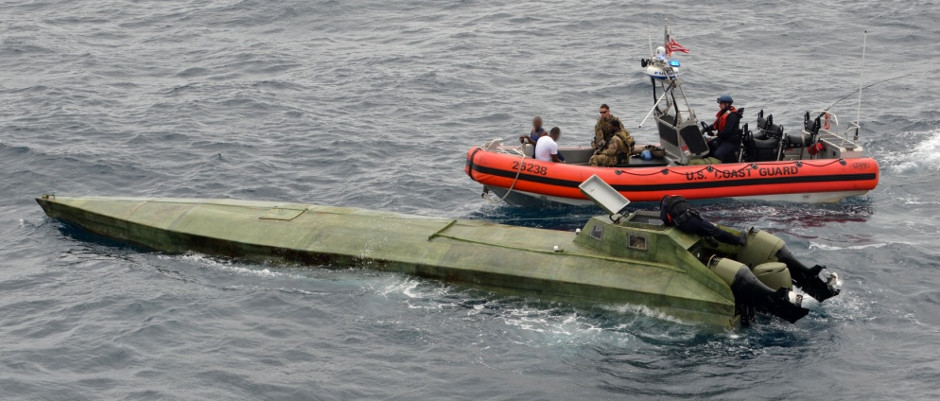
Rear-cockpit ‘hybrid narco-sub’ had been intercepted by the USCG cutter Mohawk on 3rd July 2018. Photo by Petty Officer 3rd Class Brandon Murray, USCG
Covert Shores provides the latest in a series, looking at the craft used by drug smugglers in recent interdictions, with particular emphasis on the emergence of hybrid, high-speed, cockpit aft, outboard powered craft.
Not exactly the typical low profile self propelled semi-submersible, but definitely low observable if they are not making a visible wake. Maybe their tactic is a combination of sprint and drift?



 Chuck Hill's CG Blog