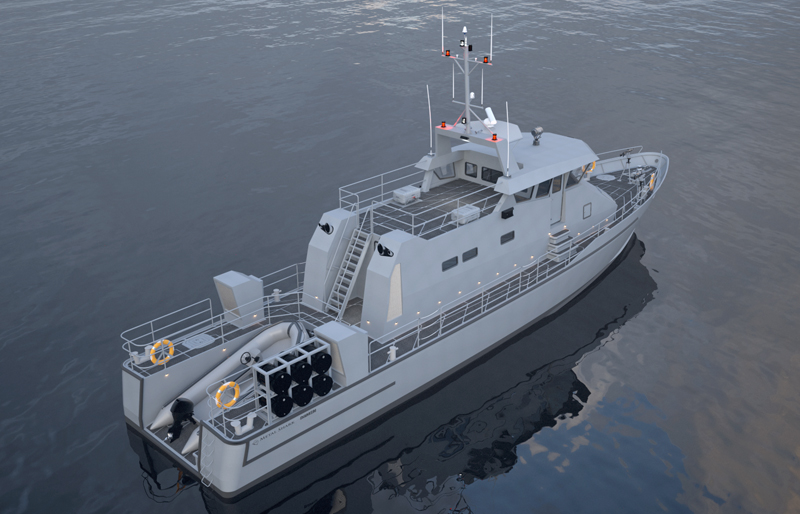
“…potentially worth upwards of $54 million, Metal Shark will build up to thirteen 85-foot Defiant-class welded aluminum cutters for the Dominican Republic, El Salvador, Honduras, Costa Rica, Guatemala, and other United States partner nations. Additionally, Metal Shark will supply electro-optical infrared sensors, diagnostic equipment, in-country reactivation, crew familiarization, and test support to NCPV (Near Coastal Patrol Vessel–Chuck) operators.
That is only $4.154M/ boat. This looks an awful lot like a potential replacement for the Marine Protector class 87 foot WPBs, the first of which should be replaced in 2023. The Metal Shark boats are a version of Damen’s Stan Patrol 2606 design, so nominally 26 meters long and 6 meters of beam, but according to the Website, 87′ length overall with a beam of 19’6″. The Marine Protector Class were also a Damen 2600 series design, so the two classes share a great deal of DNA.
There is more information on the boats at the company website here. Unfortunately there appears to be no information on speed, range, or endurance. I would presume those characteristics would at least equal those of the Marine Protector class
Would not be surprised to see the Coast Guard personnel tasked with some training for the crews of these new patrol boats.
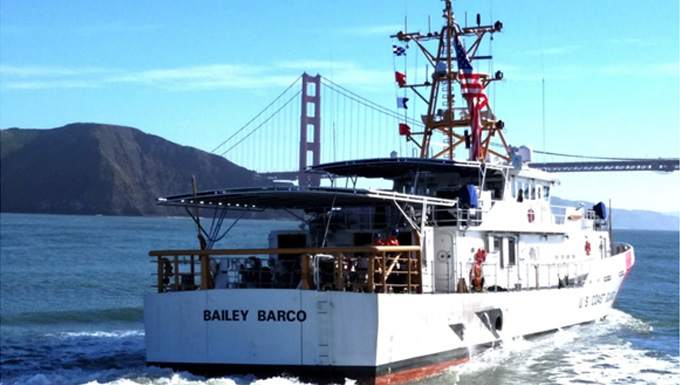
Coast Guard Cutter Bailey Barco (WPC-1122) enters San Francisco Bay during the 6,200-mile trip from Key West, Florida, to its homeport in Ketchikan, Alaska, April 28, 2017. The cutter is the second fast response cutter based in Alaska. U.S. Coast Guard photo.
Acquisition Update: Coast Guard Exercises Contract Option For FRCs 39-44
June 16, 2017
The Coast Guard awarded a $289 million contract option to Bollinger Shipyards of Lockport, Louisiana, June 9 for the production of six more fast response cutters (FRCs). This option award brings FRCs 39-44 under contract with Bollinger. The current FRC contract contains options for up to 58 cutters and is worth $1.5 billion if all options are exercised.
The Coast Guard is acquiring 58 FRCs to replace the 1980s-era Island-class 110-foot patrol boats. FRCs feature advanced command, control, communications, computers, intelligence, surveillance and reconnaissance equipment; over-the-horizon cutter boat deployment to reach vessels of interest; and improved habitability and seakeeping. The cutters are designed for multiple missions, including drug and migrant interdiction; ports, waterways and coastal security; fishery patrols; search and rescue; and national defense.
Twenty-two FRCs are in service, with six stationed in Miami; six in Key West, Florida; six in San Juan, Puerto Rico; two in Cape May, New Jersey; and two in Ketchikan, Alaska. Future FRC homeports include: Pascagoula, Mississippi; Atlantic Beach, North Carolina; San Pedro, California; and Honolulu.
Note a few things:
While this is not the total cost of the vessel, the shipyard cost is less than $48.2M. As I recall this is a decrease from previous buys, reflecting the maturity of the program and the decision to order six at a time.
This is presumably FY2017 money and it leaves 14 vessels for future funding. Both the previous and current administration have consistently requested four or fewer vessels be funded, but the Congress has been fairly consistent in funding six per year. It seems likely the remaining 14 will be funded over the next three years. If so all 58 will be fully funded by FY2020.
Bollinger is delivering at a rate of five per year. We just commissioned #22, so we can expect the last of the currently planned 58 in FY2024.
The first three of the 87 foot Marine Protector class WPB were commissioned in 1998. It was 26 years from the commissioning of the first 110 to the commissioning of the first Webber class WPC. If there is a similar 26 year span from the first 87 footer to the commissioning of the first of its replacement class, we should see that boat come on line in FY2024, just as Webber class construction is ending. To make that happen, we need to start market research and planning in FY2021, the year after the last WPC is funded or FY2022 at the latest.
There is talk of building six additional WPCs to replace the six 110s currently in Bahrain. I’ll have more on this later.
The program currently stands at 23 vessels delivered with 22 commissioned. They are being delivered at a rate of 5 per year meaning the last of 58 planned should be commissioned by the end of FY2024.
MarineLink has a story about Bollinger and their production of the Webber class WPBs. I found this particular paragraph interesting.
Making it Personal
To help combat complacency Bollinger came up with the Sentinel Program, to both incentivize its shipbuilders and to make each vessel more meaningful to them. “Each of these vessels is named for a hero in the Coast Guard,” Remont said. For every vessel Bollinger creates a name board, a 4 x 3 board that describes the ship’s namesake with details of their heroic act. “What we’re trying to do is personalize it for our shipbuilders. It’s not just some big hunk of metal with a bunch of cables, it (the ship) is there for a real reason. We erect these sign posts at each station where the vessel is getting created, and the name board follows the ship, traveling with the boat as it moves through the production line. “Every time our shipbuilders get on that vessel they can read about the person, and understand why we are building it.” When the vessel is delivered the name board is given to the CO of the boat so that they and the crew can be reminded of the namesake, too. Following the delivery ceremony, Bollinger selects one employee from each department who exhibits the same characteristics of the vessel’s namesake, and they are publicly recognized and awarded.
–
This points to yet another reason the decision to name these cutters after Coast Guard heroes was a good one. I knew it would mean something to the crew, but apparently it means something to put a human face on the ships, even to the shipyard works, and perhaps to others that come in contact with the ships. It also teaches Coast Guard history in easily digestible bits.
–
Hopefully we will continue with this when we name the Offshore Patrol Cutters. I don’t think we could do better than name the first of class for the captain of the Revenue Cutter Hudson during the Spanish-American War, Frank H. Newcomb. There has never been a cutter named after him, and the honor is long overdue.
DefenseNews had an interview with the Commandant. You can read it here. I will not repeat the Commandant’s responses here, but I will repeat one of the questions and add my own thoughts.
Admiral, you have said that the Coast Guard’s identity as an armed service is forgotten. Can you tell me what you mean by that?
The Commandant talks here about budget, but I think this starts with self image. We do SAR. We rescue sea turtles. Armed services are first and foremost ARMED. We are by law a military service, but we are currently inadequately armed for even our peacetime counter terrorism, DHS mission. We are less capable of forcibly stopping a ship than we were 90 years ago.
Do our people know what their role will be if there is a major conflict with the Chinese or Russians? You can bet Navy and Marine Personnel have a pretty good idea of their roles.
We have had a quarter century hiatus in a mono-polar world where no one could challenge American seapower. That is changing rapidly and it is time for the Coast Guard to see itself in a new light. Just as the nation has benefited from having two land forces (Army and Marines), it can benefit from having two sea forces. The Coast Guard is a substantial naval force. Certainly we will not replace the Navy’s sophisticated systems, but there is a need for a high low mix and the marginal cost of adding capability to Coast Guard vessels that are going to be built anyway is very small.
We are currently in an unrecognized naval arms race with China. It is time to give the Coast Guard back the ASW and ASuW capabilities it was building before the collapse of the Soviet Union.
When I reported to the academy in 1965, it had a gun lab, and we were taught ASW (badly) during swab summer. The Coast Guard had 36 ships equipped with sonar, ASW torpedoes and 5″ guns. The ships were old (not as old as now), but we were building a new fleet of 36 Hamilton Class WHECs equipped with a better sonar in addition to torpedoes and a 5″ gun. Being armed did not stop us from doing SAR, fisheries, or aids to navigation.
At that time (1965) in terms of personnel, the US Navy was about 25 times larger than the Coast Guard and had 287 cruisers, destroyers, and frigates. Now it is only eight times as large as the Coast Guard and has only 85 ASW equipped surface ships. We also had a powerful naval ally in Europe in the form of the Royal Navy. Now the Coast Guard is supplying personnel to the Royal Navy and in terms of personnel the Coast Guard is larger than the Royal Navy or the French Navy. Equipping our planned 33 to 35 large cutters as true surface combattants could make a real difference.
Even if we never go to war, preparation can make us better at our peacetime roles. Drug interdiction, migrant interdiction, and even SAR benefit from military grade ISR and C4I. Recognition of naval capabilities in the Coast Guard may justify additional resorces that have dual use for peacetime missions. Its a win-win.
The Office of Naval Research’s online magazine, “Future Force,” has some insights into how they are approaching the task of helping to design the Coast Guard’s new heavy icebreakers.
It also seems to indicate the Navy is increasingly thinking about operating surface ships in the Polar regions and that they are realizing, its very hard.
They are looking at the capabilities of non-ice-strengthened ships in polar regions and at the effects of ice loading. Considering we have been sending National Security Cutters into the Arctic their findings should also be of some interest to us.
The Homeland Security “FY2018 Budget in Brief” has been published. You can see it in pdf form here.
The Coast Guard portion is on pages 44-48. The breakdown of the elements of the Coast Guard budget request are on page 47.
The total DHS budget request is $70,692,491,000. Of that, the Coast Guard portion is 15.1%. The DHS request is 7.1% greater than the FY2017 annualized continuing resolution. By comparison, the Coast Guard request is down 2.4%.
Highlights of the Coast Guard budget request noted include:
(“FTE refers to personnel changes. They are “Full Time Equivilents”)
Offshore Patrol Cutter (OPC) ……………………………………. $500.0M, 0 FTE Provides funding to begin construction of the first OPC, which is scheduled for delivery in 2021. The OPC will replace the Medium Endurance Cutter classes that conduct missions on the high seas and coastal approaches;
Fast Response Cutter (FRC)……………………………………….$240.0M, 0 FTE Funds procurement of four FRCs. These assets replace the less capable 110-foot patrol boats, enhancing the Coast Guard’s coastal capability to conduct Search and Rescue operations, enforce border security, interdict drugs, uphold immigration laws, prevent terrorism, and enhance resiliency to disasters;
Polar Icebreaker ……………………………………………………. $19.0M, 0 FTE Continues efforts toward awarding a contract for detail design and construction in 2019. This acquisition is recapitalizing the Coast Guard’s heavy polar icebreaker fleet;
Inland River and Western Rivers Tender ……………………….. $1.1M, 0 FTE Supports exploratory activities to analyze potential options to replace the capabilities provided by an obsolete fleet of inland tenders and barges commissioned between 1944 and 1990;
C-27J ………………………………………………………………… $52.0M, 0 FTE Funds support continued activities of the C-27J Asset Project Office (APO), which organizes logistics, training development, maintenance support, and ensures that these newly acquired aircraft are ready for induction into the operational fleet. Continues funding for initial spares and logistics, training, and mission system development;
Pay and Allowances……………………………………………….$109.8M, 0 FTE Maintains parity with DOD for military pay, allowances, and health care, and for civilian pay raise and retirement contributions, including providing a 2.1 percent military and 1.9 percent civilian pay raise in FY 2018. As a branch of the Armed Forces of the United States, the Coast Guard is subject to the provisions of the National Defense Authorization Act, which include pay and personnel benefits for the military workforce;
Operating and Maintenance of New Assets……………………$98.6M, 233 FTE Increases funding for operations and maintenance of shore facilities and provides sustainment funding for new cutters, boats, aircraft, and associated C4ISR subsystems delivered through acquisition efforts;
Mission Essential Systems and Cyber Security …………… ……$26.2M, 2 FTE Funds sustainment of critical Coast Guard network infrastructure and pays DOD working capital fund increases necessary to comply with DOD information network and cybersecurity requirements; and
Workforce Support Improvements ………………………………….$9.1M, 34 FTE Provides funding and personnel to manage the new Blended Retirement System, increase the frequency of Personnel Security suitability background investigations, and enhance capabilities to handle sexual assault allegations.
FY 2018 Major Decreases:
Decommissioning of Legacy Assets…………………………. ($14.1M) (129 FTE) Decommissions one 378-foot high endurance cutter, three 110-foot patrol boats, and one HC-130H aircraft in line with the Coast Guard decommissioning plan; and
Management and Support Efficiencies ………………………. ($13.9M) (13 FTE) Reflects savings generated from an enterprisewide efficiency review that can be taken with no direct operational impacts and a minimal loss of current service delivery
This is neither the disastrous cuts that were talked about earlier, nor is it a substantial boost. While less than the FY2017 budget as ultimately funded, it compares favorably to the initial FY2017 request. If the Congress does what it has done in the past, and adds some to the AC&I budget, we may feel this is a better than workable budget.
Compared to the enacted FY2017 budget, Operating Expenses are up $333,772,000 while AC&I is down $720,382,000. Hopefully the Congress will bump this up to nearer what we need annually, about $2B. I would be very surprised if the Congress does not increase the Fast Response Cutter buy from four to six, and NSC#10 and another C-130J are possibilities.
The administration’s FY 2018 budget request was not available, but the Commandant was there to discuss future priorities, requirements, and programs. The Department Secretary, General Kelly, is expected to address the Subcommittee on May 24 at 3PM Eastern.
I will just mention a few of the items I thought significant.
Admiral Zukunft noted that Huntington Ingalls has begun cutting steel for NSC #9. Questioned about NSC#10, he said, if it were funded, the Coast Guard would of course use it, but that the Offshore Patrol Cutter (OPC) is the Coast Guard’s #1 priority. His response, that another NSC would have an effect on long-range operating cost, seemed to suggest anticipated significantly lower operating costs for the OPC. Significantly, there has been no mention of reducing the OPC program by one ship to offset the addition of NSC #9. (There is already a strong push to build more NSCs, a bill to authorized a multi-year buy of three more.)
He contended that the Coast Guard has taken a harder hit, due to budget restrictions, than other armed services and would need 5% annual growth and at least $2B annually for Acquisitions, Construction, and Improvements (AC&I). Later he stated that this annual AC&I appropriation would included about $300M annually for shore facilities. He pointed to a need to restore 1100 Reserve Billets and add 5,000 active duty military billets while retaining current levels of Civilian staff.
Apparently the FY2918 budget will begin a program to replace 35 Inland tenders at an estimated cost of approximately $25M each ($875M total). (Even if, in the unlikely event, this program were funded in only five years, that would only average $175M/year, so it is not a big program, but one that should have begun at least a decade ago.)
Cyber security for ports was discussed. The Commandant sees the Coast Guard role as decimating best practices, rather than imposing regulation. We now have a cyber program of record–still very small, two CG Academy graduates going directly into the program. The fact that two billets is worth mentioning, is probably the best indication of how really small the program is. A much smaller pre-World War II Coast Guard probably had more people working on breaking German and Japanese codes.
Marine Inspection was addressed. The Commandant noted the increased demand for Inspections because 6,000 tugs have been added to inspection program. He noted a need for more stringent oversight of 3rd party inspectors, who in some cases have not been as meticulous as they should have been. He also noted that the US flag merchant fleet, notably the MSC’s Afloat Prepositioning Fleet, will need replacement, which will also raise demand for marine inspectors.
The Commandant also voiced his support for the Jones Act. He noted, we only have three shipyards building Jones Act ships in the US, and their loss would be short-sighted.
There was much discussion about the Arctic and the Icebreaker Fleet. Looks like follow-on funding for icebreaker program (at least after the first) will have to come from CG AC&I rather than the Navy budget. This may be difficult, but it is the way it should be. The chair of committee expressed his reservations about attempting to fund such big-ticket items through the DHS budget. The Commandant stated that the Coast Guard is still considering the acquisition of the commercial Icebreaker Aiviq (but apparently they are doing it very slowly–the chairman of the committee seemed a bit irritated about this).
The committee members seemed to latch onto the idea that the USCG, rather than the Navy, would be responsible for enforcing US sovereignty in the Arctic (which by US definition includes the Aleutians), and seemed to be asking if the Coast Guard was prepared to fight the Russians and/or Chinese in the Arctic. The Commandant suggested instead, that our role was to provide presence in the pre-conflict phase in order assert US sovereignty. He acknowledged that the National Security Cutters are only armed defensively and are not suitable for conventional naval warfare against an enemy combatant.
The Commandant acknowledged that, at some point it may be desirable to arm Polar Icebreakers, meaning they should be built with space, weight, and power reservations for additional weapons.
(I am all for keeping open the option of arming our icebreakers, so that they can defend themselves and do their part, if there is a conflict in a polar region, but there did not seem to be recognition among the Congression Representatives, that an Arctic conflict is most likely to be determined by submarines and aircraft. The icebreakers’ role is likely to be primarily logistical.)
The Commandant apparently does expect that there may be disagreements with regard to the extent of the US authority over certain areas of the Arctic.
In discussing the need for land based Unmanned Air Systems, there was a curious note at minute 40 about go-fast boats going south. Where are they going?
Alien Migrant Interdiction (AMIO). We have gone for seven weeks without a single Cuban Migrant being interdicted. This is because of the end of Wet Foot/Dry Foot Policy. This has allowed reallocation of resources to drug interdiction South of Cuba and human trafficking from the Bahamas
A Congressional Representative, from Texas pointed out there is no CG presence on the Rio Grande River, in spite of it being an international waterway. There was no mention of it, but perhaps he was thinking of the Falcon Lake incident in 2010 when an American was allegedly shot in the head by Mexican drug runners. Maybe something we should reconsider.
NavyRecognition reports on Russian icebreaker development. They have a diverse and very impressive program. Not content with the Arctika class nuclear powered icebreakers, they are now expecting to build even bigger icebreakers, the Project 10510 Leader class.
The Iceberg Design Bureau also is developing the world’s most powerful nuclear icebreaker of the Project 10510 Leader class. According to Ryzhkov, “its power is 120MW and its maximum ice-breaking capability equals 4.3 m, and if ice is 2 m thick, the ship can lead convoys at a speed of more than 11 knots, thus ensuring cost-effective traffic via the Northern Sea Route.”
120 MW, that is about 160,000 HP. That is about twice as powerful as the Polar Star.
There is a lot of interesting stuff in this post.
It is important to remember that most of these program are for the development of the Arctic for Economic purposes. That is not to say the Russians could not turn them to military purposes, but the Russians have ample reason to see them, not so much as military assets, but as economic necessities.
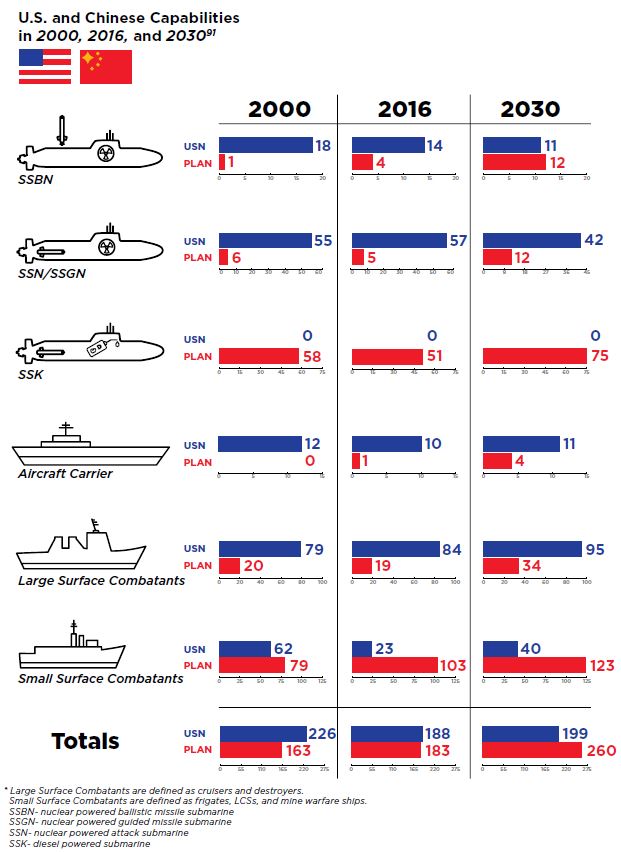
Considering that the US Navy is spread all over the globe, with responsibilities in the Atlantic as well the Pacific, while the Chinese Navy will be concentrated in the Western Pacific, far from American Naval bases with the exception of a small number of units in Guam, Japan, and possibly Singapore, the Chinese Navy is likely to enjoy a considerable local advantage, particularly early in any conflict.
In peacetime, it takes three CONUS based ships to maintain one in the Western Pacific. That would improve in wartime, but the Chinese would always have an advantage. Not to mention Chinese land based air and missiles.
Is there anything the Coast Guard can do to mitigate the coming imbalance in the Western Pacific?
The May issue of US Naval Institute Proceedings is the Naval Review issue. It includes updates on the Coast Guard as well as the Navy and Marine corps that are behind the membership pay wall, but it also has an article, “Too Small to Answer the Call,” by Capt. David Ramassini, future CO of USCGC Kimball (WMSL-756) that is accessible to all, and I think is worth a read.
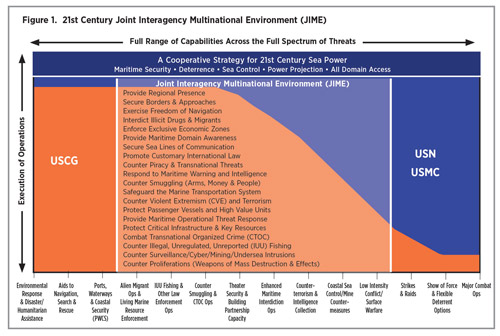
Basically he is advocating using the Coast Guard internationally to build capacity and counter threats of lawlessness and poor governance in trouble spots all around the world. Below is his recommended building program.
Build a New Great White Fleet
Enhancing regional security in partnership with willing nations requires a 21st-century Great White Fleet of forward deployable (or stationed) national security cutters (NSCs), offshore patrol cutters (OPCs), and fast response cutters (FRC). The mix of platforms and duration of presence would be tailored to the distinct geographies and vary based on the receptiveness of the host nation(s), problem sets to be addressed, and mutual goals of the combatant commands and partner nations. Building on a proven bilateral approach for counterdrug operations and EEZ enforcement, the Great White Fleet would leverage existing agreements—based on the extent to which partner governments are willing—to strengthen CTOC (counter transnational organized crime–chuck) and CT (counter terrorism–Chuck) across the JIME (Joint Interagency Multinational Environment–Chuck).
From an acquisition perspective, doubling the size of both the OPC (from 25 to 50) and FRC (from approximately 50 to 100) programs equates to the projected cost of one Gerald R. Ford (CVN-78)-class aircraft carrier (approximately $13 billion). Furthermore, procuring an additional seven NSCs over the nine planned would cost the equivalent of one Zumwalt (DDG-1000)-class guided-missile destroyer (approximately $4.2 billion). The NSC and OPC both offer more than three times the on-station time between provisioning than is afforded by a littoral combat ship (LCS).
Building more OPCs also could rapidly grow the National Fleet by leveraging commercial shipyards outside the mainstream industrial complex. These shipyards may be able to provide better value to the government during an economic downturn in the oil and offshore supply industry. Further leveraging this acquisition would continue to drive down the cost of the OPCs and provide an additional industrial base to build a 400-ship National Fleet of ships with far lower operating and maintenance costs than the LCS.
Redirecting proposed future LCS/frigate dollars (approximately $14 billion) to a Great White Fleet to modernize the U.S. National Fleet mix would provide a greater return on investment and more staying power abroad. For instance, building international security cutters—NSCs with Navy-typed/Navy-owned enhancements such as the SeaRAM antiship cruise missile—could offer combatant commanders a truly useful “frigate,” leveraging mature production lines that now operate at only 70 percent capacity. These estimates are for relative comparison and do not include the associated aviation, infrastructure, basing support agreements, and personnel plus-ups that are needed to provide a more credible and persistent presence across the JIME. But investing in a larger Coast Guard and the supporting infrastructure would return high dividends.
I’m not sure I agree, but it is worth considering. We should, however, keep in mind a sentiment expressed by friend Bill Wells that white paint is not bullet proof. We should not perpetuate the idea that only white painted ships can enforce laws, that is a uniquiely American concept and perpetuating it plays into the hands of the Chinese, who have more coast guard ships than any other country in the world.
Still I think there is merit to this concept. It seems to be working for PATFORSWA (Patrol Forces South West Asia). There has already been talk about a similar deployment to SE Asia. We might consider similar detachments of various sizes for West Africa, the Eastern Pacific, and the Marshall Islands.
The additional ships, 7 NSCs, and “doubling the size of both the OPC (from 25 to 50) and FRC (from approximately 50 to 100)” Is clearly arbitrary. There is very little the NSCs can do that the OPCs will not also be able to do cheaper, so I don’t see a need for more NSCs.
If we take on additional international roles it probably will not be done in one fell swoop. It will probably be done incrementally. Captain Ramassini is clearly looking at this as a near term possibility. Some movement in this direction is clearly possible, but it will take a radical change in the Administration, the Navy, and the Coast Guard for this to happen on the scale he envisions.
Meanwhile, if you look at the “Offshore and Aviation Fleet Mix Study,” the Coast Guard actually needs 9 NSCs, 57 OPCs, and 91 FRCs just to meet all of our statutory obligations. That is not far from his 16 NSCs, 50 OPCs, and 100 FRCs. The study and the “Great White Fleet” would both probide 66 large ships (NSCs and OPCs).
Actually the only way I see this happening is if there is a realization that keeping the USN constantly cycling through distant deployments may not be the best way to maintain readiness. That it wears out very expensive ships and drives people from the service, and that perhaps cutters can perform at least some of the presence missions.





 Chuck Hill's CG Blog